

Note: This article contains affiliate links. If you click on these links and make a purchase, I may earn a small commission at no extra cost to you. This helps support my research and content. Read my full affiliate disclosure here.
If you tow heavy loads or drive long highway miles in your Ford F-450, the transmission cooler line is a small component with an outsized effect on reliability. A worn or leaking cooler line can reduce cooling efficiency, contaminate fluid, or create overheating during hard use. Choosing the right transmission cooler line matters because it affects fitment, leak resistance, and long-term serviceability specific to the F-450.This guide outlines the top shortlisted transmission cooler line options built for the F-450 and explains the practical criteria we used to evaluate them, including material construction, connector type, and ease of installation. Read on for decision-focused guidance to help you pick the best replacement or upgrade for heavy-duty use.
Top Picks at a Glance
| Best Overall The best all-around choice for most situations | A-Premium Transmission Oil Cooler Line Hose Assembly for Ford Super Duty (6R140) |  |
| Best Quality Built to a higher standard if you want something more solid | EVIL ENERGY Transmission Cooler Lines Kit for 2011–2016 Ford 6.7L Powerstroke (6R140) – 8AN CPE Hose |  |
| Best Value The sweet spot between price and what you get | Dorman 624-542 Automatic Transmission Oil Cooler Hose Assembly |  |
| Best Budget The cheapest option that still gets the job done reliably | A-Premium Transmission Oil Cooler Line Hose Assembly (Outlet) for Ford Super Duty 1999–2004 |  |
| Most Popular A crowd favorite that many people choose with confidence | Generic 6AN 70" Stainless Steel Braided PTFE Transmission Cooler Hose Line Kit |  |
| Best Seller A high-volume bestseller chosen again and again | 6AN 52" Stainless Steel Braided PTFE Transmission Cooler Hose Line Kit |  |
1. A-Premium Transmission Oil Cooler Line Hose Assembly for Ford Super Duty (6R140)

| Material Type | Metal |
|---|---|
| Maximum Pressure | 250 psi |
| Item Length | 58.8 inches |
This A-Premium transmission oil cooler line is a direct-fit replacement for select Ford Super Duty models equipped with the 6R140 six-speed automatic transmission. It replaces the factory cooler hose assembly to carry transmission fluid between the transmission and external oil cooler, helping reduce fluid temperature for more stable shift performance under load. The line is metal construction with corrosion-resistant finish and is built to the vehicle-specific reference numbers listed by the manufacturer. Installation is typical for a transmission cooler line swap and will require routing and secure mounting at factory connection points; expect dealer or shop labor if you do not have hand tools and vehicle lift access. The practical benefits are an OEM-style fit, a 250 psi rated design for normal operating pressures, and a one-year parts guarantee. Limitations are that fitment is restricted to the stated Ford Super Duty years and the 6R140 transmission, so double-check reference numbers and vehicle compatibility before ordering.
Best for: Buyers who want a direct-fit, factory-style replacement line for routine maintenance or repair on supported Ford Super Duty trucks and prioritize reliable fit and corrosion resistance.
Less Ideal for: Drivers with nonlisted model years, different transmissions, or those seeking a universal or custom-length cooler line should look elsewhere.
- Vehicle-specific design for Ford Super Duty models with the 6R140 transmission
- Metal, corrosion-resistant construction for durable, leak-resistant service
- 250 psi rated for normal transmission cooling system pressures
- Matches listed reference numbers for easier verification of fitment
- Fitment limited to specific model years and the 6R140 transmission so it is not universal
Verdict: Choose this A-Premium cooler line when you need a vehicle-specific, durable replacement for Ford Super Duty trucks with the 6R140 transmission.
2. EVIL ENERGY Transmission Cooler Lines Kit for 2011–2016 Ford 6.7L Powerstroke (6R140) – 8AN CPE Hose

| Fitment | 2011–2016 Ford 6.7L Powerstroke (6R140) |
|---|---|
| Hose size | -8AN |
| Hose lengths | 4.7 ft + 3.9 ft |
| Materials | CPE hose, nylon braid, stainless steel mesh, 6063 aluminum fittings |
This transmission cooler line kit replaces the factory metal lines on 2011–2016 Ford 6.7L Powerstroke trucks (6R140) with larger-diameter -8AN CPE braided hoses and billet aluminum fittings. It is installed as a direct replacement for BC3P-7H420-BH and includes two hose lengths plus a threaded billet adapter designed to reduce leaks compared with stock connections. In use the larger hose and multi-layer construction (nylon braid, CPE core, stainless mesh) should increase oil flow and cooling capacity, which helps lower transmission temperatures under heavy towing or performance driving. The kit also includes clamps and a segmented hose design so damaged sections can be serviced without removing the whole run. Expect a more flexible routing compared with rigid factory lines and improved resistance to abrasion and heat, though the kit relies on proper installation and quality fittings to avoid problems. This is a practical upgrade for drivers who want better cooling and serviceability over the stock metal lines.
Best for: Drivers who push their 6.7L Powerstroke with heavy towing, hauling, or performance modifications and want improved transmission cooling and serviceability over factory lines.
Less Ideal for: Owners seeking a simple, factory-identical metal line replacement or those unwilling to modify routing and fittings should consider OEM-style replacements instead.
- Larger -8AN hose diameter increases oil flow and cooling potential compared with restrictive stock lines
- Three-layer CPE hose construction with nylon braid and stainless mesh improves heat and abrasion resistance
- Billet aluminum threaded adapter combines OE-style and threaded connection to reduce leak risk
- Segmented hose design and included clamps allow partial replacement without removing entire line
- Requires careful installation and proper fittings to ensure leak-free performance
- Made partly from CPE rubber which is durable but can be less rigid than metal lines for some routing scenarios
Verdict: Choose this kit if you want a performance-focused, serviceable upgrade that improves transmission oil flow and cooling for 2011–2016 6.7L Powerstroke trucks.
3. Dorman 624-542 Automatic Transmission Oil Cooler Hose Assembly

| Material Type | Metal, Rubber |
|---|---|
| Included Components | 2 Transmission lines |
| Unit Count | 1.0 Count |
This Dorman transmission oil cooler hose assembly replaces worn or leaking factory lines on select Ford Super Duty trucks and the 2005 Excursion. It includes two transmission lines built from metal and rubber to match factory fit and routing and is used where corrosion, collision damage, vibration, or failed fittings have compromised the original hoses. In practice the part simplifies repair by delivering a close-fit replacement that reconnects the cooler circuit without extensive modification. Notable features are its durable metal/rubber construction and factory-style connectors that help prevent future leaks. The assembly is intended for a direct swap, so installation is straightforward for anyone comfortable with basic underbody work and fluid handling. Limitations are that fitment is vehicle-specific for the stated model years, so you must confirm trim-level compatibility, and replacement requires draining and refilling transmission fluid as part of the job. The part is a practical, no-frills fix for restoring transmission cooling on affected Super Duty trucks.
Best for: Buyers who want a practical, factory-style repair to stop leaks and restore transmission cooling on mid-2000s Ford Super Duty trucks without upgrading to aftermarket braided or custom lines.
Less Ideal for: If you want performance upgrades, reusable braided lines, or a universal kit for multiple vehicle models, this stock-style assembly is not the best choice.
- Direct-replacement design intended to match factory fit and routing
- Durable metal and rubber construction for corrosion resistance
- Includes both transmission lines needed for a complete cooler circuit repair
- Simplifies repair with factory-style connectors for easier installation
- Fitment limited to specified Ford model years and trims so confirmation is required before purchase
- Installation requires handling transmission fluid and basic underbody work
Verdict: A straightforward, factory-fit replacement hose assembly that restores proper transmission cooling on the specified mid-2000s Ford Super Duty models.
4. A-Premium Transmission Oil Cooler Line Hose Assembly (Outlet) for Ford Super Duty 1999–2004

| Fitment | Ford F-250/F-350/F-450/F-550 1999–2004 |
|---|---|
| Transmission | 4R100 compatible |
| Position | Radiator passenger side to auxiliary cooler inlet |
| Material | Metal |
| Manufacturer Part Number | APOCL288 |
This transmission oil cooler outlet line replaces the factory run from the radiator passenger-side fitting to the auxiliary cooler inlet on 1999–2004 Ford Super Duty trucks with a 4R100 transmission. Made of metal and sold as a direct replacement, it installs where the original line did and is intended for owners who need a like-for-like fix for a leaky or damaged cooler line. The part includes the correct reference numbers for matching and does not include gaskets or seals, so expect to reuse original seals or buy new ones when installing. Its metal construction should resist heat and routing abrasion better than a soft hose, and the one-year unlimited-mileage guarantee provides extra confidence for budget repairs. Limitations are that the listing specifies the outlet side only and fitment requires an auxiliary cooler; it is not a universal upgrade and may require additional seals or clamps at installation.
Best for: Buyers who need an affordable, straightforward factory-quality replacement line for a leaking or damaged outlet cooler line on a 1999–2004 Super Duty with an auxiliary cooler and 4R100 transmission.
Less Ideal for: Those looking to upgrade cooling capacity or replace an inlet line, users without an auxiliary cooler, or anyone who prefers a complete kit with new seals and fittings included.
- Direct-replacement for the specified Ford Super Duty years and 4R100 transmission
- Metal construction for improved durability against heat and chafing
- Matches common OEM reference numbers for easier fit verification
- One-year unlimited-mileage guarantee for added buyer confidence
- Does not include gaskets or seals, so additional parts may be needed at installation
Verdict: A budget-friendly, factory-style metal outlet cooler line that directly replaces the worn or leaking line on 1999–2004 Ford Super Duty trucks with an auxiliary cooler and 4R100 transmission.
5. Generic 6AN 70" Stainless Steel Braided PTFE Transmission Cooler Hose Line Kit

| Material | Stainless Steel/PTFE |
|---|---|
| Length | 70 Inches |
| Fitting Size | AN6 |
| Nominal Wall Thickness | 0.0375 inches |
This 70-inch stainless steel braided PTFE hose kit supplies a durable AN6-line option for adding or replacing a transmission cooler feed/return line. It is built with a stainless braid over PTFE inner hose and crimped fittings to resist abrasion, corrosion, and heat exposure typical around an engine bay. Typical use is routing between an aftermarket cooler and the transmission or adapter fittings when fitting a remote cooler for heavy-duty tasks like towing. The material and wall construction promise longer service life than many rubber hoses and reduce the chance of swelling or seepage under pressure. Because it is a universal kit it requires correct AN6 adapters and careful routing and clamping to fit a specific vehicle; expect some trimming or custom fittings for exact attachment points. The kit improves cooling capacity when paired with an appropriately sized cooler but does not include vehicle-specific adapters or mounts, so installation may take more time for a truck that needs tailor-made fittings.
Best for: Buyers who prioritize proven materials and visible user feedback and who plan to add or upgrade a remote transmission cooler on a heavy-duty truck and can handle sourcing or fitting vehicle-specific adapters.
Less Ideal for: Drivers seeking a plug-and-play, vehicle-specific hose assembly with dedicated mounting brackets and fittings should look for model-specific kits instead.
- Durable stainless steel braid and PTFE inner hose resist corrosion and high temperatures.
- Universal AN6 fittings work with common aftermarket transmission coolers.
- 70-inch length provides flexibility to route to remote coolers on large trucks.
- Crimped construction reduces risk of leaks compared with clamp-on hose ends.
- Universal kit does not include vehicle-specific adapters or mounting hardware, so additional parts may be needed.
- May require trimming or custom routing to fit heavy-duty truck frames and chassis points.
Verdict: If you want a durable, long-lasting AN6 transmission hose to pair with an aftermarket cooler on a heavy-duty truck, this stainless braided 70" PTFE kit is a reliable choice.
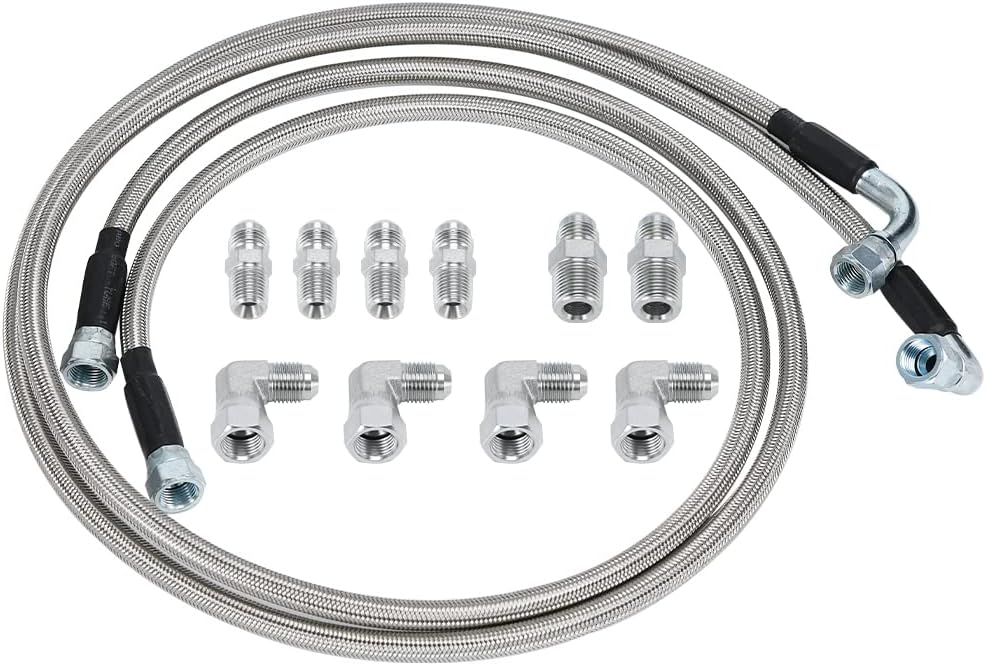
6. 6AN 52" Stainless Steel Braided PTFE Transmission Cooler Hose Line Kit
| Material | Stainless Steel and PTFE |
|---|---|
| Item Length | 52 Inches |
| Outside Diameter | 0.38 Inches |
| Nominal Wall Thickness | 0.0625 inches |
This stainless steel braided PTFE hose kit is a universal-style transmission cooler line intended to add or replace cooling plumbing on compatible automatic transmissions. It supplies a 52-inch length of PTFE inner hose with stainless braid and AN6 fittings for a corrosion-resistant, flexible line that resists swelling and leakage better than rubber in high-heat applications. Installers typically use it to route from the transmission cooler outlet to an external cooler or remote-mounted cooler when upgrading cooling capacity for towing or heavy-duty use. The kit lists fitment for many common transmissions, and its durable construction should hold up under road exposure and heat cycling. Limitations for a Ford F-450 buyer are that the kit is universal rather than vehicle-specific, so you may need adapters, proper AN ports, correct routing, and clamps for a clean, secure install on F-450 transmissions; professional installation or careful measurement is recommended for a risk-averse buyer. Overall it offers a durable, corrosion-resistant upgrade path to improve transmission cooling when fitted correctly.
Best for: A buyer who wants a durable aftermarket transmission cooler line to improve cooling for towing or heavy use and prefers a corrosion-resistant, serviceable hose but will accept a universal fit that may need tailoring.
Less Ideal for: Buyers who want a direct-fit, plug-and-play replacement designed specifically for a Ford F-450 without any additional adapters or custom routing should consider vehicle-specific lines instead.
- Stainless steel braid and PTFE core resist corrosion, heat, and swelling compared with rubber lines
- 52-inch length suits flexible routing to remote coolers or aftermarket coolers
- AN6 fittings provide a common aftermarket connection standard for transmission cooler plumbing
- Universal fit requires adapters or custom routing for exact fit on some vehicle transmissions
- Not sold as a vehicle-specific kit for the Ford F-450 so additional fittings or modifications may be required
Verdict: A corrosion-resistant, stainless braided PTFE hose kit that gives risk-averse buyers a durable way to upgrade transmission cooling for heavy-duty F-450 use when fitted with the proper adapters and routing.
Choosing the Right Ford F-450 Transmission Cooler Line: Key Factors to Consider
Material and Corrosion Resistance
The transmission cooler line material determines how well it handles heat, pressure, and road exposure. Steel hard lines resist puncture and offer excellent pressure tolerance, but untreated steel can corrode where road salt or moisture is present. Stainless steel or corrosion-resistant coated lines provide better long-term protection in wet climates and for trucks used year-round.
Hose-based sections are often reinforced with braided stainless wire or synthetic layers; their inner liners resist fluid breakdown. For an F-450 that sees heavy towing, prioritize materials with published pressure ratings and anti-corrosion finishes to reduce the chance of leaks or failure over time.
Connector Type and Fitment
Correct connector type is essential to avoid leaks and ensure a straightforward swap. The F-450 uses specific fitting styles at the transmission cooler, radiator, and cooler assembly; mismatched fittings can require adapters or extra adapters that add potential leak points. Choose lines that list Ford F-450 fitment explicitly or include factory-style fittings to streamline installation.
Consider whether the kit includes the proper clamps, o-rings, or compression fittings. For owners replacing only a hose section, matching fitting diameters and thread forms is critical to achieving a leak-free seal.
Line Type: Hard Line Versus Hose Sections
Hard lines and flexible hoses each have tradeoffs. Hard lines maintain shape and resist kinking, which helps keep fluid flow steady under pressure and over long runs common on large trucks. They are typically more durable against abrasions but may require precise bending or pre-formed shapes for fitment.
Flexible hoses simplify installation around tight engine bay routing and can absorb vibration, reducing stress at connection points. For a heavy-duty F-450, consider a hybrid approach: durable hard lines where routing is fixed and reinforced hoses where flexibility is needed near moving components.
Pressure Rating and Heat Tolerance
Transmission systems can see significant pressure and elevated fluid temperatures, especially under heavy towing. Lines should list an operating pressure rating and maximum temperature tolerance. Higher-rated lines reduce the risk of burst or expansion-related failures and help maintain fluid cooling efficiency.
Materials and reinforcement layers affect heat resistance. For towing-heavy F-450 duty cycles, prioritize lines designed for elevated temperature exposure and that maintain sealing integrity after repeated heat cycles.
Installation Ease and Serviceability
Replacing a transmission cooler line on an F-450 can involve underbody access and working near hot components. Lines that arrive pre-bent to match factory routing or that include clear instructions, fittings, and mounting hardware reduce installation time and mistakes. Kits that allow for section replacement instead of full-line replacement can be more efficient for minor repairs.
Serviceability also covers the ability to replace individual fittings or hose portions in the future. Choose lines where common replacement parts are available and where connections use standard fittings to simplify future repairs.
Leak Prevention and Sealing Methods
Leak resistance comes from both material quality and how connections are sealed. Compression-style fittings, crimped ends, or properly seated o-ringed connectors all have different leak profiles. Lines with factory-style crimping or reinforced ends reduce the chance of seepage at high temperatures.
Also consider whether the kit includes anti-corrosion coatings at joints and whether mounting brackets minimize vibration. Properly secured lines reduce chafing and stress at seals, which is a common cause of leaks on heavy-duty trucks.
Signs Your F-450 Needs a Transmission Cooler Line Service
Recognizing symptoms early can prevent major transmission damage. Common signs include visible fluid drips under the truck near the transmission or cooler area, a noticeable drop in transmission fluid level, or a foul burning transmission fluid smell after towing. Owners may also notice higher-than-normal transmission temperatures or erratic shifting under load.
If you observe any of these symptoms, inspect visible line runs and fittings for wetness, corrosion, or abrasions. Quick visual checks around hose fittings and along hard line bends often reveal the source of leaks before deeper diagnostics are needed.
- Puddles or wet spots near the transmission or cooler
- Low transmission fluid level without other obvious leaks
- Raised transmission temperature readings during towing
- Fluid residue or corrosion at fittings and clamps
Repair Versus Replace: When to Patch a Line
Minor issues such as a small hose section failure or a loose clamp can sometimes be addressed with a targeted repair. Replacing a short hose segment or swapping a fitting can restore function quickly and is less invasive than replacing an entire hard line assembly. However, repairs are best when the surrounding hardware and line runs are in good condition.
For lines with significant corrosion, multiple pinhole leaks, or damaged crimped ends, full replacement is the safer choice. Repaired areas may become recurrent failure points, particularly under the high pressures and heat cycles a loaded F-450 experiences.
- Patch or replace hose sections for isolated failures
- Replace entire runs when corrosion or multiple leaks exist
- Re-evaluate fittings and clamps when performing any repair
Routing and Mounting Considerations for Heavy Loads
Routing matters more on a heavy truck because suspension travel, frame flex, and towing hardware can shift relative positions. Lines should be secured away from sharp edges, exhaust components, and moving suspension parts. Proper mounting reduces vibration and prevents chafing that leads to premature failure.
When planning routing, account for engine and transmission movement under load. Allow small service loops or flexible sections near mount points to absorb motion. Use durable clamps and isolators where lines pass through brackets or near heat sources.
- Keep lines clear of exhaust and sharp frame edges
- Use antivibration clamps and protective sleeves where needed
- Allow small flexible sections to absorb engine and frame movement
Hose Fittings and Seal Types Explained
Fittings vary from threaded compression fittings to o-ring sealed banjo or flare-style connectors. Each sealing method has installation nuances and leak tendencies. For an F-450, matching the factory connection style minimizes adapters and potential leak points.
When replacing a hose, inspect the mating surfaces for wear and ensure o-rings or crush washers are replaced during reassembly. Proper torque and clean sealing surfaces are essential for a long-lasting connection.
- Compression fittings: reliable when properly installed
- O-ring/boss fittings: require new o-rings on reassembly
- Flare-style: good metal-to-metal seals if undamaged
Preventive Maintenance Tips to Extend Line Life
Regularly inspect visible sections of the cooler lines during oil changes or scheduled maintenance. Look for rubbing, small leaks, or signs of heat degradation. Replace clamps and mounts that show corrosion to keep lines properly supported.
If you frequently tow heavy loads, consider installing protective sleeves or routing upgrades that keep lines away from exposure to debris and road chemicals. Periodic pressure checks and monitoring transmission temperature can catch deteriorating lines before they fail catastrophically.
- Inspect lines each service interval and after heavy towing
- Replace worn clamps and protective sleeves proactively
- Monitor transmission temperature under load to detect cooling issues
How We Chose the Best Ford F-450 Transmission Cooler Line
We evaluated candidates using selection filters tailored to heavy-duty Ford F-450 use. Core evaluation criteria included material and construction, with attention to corrosion resistance and burst pressure ratings; connector compatibility, ensuring fittings match factory-style ports and common hose-end types for the F-450; leak performance, assessed by reported sealing methods and reinforcement features; and ease of installation for owners who perform vehicle maintenance, focusing on pre-bent shapes, included fittings, and clear instructions.We also considered serviceability features such as replaceable hose segments or readily available fittings, and packaging that includes necessary clamps or mounting hardware. Durability under load was a critical factor, so we prioritized options with proven reinforcement like braided layers or thicker-wall tubing. Exclusions: we did not include items that lacked clear fitment for the Ford F-450, products without verifiable material specs, or items that required extensive custom fabrication. The result is a list of well-specified, F-450-focused transmission cooler line options that balance long-term reliability and straightforward installation.
Our full evaluation process is outlined in our review methodology.
FAQ
What are common symptoms of a failing transmission cooler line on an F-450?
Common symptoms include visible fluid leaks under the truck, a steady drop in transmission fluid level, higher transmission temperatures during towing, and fluid residue around fittings. Owners may also notice poor shift quality if fluid level drops significantly.
Can I replace just a section of the cooler line or do I need a full replacement?
You can often replace only a damaged hose section if the remaining line and fittings are in good condition. Full replacement is advisable when there is widespread corrosion, multiple leaks, or damage to crimped ends and hard-line bends.
How do I know whether to choose hard line or hose sections for my F-450?
Hard lines are durable and resist kinking, making them well suited for fixed runs. Reinforced hose sections offer flexibility near moving components. For heavy towing, a combination often works best: hard lines where routing is stable and reinforced hoses where motion or tight bends require flexibility.
Are there maintenance steps that reduce the chance of cooler line leaks?
Yes. Regular inspection for corrosion, replacing worn clamps and seals, and keeping lines clear of heat sources and sharp edges all reduce leak risk. Installing protective sleeves or rerouting lines away from debris-prone areas also helps prolong service life.
How long does it typically take to replace a transmission cooler line on an F-450?
Replacement time varies with accessibility and whether you replace a section or the full run. Simple hose-section swaps can take under an hour, while full-line replacements that require removing shields or accessing tight underside areas can take several hours.
Will switching to a reinforced or braided hose change cooling performance?
Reinforced or braided hoses primarily improve durability and pressure tolerance and do not inherently increase cooling capacity. However, maintaining correct flow and preventing leaks helps preserve overall cooling performance during heavy use.
Final Verdict
When choosing a transmission cooler line for your Ford F-450, prioritize fitment accuracy, material durability, and the right balance of hard line and flexible hose sections for your towing demands. Pay attention to connector types and pressure and temperature ratings to avoid future leaks and failures.A practical decision balances ease of installation and serviceability with robust construction. For most F-450 owners who tow regularly, selecting lines with corrosion resistance, solid fittings, and clear routing provisions will deliver the most reliable long-term results.
