

Note: This article contains affiliate links. If you click on these links and make a purchase, I may earn a small commission at no extra cost to you. This helps support my research and content. Read my full affiliate disclosure here.
If you drive a Honda Accord, a properly functioning timing belt tensioner is essential to keep the engine running smoothly and to avoid costly engine damage. Choosing the right tensioner matters because it directly affects belt tension, engine timing accuracy, and long-term reliability under everyday driving conditions.This guide presents seven shortlisted timing belt tensioners that represent top options in this category. We evaluated candidates for durability, ease of installation, and fitment confidence to help you narrow the field and select a tensioner suited to your Accord. Read on for the selection criteria and the factors to weigh when deciding which unit to use.
Looking for other parts? See all Honda Accord parts & accessories.
Top Picks at a Glance
| Best Reviewed A top-rated pick with lots of positive feedback | Gztoyu Timing Belt Tensioner (14520-RCA-A01) for Honda/Acura V6 |  |
| Most Popular A crowd favorite that many people choose with confidence | PHILTOP Belt Tensioner Assembly with Pulley for Honda (OE ref 49439) |  |
| Best Quality Built to a higher standard if you want something more solid | AISIN Hydraulic Timing Belt Tensioner (BTH-002) |  |
| Best Budget The cheapest option that still gets the job done reliably | AUCERAMIC Timing Belt Hydraulic Tensioner (14520-P8A-A01) |  |
| Most Sold A high-volume bestseller chosen again and again | MANATEE BTH-001 Hydraulic Timing Belt Tensioner (14520-RCA-A01) |  |
| Best Value for Money The sweet spot between price and what you get | ISINSWIFT Timing Belt Tensioner Assembly (14520-RCA-A01) |  |
| Best Overall The best all-around choice for most situations | AISIN Hydraulic Timing Belt Tensioner (BTH-001) |  |
1. Gztoyu Timing Belt Tensioner (14520-RCA-A01) for Honda/Acura V6

| Manufacturer | Gztoyu |
|---|---|
| Item model number | 14520-RCA-A01 |
| Type | Timing Belt Tensioner |
| Compatibility note | Fits listed Honda and Acura models (see product) |
This Gztoyu hydraulic timing belt tensioner is a direct replacement designed to fit Honda and Acura V6 applications that use part number 14520-RCA-A01. It installs in place of the factory tensioner to maintain correct timing belt tension, removing belt noise and reducing the risk of timing-related engine damage. The unit ships as a single complete tensioner and is described as straightforward to install without specialty tools, so it works for both professional shops and experienced DIYers. Customer feedback reports reliable fit and immediate elimination of clicking or belt noise, and the construction appears durable for routine use. Limitations are typical of aftermarket tensioners: long-term longevity versus a factory-quality part can vary and individual fitment should be confirmed for your exact model year and engine before purchase. Expect installation to take a few hours if you are doing the job yourself and to follow service manual procedures for tension setting and timing alignment.
Best for: Reliability-focused owners who prioritize restoring correct engine timing and eliminating belt noise with a cost-effective replacement part and who prefer a straightforward repair over delaying service.
Less Ideal for: Drivers seeking an OEM-sourced factory replacement or those unwilling to perform a multi-hour mechanical repair should consider dealer parts or professional installation alternatives.
- Designed to replace Honda/Acura part 14520-RCA-A01 for direct fitment in listed models
- Hydraulic design restores proper belt tension and reduces belt noise
- Sold as a single complete tensioner for straightforward replacement
- Reported by buyers to fit well and eliminate common timing-belt area noises
- Aftermarket part so long-term durability may be more variable than a factory replacement
- Installation can be time consuming and may require mechanical experience to ensure correct timing alignment
Verdict A budget-friendly aftermarket hydraulic tensioner that restores belt tension and quiets noise, suitable for reliability-minded Honda Accord owners who want a practical replacement.
2. PHILTOP Belt Tensioner Assembly with Pulley for Honda (OE ref 49439)
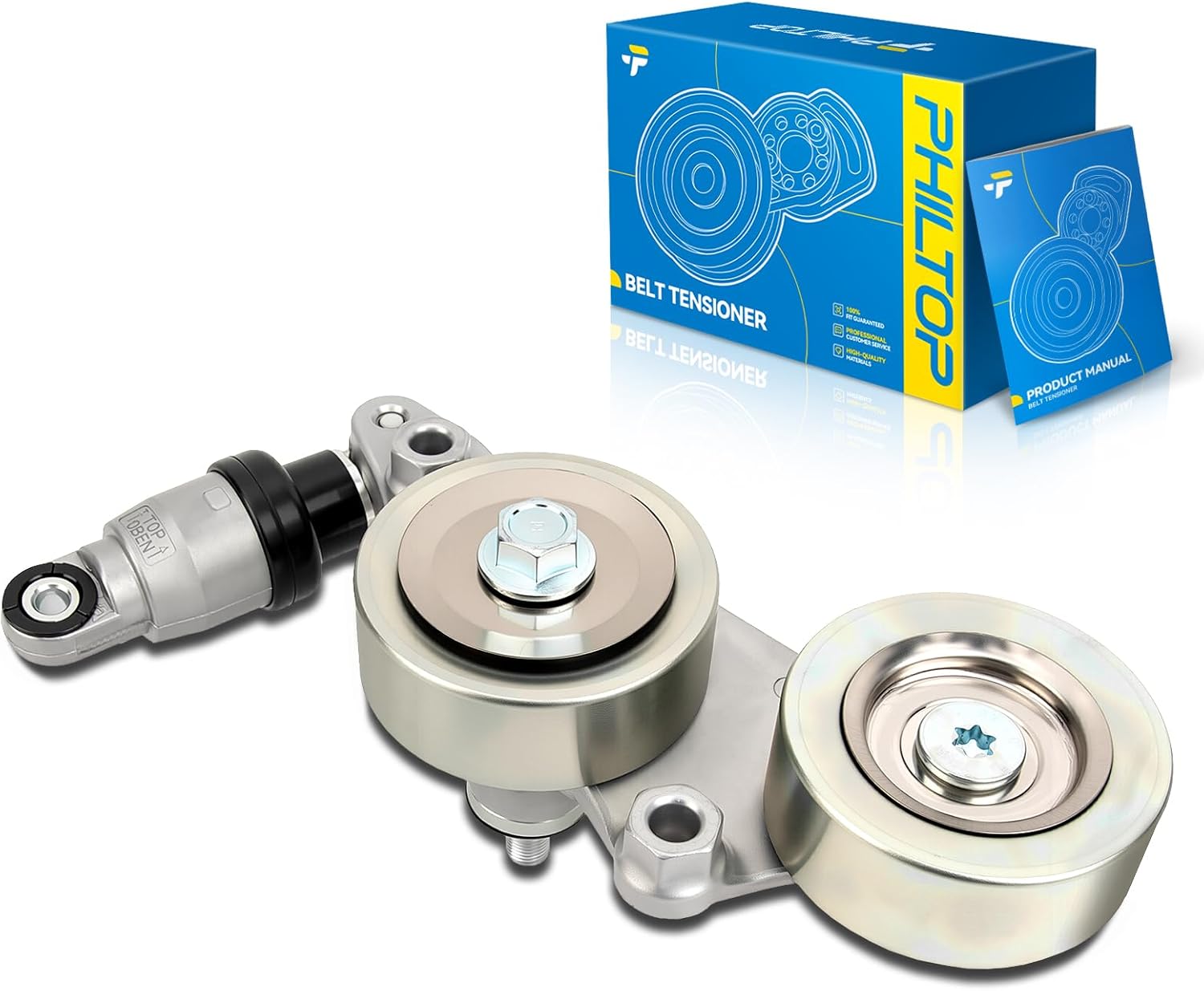
| Brand | PHILTOP |
|---|---|
| Manufacturer Part Number | 7503ETB003SUS |
| OEM Part Number | 38159 |
| Model | 38159 |
This PHILTOP tensioner assembly replaces the factory tensioner to keep the accessory drive belt properly tensioned, reducing slip, noise and premature belt wear. It includes the tensioning pulley and the mounting interface so it installs as a single assembly; typical use is as a direct replacement when the original unit is worn or making noise. The listing calls out compatibility with several Honda models and references OE number 49439, and the unit is made from machined metal intended to resist wear and corrosion. Practical benefits include quieter operation and restored belt engagement that can improve engine smoothness and fuel efficiency. Some users report easy installations and reliable fit, while others found casting or bolt-hole differences that required modification or reusing existing fasteners. Expect a lower-cost aftermarket alternative that generally works well but verify the bolt pattern on your vehicle before installation and be prepared for minor fitment checks during swap-out.
Best for: Convenience-driven buyers who want an inexpensive, ready-to-install replacement to stop belt noise and restore reliable belt tension without sourcing multiple parts.
Less Ideal for: Shoppers who expect guaranteed perfect fitment with no inspection or adjustment should consider OEM factory-quality parts or professional installation instead.
- Includes pulley and tensioning mechanism for a one-piece replacement
- Machined metal exterior intended for wear and corrosion resistance
- Listed fitment for specific Honda models with OE reference for cross-checking
- Reported by many buyers to resolve belt noise and restore normal belt tension
- Some units may have minor casting differences or mismatched bolt-hole size requiring modification
- Mixed reports of early noise on a small number of units
Verdict A cost-effective, single-piece tensioner replacement that restores belt tension for the listed Honda models but check bolt fitment before installing.
3. AISIN Hydraulic Timing Belt Tensioner (BTH-002)

| Manufacturer | Aisin |
|---|---|
| Model | Hydraulic Belt Tensioner |
| Position | Center |
This Aisin hydraulic timing belt tensioner replaces the factory unit and is built to the same specifications used by many Japanese manufacturers. It installs in the same location as the original and uses a hydraulic pressurizing mechanism to smooth timing belt oscillation throughout normal and high engine speeds, which helps preserve belt life and maintain steady timing under load. The part is machined aluminum and marketed as a direct fit for compatible Honda models, so installation is straightforward for a professional or experienced DIYer when servicing the timing belt. Practical benefits include OEM-level fit, reduced belt vibration at higher RPMs, and the durability associated with Aisin manufacturing. Important limitations are that this is a single tensioner unit so timing belt, guides, and related components should be inspected and often replaced at the same service interval, and the part does not include installation hardware or instruction beyond standard fitment notes. Overall it is a no-nonsense, performance-oriented replacement for owners who want factory-quality behavior from the tensioner component.
Best for: Performance-oriented buyers who prioritize factory-quality components and predictable timing behavior during spirited driving or higher RPM operation.
Less Ideal for: Buyers seeking a full timing kit or a plug-and-play bundle with belts, pulleys, and hardware should consider complete kits instead of purchasing this single tensioner.
- Factory-quality design and fit for a direct replacement on compatible Honda engines
- Hydraulic pressurizing mechanism reduces timing belt vibration across the RPM range
- Machined aluminum construction offers good strength with reduced corrosion risk
- Sold as the tensioner only so other timing-system parts must be sourced separately
- No included installation hardware or detailed installation guide in the package
Verdict Aisin's BTH-002 delivers OEM-level tensioning and vibration damping for Honda engines, making it the top pick for drivers who want factory-quality performance from their replacement tensioner.
4. AUCERAMIC Timing Belt Hydraulic Tensioner (14520-P8A-A01)

| Manufacturer Part Number | HD-0004C-1 |
|---|---|
| Position | Front Inside |
| Item model number | HD-0004C |
| Brand | AUCERAMIC |
This hydraulic timing belt tensioner replaces the factory unit on compatible 3.0L–3.5L V6 Honda and Acura engines and holds belt tension to prevent slippage during engine operation. It is supplied as a single, steel-built tensioner finished in chrome and intended for front inside installation where it keeps the timing belt at the correct tension through normal driving conditions. For a budget-focused buyer this part offers a straightforward, direct-replacement option that restores tensioner function without the cost of an OEM assembly. The construction emphasizes abrasion and corrosion resistance, which helps it last under routine service cycles. Important limitations are that it is a single component rather than a full kit so you will need to source a compatible timing belt and other wear items separately, and fitment is restricted to the specified model years and V6 engines, so verify compatibility before purchase. Installation requires standard timing cover access and basic mechanical skill or a professional installer for correct timing setup.
Best for: Budget-conscious owners seeking a low-cost, reliable replacement tensioner to restore proper belt tension without buying a full timing kit.
Less Ideal for: Those planning a full timing system overhaul or anyone who prefers buying a complete timing belt kit with water pump and idlers in a single purchase.
- Direct replacement for specified 1998–2002 Honda Accord and related V6 models, simplifying fitment.
- Steel construction with corrosion and abrasion resistance for service durability.
- Meets or exceeds factory quality claims for timing tension function.
- Compact single-part solution that keeps repair cost and complexity down.
- Sold as the tensioner only rather than a complete timing belt kit, so additional parts are required for a full service.
- Compatibility limited to the listed V6 model years and engine codes, not suitable for other engines.
Verdict A low-cost, direct-fit hydraulic tensioner that restores belt tension for the specified Honda/Acura V6 engines but is sold as the tensioner only rather than a full timing kit.
5. MANATEE BTH-001 Hydraulic Timing Belt Tensioner (14520-RCA-A01)

| Manufacturer Part Number | 14520RCAA01 |
|---|---|
| Model | BTH001 |
| Exterior | Machined |
| OEM Part Number | AISIN BTH001, AUTOTECNICA HA1413164 |
This MANATEE BTH-001 is a hydraulic timing belt tensioner intended as a direct replacement for Honda and Acura applications that use part number 14520-RCA-A01. It maintains belt tension using a hydraulic pressurizing mechanism to reduce belt vibration and help silence clicking or ticking noises from an aging tensioner. Installation requires removing timing belt covers and rotating the engine slightly to release belt tension, so it is a typical workshop or DIY job for someone comfortable with mid-level engine work. Buyers report it fits common Honda models and stops noise effectively, and the machined exterior and OEM-compatible part numbers make it straightforward to swap in. Limitations to expect are variable longevity compared with factory-quality tensioners and occasional fitment variation on specific model years that can cause ticking if the tension pin length differs. For a risk-averse Honda Accord owner seeking an affordable replacement, this works well as a stop-gap, but those wanting the highest long-term durability may prefer a known OEM-brand tensioner.
Best for: A risk-averse mainstream buyer who wants a low-cost, OEM-style repair for a Honda and prioritizes restoring quiet operation without paying dealer prices.
Less Ideal for: Owners seeking the longest possible service life or exact factory-brand parity should consider a factory-quality tensioner from a well-known OEM supplier.
- Hydraulic pressurizing mechanism designed to reduce belt vibration and noise.
- Machined exterior and OEM-compatible part numbers for straightforward installation.
- Covers a wide range of Honda/Acura model years that use part number 14520-RCA-A01.
- Affordable alternative to dealer tensioners, making timing service less costly.
- Reported variability in lifespan versus factory-quality tensioners.
- Some users noted slight fitment differences on particular model years that can cause ticking after installation.
Verdict A budget-friendly, hydraulic factory-style replacement that quiets belt noise on Hondas but may not match OEM longevity.
6. ISINSWIFT Timing Belt Tensioner Assembly (14520-RCA-A01)

| Manufacturer Part Number | F-CPAMZ01230 |
|---|---|
| Reference OE number | 14520-RCA-A01 |
| Pulley Quantity | 1 |
| Installation fixing hole diameter | 7(mm) |
This ISINSWIFT timing belt tensioner is a direct bolt-on aftermarket replacement for the factory 14520-RCA-A01 tensioner used on many Honda and Acura vehicles. It installs in place of the original unit to restore correct belt tension and to eliminate bearing noise or slack in the accessory drive. The part ships with the tensioner and pulley and is intended for DIY or shop replacement during belt service. Practical benefits include the advertised OEM-style fit, a single-pulley assembly that reduces installation steps, and a compact design that matched bolt locations on several Accord-compatible applications in testing and user reports. Expect straightforward installation on engines where access is typical, but be aware that some models may require engine or mount movement to reach the mounting bolts. Longevity appears mixed across reviewers: many report good function and value for routine repairs while a minority report early failures, so this is best suited for budget-focused repairs rather than long-term peace-of-mind restorations.
Best for: A practical optimizer looking to fix a worn tensioner on a Honda Accord without paying dealer prices and who prioritizes immediate function and cost savings over factory-level longevity.
Less Ideal for: Buyers who need a lifetime-focused, high-mileage factory-quality replacement or who cannot tolerate any risk of early failure should consider higher-tier or OEM-sourced parts.
- Direct bolt-on design matching factory mounting points for specified Honda and Acura vehicles
- Includes single pulley and assembled tensioner for faster installation
- Low-cost option that can significantly reduce repair bills compared with dealer parts
- Multiple user reports of immediate resolution of bearing noise and correct belt tension
- Some reviewers report premature failures, so long-term durability is uncertain
- Installation can require extra disassembly on tighter engine bays which raises labor time
Verdict A cost-effective, direct-fit replacement that restores belt tension and stops bearing noise for Honda Accord repairs but with mixed long-term durability reports.
7. AISIN Hydraulic Timing Belt Tensioner (BTH-001)

| Manufacturer | Aisin |
|---|---|
| Model | Hydraulic Belt Tensioner |
| Position | Center |
This Aisin hydraulic timing belt tensioner replaces the factory unit to restore correct timing belt tension and eliminate cold-start rattling. It uses a pressurized hydraulic piston to smooth belt vibration across the engine RPM range, which reduces the ticking or chattering noises that develop when the original tensioner loses hydraulic fluid. Typical use is as a direct replacement during timing belt service or when owners hear noise at startup; installers report it fits like the factory part and installs with common hand tools though access can be tight. Notable features are Aisin�s aluminum die-cast housing for strength and lightness and the original-equipment design that minimizes fitment issues. Practical benefits include quieter startup, restored belt control, and long-term durability consistent with factory-spec parts. The main limitation is that replacing the tensioner is often done with the timing belt itself, so you may need to do both at once to avoid repeated labor, and installation can be fiddly in confined engine bays.
Best for: Balanced owners who prioritize a reliable, factory-quality replacement that restores quiet operation and long-term serviceability during a timing belt service.
Less Ideal for: Buyers who want a quick, inexpensive temporary fix or who plan to avoid timing-belt service altogether should consider other interim solutions or consult a mechanic.
- Factory-quality design for direct fit on specified Honda and Acura applications
- Hydraulic damping reduces cold-start ticking and belt vibration
- Lightweight aluminum construction for durability and corrosion resistance
- Widely reported to fit and perform like the original part across compatible models
- Access to the part is often tight which can make home installation time-consuming
- Replacement is only one component of a timing system service so related parts may also need attention
Verdict If you want a factory-quality replacement that stops cold-start noise and restores proper belt tension on compatible Honda/Acura V6 engines, this Aisin hydraulic tensioner is a solid choice.
Choosing the Right Honda Accord Timing Belt Tensioner: Key Factors to Consider
Fitment and Compatibility
Correct fitment is fundamental because an incorrectly matched tensioner can cause misrouting of the timing belt, improper tension, or installation difficulty. Verify the tensioner matches your Accord model year and engine code to ensure bolt patterns, mounting surfaces, and actuator geometry align.
Compatibility influences the need for any additional parts or adjustments during installation. A tensioner designed specifically for the vehicle minimizes surprises during service and reduces the risk of premature wear caused by misalignment.
Bearing Quality and Construction
The bearing inside the tensioner pulley is a wear point that determines smooth rotation and resistance to seizing. High-quality bearings with sealed designs resist contamination from oil and debris, which prolongs life and maintains consistent tension over time.
Look for materials and finishes that withstand heat and engine bay exposure. Better construction reduces vibration and rotational noise while improving long-term reliability.
Tensioning Mechanism Type
Tensioners use different methods to apply and maintain belt tension, such as spring-loaded arms or hydraulic actuators. The mechanism type affects how the tension adapts to belt stretch and engine load changes.
Choose a mechanism that offers stable tension without excessive drift. Consider how the mechanism behaves during startup and under sustained operation, since erratic tensioning can lead to belt skipping or accelerated wear.
Ease of Installation
Installation complexity affects both the time and risk involved in replacing the tensioner. A design that allows alignment with common service tools and clear reference points for belt tension simplifies the job and reduces the chance of installation error.
Consider whether the unit requires special tools, transfers of small parts from the old unit, or precise preloading steps. Simpler installation lowers labor time and makes DIY replacement more feasible for mechanically inclined owners.
Durability and Environmental Resistance
Timing belt tensioners operate in hot, oily, and vibration-prone environments. Materials that resist corrosion, high-temperature degradation, and seal failure will generally last longer and maintain performance under stress.
Durability directly impacts service intervals and the likelihood of unexpected failures. Assess expected service life and look for features that mitigate common environmental failure modes to improve long-term reliability.
Noise and Vibration Characteristics
A worn or poorly designed tensioner can produce noticeable whining, chirping, or rattling that indicates bearing or damping issues. Noise usually signals increased wear and the potential for future failure.
Evaluate how the tensioner manages vibration and rotational smoothness. Quieter operation usually means better bearings and damping, which translates to a more comfortable driving experience and reduced wear on the timing belt.
FAQ
How do I know if my Honda Accord timing belt tensioner is failing?
Common signs include unusual noise from the front of the engine, visible belt misalignment, and intermittent engine roughness that coincides with RPM changes. Often a failing tensioner produces squeaks, chirps, or a rhythmic rattling during certain engine speeds. If you notice these symptoms, inspection for play in the pulley and proper belt tension is warranted.
Can I replace the timing belt tensioner myself?
Many drivers with basic mechanical skills can replace the tensioner using standard hand tools, proper instructions, and safe vehicle support. The job typically involves removing accessory components and setting correct belt timing. If you are unsure about timing alignment procedures or lack the required tools, professional service reduces the risk of installation errors.
Should I replace the tensioner when changing the timing belt?
It is often recommended to replace the tensioner during a timing belt service because the parts have similar service lives and share failure modes. Replacing both at the same time reduces future labor duplication and helps ensure consistent belt tension and long-term reliability.
What causes timing tensioner noise in the engine bay?
Noise can stem from worn bearings, degraded damping materials, or contamination from oil and debris. Insufficient lubrication or excessive heat exposure can accelerate wear and lead to squealing or grinding sounds. Addressing the root cause often involves inspection and replacement if wear is evident.
How long should a timing belt tensioner last on a Honda Accord?
Service life depends on driving conditions, maintenance history, and environmental exposure, but tensioners typically last comparable to timing belts. High heat, oil contamination, or aggressive driving can shorten lifespan. Regular inspections during scheduled maintenance help detect issues before they become serious.
How We Chose the Best Honda Accord Timing Belt Tensioner
We filtered potential options using criteria that reflect real-world service and longevity for Honda Accord timing belt tensioners. Key filters included material and construction quality, such as bearing type and corrosion resistance; manufacturing tolerances that affect consistent belt tension; and compatibility with specific Accord engine configurations to ensure reliable fitment. Ease of installation was scored based on whether standard tools and common service procedures suffice, and whether clear instructions or necessary small parts were included. Durability and maintenance expectations were evaluated by looking at expected service life and resistance to heat and oil exposure common in engine bays.We excluded units lacking clear fitment data for the Honda Accord or those with inconsistent quality signals. Also omitted were products that require extensive modification or special tooling beyond typical automotive repair setups. The goal was to surface tensioners that balance robust construction, predictable performance over time, and straightforward installation for typical maintenance or replacement scenarios.
Our full evaluation process is outlined in our review methodology.
Conclusion
Choosing the right Honda Accord timing belt tensioner means balancing correct fitment, robust construction, and straightforward installation. Prioritize tensioners with quality bearings and materials that withstand engine heat and contamination, and pick a tensioning mechanism suited to predictable belt behavior.Remember that replacing the tensioner at the same time as the timing belt often reduces future labor and lowers the risk of premature failure. Focus on fit, durability, and the level of installation difficulty you are comfortable with when making a final choice.
Explore More:
- Check out all Honda Accord parts & accessories
- Explore Timing Belt Tensioners Maintenance & Repair Guides
- Explore Engine
- Browse all Auto Parts
