

Note: This article contains affiliate links. If you click on these links and make a purchase, I may earn a small commission at no extra cost to you. This helps support my research and content. Read my full affiliate disclosure here.
A properly functioning Jeep Gladiator tie rod end is essential for predictable steering and safe handling. Worn or loose tie rod ends cause wandering, uneven tire wear, and vague steering feel, so selecting the right replacement keeps your truck driving straight and responsive.This guide highlights seven shortlisted tie rod ends chosen for their fitment and durability. We explain the criteria used to evaluate them and what to expect when replacing steering components, then summarize practical considerations to help you pick the right option.
Looking for other parts? See all Jeep Gladiator parts & accessories.
Top Picks at a Glance
| Best Overall The best all-around choice for most situations | Steer Smarts Yeti XD Tie Rod Assembly for Jeep Wrangler JL / Gladiator JT (Rubicon axle) |  |
| Best Quality Built to a higher standard if you want something more solid | TeraFlex HD Chromoly Tie Rod Kit for Jeep JL/JT (0-6" Lift) |  |
| Best Value The sweet spot between price and what you get | bproauto Steering Tie Rod End for Jeep Gladiator and Wrangler (Outer, Machined) |  |
| Best Budget The cheapest option that still gets the job done reliably | Detroit Axle Front Left Outer Tie Rod End (MS25669) |  |
| Highest Rated A top-rated pick with lots of positive feedback | TRQ Front Driver Side Outer Tie Rod for Jeep Wrangler/Gladiator (PSA51620) |  |
| Most Popular A crowd favorite that many people choose with confidence | MOOG ES800594 Outer Steering Tie Rod End |  |
| Best Seller A high-volume bestseller chosen again and again | A-Premium Front Left Outer Tie Rod End for Jeep JL/JT (2018–2024) |  |
1. Steer Smarts Yeti XD Tie Rod Assembly for Jeep Wrangler JL / Gladiator JT (Rubicon axle)

| Brand | Steer Smarts |
|---|---|
| Model | JEGS |
| Manufacturer Part Number | SS-780 |
| OEM Part Number | 78088001 |
This Steer Smarts Yeti XD tie rod assembly replaces the factory tie rod on select Jeep Wrangler JL and Gladiator JT Rubicon-axle models to provide a ready-to-install steering linkage. It is supplied as a complete assembly so installation is straightforward for a mechanic or competent DIYer using standard steering removal tools. The assembly is built for wider-track Rubicon applications, so it preserves proper alignment and steering feel on lifted or wide-track setups. Practical benefits include a single-part replacement that eliminates the need to match ends and saves installation time, and the unitized design reduces alignment guessing after fitment. Important limitations are fitment specificity — it is intended for Rubicon axle widths and will not fit standard JL/Unlimited widths — and the listing details can be confusing, so confirm width before ordering.
Best for: Balanced all-round Jeep owners who prioritize a reliable, factory-replacement steering component and want a ready-to-install solution that maintains correct steering geometry on Rubicon-width Gladiator/Jeep setups.
Less Ideal for: Owners with standard-width JL/Unlimited Jeeps or anyone needing a universal or adjustable tie rod for multiple track-widths should consider other parts built for those configurations.
- Complete assembly for quicker install and consistent steering geometry
- Made for Rubicon-width applications to maintain proper track and alignment on wide-track setups
- Factory-quality replacement fitment for direct swap on specified models
- Not compatible with standard-width JL/Unlimited models
- Product description and compatibility notes can be unclear, requiring extra verification before purchase
Verdict: A factory-quality, complete tie rod assembly built to restore proper steering geometry on Rubicon-width Jeep Gladiator and Wrangler JL applications.
2. TeraFlex HD Chromoly Tie Rod Kit for Jeep JL/JT (0-6" Lift)
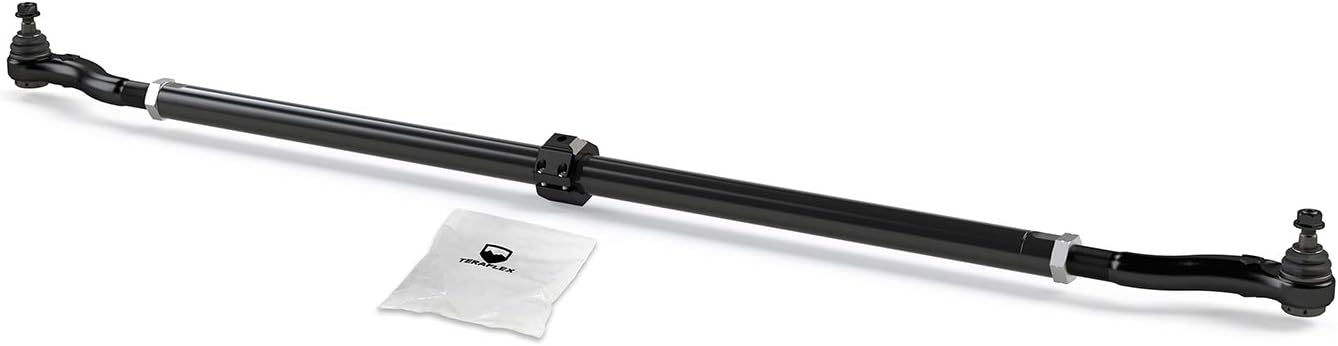
| Vehicle fit | Jeep JL Wrangler and JT Gladiator |
|---|---|
| Lift range | 0-6" Lift |
| Material | 4140 heat treated chromoly steel |
| Exterior finish | Triple‑stage powder coat UV protected |
This TeraFlex HD Chromoly Tie Rod Kit replaces the factory steering tie rod on Jeep JL Wrangler and JT Gladiator models and is built for aggressive use and lifted vehicles. It uses 4140 heat‑treated chromoly with a 42mm outside diameter and thicker wall for a much stronger, stiffer steering link; TeraFlex states it is over 66% stronger and 75% stiffer than the factory part. The kit relocates the steering stabilizer above the tie rod to reduce damage risk and includes a UV‑protected triple‑stage powder coat to resist corrosion. Installation is designed to fit without cutting or removing factory brackets, making it practical for shop or competent DIY installation. The result is firmer, more predictable steering under heavy steering loads, larger tires, and off‑road impacts. Drawbacks are the added stiffness that slightly increases steering feedback and the heavier component weight compared with stock parts, which may be unnecessary for mild daily drivers focused on comfort.
Best for: Performance‑oriented Jeep owners who prioritize steering strength and predictable handling on lifted Gladiator builds and frequent off‑road use.
Less Ideal for: Drivers who want the softest, most compliant steering for daily street commuting or who will never run larger tires or off‑road loads.
- Purpose‑built 4140 heat‑treated chromoly construction for high strength
- Significantly stiffer and stronger than factory tie rod for lifted and off‑road use
- Relocated steering stabilizer reduces chance of stabilizer damage
- Triple‑stage powder coat provides UV protection and corrosion resistance
- Increased steering stiffness and heavier mass compared with factory part
- Designed specifically for JL and JT models so benefits are limited to that vehicle scope
Verdict: A heavy‑duty chromoly steering upgrade that gives lifted Jeep Gladiators much stronger, stiffer, and more reliable steering under demanding use.
3. bproauto Steering Tie Rod End for Jeep Gladiator and Wrangler (Outer, Machined)

| Manufacturer | bproauto |
|---|---|
| Position | Outer |
| Exterior | Machined |
| OEM Part Number | 68258761AA |
This bproauto outer tie rod end is a direct-fit aftermarket replacement for select 2020–2024 Jeep Gladiator and 2018–2024 Wrangler applications and is built from heat-treated alloy steel with a corrosion-resistant coating. It uses a multi-seal design to keep dirt and moisture out and a longer internal thread to simplify installation and alignment adjustments. In everyday use it restores steering linkage integrity and helps eliminate play that causes wandering or uneven tire wear. The machined exterior and sealed joint aim to extend service life compared with basic economy parts, while the design choices make it straightforward for a home mechanic or shop to install during a steering or suspension service. Buyers should note this is an aftermarket part so fitment and finish may differ slightly from factory parts and installation may require alignment after replacement.
Best for: Practical owners who want a durable, cost-conscious replacement that balances reliability and ease of installation during routine steering or suspension maintenance.
Less Ideal for: Buyers seeking an exact factory-specified part with manufacturer-backed documentation or those who prefer dealer-supplied components for warranty-backed repairs.
- Heat-treated alloy steel construction for stronger wear resistance
- Multi-seal design reduces contaminant ingress and extends joint life
- Longer internal thread simplifies installation and alignment adjustments
- Surface coating improves corrosion resistance for longer service in wet environments
- Aftermarket fit and finish can vary compared with factory parts
- Limited model-specific documentation compared with OEM suppliers
Verdict: A value-focused, durable outer tie rod end built to restore steering control on specified Gladiator and Wrangler models while keeping cost and installation effort low.
4. Detroit Axle Front Left Outer Tie Rod End (MS25669)

| Brand | Detroit Axle |
|---|---|
| Model | Front Outer Tie Rod |
| Manufacturer Part Number | MS25669 |
| Fitment Note | Front Left Outer Tie Rod End |
This Detroit Axle front left outer tie rod end is sold as a single replacement part intended to restore steering linkage function on compatible Jeep Gladiator and Wrangler models. It installs in place of the factory outer tie rod and is typically used during steering wear, looseness, or after collision damage. The part is described as undergoing impact and fatigue testing and comes with a 10-year warranty, which offers reassurance for long-term ownership. Practical benefits include a straightforward direct-fit design that simplifies installation and a polished finish that resists corrosion. As a budget-focused aftermarket option, it may not match OE refinements like tighter tolerances or pre-greased joints found on higher-end replacements, and buyers should expect to perform alignment after installation. The single-piece kit keeps initial cost and parts complexity low, making it a sensible repair choice when replacing only the driver side outer tie rod end.
Best for: Budget-conscious Jeep Gladiator owners who prioritize an affordable, straightforward repair to restore steering feel without upgrading other suspension components.
Less Ideal for: Owners seeking a premium factory-quality replacement with the tightest tolerances or pre-assembled dual-side kits should consider higher-end options.
- Direct-fit replacement for front left outer tie rod on specified Jeep models
- Undergoes impact and fatigue testing for durability expectations
- Includes a 10-year warranty for long-term reassurance
- Sold as a single outer tie rod end so matching passenger-side replacement must be purchased separately
Verdict: A cost-effective, direct-fit front left outer tie rod end that restores steering function on compatible Jeep Gladiator models with a long warranty backing.
5. TRQ Front Driver Side Outer Tie Rod for Jeep Wrangler/Gladiator (PSA51620)

| Fitment | Jeep Wrangler 2018-25, Jeep Gladiator 2020-25 |
|---|---|
| Finish | E-Coated |
| Pre-Greased | Yes |
| Dust Boot Included | Yes |
This TRQ front outer tie rod is a direct-fit replacement for the driver-side front steering linkage on Jeep Wrangler (2018-25) and Gladiator (2020-25). It arrives pre-greased with a dust boot installed and a machined, steel housing that mimics factory fit and function so installation is straightforward for DIY or professional shops. The part is E-coated for corrosion resistance and shipped as a pre-assembled unit to reduce install time and alignment guesswork. Practical benefits include OEM-style fitment, included grease-ready ball joint, and a dust boot to protect the joint from road contamination. Some listings and photos show different fastener styles, and a few long-term reviews note premature play on heavy-duty truck applications, so expect typical wear life for a replacement part under normal driving rather than heavy commercial use. For Gladiator and Wrangler owners wanting a reliable, ready-to-install steering component, this part balances factory compatibility and ease of installation.
Best for: Reliability-focused Jeep owners who prioritize factory-fit replacement parts and straightforward DIY or shop installation for routine steering repairs.
Less Ideal for: Drivers who need heavy-duty, commercial-grade steering components for sustained high-load or off-road abuse should consider purpose-built heavy-duty options instead.
- Direct-fit design for 2018-2025 Wrangler and 2020-2025 Gladiator simplifies installation
- Pre-greased ball joint and dust boot help protect the joint and reduce prep work
- Machined steel construction with E-coating improves corrosion resistance
- Pre-assembled unit reduces install time and the need for modifications
- Some users report fastener/ hardware mismatch compared with listing photos
- A minority of long-term reports cite premature looseness under heavy-duty use
Verdict: A factory-compatible, pre-assembled front outer tie rod that makes replacing the driver-side steering link on 2018-25 Wrangler and 2020-25 Gladiator quick and straightforward.
6. MOOG ES800594 Outer Steering Tie Rod End

| Compatible models | Jeep Wrangler JK 2007-2018 (per product listing) |
|---|---|
| Material | Neoprene-sealed rubber (with heat-treated ball stud) |
| Bearing type | Ball bearing |
| Lubrication | Greasable socket |
This MOOG ES800594 outer tie rod end replaces a worn steering linkage to restore steering precision and correct alignment on compatible Jeep Wrangler models. It installs in the steering knuckle to steering gear linkage and is typically used when you have loose steering, uneven tire wear, or a diagnostic pointing to a bad outer tie rod. Notable features include a heat-treated ball stud for improved fatigue strength, a pressed-in cover plate to seal out debris, and a greasable socket so you can refresh lubrication over time. The Problem Solver gusher bearing design lets grease flow across the bearing surface for reduced friction and longer life, and a Belleville preload washer maintains bearing preload as parts wear. Those features make installation straightforward and help the replacement behave like a factory-quality part in everyday driving. Limitations: this is a direct replacement sized for specific Wrangler/JK fitments and is not intended as a heavy-duty upgrade for seriously lifted or off-road modified Gladiators or Wranglers with oversized tires.
Best for: Convenience-driven owners who prioritize an easy, reliable repair that restores factory steering feel with minimal fuss and time in the garage.
Less Ideal for: Drivers planning serious lifts or running oversized tires who need a beefier, heavy-duty steering linkage should consider performance-oriented tie rod upgrades instead.
- Factory-style fit and precision tolerances for easier installation and alignment
- Heat-treated ball stud and gusher bearing design for improved durability and smoother operation
- Press-in cover plate and greasable socket help keep contaminants out and allow maintenance lubrication
- Belleville preload washer helps maintain tight bearing package as wear occurs
- Designed as a direct factory-replacement rather than a heavy-duty, high-angle tie rod for extreme lift or oversized tire setups
Verdict: A straightforward, factory-quality outer tie rod end that restores steering precision and is easy to install for convenient, maintenance-friendly repairs.
7. A-Premium Front Left Outer Tie Rod End for Jeep JL/JT (2018–2024)

| Position | Front Left Outer |
|---|---|
| Compatible Models | Jeep Wrangler JL 2018-2024, Gladiator JT 2020-2024 |
| Ball Stud Material | Steel |
| Exterior | Corrosion-Resistant Coating |
| Pre-Greased | Yes |
This A-Premium front left outer tie rod end is a factory-replacement style steering component made to fit Jeep Wrangler JL (2018–2024) and Gladiator JT (2020–2024). It replaces the outer driver-side tie rod to address loose or wandering steering, uneven tire wear, and suspension noise. The part ships pre-greased and features a steel ball stud with a corrosion-resistant coating for longer life in road and off-road conditions. Installation is typical for a steering outer tie rod end and should be straightforward for a competent DIYer or a shop, since the unit matches original dimensions and includes the pictured accessories. Practical benefits include restoring steering feel and reducing play without the need for modification, and the included one-year unlimited-mileage warranty gives conservative buyers extra assurance. Important limitations are minimal: it does not include a grease fitting for on-vehicle re-greasing and requires alignment after installation.
Best for: Risk-averse mainstream buyers who prefer factory-style, dependable steering components and want a straightforward replacement that restores original steering feel with minimal fuss.
Less Ideal for: Drivers who plan frequent off-road use requiring serviceable grease fittings or who prefer upgraded heavy-duty or performance steering components should consider specialty alternatives.
- Direct-fit replacement matching original dimensions for straightforward installation
- Pre-greased ball joint reduces initial maintenance and eases installation
- Corrosion-resistant coating improves durability in wet and winter conditions
- Backed by a one-year unlimited-mileage warranty for added buyer confidence
- No grease fitting for future on-vehicle re-greasing of the ball joint
Verdict: A practical, direct-fit tie rod end that restores steering precision for Jeep Wrangler JL and Gladiator JT owners seeking a reliable factory-style replacement.
Choosing the Right Jeep Gladiator Tie Rod End: Key Factors to Consider
Fitment and Thread/Spline Compatibility
Accurate fitment is the foundation of a successful replacement. Matching the correct thread pitch, spline count, and overall dimensions ensures the tie rod end installs without forcing modifications. A mismatched part can damage steering components or change toe settings.
Confirming factory-style connections preserves steering geometry and reduces the chance of leaks or loosening. Fitment that mirrors original specifications also simplifies installation and helps mechanics estimate labor and alignment needs.
Ball Joint Quality and Tolerance
The ball joint inside the tie rod end transfers steering inputs while allowing articulation. Higher-quality joints use tighter tolerances and smoother finishes, which reduces play and improves steering precision. Excessive internal clearance leads to vague steering and accelerated wear.
Look for parts that specify hardened contact surfaces and controlled clearances. Better tolerance control contributes to longer service life and more consistent handling over time.
Materials and Corrosion Protection
Tie rod ends operate in harsh environments, exposed to water, salt, and road debris. Corrosion-resistant materials and protective coatings extend service life and prevent joint seizure. Zinc plating, nickel finishes, or specialized coatings can slow rust and maintain smooth operation.
Consider components with robust seals and treated steel to resist pitting. Durability against corrosion reduces the likelihood of unexpected failure and simplifies future maintenance.
Serviceability and Greaseability
Some tie rod ends include grease fittings that let you refresh lubrication during routine service. Greaseable joints can significantly extend component life when maintained properly. Non-serviceable sealed units remove maintenance but may require replacement sooner if contaminants breach the seal.
Evaluate whether you prefer low-maintenance sealed parts or serviceable units that align with your maintenance habits. Greaseability also affects how failures progress; greasable joints often show warning signs before catastrophic failure.
Impact on Alignment and Steering Geometry
Replacing tie rod ends affects toe settings and overall steering alignment. Parts that remain within original length tolerances minimize the amount of adjustment needed during alignment. Excessive deviation in length or angle can complicate achieving correct toe and suspension geometry.
Choose components that allow for fine adjustments or that match factory dimensions to simplify getting precise alignment, which helps prevent uneven tire wear and preserves handling characteristics.
Durability Under Load and Usage Pattern
Consider how you use the Gladiator when selecting a tie rod end. Heavy towing, off-road driving, or frequent low-speed impacts increase loads on steering components. Parts engineered for higher load cycles and shock resistance are better suited to demanding use.
Assess construction details like reinforced housings, heavier-duty ball studs, and improved sealing when durability under repeated stress matters. Vehicle usage drives the tradeoff between lighter, everyday parts and more robust units built for extreme conditions.
How We Chose the Best Jeep Gladiator Tie Rod End
We focused on components designed specifically for the Jeep Gladiator, prioritizing fitment and build quality. Key evaluation criteria included thread and spline compatibility, materials and corrosion resistance, serviceability and greaseability, and whether the part supports proper steering geometry after installation. We also considered part tolerances and the robustness of ball joints under load, plus documented installation guidance that helps with alignment.We excluded generic or universal tie rod ends and any items lacking clear fitment data for the Gladiator. We did not consider warranty length alone; instead we treated it as a supporting factor alongside verified construction and compatibility. The end result is a collection of parts that meet practical installation needs and steering performance expectations for this vehicle.
Our full evaluation process is outlined in our review methodology.
FAQ
What are common symptoms of a bad tie rod end?
Common symptoms include uneven tire wear, a loose or wandering steering feel, and clunking noises when turning. You may also notice vibration through the steering wheel at higher speeds. These signs often appear gradually and tend to worsen if the joint continues to wear.
How does replacing a tie rod end affect wheel alignment?
Replacing a tie rod end can change toe settings and therefore requires an alignment check. Parts that match factory length help minimize the amount of adjustment needed, but an alignment is usually recommended after installation to ensure correct steering geometry and even tire wear.
Can I inspect a tie rod end myself?
A basic inspection is possible by checking for visible play, torn boots, or corrosion. With the vehicle safely lifted, you can grasp the wheel and feel for excessive movement while someone else turns the steering. However, a thorough assessment is best done by a technician with the proper tools to detect internal play.
Are greasable tie rod ends worth choosing?
Greasable tie rod ends allow periodic lubrication, which can extend service life if you perform regular maintenance. They are advantageous in harsh environments or for vehicles that see heavy use. Sealed units reduce routine maintenance but may need replacement sooner if contamination occurs.
How long do tie rod ends usually last?
Lifespan varies with driving conditions and maintenance; many tie rod ends last tens of thousands of miles under normal driving. Off-road use, frequent impacts, or exposure to corrosive conditions can shorten life considerably. Regular inspections help catch wear before it affects safety.
Conclusion
When picking a tie rod end for your Jeep Gladiator, prioritize correct fitment, robust ball joint construction, and appropriate corrosion protection. Balance whether you want a greasable unit for extended serviceability or a sealed component for lower maintenance.Also consider how you use the vehicle; heavier-duty parts make sense for off-road or heavy-load use, while standard replacements often suffice for everyday driving. After installation, plan an alignment to restore proper steering geometry and ensure predictable handling.
Explore More:
- Check out all Jeep Gladiator parts & accessories
- Explore Tie Rod Ends Maintenance & Repair Guides
- Explore Suspension & Steering
- Browse all Auto Parts
