

Note: This article contains affiliate links. If you click on these links and make a purchase, I may earn a small commission at no extra cost to you. This helps support my research and content. Read my full affiliate disclosure here.
If you own a 1995-2001 Ford Explorer, worn or cracked tail lights are a common issue that affects safety and vehicle appearance. Choosing the right tail light assembly ensures correct fitment, reliable illumination at night, and a watertight seal to prevent corrosion and electrical faults. This guide shortlists seven top tail light assemblies that suit the 1995-2001 Explorer and explains the evaluation factors behind our picks.We focused on fitment accuracy, lens and housing quality, and ease of installation so you can confidently replace a failing rear tail light assembly. Read on to compare the shortlisted options and learn what matters when selecting a replacement for your Explorer.
Looking for other parts? See all Ford Explorer parts & accessories.
Top Picks at a Glance
| Best Overall The best all-around choice for most situations | SPEC-D Tuning Black Housing Clear Lens Tail Lights, Pair |  |
| Best Quality Built to a higher standard if you want something more solid | CarLights360 Tail Light Assembly Pair for Ford Explorer/Mountaineer (1998–2001) |  |
| Best Value The sweet spot between price and what you get | Garage-Pro Tail Light Pair for Ford Explorer 1995–1997 |  |
| Best Budget The cheapest option that still gets the job done reliably | Garage-Pro Tail Light Assembly for Ford Explorer (1998–2001) — Right Passenger Side |  |
| Highest Rated A top-rated pick with lots of positive feedback | CarLights360 Rear Tail Light Pair for 1995-1997 Ford Explorer |  |
| Most Popular A crowd favorite that many people choose with confidence | AmeriLite Black Replacement Tail Light Pair for 1998–2001 Ford Explorer |  |
1. SPEC-D Tuning Black Housing Clear Lens Tail Lights, Pair

| Fitment Year | 1998-2001 |
|---|---|
| Compatible Vehicles | Ford Explorer, Mercury Mountaineer |
| Lens Material | Polycarbonate |
| Wattage | 21 watts |
| Set | Pair |
These SPEC-D Tuning tail lights are a bolt-on replacement set meant to swap directly into late 90s Ford Explorer and Mercury Mountaineer models without wiring changes. They use impact-resistant polycarbonate lenses and a sealed housing intended to be waterproof and UV resistant for everyday driving and occasional harsher conditions. The lights arrive as a matched left and right pair and are designed to meet DOT and SAE compliance, making them suitable for street use. Installation is generally straightforward for someone with basic experience, though the seller recommends professional installation and no instructions are included. Practical benefits include updated styling with black housings and clear lenses, reasonable durability from ISO-certified manufacturing, and compatibility with factory mounting points. Limitations are that they exclude certain 2001 variants and come without installation guidance, so budget DIYers should be comfortable with basic tail light swaps or plan for shop time.
Best for: Buyers who want a factory-style direct replacement with refreshed black-housing styling and reliable street-legal performance for a late 90s Explorer or Mountaineer and prefer a matched pair replacement.
Less Ideal for: People seeking a plug-and-play upgrade with step-by-step instructions or owners of 2001 Sport and Sport Trac models should look for a different fitment or a unit with included guidance.
- Direct bolt-on design for 1998-2001 Ford Explorer and 1998-2001 Mercury Mountaineer (excludes 2001 Sport and Sport Trac)
- Impact-resistant polycarbonate lens with sealed housing for waterproofing and UV resistance
- DOT and SAE compliant construction for legal street use
- Comes as a matching left and right pair from an ISO-certified manufacturer
- No installation instructions included, which may require professional installation
- Does not fit 2001 Sport or Sport Trac models
Verdict: A matched, DOT-compliant bolt-on tail light pair that refreshes late 90s Explorer and Mountaineer rear styling while keeping factory-style fit and durability.
2. CarLights360 Tail Light Assembly Pair for Ford Explorer/Mountaineer (1998–2001)

| Light Source | Halogen |
|---|---|
| Voltage | 12 |
| Auto Part Position | Rear |
| Lens Material | Polycarbonate |
| Automotive Fit Type | Vehicle Specific Fit |
These CarLights360 tail light assemblies replace the factory rear lamps on 1998–2001 Ford Explorer and Mercury Mountaineer models and are sold as a matching driver and passenger pair. They are molded from polycarbonate, DOT certified, and rated for 12V halogen bulbs, so installation is a direct vehicle-specific fit and uses the vehicle wiring and bulb sockets. The housings are waterproof and come factory-sealed, which helps durability and keeps moisture out of the lens. Bulbs are not included, so plan to transfer the stock bulbs or buy replacements. Because these are aftermarket replacements built to OEM-equivalent part numbers, they offer a cost-effective way to restore a clean, matching rear lighting appearance without modifying the vehicle. Limitations are that they are halogen-only housings and not a performance LED upgrade, so they will not change illumination response or styling beyond restoring factory functionality.
Best for: Buyers who want a direct-fit, durable replacement to restore factory rear lighting and appearance on a late 1990s Explorer or Mountaineer without modifying wiring or lights.
Less Ideal for: Drivers seeking a performance lighting upgrade, modern LED styling, or quicker illumination response should consider aftermarket LED conversion kits instead.
- Vehicle-specific fitment for 1998–2001 Ford Explorer/Mercury Mountaineer using OEM part cross numbers
- DOT certified and factory-sealed housings for reliable safety and moisture protection
- Polycarbonate lens material resists impacts and offers long-lasting clarity
- Sold as a matching driver and passenger pair for consistent appearance
- Bulbs are not included so additional purchase or reuse of original bulbs is required
- Uses halogen light source only and does not provide LED-style brightness or faster illumination
Verdict: A DOT-certified, vehicle-specific pair that reliably restores factory rear lighting and appearance on 1998–2001 Explorers without rewiring or modification.
3. Garage-Pro Tail Light Pair for Ford Explorer 1995–1997

| Light Source | Halogen |
|---|---|
| Auto Part Position | Rear |
| Automotive Fit Type | Vehicle Specific Fit |
| Lens Material | Plastic |
These Garage-Pro tail lights are a vehicle-specific replacement pair that restore rear lighting appearance and function for 1995–1997 Ford Explorer and 1997 Mercury Mountaineer models. They mount in place of the original assemblies and use halogen bulbs (sold separately) to provide stop, turn, and tail illumination through amber, clear, and red lenses. Typical use is a bumper-to-bumper replacement when originals are cracked, faded, or leaking; the fit is marketed as direct-fit with part-number interchangeability to simplify installation. The plastic lenses deliver the factory look and the set includes both driver and passenger sides so you can replace both corners at once. Expect a straightforward bolt-in swap for DIYers, though bulbs and minor wiring checks are required before road use. The product is backed by a one-year unlimited-mileage warranty, but buyers should note these are aftermarket replacements rather than factory parts and finish or long-term UV resistance can vary with climate and exposure.
Best for: Buyers who want a practical, budget-conscious way to replace cracked or faded tail lights with a direct-fit pair that restores factory appearance and keeps installation simple.
Less Ideal for: Owners seeking exact factory-manufactured assemblies or enhanced long-term UV/impact durability should consider OEM or higher-end replacement options.
- Vehicle-specific fit for 1995–1997 Ford Explorer and 1997 Mercury Mountaineer with listed interchange part numbers
- Sold as a matched driver and passenger pair for consistent appearance
- Factory-style amber, clear, and red lens design that restores original look
- One-year unlimited-mileage warranty provides basic replacement coverage
- Sold without bulbs so additional purchase and installation of halogen bulbs is required
- Aftermarket plastic lenses may vary in long-term UV resistance compared with factory parts
Verdict: A cost-effective, direct-fit tail light pair to quickly restore factory look and function on mid-90s Ford Explorer and 1997 Mountaineer models.
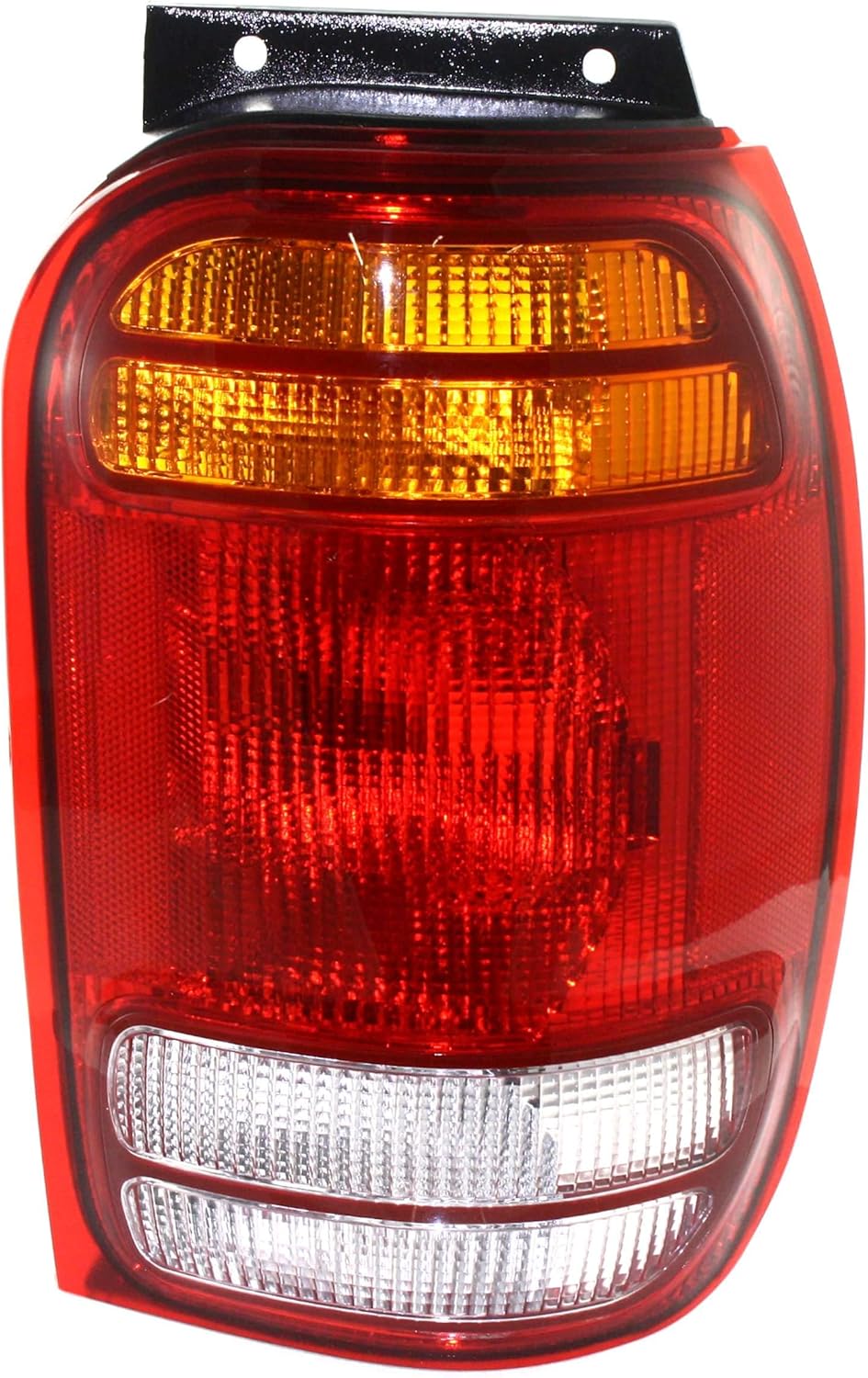
4. Garage-Pro Tail Light Assembly for Ford Explorer (1998–2001) — Right Passenger Side
| Light Source | Halogen |
|---|---|
| Voltage | 12 Volts |
| Wattage | 55 watts |
| Auto Part Position | Right |
| Lens Material | Acrylic |
This Garage-Pro tail light is a direct-fit replacement for the right rear of 1998–2001 Ford Explorer, Mercury Mountaineer, and Explorer Sport models. It accepts halogen bulbs and is wired for standard 12-volt, 55-watt bulbs sold separately, so installation generally involves swapping the old housing and reconnecting the factory harness. The lens is acrylic and the unit is labeled as OE comparable, which means it matches the factory appearance and mounting points for a straightforward installation. Benefits include simple bolt-on fitment for the specified years, a factory-style look, and compatibility with common halogen bulbs if you prefer an economical lighting option. Limitations are that bulbs are not included and the halogen light source does not offer the brighter, longer-life performance of LED upgrades. Expect competent fit for routine tail-light replacement but plan to reuse or buy bulbs and follow basic bulb handling and aiming steps when you install it.
Best for: Buyers needing an affordable, straightforward factory-style replacement for a damaged right tail light on a late 1990s to 2001 Explorer who prioritize correct fit and appearance over upgraded lighting.
Less Ideal for: Shoppers wanting a brighter, longer-lasting LED conversion or an aftermarket styling upgrade should consider LED assemblies or upgraded lenses instead.
- Vehicle-specific fit for 1998–2001 Ford Explorer, Mercury Mountaineer, and Explorer Sport
- Factory-style appearance with acrylic lens for a close match to original lighting
- Direct bolt-on replacement that uses standard 12V halogen bulbs
- Manufactured to be OE comparable so mounting points and alignment match factory
- Bulbs are not included, so you must purchase and install halogen bulbs separately
- Uses halogen bulbs rather than LEDs, so it is less bright and has shorter bulb life compared with LED options
Verdict: A budget-friendly, factory-style right-side tail light that delivers reliable, vehicle-specific fitment for 1998–2001 Ford Explorer models.
5. CarLights360 Rear Tail Light Pair for 1995-1997 Ford Explorer

| Light Source | Halogen |
|---|---|
| Auto Part Position | Rear |
| Additional Features | Waterproof |
| Voltage | 12 |
These CarLights360 tail light assemblies are sold as a matching driver and passenger pair and are intended as direct aftermarket replacements for the 1995–1997 Ford Explorer. They mount in the rear positions and accept standard halogen bulbs sold separately, so installation is a straightforward swap of the factory units with no assembly required. The housings are plastic and rated waterproof, and the parts are listed to meet DOT and SAE compliance standards, which supports reliable performance in everyday driving and in wet conditions. Because they are vehicle-specific fit parts and listed with the factory part numbers, you get a near-factory look and alignment without modification. Keep in mind these are aftermarket units rather than factory-manufactured pieces, so finish consistency or exact fit can vary slightly compared with OEM panels. Also bulbs are not included, so plan to reuse your originals or purchase replacements at installation.
Best for: Buyers who prioritize a dependable, direct-fit replacement for worn or damaged Explorer tail lights and want a matching pair that restores factory appearance with minimal fuss.
Less Ideal for: Shoppers seeking original factory-manufactured parts or those who want assemblies that include bulbs and hardware in one package should consider alternative sources.
- Vehicle-specific fit for 1995–1997 Ford Explorer using listed OEM-equivalent part numbers
- Sold as a matching driver and passenger pair for a consistent appearance
- Waterproof plastic housings designed to meet DOT and SAE compliance standards
- Factory-sealed new-in-box condition requires no assembly
- Aftermarket part rather than factory-manufactured so finish or fit may differ slightly from original
Verdict: A practical, vehicle-specific aftermarket pair that restores the rear lighting and appearance of a 1995–1997 Ford Explorer with a reliable, direct-fit replacement.
6. AmeriLite Black Replacement Tail Light Pair for 1998–2001 Ford Explorer

| Compatible with Vehicle Type | ford explorer |
|---|---|
| Light Source | Incandescent |
| Voltage | 12 Volts (DC) |
| Wattage | 24 watts |
| Lens Material | Polycarbonate |
These AmeriLite tail lights replace the rear assemblies on 1998–2001 Ford Explorer 4-door models (excluding Sport and Sport Trac). They come as a matching left and right pair with polycarbonate lenses and use incandescent bulbs at 12V and 24W, so installation swaps into the factory wiring without electrical upgrades. The housings are marketed as waterproof and built to meet U.S. and Canadian safety standards, which helps resistance to weather and road grime in everyday driving. Buyers should expect a near-factory look with blacked-out styling and plug-and-play fitment, although the listing notes no installation instructions, so some mechanical familiarity or professional installation is practical. These are aftermarket replacements made to be compatible with listed OEM numbers and are suitable for restoring function and appearance after damage or wear. If you want exact factory-original materials or prefer LED illumination, this incandescent aftermarket set will not provide that upgrade.
Best for: Buyers who want a reliable, vehicle-specific replacement to restore rear lighting and appearance on a 1998–2001 Explorer 4-door and value products that meet safety standards and have visible customer feedback.
Less Ideal for: Do not choose this if you prioritize aftermarket LED conversion, require fitment for Sport or Sport Trac models, or expect bundled installation support.
- Vehicle-specific fit for 1998–2001 Ford Explorer 4-door models, sold as a complete left and right pair.
- Polycarbonate lens construction improves toughness and impact resistance versus cheaper plastics.
- Meets U.S. and Canadian safety standards and listed as waterproof for better durability in wet conditions.
- Direct replacement design that uses existing incandescent bulbs and factory wiring for straightforward swap-in.
- Uses incandescent light source rather than LED technology, so it offers lower efficiency and brightness compared with modern LED assemblies.
- No installation instructions included, which may require pay-for professional installation for some buyers.
Verdict: A practical, vehicle-specific incandescent tail light pair that restores function and weather resistance for 1998–2001 Ford Explorer 4-door models.
Choosing the Right 1995-2001 Ford Explorer Tail Light Assembly: Key Factors to Consider
Exact Fitment and Mounting Alignment
Correct fitment is the most critical factor when replacing a tail light assembly on a 1995-2001 Ford Explorer. Assemblies designed specifically for this year range align with the factory mounting points and avoid trimming or drilling. Proper alignment ensures the unit sits flush with the body to maintain weather sealing and avoid stress on mounting tabs.
Poor alignment can cause vibration, gap-related water intrusion, and misdirected light beams that reduce visibility. When fitment is right, installation is quicker and the chances of needing additional brackets or adapters are minimal, which is important for owners who want a straightforward swap.
Lens Clarity and Optical Performance
The lens and internal reflector design determine how effectively the tail light communicates braking, turning, and presence to other drivers. Look for lenses with good optical clarity and even refractive patterns so light is distributed properly. Scratched, hazy, or poorly patterned lenses reduce nighttime visibility and can make signals harder to interpret.
Quality internal reflectors and well-shaped lens facets also improve perceived brightness without changing bulbs. For older vehicles like the Explorer, replacing a clouded tail light lens and housing with a clear assembly restores original light output and improves safety.
Housing Durability and Weather Sealing
A robust housing and reliable sealing keep moisture and road contaminants out of the electrical area. For a 1995-2001 Explorer exposed to the elements for many years, look for assemblies with reinforced mounting ears, thicker plastic, and integrated gaskets or sealant beads that prevent leaks.
Repeated moisture ingress can corrode sockets and wiring and lead to intermittent faults. Durable materials and corrosion-resistant finishes increase service life and reduce the risk of needing another replacement soon after installation.
Electrical Compatibility and Socket Quality
Electrical compatibility with the Explorer's existing bulb sockets and wiring harness matters to minimize modifications. Assemblies that accept the same bulb types and use matching sockets reduce installation time and the need for adapters. Socket quality and secure wiring passages also prevent poor contacts and arcing.
Check that the assembly provides good strain relief at the harness entry and that the contacts are solidly mounted. Poor socket fit or exposed wiring increases the chance of intermittent lighting issues, which can be a safety hazard.
Installation Complexity and Replacement Steps
Consider how much disassembly is required to change the tail light assembly on the 1995-2001 Explorer. Some replacements are simple bolt-and-plug swaps while others require partial trim removal or access from inside the cargo area. Lower installation complexity reduces labor time and the chance of accidentally damaging other components.
Availability of clear instructions or included mounting hardware simplifies the process. For owners doing the work themselves, a straightforward swap without special tools is preferable.
Material Finish and Long-Term Appearance
The finish of the lens and housing affects both looks and longevity. UV-stabilized plastics and scratch-resistant coatings preserve clarity and color longer than untreated materials. For a vehicle of this age, selecting an assembly with a durable finish helps maintain a cohesive appearance with the rest of the vehicle.
Well-finished assemblies resist yellowing and surface crazing, which means fewer cosmetic issues and less frequent replacement over time.
Replacing Bulbs Versus Full Assembly Replacement
If the lens and housing are intact and only the bulb or socket is faulty, replacing the bulb or socket can be a cost-effective fix. However, cracked lenses, warped housings, or persistent moisture usually justify swapping the entire rear tail light assembly to resolve both cosmetic and functional issues.
A full assembly replacement restores mounting integrity and sealing, while a bulb-only fix may leave underlying problems unresolved. Consider the condition of the lens and the housing attachment points before deciding which route to take.
- Bulb or socket replacement is faster and cheaper when damage is limited to the light source.
- Full assembly replacement addresses sealing, mounting, and lens clarity in one solution.
- Inspect mounting tabs and gasket areas to determine whether the housing itself is compromised.
LED Conversion Considerations for the Explorer
Upgrading to LED units or LED-compatible bulbs can improve brightness and response time, but confirm electrical and fitment compatibility with the 1995-2001 Explorer. Some LED options require resistors or wiring changes to prevent hyper-flashing or to ensure the Explorer's turn signal relay works correctly.
If you choose LED elements, verify that the lens optics remain appropriate for the new light source so beam patterns and signal visibility are not degraded.
- LED upgrades may need load resistors or relay replacements.
- Check that the housing provides adequate heat dissipation for LEDs.
- Ensure optical patterns match the intended function to avoid regulatory or visibility issues.
Common Signs You Need a New Tail Light Assembly
Several indicators point to the need for a new tail light assembly. Look for visible cracks, fogging or condensation inside the lens, broken mounting tabs, or inconsistent lighting like flicker or intermittent operation. Physical damage from impacts often compromises the seal and alignment.
Electrical issues such as corroded sockets or burned contacts also suggest the housing has failed to protect internal components and that replacing the entire assembly is the safer long-term option.
- Visible moisture or condensation inside the lens
- Cracked or severely scratched lens surface
- Broken or loose mounting tabs
- Intermittent lighting or socket corrosion
Tools and Prep Work for a Smooth Installation
Gather basic hand tools such as a ratchet set, screwdriver set, and trim panel tools to reduce the risk of damaging interior panels when accessing tail light fasteners. Have replacement bulbs or an electrician-grade contact cleaner on hand to ensure sockets are clean before installing the new assembly.
Work on a flat surface with good lighting and consider using gloves to avoid leaving fingerprints on lens surfaces. Keep mounting hardware and fasteners organized for reassembly.
- Basic ratchet set and screwdrivers
- Trim panel tools to avoid damage
- Contact cleaner and dielectric grease for electrical contacts
- Replacement bulbs if not included with the assembly
Legal and Safety Notes for Lighting Upgrades
Local vehicle lighting regulations can affect allowable modifications, such as lens tinting or changes to signal colors. For the 1995-2001 Ford Explorer, ensure any replacement assembly maintains required red and amber signaling and meets visibility standards.
Prioritize assemblies that preserve required light positions and colors to avoid compliance issues, and test lights after installation to confirm proper operation.
- Avoid lens modifications that change signal color
- Confirm turn signal and brake light function immediately after installation
- Replace bulbs with correct types specified for the vehicle
Still looking for the perfect fit?
Select your Ford Explorer configuration to see the most relevant Tail Light Assemblies recommendations
How We Chose the Best 1995-2001 Ford Explorer Tail Light Assembly
We prioritized candidates that deliver correct fitment for the 1995-2001 Ford Explorer and durable construction suited to the vehicle's age and exposure. Evaluation emphasized mechanical compatibility, sealing and moisture resistance, optical clarity of the lens and housing, and the quality of connection points and mounting tabs. Electrical interface consistency and bulb/socket compatibility were checked to reduce modification needs and ensure straightforward installation. Ease of installation and the availability of clear fitment documentation were also important, since many owners perform this repair themselves.Excluded items included universal-fit assemblies that require extensive modification and parts that lack clear fitment guidance for the 1995-2001 Explorer. We also deprioritized units with thin housings, visible manufacturing defects, or reports of recurrent moisture intrusion. The final shortlist balances reliable sealing and optical performance with accurate fitment and dependable mounting, which are the dimensions that most directly affect real-world durability and safety for this Explorer range.
Our full evaluation process is outlined in our review methodology.
FAQ
How do I confirm a tail light assembly fits my 1995-2001 Ford Explorer?
Check the product listing or documentation for explicit fitment to 1995-2001 Ford Explorer and inspect mounting hole patterns and connector type. Verify that the housing aligns with the factory mounting points and that the bulb types match your vehicle's sockets.
Can I replace only the lens instead of the whole assembly?
If the housing and mounting tabs are intact and there is no moisture intrusion, replacing the lens may be possible, but lens-only replacements are less common. Often a full housing swap is more reliable for addressing sealing or mounting issues.
Will LED bulbs work in the Explorer tail light assembly?
LED bulbs can work, but some installations require resistors or a different flasher relay to avoid hyper-flashing and to ensure correct signal behavior. Also confirm lens optics are suited to the LED output to maintain proper visibility.
What causes condensation inside a tail light assembly?
Condensation usually results from a compromised seal, cracked lens, or degraded gasket allowing humid air inside. Thermal cycling can also draw moisture inward if the unit lacks proper venting, leading to fogging and potential socket corrosion.
How difficult is it to install a replacement tail light assembly on the Explorer?
Difficulty is typically moderate and often a straightforward bolt-and-plug swap, though some models require partial interior trim removal for access. With basic tools and clear instructions, many owners can complete the job in under an hour.
How can I prevent future corrosion after installing a new assembly?
Ensure gaskets seat fully and apply dielectric grease to bulb contacts to reduce moisture-related corrosion. Inspect the surrounding sheet metal and mounting points for rust and address any drainage or sealing issues to keep water away from electrical contacts.
Final Verdict
When replacing a tail light assembly on a 1995-2001 Ford Explorer, prioritize correct fitment, reliable sealing, and clear lens optics to restore safety and long-term durability. Balance ease of installation and electrical compatibility to minimize modification work and reduce the risk of future failures.Focus on assemblies that offer solid mounting tabs, good weather resistance, and proper socket interfaces. By weighing these tradeoffs, you can select a replacement that returns the Explorer to dependable rear lighting and reduces the chance of repeat service.
Explore More:
- Check out all Ford Explorer parts & accessories
- Explore Tail Light Assemblies Maintenance & Repair Guides
- Explore Lighting
- Browse all Auto Parts
