

Note: This article contains affiliate links. If you click on these links and make a purchase, I may earn a small commission at no extra cost to you. This helps support my research and content. Read my full affiliate disclosure here.
If your Mitsubishi Eclipse feels loose in corners or you hear clunks over bumps, worn sway bar links are a common cause. Choosing the right sway bar link matters because the wrong fit or low-quality components can leave handling vague or introduce new noise.This guide covers the top shortlisted sway bar links for the Mitsubishi Eclipse, with attention to fitment, build quality, and expected longevity. Below we explain how we evaluated candidates and what to watch for when choosing replacements.
Looking for other parts? See all Mitsubishi Eclipse parts & accessories.
Top Picks at a Glance
| Best Reviewed A top-rated pick with lots of positive feedback | Fit4drive Zinc-Nickel Alloy Stabilizer Sway Bar Link Kit |  |
| Most Popular A crowd favorite that many people choose with confidence | Detroit Axle Front Sway Bar Link Kit (pair) |  |
| Best Quality Built to a higher standard if you want something more solid | A-Premium Sway Bar End Link Kit (Set of 4) for Mitsubishi Eclipse, Galant, Endeavor |  |
| Best Budget The cheapest option that still gets the job done reliably | GZYQPDZ Front Stabilizer Sway Bar Link Kit (pair) |  |
| Most Sold A high-volume bestseller chosen again and again | MOTOKU Front Sway Bar Link Kit |  |
| Best Value for Money The sweet spot between price and what you get | TCHENPART K80296 Front Sway Bar Link Kit |  |
| Best Overall The best all-around choice for most situations | X4XZ Zinc-Nickel Sway Bar Link Kit (K80296) |  |
1. Fit4drive Zinc-Nickel Alloy Stabilizer Sway Bar Link Kit

| Manufacturer | Fit4drive.CO.,LTD |
|---|---|
| Coating | Zinc-Nickel alloy |
| Compatibility note | Fits select Mitsubishi Eclipse years (verify vehicle fitment) |
These sway bar links replace the connection between the antiroll bar and suspension to reduce body roll and eliminate clunks from worn links. Fit4drive supplies the links with wrench flats and an allen-wrench hold feature to make installation and removal straightforward for a home mechanic or technician. The zinc-nickel alloy coating is the standout feature, specified to exceed 800 hours in salt spray testing, which helps resist corrosion in wet or road-salt conditions and extends service life compared with uncoated steel links. In use the parts restore steering confidence and reduce noise from the front suspension when the original links have failed. Limitations to keep in mind are occasional reports of incorrect fitment for some models and a few reviews citing early failure, so confirm fit for your Eclipse and inspect parts before installation. The kit is a practical, corrosion-resistant replacement for worn stabilizer links when you want a long-lasting, budget-friendly repair that you can fit yourself or have installed by a shop.
Best for: Reliability-focused buyers who prioritize a corrosion-resistant, long-lasting repair that restores handling and reduces suspension noise on their Mitsubishi Eclipse.
Less Ideal for: Buyers who need guaranteed OEM-specific fitment without verification or those preferring heavy-duty performance uprated links for track use should consider alternatives.
- Zinc-nickel coating with high salt spray resistance for improved corrosion protection
- Wrench flats and allen-hold design simplify installation and removal
- Engineered as direct replacement links to restore handling and eliminate clunking noises
- Market feedback shows consistent fit and noise elimination on many installs
- Some buyers reported wrong fitment for specific vehicle years or models
- A minority of reviews describe premature failure after installation
Verdict A corrosion-resistant, budget-friendly direct-replacement sway bar link kit that restores handling on the Mitsubishi Eclipse when proper fit is confirmed.
2. Detroit Axle Front Sway Bar Link Kit (pair)

| Auto Part Position | Front |
|---|---|
| Material | Metal |
| Automotive Fit Type | Vehicle Specific Fit |
| Manufacturer | Detroit Axle |
This Detroit Axle kit supplies two front sway bar links intended as direct replacements for the Mitsubishi Eclipse (2006–2011). The parts are metal, feature a factory-style design and are sold as a ready-to-install pair so they are commonly used during routine front suspension repairs or when clunking from the sway bar appears. Detroit Axle says the links undergo impact and fatigue testing and the design includes greasable joints so you can maintain them for quieter operation and longer service life. In real-world use the kit restores the connection between the sway bar and control arm, reducing body roll and eliminating worn-link noise. Installation is straightforward for a DIYer with basic tools and a jack, and reviewers report good fit and immediate noise removal. Some owners have found the protective boots wear faster than expected and a few have reported early failure on heavily used vehicles, so these are best when you want a convenient, affordable factory-style replacement rather than a heavy-duty performance upgrade.
Best for: Convenience-driven buyers who want a ready-fit, factory-style replacement for routine maintenance on a Mitsubishi Eclipse and value ease of installation and quick noise resolution.
Less Ideal for: Drivers seeking heavy-duty performance sway links for aggressive driving or long-life off-road use should consider upgraded aftermarket options instead.
- Vehicle-specific fit for Mitsubishi Eclipse 2006–2011 for straightforward replacement.
- Sold as a pair so both front links are replaced at once for matched wear.
- Greasable joint design lets you add grease to reduce noise and extend service life.
- Metal construction and impact/fatigue testing aim to match factory ride characteristics.
- Some users report the rubber dust boots can shred or degrade within a couple of years.
- A few reports of premature joint failure on high-mileage or heavily driven vehicles.
- Not engineered as a heavy-duty or performance upgrade compared with premium aftermarket links.
Verdict A convenient, vehicle-specific pair of front sway bar links that restore ride feel and silence clunks on Mitsubishi Eclipse models, but not a performance or heavy-duty upgrade.
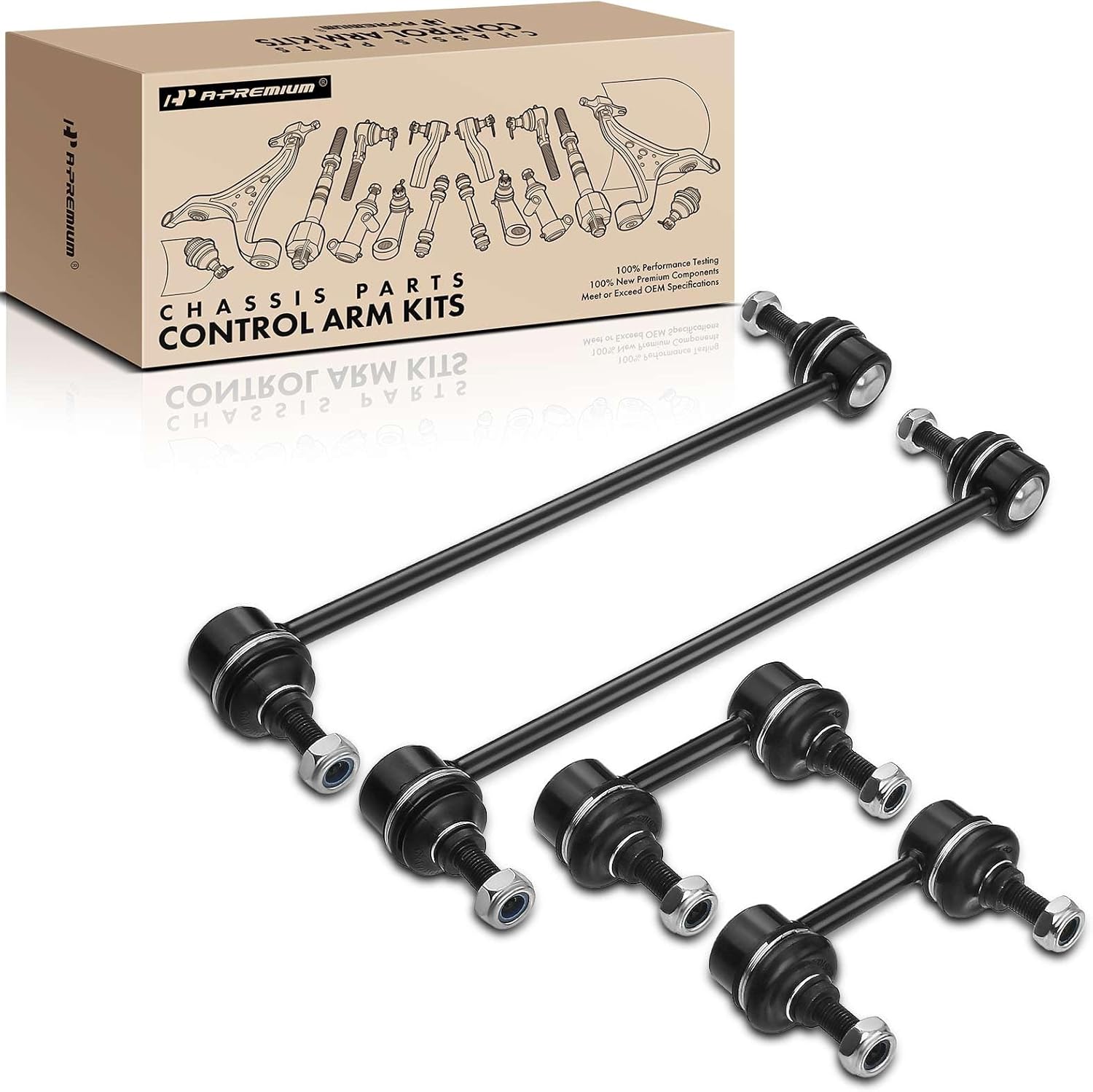
3. A-Premium Sway Bar End Link Kit (Set of 4) for Mitsubishi Eclipse, Galant, Endeavor
| Brand | A-Premium |
|---|---|
| Position | Front, Rear |
| Exterior | Corrosion-Resistant Coating |
| Pre-Greased | Yes |
This kit replaces both front and rear sway bar end links on compatible Mitsubishi models to reduce body roll, stop clunking noises, and restore steering response. It is supplied as a four-piece bundle with pre-greased steel shafts and corrosion-resistant coating, so installation is straightforward for a DIYer with basic suspension tools or a professional mechanic. The kit targets common symptoms of worn links such as excessive body lean, vibration, and noisy suspension joints and includes parts that match OEM reference numbers for proper fit. Because the links are pre-greased and finished against corrosion, they should install smoothly and resist premature surface rust in normal road conditions. Limitations to consider are that the kit does not include sway bar bushings or grease fittings and is specified for front-wheel-drive fitment on the listed models, so it does not cover all drivetrain variants or related suspension components you might need while doing a wider service.
Best for: Performance-oriented owners who want to restore crisp handling and reduce body roll on their Mitsubishi Eclipse, Galant, or Endeavor and prefer replacing all links at once to regain factory-style handling.
Less Ideal for: If you plan a complete suspension overhaul that includes bushings or drive-train specific parts, this kit alone will not cover those additional components and you should consider a fuller parts list.
- Complete front and rear set covers both axles for one repair job
- Pre-greased steel shafts reduce initial installation hassle and improve initial lubrication
- Corrosion-resistant coating helps longevity in wet or salted conditions
- Does not include sway bar bushings or separate grease fittings, which may be needed during a full suspension refresh
- Fitment is limited to the listed front-wheel-drive Mitsubishi models and may not suit other variants
Verdict A practical four-piece replacement that restores stabilizer-bar performance for the specified Mitsubishi front-wheel-drive models without including bushings or extra suspension hardware.
4. GZYQPDZ Front Stabilizer Sway Bar Link Kit (pair)

| Auto Part Position | Front Left |
|---|---|
| Material | Metal |
| Automotive Fit Type | Vehicle Specific Fit |
| Manufacturer | GZYQPDZ |
This pair of front stabilizer sway bar links is a straightforward, budget-focused replacement for worn or noisy front suspension links on compatible Mitsubishi vehicles. Designed to replace factory front links, the kit installs at the front left and right positions to reduce clunking noises, excessive body roll, and loose steering feel. The parts are metal with a machined finish and come as a vehicle-specific fit intended to match factory attachment points. In practice these work well for routine street use and simple repairs where a low-cost, serviceable link is needed. Buyers should expect basic hardware and straightforward installation but not the extra durability features of premium or performance link kits. The product comes with customer support and is suitable for DIY replacement or quick shop jobs, though drivers who push the suspension hard or want long-life, high-end bushings may prefer a heavier-duty option.
Best for: Budget-conscious Mitsubishi owners needing an affordable, direct replacement to stop front-end clunks and restore normal handling on daily-driven vehicles.
Less Ideal for: Drivers seeking long-term performance upgrades for track use or off-road duty should consider reinforced or performance-oriented link kits instead.
- Vehicle-specific fit intended to match factory mounting points for compatible Mitsubishi models
- Metal construction with machined finish for a straightforward, functional replacement
- Sold as a pair to replace both front links in one service visit
- Affordable option that resolves common symptoms like noise, body roll, and poor handling
- Basic design lacks premium bushings or heavy-duty hardware for high-performance driving
- Limited longevity compared with higher-end aftermarket or reinforced links
Verdict A cost-effective, vehicle-specific front sway bar link pair that fixes common suspension noises and handling issues on compatible Mitsubishi models but stops short of premium durability.
5. MOTOKU Front Sway Bar Link Kit

| Auto Part Position | Front |
|---|---|
| Material | Metal |
| Automotive Fit Type | Universal Fit |
| Extended Length | 8 Inches |
This MOTOKU front sway bar link kit is a direct replacement intended to restore the connection between the anti-roll bar and suspension control arms. For a Mitsubishi Eclipse, the links replace worn or noisy factory pieces and are fitted during a front suspension refresh or when knocking is present. The kit is metal finished in black and sold as a universal-fit front link with an extended length listed, which helps cover multiple model years without custom modification. Real-world benefits include quieter steering response and reduced body roll after installation, and several buyers report straightforward fitment and improved feel. Notable limitations are variable hardware quality and occasional stripped nuts reported by users, so expect to inspect or swap fasteners during installation. Durability reviews are mixed, with some owners seeing long service and others reporting early failure, so plan to torque hardware correctly and verify thread condition at installation. The kit is a practical, low-cost fix when the front sway bar links are the source of noise or looseness on a Mitsubishi Eclipse.
Best for: Practical, risk-averse buyers who want an affordable, straightforward replacement to stop front sway bar noise and restore handling without aftermarket upgrades.
Less Ideal for: Enthusiasts seeking heavy-duty or performance-grade sway bar links or owners who prefer fully OEM-specified parts and long-term warranty support.
- Designed to replace front sway bar links and restore anti-roll bar function
- Universal-fit coverage includes multiple model years which can simplify sourcing
- Metal construction and black finish match common replacement parts
- Many buyers report easy installation and immediate elimination of knocking
- Some customers report stripped or soft hardware requiring replacement
- Mixed longevity reports with a few cases of early failure
Verdict A budget-friendly front sway bar link kit that fits multiple years of the Mitsubishi Eclipse but may require replacing supplied fasteners for reliable long-term service.
6. TCHENPART K80296 Front Sway Bar Link Kit

| Manufacturer Part Number | PHG06 |
|---|---|
| OEM Part Number | K80296 |
| Position | Front |
| Brand | TCHENPART |
The TCHENPART K80296 sway bar link kit replaces worn front stabilizer end links to restore steering precision and reduce suspension noise on compatible Mitsubishi Eclipse models. Each kit supplies two links that install between the sway bar and lower control arm to reduce body roll and eliminate clunks from failed ball joints. Reviewers report straightforward installation with common hand tools and that the parts fit the factory mounting points without modification. Notable features include polished exterior finish and factory-style ball joints intended to match original geometry. Practical benefits are improved anti-roll control, quieter operation, and a low-cost way to address front-end knocking without needing a full suspension job. Limitations to consider are that these are mid-range aftermarket parts rather than high-end performance links, some units arrive without grease pre-applied so fittings may need installation and lubrication, and a few users noted occasional fastener fitment or nut retention issues that require careful torquing or replacement hardware. For a budget-focused repair that restores everyday handling, this kit delivers solid value for the money.
Best for: Practical optimizers who want an economical, no-frills repair to restore the Mitsubishi Eclipse front suspension function and curb clunking and body roll without spending on premium parts.
Less Ideal for: Drivers seeking heavy-duty or performance-tuned sway bar links for aggressive driving or track use should look for stronger aftermarket or performance-specific options.
- Direct-replacement design that fits factory mounting points for compatible models
- Polished finish and factory-style ball joints that restore steering feel and reduce noise
- Affordable kit that addresses clunking and body roll without a full suspension overhaul
- Generally easy to install with common hand tools
- Grease is not always pre-applied so fittings may require installation and greasing before use
- Some buyers reported loose or marginal fastener fitment requiring attention to torque or replacement hardware
Verdict A budget-friendly, direct-fit front sway bar link kit that restores everyday handling on compatible Mitsubishi Eclipse models but may need greasing and careful fastening during installation.
7. X4XZ Zinc-Nickel Sway Bar Link Kit (K80296)

| Item model number | K80296 |
|---|---|
| Manufacturer | X4XZ |
| Compatible vehicle | Mitsubishi Eclipse 2006–2012 |
| Surface treatment | Zinc-Nickel alloy coating |
This X4XZ sway bar link kit replaces worn front links to reduce clunking over bumps and restore tighter steering response. It installs like a typical suspension link kit with wrench flats and an Allen access to hold the stud while tightening, so a backyard mechanic can complete the swap with common hand tools after removing the old corroded fasteners. The links use a Zn-Ni alloy coating and neoprene boots intended to resist corrosion and extend service life in salted or wet climates, and the cold-forged ball stud and heat-treated carbon steel aim to improve fatigue strength compared with untreated parts. Buyers should note fitment needs to be confirmed for a 2006–2012 Mitsubishi Eclipse; compatibility is model-year specific so verify the vehicle fitment before purchasing. The kit provides a cost-effective factory-quality replacement feel, though installation can be slowed by seized original hardware and the parts are an aftermarket option rather than a factory-branded component.
Best for: A balanced all-round buyer looking for a reliable, affordable replacement that restores steering feel and reduces suspension noise on a Mitsubishi Eclipse without overspending on premium branded parts.
Less Ideal for: Drivers seeking an exact factory-branded part or those who prefer professional installation-only solutions should consider OEM or dealer options instead.
- Zinc-nickel coating for strong corrosion resistance backed by extended salt spray performance
- Neoprene boots for improved resistance to oxidation and abrasion
- Cold-forged ball stud and heat-treated carbon steel for increased fatigue strength
- Wrench flats and Allen access make tightening and removal easier for DIY installation
- Aftermarket part so finish and fit can vary compared with factory-branded components
- Old or rusted factory fasteners may require penetrating oil and extra effort to remove
Verdict Solid, corrosion-resistant aftermarket links that restore front-end stability on compatible Mitsubishi Eclipse models at a budget-friendly value.
Choosing the Right Mitsubishi Eclipse Sway Bar Link: Key Factors to Consider
Fitment And Compatibility
Exact fitment matters because sway bar links connect to specific mounting points on the Mitsubishi Eclipse and must align without forcing hardware. A correct-fitting link reduces installation time and avoids stress on adjacent suspension components.
Check thread sizes, stud lengths, and ball-joint offsets when evaluating parts. Even small differences can change sway bar preload or produce binding through suspension travel, which affects handling and can accelerate wear.
Joint Type And Bushing Design
Sway bar links use either ball joints, polyurethane bushings, or rubber isolators, and the choice affects NVH and responsiveness. Ball joints typically offer precise motion transfer and lower deflection, while bushings can absorb noise but may allow more slight movement.
Consider how much steering firmness you want versus tolerance for road noise. Durable seals and quality bushing compounds help maintain smooth operation and extend service life under varying temperatures and road conditions.
Materials And Corrosion Resistance
Materials and protective finishes directly influence how long a sway bar link lasts, especially in wet or salted-road environments. Look for steel with zinc plating, powder coat, or stainless elements on studs and hardware to resist rust.
Corrosion can seize joints or weaken fasteners, making future maintenance harder and increasing the chance of sudden failure. Quality fasteners and coatings also preserve appearance and mechanical integrity over time.
Strength And Stiffness
Sway bar links must transmit lateral forces between the stabilizer bar and suspension; insufficient strength or excessive flex changes handling balance. For performance-focused drivers, stiffer links provide crisper roll control, while more compliant links soften responses.
Balance desired handling gains with everyday comfort. Overly stiff links can transfer more vibration and noise into the cabin, while too-flexible links may reduce the effectiveness of the sway bar in controlling body roll.
Hardware And Ease Of Installation
Replacement ease is influenced by whether links include correct nuts, washers, and replacement bolts. Kits that supply required hardware and match original lengths reduce the chance of improper assembly.
Also consider whether joint designs require specific torque specs or alignment during tightening. Clear instructions and hardware that match factory threads help avoid cross-threading and ensure secure attachment without additional trips to the parts counter.
Serviceability And Replaceable Components
Some sway bar links allow replacing worn bushings or joints rather than the entire link, which can save money over time. Serviceable designs also make future repairs easier when only a small part has failed.
Evaluate whether the link has replaceable components, accessible fasteners, and available spare parts. This matters if you plan to maintain the suspension gradually instead of full assembly swaps.
FAQ
What are common symptoms of a failing sway bar link on a Mitsubishi Eclipse?
Common symptoms often include a clunking or rattling noise when going over bumps, increased body roll during cornering, or a loose feeling in steering response. These signs usually appear gradually and are more noticeable at low speeds or on uneven roads.
Can I replace a sway bar link on my Mitsubishi Eclipse myself?
Many owners can complete a replace sway bar link DIY job with basic hand tools, a jack, and jack stands. The task usually involves removing two nuts and swapping the link, but access, corrosion, or seized hardware can complicate the work, so allow extra time and have penetrating oil available.
How long do sway bar links typically last on the Mitsubishi Eclipse?
Service life depends on driving conditions and part quality; links often last several years under normal driving but wear faster in harsh climates with road salt or frequent rough roads. Regular inspections for play and corrosion help catch wear before it affects handling.
Should I replace front and rear sway bar links at the same time?
It depends on condition. If only one link shows wear or noise, replacing just that side can be acceptable, but matched replacement helps maintain consistent handling balance. Inspect both front and rear links for similar wear before deciding.
What causes sway bar links to make a noisy clunk?
A noisy clunk usually comes from wear or play in the joint or bushing, or from corroded fasteners that allow movement. Loose mounting hardware and degraded bushings reduce the connection between the stabilizer bar and suspension, producing audible impacts over bumps.
Do sway bar link torque specs matter when installing replacements?
Yes, proper torque ensures the link is secure without overloading threads or crushing bushings. Using specified torque helps maintain correct joint preload and prevents premature wear or loosening. If you do not have factory specs, use conservative torque values and recheck after a short break-in period.
How We Chose the Best Mitsubishi Eclipse Sway Bar Link
We focused on parts that specifically fit the Mitsubishi Eclipse and prioritized criteria that most affect safety and driving feel. Key evaluation criteria included fitment accuracy to factory mounting points, materials and corrosion resistance, bushing or joint design, load capacity and stiffness, and ease of installation.We also considered long-term durability indicators such as protective finishes and replaceable hardware. Common exclusions included one-off or universal-style links that require significant modification, parts without clear fitment information, and components lacking basic corrosion protection.To narrow the list we filtered for parts that match OEM mounting geometry, use durable joint designs or bushings, and provide clear installation instructions or hardware. The final selection favors options that balance stable handling, minimal noise, and straightforward replacement for the Mitsubishi Eclipse.
Our full evaluation process is outlined in our review methodology.
Conclusion
When replacing sway bar links on a Mitsubishi Eclipse, prioritize correct fitment, durable joint design, and corrosion-resistant materials. Those factors most directly affect handling, noise, and how long the replacement will last.Balance desired handling firmness with everyday comfort and consider hardware quality and serviceability. Inspect existing links for play or damage, then choose a replacement that matches factory mounting geometry and offers the durability you need.
Explore More:
- Check out all Mitsubishi Eclipse parts & accessories
- Explore Sway Bar Links Maintenance & Repair Guides
- Explore Suspension & Steering
- Browse all Auto Parts
