

Note: This article contains affiliate links. If you click on these links and make a purchase, I may earn a small commission at no extra cost to you. This helps support my research and content. Read my full affiliate disclosure here.
Upgrading to stainless steel brake lines can noticeably firm up pedal feel and reduce the risk of fluid contamination on a Ford F-350. Because this truck often tows, hauls, or spends time in corrosive conditions, line durability and proper fitment are especially important. This guide shortlists the top seven stainless steel brake line options selected for this vehicle and explains the practical tradeoffs you should consider before installing them.We examine fitment, material and fitting quality, installation complexity, and corrosion resistance so you can pick a kit that matches how you use your F-350. Read on for what matters and what to expect during installation.
Top Picks at a Glance


1. Rough Country Stainless Extended Brake Lines for 1999-2004 Ford Super Duty

| Material Type | Stainless Steel |
|---|---|
| Maximum Pressure | 4000 psi |
| Included Components | Front & Rear Stainless Steel Brake Lines |
| Nominal Wall Thickness | 0.0635 inches |
These Rough Country stainless extended brake lines are a direct replacement kit intended to swap in for worn rubber hoses on 1999-2004 Ford Super Duty trucks. The braided stainless exterior and internal Teflon layer wrapped in Kevlar resist abrasion and contamination from off-road debris, while the kit is pressure tested to 4000 psi to keep braking performance consistent. In practice the extra length simplifies installation on lifted or modified trucks and the hollow, crimped fittings are designed for a leak-free connection to existing brake system ports. Drivers can expect a firmer pedal feel and longer service life compared with factory rubber lines, especially in harsh environments. Installation requires basic brake-line tools and bleeding the system afterward, and buyers should follow the recommended bolt- and fitting-check intervals. This kit covers front and rear lines and is a practical upgrade for owners who want durable, maintenance-minded replacements rather than short-term fixes.
Best for: Practical owners who want a durable, longer-lasting replacement for aging rubber brake lines and who value improved pedal feel and protection for off-road or modified Super Duty trucks.
Less Ideal for: If you prefer a no-hassle bolt-in replacement for a wide range of model years or lack tools/experience to safely replace and bleed brake lines, consider professional installation or a different fitment option.
- Braided stainless steel exterior protects lines from rocks, mud, and abrasion
- Internal Teflon layer wrapped in Kevlar reduces expansion for firmer pedal feel
- Pressure tested to 4000 psi for reliable hydraulic performance
- Extended length simplifies installation on lifted or modified Super Duty trucks
- Includes front and rear lines with hollow crimped fittings for leak-resistant connections
- Requires brake-line tools and system bleeding during installation
- Not a direct-fit solution for vehicles outside 1999-2004 Ford Super Duty without verification
Verdict: A durable, pressure-tested stainless steel kit that upgrades braking feel and longevity for 1999-2004 Ford Super Duty trucks, especially useful for lifted or off-road setups.
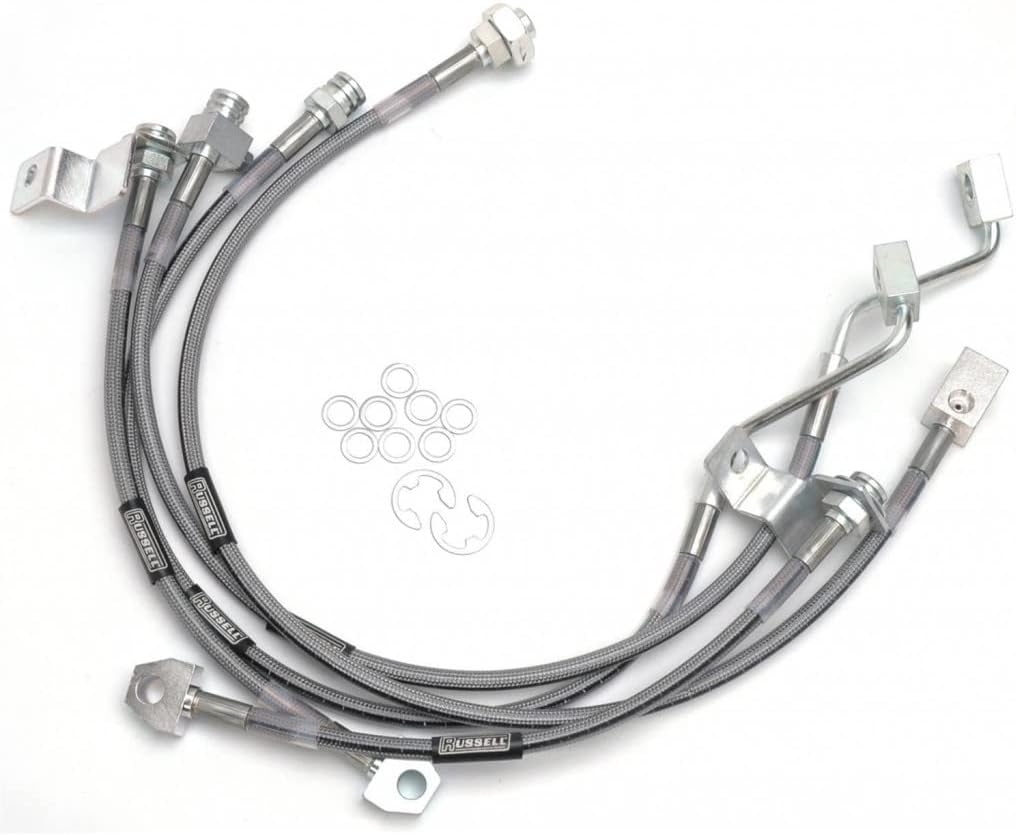
2. Russell Performance Brake Line Kit for Ford Super Duty (1999–2004)
| Compatible years | 1999–2004 |
|---|---|
| Material | Rubber, Stainless Steel |
| Front/Rear | Disc/Disc |
| Kit quantity | 5 |
This Russell Performance brake line kit swaps the stock rubber hoses for stainless-steel braided lines with zinc-plated fittings, delivering firmer, more consistent brake feel under load. It is a direct bolt-on kit intended for Ford Super Duty 1999–2004 Super Duty models and is assembled at the factory for straightforward installation. In everyday driving the reduced hose expansion translates to a more immediate pedal response and less fade during repeated stops; for spirited or heavy-duty towing use the kit helps maintain consistent braking as temperatures rise. The hoses meet US DOT FMVSS-571.106 guidelines and come factory-sealed. Limitations are that the kit is aimed at stock applications and a lifted or heavily modified brake system may require different lengths or fittings, and installation still requires basic brake bleeding and mechanical competence. Overall it is a practical upgrade when you want stronger, more predictable braking without major system changes.
Best for: Buyers who want a measurable improvement in pedal feel and braking consistency for spirited driving or towing, and who prefer a bolt-on upgrade without overhauling the brake system.
Less Ideal for: Drivers planning major suspension or brake geometry modifications that change hose routing or length should consider custom-length lines or vehicle-specific solutions.
- Stainless-steel braided construction reduces hose expansion for firmer pedal feel
- Zinc-plated fittings and factory assembly simplify installation and corrosion resistance
- Meets US DOT FMVSS-571.106 safety guidelines
- Designed as direct bolt-on replacement for straightforward fitment on specified Super Duty years
- Specified for stock applications so highly modified or nonstandard lift setups may need custom lines
Verdict: Choose this Russell stainless-steel braided kit when you want firmer, more consistent braking on a 1999–2004 Ford Super Duty with a simple bolt-on installation.
3. maXpeedingrods Extended Stainless Steel Brake Lines for Ford F-250/F-350 (1999–2004)

| Fitment | 1999–2004 Ford F-250/F-350 4WD |
|---|---|
| Lift compatibility | 4–8 inch lifts |
| Material Type | Stainless Steel |
| DOT approval | Yes |
These stainless steel braided extended brake lines swap in for the factory rubber hoses on 1999–2004 Ford F-250/F-350 4WD trucks that have been lifted 4 to 8 inches. They provide additional length to prevent binding after a suspension lift and use braided stainless construction to resist swelling under pressure, which helps preserve firmer pedal feel and quicker brake response when using larger tires or heavier loads. The kit is DOT approved and uses hollow fasteners intended to prevent leaks. Typical installation is a direct replacement at the caliper and hardline fittings and is useful when re-routing or adding slack for altered suspension geometry. Practical benefits include improved durability over rubber lines and consistent braking performance under repeated heavy use. Limitations are that fitment is limited to the specified model years and 4WD configuration and you must verify the exact line routing for your lift height before ordering; professional installation is recommended if you are not comfortable bleeding and torqueing brake fittings.
Best for: Buyers who upgraded suspension or tires on a 1999–2004 Ford F-250/F-350 4WD and want a durable, lift-specific brake line that restores proper length and braking feel.
Less Ideal for: Drivers with stock-height trucks, 2WD models, or those seeking a universal or multi-vehicle hose solution should look elsewhere.
- Stainless steel braided construction reduces hose swelling and improves brake pedal firmness.
- Extended length made specifically for 4–8 inch lifted F-250/F-350 4WD setups to prevent line binding.
- DOT approved design with dedicated fittings to minimize leak risk.
- Durable materials better resist abrasion and corrosion than rubber lines.
- Compatibility limited to 1999–2004 Ford F-250/F-350 4WD; not universal for other years or 2WD models.
Verdict: If you need a lift-specific, durable replacement to restore braking feel and line length on a lifted 1999–2004 Ford F-250/F-350 4WD, these stainless steel extended lines are a practical choice.
4. FAPO Rear Extended Stainless Steel Brake Lines for Ford F-250/F-350 Super Duty (1999–2004)

| Vehicle fit | Ford F-250/F-350 Super Duty 1999–2004 |
|---|---|
| Lift compatibility | 4–8" lift |
| Material Type | Stainless Steel |
| DOT approval | DOT approved |
These FAPO rear extended stainless steel brake lines are a direct-fit replacement for lifted Ford Super Duty trucks from 1999–2004 and are intended to restore reliable hydraulic routing after a suspension lift. The kit supplies longer, DOT-approved stainless steel lines with Teflon inner tubing and a protective outer layer to resist abrasion, corrosion, and debris exposure common on off-road rigs. Installation is typical of brake-line swaps: unbolt the old hoses, replace fittings, and bleed the system to remove air. Practical benefits include increased service life versus rubber lines, reduced expansion under pressure for firmer pedal feel, and extra length to prevent binding on lifted axles. Limitations are that this is a vehicle-specific rear kit and does not address front lines or full-system upgrades, and you will still need basic tools and brake-bleeding know-how or professional installation. For budget-focused owners, it is a cost-effective way to maintain safe brake routing after a lift without upgrading to a full stainless line set or braided performance systems.
Best for: Truck owners who raised their rear suspension and need an affordable, durable replacement rear brake line to restore safe routing and consistent pedal feel without upgrading the entire brake system.
Less Ideal for: Drivers looking for a complete stainless-braided full-system performance upgrade or those who want a plug-and-play front and rear kit should consider broader sets or professional retrofit packages.
- DOT approved length for 4–8 inch lifts provides the extra routing needed on lifted rear axles
- Stainless steel outer construction resists corrosion and road debris better than rubber lines
- Teflon-lined inner hose reduces expansion for a firmer, more consistent brake pedal feel
- Includes necessary brake line fittings and components for a straightforward replacement
- Kit covers rear lines only and does not replace front hoses or provide a full-system upgrade
Verdict: A budget-friendly rear stainless steel brake line kit that restores safe, corrosion-resistant brake routing for lifted 1999–2004 Ford F-350/F-250 trucks.
5. maXpeedingrods Extended Stainless Steel Brake Lines for Ford F-250/F-350 Super Duty (4WD) 2008–2016, for 4–6" Lifts

| Fitment | Ford F-250/F-350 4WD 2008-2016 |
|---|---|
| Suit | For 4-6" lifts |
| Brake Line Type | Stainless steel braided |
| DOT | Fully DOT approved |
These maXpeedingrods extended stainless steel brake lines are a direct-fit replacement for the front brake lines on lifted Ford F-250 and F-350 Super Duty 4WD trucks from 2008 to 2016 that need extra length for 4 to 6 inch suspension lifts. They replace flexible rubber hoses with steel-braided lines that resist swelling under higher brake pressure, which translates into firmer pedal feel and quicker braking response when running larger tires or towing. The kit is DOT approved and uses hollow fasteners intended to provide a leak-free fluid path. Installation is typical for brake-line swaps and will require basic tools and care bleeding the system. Practical benefits include improved long-term durability compared with rubber hoses and restored brake feel on modified trucks, but buyers should plan for a proper bench-bleed and careful routing to avoid chafing on suspension components. The product comes with lifetime technical support and a one-year limited warranty for quality issues.
Best for: Drivers of lifted Ford Super Duty 4WD trucks who prioritize reliable, factory-quality braking performance and reduced hose degradation after installing larger tires or towing.
Less Ideal for: Do not choose this if your truck is not within the 2008–2016 4WD F-250/F-350 fitment or if you need a universal or front-and-rear comprehensive brake line kit.
- Stainless steel braid prevents hose swelling and preserves firm brake pedal feel under heavy use
- Extended length designed specifically for 4–6 inch suspension lifts on F-250/F-350 4WD (2008–2016)
- DOT approved construction and hollow fasteners for a leak-free fluid path
- Manufacturer offers lifetime technical support and a one-year limited warranty
- Requires careful installation and proper bleeding to avoid air in the brake system
- No listed hardware compatibility beyond the specified fitment, so verify fittings before installation
Verdict: If you run a 4–6 inch lift on a 2008–2016 Ford F-250/F-350 4WD and want firmer, more durable braking, these stainless steel extended lines restore pedal feel and resist swelling better than rubber hoses.
6. Rough Country Front Stainless Steel Braided Brake Lines (1999–2004 Ford F-250/F-350, 27" Length)

| Vehicle fitment | 1999–2004 Ford F-250/F-350 Super Duty front |
|---|---|
| Designed lift range | 4–8 inches |
| Pressure rating | 4000 psi |
| Material | Stainless steel braided with Teflon/Kevlar liner |
| Included components | Front brake lines and hardware |
These Rough Country front stainless steel braided brake lines are made to replace stretched or decaying factory rubber lines on lifted 1999–2004 Ford F-250/F-350 Super Duty trucks. They provide extra length for 4–8 inch lifts and fit like a direct replacement for the front lines. The braided stainless exterior shields the internal Teflon liner from abrasion and debris while resisting expansion under heavy braking, which translates to a firmer, more consistent pedal feel. Hardware with hollow, crimped fittings helps deliver leak-free fluid flow and the kit is DOT approved and pressure tested to 4000 psi. Install typically requires basic brake line fitting skills and a bleed of the system; Rough Country recommends a professional installer for lift work. Expect long service life compared with rubber lines and better protection off road, but you will need to verify routing and clearances on lifted suspension and follow post-install checks for safety.
Best for: Buyers who prioritize safer, firmer braking after installing a moderate lift on their late 1990s to early 2000s Super Duty and who prefer products backed by positive user feedback and proven pressure testing.
Less Ideal for: Drivers keeping an unlifted truck who want a simple, low-cost rubber replacement or those unwilling to have brake work inspected by a qualified mechanic after installation.
- Designed specifically with extra length for 4–8 inch lifts to prevent binding or stretching
- Braided stainless steel exterior resists abrasion from rocks, mud, and debris
- Internal Teflon liner wrapped in Kevlar reduces expansion for firmer brake pedal feel
- Pressure tested to 4000 psi and DOT approved for dependable performance
- Includes hardware with hollow fittings intended for leak-free fluid flow
- Installation may require a professional for lifted suspension and proper routing and bleeding
Verdict: If you need reliable, extended-length front brake lines for a 4–8 inch lifted 1999–2004 Super Duty, these stainless braided lines deliver firmer pedal feel and durable off-road protection.
7. 4LifetimeLines 3/16 in Stainless Steel Brake Line Kit (25 ft)

| Material | Stainless Steel |
|---|---|
| Maximum Pressure | 15310 Pound per Square Inch |
| Nominal Wall Thickness | 0.028 inches |
| Size | 3/16 x 25 Kit |
This 3/16-inch stainless steel brake line kit supplies flexible, corrosion-resistant tubing and matching fittings intended for full brake-line repairs. Typical use is replacing or extending metal hard lines on trucks where a durable, non-rusting line is preferred; the kit’s polished stainless construction and 25-foot length let you run new sections or rebuild multiple connections without hunting parts. The tubing’s 0.028-inch nominal wall and rated maximum pressure indicate it is built for high-pressure brake systems, and the included fittings simplify installation for experienced DIYers or pro techs. Practical benefits are longevity in salty or humid environments and fewer worries about rusted lines leaking over time. Limitations are that the kit is a generic length-and-size bundle rather than a vehicle-specific pre-bent assembly, so expect to cut, flare, route, and fit lines for an F-350 application and allow time for proper brake bleeding and leak testing. This product suits risk-averse buyers who prioritize durable materials and clear fitment work over plug-and-play preformed lines.
Best for: Buyers who want a durable, corrosion-resistant brake line solution and are comfortable performing or overseeing a custom-fit installation on their F-350.
Less Ideal for: Drivers seeking a pre-bent, vehicle-matched plug-and-play brake line replacement or those unwilling to have lines flared and routed by a shop.
- Stainless steel construction resists corrosion for long service life
- 25-foot length provides enough tubing to replace multiple sections or larger runs
- High maximum pressure rating suitable for vehicle brake systems
- Comes with fittings to simplify connection and installation
- Not vehicle-specific; requires cutting, flaring, and routing for Ford F-350 installations
Verdict: A robust stainless-steel 3/16-inch brake line kit that delivers long-term corrosion resistance for F-350 brake repairs when you can handle or pay for custom fitting.
Choosing the Right Ford F-350 Stainless Steel Brake Line: Key Factors to Consider
Material Grade and Braiding
Stainless steel braid and the underlying hose core determine both durability and feel. Higher-grade stainless braid resists rust and abrasion better, which is important for trucks driven in wet or salty conditions. The braid transfers load to the fittings and limits expansion under pressure, which reduces pedal sponginess and improves responsiveness.
Pay attention to the hose core material beneath the braid. A thicker or multi-layer core will withstand higher thermal and pressure cycles, which matters for heavy towing or repeated braking on long descents. Poor-quality braiding or a thin core can fray or balloon, degrading performance over time.
Fitting Types and Thread Compatibility
Correct end fittings and thread sizes are essential for leak-free connections on the F-350. Many stainless kits offer a mix of metric and SAE fittings or require adapters; using the wrong fitting can lead to leaks or require rework during installation. Ensure the kit lists compatible fitting types for the F-350 brake ports and master cylinder connections.
Solid, properly swaged crimps and high-quality female fittings reduce the chance of failure at high pressures. Replacing a line is not just about hose length; it is about matching the connection geometry and ensuring the flare angles and seat depths match factory hardware to maintain braking system integrity.
Corrosion Protection and Coatings
Trucks like the Ford F-350 often encounter harsh environments where corrosion shortens component life. Look for hoses with corrosion-resistant stainless braid, protective outer coatings, or chemically resistant sleeves. These layers help prevent salt and road grime from wedging into the braid and initiating rust in otherwise exposed spots like fittings and crimps.
Consider whether the kit includes coated fittings or protective boots for exposed connections. Extra protection around bends and near chassis mounting points will extend service life, reduce maintenance, and preserve a consistent pedal feel over time.
Hose Lengths, Routing, and Kit Completeness
A kit that matches the F-350s hose routing and provides correct lengths for each corner saves time and reduces installation risk. Poorly matched lengths may require splicing or awkward routing that can create stress points and premature wear. Verify that the kit is specified for the cab, bed, wheelbase, and axle configuration of your Ford F-350.
Complete kits that include necessary adapters, mounting clips, and protective sleeves minimize trips to the parts store and reduce the chance of using inferior aftermarket hardware. When routing, ensure hoses clear suspension components and pivot points to avoid chafing.
Installation Complexity and Tools Required
Some owners will install stainless lines themselves, while others will rely on a professional. Stainless steel hoses often require specific tools such as flare wrenches, proper torque specifications, and sometimes a vise for holding fittings during tightening. Kits that are nearly bolt-on reduce the skill and time required.
Also factor in the need for brake fluid replacement and bleeding after installation. A complex routing or hidden fittings can extend shop time and labor. If you plan to DIY, choose a kit with clear instructions and straightforward connections to avoid safety risks from improperly tightened lines.
DOT Compliance and Safety Standards
Brake lines are safety-critical components and should meet DOT or equivalent regulatory requirements. Compliance means the hose materials, fittings, and assembly methods have been tested for burst pressure, temperature cycling, and chemical exposure. Choosing compliant components reduces the risk of premature failure under real-world braking loads common to heavy-duty F-350 use.
Look for documentation or markings that indicate compliance and acceptable operating pressures. Avoid kits that do not clearly state testing standards or that omit important performance specifications.
Why Stainless Lines Matter on a Heavy-Duty Truck
On a Ford F-350 the demands on the braking system differ from lighter vehicles. Heavier payloads, frequent towing, and extended downhill braking increase thermal and mechanical stress on rubber hoses. Stainless steel braided lines reduce expansion under pressure, which preserves firm pedal response and consistent braking performance under load.
Beyond feel, stainless construction helps prevent the slow degradation caused by moisture and corrosive road chemicals. That longer service life and reduced maintenance make stainless lines a sensible upgrade for owners who use their F-350 for work or heavy recreational towing.
- Reduced hose expansion improves pedal firmness during heavy braking
- Braided construction resists abrasion and external damage
- Enhanced resistance to corrosion extends replacement intervals
Installation Tips for the F-350 Chassis
Plan your route before loosening any fittings. Identify factory mounting points, clips, and areas where suspension travel could cause contact. Use new mounting hardware if the kit does not include clips to avoid rubbing or chafing.
When tightening fittings, use the correct-size flare wrench and torque values for the F-350 brake ports. Inspect threads and seats for damage before assembly. After installation, perform a thorough bleed and road test at low speed to confirm pedal firmness and check for leaks.
- Support the vehicle securely and relieve pressure before starting
- Replace any corroded banjo bolts or crush washers with DOT-grade hardware
- Bleed the system completely and verify pedal firmness under load
Common Symptoms That Indicate Line Degradation
Some braided brake lines symptoms are subtle at first. A progressively softer pedal that returns to normal after cooling, visible fraying in the braid, or fluid seepage at fittings are signs of impending failure. For trucks regularly exposed to salt or mud, inspect lines at every service interval.
Addressing small issues early prevents sudden failures. If you notice any bulging, significant corrosion at crimps, or persistent dampness around connections, consider replacing the affected line or the full kit to maintain uniform performance across all corners.
- Soft or spongy brake pedal under load
- Visible fraying, rust, or damaged braid
- Fluid seepage around fittings or along hose length
Compatibility Notes Specific to Ford F-350
Verify that the kit you choose lists compatibility with the exact Ford F-350 configuration you own. Differences in wheelbase, axle arrangement, brake proportioning hardware, and factory hose routing can affect fitment. Select kits that specify they were built for the F-350 rather than generic truck fitments.
If your F-350 has factory upgrades such as larger brakes, auxiliary brake controllers, or modified suspension, confirm whether any adapter fittings or different hose lengths are required. Proper fitment avoids unnecessary modifications and preserves the vehicle's braking geometry.
- Check kit listings for F-350-specific hose lengths and fittings
- Confirm compatibility with any aftermarket brake or suspension changes
- Plan for adapters only when explicitly noted by the kit documentation
Maintaining Stainless Brake Lines Over Time
Regular inspections help spot wear before it becomes a problem. Clean exposed braid periodically and inspect crimps and fittings for corrosion. Use protective sleeves where lines run near abrasive surfaces or road debris to prevent external damage.
When servicing brakes, avoid bending or kinking braided lines. Replace hardware like banjo bolts and crush washers on reassembly when they show corrosion. Keep brake fluid fresh and use the correct specification to reduce internal chemical attack on hose cores.
- Inspect lines visually at every oil change or brake service
- Replace corroded mounting hardware promptly
- Use protective sleeves on exposed runs near debris paths
How We Chose the Best Ford F-350 Stainless Steel Brake Line
We prioritized items that address the specific demands of the Ford F-350 platform: robust corrosion resistance for trucks exposed to road salt and moisture, correct vehicle-side fittings and hose lengths for reliable fitment, and construction that delivers firmer pedal response without compromising safety. Our evaluation criteria included material grade and coating, end fittings and thread compatibility with OEM ports, hose length and routing options for Super Duty chassis layouts, and evidence of long-term durability such as external protection and reinforcement.We also considered installation complexity and the availability of complete kits that minimize the need for splicing or adapters. Exclusions included products lacking clear vehicle-specific fitment information, parts without DOT-compliant materials, and hoses that use inferior braiding or low-quality crimping methods. The final shortlist balances corrosion resistance, correct fitment, installation practicality, and expected longevity for the Ford F-350 owner.
Our full evaluation process is outlined in our review methodology.
FAQ
Will stainless steel brake lines make my Ford F-350 stop faster?
They will not reduce stopping distance directly, but they can improve pedal firmness and responsiveness. That firmer feel helps you modulate braking more precisely, especially when towing or hauling heavy loads.
Are stainless lines compatible with the factory master cylinder and ABS on the F-350?
Most stainless kits are compatible with factory master cylinders and ABS when they use correct fittings and are DOT-compliant. Verify the kit lists explicit compatibility with the Ford F-350 and includes appropriate fittings to avoid sensor or proportioning issues.
How difficult is stainless brake line install on an F-350 for a DIYer?
Difficulty varies. Kits that are vehicle-specific and nearly bolt-on are manageable for a competent DIYer with basic tools and a friend to assist. More complex routing or unclear fittings may require professional installation to ensure safety and correct bleeding.
Do stainless lines require special maintenance compared with rubber hoses?
They generally need the same basic checks but benefit from periodic cleaning and inspection of braid and fittings. Because the braid resists corrosion better than rubber, they often have longer service intervals but still require visual checks for damage.
Can I replace a single damaged rubber hose with a stainless section?
You can, but ensure the replacement matches the F-350s fitting type and length. Partial replacements can work, but for uniform performance and appearance many owners replace the entire run or corner to keep consistent flex and feel.
What symptoms indicate it is time to replace a brake line on my F-350?
Signs include a soft or sinking pedal under load, visible fraying or corrosion on the braid, fluid seepage at fittings, or any bulging along the hose. If you observe these, address them promptly to maintain braking safety.
Final Verdict
Upgrading to stainless steel brake lines on a Ford F-350 is primarily about improving pedal feel, reducing maintenance, and resisting corrosion in heavy-use conditions. Prioritize kits that offer correct F-350 fitment, high-quality braid and cores, and DOT-compliant fittings to preserve system safety and performance.Balance installation complexity against long-term durability: choose a vehicle-specific kit if you want a near bolt-on installation, or budget professional installation if routing or adapter needs are unclear. Focusing on correct fitment and material quality will give the most reliable outcome for towing and day-to-day use.
