

Note: This article contains affiliate links. If you click on these links and make a purchase, I may earn a small commission at no extra cost to you. This helps support my research and content. Read my full affiliate disclosure here.
If your Kia Forte is showing symptoms of poor exhaust flow or louder-than-normal engine noise, the exhaust manifold could be the source. Choosing the right Kia Forte exhaust manifold matters because fit, material, and heat tolerance affect engine performance, emissions, and long-term durability. This guide shortlists the top options we vetted for fitment and thermal performance, and explains the key factors that influence reliability and installation complexity. Read on to see the top picks and the criteria used to evaluate them before moving on to product specifics.
Looking for other parts? See all Kia Forte parts & accessories.
Top Picks at a Glance
| Best Overall The best all-around choice for most situations | ECHO AUTOMILES Catalytic Converter for Hyundai Elantra / Kia Forte (fits 2013-2016 1.8L/2.0L) |  |
| Best Quality Built to a higher standard if you want something more solid | A-Premium Front Catalytic Converter and Gasket Kit for Hyundai Elantra/Kia Forte 2.0L |  |
| Best Value The sweet spot between price and what you get | QKVBKAU Direct-Fit Catalytic Converter for Kia Forte 2.0L / 2.4L |  |
| Best Budget The cheapest option that still gets the job done reliably | AutoShack Exhaust Manifold Catalytic Converter for Hyundai Elantra / Kia Forte 2.0L |  |
| Highest Rated A top-rated pick with lots of positive feedback | A-Premium Catalytic Converter Kit Compatible with Kia Forte 2013-2016 / Hyundai Elantra 2011-2016 |  |
| Best Seller A high-volume bestseller chosen again and again | PHILTOP Front Catalytic Converter Kit for Kia Forte/Optima/Sonata Compatible 2009–2015 |  |
1. ECHO AUTOMILES Catalytic Converter for Hyundai Elantra / Kia Forte (fits 2013-2016 1.8L/2.0L)
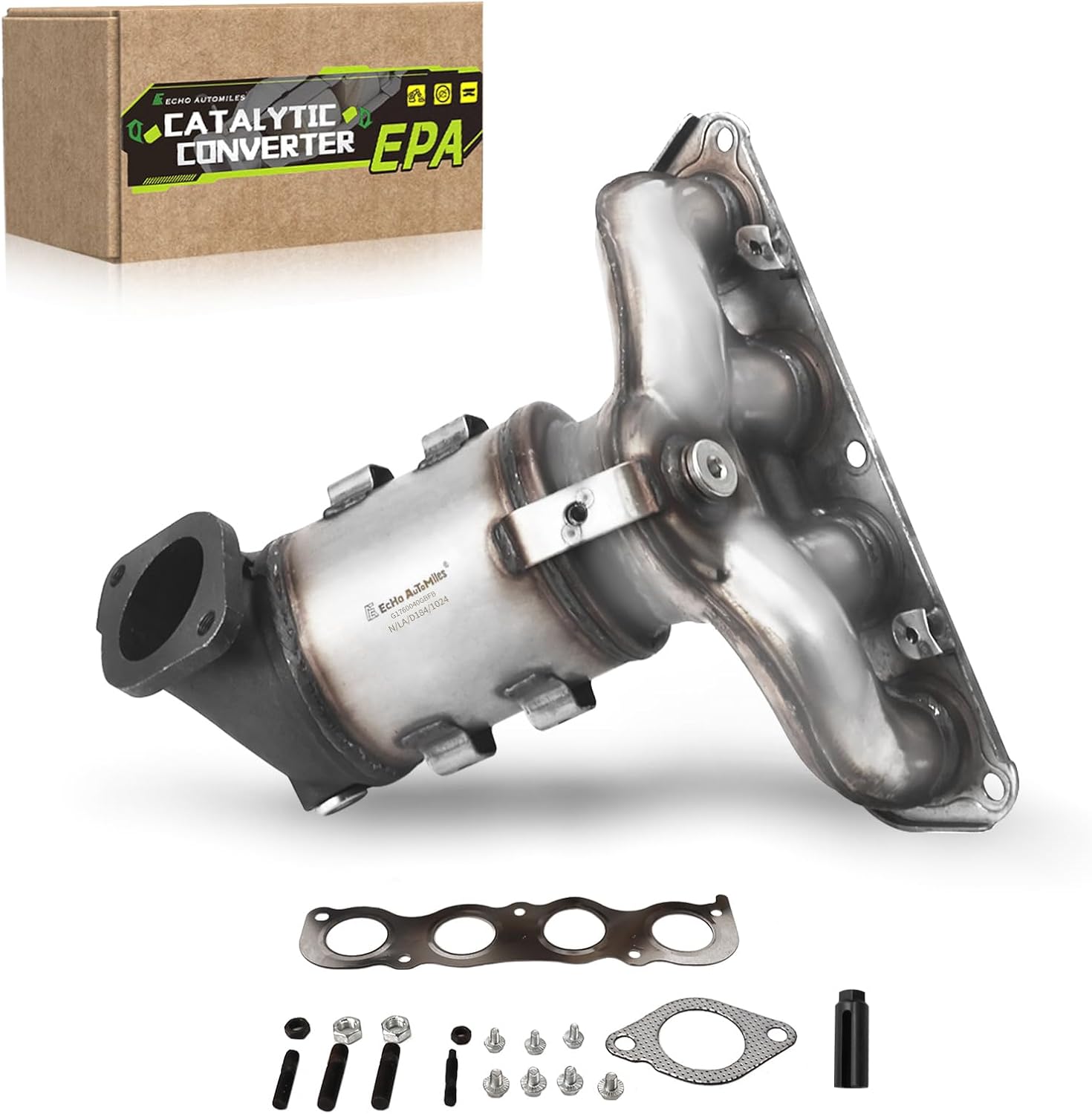
| Manufacturer | ECHO AUTOMILES |
|---|---|
| Manufacturer Part Number | G1760040GBFB |
| OEM Part Number | 28510-2E350, 28510-2EFA0 |
| Applicable Engines | 1.8L and 2.0L L4 (listed fitment includes Forte 2013-2016) |
| Compliance | EPA-compliant |
This ECHO AUTOMILES catalytic converter is a direct-fit replacement designed to match OEM part numbers and EPA compliance for select Hyundai and Kia 1.8L and 2.0L models, including the Kia Forte (2013 and 2014-2016 depending on engine). It installs in the exhaust line where the original converter sat and is intended to restore emissions control and normal exhaust flow after a failed unit. Notable features include a high-flow internal design aimed at reducing backpressure and improving exhaust efficiency and a polished exterior for corrosion resistance. In practice the unit should quiet check-engine light issues caused by a damaged converter and help the vehicle pass emissions tests in states that allow this part. Important limitations are regional restrictions: it is not eligible for sale or installation in California or Colorado and may be restricted in Maine and New York, so confirm local emission rules before choosing this replacement. Fitment must be verified against your Forte s VIN and engine configuration to ensure correct side and connection style.
Best for: Balanced buyers who want a reliable, factory-style replacement to restore emissions control and normal exhaust function on a Kia Forte without seeking performance-only aftermarket parts.
Less Ideal for: Drivers in states with strict emissions rules who need CARB-certified parts or owners looking for performance-tuned manifolds rather than a like-for-like catalytic replacement.
- Built to match OEM part numbers 641618 and 16867 for straightforward replacement
- High-flow design that reduces backpressure and can improve exhaust efficiency
- EPA-compliant construction for use in most states
- Polished exterior finish for improved corrosion resistance
- Not legal for sale or installation in California and Colorado and may be restricted in other states
- Fitment varies by year and engine so VIN-level verification is required prior to purchase
Verdict: A practical, factory-matching catalytic converter option for Kia Forte owners who need a reliable emissions replacement that restores proper exhaust flow.
2. A-Premium Front Catalytic Converter and Gasket Kit for Hyundai Elantra/Kia Forte 2.0L

| Vehicle Fitment | Hyundai Elantra 2017-2020 L4 2.0L; Kia Forte 2017-2018 L4 2.0L |
|---|---|
| EPA Compliant | Yes |
| Material | Stainless Steel |
| Position | Front |
| Mounting Hardware | Included |
This A-Premium front catalytic converter is a direct-fit replacement intended for 2.0L Kia Forte (2017–2018) and Hyundai Elantra (2017–2020) applications and includes gaskets and mounting hardware for installation. Built from stainless steel with welded 5-bolt and 2-bolt flanges and a 4-inlet to 1-outlet configuration, it mounts in the front position to handle exhaust flow and emissions processing like the factory unit. The EPA-compliant designation and included hardware simplify swap-in replacement for shops and experienced DIYers while the one-year unlimited-mileage guarantee gives added confidence. Practical benefits are solid fitment claims, stainless construction that resists corrosion better than painted assemblies, and bundled gaskets that reduce parts chasing during the repair. Important limitations are regulatory: EPA-compliant converters cannot be sold or installed in certain states, so confirm local rules and the vehicle emissions label before purchasing, and buyers seeking an emissions solution for restricted states should look for the correct state-compliant part instead.
Best for: Performance-oriented buyers who want a high-quality, factory-style replacement that restores proper exhaust flow and emissions control while minimizing installation time and fitment headaches.
Less Ideal for: Buyers in states with strict aftermarket converter regulations or owners who require a state-specific certified converter should seek a part explicitly listed for their state.
- Direct-fit design with included gaskets and mounting hardware for straightforward installation
- Stainless steel construction improves corrosion resistance over coated assemblies
- EPA-compliant build suitable for federal-emissions vehicles
- Welded flange inlets and outlets match factory-style connections for reliable sealing
- Not legal for sale or installation in some states with stricter emissions rules
- Limited warranty duration is one year which may be shorter than some factory replacements
Verdict: A direct-fit stainless steel front catalytic converter kit that restores factory-style fitment and emissions performance for 2.0L Kia Forte owners seeking a high-quality replacement.
3. QKVBKAU Direct-Fit Catalytic Converter for Kia Forte 2.0L / 2.4L

| Manufacturer Part Number | GZBJ-US-TWC-07 |
|---|---|
| OEM Part Number | 16648, 289602G540, 289602G710 |
| Compliance | EPA and CARB |
| Fitment | Direct-fit for select Kia Forte 2.0L/2.4L models |
This QKVBKAU catalytic converter is a direct-fit replacement engineered for Kia Forte 2.0L and 2.4L applications listed by the manufacturer. It installs between the exhaust manifold and downstream pipe and is intended to match factory form, fit, and function while meeting EPA and CARB emissions requirements. The unit uses a stainless steel housing and a high-density ceramic substrate with a triple-metal catalyst to reduce emissions and help the engine run within required thresholds. For practical use it simplifies repairs after a failed converter or emissions test because flange angles and sensor ports are made to align with the stock exhaust layout, and several buyers report straightforward installs. The product is sold as a complete kit but professional installation is recommended to ensure proper torque and leak-free joints. Expect a budget-friendly alternative to factory parts: build materials appear lighter than premium OEM units, so long-term durability is less certain compared with high-end replacements, but performance and emissions compliance meet legal standards for road use.
Best for: Practical optimizers who need a compliant, cost-conscious replacement that restores emissions performance and fitment without paying for a premium OEM unit.
Less Ideal for: Buyers seeking a long-term heavy-duty upgrade or racing modifications should consider higher-end or performance-specific converters instead.
- Direct-fit design tailored to listed Kia Forte 2.0L and 2.4L applications for easier installation
- EPA and CARB compliance ensures legal emissions performance in all states including California
- Triple-metal catalyst (platinum, palladium, rhodium) and high-density substrate for effective emission reduction
- Stainless steel housing resists corrosion better than untreated assemblies
- Materials and hardware feel lighter than premium factory-quality parts, leaving long-term durability uncertain
- May require professional installation to guarantee proper sealing and to protect warranty
Verdict: A budget-focused, direct-fit catalytic converter that restores emissions compliance and fit for Kia Forte 2.0L/2.4L without the cost of a premium factory unit.
4. AutoShack Exhaust Manifold Catalytic Converter for Hyundai Elantra / Kia Forte 2.0L

| Compatible engines | FWD L4 2.0L |
|---|---|
| Fitment years | Elantra 2017-2020, Forte 2017-2018, Forte5 2020-2021 |
| Exterior | Stainless Steel and Ceramic |
| Part numbers | Manufacturer EMCC774094, OEM 674-092 |
This AutoShack unit combines an exhaust manifold and catalytic converter in a single assembly to replace a failed factory piece on compatible 2.0L Hyundai Elantra and Kia Forte models. It is supplied as a complete manifold-converter bundle so installation replaces the front section of the exhaust system and restores catalytic function and exhaust flow. The listing highlights stainless steel exterior and a ceramic substrate, and the converter meets federal emissions in 46 states but is not legal in California, Colorado, New York, or Maine. For budget-focused buyers the main benefits are lower cost compared with dealer assemblies and a single-piece replacement that can simplify installation for a professional mechanic. Limitations to consider include state legality restrictions, possible fitment gaps around heat shields reported by some buyers, and the seller recommendation to replace oxygen sensors during installation to avoid false codes. Professional installation is advised to ensure engine issues that damaged the old converter are corrected first.
Best for: Budget-conscious owners seeking an affordable, ready-to-install manifold-converter that restores emissions function on qualifying 2.0L Hyundai/Kia models and prioritizes cost savings over premium OEM fit and finish.
Less Ideal for: Owners in states with strict emissions laws or those who need exact factory-fit heat shield and finish should consider higher-end or state-compliant alternatives.
- Combined manifold and converter simplifies front-end replacement
- Stainless steel exterior for corrosion resistance
- Designed to meet federal emissions standards in 46 states
- Includes the catalytic converter pre-attached to the manifold so fewer parts to source
- Not legal for use in California, Colorado, New York, or Maine due to emissions rules
- May require replacement of O2 sensors to avoid diagnostic codes and to preserve warranty
Verdict: An affordable, single-piece exhaust manifold catalytic converter that restores emissions function for qualifying 2.0L Hyundai and Kia models without OEM cost.
5. A-Premium Catalytic Converter Kit Compatible with Kia Forte 2013-2016 / Hyundai Elantra 2011-2016

| EPA Compliant | Yes |
|---|---|
| Vehicle Emissions | Federal Emissions |
| Body Material | Stainless Steel |
| Inlet Type | 5 Bolt Welded Flange |
| Outlet Type | 2 Bolt Welded Flange |
This A-Premium catalytic converter is a direct-fit replacement intended to restore emissions control and clear codes on compatible Kia Forte and Hyundai Elantra models. Designed for federal-emissions Forte 2013 2.0L and 2014-2016 1.8L applications, the unit uses stainless steel construction, welded 5-bolt inlet and 2-bolt outlet flanges and ships with gaskets and bolts to simplify installation. In real-world use it functions like a factory-quality converter: reviewers report straightforward fitment on Forte and Elantra engines, resolution of P0420-like codes, and a return to normal fuel economy after replacement. Notable features include EPA compliance for allowed states and a one-year unlimited-mileage guarantee. Important limitations are that this EPA-compliant unit cannot be sold or installed in California, Colorado, New York, or Maine and installation can be physically difficult depending on access and rusty hardware. Buyers should expect to reuse some original fasteners in many cases and plan for a moderately challenging DIY or shop installation.
Best for: Reliability-focused owners who prioritize restoring proper emissions control and clearing check-engine codes on a Kia Forte 2013–2016 while keeping a close eye on long-term operation.
Less Ideal for: Owners who live in states with stricter emissions laws or those seeking an OEM-branded unit and full manufacturer-backed support should consider alternatives.
- Direct-fit design for specified Kia Forte and Hyundai Elantra models reduces need for modifications
- Stainless steel body resists corrosion compared with lower-grade materials
- Includes gaskets and bolts to simplify installation and lower parts risk
- EPA-compliant for use in states that allow aftermarket converters and helps restore emissions performance
- Not legal for sale or installation in California, Colorado, New York, or Maine
- Some buyers report missing parts or inconsistent warranty support from the seller
Verdict: A practical, direct-fit catalytic converter kit that restores emissions performance on supported Kia Forte models without major modifications.
6. PHILTOP Front Catalytic Converter Kit for Kia Forte/Optima/Sonata Compatible 2009–2015

| Compatible engines | 2.0L and 2.4L (listed Forte fitments) |
|---|---|
| Position | Front |
| EPA compliance | EPA-compliant (not for certain states) |
This PHILTOP kit replaces the front catalytic converter assembly on applicable Kia Forte and related Hyundai/Kia 2.0/2.4L models and is intended as a factory-style replacement. It uses a high-flow ceramic honeycomb carrier inside an aluminized stainless steel body to reduce backpressure and help restore engine smoothness when a failing converter is causing rough running or check-engine codes. The kit ships with gaskets, bolts and OE-style hardware to simplify installation and generally fits the factory mounting points without modification when matched correctly to the vehicle. Practical benefits include restored emissions compliance in federal states, potential small gains in throttle response from reduced restriction, and less exhaust noise if the original unit was damaged. Reported downsides from owners include occasional fitment misalignment that can require trimming or modification and mixed long-term durability reports, so careful verification of fit and inspection after installation are recommended. Professional installation is advisable for risk-averse buyers who want a reliable result.
Best for: Risk-averse mainstream buyers looking for a direct, EPA-compliant replacement to restore normal operation and emissions performance on a Kia Forte or covered Hyundai/Kia models without pursuing performance aftermarket parts.
Less Ideal for: Buyers seeking a performance exhaust manifold or a custom-fit, vehicle-specific aftermarket upgrade should look elsewhere; this kit is meant as a factory-style replacement rather than a performance part.
- Designed to match factory mounting points with included gaskets and hardware
- High-flow ceramic substrate aims to reduce backpressure and improve engine smoothness
- Aluminized stainless steel body for better corrosion resistance than plain steel
- Some customers report flange alignment or length differences that required trimming or drilling during installation
- Mixed reports on long-term internal durability under heavy use
Verdict: A practical, factory-style front catalytic converter kit that restores emissions function and drivability for risk-averse Kia Forte owners.
Choosing the Right Kia Forte Exhaust Manifold: Key Factors to Consider
Fitment and Flange Alignment
Accurate fitment is essential because the manifold must line up precisely with the cylinder head ports and mounting points. Even small misalignments can cause exhaust leaks, stress on mounting bolts, or the need for costly adjustments during installation. When a manifold matches factory flange geometry, gasket sealing is more reliable and installation time is reduced. Fitment also affects clearance to nearby components such as heat shields, the turbocharger or catalytic converter in variant models. If you plan to swap exhaust manifold styles, ensure the replacement maintains the same mounting pattern and sensor ports. Prioritize parts with verified fitment data and clear mounting instructions to avoid problems during installation.
Material and Heat Resistance
Manifolds are exposed to extreme temperatures and thermal cycling, so the construction material determines long-term durability. Cast iron withstands heat and resists warping but can be heavy; stainless steel offers corrosion resistance and lighter weight but may be more prone to expansion differences. Coatings or high-temperature finishes improve corrosion protection and can reduce surface heat transfer. Material choice influences susceptibility to cracking under repeated thermal stress and affects how the component tolerates rapid temperature changes. Consider the operating environment and expected mileage when choosing a material to balance longevity and performance.
Sealing Surfaces and Gasket Compatibility
A reliable seal between the manifold and cylinder head is critical to prevent exhaust leaks that produce noise, reduce power, and affect emissions. The flatness of flange faces, precision of bolt holes, and compatibility with high-temperature gaskets determine sealing quality. Some manifolds are designed to work with multi-layer steel gaskets or molded graphite types; others may require a specific gasket profile. Gasket choice can mitigate minor flange imperfections and accommodate thermal expansion. When evaluating options, confirm the recommended gasket type and whether it is included or sold separately to plan for a proper installation.
Mounting Hardware and Installation Accessibility
Ease of installation depends on access to fasteners, the availability of correct studs or bolts, and whether any ancillary brackets are required. Manifolds that preserve factory mounting points and hardware reduce the need for additional parts. Consider whether fasteners are exposed or tucked under other components, which affects labor time and potential need to remove adjacent parts. Some designs include heat shields or mounting tabs that interact with existing brackets; verify these match your vehicle. If you anticipate doing the work yourself, look for parts with user-friendly fitment notes and clear instructions.
Crack Resistance and Long-Term Durability
Cracks in the manifold lead to exhaust leakage, increased noise, and potential sensor issues, so resistance to cracking is a primary durability concern. Materials, casting quality, and design features like thicker walls at stress points help reduce the likelihood of cracks forming. Consider whether the manifold design minimizes sharp corners and stress concentrators, and whether it has been tested for thermal cycling. Warranty coverage and manufacturer quality controls provide additional confidence in long-term performance. Assess expected driving conditions and mileage to judge how much emphasis to place on crack resistance.
Sensor and Emissions Port Compatibility
Modern engines rely on oxygen sensors and other monitoring devices that must be retained when replacing a manifold. Ensure the manifold includes the necessary ports in the correct locations and threads for the vehicle's sensors. Misplaced or missing ports can require adapters or rework, and can affect emissions performance and onboard diagnostics. Compatibility with the catalytic converter inlet and downstream hardware is also important to maintain the original exhaust path and emissions behavior. Confirming port placement and thread size upfront reduces surprises during installation and helps preserve emissions system function.
How We Chose the Best Kia Forte Exhaust Manifold
We prioritized parts and suppliers that deliver reliable fitment for the Kia Forte chassis and engine families, focusing on the dimensions and flange alignment that determine sealing and ease of installation. Material and coating choices were assessed for thermal resistance and corrosion protection, since these affect how long the manifold will withstand repeated heating cycles. We evaluated gasket sealing surfaces and port smoothness because these influence leakage risk and exhaust flow efficiency. Fastener access and compatibility with stock mounting hardware were considered to gauge real-world installation effort. Emissions compatibility and vacuum or sensor port availability were checked to ensure functional integration with the vehicle's exhaust and sensor systems. We excluded items that lacked verified fitment data or that required extensive vehicle modifications; anything needing custom fabrication or major engine changes was not considered. The shortlist reflects parts that balance correct fit, durable materials, leak-resistant sealing, and straightforward installation for the Kia Forte.
Our full evaluation process is outlined in our review methodology.
FAQ
What are common exhaust manifold symptoms on a Kia Forte?
Common signs often include a loud ticking or tapping noise on cold start that disappears as the engine warms, reduced engine responsiveness, and a noticeable exhaust smell in the cabin. You may also see reduced fuel efficiency or a check engine light if sensors detect abnormal exhaust flow. These symptoms usually indicate a sealing issue, crack, or gasket failure rather than unrelated engine faults.
How can I diagnose an exhaust manifold leak?
A basic diagnosis often starts with a visual inspection for soot deposits or hairline cracks around flange edges and welds. Listening near the manifold with the engine running can help locate ticking noises that correlate to leaks. A smoke or smoke-pen test and using a stethoscope or automotive listening tool can confirm leak locations. For sensor-related codes, scanning the vehicle can reveal symptoms tied to exhaust leaks.
When should I replace the exhaust manifold gasket versus the entire manifold?
If the flange faces are flat and free of cracks, replacing the gasket may restore a proper seal. However, if you find warping, corrosion through the flange, or visible cracks in the manifold body, replacing the entire manifold is usually the better long-term solution. Assess flange condition and perform a thorough inspection before deciding whether gasket replacement alone will be sufficient.
Are aftermarket manifolds a practical choice compared with OEM parts?
Aftermarket manifolds can provide good fitment and materials, and some offer enhanced durability or different material options. Quality varies, so look for parts with verified fitment data, clear specifications, and manufacturing quality controls. Consider the tradeoffs between material choice, warranty, and proven fitment rather than assuming one source is always superior. Choosing parts that match the vehicle's mounting and sensor requirements reduces complication.
What installation challenges should I expect with a Kia Forte exhaust manifold?
Expect tight working space around the exhaust ports and possible difficulty accessing studs or bolts, which can extend labor time. Corroded fasteners on older vehicles may require penetrating oil, replacement studs, or specialty tools. Ensuring correct torque and using the recommended gasket type are important to prevent leaks. Planning for potential removal of adjacent components and having replacement hardware on hand reduces risk of delays.
Conclusion
Prioritize correct fitment, material durability, and reliable sealing when choosing a Kia Forte exhaust manifold. Those factors most directly influence leak risk, long-term crack resistance, and installation complexity. Balance ease of installation against material and coating properties based on your driving conditions and expected mileage. Focusing on verified fitment data, compatible sensor ports, and proper gasket selection will help you achieve a durable repair or upgrade.
Explore More:
- Check out all Kia Forte parts & accessories
- Explore Exhaust Manifolds Maintenance & Repair Guides
- Explore Exhaust & Emissions
- Browse all Auto Parts
