

Note: This article contains affiliate links. If you click on these links and make a purchase, I may earn a small commission at no extra cost to you. This helps support my research and content. Read my full affiliate disclosure here.
If you drive a Honda Accord and are noticing reduced performance or louder engine noise, the exhaust manifold can be a common source of trouble. Choosing the right Honda Accord exhaust manifold matters because it affects engine breathing, emissions sealing, and long-term durability. This guide highlights the top shortlisted exhaust manifolds for the Accord and explains the practical tradeoffs buyers should know. We evaluated options based on fitment reliability and material construction to help you pick a durable replacement or upgrade.Read on to see the top choices and the criteria we used to narrow them down.
Looking for other parts? See all Honda Accord parts & accessories.
Top Picks at a Glance
| Best Overall The best all-around choice for most situations | Dorman 674-547 Exhaust Manifold Kit with Gaskets and Hardware |  |
| Best Value The sweet spot between price and what you get | NewYall Manifold Catalytic Converter with Gasket for Honda Accord L4 2.4L (2008–2012) / Acura TSX 2.4L (2009–2014) |  |
| Best budget The cheapest option that still gets the job done reliably | FortunaFlow Front Right Catalytic Converter (Front Right) compatible with Honda Accord 3.5L |  |
| Most Popular A crowd favorite that many people choose with confidence | VAVICARS Stainless Steel Catalytic Converter Manifold for Honda Accord 2.4L |  |
| Best Seller A high-volume bestseller chosen again and again | Honjer Exhaust Manifold Catalytic Converter for Honda Accord 2.4L (2013–2017) |  |
1. Dorman 674-547 Exhaust Manifold Kit with Gaskets and Hardware

| Manufacturer | Dorman Products |
|---|---|
| Model | 674-547 |
| Automotive Fit Type | Vehicle Specific Fit |
| Position | Front, Rear |
This Dorman exhaust manifold kit is a ready-to-install replacement designed to match factory fit and function for specified Honda models. It ships with all required gaskets and downpipe hardware so you can complete the manifold-to-downpipe connection without multiple parts orders. In typical use it replaces a cracked or warped factory manifold and is installed using common hand tools and basic shop procedures. Notable features include precision-engineered mounting surfaces and machined exterior surfaces intended to resist warping and leaks. The practical benefits are straightforward: fewer missing parts during repair, potentially faster installation, and a lower-cost alternative to buying a factory manifold separately. Some customers report excellent fit and easy installation while others cite inconsistent weld quality, so inspection before installation is advisable. This part is offered as a vehicle-specific fit so confirm trim and year compatibility for your Honda Accord before purchasing. Professional installation will help ensure proper torque and gasket sealing on vehicles with rusted fasteners or tight clearances.
Best for: Balanced, budget-aware buyers who want a full, vehicle-specific replacement manifold that simplifies repairs and avoids multiple part orders.
Less Ideal for: Buyers seeking a factory-branded OEM manifold or those who prefer a professionally remanufactured unit for guaranteed weld quality should consider other options.
- Includes all necessary gaskets and downpipe hardware for a complete repair
- Designed to match factory fit and mounting locations for direct replacement
- Machined surfaces intended to resist warping and leaking for longer service life
- Some reports of inconsistent weld or build quality between units
Verdict: A complete, vehicle-specific replacement manifold kit that simplifies exhaust repairs by including gaskets and hardware for a one-order solution.
2. NewYall Manifold Catalytic Converter with Gasket for Honda Accord L4 2.4L (2008–2012) / Acura TSX 2.4L (2009–2014)
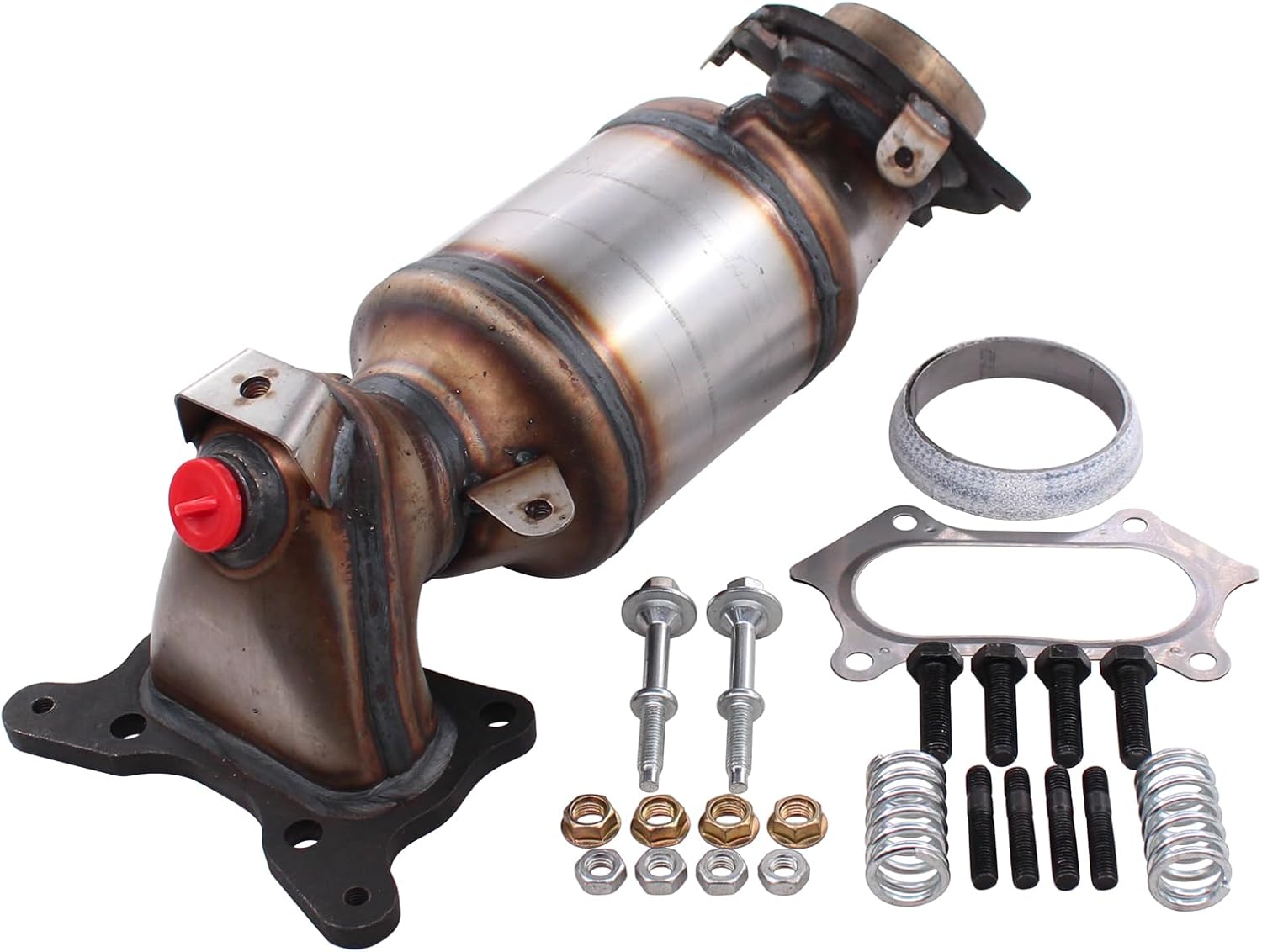
| Brand | NewYall |
|---|---|
| Item model number | 64128l |
| Manufacturer Part Number | 64128l |
| Fitment | Honda Accord L4 2.4L 2008-2012; Acura TSX L4 2.4L 2009-2014 |
This NewYall manifold catalytic converter replaces the factory manifold and integrates a gasket for a direct-fit installation on 2.4L four-cylinder Honda Accord and Acura TSX engines within the listed years. It is used where the original catalytic component is damaged, clogged, or when emissions equipment must be restored to pass inspection. The unit’s direct-fit design simplifies replacement compared with separate manifold and converter assemblies, and the included gasket helps speed installation and reduce exhaust leaks. Practical buyers will appreciate that it targets a specific engine and year range, which reduces fitment guesswork. Expect standard emissions performance for a replacement converter of this type, but note it is not presented as a high-flow performance upgrade and may not match factory metal quality or internal substrate maturity from OEM parts. Also installation may require common shop tools and familiar exhaust procedures rather than being a true bolt-on for every skill level.
Best for: Practical optimizers who want a cost-conscious, single-part replacement to restore emissions and exhaust integrity on the specified Honda Accord or Acura TSX rather than pursuing performance upgrades.
Less Ideal for: Buyers seeking a performance-oriented or high-flow exhaust solution or those who require factory-specified materials and documented longevity should consider other options.
- Direct-fit design for Honda Accord L4 2.4L (2008–2012) and Acura TSX L4 2.4L (2009–2014) reduces fitment uncertainty
- Includes gasket to help ensure a tighter seal and simplify installation
- Replaces both manifold and converter in one assembly which speeds repair compared with sourcing parts separately
- Not marketed as a high-flow or performance unit so it may not improve power or exhaust flow
- Build materials and internal substrate details are not specified so long-term durability versus factory parts is unknown
Verdict: A practical, single-piece manifold catalytic converter with gasket that provides a straightforward emissions replacement for 2.4L Honda Accord and Acura TSX engines.
3. FortunaFlow Front Right Catalytic Converter (Front Right) compatible with Honda Accord 3.5L

| Position | Front Right |
|---|---|
| Model | HAFR083.5 |
| Manufacturer | FortunaFlow |
| EPA Compliance | Yes |
This FortunaFlow front-right catalytic converter is a direct-replacement part intended for Honda Accord 3.5L V6 models and similar Honda/Acura vehicles. It installs in place of the factory unit using the supplied gaskets and hardware, and the flange is built to match factory bolt patterns so no major modification is typically required. The converter is stainless steel with CNC-MIG welds for structural strength and is marketed as EPA compliant to restore emissions function and clear check-engine codes. For budget-minded owners it provides a cost-effective option to get a car back to emissions compliance and normal performance without an expensive dealer unit. Limitations to expect are that it is not legal for sale in certain states and the fitment list must be checked carefully against your exact engine and model year; buyers should also plan for professional installation if they lack exhaust experience because welding or exhaust support may still be needed in some installs.
Best for: Budget-conscious buyers seeking a low-cost, factory-replacement style catalytic converter to restore emissions compliance and clear a check-engine light on a Honda Accord 3.5L.
Less Ideal for: Owners in states that require California-compliant parts or buyers who want a dealer factory-quality unit with full statewide legal coverage should consider alternatives.
- Direct-fit flange and mounting holes designed to match factory bolt patterns for simpler installation
- Stainless steel construction with CNC-MIG welds for improved heat and pressure resistance
- EPA compliant for clearing emissions-related check engine lights in allowed states
- Includes gaskets and installation hardware to reduce parts needed at installation
- Not legal for sale or shipment to California, New York, Colorado, or Maine
- Fitment is specific to 3.5L Honda/Acura models so it will not fit other engine variants
Verdict: A cost-effective, direct-fit converter for Honda Accord 3.5L owners who need a quick emissions-compliant replacement outside restricted states.
4. VAVICARS Stainless Steel Catalytic Converter Manifold for Honda Accord 2.4L

| Fitment | 2008–2012 Honda Accord / 2009–2014 Acura TSX 2.4L |
|---|---|
| Material | 409L stainless steel shell |
| Position | Front |
| EPA | Federal emissions approved |
This VAVICARS catalytic converter manifold is a budget-friendly, direct-fit replacement intended for 2008–2012 Honda Accord and 2009–2014 Acura TSX 2.4L engines with federal emissions. It uses a 409L stainless steel shell and factory-molded flanges to bolt into the stock exhaust layout without cutting or modification, which makes it a convenient option for DIYers and quick shop installs. The unit is EPA certified for federal models and includes internal ceramic substrates with metal catalysts to restore emissions control and reduce exhaust leaks. Practical benefits include corrosion resistance from the stainless shell and straightforward installation using existing hardware and heat shields. Notes to consider: build quality is mixed in customer reports with some users seeing early catalyst deterioration or weld issues, so long-term durability may be lower than factory replacement parts. Professional installation is recommended to ensure sensor placement and gasket sealing are correct and to avoid check-engine light complications.
Best for: Convenience-driven buyers who want a ready-to-install, bolt-on replacement to get a 2008–2012 Accord or compatible TSX back on the road quickly without custom work.
Less Ideal for: Buyers seeking a long-term factory-quality replacement or who need parts legal in California, New York, Maine or Colorado should consider higher-grade factory replacement options or state-compliant units.
- Direct-fit design using original car mold for bolt-up replacement without modification
- 409L stainless steel shell offers improved corrosion and heat resistance compared with mild steel
- EPA federal certification for use on non-California federal-emissions models
- Includes internal ceramic substrate with metal catalysts to restore emissions performance and reduce exhaust leaks
- Some reviewers report premature catalyst failure or weld/quality issues affecting long-term durability
Verdict: A convenient, EPA-approved direct-fit stainless steel catalytic converter manifold that restores emissions control and fits without modification for specified Accord and TSX 2.4L models.
5. Honjer Exhaust Manifold Catalytic Converter for Honda Accord 2.4L (2013–2017)

| Brand | Honjer |
|---|---|
| Model | HJRHDCZ1646-A |
| Compatible Vehicles | Honda Accord 2013-2017 2.4L L4 |
| EPA Compliance | Yes / Not approved CA, NY, CO, ME |
This Honjer exhaust manifold catalytic converter is a direct-fit replacement meant to restore emissions control and exhaust flow on 2013–2017 Honda Accord 2.4L engines. It installs in place of the factory manifold-catalyst and is typically used when the original unit has failed or triggered a check engine light. The part ships with welded flanges and rigid mounting points and includes the necessary hardware and gaskets, which simplifies installation for a professional or experienced DIYer. In real-world use it closely matches factory fitment so bolt holes align and the check engine light can be resolved quickly. It is sold as an EPA-compliant unit for most states but is not approved for some strict emissions regions. Buyers should note there is limited public information about the catalyst substrate and long-term durability, so while initial fit and function are promising, long-term emissions performance is less certain than an OEM part.
Best for: Risk-averse, mainstream Accord owners who prioritize a straightforward, factory-style replacement to clear emissions faults and return the vehicle to normal operation with minimal fuss.
Less Ideal for: Drivers in states with stricter emissions regulations or owners who require documented long-term catalyst performance data should consider a verified factory-quality replacement or dealer option.
- Direct-fit design matches factory bolt patterns for straightforward installation
- Comes with gaskets and hardware needed to complete the replacement
- Machined exterior and rigid mounts provide solid structural fit
- EPA-compliant for most states, addressing emissions and check engine light issues
- Not approved for sale in certain strict emissions states
- Manufacturer provides limited published information about the internal catalyst substrate and long-term durability
Verdict: A practical, direct-fit replacement that restores emissions function on 2013–2017 Accord 2.4L cars but lacks full approvals and long-term catalyst transparency.
Looking for the perfect fit?
Select your Honda Accord configuration to see the most relevant Exhaust Manifolds recommendations
Choosing the Right Honda Accord Exhaust Manifold: Key Factors to Consider
Vehicle Fitment and Port Alignment
Exact fitment is critical because an exhaust manifold must match the Accord engine bank and cylinder head flange to seal properly and avoid distortion. Even small misalignments can cause exhaust leaks, warped flanges, and accelerated gasket failure.
When shopping, confirm the manifold is specified for your model year and engine code. Correct port spacing and bolt hole locations reduce the need for modification and make installation straightforward. A well-aligned manifold shortens install time and reduces the risk of exhaust pulses escaping at the flange, which can affect performance and emissions.
Material and Heat Resistance
Materials such as cast iron and high-grade stainless steel handle heat differently and influence how the manifold responds to thermal cycling. Cast iron resists cracking under sustained high temperatures and dampens vibration, while stainless steel can be lighter and more corrosion resistant depending on alloy grade.
Consider the material's expansion properties and expected operating temperatures. Manifolds that use thicker wall sections and quality metallurgy tend to resist hairline cracks and can maintain a better seal over time. Material choice also impacts long-term corrosion resistance in climates where road salt or moisture is present.
Flange Flatness and Gasket Seating
A flat, accurately machined flange ensures an even gasket seal and reduces the chance of leaks at the head-to-manifold joint. Warped or uneven flanges force gaskets to compress unevenly, which often leads to exhaust manifold symptoms such as ticking noises or loss of backpressure.
Look for manifolds with machined flanges or those that clearly state tight tolerances. Quality gaskets and proper torque sequencing are part of the sealing system, but starting with a true flange surface is the most reliable way to prevent leaks and the need for re-torquing or retorquing.
Heat Cycling and Fatigue Resistance
Exhaust manifolds repeatedly heat and cool with engine operation, which can cause metal fatigue and eventual cracking. Designs that account for thermal expansion, such as incorporating flexible sections or using alloys with good fatigue properties, are less likely to develop exhaust manifold cracks over time.
Assess whether a design is likely to handle frequent temperature swings, particularly if you do a lot of short trips or spirited driving. Durable manifolds will keep sealing surfaces intact and maintain structural integrity through many heat cycles.
Installation Accessibility and Hardware Quality
Some manifolds are easier to install than others because of header tube routing, proximity to engine accessories, and included hardware. Hardware quality matters because studs, bolts, and nuts exposed to exhaust heat can seize or strip if they are low grade.
Choose manifolds that include or recommend high-quality replacement hardware and that fit without requiring removal of numerous components. Clear installation guidance and accessible mounting points reduce labor time, lower the chance of cross-threading, and help ensure a reliable seal.
Serviceability and Replacement Parts
Consider whether replacement gaskets, studs, or heat shields are readily available for the manifold you select. Manifolds designed with common, replaceable parts make future maintenance simpler and usually cost less to keep in service over the life of the vehicle.
A serviceable design also makes it easier to inspect for leaks and address minor issues before they become failures. Confirm that gaskets and mounting hardware match common specifications so repairs do not require custom parts or fabrication.
How We Chose the Best Honda Accord Exhaust Manifold
To assemble this list we focused on factors that directly affect reliability and fit for a Honda Accord. Primary evaluation criteria included exact vehicle fitment to ensure bolt-on installation and correct port alignment, material and casting quality because these determine heat resistance and longevity, flange flatness and gasket sealing surface to reduce leak risk, and heat-cycle durability which affects how components hold up to repeated thermal expansion. We also considered compatibility with common engine variants and ease of installation, plus manufacturer support for replacement parts.We excluded items that required extensive modification, custom fabrication, or were known to have chronic fitment issues. Products that did not clearly document vehicle coverage, flange tolerances, or construction materials were also omitted. The resulting shortlist reflects options that meet practical fitment standards, robust material choices, and clear installation characteristics suited for the Accord.
Our full evaluation process is outlined in our review methodology.
FAQ
What are common exhaust manifold symptoms on a Honda Accord?
Common signs include a sharp ticking or tapping noise from the engine bay that changes with RPM, reduced engine smoothness, and the smell of exhaust near the firewall. These symptoms often indicate a leak at the manifold flange or a small crack in the manifold casting, but diagnosis should confirm the cause before replacing parts.
How can I diagnose an exhaust manifold leak safely?
You can often detect leaks by listening for a distinct ticking noise during cold starts and by feeling for escaping exhaust gases around the flange area with the engine idling. Using a smoke source or soapy water to spot escaping gases can help, but avoid putting your hands near hot components and consider having a professional confirm the diagnosis.
Is it better to replace the gasket or the entire exhaust manifold?
Whether to replace the gasket or the entire manifold depends on the source of the leak. If the flange is flat and the manifold is crack-free, a new gasket and hardware may resolve the issue. If the manifold is warped, cracked, or shows heat-related damage, replacing the entire manifold usually provides a longer-term solution.
What causes an exhaust manifold crack?
Cracks often develop from repeated heat cycling, thermal shock, or prolonged high-temperature exposure, which cause metal to fatigue. Corrosion and mechanical stress from misalignment or overtightening can also contribute. Addressing underlying causes and choosing a durable replacement material can reduce recurrence.
Will swapping the exhaust manifold affect vehicle performance?
Swapping a damaged or leaking manifold for a correct-fit replacement typically restores engine efficiency and can reduce noise. Performance changes beyond restoring proper function are limited unless the replacement alters flow characteristics significantly. For normal use, the priority is a sealed, heat-resistant manifold that matches the engine.
Conclusion
When choosing a Honda Accord exhaust manifold, prioritize correct fitment, flange flatness, and material durability. These factors most directly affect sealing, longevity, and the likelihood of future leaks.Weigh the tradeoffs between material properties and installation ease. Opt for a solution that matches your engine variant and offers accessible replacement parts so you minimize downtime and maintain reliable exhaust sealing.
Explore More:
- Check out all Honda Accord parts & accessories
- Explore Exhaust Manifolds Maintenance & Repair Guides
- Explore Exhaust & Emissions
- Browse all Auto Parts
