

Note: This article contains affiliate links. If you click on these links and make a purchase, I may earn a small commission at no extra cost to you. This helps support my research and content. Read my full affiliate disclosure here.
If you own a 2004-2008 Ford F-150 and are hearing ticking noises, losing low-end torque, or dealing with exhaust smell in the cab, the exhaust manifold is a likely suspect. Choosing the right exhaust manifold affects engine breathing, thermal management, and the long-term integrity of the exhaust ports on these model years. This guide looks at seven shortlisted exhaust manifolds that match the 2004-2008 F-150 flange and port layout and focuses on fit, heat control, and sealing reliability.Below you will find the top picks selected for this vehicle scope and clear explanations of the factors that matter when replacing or upgrading an exhaust manifold. Use the evaluation criteria to narrow options for your use, whether you need a direct replacement or a more durable long-term fix.
Looking for other parts? See all Ford F-150 parts & accessories.
Top Picks at a Glance
| Best Overall The best all-around choice for most situations | Marketplace Auto Parts Exhaust Manifold Set with Gaskets for 2004-2009 Ford F-150 5.4L V8 |  |
| Best Quality Built to a higher standard if you want something more solid | Dorman Driver Side Ceramic Coated Exhaust Manifold Kit |  |
| Best Value The sweet spot between price and what you get | PartsFlow Left and Right Exhaust Manifold Kit (fits listed Ford models) |  |
| Best Budget The cheapest option that still gets the job done reliably | AngyMeck Left Exhaust Manifold for 1999–2008 Ford F150 and E-Series (cast iron) |  |
| Highest Rated A top-rated pick with lots of positive feedback | maXpeedingrods Right Passenger Exhaust Manifold Kit with Gaskets for 5.4L V8 |  |
| Most Popular A crowd favorite that many people choose with confidence | Dorman Ceramic-Coated Passenger Side Exhaust Manifold (674-694XD) |  |
| Best Seller A high-volume bestseller chosen again and again | A-Premium Right Side Exhaust Manifold Kit for 5.4L V8 |  |
Marketplace Auto Parts Exhaust Manifold Set with Gaskets for 2004-2009 Ford F-150 5.4L V8

| Compatible Engine | 5.4L V8 |
|---|---|
| Fitment Years | 2004 – 2009 |
| Kit Contents | Left and right manifolds, 4 gaskets, 4 nuts |
| Brand | Marketplace Auto Parts |
This exhaust manifold set supplies both left and right manifolds with four gaskets and four nuts so you can replace the full bank on a 5.4L V8 F-150 in one job. Installation is the typical bolt-on swap that most independent shops or experienced DIYers can handle; the kit covers the common failure points by replacing the manifold flanges and sealing surfaces. The manifolds appear to be cast, offering the heat resistance and rigidity expected for exhaust duty, while the included gaskets simplify reassembly and help prevent exhaust leaks. Because it is a direct-fit replacement specifically listed for 2004–2009 F-150 5.4L engines, you avoid the fitment headaches of universal parts. Limitations are that the listing does not specify material finish or heat shielding and it does not include studs or extended fasteners for damaged threads, so you may need to source those separately during an engine with corrosion or stripped bolts. Overall it is a practical, complete kit for restoring a leaky or damaged manifold bank on the specified F-150 application.
Best for: Buyers who want a complete, direct-fit replacement to repair exhaust leaks or a cracked manifold on a 5.4L F-150 and prefer a ready-to-install kit to minimize parts sourcing and shop time.
Less Ideal for: If you need upgraded performance manifolds, specialized coatings for corrosion resistance, or an exact OEM branded part, consider performance or factory-branded alternatives.
- Includes both left and right manifolds so you can replace the entire bank in one service visit
- Comes with gaskets and nuts to simplify reassembly and reduce parts hunting
- Listed fitment for 2004–2009 Ford F-150 5.4L V8 minimizes compatibility guesswork
- Cast construction provides heat resistance and structural rigidity for exhaust applications
- Does not list material coating or heat shielding details which affects long-term corrosion resistance
- Does not include studs or extended fasteners for cases with damaged exhaust ports or bolts
Verdict: A straightforward, complete replacement kit that gets both manifolds and basic hardware in one purchase to fix exhaust leaks on 2004–2009 F-150 5.4L trucks.
Dorman Driver Side Ceramic Coated Exhaust Manifold Kit

| Manufacturer | Dorman Products |
|---|---|
| Item model number | 674-695XD |
| OEM Part Number | 3L3Z 9431-CA; 5L1Z9431AA; 7L1Z9431A |
| Compatible engines/years | Select Ford/Lincoln 5.4L 3V, 2004-2014 (see fitment) |
| Coating | Ceramic coated |
This Dorman driver-side exhaust manifold replaces the factory cast unit on select 5.4L 3-valve Ford engines and arrives ceramic coated to help manage heat and resist corrosion. It is supplied as a kit with the gaskets and hardware needed for a single-side repair so you can complete the job without chasing parts. The ceramic coating evens out heat across the casting which helps reduce thermal cracking and can keep exhaust gas temperatures higher for improved flow and scavenging compared with an uncoated replacement. Fitment across 2004 through 2014 5.4L applications is reported as direct in many installs, though some users bend a heat shield or re-use higher-quality studs and gaskets for the best long-term seal. Practical benefits include cleaner appearance under the hood, reduced chance of early rust, and a one-order solution for a common failure. The kit is a solid performance-minded swap when you want a durable, heat-managed manifold without moving to headers, but installers should inspect provided gaskets and fasteners and be prepared to upgrade hardware for longevity.
Best for: Buyers who want a durable, heat-controlled factory-style replacement that improves longevity and exhaust flow without switching to performance headers; ideal for DIY installers or shops focusing on reliable repairs with minimal modification.
Less Ideal for: Drivers seeking maximum power gains or free-flowing exhaust tuning should consider aftermarket headers or performance manifolds instead of a factory-style replacement.
- Ceramic coating improves heat distribution and reduces risk of thermal cracking
- Includes gaskets and hardware for a single-side repair to simplify installation
- Coating is corrosion resistant so the manifold maintains a cleaner appearance over time
- Designed as a direct replacement for common Ford 5.4L 3V applications for easier fitment
- Some installers report the supplied gaskets or studs are lower quality and may prefer to replace them for a more reliable seal
Verdict: Choose this ceramic-coated Dorman manifold when you want a durable, heat-managed factory-style replacement for the 5.4L F-150 that simplifies repair without sacrificing reliability.
PartsFlow Left and Right Exhaust Manifold Kit (fits listed Ford models)
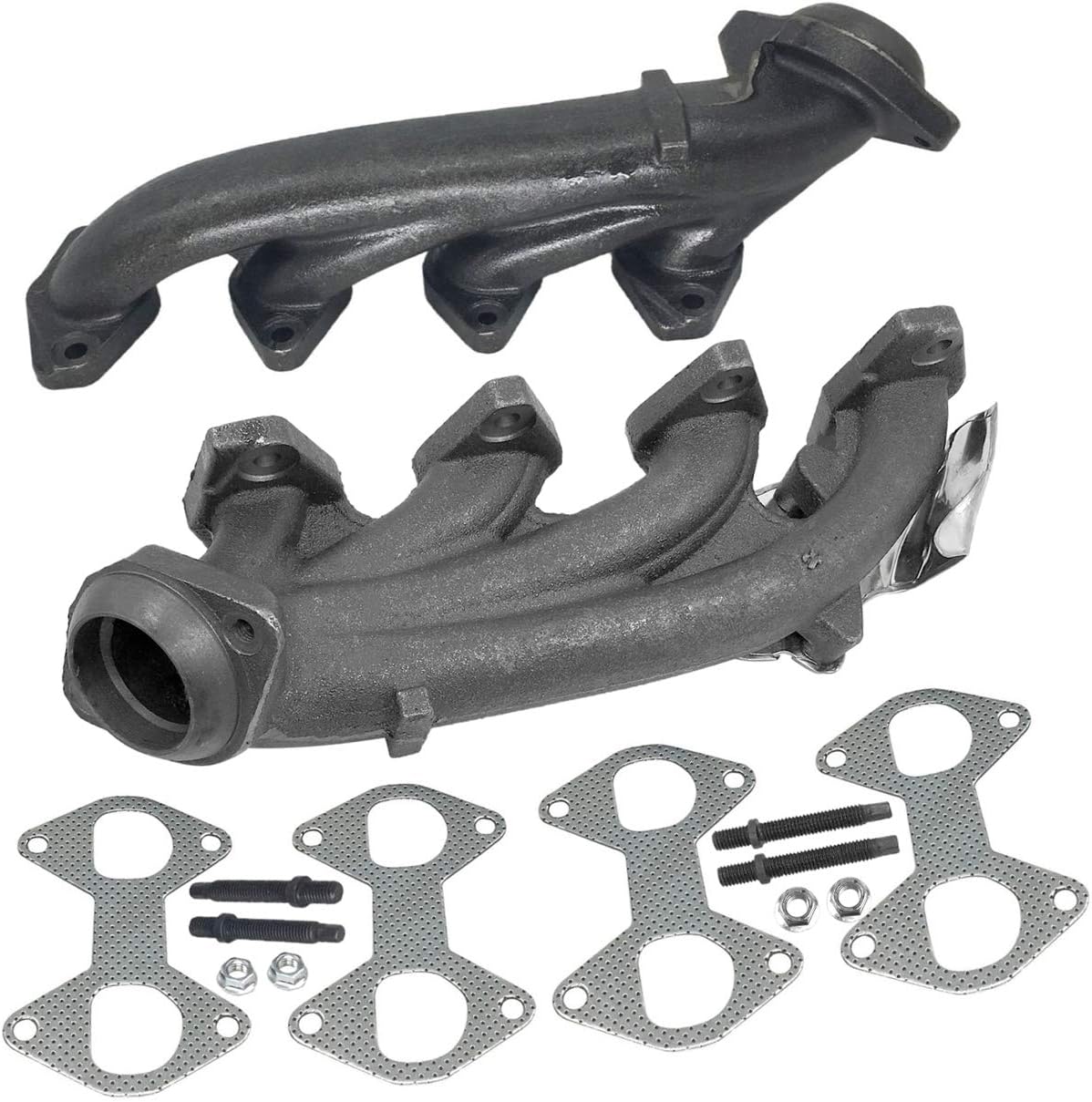
| Manufacturer | PartsFlow |
|---|---|
| Material | Stainless Steel |
| Placement on Vehicle | Left, Right, Front |
| OEM Part Number | 674-695, 7L1Z9431A, 674-694, 3L3Z9431CA |
This PartsFlow kit supplies both left and right exhaust manifolds for the mid-2000s Ford F-150 and related Ford/Lincoln trucks and SUVs, intended as a direct replacement for worn or cracked factory manifolds. Made of stainless steel and sold as a pair, the set includes parts that match common OEM part numbers and is typically used when a manifold leak, cracked flange, or damaged header requires replacement. In practice the kit simplifies repairs by providing both sides at once and comes with images showing gaskets and studs in some listings, which helps avoid sourcing extra hardware. Buyers report mostly straightforward fitment and factory-quality fit where it matches the vehicle, and the stainless construction should resist corrosion better than cast iron. Important limitations are fitment inconsistencies across some model years and occasional arrival damage, so confirm exact trim and compare OEM numbers before installing and inspect parts on receipt.
Best for: A practical buyer who wants a ready-to-install replacement pair to repair exhaust leaks or cracked manifolds on compatible mid-2000s Ford F-150 and similar trucks and SUVs and who prioritizes getting both sides replaced at once.
Less Ideal for: Anyone who cannot verify exact OEM part numbers or vehicle trim before purchase or who needs a guaranteed brand-specific factory part should consider verifying fitment with a dealer or choosing a different supplier.
- Supplies both left and right manifolds together to simplify a full exhaust repair
- Stainless steel construction offers improved corrosion resistance over older cast parts
- Matches common OEM part numbers listed for mid-2000s Ford/Lincoln applications
- Includes or is sold with gaskets and studs in many listings so fewer extra parts to buy
- Some buyers reported fitment mismatches for certain model years or trims
- A few units arrived damaged, so parts should be inspected immediately on delivery
Verdict: Buy this kit if you want a convenient paired stainless-steel replacement to resolve manifold leaks on compatible mid-2000s Ford F-150 and related trucks quickly and with fewer extra parts.
AngyMeck Left Exhaust Manifold for 1999–2008 Ford F150 and E-Series (cast iron)

| Placement on Vehicle | Left |
|---|---|
| Material | Cast Iron |
| Gasket Included | Yes |
| Compatible Models | 1999–2008 Ford F150; select 1999–2003/2004 E150/E250 variants |
This AngyMeck left exhaust manifold is a budget-friendly, cast-iron replacement for select 1999–2008 Ford F150 and some E150/E250 Econoline models. It is intended as a direct-fit part, with mating surfaces and sensor ports machined to align with the factory layout and gaskets included to simplify installation. In daily use it restores proper exhaust routing, helps eliminate exhaust leaks at the cylinder head, and supports normal engine tuning and emission control when swapped in place of a damaged manifold. The cast-iron construction prioritizes durability and heat resistance, though it is heavier than some aftermarket stainless alternatives. The part is offered as a single left-side unit and ships as a straightforward bolt-on option for DIY mechanics or repair shops looking to keep costs down. Important limitations are that fitment is vehicle-specific so buyers should confirm part numbers and appearance before ordering, and cast iron can develop surface rust over time if exposed to moisture without coating.
Best for: Buyers who prioritize an affordable, no-frills repair that restores factory exhaust function and want a part they can install or have installed without custom work.
Less Ideal for: Drivers seeking a lightweight or corrosion‑resistant performance upgrade or a polished appearance should consider stainless or performance headers instead.
- Direct-fit design with included gaskets for easier bolt-on installation
- Cast iron construction offers strong heat resistance and durability
- Made to align with factory sensor ports to avoid modification
- Compatible with a range of 1999–2008 F150 and select E-Series applications
- Heavier material and more prone to surface rust than stainless options
Verdict: A cost-conscious, factory‑style left exhaust manifold that restores proper exhaust sealing and sensor alignment for 1999–2008 Ford F150s without expensive extras.
maXpeedingrods Right Passenger Exhaust Manifold Kit with Gaskets for 5.4L V8

| Fitment | Ford 5.4L V8 2004-2009 (passenger side) |
|---|---|
| Material | Cast iron |
| Kit contents | 1 manifold, 2 gaskets, 2 studs, 2 nuts |
| Manufacturer part number | EG37CX |
This passenger-side exhaust manifold kit replaces the factory unit on 5.4L Ford trucks and SUVs from the mid-2000s and ships with gaskets, studs, and nuts to make installation straightforward. Made from heavy duty cast iron, the manifold aims for long service life and resistance to heat and corrosion that commonly cause cracks and leaks on older trucks. Buyers report the casting is thick, flanges line up well, and the included hardware covers the pipe connection so you do not need to source additional parts. Expect it to restore smooth exhaust flow and eliminate ticking or exhaust leaks associated with a cracked manifold. Limitations to note: this listing is for the right passenger side only and fitment must match the specified years and 5.4L V8; it is a direct replacement design rather than a performance upgrade. If you need a left-side unit or a performance-oriented header, look elsewhere. For routine repair and long-term reliability this kit provides a durable, budget-friendly factory-style replacement.
Best for: Buyers prioritizing a long-lasting, factory-quality repair for a mid-2000s Ford 5.4L who want a ready-to-install replacement that restores normal exhaust sealing and operation.
Less Ideal for: Drivers seeking a performance header, a left-side manifold only, or a repair for vehicles outside the listed 5.4L mid-2000s fitment should consider other options.
- Thick cast iron construction for durability and heat resistance
- Includes gaskets, exhaust flange studs, and nuts for a complete install
- Factory-style fitment reported to align and bolt up without modification
- Sold as a right-side passenger manifold only, left side not included
Verdict: Choose this cast iron right-side manifold when you need a durable, factory-style replacement to stop leaks and restore reliable exhaust operation on a 5.4L mid-2000s Ford.
Dorman Ceramic-Coated Passenger Side Exhaust Manifold (674-694XD)

| Brand Name | Dorman |
|---|---|
| Manufacturer Part Number | 674-694XD |
| OEM Equivalent Part Number | 3L3Z 9430-DA; 7C3Z 9430-A |
| Included Components | Exhaust Manifold |
This Dorman passenger-side exhaust manifold replaces the factory part and adds a ceramic coating intended to improve durability and heat management. It is used when repairing a cracked or leaking manifold on compatible Ford/Lincoln 5.4L V8 engines from the mid 2000s. The coating smooths the internal surface, helps retain heat for higher exhaust velocity, and resists corrosion to keep the manifold looking better than untreated cast parts. Included gaskets and hardware let you complete a direct replacement without sourcing extra pieces, though multiple reviewers note installation can be difficult because studs often seize in the head. The coating should reduce thermal cracking and gasket failure compared with bare cast manifolds, but some buyers still replace studs and gaskets with stainless hardware for a more robust install. Expect a durable, visually improved replacement at a lower cost than dealer parts, but plan for a time-consuming installation and have tools or a shop ready if studs are stuck.
Best for: Buyers seeking a cost-effective, factory-fit replacement that improves longevity and appearance over uncoated cast manifolds and who value social proof from many positive installs.
Less Ideal for: People who need a quick, no-fuss swap without specialty tools or who prefer paying for dealer parts and shop-installed replacement hardware.
- Ceramic coating reduces hot spots and improves resistance to corrosion.
- Manufactured as a direct replacement for passenger-side manifolds on covered Ford/Lincoln models.
- Smoother internal surface helps maintain exhaust flow and thermal efficiency.
- Includes gaskets and hardware for a more complete replacement package.
- Lower-cost alternative to factory parts while matching fitment for listed years.
- Installation can be difficult due to seized or broken studs and may require welding or specialty tools.
- Some buyers replace the supplied studs and gaskets for longer-term reliability.
Verdict: A budget-friendly, ceramic-coated factory-fit replacement that improves heat control and corrosion resistance for mid-2000s Ford/Lincoln V8s while delivering proven real-world fitment.
A-Premium Right Side Exhaust Manifold Kit for 5.4L V8
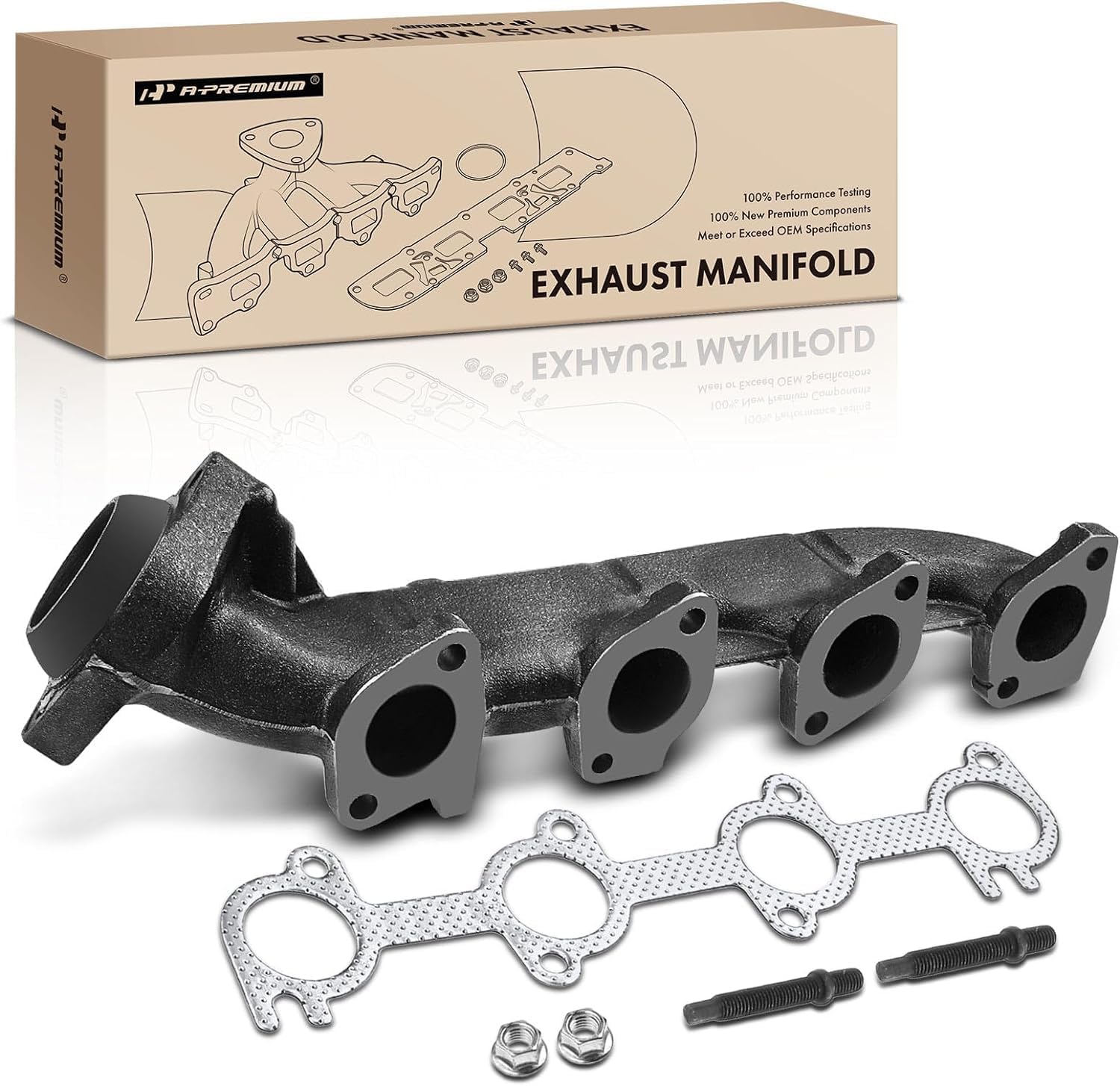
| Material | Cast Iron |
|---|---|
| Fitment | Right side, 5.4L V8 Ford vehicles (listed years) |
| Included | 1 manifold, 1 flange gasket, 2 studs, 2 nuts |
| Grade Type | Standard Replacement |
This A-Premium right-side exhaust manifold is a direct replacement cast iron unit intended for 5.4L V8 Ford vehicles in the listed model years. It bolts to the cylinder head and routes exhaust gases toward the catalytic converter like the factory part. The kit ships with a flange gasket plus two studs and two nuts so you have the basic hardware to install the manifold; the listing notes it does not include a ceramic coating and several reviewers recommend using steel gaskets for longer life. In practice the part is a budget-friendly option that generally fits and seals well on many 5.4L applications, and customers report it cured exhaust leaks and matched factory fitment in most cases. However fitment can be sensitive; a few buyers found flange alignment issues and missing mounting studs when removing stubborn old hardware, so expect to supply replacement studs or bolts in some installs. For routine replacement on an aging F-150 this manifold gets the job done, but plan for basic shop time and fasteners when swapping from an old, rusted original.
Best for: Buyers who want an affordable, factory-style replacement manifold to stop exhaust leaks and restore normal exhaust routing on a 5.4L F-150 and prefer a straightforward part rather than an upgraded performance unit.
Less Ideal for: Those looking for a corrosion-resistant or performance-coated manifold or installers who want a guaranteed drop-in fit without any possibility of replacing old studs or adjusting flange alignment.
- Cast iron construction matches factory material for durability under heat
- Comes with a flange gasket plus studs and nuts to simplify installation
- Direct replacement design intended for 5.4L V8 Ford fitment
- Strong customer feedback for sealing leaks and restoring exhaust flow
- Does not include ceramic coating which may reduce long-term corrosion resistance
- Some buyers reported flange alignment differences requiring extra work or different fasteners
Verdict: A cost-conscious, factory-style right-side replacement manifold that reliably fixes leaks on 5.4L F-150s when you are prepared to supply or replace old fasteners during installation.
Choosing the Right 2004-2008 Ford F-150 Exhaust Manifold: Key Factors to Consider
Fitment and Flange Geometry
Correct fitment is critical on the 2004-2008 Ford F-150 because flange alignment and port shape directly affect sealing and exhaust flow. A manifold with accurate flange geometry sits flush against the cylinder head and reduces stress on studs and gaskets. Poorly matched flanges can lead to exhaust leaks that are difficult to resolve without machining or adapter plates.
When evaluating fit, account for the model year variations in port spacing and bolt patterns. Even small misalignments will concentrate loads on a few studs and increase the chance of warping or cracking over time. For installations where hardware is reused, check that flange tolerances will not force excessive torque or deformation in the original studs.
Material and Construction
The material determines how the manifold handles heat cycles and resists cracking. Cast iron provides good thermal mass and damping but can be vulnerable to stress fractures if surface defects exist. High-quality ductile iron variants improve strength and thermal fatigue life. Fabricated steel headers or manifolds can offer lighter weight and faster heat rejection but must use proper welds and thicker flanges to avoid distortion.
Pay attention to construction details such as reinforced flange areas, uniform wall thickness, and quality of welds on fabricated pieces. These elements reduce the likelihood of hairline cracks that often start at stress risers around ports or bolt bosses.
Heat Management and Coatings
How the manifold handles heat affects nearby components and engine bay temperatures on the F-150. Manifolds that retain excessive heat increase under-hood temperatures, which can accelerate wear on hoses and electronics. Conversely, units designed to shed heat or equipped with thermal coatings help manage temperatures and preserve surrounding parts.
Ceramic coatings or high-temperature paints serve two purposes: they reduce radiant heat transfer and protect the metal from oxidation. Consider whether the coating is applied inside and out or only externally, as internal coating longevity varies. Also review whether a manifold's design interferes with existing heat shields or requires reshaping of adjacent panels.
Sealing and Gasket Compatibility
A reliable seal prevents exhaust gas intrusion into the cabin and avoids performance losses. Gasket compatibility with the manifold and the F-150 cylinder head bolt pattern is essential. Some manifolds accept OEM-style multi-layer steel gaskets easily, while others require thicker or asymmetrical gaskets that complicate installation.
Evaluate the compression surface finish and whether manufacturers recommend torque sequences or anti-seize products. Consistent clamping across the flange reduces the chance of leaks. Also consider flange flatness specifications and whether the manifold includes alignment dowels or boss features that aid correct installation.
Resistance to Cracking and Fatigue
Thermal cycling on 2004-2008 F-150 engines produces repeated expansion and contraction, which is the leading cause of manifold cracks. Design elements that reduce stress concentration—such as generous fillets, uniform wall thickness, and proper bolt spacing—improve fatigue life. Materials with higher fracture toughness will tolerate minor impacts and temperature gradients better.
Check reported failure modes and documented lifespans for comparable constructions. Reinforcements around port transitions and thicker flange sections lengthen service life. If you plan to keep the vehicle for many years, prioritize designs proven to survive the typical highway and towing duty cycles of F-150 ownership.
Serviceability and Installation Complexity
Ease of installation matters for owners who want to do the job themselves or expect minimal shop labor. Manifolds that allow reuse of factory hardware, provide clear bolt access, and do not require removal of unrelated components simplify the job. Units that force disassembly of accessories or require cutting heat shields increase labor time and cost.
Consider whether the manifold comes with necessary hardware or requires special fasteners. Check for clearance with steering and suspension components on the truck. Serviceability also covers repair options: some cast units can be welded and patched while others cannot, so understand whether a damaged manifold can be economically repaired.
Common Symptoms Pointing to a Failing Manifold
Recognizing early signs of manifold trouble helps prevent secondary damage. Typical symptoms on the 2004-2008 F-150 include a sharp ticking or rasping noise during cold starts, increased cabin fumes, drop in low-end torque, and a visible soot buildup around flange joints. These signs often show before catastrophic cracks develop, so addressing symptoms early can be less invasive.
A consistent or worsening leak typically presents as a change in engine note under acceleration and may be more pronounced at idle. Heat-related damage to nearby wiring or vacuum lines can also be a downstream consequence of a failing manifold, so inspect adjacent components when you diagnose an issue.
- Sharp ticking or metallic noise on start
- Exhaust smell inside the cabin
- Black soot or visible leak around flange seams
- Loss of torque at low RPM
When to Replace Versus Repair
Minor flange warping or small, accessible cracks can sometimes be repaired by welding or by machining faces flat and installing a new gasket. However, repairability depends on material and crack location. Cracks near bolt bosses or extending into port openings often compromise the structural integrity and are more reliably addressed with replacement.
Replacement is usually the better option when the manifold has multiple cracks, severe corrosion, or if previous repairs have failed. A new unit also reduces the chance of recurring leaks thanks to fresh sealing surfaces and modern manufacturing tolerances.
- Repair if crack is small and weldable away from ports
- Replace for extensive corrosion, multiple cracks, or failed prior repairs
Installation Tips for the 2004-2008 F-150
Prepare the engine by allowing it to cool fully and disconnecting the battery. Clean mating surfaces thoroughly and inspect head studs for straightness and damage. Use high-temperature anti-seize on studs if recommended, but follow torque specs closely to avoid over-compressing gaskets.
Tighten bolts in the correct sequence and in stages to achieve even clamping. If the replacement unit changes the flange thickness, confirm that the torque specification still provides correct gasket compression. Reinstall any heat shields and verify clearance with nearby wiring, lines, and steering components before starting the engine.
- Cool engine fully and disconnect battery
- Clean mating surfaces and inspect studs
- Use proper torque sequence and spec
- Verify heat shield clearance before operation
Impact of Manifold Choice on Emissions and Sensors
On these F-150 years, the manifold position relative to oxygen sensors and downstream emissions components affects warm-up behavior and sensor readings. A design that alters sensor location or routing can change how quickly the sensor reaches operating temperature, which in turn affects closed-loop fueling behavior. Maintain factory sensor placement whenever possible to preserve predictable emissions system operation.
If the manifold modifies ports or requires sensor relocation, ensure the new configuration does not create excessive sensor exposure to exhaust leaks or direct heat that can shorten sensor life. Proper installation and sealing around sensor ports reduce false codes and drivability issues.
- Keep OEM sensor location when possible
- Check sensor wiring clearance from hot surfaces
- Avoid designs that expose sensors to flange leaks
Preparing for a Swap Exhaust Manifold Job
If you plan to swap the exhaust manifold yourself or have it done, gather the required tools and replacement hardware ahead of time. A replacement gasket set, new manifold bolts or studs if recommended, and high-temp thread locker or anti-seize will prevent delays. Account for the time needed to remove heat shields, oxygen sensors, and any obstructing accessories.
Document torque values and sequences for the specific engine in your 2004-2008 F-150. When swapping to a different construction style, double-check for clearance with the steering linkage and A/C lines to avoid surprises during reassembly.
- Have gaskets and recommended hardware on hand
- Remove obstructing components methodically and label fasteners
- Confirm clearances after test fitting before final torque
Still looking for the perfect fit?
Select your Ford F-150 configuration to see the most relevant Exhaust Manifolds recommendations
How We Chose the Best 2004-2008 Ford F-150 Exhaust Manifold
We focused on criteria that matter specifically for the 2004-2008 Ford F-150 platform. Fitment and flange accuracy were primary filters because incorrect flange geometry or port mismatch leads to leaks and premature gasket failure. Heat management followed closely: materials and coating choices influence heat soak into the cylinder head and downstream components on these trucks. Durability and resistance to cracking were assessed via material type and construction method, since the 4.2L/4.6L/5.4L engines in these years experience thermal cycling that commonly causes fatigue.Sealing performance was a separate criterion, including how easily a unit accepts OEM-style gaskets and how the bolt pattern aligns with factory studs. Ease of installation and serviceability were considered, including clearance for heat shields and routing of nearby lines. We excluded units that required extensive modification of mounting points or altered emissions equipment without clear instructions. Finally, customer repair frequency and reported failure modes informed our editorial weighting to favor long-term reliability over short-term improvements.
Our full evaluation process is outlined in our review methodology.
FAQ
How can I tell if my F-150 has an exhaust manifold crack?
Common indicators include a sharp ticking noise on cold start that changes with engine speed, visible soot around the manifold flange, and the smell of exhaust in the cabin. A smoke test or a visual inspection when the engine is cold can help confirm a crack.
Is an exhaust manifold leak dangerous while driving?
An exhaust leak can introduce fumes into the cabin and reduce engine efficiency. Small leaks are often tolerable for short periods, but prolonged exposure risks carbon monoxide intrusion and can damage nearby components due to elevated heat, so address leaks promptly.
Can I reuse the original gasket when replacing the manifold?
Reusing a gasket is not recommended because gaskets compress and conform to surfaces. For reliable sealing on a 2004-2008 F-150, install a new gasket designed for the replacement manifold and follow the correct torque sequence.
Will changing the manifold affect engine performance noticeably?
If the original manifold had significant leaks or severe flow restriction, replacing it often restores lost torque and improves throttle response. Upgrades that alter flow characteristics may change power delivery, but results depend on the engine and supporting modifications.
How long does exhaust manifold installation typically take?
Installation time varies by engine and shop experience. A straightforward replacement with good access often takes a few hours, while units requiring removal of accessories or heat shields can take longer. Unexpected seized fasteners will also increase labor time.
What are signs that a recent repair did not fix the problem?
Recurring ticking noises, persistent exhaust smell in the cab, or repeat check engine lights after a repair suggest incomplete sealing or an adjacent issue. Reinspect the flange faces, torque values, and surrounding components to ensure the repair addressed the actual failure point.
Final Verdict
For the 2004-2008 Ford F-150, prioritize a manifold that matches the factory flange geometry, offers robust material construction, and provides reliable sealing for long-term use. Balance heat management with durability: a design that sheds or isolates heat without sacrificing structural strength will reduce downstream failures.When deciding between repair and replacement, factor in the crack location and the extent of corrosion. If you plan to keep the truck long term or tow frequently, choose a unit built to resist thermal fatigue and accept OEM-style gaskets to simplify service and lower the risk of repeat leaks.
Explore More:
- Check out all Ford F-150 parts & accessories
- Explore Exhaust Manifolds Maintenance & Repair Guides
- Explore Exhaust & Emissions
- Browse all Auto Parts
