

Note: This article contains affiliate links. If you click on these links and make a purchase, I may earn a small commission at no extra cost to you. This helps support my research and content. Read my full affiliate disclosure here.
A dash cam is one of the simplest upgrades you can add to a Ford Explorer to improve safety, document incidents, and capture memorable drives. The right Ford Explorer dash cam records clear video, handles start-stop traffic, and stays unobtrusive on the windshield or dash. It also needs to be straightforward to install and maintain so you are more likely to use it every time you drive.This guide shortlists seven top options that suit Explorer owners, focusing on video quality, mounting and placement, power options, and features like loop recording and Wi-Fi. Below you will find practical evaluation points to help you choose the best dash cam for your driving style and needs, followed by detailed buying guidance and common owner questions.
Looking for other parts? See all Ford Explorer parts & accessories.
Top Picks at a Glance
| Best Overall Dash Cam The best all-around dash cam balancing features, reliability, and ease | mangoal Front 4K & Rear 1080p Dash Cam for Ford Explorer (2020-2024) |  |
| Best Budget Dash Cam A low-cost option that still records dependable footage | ROVE R2-4K DUAL Front and Rear Dash Cam with 128GB Card |  |
| Best Premium Dash Cam A high-end unit with top video quality and advanced features | VANTRUE N5S 4-Channel 360° Dash Cam with STARVIS 2 Night Vision |  |
| Best Compact Dash Cam A small, low-profile camera that hides easily behind mirrors | VANTRUE E1 Pro 4K Mini Dash Cam with STARVIS 2 and 5G WiFi |  |
| Best Dual-Channel Dash Cam Front-and-rear recording system for complete incident coverage | mangoal Model D Dual-Channel Dash Cam (4K Front / 2K Rear) — Ford Explorer Fit |  |
| Best 4K Dash Cam Ultra-high-resolution recording for maximum detail and clarity | FITCAMX Integrated 4K Dash Cam for Ford Explorer (2011–2023) |  |
| Best Parking Mode Dash Cam Reliable parked-vehicle monitoring with motion or impact detection | 70mai A810 Lite 4K Front and Rear Dash Cam with 4G LTE and 5GHz Wi‑Fi 6 |  |
1. mangoal Front 4K & Rear 1080p Dash Cam for Ford Explorer (2020-2024)
Best Overall Dash Cam

| Compatible with Vehicle Type | Ford Explorer U625 2020–2024 |
|---|---|
| Video Capture Resolution | Front 4K and Rear 1080P |
| Field Of View | 150 Degrees |
| Connectivity Technology | Wi-Fi |
| Included Memory Card Size | 128 GB |
This mangoal dash cam is built to integrate into the Ford Explorer U625 (2020–2024) and combines a 4K front sensor with a 1080p rear camera for clear daytime and improved low-light footage. It mounts behind the rearview mirror for a concealed, factory-style install and includes a GPS module, OBD power adapter, and a preloaded 128GB microSD card so you can use it right away. The unit uses built-in WiFi and a free app for previewing and downloading clips while the car is running, and supports loop recording, G-sensor automatic incident locking, parking monitoring, and motion detection. Practical benefits include a wide 150-degree field of view, app-based settings (no physical buttons), and STARVIS-grade imaging for cleaner night captures. Limitations to expect are vehicle-specific fitment so it will only suit the listed Explorer models and the camera WiFi only works locally with the engine on; live preview in the app is compressed so full-quality files must be retrieved from the camera files. Overall it balances high-resolution front recording and a tidy OEM appearance for owners who want a reliable, integrated solution.
Best for: Buyers who want a clean, factory-style dash cam with high-resolution front video and straightforward DIY install for a Ford Explorer 2020–2024, prioritizing integrated appearance and dependable recording.
Less Ideal for: Drivers looking for a universal or multi-vehicle dash cam, or those who need remote WiFi access and live high-quality streaming to their phone from outside the car.
- True 4K front recording for detailed daytime footage
- Custom-fit design hides wiring and matches factory appearance
- Includes GPS module and 128GB microSD card for immediate use
- Built-in WiFi and mobile app for quick clip download and configuration
- Parking monitor, G-sensor, and loop recording protect incident footage
- Fitment is specific to Ford Explorer U625 2020–2024 and will not fit other vehicles
Verdict: The best all-around dash cam that balances video quality, reliability, ease of installation, and useful features for most drivers and DIY installers.
2. ROVE R2-4K DUAL Front and Rear Dash Cam with 128GB Card
Best Budget Dash Cam

| Front resolution | 4K 3840×2160 @30fps |
|---|---|
| Rear resolution | 1080P 1920×1080 @30fps |
| Sensor | Sony STARVIS 2 (IMX675) |
| Storage support | Up to 1TB microSD |
| Connectivity | USB, Wi-Fi (dual-band 2.4/5GHz) |
The ROVE R2-4K DUAL is a dual-channel dash cam designed to give clear daytime footage without a lot of fuss. It records the front view at 4K/30fps and the rear at 1080p/30fps, so you get detailed evidence for incidents and traffic interactions while driving your Ford Explorer. The Sony STARVIS 2 sensor plus wide apertures improve clarity in bright and mixed lighting, and built-in GPS stamps speed and route onto recordings for easy playback in ROVE's GPS player. Setup is straightforward using the included mounts and long rear extension cable, and the 3" IPS screen and 5GHz WiFi let you preview and quickly download clips to the ROVE app. For parked-vehicle coverage it supports three parking modes but requires a separately sold hardwire kit for true 24/7 monitoring. The unit uses a supercapacitor for better heat tolerance than small batteries, and a free 128GB card is handy for first use. If you want solid, easy-to-use daytime recording and basic parking alerts for an Explorer, this delivers without complicated extras.
Best for: Budget-minded Ford Explorer drivers who want dependable, high-resolution daytime recording and simple app-based file access without advanced fleet features.
Less Ideal for: Drivers who need true continuous battery-backed parking surveillance or specialists who require integrated fleet telematics should consider other solutions.
- 4K front and 1080p rear simultaneous recording for clear daytime evidence
- Sony STARVIS 2 sensor and wide apertures for improved image quality in varied light
- Built-in GPS which overlays speed and route for playback with location data
- Includes a 128GB microSD card and long rear extension cable for easier installation
- 5GHz WiFi and ROVE app enable fast on-phone downloads and firmware updates
- Full 24/7 parking mode requires a separately sold hardwire kit
- High-resolution files can consume large amounts of storage without frequent offload
Verdict: The best low-cost dash cam that provides dependable daytime recording and simple features for budget-conscious buyers who still want basic protection.
3. VANTRUE N5S 4-Channel 360° Dash Cam with STARVIS 2 Night Vision
Best Premium Dash Cam

| Video Capture Resolution | 2.7K+1080P+1080P+1440P |
|---|---|
| Field Of View | 360 Degrees |
| Other Special Features of the Product | STARVIS 2 Night Vision, Dual GPS, Supercapacitor, Buffered Parking Mode |
| Flash Memory Supported Size Maximum | 1 TB |
| Control Method | App, Voice |
The VANTRUE N5S is a premium 4‑channel dash cam package that gives full 360° coverage by combining a 2.7K front sensor, a 2.5K rear sensor, and dedicated inside and rear-cabin cameras. It is normally mounted to the windshield with an adhesive GPS mount and runs with flexible recording modes (1CH–4CH) so you can prioritize front-only or full-coverage capture. STARVIS 2 sensors and HDR/WDR processing improve low-light license plate legibility and cabin visibility, while 5GHz WiFi plus the Vantrue app makes file transfer and GPS-tagged trip logs faster. Built-in buffered parking mode with pre-recording captures events when the vehicle is off, and the supercapacitor design boosts temperature tolerance for long-term reliability. Trade-offs are the need to hardwire the unit for true 24/7 protection and that four-channel recording demands a high-capacity microSD card and more frequent file management. Installation on an SUV like a Ford Explorer is straightforward but may require routing the long rear camera cable and choosing optional suction mounts for nonstandard glass angles.
Best for: Buyers who prioritize the highest video fidelity, comprehensive incident coverage, and robust construction for long-term use in an SUV such as the Ford Explorer.
Less Ideal for: Casual drivers who want a simple single-channel dash cam with plug-and-play installation and minimal storage management.
- True 360° coverage with four independent cameras for front, rear, inside, and rear-cabin monitoring.
- STARVIS 2 sensors and HDR/WDR deliver stronger low-light performance and clearer license plate capture at moderate speeds.
- 5GHz WiFi and app support speed up transfers and let you view GPS-tagged footage and mileage reports.
- Buffered 24/7 parking mode with pre-recording and G-sensor locking preserves incidents while parked.
- Supercapacitor and heat-resistant design improve durability in hot or cold climates.
- Full-time parking protection requires a separate hardwire kit to access vehicle battery power when off.
Verdict: The best premium dash cam for buyers who want top-tier video resolution, advanced driver-assist features, and the highest build quality regardless of price.
4. VANTRUE E1 Pro 4K Mini Dash Cam with STARVIS 2 and 5G WiFi
Best Compact Dash Cam

| Video Capture Resolution | 1440p, 2160p |
|---|---|
| Field Of View | 158 Degrees |
| Control Method | App, Remote, Voice |
| Flash Memory Type | microSD |
| Flash Memory Supported Size Maximum | 1 TB |
The VANTRUE E1 Pro is a coin-sized front dash cam designed for drivers who want a low-profile install that still records high-resolution evidence. It captures 4K/30fps video using a STARVIS 2 sensor and PlatePix processing to improve plate legibility, and the 158 degree lens covers a wide view without dominating the windshield. You control and download clips via built-in 5G WiFi and the Vantrue app, while GPS logs speed and route. The unit supports loop recording, G-sensor incident locking, and a buffered parking mode that records seconds before an event when used with a hardwire kit. A super capacitor improves heat tolerance compared with battery designs and the included CPL filter helps cut windshield glare. Downsides include a tiny 1.54 inch screen that limits on-device playback and a single microSD slot so storage and archival depend on card choice and app transfers. For use in a Ford Explorer the magnetic mount and small footprint make it easy to hide behind the rearview mirror for an unobstructed view and minimal interior clutter.
Best for: Drivers who want a near-invisible, space-saving installation that still delivers clear daytime and nighttime evidence for routine and parking protection in their vehicle.
Less Ideal for: People who need multi-channel or cabin-facing coverage or those who prefer large on-screen controls and local playback instead of app-based management.
- True 4K/30fps recording with STARVIS 2 sensor for strong low-light detail
- PlatePix processing and F1.8 lens improve license plate readability
- Compact, coin-sized design and magnetic mount for discreet windshield placement
- Built-in 5G WiFi and GPS for fast clip transfer and route logging
- Buffered parking mode with pre-record feature when hardwired
- Small 1.54 inch display limits on-camera review and menu navigation
- Only one microSD slot so managing long-term storage requires large cards or frequent offload
Verdict: The best compact dash cam for drivers who prioritize a discreet, space-saving install without sacrificing essential recording performance.
5. mangoal Model D Dual-Channel Dash Cam (4K Front / 2K Rear) — Ford Explorer Fit
Best Dual-Channel Dash Cam
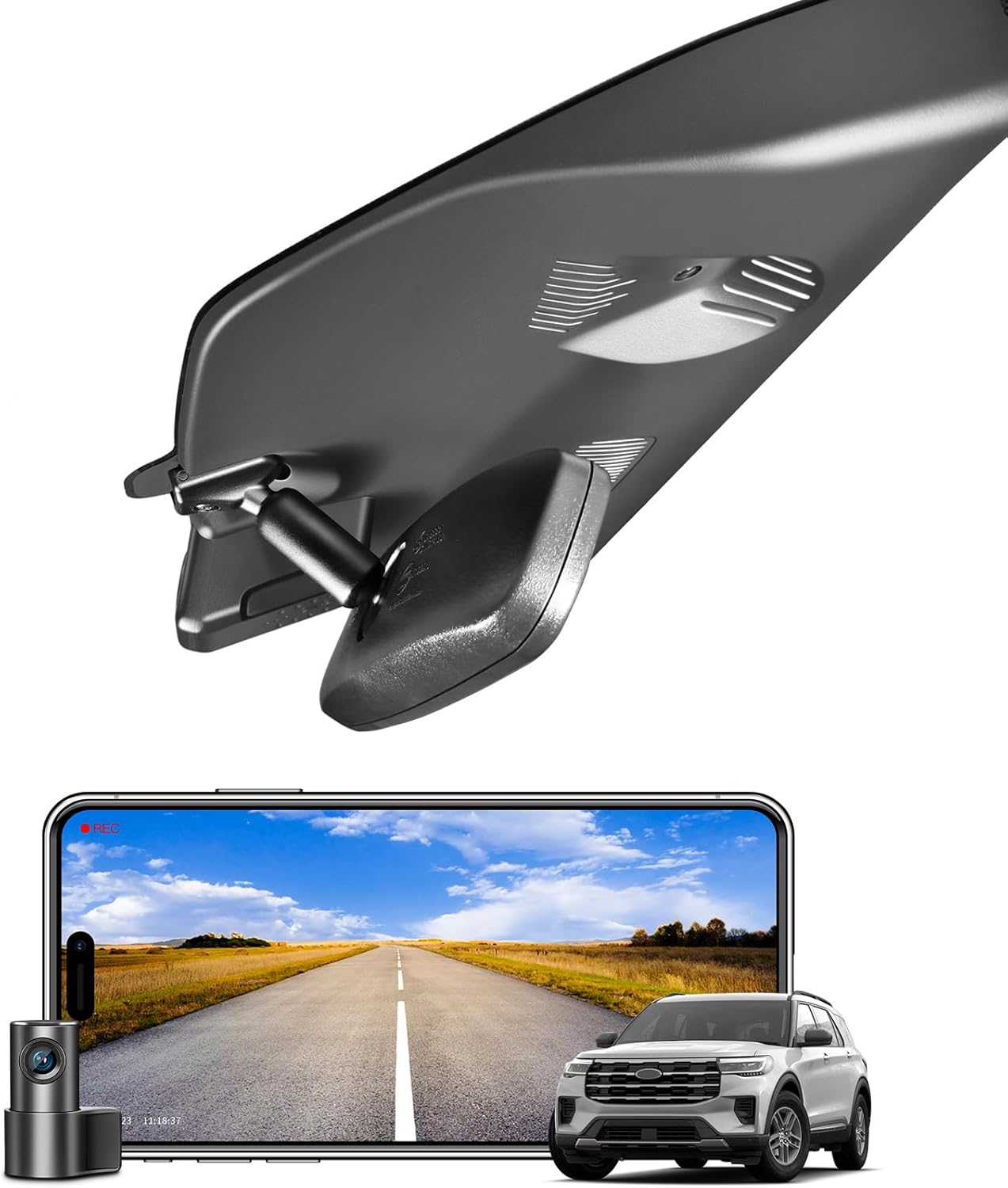
| Compatible with Vehicle Type | Ford Explorer U625 2025 2026 |
|---|---|
| Video Capture Resolution | Front 4K and Rear 2K |
| Other Special Features of the Product | STARVIS 2 sensors, HDR 2.0, Parking Monitor, G-sensor |
| Connectivity Technology | Wi-Fi (5GHz) |
| Control Method | App |
This mangoal Model D is a hardwired dual-channel dash cam designed to integrate neatly behind the rearview mirror of the 2025–2026 Ford Explorer. It records the front view at 4K 30fps and the rear at 2K 30fps using STARVIS 2 sensors for improved low-light performance and HDR 2.0 to balance highlights and shadows. Typical use is continuous loop recording with automatic incident detection and a G-sensor that locks clips on impact, plus a parking monitor for unattended protection. Built-in GPS logs speed and route, while 5GHz Wi-Fi and an app let you preview and download footage without removing the card. The package includes a 128GB card, rear camera, and vehicle-specific adapters for a clean OEM-style installation, and the unit supports up to 512GB. Expect cinematic clarity for license plates in many conditions, but installation requires vehicle-specific connectors and some trimming to hide cables, and advanced features like parking surveillance depend on correct hardwiring or the included adapters.
Best for: Drivers who want reliable, synchronized front-and-rear evidence capture and a clean, factory-style installation on a 2025–2026 Ford Explorer.
Less Ideal for: People who need a simple plug-and-play dash cam without any vehicle-specific hardwiring or those who use multiple vehicle models and need a universal mount.
- Synchronized dual-channel recording with 4K front and 2K rear captures detailed footage from both directions
- STARVIS 2 sensors plus HDR 2.0 improve night and high-contrast recordings
- OEM-style fit for Ford Explorer U625 2025–2026 for a clean, factory-integrated installation
- 5GHz Wi-Fi and companion app enable fast live preview and file transfer to a smartphone
- Includes 128GB card, rear camera, and vehicle-specific adapters to simplify hardwired setup
- Fully featured parking monitoring and continuous protection require proper hardwiring or use of included adapters
- Some users may need professional help to achieve concealed wiring and full integration
Verdict: The best dual-channel dash cam for those who want synchronized front and rear video recording to capture incidents from both directions.
6. FITCAMX Integrated 4K Dash Cam for Ford Explorer (2011–2023)
Best 4K Dash Cam

| Compatible with Vehicle Type | Ford Explorer 2011-2023 with Auto Dimming/Rain Sensor |
|---|---|
| Video Capture Resolution | 2160p |
| Frame Rate | 30 fps |
| Field Of View | 160 Degrees |
| Flash Memory Supported Size Maximum | 128 GB |
This FITCAMX integrated dash cam replaces the factory rearview housing on Ford Explorer models with auto-dimming or rain-sensor mirrors and records up to 2160p at 30 fps for very high-detail footage. It mounts in the ceiling to stay discreet and uses a CMOS sensor with an f/1.6 aperture and WDR processing to improve low-light clarity and contrast, which helps when trying to capture license plates and distant signs. Built-in WiFi and the FITCAMX app let you preview and download clips without removing the card, and automatic recording starts with the vehicle so it works hands-off. The unit supports loop recording, a G-sensor that locks collision clips, and ships with a 64 GB microSD card while supporting up to 128 GB. Expect a factory-like fit, straightforward app control, and strong daytime detail; there is no advertised parking mode unless upgraded through the manufacturer, so it will not record while the vehicle is off without extra options.
Best for: Buyers who prioritize the highest-resolution dash cam footage to reliably capture small details and who want a discreet, factory-style installation matched to Ford Explorer models with auto-dimming or rain-sensor mirrors.
Less Ideal for: Drivers who need continuous parked-vehicle surveillance out of the box or who prefer a universal plug-and-play dash cam that moves between vehicles frequently.
- True UHD 2160p capture for fine detail like license plates at range
- Discrete integrated ceiling mount with OEM appearance
- Built-in WiFi and mobile app for easy previewing and file transfer
- G-sensor locks collision footage and loop recording manages storage automatically
- Includes 64 GB microSD and supports up to 128 GB for extended recording
- No built-in parking surveillance mode unless arranged with the manufacturer
Verdict: The best 4K dash cam for buyers who need the highest-resolution footage to capture fine details like license plates and distant objects.
7. 70mai A810 Lite 4K Front and Rear Dash Cam with 4G LTE and 5GHz Wi‑Fi 6
Best Parking Mode Dash Cam

| Video Capture Resolution | 1080p, 2160p |
|---|---|
| Connectivity Technology | 5GHz Wi-Fi 6 |
| Other Special Features of the Product | 24H Parking Mode, G-Sensor Protection, Loop Recording, 4G LTE Support |
| Field Of View | 140 Degrees |
| Included Memory Card Size | 64 GB |
The 70mai A810 Lite is a compact dual dash cam system designed to keep a parked Ford Explorer monitored and provide high-resolution evidence when driving. The front camera records in true 4K while the rear captures 1080p; HDR plus an f/1.55 aperture improves night and tunnel detail. It connects to a phone over 5GHz Wi‑Fi 6 for faster downloads and supports optional 4G LTE remote access and live view when paired with the compatible hardwire kit. Built-in 3-mode GPS logs location and speed, voice control lets you operate hands-free, and a supercapacitor improves reliability in extreme temperatures. For parked-vehicle surveillance it offers 24-hour parking mode with G-sensor impact-triggered locking and time-lapse low-power recording, plus loop recording and low-voltage protection to avoid draining the Explorer battery. Trade-offs include needing a hardwire kit for full remote and true 24/7 use and the usual installation routing for the rear camera, but for drivers prioritizing clear evidence capture and remote monitoring this unit covers the essentials well.
Best for: A Ford Explorer owner who wants dependable parked-vehicle surveillance and clear day/night evidence, and who values remote access and robust recording when the vehicle is unattended.
Less Ideal for: Drivers who need a completely plug-and-play parking solution without any hardwiring or who prefer a simpler single-camera setup for short trips.
- True 4K front recording with 1080p rear for clear license-plate and sign detail.
- Enhanced low-light performance via HDR and a large f/1.55 aperture.
- 5GHz Wi‑Fi 6 for faster in-car transfers and app access.
- 24-hour parking modes with G-sensor impact locking and time-lapse low-power recording.
- Supercapacitor power design improved heat tolerance and longevity versus battery-based units.
- Requires an optional hardwire kit to enable full 4G remote live view and continuous hardwired parking monitoring.
Verdict: The best parking mode dash cam for owners who want dependable parked-vehicle surveillance and incident capture using motion, impact, or low-power recording modes.
Choosing the Right Ford Explorer Dash Cam: Key Factors to Consider
Video Resolution and Low-Light Performance
Video resolution determines how much detail the camera captures, which affects whether you can read license plates or see facial features in an incident. For a Ford Explorer, prioritize dash cams that deliver at least 1080p daytime footage and maintain usable detail at night. Low-light performance is driven by the sensor quality, aperture, and software processing. Better low-light footage reduces the chance of unusable clips from evening commutes or poorly lit parking areas.
Also consider frame rate. Higher frame rates help with smooth playback and can make it easier to discern fast-moving details. Keep in mind file sizes increase with resolution and frame rate, so ensure your storage plan or card capacity matches the camera's output.
Mounting, Field of View, and Placement
Mount location on the windshield or dashboard influences the camera's field of view and how unobtrusive it is while driving. The Ford Explorer has a tall windshield and driver assistance sensors near the rearview mirror; choose a compact dashboard camera or a low-profile mount that does not block sightlines or sensors. A slightly higher mounting position behind the rearview mirror often gives the best centered view without drawing attention.
Field of view matters for coverage. A wider angle captures more of the road and adjacent lanes but can introduce edge distortion. For an Explorer, a balanced field of view that captures the lane ahead and some side area is typically best for incident context without excessive fisheye warping.
Power Options and Installation
Dash cams can be powered using the vehicle's 12V accessory outlet, a hardwire kit to the fuse box, or internal battery/capacitor systems for short-term parking mode. For Explorer owners who want continuous parking surveillance or event recording while away from the vehicle, a hardwire connection with a proper fuse tap and a low-voltage cutoff is the most reliable option. If you prefer a plug-and-play setup, choose a camera with an easily accessible 12V adapter and tidy cable routing.
Installation ease affects long-term use. Cameras that require complex routing or frequent removal for charging tend to get neglected. Assess how much professional installation you are willing to do versus DIY, and whether the camera includes adhesive vs suction mounts that suit your dash surface.
Event Detection, Loop Recording, and Storage
Event detection via a G-sensor locks files when sudden acceleration, braking, or impact occurs so those clips are not overwritten. Loop recording is essential because it automatically overwrites the oldest files when the memory card fills, ensuring continuous recording without manual intervention. For Explorer owners, reliable event locking prevents overwrites of crucial evidence after collisions or road incidents.
Consider supported memory card sizes and file management. Cameras that support large microSD cards and record in manageable file segment lengths will be easier to maintain. Also look for options to manually protect files or to back them up through Wi-Fi or a companion app.
Connectivity and User Controls
Built-in Wi-Fi and companion apps make it easier to review, download, and share footage without removing the memory card. For occasional trips where you want to capture scenic drives or immediately transfer an incident clip, this convenience can be decisive. However, app stability and transfer speed vary across manufacturers, so prioritize solutions with straightforward interfaces and reliable updates.
Physical controls and on-device menus matter for quick adjustments. A simple menu, intuitive button layout, and clear status indicators reduce in-car distraction. If you plan to change settings often, a camera with a responsive app plus usable on-device controls is the best balance.
Durability, Heat Tolerance, and Warranty
Electronics inside a dash cam are exposed to wide temperature swings, especially in a vehicle that spends time parked in sun or winter cold. Heat tolerance is crucial to avoid sudden shutdowns or sensor damage. Look for cameras with capacitors rather than small batteries where longevity in heat is a concern. A solid manufacturer warranty and clear support channels are valuable because repairs or replacements can be inconvenient for vehicle owners.
Also consider build materials and lens protection. A camera that resists vibration and has a secure mount will maintain alignment and image quality over time, which matters for long-term reliability in the Explorer.
Placement Tips For The Ford Explorer Windshield
Positioning the dash cam correctly on an Explorer affects both coverage and compliance with local windshield obstruction laws. Aim to mount the camera just behind the rearview mirror or slightly lower on the passenger side so it captures the forward lane without intruding into the driver's field of view. Test the view with passengers and driver seat adjustments to ensure the camera does not block sensors or mirrors.
Hide cables along the headliner and A-pillar trim to keep the interior tidy and prevent cable snagging. If you use a suction mount, verify the suction stays secure with temperature changes; adhesive mounts provide a more permanent mounting but are harder to reposition.
- Mount behind the rearview mirror for centered footage
- Avoid blocking ADAS sensors or sightlines
- Route cables under trim for a clean install
When To Use Front-Only Versus Front-and-Rear Cameras
Front-only cameras are usually easier to install and sufficient for most collision documentation since the majority of incidents involve forward-facing events. They are also a good choice if you prefer a compact dashboard camera with minimal wiring.
Front-and-rear solutions add coverage for rear-end collisions and hit-and-run scenarios while parked. If you frequently drive in congested urban areas or want more complete coverage during road trips, a dual-camera setup can provide extra context. Keep in mind rear cameras require routing cable to the back of the vehicle and may need professional installation for a seamless look.
- Choose front-only for simpler installs and primary incident capture
- Add rear camera for comprehensive coverage and parking incidents
Managing Footage: Cards, File Sizes, and Backup
Recording at higher resolutions and frame rates increases file sizes quickly. For an Explorer owner who records many short trips, choose a camera supporting larger microSD cards and predictable file segment lengths to avoid frequent maintenance. Class 10 or UHS speed-rated cards help prevent dropped frames during continuous recording.
Consider a routine for backing up important clips. Wi-Fi enabled dash cams let you transfer critical files to a phone immediately after an incident. Otherwise, keep a spare microSD card or periodically download footage to a computer to maintain a clear card for ongoing use.
- Use high-quality microSD cards with adequate speed ratings
- Regularly back up incident clips to avoid overwrite
- Adjust resolution/frame rate to balance detail and storage
Parking Modes and Power Management
If you want protection while your Explorer is parked, look for dash cams with parking mode options that either sense motion or record on impact. These modes typically require a hardwired connection or a battery pack to function when the vehicle is off. Balance the benefits of overnight monitoring with the risk of battery drain by choosing systems with low-voltage cutoffs or time-limited recording.
Some compact dashboard cameras offer a buffered parking event that records a short pre- and post-event clip using an internal capacitor rather than a battery. That approach reduces long-term heat sensitivity and maintenance while still capturing critical moments during brief parking incidents.
- Hardwire for reliable 24/7 parking surveillance
- Use low-voltage protection to prevent vehicle battery drain
- Consider capacitor-based units for improved heat tolerance
Legal and Privacy Considerations
Laws about recording audio and visible camera placement vary by region. Make sure to follow local regulations regarding audio recording and mounting visibility. When using features that upload footage to cloud services, understand privacy policies and how long data is retained.
If you record passengers, notify them when required by law. Keep sensitive footage secure by using password-protected apps or transferring critical clips to private storage rather than leaving them on a device connected to cloud services.
- Check local rules on in-car audio recording
- Secure footage stored in apps or cloud services
- Inform passengers when legally required
How We Chose the Best Ford Explorer Dash Cam
We evaluated candidates based on criteria that matter to Ford Explorer owners and daily driving conditions. Primary evaluation points included video resolution and low-light performance, since clear footage is the core function of any dash cam. We prioritized devices providing consistent 1080p capture or better, good dynamic range, and usable night footage.Mounting and placement flexibility was another key filter. We looked for compact dashboard cameras and unobtrusive mounts that fit the Explorer windshield geometry without blocking sightlines or interfering with driver assistance sensors. Power and wiring options were assessed to ensure reliable operation during short trips and when using parking or hardwire modes.Feature criteria included dependable loop recording, G-sensor event locking, and convenient connectivity such as Wi-Fi for easy footage transfer. We also considered build quality, warranty, and user control simplicity so owners can operate the device without frequent adjustments. Exclusions: devices lacking event-locking, poor low-light performance, or unclear wiring options were removed from consideration. The final picks balance real-world usability, consistent recording reliability, and install practicality for the Ford Explorer.
Our full evaluation process is outlined in our review methodology.
FAQ
Will a dash cam affect my Explorer's ADAS sensors or airbags?
A properly mounted dash cam positioned behind the rearview mirror or slightly lower should not interfere with ADAS sensors or airbags. Avoid adhesive placement directly over sensors, and follow both the vehicle and camera manufacturer guidance for safe mounting locations.
How much storage do I need for daily driving in the Explorer?
Storage needs depend on resolution and frame rate. For 1080p recording at standard frame rates, a 32GB to 64GB microSD card typically covers daily commutes, while long road trips or 1080p at higher frame rates may require 128GB or more. Use loop recording to manage space automatically.
Is hardwiring necessary for parking mode on the Explorer?
Hardwiring is usually required for continuous parking surveillance because the camera needs a steady power source when the ignition is off. Some models offer short-term buffered parking capture using internal capacitors that do not require hardwiring, but they provide limited recording time compared with a properly installed hardwire kit.
Can I use the dash cam's Wi-Fi to download clips on the road?
Many dash cams include Wi-Fi that lets you connect to a smartphone app to review and download clips. Performance varies, but this is useful for quickly saving footage after an incident without removing the card. Large files may take longer to transfer over Wi-Fi.
What is the best placement to minimize fingerprints and glare?
Mounting behind the rearview mirror or slightly off-center on the passenger side reduces the chance of passenger contact. Use a polarizing filter or check for camera models with anti-glare lens coatings if windshield reflections are a regular issue in your driving environment.
How do I maintain a dash cam in extreme temperatures?
Parked vehicles can reach high interior temperatures, so choose a camera with a capacitor-based power system and rated operating temperatures. Avoid leaving exposed suction mounts and keep firmware updated to benefit from manufacturer stability improvements in heat management.
Final Verdict
Prioritize video clarity, reliable event locking, and a mounting solution that fits the Ford Explorer's windshield when choosing a dash cam. Decide whether a front-only camera meets your needs or if a front-and-rear setup is worth the extra wiring for additional coverage. Balance parking mode capabilities with installation complexity and power management to avoid battery drain.Focus on durable hardware, straightforward controls, and practical connectivity so you can access footage when it matters. Using the decision factors above will help you select a dependable dash cam that provides clear evidence and consistent operation for daily driving and road trips in your Explorer.
Explore More:
- Check out all Ford Explorer parts & accessories
- Explore Electronics
- Browse all Accessories
