

Note: This article contains affiliate links. If you click on these links and make a purchase, I may earn a small commission at no extra cost to you. This helps support my research and content. Read my full affiliate disclosure here.
Picking the right coolant for your Ford F-150 matters because it directly affects engine temperature regulation, corrosion control, and long-term reliability. Using an appropriate formula helps maintain consistent cooling under load, reduces the risk of overheating, and protects aluminum and alloy components inside the cooling system.This guide covers seven shortlisted coolants that meet common performance and compatibility needs. We evaluated each option on freeze and boilover protection, corrosion inhibition, and chemical compatibility with typical F-150 cooling system materials. Read on for what to look for and how to choose the best fit for your truck.
Looking for other parts? See all Ford F-150 parts & accessories.
Top Picks at a Glance
| Best Overall The best all-around choice for most situations | Zerex Dex‑Cool Antifreeze/Coolant 50/50 Ready‑to‑Use – 1 Gallon |  |
| Best Quality Built to a higher standard if you want something more solid | Ford Genuine Antifreeze/Coolant VC-13DL-G |  |
| Best Value The sweet spot between price and what you get | PEAK OET Extended Life Gold 50/50 Prediluted Antifreeze/Coolant, 1 Gal |  |
| Best Budget The cheapest option that still gets the job done reliably | Prestone MAX Asian Green 50/50 Antifreeze Coolant (Premixed) |  |
| Highest Rated A top-rated pick with lots of positive feedback | PEAK OET Extended Life Orange 50/50 Prediluted Antifreeze/Coolant, 1 Gal. |  |
| Most popular A crowd favorite that many people choose with confidence | Motorcraft (Ford) VC-7-B Concentrated Antifreeze/Coolant – 1 Gallon |  |
| Best Seller A high-volume bestseller chosen again and again | PEAK OET Extended Life Orange Concentrate Antifreeze/Coolant (1 gal) |  |
1. Zerex Dex‑Cool Antifreeze/Coolant 50/50 Ready‑to‑Use – 1 Gallon

| Volume | 1 gallon |
|---|---|
| Mix | 50/50 ready‑to‑use |
| Technology | Organic Acid Technology (OAT) |
Zerex Dex‑Cool is a factory‑replacement style, ready‑to‑use coolant based on Organic Acid Technology (OAT) designed for modern passenger cars and light trucks. It is typically poured straight from the gallon container for topping off or after a full system flush and supplies protection against corrosion, scale, freezing and boiling without additional mixing. Notable features include an OAT formula that is silicate and phosphate free, compatibility with aluminum components, and a bittering agent to deter ingestion. For a Mazda CX‑9, this coolant would be appropriate only if the vehicle’s manual specifies an orange OAT Dex‑Cool type coolant; used correctly it helps keep radiators and water pumps cleaner and extends service intervals compared with generic fluids. Limitations are that Dex‑Cool is a specific chemistry and must not be mixed with incompatible coolant types, and the orange color and long‑life chemistry mean you should follow Mazda’s recommended change interval and system flush procedures to avoid cross‑contamination.
Best for: Risk‑averse mainstream buyers who prioritize using factory‑matching, long‑life coolants and want a ready‑to‑use product that reduces the chance of installation mistakes.
Less Ideal for: Owners who are uncertain about their Mazda CX‑9 coolant specification or who need a universal or hybrid coolant for mixed systems should consult a dealer or service manual instead of using this product.
- Ready‑to‑use 50/50 mixture eliminates onsite dilution errors
- Organic Acid Technology resists corrosion and protects aluminum cooling components
- Formulated for extended service life compared with conventional IAT coolants
- Pre‑blended bittering agent reduces accidental ingestion risk
- Not compatible with all coolant chemistries so mixing with other types can cause damage
- Orange OAT formula must match Mazda CX‑9 manufacturer coolant specification before use
Verdict: A convenient, factory‑replacement orange OAT coolant for cars that require Dex‑Cool chemistry, but confirm Mazda CX‑9 coolant specs before using.
2. Ford Genuine Antifreeze/Coolant VC-13DL-G

| Brand | Ford |
|---|---|
| Model | VC-13DL-G |
| Manufacturer Part Number | VC-13DL-G |
| Item model number | VC-13DL-G |
This Ford Genuine Antifreeze VC-13DL-G is a factory-grade coolant sold ready for use and intended to replace or top off the cooling system on Ford vehicles. It is typically poured into the radiator or coolant reservoir after the system is cool and is used to protect the engine from overheating and freezing while providing corrosion protection for internal components. The listing and user reports indicate a pre-diluted formulation, so do not add water and avoid mixing with other coolant types. Practical benefits include manufacturer-matched chemistry for Ford engines, simple pour-in serviceability, and broad user satisfaction in street and light-duty applications. Limitations to note are that color and formula have changed over time so compatibility with older fluids should be checked and mixing different coolant formulas can cause issues. Also this is a brand-specific option rather than a universal aftermarket coolant, so it is best used where Ford-recommended fluids are required.
Best for: Performance-oriented Ford owners focused on maintaining factory-compatible cooling performance and corrosion protection during spirited driving or towing.
Less Ideal for: Buyers seeking a universal aftermarket coolant blend, a long-term concentrate for custom mixing, or those who prefer a coolant compatible with multiple manufacturers without checking fitment.
- Manufacturer-formulated for Ford engines which helps ensure chemical compatibility with factory systems
- Sold pre-diluted for immediate use, eliminating the need to measure and mix coolant and water
- Widely reviewed as easy to pour and suitable for routine top-offs and full replacements
- Consistent corrosion protection for engine and cooling components when used as intended
- Not recommended to mix with other coolant types or formulas due to potential chemical incompatibility
- Product color and formulation have changed over time which can cause confusion during fluid matching
Verdict: Choose this Ford genuine antifreeze when you want a factory-matched, ready-to-use coolant for Ford vehicles to preserve cooling-system performance.
3. PEAK OET Extended Life Gold 50/50 Prediluted Antifreeze/Coolant, 1 Gal

| Volume | 1 gallon |
|---|---|
| Dilution | 50/50 prediluted |
| Vehicle fitment | North American vehicles; recommended for Ford and Chrysler |
| Technology | Gold hybrid organic acid technology (HOAT) |
This PEAK OET Extended Life Gold coolant is a ready-to-use 50/50 antifreeze engineered for North American engines, marketed to match Ford hybrid organic acid technology needs. You use it for a flush-and-fill or topping off the cooling system without mixing, which simplifies maintenance and reduces chance of dilution mistakes. The formula claims extended-life protection up to 150,000 miles or five years when installed as part of a complete service and includes corrosion inhibitors to protect radiators, water pumps, and hoses. Being prediluted also makes it convenient for quick service and roadside top-offs. Limitations: it is tuned for North American vehicle chemistries and Ford/Chrysler recommendations, so it is best chosen when your owner's manual specifies a gold or HOAT-type coolant; it is not a concentrate so you cannot tailor freeze/boil point with custom mix ratios. The product includes a bittering agent for safety and has strong user feedback for fitment in Ford trucks.
Best for: Practical optimizers who prioritize straightforward, low-fuss maintenance and want a factory-style extended-life coolant for routine service on Ford trucks.
Less Ideal for: Drivers who need to customize freeze or boil protection with concentrate mixes or whose Ford F-150 manual specifies a different coolant chemistry should choose another product.
- Prediluted 50/50 formula for immediate use and easy top-offs
- Designed for North American vehicles and compatible with Ford/Chrysler HOAT requirements
- Extended-life formulation rated for service up to 150,000 miles or 5 years when used with a full flush
- Contains corrosion and rust inhibitors to protect cooling system components
- Not a concentrate so users cannot adjust mix ratio for extreme climates or custom freeze protection
- Formulated specifically for North American HOAT systems which limits suitability if a different coolant chemistry is required
Verdict: A ready-to-use, extended-life gold coolant tailored to Ford North American cooling systems for hassle-free service and long interval protection.
4. Prestone MAX Asian Green 50/50 Antifreeze Coolant (Premixed)
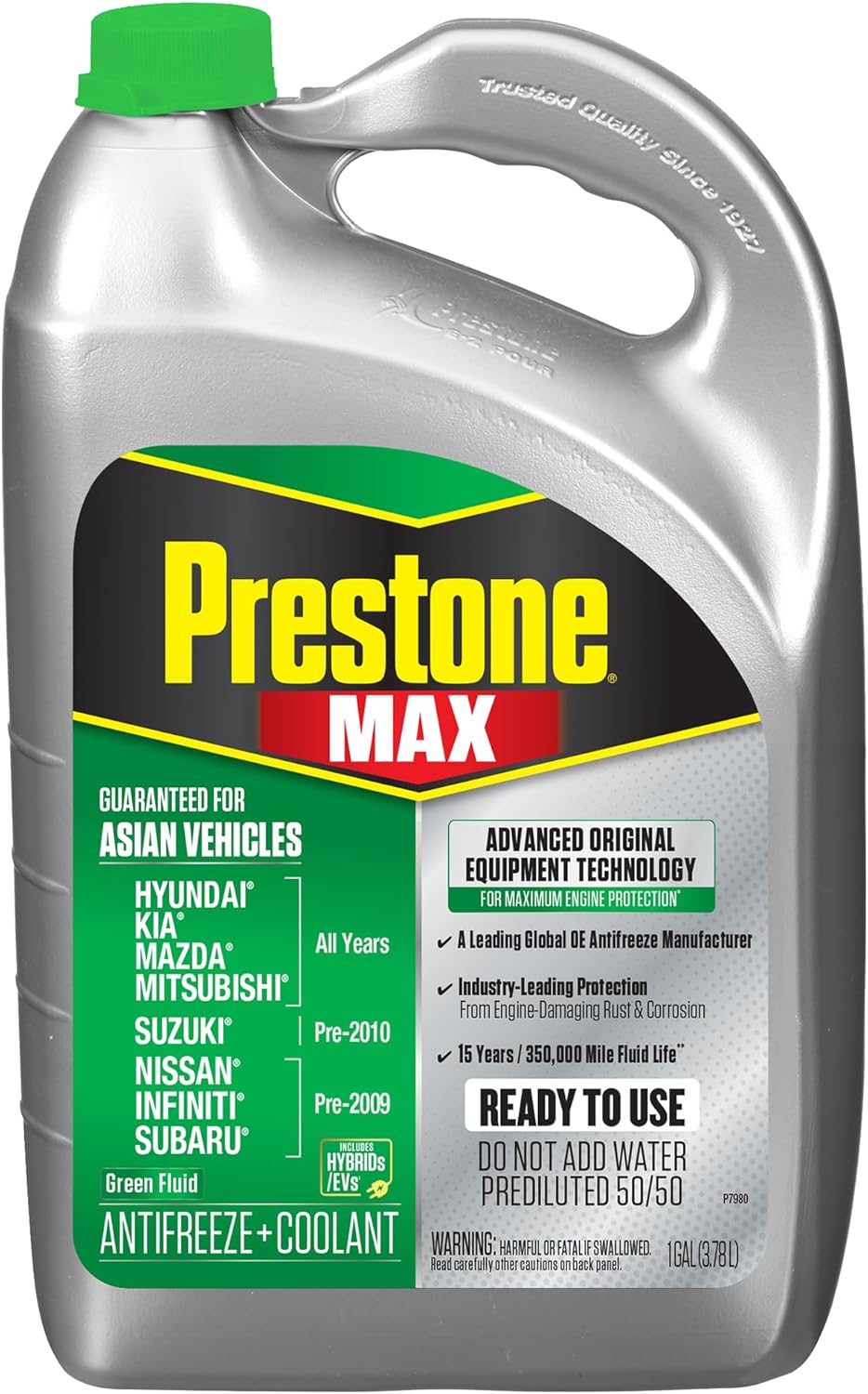
| Brand | Prestone |
|---|---|
| Model | AF6610/F |
| Mixture | 50/50 premixed |
| Color | Asian green |
This Prestone MAX premixed 50/50 antifreeze is a ready-to-use coolant intended to protect an engine from extreme heat and cold while helping reduce corrosion in the cooling system. It is used the same way as other ready-mix coolants — pour into the radiator or overflow reservoir after draining old fluid or topping off as directed. Notable features include Prestone CorGuard corrosion protection and a bitterant to discourage ingestion. The premixed formula saves time and avoids mixing errors, and customer feedback indicates good performance and value compared with dealer fluid. Limitations to be aware of: this is an Asian green formulation designed to match specific factory-type coolants, so compatibility should be confirmed against Ford F-150 fluid requirements before use, and it does not replace manufacturer-specified fluid types that call for other chemistries or colors.
Best for: Budget-conscious owners prioritizing lower-cost, ready-to-use coolant and straightforward maintenance solutions for routine coolant top-offs or full flushes.
Less Ideal for: Owners who must strictly follow Ford factory coolant specifications or who need a coolant type specifically recommended for a particular F-150 model year should choose a factory-specified fluid instead.
- Premixed 50/50 formula ready to install with no on-site mixing required.
- Includes corrosion-inhibiting CorGuard chemistry to protect cooling system components.
- Bitterant added to discourage accidental ingestion.
- Widely reported as a cost-effective alternative to dealer coolant.
- Asian green formulation may not match Ford-approved coolant specifications for all F-150 model years.
Verdict: A premixed, budget-friendly coolant that delivers corrosion protection and convenient, no-mix installation.
5. PEAK OET Extended Life Orange 50/50 Prediluted Antifreeze/Coolant, 1 Gal.

| Volume | 1 gallon |
|---|---|
| Dilution | 50/50 prediluted |
| Technology | Organic Acid Technology (OAT) |
| Intended market | North American vehicles |
This PEAK OET Extended Life Orange coolant is a ready‑to‑use 50/50 prediluted formula designed to protect cooling systems in North American cars. For an Infiniti Q50, it provides corrosion and rust protection and simplifies maintenance because you can pour it straight into the reservoir or use it for a full flush and fill without mixing. The extended‑life chemistry is intended to last longer between services than conventional coolants, and the orange color makes leaks easier to spot. Being formulated for Ford, Chrysler, and GM type OAT systems means it follows an organic acid technology approach; that generally works well in vehicles that specify extended‑life OAT coolants, but you should confirm the Q50 service manual for compatibility before switching. Practical benefits here are the convenience of predilution and broad extended‑life protection, while limitations are color/type differences versus Nissan/Infiniti factory coolant specifications and potential compatibility issues if the Q50 requires a specific OEM formulation.
Best for: Budget‑conscious owners who want an inexpensive, ready‑to‑use extended‑life coolant for routine maintenance and topping off the Q50 cooling system.
Less Ideal for: Owners who prefer to stick strictly to Infiniti factory‑specified coolant formulations or who need a coolant explicitly listed for Nissan/Infiniti vehicles should choose a labeled factory replacement instead.
- Comes prediluted 50/50 so no mixing required for quick top‑offs or refills
- Extended‑life OAT formulation designed to reduce frequency of coolant changes
- Rust and corrosion inhibitors protect cooling system components
- Orange color makes leaks and level checks easy
- Formulation is described for North American OAT systems and may not match Infiniti factory coolant specifications
Verdict: A convenient, low‑cost prediluted extended‑life coolant that’s great for budget maintenance on the Q50 if its OAT chemistry is compatible with Infiniti specifications.
6. Motorcraft (Ford) VC-7-B Concentrated Antifreeze/Coolant – 1 Gallon

| Brand | Ford |
|---|---|
| Model | VC-7-B |
| Form | Concentrated antifreeze/coolant |
| Volume | 1 gallon |
This Motorcraft VC-7-B concentrated antifreeze is the factory-recommended coolant blend for many Ford engines and is supplied as a one-gallon concentrate to mix with water before use. It is typically used during a coolant flush, refill after repairs, or routine maintenance to restore proper freeze and boil protection and to maintain corrosion control in aluminum and mixed-metal cooling systems. As a branded Ford product, it matches factory specifications so you can expect predictable chemistry and compatibility when topping or refilling Ford cooling systems. The concentrate format lets you mix the exact ratio required for your climate, which reduces waste compared with pre-diluted jugs, but it does require careful measuring and mixing. Packaging is standard and durable for garage storage, though buying concentrate means you must have distilled water on hand and follow your vehicle manual for the correct dilution. It is a straightforward choice for anyone prioritizing convenience and fitment for Ford trucks, with the main sacrifice being the extra step of mixing compared with ready-to-use coolant.
Best for: Buyers who value convenience and guaranteed fitment for Ford trucks and prefer the assurance of a factory-formulated product when doing routine maintenance or post-repair coolant service.
Less Ideal for: Shoppers who want a ready-to-use coolant straight from the bottle or those unwilling to mix concentrate and source distilled water should consider pre-diluted alternatives.
- Factory-formulated to match Ford cooling system chemistry and compatibility
- Concentrated formula lets you mix to the exact coolant-to-water ratio for climate and service needs
- One-gallon size is convenient for full system fills on many trucks
- Durable OEM branding and packaging reduce uncertainty about product identity
- Requires measuring and mixing with distilled water rather than coming ready to use
- Higher initial cost per container compared with some generic coolants
Verdict: A factory-formulated concentrated coolant for Ford owners who want exact compatibility and the flexibility to mix to spec, but it requires mixing before use.
7. PEAK OET Extended Life Orange Concentrate Antifreeze/Coolant (1 gal)

| Product type | Concentrate antifreeze/coolant |
|---|---|
| Intended vehicles | North American vehicles (Ford, Chrysler, GM recommended) |
| Volume | 1 gallon |
| Service life claim | Up to 150,000 miles or 5 years |
This PEAK OET Extended Life Orange concentrate is an orange organic-acid-technology coolant designed for North American cars and trucks and is sold as a 1 gallon bottle for use in flush-and-fill or topping-off procedures. For Ford F-150 owners it serves as a direct factory-quality replacement when the manufacturer calls for an OAT orange formula, and it is intended to prevent rust and corrosion across the cooling system. The concentrate lets you mix to the required 50/50 ratio or use it selectively during a full coolant exchange, and PEAK claims up to 150,000 miles or five years of protection when installed as part of a complete service. Practical benefits include visible color for leak checking and broad compatibility with Ford cooling-system materials. Limitations are that you must mix the concentrate correctly and confirm your F-150 model year calls for an orange OAT coolant before use; using the wrong chemistry can reduce effectiveness and risk component issues in incompatible systems.
Best for: A risk-averse mainstream buyer who prioritizes long service intervals and wants a factory-quality extended-life coolant for routine maintenance on a Ford F-150.
Less Ideal for: Drivers who prefer ready-to-use premixed coolant or owners of F-150 model years that require a different coolant chemistry should consider other options.
- Formulated with orange OAT chemistry recommended for many Ford cooling systems.
- Concentrated bottle lets you mix to the correct 50/50 ratio for a full system flush and refill.
- Manufacturer states extended protection up to 150,000 miles or 5 years when used with a complete flush and fill.
- Color makes fluid level and leak detection easier during routine checks.
- Requires correct mixing and proper service procedure to achieve the claimed service life.
- Not appropriate if your F-150 specifies a different coolant chemistry than orange OAT.
Verdict: A good choice for Ford F-150 owners who need an orange OAT concentrate with extended-life protection, provided you mix it correctly and the vehicle requires that chemistry.
Looking for the perfect fit?
Select your Ford F-150 configuration to see the most relevant Coolants recommendations
Choosing the Right Ford F-150 Coolant: Key Factors to Consider
Freeze and Boil Protection
Freeze and boilover protection determines the temperature extremes your coolant can handle. In cold climates you need a formula that resists freezing at low temperatures when mixed appropriately. In hot conditions or under heavy towing the coolant must raise the boiling point to reduce vapor lock and local hotspots.
Failure to match protection levels to your climate or driving load can lead to overheating, cracked blocks, or burst hoses. Consider the lowest and highest operating temperatures you expect and choose a coolant concentration or pre-mix that provides an adequate safety margin.
Corrosion Inhibition
Corrosion inhibitors are chemical additives that slow metal oxidation and electrochemical attack inside the cooling system. Effective inhibitors protect aluminum radiators, cast-iron blocks, and steel components from pitting and galvanic corrosion.
Degraded or inadequate inhibitors result in rust, blocked coolant passages, and reduced heat transfer. Look for formulas with documented inhibitor packages and consider service interval recommendations to maintain protection over time.
Compatibility With Cooling System Materials
Modern F-150 cooling systems use a mix of metals, plastics, and elastomers. Coolant chemistry must be compatible with hoses, seals, gaskets, and radiator cores to avoid swelling, shrinking, or premature failure.
Some formulas use organic acid technology while others use silicates or hybrid packages. Choosing a coolant that matches the vehicle maker's material compatibility guidance reduces the risk of leaks and component wear.
Concentrate Versus Pre-Mixed (Concentrate Vs 50/50)
Concentrate allows you to control the final mix ratio and can be cost-effective if you prepare a 50/50 blend with distilled water. Pre-mixed 50/50 solutions offer convenience and consistent protection out of the bottle. Each approach has tradeoffs in handling and storage.
If you mix concentrate, use distilled water and measure carefully to achieve the desired freeze and boil protection. Pre-mixed products remove that step but may be heavier to store and dispose of. Decide based on how comfortable you are with mixing and whether you need exact concentration control for extreme climates.
Service Life and Maintenance Interval
Different coolant chemistries have varying recommended service intervals, from shorter-life formulas to extended-life organic acid technology. Longer service life reduces frequency of full flushes but may require specific top-off fluids to maintain chemistry.
Consider how often you want to service the cooling system and whether you prefer fewer, planned flushes or routine top-offs. Maintenance habits influence total protection over the vehicle lifetime and affect long-term corrosion control.
Radiator Coolant Performance Under Load
How a coolant performs under heavy engine load, towing, or stop-and-go traffic affects real-world temperatures and component stress. A coolant that maintains stable heat transfer properties prevents local boiling and hotspots, which can cause head gasket or thermostat issues.
Assess expected towing loads, highway driving habits, and ambient temperatures when choosing a coolant. Prioritizing heat-transfer stability helps ensure consistent engine cooling during demanding use.
How We Chose the Best Ford F-150 Coolant
We selected products that meet the material and performance demands typical of Ford F-150 cooling systems, focusing on several concrete criteria. First, freeze and boil-over protection: we prioritized formulas that provide wide temperature range coverage suitable for varied climates. Second, corrosion inhibition: we looked for coolants formulated to protect aluminum, cast iron, and common soldered joints found in modern radiators and engine blocks. Third, chemical compatibility: we favored options that work with common gasket and hose materials to reduce the risk of degradation or leaks. Fourth, maintenance interval and longevity: we considered typical change intervals and how long protection lasts under normal driving. Fifth, application flexibility: we included both pre-mixed and concentrate formats to suit different user preferences and service approaches.We excluded products that lack clear specification data, those aimed solely at specialty racing use with very short service lives, and formulas that do not document corrosion control for aluminum components. The final list reflects products that balance protection, compatibility, and practical service life for everyday Ford F-150 use.
Our full evaluation process is outlined in our review methodology.
FAQ
How often should I change the Ford F-150 coolant?
Change intervals vary by coolant chemistry and driving conditions, but many modern extended-life formulas last several years or tens of thousands of miles. Check the coolant label and your vehicle maintenance guidelines, and inspect for discoloration or debris that can indicate it is time for a change.
Can I mix different types of coolant in my F-150?
Mixing different chemistries is usually not recommended because incompatible inhibitor packages can reduce protection and create sludge. If you must top off between services, try to use the same type already in the system or perform a full flush before switching chemistries.
Should I use concentrate or a 50/50 pre-mix?
Both options can work well. Concentrate gives you control over freeze and boil points when mixed with distilled water, while 50/50 pre-mix is convenient and consistent. Choose concentrate if you need a nonstandard blend for extreme climates, otherwise pre-mix is easier for routine maintenance.
What role does coolant play in preventing overheating?
Coolant transfers heat away from the engine and raises the boiling point to reduce vapor formation. Properly formulated coolant with adequate freeze and boil protection, combined with a well-maintained cooling system, reduces the risk of overheating under load or in hot weather.
How can I tell if the coolant is losing corrosion protection?
Signs include rusty or discolored fluid, buildup in the radiator or heater core, and metallic particles on drain plugs or in the thermostat housing. Regular testing with test strips or periodic lab analysis can also indicate declining inhibitor levels before visible damage occurs.
Is distilled water necessary when mixing concentrate?
Yes, distilled or deionized water is recommended because it lacks minerals that can reduce freeze and boil protections and contribute to scale buildup. Using tap water can shorten coolant life and degrade heat transfer performance over time.
Conclusion
Choosing the right Ford F-150 coolant comes down to matching freeze and boil protection, corrosion inhibition, and chemical compatibility to your driving conditions. Balance convenience versus control when deciding between pre-mixed and concentrate formats, and follow service interval guidance to maintain inhibitor levels.Prioritize a formula that protects aluminum components and withstands your typical operating loads. Regular inspection and proper mixing or top-offs will keep the cooling system functioning and reduce the risk of overheating or premature component wear.
Explore More:
- Check out all Ford F-150 parts & accessories
- Explore Fluids & Chemicals
- Browse all Accessories
