

Note: This article contains affiliate links. If you click on these links and make a purchase, I may earn a small commission at no extra cost to you. This helps support my research and content. Read my full affiliate disclosure here.
If you drive a Volkswagen Atlas, the catalytic converter plays a central role in controlling exhaust emissions and keeping engine systems operating normally. Choosing the right replacement matters because an incorrect or failing unit can trigger diagnostics, reduce fuel efficiency, or cause emissions test failures. This guide highlights the top shortlisted catalytic converters for the Volkswagen Atlas, selected for their fitment reliability and emissions performance.Below we summarize the evaluation criteria used to pick these top options and then present the full list of recommended units for this vehicle.
Looking for other parts? See all Volkswagen Atlas parts & accessories.
Top Picks at a Glance
| Best Overall The best all-around choice for most situations | MagnaFlow OEM Grade Universal Catalytic Converter 51356 (2.5" In/Out) |  |
| Best Value The sweet spot between price and what you get | MagnaFlow California-Grade Universal Catalytic Converter (3" In/Out) |  |
| Best Budget The cheapest option that still gets the job done reliably | FOMIUZY 2.5" High Flow Universal Front Catalytic Converter with O2 Port (EPA Compliant) |  |
| Highest Rated A top-rated pick with lots of positive feedback | Walker Ultra EPA Direct-Fit Catalytic Converter for Volkswagen Atlas |  |
| Most Popular A crowd favorite that many people choose with confidence | MAC Front and Rear Catalytic Converters with Resonators for Volkswagen Atlas 3.6L (2018–2023) |  |
| Best Seller A high-volume bestseller chosen again and again | Dylannet Universal Weld-on Catalytic Converter with Heat Shield and O2 Port (2.5" Inlet/Outlet, 13" Length) |  |
1. MagnaFlow OEM Grade Universal Catalytic Converter 51356 (2.5" In/Out)

| Inlet Diameter | 2.5" |
|---|---|
| Outlet Diameter | 2.5" |
| Oxygen Sensor Location | Midbed |
| Body Type | Clam Shell |
| Heat Shield | Included |
This MagnaFlow OEM Grade universal catalytic converter is built as a factory‑quality replacement intended to meet Federal/EPA emissions requirements and to keep the check engine light from returning on OBDII systems. It installs as a weld‑on unit and is typically used where a direct factory fitment part is unavailable or the factory converter has failed. Notable features include stainless steel construction for corrosion resistance, a mid‑bed oxygen sensor boss, and an aluminized steel heat shield. In practical use the unit provides reliable emissions control and often clears P0420 style faults when properly matched and installed by a shop. The universal design requires cutting and welding and may need adapter piping or minor modifications for proper fit, so professional installation is recommended. Some reviewers report excellent longevity and fit while a small number note fitment or internal failure issues on specific installs, so confirm sensor placement and exhaust routing before purchase.
Best for: Balanced, practical buyers who want a factory‑grade, emissions‑compliant replacement and are comfortable having a shop adapt and weld a universal part for a reliable repair.
Less Ideal for: Buyers seeking a direct bolt‑in, vehicle‑specific factory replacement or those who want to avoid any welding or exhaust modification should consider a model‑matched converter instead.
- Federal/EPA compliant for emissions legalities
- Stainless steel construction for improved corrosion resistance
- Mid‑bed oxygen sensor location simplifies sensor integration
- Includes aluminized steel heat shield for added protection
- Designed as an OEM‑grade replacement to help clear OBDII check engine faults
- Universal weld‑on design requires cutting/welding and possible adapter piping
- Fitment is not vehicle‑specific so length or sensor placement may need modification
- Reports of rare internal failure on some units indicate inconsistent longevity
Verdict: A factory‑grade, EPA‑compliant universal converter that gives a practical, durable emissions replacement when welded in by a shop.
2. MagnaFlow California-Grade Universal Catalytic Converter (3" In/Out)

| Inlet/Outlet Diameter | 3" |
|---|---|
| Body Material | Stainless Steel |
| CARB Certification | Executive Order #D-193-104 |
| Heat Shield | Attached (aluminized steel) |
The MagnaFlow California-Grade universal catalytic converter is a compact, CARB-compliant replacement meant for vehicles that need a 3" inlet and outlet and a durable stainless steel unit. It is typically used where a factory-style converter is required to meet emissions regulations or to replace a missing or failed unit; installation requires cutting and welding and professional installation is recommended. Notable features include a clamshell stainless-steel body, integrated heat shield, and CARB Executive Order certification that supports legal use in California and CARB-regulated states. In practical terms this means it can help a vehicle pass smog checks and reduce exhaust emissions when installed in the correct location and properly broken in. Limitations are the universal design which often needs custom fabrication to fit the Atlas exhaust routing and the lack of preinstalled oxygen sensor ports; fitment requires careful selection and skilled exhaust work. Build quality is generally solid but some users report longevity issues under heavy duty use, so expect variable service life depending on installation and operating conditions.
Best for: A practical optimizer who wants a CARB-legal, lower-cost catalytic converter solution for a Volkswagen Atlas and is comfortable paying for professional fitting or custom exhaust work to save compared with direct factory replacements.
Less Ideal for: Drivers who want a direct factory-replacement plug-and-play converter or who prefer a guaranteed long-term OEM-style lifespan without custom installation work should consider a dedicated Atlas-specific factory-quality unit instead.
- CARB-compliant with Executive Order for legal use in California and CARB-regulated states
- Stainless steel clamshell construction improves corrosion resistance and thermal efficiency
- Universal 3" inlet/outlet allows placement flexibility for custom exhaust routing
- Integrated heat shield and factory-style construction simplify professional installation alignment
- Universal unit requires cutting, welding, and custom fabrication to fit specific exhaust layouts
- No oxygen sensor ports preinstalled which can complicate sensor relocation
- Smaller low-mass design may shorten service life on high-mileage or heavy-duty applications
Verdict: A budget-friendly, CARB-compliant universal converter that can get a Volkswagen Atlas smog-legal when fitted by a pro, but it needs custom installation and may not match OEM longevity.
3. FOMIUZY 2.5" High Flow Universal Front Catalytic Converter with O2 Port (EPA Compliant)

| Manufacturer | FOMIUZY |
|---|---|
| Item model number | 2.5 wqpf |
| Inlet/Outlet | 2.5" |
| Overall Length | 11" |
This FOMIUZY catalytic converter is a universal high-flow front unit intended to replace a failed or missing converter and clear P0420 codes. It installs in-line using welding or flange work and includes an O2 sensor port so you can reuse the factory sensor location. The stainless aluminized body and double-layer ceramic carrier are marketed to resist corrosion and improve flow, which in practice helps restore quieter exhaust and reasonable emissions performance on compatible setups. It is sized as a 2.5" inlet/outlet with about an 11" overall length, so some trimming or welding may be needed for a good fit on vehicles that do not match those dimensions. The seller states EPA and OBD3 compliance but restricts sales in certain states with stricter rules. For convenience-focused buyers this unit is a straightforward replacement that gets a vehicle back to running without the dealer lead time, though professional welding and fitment verification are advised to avoid fit issues and check local emissions rules.
Best for: Convenience-driven buyers who want a quick, affordable replacement to stop emissions codes and restore normal exhaust operation without sourcing an exact OEM part.
Less Ideal for: Drivers in states with stricter emissions regulations or anyone who prefers a guaranteed direct-fit factory replacement without modification should consider other options.
- Includes O2 sensor port so the factory sensor can be reused
- Stainless aluminized body resists rust and is intended for longer service life
- Double-layer ceramic carrier aimed at higher flow and improved conversion efficiency
- Universal 2.5" sizing may require cutting, adapters, or welding for proper fit
- Not available for sale in states with stricter emission rules
Verdict: A budget-friendly universal high-flow catalytic converter that restores emissions function and exhaust quieting for convenient, fast replacement.
4. Walker Ultra EPA Direct-Fit Catalytic Converter for Volkswagen Atlas

| Brand | Walker |
|---|---|
| Model | Ultra EPA |
| Manufacturer | DRiV Incorporated |
| Manufacturer Part Number | 14825 |
This Walker Ultra EPA direct-fit catalytic converter is designed as a bolt-on replacement that keeps emissions compliance in mind for older vehicles and provides a factory-style fit. It installs using OE-style hangers, flanges, brackets and heat shields so no welding or custom fabrication is required, which makes it suitable for routine repair or restoration of exhaust systems. The converter uses a high-technology washcoat and optimized precious metal loading to reduce tailpipe emissions and help prevent emissions-related check engine light codes. Thick flanges and reinforced hangers improve durability under normal driving conditions, and the aluminized heat shields protect nearby components from exhaust heat where originally equipped. Limitations include that this EPA-specific unit is intended for pre-OBDII applications and is not legal for sale or use in certain states with stricter rules, so confirm local regulations before buying.
Best for: Reliability-focused buyers who prioritize factory-quality replacements and want a straightforward, bolt-on catalytic converter that restores emissions performance without fabrication.
Less Ideal for: Buyers in states with stricter emissions regulations or those needing converters for OBDII (1996 and newer) vehicles should look for compliant alternatives specific to their state and vehicle year.
- Direct-fit design uses OE-style hangers and flanges for bolt-on installation without welding
- EPA-compliant washcoat and precious metal load aimed at reducing tailpipe emissions
- Thick flanges, hangers and brackets for improved strength and durability
- Includes aluminized heat shields where originally equipped to protect undercarriage components
- Intended for pre-OBDII vehicles and not legal for sale or use in all states with stricter emissions laws
Verdict: A factory-style, bolt-on catalytic converter aimed at restoring emissions compliance and durability for older Volkswagen Atlas applications.
5. MAC Front and Rear Catalytic Converters with Resonators for Volkswagen Atlas 3.6L (2018–2023)

| Brand | MAC |
|---|---|
| Manufacturer | Mac Auto Parts |
| Manufacturer Part Number | 219019 |
| Fits Vehicle | Volkswagen Atlas 3.6L |
| Date First Available | May 6, 2024 |
This MAC catalytic converter kit replaces the front and rear units and includes dual rear resonators, flex pipes, and an installation kit to restore exhaust flow and emissions control on Volkswagen Atlas 3.6L vehicles. It is intended as a direct-fit replacement assembled to meet fit, form, and function expectations from ISO-certified factories, so installation is typically straightforward for a professional or experienced DIYer. The included resonators help reduce drone while the flex sections simplify alignment during installation. Because it is a complete four-piece set, buyers can replace the entire system at once rather than sourcing individual pieces. Limitations include regional shipping restrictions that prevent sale to New York and California and the product listing does not provide emissions certification details for all states, so confirm local compliance before purchase.
Best for: Convenience-focused buyers who want a single, ready-made replacement kit to swap the full exhaust catalytic system on a Volkswagen Atlas 3.6L with minimal parts sourcing and fewer installation variables.
Less Ideal for: Owners who require state-specific emissions certification or who need single-piece repairs rather than a full-system replacement should consider alternatives.
- Complete four-piece kit includes front and rear converters, flex pipes, dual resonators, and an installation kit
- Manufactured in ISO-certified facilities to meet fit and function for direct replacement
- Resonators included to reduce cabin drone compared with catalytic-only replacements
- Cannot be shipped or sold to New York or California due to regional restrictions
- Listing does not state specific emissions certification for all states
Verdict: A convenient, all-in-one direct-fit catalytic converter and resonator kit for Volkswagen Atlas 3.6L owners who want to replace the full exhaust catalytic system in one purchase.
6. Dylannet Universal Weld-on Catalytic Converter with Heat Shield and O2 Port (2.5" Inlet/Outlet, 13" Length)
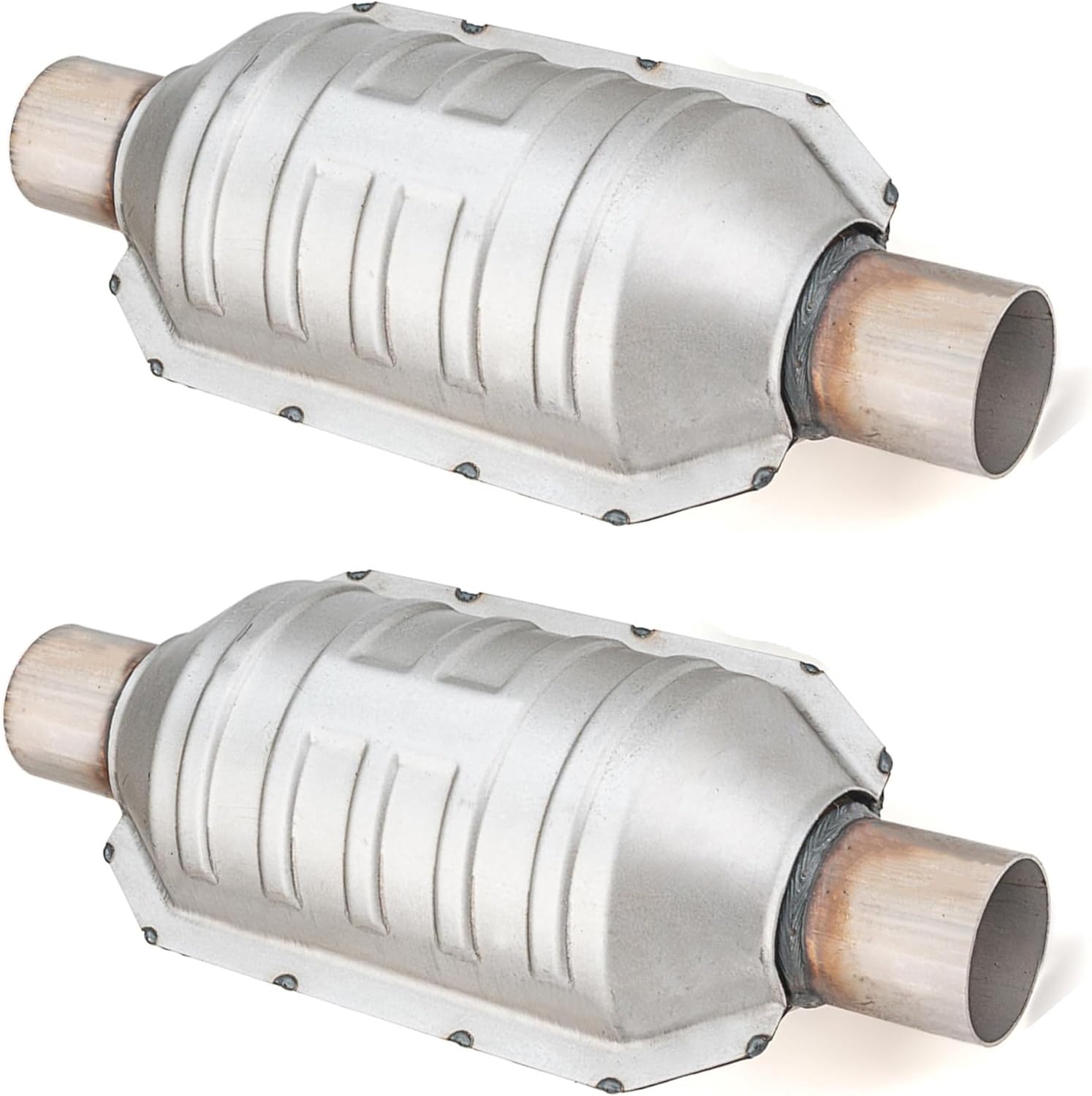
| Material | Stainless steel |
|---|---|
| Inlet/Outlet | 2.5 inch / 2.5 inch |
| Length | 13 inch |
| Includes | O2 port and heat shield |
This Dylannet universal catalytic converter is a welded, high-flow unit intended to replace a failing front catalytic converter. It is built from stainless steel, includes a heat shield and a factory-style O2 sensor port, and is coated internally with precious metal catalysts to convert harmful gases. Typical installation is a weld-in job to a vehicle exhaust pipe using a 2.5 inch inlet and outlet and about 13 inches in overall length, so it is used where a direct-fit OEM piece is not available or as a universal repair option. In practice it can improve exhaust flow and help clear emissions-related faults when fitted and tuned correctly, and the machined exterior plus stainless construction resist corrosion. Limitations are that it is a universal inlet/outlet design requiring cutting and welding for a Scion xD application and it may not meet stricter state-specific emissions rules in some states, so verify local requirements and fitment before installation.
Best for: Risk-averse, mainstream Scion xD owners looking for a durable, factory-quality replacement who prioritize restoring emissions function and reliability over a plug-and-play swap.
Less Ideal for: Owners who need a guaranteed bolt-on direct-fit converter for a Scion xD or who require parts certified for stricter state emissions programs should consider vehicle-specific OEM replacements instead.
- Stainless steel construction improves corrosion resistance and durability.
- Integrated O2 sensor port preserves factory sensor placement and simplifies reinstallation.
- Heat shield and machined exterior help protect surrounding components and look finished after installation.
- Universal weld-on design requires cutting and welding for a Scion xD rather than bolt-on direct fit.
- Not available for sale in certain states with higher emissions standards, limiting legal use in those areas.
Verdict: A durable stainless steel universal catalytic converter that restores emissions function and exhaust flow for Scion xD owners willing to weld for installation.
Choosing the Right Volkswagen Atlas Catalytic Converter: Key Factors to Consider
Vehicle-Specific Fitment
Fitment accuracy matters because the catalytic converter must match the Volkswagen Atlas exhaust geometry, hanger locations, and oxygen sensor ports. A unit that does not align precisely can cause installation difficulties, exhaust leaks, or altered backpressure that affects engine performance.
Confirming bolt pattern, inlet and outlet diameters, and sensor bung placement reduces the need for modifications at installation. Proper fitment also helps maintain a reliable seal at flanges and prevents exhaust leaks that could create noise and sensor errors.
Emissions Certification
Certification or emissions ratings indicate whether a catalytic converter meets regulatory standards for pollutant conversion. Choosing a unit with the appropriate EPA or CARB documentation helps ensure the vehicle remains compliant with local emissions testing requirements.
Certification also reflects design aspects like substrate formulation and washcoat effectiveness, which directly influence the converter's ability to reduce hydrocarbons, carbon monoxide, and nitrogen oxides over time.
Substrate and Catalyst Material
The substrate type and catalyst materials determine how efficiently pollutants are converted. Ceramic honeycomb substrates are common and offer a high surface area for catalyst coating, while metallic substrates can provide faster light-off tolerance and greater thermal shock resistance.
Understanding the tradeoffs between materials helps predict longevity and performance under different driving conditions. The catalyst coating thickness and precious metal loading also affect conversion efficiency and durability.
Oxygen Sensor Compatibility
Many Volkswagen Atlas engines rely on upstream and downstream oxygen sensors to manage fuel trim and monitor catalyst efficiency. A replacement converter must accommodate the proper sensor bungs and preserve sensor functionality to avoid false diagnostics or triggers for the check engine light.
Sensor compatibility reduces the likelihood of installation workarounds that could impair signal accuracy or expose sensors to abnormal temperatures and exhaust flows.
Durability and Construction
Construction quality influences how long a catalytic converter will last in real-world conditions. Look for robust shell material, quality welding, and corrosion-resistant finishes to withstand road salts, moisture, and heat cycling.
Durable designs reduce the risk of premature failure, substrate breakage, or flange warping. Consider maintenance factors like ease of access and whether the unit integrates with existing exhaust components for straightforward replacement.
Installation and Serviceability
Ease of installation affects the total time and labor required to replace the converter. Vehicle-specific mounting points, preinstalled sensor bungs, and matching flange types simplify fitting and reduce the chance of leaks.
Serviceability also includes availability of replacement parts and clear instructions. A design that minimizes modification or fabrication needs helps preserve exhaust integrity and saves time during routine repairs.
How We Chose the Best Volkswagen Atlas Catalytic Converter
We focused on fitment and emissions control as primary selection filters. Key criteria included exact fitment to Volkswagen Atlas exhaust geometry, EPA or CARB compliance where applicable, and catalytic substrate design that targets typical pollutant conversion rates. We also weighed durability factors such as material quality and welding or flange robustness, plus sensor compatibility to avoid triggering onboard diagnostics.Additional editorial filters included availability of vehicle-specific installation guidance and documented long-term reliability reports. We excluded generic universal converters and units lacking clear fitment data for the Atlas. Performance test results and buyer feedback informed emissions performance and longevity judgments. The final list reflects products that balance accurate fitment, emissions effectiveness, and durable construction for the Volkswagen Atlas.
Our full evaluation process is outlined in our review methodology.
FAQ
What are common catalytic converter symptoms on a Volkswagen Atlas?
Common signs often include reduced engine power, decreased fuel economy, and an illuminated check engine light related to emissions. You may also notice a sulfur or rotten-egg smell from the exhaust or unusual exhaust noise if the substrate has deteriorated. Diagnosis usually involves reading fault codes and inspecting backpressure or sensor readings.
Will a faulty catalytic converter trigger the check engine light on my Atlas?
Yes, the onboard diagnostic system often detects inefficient catalyst performance or oxygen sensor discrepancies and can illuminate the check engine light. Codes typically refer to catalyst efficiency or oxygen sensor circuit issues, but further diagnostics are usually required to confirm the converter as the root cause.
How important is exact CAT converter fitment for the Volkswagen Atlas?
Exact fitment is important because matching inlet and outlet diameters, sensor ports, and mounting points helps ensure a proper seal and correct exhaust flow. Poor fitment can lead to leaks, sensor errors, and potential drivability issues, so choosing a converter designed for the vehicle reduces installation complications.
Can I replace a catalytic converter myself on the Atlas?
Replacement is possible for experienced DIYers who have the right tools and a safe working environment. Tasks include lifting the vehicle, removing exhaust fasteners, and ensuring correct sensor reinstallation. However, some installations may require specific tools or professional torque and seal practices to avoid leaks.
How long do catalytic converters typically last in everyday driving?
Catalytic converters often last many years under normal driving conditions, but lifespan depends on driving habits, engine tune, and exposure to contaminants. Severe engine issues, oil consumption, or coolant leaks can shorten life. Regular maintenance and addressing engine faults early help extend converter longevity.
What causes catalytic converter failure signs besides age?
Failure can result from upstream engine problems such as rich running, misfires, or oil and coolant contamination that poison the catalyst. Physical damage from road debris or impacts and thermal shock from extreme temperature swings can also cause substrate cracking or washcoat loss. Addressing underlying engine issues is key to preventing repeat failures.
Conclusion
When selecting a catalytic converter for a Volkswagen Atlas, prioritize exact fitment, emissions certification, and oxygen sensor compatibility. These factors help maintain engine diagnostics, reduce the risk of leaks, and ensure the unit meets regulatory expectations.Balance durability and substrate design against installation ease. Address any underlying engine problems before replacement to protect the new converter and maximize its service life.
Explore More:
- Check out all Volkswagen Atlas parts & accessories
- Explore Catalytic Converters Maintenance & Repair Guides
- Explore Exhaust & Emissions
- Browse all Auto Parts
