

Note: This article contains affiliate links. If you click on these links and make a purchase, I may earn a small commission at no extra cost to you. This helps support my research and content. Read my full affiliate disclosure here.
If your Toyota Sequoia is showing reduced power, rough idling, or an illuminated engine warning, the catalytic converter could be a likely culprit. Choosing the right converter matters because fitment, emissions performance, and durability directly affect drivability and compliance with local emissions rules.This guide covers seven shortlisted catalytic converters that meet common fitment and emissions needs for the Sequoia. We evaluated durability, fit accuracy, and emission reduction capability to help you narrow your options. Read on to see which features matter most and why these units made the list.
Looking for other parts? See all Toyota Sequoia parts & accessories.
Top Picks at a Glance
| Best Overall The best all-around choice for most situations | AutoShack Catalytic Converter Direct Fit for 2007–2019 Toyota Tundra / 2008–2019 Sequoia 4.6L & 5.7L V8 |  |
| Best Quality Built to a higher standard if you want something more solid | MagnaFlow OEM Grade Direct-Fit Catalytic Converter 49630 (Right) for 2008-2017 Toyota Sequoia |  |
| Best Value The sweet spot between price and what you get | Walker Ultra 93251 Stainless Steel Universal Catalytic Converter |  |
| Best budget The cheapest option that still gets the job done reliably | MagnaFlow 94006 Standard Grade Universal Catalytic Converter (2.5" Inlet/Outlet) |  |
| Highest Rated A top-rated pick with lots of positive feedback | DNA MOTORING Factory-Style Catalytic Converter for Toyota Sequoia 2001–2004 4.7L |  |
| Best Seller A high-volume bestseller chosen again and again | Dylannet Universal Weld-on Catalytic Converter with Heat Shield and O2 Port (2.5" Inlet/Outlet, 13" Length) |  |
1. AutoShack Catalytic Converter Direct Fit for 2007–2019 Toyota Tundra / 2008–2019 Sequoia 4.6L & 5.7L V8

| Vehicle fit | 2008–2019 Toyota Sequoia 4.6L & 5.7L V8 |
|---|---|
| Exterior | Stainless Steel |
| Core material | Ceramic |
| Interchange | 54723 |
This AutoShack catalytic converter is a direct-fit replacement for 4.6L and 5.7L V8 Toyota Sequoia (2008–2019) and installs onto the existing exhaust system. It is an EPA-compliant unit constructed with stainless steel exterior and a ceramic substrate intended to restore emissions control and clear P0420-style codes when a failed converter is the cause. Typical use is as a one-for-one factory-quality replacement during exhaust repairs; professional installation is recommended because alignment and O2 sensor replacement are important for reliable operation. The listing warns it is not CARB-legal and therefore unsuitable for certain states, and notes that preexisting engine issues that overheat a converter must be corrected before fitting. Fitment reports indicate the collar and flange mating may need some effort to line up on the back half of the exhaust, but once installed it performs the expected emissions-reduction role and returns the vehicle to compliant operation in 46 states.
Best for: A balanced, all-round buyer who wants a factory-style replacement to restore emissions performance on a 2008–2019 Sequoia without seeking high-performance tuning or CARB compliance.
Less Ideal for: Drivers in CARB-regulated states or buyers who need a certified California-legal converter should look for CARB-compliant alternatives.
- Direct-fit design made for 2008–2019 Toyota Sequoia 4.6L and 5.7L V8 applications
- EPA-compliant for use in 46 states to meet federal emissions standards
- Stainless steel exterior with ceramic substrate for standard catalytic function
- Comes as a complete catalytic converter ready to install onto existing exhaust
- Not CARB certified and illegal for sale or use in California, Colorado, New York and Maine
- May require effort to align bolts and mating flanges during installation
Verdict: A straightforward, EPA-compliant direct-fit catalytic converter that returns a Sequoia's emissions system to factory-style operation in non-CARB states.
2. MagnaFlow OEM Grade Direct-Fit Catalytic Converter 49630 (Right) for 2008-2017 Toyota Sequoia

| Series | OEM Grade |
|---|---|
| Body Material | Stainless Steel |
| Type | Direct-Fit Federal/EPA Compliant |
| Inlet Attachment | Bolt-On |
| Substrate Material | Ceramic |
This MagnaFlow OEM Grade direct-fit catalytic converter replaces the right-side factory unit on 2008–2017 Toyota Sequoia models and is intended to restore emissions control and keep the check engine light off. It is a bolt-on, no-cut installation with included mounting hardware and gaskets, and the clamshell stainless-steel body with mandrel-bent tubing aims to preserve exhaust flow while resisting corrosion. For performance-minded owners the converter is built to match factory fit and O2-port locations so factory sensors can be retained and OBDII systems remain happy. Practical benefits include Federal/EPA compliance, a ceramic substrate for catalytic conversion, and a 5 year/50,000-mile limited warranty. Reported issues in user feedback include occasional early failures and the need to run a long heat cycle after install to properly seat internal components, so some buyers may prefer professional installation or to follow break-in driving guidance to avoid rattles or sensor triggers. This unit is not legal for sale in certain states listed by the manufacturer.
Best for: Performance-oriented Toyota Sequoia owners who prioritize factory-quality fit, emissions compliance, and maintaining exhaust flow while retaining stock sensor function.
Less Ideal for: Buyers in states with stricter emissions laws or those seeking a long-term high-mileage reliability record without accepting some reports of early failure should consider other options.
- Direct-fit design with factory-matching O2 port locations for straightforward bolt-on installation
- Stainless-steel clamshell construction and mandrel-bent tubing for corrosion resistance and improved flow
- Meets Federal/EPA emissions standards and is designed to keep the check engine light off with correct sensors
- Includes mounting hardware and gaskets to help ensure a proper seal and reduce exhaust leaks
- Not legal for sale in some states which restrict aftermarket converters
- Some users report premature failures or loose internal components if not properly heat-cycled after installation
Verdict: A factory-quality direct-fit catalytic converter for Toyota Sequoia that restores emissions compliance and preserves exhaust flow while allowing use of factory sensors.
3. Walker Ultra 93251 Stainless Steel Universal Catalytic Converter

| Material | Stainless Steel |
|---|---|
| Vehicle Service Type | Car |
| Inlet Connection Size | 2 Inches |
| Manufacturer | Tenneco (Dynomax, Walker, Thrush) |
The Walker Ultra 93251 is a universal, stainless-steel catalytic converter built for emissions compliance on OBDII vehicles and professional-fit installations. It is typically used to replace a failed converter to clear emissions faults and restore proper exhaust flow; installation often requires cutting off existing flanges and welding the Walker unit in place or using expandable bushings for fitment. Notable features include an OE-style washcoat and precious metal loading for emissions reduction, aluminized heat shields where originally equipped, and a direct-fit minded design that aims to simplify integration with existing exhaust piping. In real-world use the stainless-steel construction improves durability and heat resistance compared with cheaper alternatives, and the EPA compliance helps meet regulatory requirements. Important limitations are that this is a universal-style converter rather than a vehicle-specific drop-in for the Toyota Sequoia, so expect fabrication, flange work, or welding during installation and confirm fitment for Sequoia exhaust routing and sensor locations before purchase.
Best for: Practical optimizers who want a durable, emissions-compliant catalytic converter that balances performance and longevity while accepting some installer work to adapt the part to a Sequoia's exhaust.
Less Ideal for: Buyers seeking a guaranteed bolt-in, vehicle-specific converter or a no-fabrication, DIY-friendly kit should consider a Sequoia-specific replacement instead.
- EPA compliant for OBDII vehicles which helps meet emissions requirements
- Stainless-steel body and aluminized components for improved durability and heat resistance
- OE-style washcoat and precious metal load to reduce tailpipe emissions effectively
- Expandable bushings and direct-fit design features to simplify adaptation to existing exhaust systems
- Universal design may require cutting, welding, or fabrication for proper fit on a Toyota Sequoia
- Does not include vehicle-specific flanges or hardware, so additional parts or shop time may be needed
Verdict: A durable, EPA-compliant universal converter that delivers good value if you accept welding or fabrication to fit a Toyota Sequoia.
4. MagnaFlow 94006 Standard Grade Universal Catalytic Converter (2.5" Inlet/Outlet)

| Inlet/Outlet Diameter | 2.5 Inches |
|---|---|
| Body Material | Stainless Steel |
| Type | Universal Federal/EPA Compliant |
| Substrate Material | Ceramic |
The MagnaFlow 94006 is a compact, stainless-steel universal catalytic converter designed to meet pre-OBDII federal emissions requirements. It is used where a direct-fit Sequoia converter is missing, damaged, or too costly to replace with a vehicle-specific unit. The converter's clam-shell stainless body and integrated heat shield offer corrosion resistance and easier handling during installation, while the 2.5-inch weld-on inlet/outlet and ceramic substrate make it suitable for lower-flow applications. Because it is a universal unit, a professional muffler shop will usually cut, adapt and weld the pipes and add an O2 sensor bung if your Sequoia needs one. The main benefits are EPA compliance for pre-1996 applications, straightforward construction, and a lower price than many vehicle-specific converters. Limitations are the need for professional fabrication to fit a Toyota Sequoia correctly and the fact that this standard grade unit is targeted at older pre-OBDII systems rather than modern OBDII emissions setups found on later Sequoia model years.
Best for: Budget-conscious DIYers or owners seeking a lower-cost replacement for an older Toyota Sequoia who prioritize legal emissions compliance over plug-and-play convenience.
Less Ideal for: Owners of later-model Toyota Sequoia who need a direct-fit, OBDII-compliant factory-quality replacement or those who want a no-modification, bolt-in part.
- Stainless-steel clamshell body for corrosion resistance and durability.
- Meets or exceeds federal EPA pre-OBDII emissions requirements.
- Universal design lets installers position the unit where needed on the exhaust system.
- Integrated heat shield for added thermal protection during operation.
- Universal, weld-on installation requires cutting, welding, and possibly adding an O2 sensor bung by a professional.
- Standard grade ceramic substrate is aimed at older pre-OBDII systems, not modern OBDII emissions setups.
Verdict: A cost-focused, EPA-compliant universal converter for older Sequoia applications that saves money but requires professional fitting.
5. DNA MOTORING Factory-Style Catalytic Converter for Toyota Sequoia 2001–2004 4.7L

| Fitment | Toyota Sequoia 2001-2004 4.7L |
|---|---|
| Construction | Stainless steel body, aluminized piping |
| Compliance | Federal/EPA grade (not for sale/use in CA, ME, NY) |
| OEM References | 18078, 40482, 54569 |
This DNA MOTORING catalytic converter is a direct-fit, factory-style replacement made for the Toyota Sequoia 2001–2004 with the 4.7L engine. It installs in place of the original unit and is built with a stainless steel body and aluminized piping to resist corrosion and provide a durable connection to the exhaust. The part is marketed as EPA compliant outside of certain states and is intended to match factory fitment and mounting points so professional installation is straightforward. In practice buyers report good fit for many applications but also note occasional fitment variances around flanges and the welded downstream O2 sensor boss, so you should be prepared for minor adjustments or welding during installation. This unit is positioned as a budget-conscious factory-style replacement that restores exhaust routing and basic emissions function but may not cure an existing P0420 catalyst efficiency code on vehicles whose engine or sensor issues cause that error.
Best for: Reliability-focused owners who prioritize restoring a working, factory-style exhaust component at a lower cost and accept professional installation and occasional minor fitting work.
Less Ideal for: Drivers who need a verified emissions cure for a persistent P0420 code or who must meet California or other strict-state compliance should look at certified, state-compliant options or dealer-sourced replacements.
- Direct-fit design intended to match factory mounting points for Toyota Sequoia 2001–2004
- Stainless steel body with aluminized piping for improved corrosion resistance
- Manufactured as a factory-style, OEM replacement to restore exhaust routing
- Sold as EPA-compliant for federal use outside of states with stricter rules
- Welded downstream O2 sensor boss and flange alignment have produced fitment issues for some buyers
- Not legal for sale or use in several states with stricter emissions rules
Verdict: A cost-conscious, factory-style direct replacement that restores exhaust function on 2001–2004 Toyota Sequoia 4.7L models with generally good fitment when professionally installed.
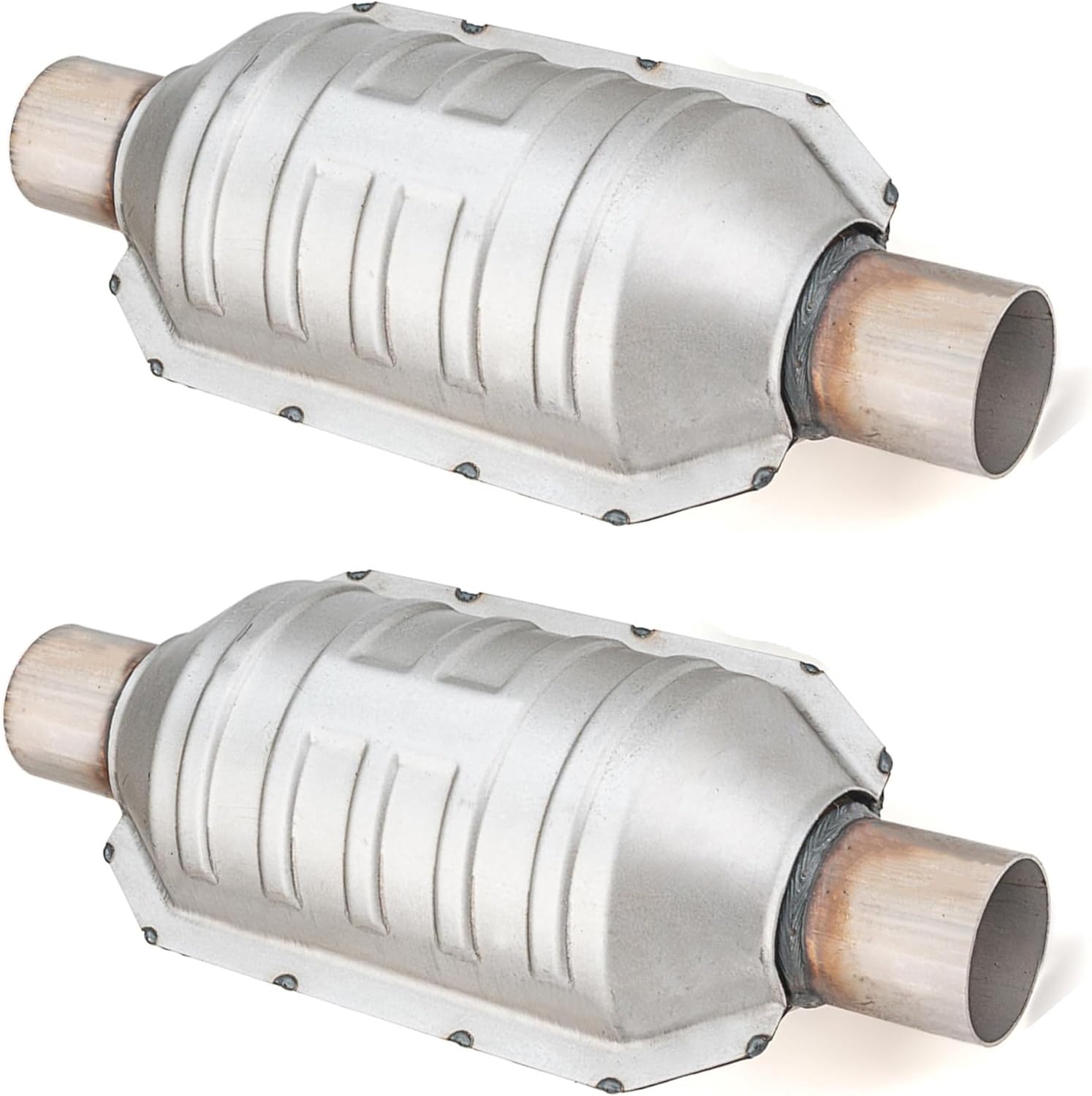
6. Dylannet Universal Weld-on Catalytic Converter with Heat Shield and O2 Port (2.5" Inlet/Outlet, 13" Length)
| Material | Stainless steel |
|---|---|
| Inlet/Outlet | 2.5 inch / 2.5 inch |
| Length | 13 inch |
| Includes | O2 port and heat shield |
This Dylannet universal catalytic converter is a welded, high-flow unit intended to replace a failing front catalytic converter. It is built from stainless steel, includes a heat shield and a factory-style O2 sensor port, and is coated internally with precious metal catalysts to convert harmful gases. Typical installation is a weld-in job to a vehicle exhaust pipe using a 2.5 inch inlet and outlet and about 13 inches in overall length, so it is used where a direct-fit OEM piece is not available or as a universal repair option. In practice it can improve exhaust flow and help clear emissions-related faults when fitted and tuned correctly, and the machined exterior plus stainless construction resist corrosion. Limitations are that it is a universal inlet/outlet design requiring cutting and welding for a Scion xD application and it may not meet stricter state-specific emissions rules in some states, so verify local requirements and fitment before installation.
Best for: Risk-averse, mainstream Scion xD owners looking for a durable, factory-quality replacement who prioritize restoring emissions function and reliability over a plug-and-play swap.
Less Ideal for: Owners who need a guaranteed bolt-on direct-fit converter for a Scion xD or who require parts certified for stricter state emissions programs should consider vehicle-specific OEM replacements instead.
- Stainless steel construction improves corrosion resistance and durability.
- Integrated O2 sensor port preserves factory sensor placement and simplifies reinstallation.
- Heat shield and machined exterior help protect surrounding components and look finished after installation.
- Universal weld-on design requires cutting and welding for a Scion xD rather than bolt-on direct fit.
- Not available for sale in certain states with higher emissions standards, limiting legal use in those areas.
Verdict: A durable stainless steel universal catalytic converter that restores emissions function and exhaust flow for Scion xD owners willing to weld for installation.
Choosing the Right Toyota Sequoia Catalytic Converter: Key Factors to Consider
Fitment and Compatibility
Accurate fitment is essential because the catalytic converter must align precisely with the Sequoia exhaust flanges and oxygen sensor locations to avoid leaks and check engine issues. A unit that matches OEM mounting points reduces installation time and the need for additional adapters or custom exhaust work.
Compatibility also affects emissions system diagnostics. If sensor ports are missing or in the wrong position, the vehicle can trigger fault codes even if the catalyst itself functions properly. Verify flange type, inlet/outlet diameters, and sensor boss placement to ensure a straightforward fit.
Emission Conversion Efficiency
The core purpose of the catalytic converter is to convert harmful exhaust gases into less harmful compounds, so conversion efficiency is a key factor. Higher-quality substrates and catalyst coatings typically achieve better reduction of hydrocarbons, carbon monoxide, and nitrogen oxides under normal operating temperatures.
Efficiency impacts not only regulatory compliance but also overall engine behavior. A well-performing catalyst helps the engine run smoothly and can prevent persistent emissions-related warning lights when the rest of the exhaust and sensor systems are functioning correctly.
Material and Construction Quality
Durable materials and robust construction extend service life and resist damage from heat cycling and road debris. Look for corrosion-resistant housings, reinforced welds, and quality flanges that maintain sealing over time.
Construction quality also influences thermal performance and longevity of the catalytic substrate. Poorly welded seams or thin housings can lead to cracks, exhaust leaks, and premature failure, so sturdier builds are generally preferable for long-term reliability.
Oxygen Sensor Integration
Most modern Sequoia models rely on upstream and downstream oxygen sensors for emissions monitoring, so converters must accommodate these sensors correctly. Proper sensor ports and thread sizes ensure accurate exhaust readings and reduce the risk of check engine light triggers due to incorrect sensor placement.
If sensor integration is incorrect, you may get false diagnostic trouble codes or degraded feedback to the engine control unit, which can affect fuel trimming and drivability. Confirm the converter provides the necessary sensor bosses or provisions.
Heat Tolerance and Thermal Management
Catalytic converters operate at high temperatures, so heat tolerance is critical for performance and durability. Materials and thermal designs that manage expansion and contraction reduce the chance of substrate cracking or catalyst washcoat deterioration.
Good thermal management also helps the converter reach optimal operating temperature more quickly after startup, improving conversion efficiency during warm-up and lowering cold-start emissions.
Warranty and Service Support
Warranty terms and available customer support offer insight into manufacturer confidence and potential long-term costs. A clear warranty covering defects or premature failure provides an extra layer of protection and can indicate higher production standards.
Consider the length and scope of coverage and whether installation support or replacement parts are available. Strong post-sale support can make repairs or warranty claims less stressful if issues arise.
How We Chose the Best Toyota Sequoia Catalytic Converter
To assemble this list we focused on criteria that matter specifically for Toyota Sequoia catalytic converters. Primary filters included precise OEM-compatible fitment to the Sequoia exhaust layout, verified substrate and catalyst formulations for reliable emissions reduction, and durable construction to withstand heat and road exposure. We also weighed build quality of flanges and oxygen sensor ports, thermal and corrosion-resistant coatings, and the presence of necessary mounting hardware or gaskets to ease installation.Performance-related criteria emphasized documented emission conversion efficiency and backing substrate density as indicators of long-term effectiveness. We considered warranty coverage and manufacturer quality control practices as proxies for reliability. Items were excluded if fitment was ambiguous, if construction details were inadequate, or if the unit lacked necessary sensor ports for the Sequoia. The resulting shortlist prioritizes accurate fitment, emission control effectiveness, and robust construction.
Our full evaluation process is outlined in our review methodology.
FAQ
What are common catalytic converter symptoms in a Toyota Sequoia?
Common symptoms often include reduced engine power, rough idling, decreased fuel economy, or a persistent check engine light. You may also notice a strong sulfur or rotten-egg smell from the exhaust. These signs frequently indicate reduced catalyst effectiveness, but similar symptoms can stem from other exhaust or ignition issues, so diagnostic testing is recommended.
Will a failing catalytic converter trigger the check engine light?
Yes, catalytic performance issues commonly trigger the check engine light through emissions-related diagnostic trouble codes. On-board sensors monitor conversion efficiency and can detect when emissions exceed expected levels. However, other faults such as oxygen sensor failures or exhaust leaks can also cause similar codes, so proper diagnosis is important.
How important is correct CAT converter fitment for installation?
Correct fitment is very important because improper alignment can cause exhaust leaks, sensor misreads, and mechanical stress on the exhaust system. A unit that matches flange types and sensor port locations simplifies installation and reduces the chance of post-installation issues. Fitment mismatches often require adapters or additional fabrication.
How long do catalytic converters usually last in a vehicle like the Sequoia?
Lifespan often depends on driving conditions, maintenance, and exposure to contaminants. Under normal conditions and with proper engine maintenance, converters can last many years, but heat cycling, physical damage, or prolonged engine misfires can shorten that life. Regular inspections and addressing engine issues promptly can help preserve converter longevity.
Can I replace the catalytic converter myself on a Sequoia?
Many mechanically inclined owners can perform a replacement if they have the right tools and mechanical experience, particularly when fitment is straightforward. However, the job can involve rusted bolts, precise sensor reinstallation, and exhaust sealing concerns. If you are unsure, consult a professional technician to ensure correct installation and emissions compliance.
Do catalytic converters affect exhaust emissions significantly?
Yes, catalytic converters play a central role in reducing harmful exhaust emissions by converting carbon monoxide, hydrocarbons, and nitrogen oxides into less harmful substances. A functioning converter helps vehicles meet emissions standards and reduces pollutants. The level of reduction depends on catalyst design, substrate quality, and operating temperature.
Conclusion
When selecting a catalytic converter for a Toyota Sequoia, prioritize accurate fitment, correct oxygen sensor provisions, and proven emission conversion performance. Balancing durable construction and good thermal management will help ensure long service life and steady emissions control.Expect tradeoffs between ease of installation and long-term durability. Focus on units that match the Sequoia S exhaust layout and offer clear warranty support to minimize the chance of fitment or performance issues down the road.
Explore More:
- Check out all Toyota Sequoia parts & accessories
- Explore Catalytic Converters Maintenance & Repair Guides
- Explore Exhaust & Emissions
- Browse all Auto Parts
