

Note: This article contains affiliate links. If you click on these links and make a purchase, I may earn a small commission at no extra cost to you. This helps support my research and content. Read my full affiliate disclosure here.
Picking the right Nissan Versa car battery matters because a correct fit and enough starting power keep daily driving dependable and prevent roadside failures. You want a unit that matches the Versa's electrical demands, fits the battery tray, and delivers reliable cold starts across seasons.This guide covers our shortlisted top picks for the Nissan Versa and explains the criteria we used to evaluate them, including starting performance and physical compatibility. Read on to see key factors and practical buying considerations before you choose.
Looking for other parts? See all Nissan Versa parts & accessories.
Top Picks at a Glance
| Best Overall The best all-around choice for most situations | OPTIMA RedTop 35 High Performance Sealed AGM Starting Battery |  |
| Best Quality Built to a higher standard if you want something more solid | UPLUS Group 48 AGM Start-Stop Car Battery (12V, 70Ah, 760 CCA) |  |
| Best Budget The cheapest option that still gets the job done reliably | MARXON Group 34 12V 55Ah AGM Start‑Stop Car Battery |  |
| Highest Rated A top-rated pick with lots of positive feedback | 1AUTODEPOT Group 47 (H5) 12V 60Ah AGM Car Battery, 680 CCA |  |
| Best Seller A high-volume bestseller chosen again and again | Mighty Max Battery MM-G35 12V 55Ah AGM Group 35 Car Battery |  |
OPTIMA RedTop 35 High Performance Sealed AGM Starting Battery

| Voltage | 12-Volt |
|---|---|
| Cold Cranking Amps | 720 CCA |
| Capacity (C20) | 44 AH |
| Reserve Capacity | 90 minutes |
| Terminal | SAE Terminal |
The OPTIMA RedTop 35 is a sealed AGM starting battery built to provide reliable, high-current starts and long service life. It uses SpiralCell technology to provide consistent cranking power in cold or demanding conditions and is maintenance free and non-spillable so it can be mounted in multiple positions. Typical use is as a direct-replacement starting battery for Nissan Versa models that require this group/size and terminal layout, where it will handle everyday starts, occasional heavy accessory draw, and short-term parasitic drains better than standard flooded batteries. Notable features include 720 CCA for strong cold starts, SAE post terminals for straightforward installation, and higher vibration resistance for durability in rough road conditions. The main limitations are its heavier weight and higher cost compared with conventional flooded batteries, and some users report occasional early failures so verifying fit and buying from a reliable source matters. It is best treated as a premium starting battery rather than a deep-cycle solution.
Best for: Buyers seeking a balanced, no-nonsense upgrade that prioritizes reliable starting performance and long-term durability for daily-driven Nissan Versa ownership.
Less Ideal for: Drivers who need a budget replacement or a deep-cycle/auxiliary battery for heavy electronics or long off-grid use should look for other options.
- High 720 CCA rating for confident cold starts
- Sealed AGM construction is non-spillable and mountable in multiple positions
- SpiralCell design and 15x vibration resistance improve durability
- Maintenance-free operation with faster recharge compared with standard flooded batteries
- Higher purchase weight and cost than conventional lead-acid batteries
- Not intended for regular deep-discharge cycling or as a house/auxiliary deep-cycle battery
Verdict: A premium, maintenance-free AGM starting battery that gives Nissan Versa owners stronger cold starts and greater durability than standard flooded batteries.
UPLUS Group 48 AGM Start-Stop Car Battery (12V, 70Ah, 760 CCA)

| BCI Group Size | 48 (H6/L3) |
|---|---|
| Voltage | 12 Volts |
| Nominal Capacity (20HR) | 70 Ah |
| Cold Cranking Amperage | 760 CCA |
| Reserve Capacity (RC) | 120 min |
This UPLUS Group 48 AGM battery is a sealed, maintenance-free replacement built for vehicles with start-stop systems and heavier electrical loads. It provides strong cold-cranking capability and a 70 Ah nominal capacity, so it can reliably start a small engine in cold weather while supporting accessories when the engine is off. Typical use is direct replacement for compatible Group 48 fits where the terminal layout and hold-down type match the vehicle tray. Notable features include AGM construction for better vibration resistance and no free acid, high cold cranking amperes for dependable starts, and claimed deeper cycling life compared with conventional flooded batteries. Practical benefits include easier installation into a matching battery tray, improved tolerance for short-trip driving and stop-and-go traffic, and reduced maintenance needs. Limits to consider are its heavier weight compared with smaller batteries and the need to confirm Group 48 fitment for the Nissan Versa model year in question before purchase, since physical fit and terminal orientation are critical.
Best for: Performance-oriented buyers who prioritize strong starting power and durability for frequent short trips or stop-and-go driving on a Nissan Versa.
Less Ideal for: Buyers seeking the lightest or smallest battery for a tight tray fit or those who prefer a different group size should consider other options that match their Versa's factory specifications.
- AGM technology for greater vibration resistance and no free acid leakage risk
- High cold cranking amperes (760 CCA) for reliable starting in cold conditions
- Designed for start-stop use and better cycle life than standard flooded batteries
- Sealed, maintenance-free design reduces routine upkeep
- BCI Group 48 size may not fit every Nissan Versa trim or model year without checking measurements
- Heavier than many standard replacement batteries which can make handling and installation harder
Verdict: A rugged AGM Group 48 battery that delivers strong cold-start performance and start-stop durability, provided you confirm Group 48 fitment for your Nissan Versa.
MARXON Group 34 12V 55Ah AGM Start‑Stop Car Battery
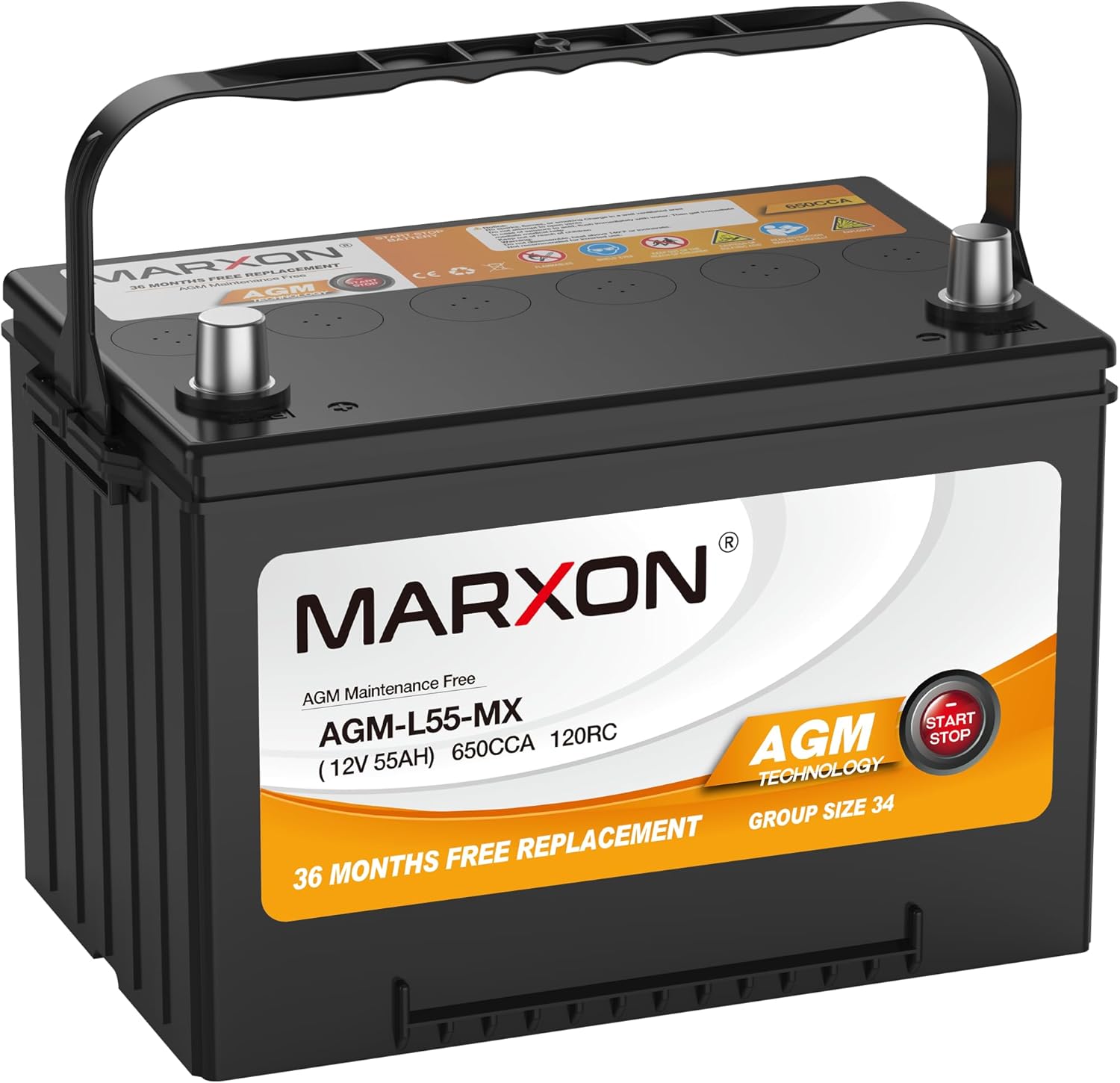
| Voltage | 12V |
|---|---|
| Capacity | 55Ah |
| Battery Type | AGM |
| Terminal | A1 |
| Start‑stop compatible | Yes |
This Group 34 MARXON AGM battery is a drop‑in style replacement intended for cars with start‑stop systems, offering 55 Ah capacity and a high cold cranking capability suitable for regular driving. It is typically used as a factory‑style replacement to restore reliable starting, support stop‑start functionality, and provide better reserve capacity than conventional flooded batteries. Notable features include AGM construction for reduced leakage risk and a faster charge acceptance that helps the alternator recharge the battery more quickly after engine stops. Practical benefits are easy installation, maintenance‑free use, and improved resistance to vibration and corrosion compared with basic wet batteries. Limitations to consider are that it is a Group 34 physical fit and may not match every Versa trim or tray layout, and long‑term lifespan is still uncertain relative to premium branded batteries despite positive early user reports. Buyers should verify terminal orientation and tray fit before purchase to ensure compatibility with their Nissan Versa.
Best for: Practical, budget‑conscious buyers who prioritize a lower upfront cost and want a factory‑style replacement that restores start‑stop functionality on a tight budget.
Less Ideal for: Drivers seeking the longest possible service life or who prefer an established premium brand with a long field history should consider higher‑end alternatives.
- AGM design reduces risk of acid leakage and allows installation in confined or slightly angled positions.
- Faster charge acceptance than basic SLA batteries, so the alternator tops the battery quicker after start‑stop events.
- Maintenance‑free construction removes need to add water or acid.
- Good cold cranking and reserve capacity reported by users for reliable starts and accessories use.
- Group 34 size may not fit every Nissan Versa trim or battery tray layout without checking dimensions and terminal orientation.
- Long‑term durability vs established premium brands is still based on limited user history rather than multi‑year proven data.
Verdict: A cost‑focused AGM replacement that restores start‑stop function and quick recharge capability for Nissan Versa owners who want a sensible budget swap.
1AUTODEPOT Group 47 (H5) 12V 60Ah AGM Car Battery, 680 CCA

| BCI Group Size | 47 |
|---|---|
| Voltage | 12V |
| Rated capacity | 60ah |
| Cold Cranking Amps (CCA) | 680 |
| Reserve Capacity (RC) | 100 |
This Group 47 (H5) 12V AGM battery is built for reliable starting and heavier electrical loads. It supplies 680 CCA and a 60 Ah rated capacity, so in a Nissan Versa it will provide confident cold starts and steadier voltage for accessories compared with older flooded batteries. The AGM construction is maintenance-free and non-spillable, which helps if the Versa is used in stop-start driving or stored for periods between uses. The battery’s higher reserve capacity and claimed greater vibration resistance also suit a small car that sees daily commuting or occasional harsh conditions. Installation is straightforward when the battery’s Group 47 dimensions and top-left negative terminal orientation match the Versa’s battery tray and posts. Limitations include the weight and the need to confirm terminal layout and tray clearance before buying, and some users prefer batteries from established OEM suppliers for a longer documented service history in a specific vehicle model.
Best for: Reliability-minded buyers who prioritize consistent starting performance and low-maintenance operation for daily-driven Nissan Versa models.
Less Ideal for: Drivers looking for the cheapest short-term replacement or who need a different battery group size or terminal layout for their Versa should consider other options.
- AGM design offers maintenance-free, non-spillable operation for safer handling and storage
- 680 CCA provides strong cold-start performance for small engines
- Higher reserve capacity and improved cycle life compared with standard flooded batteries
- Built to resist vibration and handle the demands of start-stop driving
- Must confirm Group 47 dimensions and terminal positions to ensure fitment in the Versa
- Heavier than flooded alternatives which makes handling and installation more awkward
Verdict: A durable, maintenance-free AGM Group 47 battery that delivers reliable starting and longer cycle life for Nissan Versa drivers who want dependable performance.
Mighty Max Battery MM-G35 12V 55Ah AGM Group 35 Car Battery

| Voltage | 12V |
|---|---|
| Capacity | 55 Amp Hours |
| Cold Cranking Amps | 650 CCA |
| Reserve Capacity | 100 minutes |
| Battery Type | AGM (sealed) |
The Mighty Max MM-G35 is a sealed AGM replacement intended to deliver dependable starting power and steady electrical support for everyday cars like the Nissan Versa. It installs like a standard Group 35 battery and is typically used to replace a failing factory battery to restore reliable cold starts and stable voltage for lights, stereo, and engine electronics. Notable features include a 650 CCA rating for stronger cold-weather starts, 55 Ah capacity with a 100-minute reserve for accessory use or temporary loads, and a sealed, spill-proof AGM design that allows flexible mounting and reduces maintenance. Practical benefits include reduced risk of acid leaks, improved vibration resistance, and readiness out of the box. Limitations to consider are variable long-term durability reported by some users and the need to confirm exact top post or terminal orientation for a Versa fit; buyers who want guaranteed dealer-level warranty support or direct local replacement services may prefer OEM-branded alternatives.
Best for: Risk-averse mainstream buyers who prioritize a reliable, maintenance-free replacement that restores dependable starts and steady electrical performance in daily-driven vehicles like the Nissan Versa.
Less Ideal for: Buyers who want dealer-supported replacement plans or prefer OEM-sourced batteries with direct local warranty service should consider alternatives sold through auto parts retailers or Nissan dealerships.
- Sealed AGM construction for spill-proof installation and low maintenance
- High cold-cranking amps (650 CCA) to improve starting in cold weather
- 100-minute reserve capacity helps run accessories briefly without engine
- Group 35 sizing matches many Nissan Versa battery trays for straightforward replacement
- Some users report early failures and a more cumbersome claims process compared with local auto stores
- Not a factory-branded battery so dealer-level service and direct replacements may not be available
Verdict: A budget-friendly sealed AGM Group 35 battery that gives Nissan Versa drivers strong starting power and low maintenance, but buyers seeking dealer-backed service should weigh alternatives.
Choosing the Right Nissan Versa Car Battery: Key Factors to Consider
Group Size and Fit
Group size defines the battery's physical dimensions and terminal locations. Choosing the correct group size ensures the battery sits securely in the tray, the hold-down clamps line up, and the terminals reach the cable ends without stress.
A misfit battery can cause poor clamping, vibration damage, or cable strain that leads to electrical problems. Confirming fitment prevents installation issues and reduces the likelihood of premature failure due to movement or poor contact.
Cold-Cranking Amps (CCA)
Cold-cranking amps measure a battery's ability to start an engine in cold conditions. Higher CCA is important in colder climates where engine oil is thicker and starting requires more power.
For everyday reliability, match or exceed the vehicle maker's recommended CCA to reduce hard starts and ensure consistent performance in low temperatures. CCA also gives a quick sense of how robust the battery will be under heavy starting loads.
Reserve Capacity and Auxiliary Loads
Reserve capacity indicates how long a battery can supply a minimum current without the alternator. This matters if you run accessories with the engine off or experience alternator issues.
A battery with adequate reserve capacity provides a buffer during short electrical faults and helps support electronics during traffic or short stops. For drivers who use heated seats, infotainment systems, or frequent short trips, reserve capacity affects practical in-use reliability.
Cycle Life and Durability
Cycle life refers to how many charge and discharge cycles a battery can tolerate before performance degrades. Durability also covers resistance to vibration and corrosion of terminals.
A battery that endures frequent starts and partial charges will last longer in everyday driving. Choosing a unit rated for higher cycle life and built with durable materials reduces the chance of early replacement and improves long-term value.
Terminal Type and Accessibility
Terminal placement and type affect how easily you can connect cables and whether additional accessories can be fitted. Offset or top terminals must match the vehicle's cable layout to avoid stretched leads or awkward routing.
Clear, standardized terminals simplify installation and future servicing. Accessibility also matters if you plan to use jump-start clamps or portable chargers, as tight spaces can complicate those tasks.
Maintenance and Warranty
Some batteries are maintenance-free while others may require periodic checks of fluid levels. Maintenance needs influence long-term upkeep and convenience for owners who prefer minimal intervention.
Warranty coverage signals manufacturer confidence and provides recourse if early failure occurs. Consider the length and terms of warranty alongside expected maintenance to understand total ownership effort and protection.
How to Diagnose Battery Problems on a Nissan Versa
A Nissan Versa car battery will usually give warning signs before it fails completely. Start with symptoms you can observe without tools. Frequent slow engine cranks on cold starts, dim headlights at idle, dashboard lights that flicker or behave inconsistently, and electronics that lose presets or clock time are common indicators. If the vehicle struggles to start after sitting for several hours or overnight, that is a strong early sign of battery weakness rather than an alternator fault.
If you want a simple, low-cost check, try a rest voltage test. After the car has been off for at least an hour, measure the battery voltage at the terminals with a basic multimeter. A fully charged battery will read about 12.6 volts. Readings below about 12.3 volts indicate a partially discharged battery and readings under 12.0 volts mean the battery is significantly depleted. For a more definitive assessment, perform a load test or have the battery tested at a shop. A failing battery may pass a static voltage test but fail under load.
Pay attention to one-off events versus recurring problems. A single hard start after lots of accessory use does not necessarily mean replacement. Repeated starting issues, rapid voltage drops while cranking, or multiple jump-starts in a short period point toward replacement. Also check for obvious issues like corroded terminals, loose connections, or accessory drains that could mimic battery failure.
- Symptoms to watch for: slow cranks, dim lights, electronics resetting
- Quick multimeter check: >12.6 V healthy, <12.3 V partial, <12.0 V low
- When to suspect replacement: repeated failures or failed load test
Age, Mileage, and How Long a Versa Battery Typically Lasts
Predicting exact car battery life for a Nissan Versa depends on driving habits, climate, and how often the battery is cycled. In temperate conditions with steady driving, many batteries last three to five years. Short trips, frequent accessory use with the engine off, or extreme temperatures can shorten that span. If your Versa is approaching the three year mark and you are seeing intermittent starting issues, plan for replacement sooner rather than later to avoid being stranded.
Keep in mind that mileage alone is not a reliable indicator because a battery ages by calendar time and by the number of discharge cycles. A high-mileage Versa driven mostly on long highway trips may have a healthier battery than a low-mileage car left parked for long stretches. Use age plus performance signs to time replacement decisions. When diagnosing an older battery, combine age information with a proper voltage and load test to make a confident choice.
Budgeting for replacement is easier when you track battery age. Make a habit of noting the installation date on your service records and checking the battery during regular maintenance. That approach turns surprise failures into preplanned maintenance and reduces the likelihood of an inconvenient breakdown.
- Typical lifespan: roughly three to five years in normal conditions
- Short trips and extreme weather reduce battery life
- Track installation date to plan timely replacement
Preparing for a Nissan Versa Battery Replacement: Specs and Fitment Notes
Before buying a replacement, confirm the exact Nissan Versa car battery specifications your vehicle needs. Check the owner manual or the label on the existing battery for the recommended group size and terminal configuration. Also record the cold-cranking amps requirement and any reserve capacity guidance. Having these specs on hand ensures you get a unit that fits the battery tray and connects correctly without modification.
Car battery sizes vary and using the right physical group size prevents fitment issues. The correct size ensures the hold-down clamps align and that terminals are accessible for jump-starting or routine maintenance. If you are comparing options, match the battery group number and confirm top or side terminal orientation so you do not run into clearance problems with nearby components.
When you shop, bring the vehicle details and the battery specs with you or have them available when ordering. Also note any extras you may want such as a battery with improved vibration resistance or one rated for longer reserve capacity if you routinely run accessories with the engine off. Recording the battery for car details ahead of time saves time and reduces the chance of returns due to incorrect fit.
- Confirm group size and terminal orientation before purchase
- Match or exceed the recommended cold-cranking amps
- Note reserve capacity if you use aftermarket electronics
DIY Installation Overview for a Nissan Versa
If you plan to handle the car battery installation yourself on a Nissan Versa, follow a clear, safety-first procedure. Park on level ground, set the parking brake, and wear safety eyewear and gloves. Start by turning off all vehicle electronics. Always disconnect the negative terminal first to minimize the risk of a short. After the negative terminal is off, disconnect the positive terminal and remove any hold-down clamps or battery trays. Lift the old battery straight up to avoid tipping and spilling any acid if the battery is not maintenance free.
Install the new battery by placing it in the tray with the correct orientation so terminals are positioned for the cables to reach without stretching. Secure the hold-down clamp to prevent movement during driving. Connect the positive terminal first and then the negative terminal. Tighten terminal clamps snugly but avoid over-torquing which can damage the terminal. After installation, start the car and confirm normal electrical operation. Check that headlights and accessories operate correctly and that no warning lights appear on the dash.
If your Versa has any stored radio or navigation presets that may require a memory clear during battery removal, check how to restore codes or settings before starting. Some owners use a memory saver device during replacement to retain settings, but follow the device instructions carefully. When finished, dispose of the old battery responsibly at a recycling facility or a parts store that accepts used batteries.
- Safety first: wear eye protection and gloves
- Disconnect negative terminal first, reconnect it last
- Secure battery in the tray and tighten terminals properly
Maximizing Battery Life in Your Nissan Versa
Routine maintenance and small habit changes can extend the effective life of a Nissan Versa car battery. Keep terminal connections clean and tight because corroded or loose connections increase resistance and accelerate wear. Periodically inspect the battery case for swelling or cracks which indicate internal damage. For battery maintenance, applying a light coating of terminal protectant after cleaning can reduce corrosion buildup.
Manage vehicle usage to reduce deep discharges. Avoid long durations of accessory use with the engine off and try to drive the car long enough for the alternator to recharge the battery after heavy accessory use. If the Versa is stored for extended periods, consider a float charger or battery maintainer to keep the battery at an optimal state of charge. Regularly scheduled drive cycles help prevent sulfation and preserve capacity.
In colder climates, keep the battery charged because cold reduces starting capacity. If you park outside in winter, using block heaters where available and parking in a sheltered spot can help. For drivers seeking a lower-cost option when replacing a failing battery, prioritize getting a unit that meets the vehicle manufacturer's minimum specifications rather than choosing the cheapest battery available. A cheap car battery that fails early often costs more in the long run due to repeat replacements and potential roadside assistance needs.
- Clean and protect terminals to reduce corrosion
- Use a maintainer for long storage periods
- Avoid excessive accessory use with the engine off
Practical Tips for Testing, Jump-starting, and Roadside Response
Knowing how to test car battery condition and perform basic roadside procedures can prevent stress if a battery fails. Keep a small digital multimeter in the trunk so you can quickly check resting voltage. If the rest voltage is low, a jump-start may be required. When jump-starting a Nissan Versa, follow safe clamp order: connect positive to positive first, then negative to a clean chassis ground away from the battery to avoid sparks near the battery vents. Start the donor vehicle, then the Versa, and remove clamps in reverse order.
If you experience repeated battery issues after a jump-start, follow up with a full charging system check. A battery that repeatedly discharges could indicate an alternator problem or a parasitic drain. Portable jump starters are convenient and avoid relying on another vehicle but make sure they are rated to provide enough cold-cranking amps for your Versa and are maintained charged in the trunk.
Plan for emergencies by storing a small roadside kit with jumper cables or a jump starter, gloves, and manufacturer battery specs. If you need to replace the battery on the road, having the correct car battery specs and a basic tool set will make a mobile replacement straightforward for roadside services or a DIY install at a safe location.
- Carry a multimeter and jumper cables or a portable jump starter
- Jump-start safely: positive to positive, negative to chassis ground
- If problems persist after a jump, check alternator and parasitic draw
How We Chose the Best Nissan Versa Car Battery
We focused on attributes that matter specifically for the Nissan Versa and similar compact sedans. Primary filters included correct group size and terminal orientation to ensure proper fit and easy installation. We prioritized adequate cold-cranking amps and reserve capacity to handle typical starting loads and short trips with accessories running. Durability and expected cycle life were considered to reflect how long a battery will reliably perform under everyday driving conditions. We also evaluated build quality and vibration resistance because compact cars often experience varied road conditions. Ease of installation and clear labeling of specs were included to reduce user error and installation time.We excluded batteries that lack clear fitment data, non-automotive specialty cells, or products intended only for heavy-duty or performance vehicles. The resulting list emphasizes batteries that balance fit, starting power, and longevity for the Nissan Versa owner.
Our full evaluation process is outlined in our review methodology.
FAQ
How do I know which battery size fits my Nissan Versa?
Check your vehicle's owner manual or the battery tray for the specified group size and terminal orientation. Fitment ensures the battery clamps down securely and the cables reach without strain. If unsure, measure the tray and cable locations before purchasing.
What CCA rating should I choose for a Nissan Versa?
Aim to match or slightly exceed the cold-cranking amps recommended in the Versa's specifications. Higher CCA helps in cold weather and hard-start situations, while an overly high rating is not necessary for normal driving conditions.
Can I install a Nissan Versa car battery myself?
Many owners can replace a battery using basic tools, provided they follow safety steps like disconnecting the negative terminal first and securing the replacement properly. If you are uncomfortable with battery handling or tight engine-bay access, professional installation is advisable.
How can I test a Nissan Versa car battery at home?
A simple test uses a multimeter to check resting voltage; around 12.6 volts indicates a full charge. For a more definitive check, a load tester or visit to a service center can assess starting performance under load. Tests often reveal whether the battery needs charging or replacement.
What maintenance keeps a car battery in good condition?
Keep terminals clean and free of corrosion, ensure hold-downs are tight to prevent vibration, and avoid leaving the vehicle unused for long periods without a trickle charger. Regular driving that fully charges the battery helps preserve its lifespan.
Final Verdict
When choosing a Nissan Versa car battery, prioritize correct group size and terminal orientation first, then focus on adequate cold-cranking amps and reserve capacity for your climate and driving habits. Balance cycle life and durability against maintenance needs and warranty coverage to find a practical, long-lasting option.Consider installation accessibility and clear labeling of specs to avoid fitment errors. By weighing these tradeoffs, you can pick a battery that delivers reliable starts and fewer surprises over its service life.
Explore More:
- Check out all Nissan Versa parts & accessories
- Explore Car Batteries Maintenance & Repair Guides
- Explore Electrical System
- Browse all Auto Parts
