

Note: This article contains affiliate links. If you click on these links and make a purchase, I may earn a small commission at no extra cost to you. This helps support my research and content. Read my full affiliate disclosure here.
If you drive a Honda Odyssey, choosing the right car battery matters for dependable starts, consistent accessory power, and fewer roadside surprises. The wrong battery can lead to slow cranks, shortened service life, or insufficient power for electronics when the engine is off. This guide shortlists the top options for the Honda Odyssey, focusing on fitment, cold-cranking performance, and longevity. We evaluated candidates across starting power and reserve capacity, battery type, and compatibility with common Odyssey electrical loads. Read on to see the top picks and the factors that guided our selection.
Looking for other parts? See all Honda Odyssey parts & accessories.
Top Picks at a Glance
| Best Reviewed A top-rated pick with lots of positive feedback | UPLUS Group 48 AGM Start-Stop Car Battery (12V, 70Ah) |  |
| Best Quality Built to a higher standard if you want something more solid | MARXON Group 94R H7 L4 12V 80Ah AGM Start-Stop Car Battery |  |
| Best Budget The cheapest option that still gets the job done reliably | Relistart 12V 80Ah Group 94R AGM Start-Stop Car Battery (800 CCA) |  |
| Most Sold A high-volume bestseller chosen again and again | Mighty Max Battery MM-H6 Group 48 12V 70Ah AGM Car Battery |  |
| Best Value for Money The sweet spot between price and what you get | 1AUTODEPOT Group 94R (H7) 12V AGM Car Battery, 80Ah, 850 CCA |  |
| Best Overall The best all-around choice for most situations | OPTIMA RedTop 34/78 Sealed AGM Starting Battery (800 CCA) |  |
1. UPLUS Group 48 AGM Start-Stop Car Battery (12V, 70Ah)

| Voltage | 12 Volts |
|---|---|
| Nominal Capacity (20HR) | 70 Ah |
| Cold Cranking Amperage | 760 CCA |
| Reserve Capacity (RC) | 120 min |
| Battery Technology | AGM |
The UPLUS Group 48 AGM is a maintenance-free, absorbed glass mat battery built for start-stop applications and vehicles with significant accessory loads. It supplies 12 volts with a 70 Ah nominal capacity, high cranking power and a long reserve capacity, so it can handle frequent short trips, heavy electronics and repeated engine starts. Typical use is as a factory-style replacement where Group 48 (H6/L3) fits the tray and terminal layout matches the vehicle. Notable features include AGM construction for vibration resistance and no free acid, a high cold cranking rating for reliable starts in cold weather, and claimed extended cycle life versus conventional flooded batteries. Practical benefits are a reduced risk of acid leakage, better performance with modern start-stop charging systems and stronger starting under load. Limitations are its heavier weight and the need to confirm fitment and terminal orientation for the Honda Odyssey application before purchase; installation may require measuring the battery bay and ensuring compatibility with the Odyssey's charging and battery management system.
Best for: Reliability-focused buyers who prioritize a durable, maintenance-free replacement that stands up to frequent short trips, heavy electrical loads, and start-stop driving.
Less Ideal for: Drivers seeking the lightest possible battery for performance or those unwilling to verify physical fit and terminal orientation for their specific Honda Odyssey model should consider other options.
- AGM design improves vibration resistance and reduces risk of acid leakage.
- High cold cranking capability for reliable starts in cold conditions.
- Designed for start-stop duty and frequent short-trip use with improved cycle life.
- 120 minute reserve capacity supports accessory loads when the engine is off.
- Heavier than many conventional batteries which can make handling and installation more difficult.
- Requires exact Group 48 fit and terminal orientation check for proper installation in the vehicle.
Verdict A robust, reliability-oriented Group 48 AGM battery that delivers strong starting power and start-stop durability when its fit and terminal layout match the Honda Odyssey.
2. MARXON Group 94R H7 L4 12V 80Ah AGM Start-Stop Car Battery
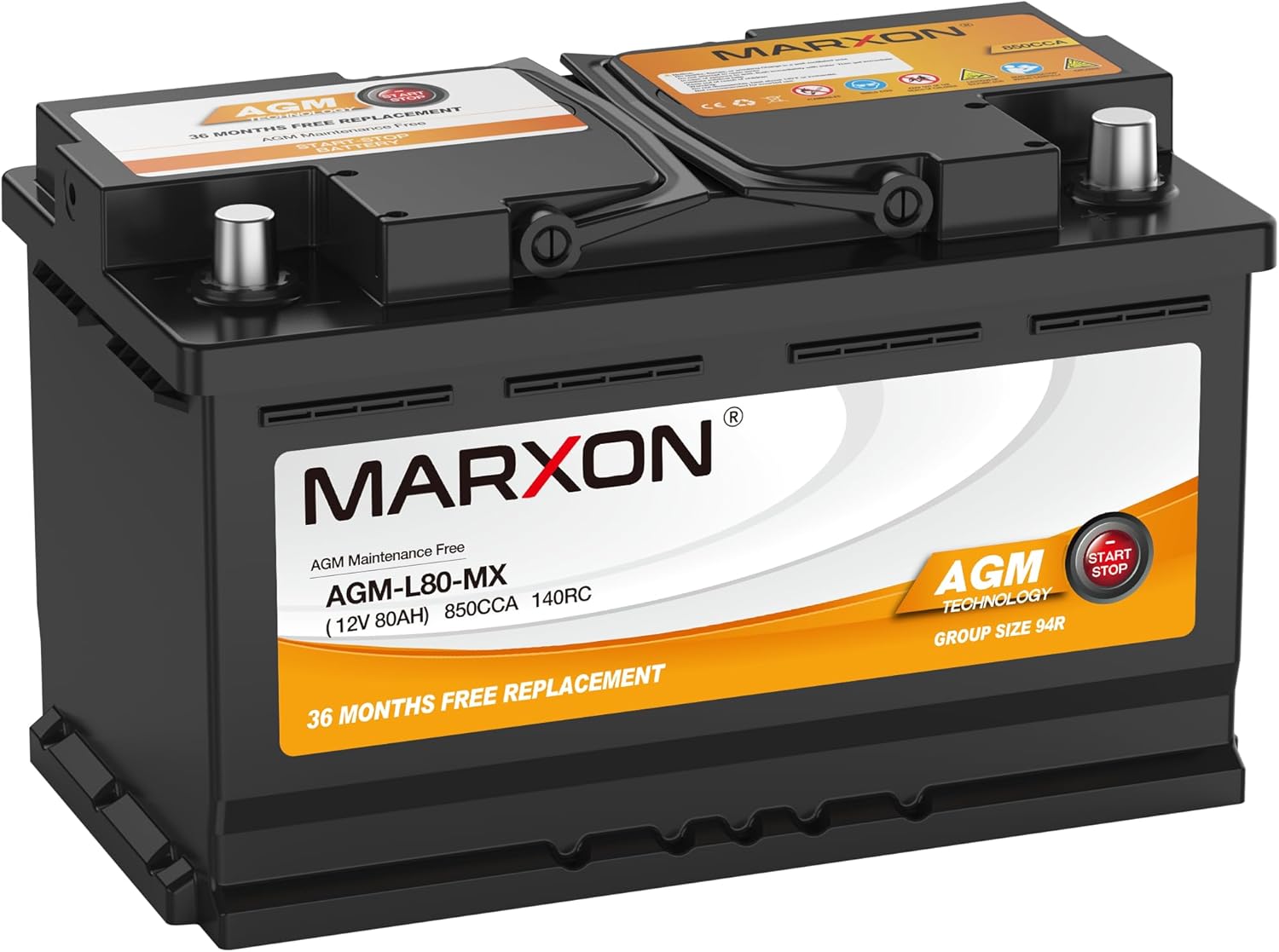
| Voltage | 12V |
|---|---|
| Capacity | 80Ah |
| Battery type | AGM |
| Group | BCI 94R (H7 L4) |
This MARXON Group 94R is a 12V, 80Ah AGM battery built for vehicles that require a Group 94R/H7/L4 replacement and need start-stop functionality. It is typically used as a direct-fit replacement where the factory battery supports start-stop systems and higher charge acceptance. Notable features include AGM construction for reduced leakage and better vibration resistance, a claimed faster charging acceptance compared with traditional SLA batteries, and a maintenance-free design that does not require adding water. In real-world use it delivers strong cranking power for modern engines and supports repeated engine restarts in city driving thanks to its deep-cycle characteristics. Limitations to consider are that fitment must match the Odyssey's battery tray and terminal orientation and that some Honda charging systems may require verification to ensure optimal long-term charge profiles for AGM chemistry. Buyers who prioritize robust start-stop performance and faster recharge will appreciate this unit, while installers should confirm fit and charging compatibility before purchase.
Best for: Performance-oriented owners who want a factory-quality start-stop replacement that delivers strong cranking and quick recharge for frequent stop-and-go driving.
Less Ideal for: Owners who prefer plug-and-play replacements without checking fit or who drive an Odyssey rarely and prioritize lowest initial cost over start-stop performance.
- AGM design reduces risk of acid leakage and handles vibration better than flooded batteries
- Designed for start-stop systems and repeated restarts, supporting city driving demands
- Higher charge acceptance than basic SLA batteries for faster recovery after discharge
- Maintenance-free operation eliminates the need to add water or check electrolyte levels
- Requires confirmation of physical fit and terminal orientation for Honda Odyssey battery tray
- AGM chemistry may need a compatible charger or vehicle charging profile to reach full long-term capacity
Verdict A solid AGM start-stop replacement aimed at drivers who need reliable cranking and faster recharge, provided you confirm fit and charging compatibility with your Honda Odyssey.
3. Relistart 12V 80Ah Group 94R AGM Start-Stop Car Battery (800 CCA)

| Nominal voltage | 12V |
|---|---|
| Capacity | 80 Ah |
| Cold Cranking Amps (CCA) | 800A |
| Reserve Capacity (RC) | 155RC |
This Relistart Group 94R AGM battery is a sealed, maintenance-free option engineered for vehicles with start-stop systems and higher electrical demand. For a Honda Odyssey owner seeking an affordable AGM replacement, it supplies 800 CCA for reliable cold starts and an 80 Ah capacity for accessory load and parasitic draws. The battery is designed for deep-cycle use and claims extended cycle life and vibration resistance compared with standard flooded units. Typical use is direct replacement when the Odyssey requires a compatible Group 94R battery or as an upgrade from a conventional lead-acid cell; installation may require checking terminal orientation and fitment in the Odyssey battery tray. Practical benefits are strong cranking power, better tolerance for repeated start-stop cycles, and a non-spill sealed design that reduces maintenance. Important limitations are that Group 94R sizing and terminal placement are not universal for all model years of the Odyssey, so owners must confirm fit and may need minor tray or clamp adjustments to secure the battery properly.
Best for: Budget-conscious Odyssey owners who prioritize a low-cost, factory-quality replacement that still improves start-stop durability and accessory performance.
Less Ideal for: Owners unwilling to check physical fitment or perform minor tray or clamp adjustments should consider batteries sized specifically for their Odyssey model or have professional installation.
- High cold cranking amps (800 CCA) suitable for reliable starting in cold weather
- AGM sealed design provides maintenance-free, non-spill operation
- Designed for start-stop and higher accessory loads, offering better cycle life than standard flooded batteries
- Low self-discharge for longer storage between uses
- Group 94R size and terminal layout may not fit every Honda Odyssey model year without modifications
- May require verifying charging settings since AGM batteries prefer specific charging voltages
Verdict A cost-focused AGM replacement that delivers solid starting power and start-stop durability for Odyssey owners who confirm Group 94R fitment.
4. Mighty Max Battery MM-H6 Group 48 12V 70Ah AGM Car Battery
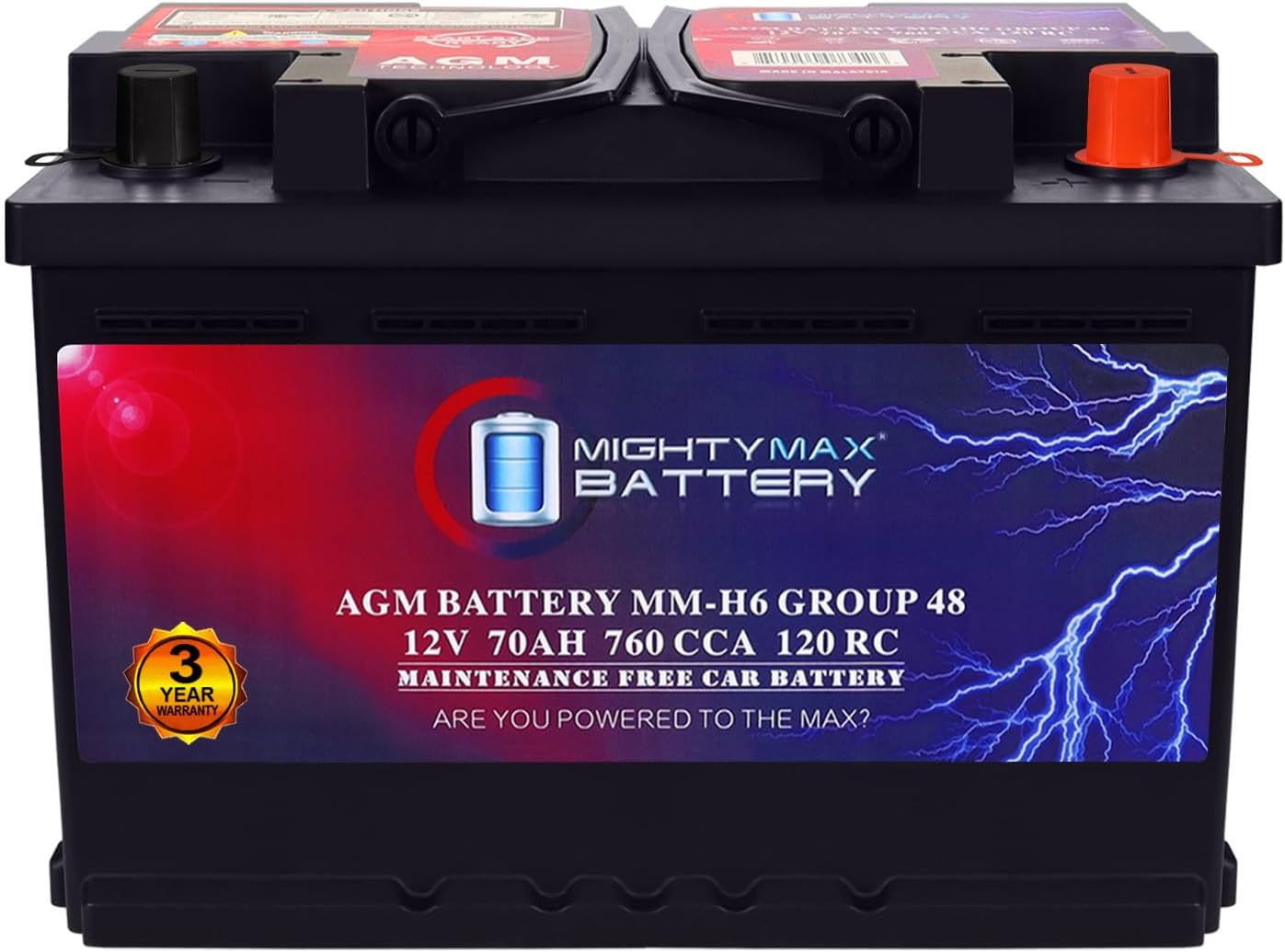
| Voltage | 12V |
|---|---|
| Capacity | 70 Amp Hours |
| Cold Cranking Amps | 760 CCA |
| Reserve Capacity | 120 minutes |
| Terminal | Stud Terminal |
The Mighty Max MM-H6 is a sealed AGM Group 48 battery built for reliable starting and longer standby power. It provides 760 cold cranking amps and a 120-minute reserve capacity, so it handles repeated starts and supports accessory draw when the engine is off. For Honda Odyssey owners this battery is typically used as a direct replacement in the under-hood location where Group 48 fitment is required or acceptable. Notable features include a spill-proof AGM construction, stud terminals, and rugged casing designed to resist vibration. Practical benefits are strong cold-weather starts, flexibility in mounting orientation (not upside down), and minimal maintenance because it is sealed. Limitations to consider are stud-style terminals that may need an adapter for some Odyssey clamp setups, and the universal fit description means double-checking physical clearance under the battery cover. Warranty and seller service experiences vary among buyers, so expect to follow the manufacturer process if you need support.
Best for: Risk-averse mainstream buyers who prioritize dependable starts and low-maintenance operation for their Honda Odyssey and want a cost-effective, factory-replacement style battery.
Less Ideal for: Drivers who need plug-and-play exact-match terminals or who prefer dealer-sourced factory batteries with dealer-managed warranty support should consider alternatives.
- High cranking power at 760 CCA helps reliable cold starts.
- Sealed AGM design is spill-proof and maintenance-free.
- 120-minute reserve capacity supports electronics and short accessory use without the engine.
- Rugged construction resists shock and vibration for daily driving conditions.
- Uses stud terminals which may require adapters or different hardware for some factory clamp connections.
- Universal fit means physical clearance should be verified for the Odyssey battery tray and cover.
Verdict A cost-conscious, maintenance-free AGM option that delivers strong starting power for Honda Odyssey owners who verify fit and terminal compatibility.
5. 1AUTODEPOT Group 94R (H7) 12V AGM Car Battery, 80Ah, 850 CCA

| BCI Group Size | 94R |
|---|---|
| Rated capacity | 80 Ah |
| Cold Cranking Amps | 850 CCA |
| Reserve Capacity | 140 RC (min) |
| Battery Technology | Absorbed Glass Mat (AGM) |
This 1AUTODEPOT Group 94R AGM battery is a high-capacity, maintenance-free replacement intended for vehicles that need strong starting power and reliable reserve capacity. It supplies 850 CCA and an 80 Ah rating, so it handles heavy accessory loads and repeated starts common in family vans. Typical use is straightforward: swap into the battery tray, connect the tapered Type A terminals in the correct polarity, and benefit from lower self-discharge and improved vibration resistance compared with flooded batteries. The AGM construction makes it leak-proof and better suited for start-stop systems and harsh climates, and the battery arrives fully charged and ready to install. Important limitations are fitment and physical heft; you must confirm the Group 94R (H7) size and terminal layout fit your Honda Odyssey battery tray and cable orientation, and the battery is heavy to lift during installation. There is no explicit manufacturer warranty listed in the product specs, so expect to rely on seller or retailer policies for coverage.
Best for: Practical owners who prioritize long-term reliability and lower maintenance costs and who want a value-oriented AGM upgrade for a Honda Odyssey with higher accessory demand.
Less Ideal for: Drivers looking for a direct, no-check swap without confirming battery group size or those who prefer a lighter, lower-capacity option for older low-demand vehicles.
- High 850 CCA rating for confident cold starts and heavy accessory use
- AGM design is maintenance-free, non-spillable, and more vibration-resistant than flooded batteries
- 80 Ah capacity and 140 RC provide longer reserve power for electronics and infrequent use
- Designed for start-stop systems and faster recharge cycles compared with conventional batteries
- Group 94R (H7) physical size and terminal orientation may not fit every Honda Odyssey trim without verification
- Relatively heavy, which makes handling and installation awkward without assistance
- No explicit warranty information provided in the product details
Verdict A cost-conscious AGM option that gives a Honda Odyssey strong starting power and low maintenance, provided the Group 94R size and terminal layout match the van.
6. OPTIMA RedTop 34/78 Sealed AGM Starting Battery (800 CCA)

| Cold Cranking Amps | 800 CCA |
|---|---|
| Reserve Capacity | 100 minutes |
| Voltage | 12-Volt |
| C20 Capacity | 50 AH |
| Terminal | Dual SAE & GM posts |
The OPTIMA RedTop 34/78 is a sealed AGM starting battery built to deliver high cranking power and long service life for vehicles like the Honda Odyssey. It uses spiralcell construction to provide consistent starting current and faster recharge compared with conventional flooded batteries. Typical use is as a direct replacement starting battery where reliable cold starts and resistance to vibration matter, for example daily driving and family hauling. Notable features include 800 cold cranking amps, dual top and side terminals for flexible installation, a maintenance-free sealed design, and a 100-minute reserve capacity for steady electrical support. In practice the RedTop is easy to fit in vehicles that accept the 34/78 group and gives confident starting in cold weather while tolerating rough roads and engine-bay vibration. Downsides are its heavier weight and premium cost compared with basic flooded batteries, and the RedTop is optimized for starting rather than deep-cycle loads so it is not the best choice if you frequently run heavy accessories while the engine is off. Installation may require checking terminal type and battery tray fit on the Odyssey before purchase.
Best for: Balanced buyers who want a reliable, low-maintenance starter battery for everyday family use and value long-term durability over lowest upfront cost.
Less Ideal for: Drivers who need a deep-cycle battery for long accessory run times, or those prioritizing the cheapest short-term replacement option should consider alternatives.
- High 800 CCA starting power for reliable cold starts.
- Sealed AGM design is maintenance-free and non-spillable.
- SpiralCell construction improves vibration resistance and recharge speed.
- Dual SAE and GM-style terminals give installation flexibility.
- 100-minute reserve capacity supports short accessory loads.
- Optimized for starting power rather than deep-cycle use.
- Higher weight compared with standard flooded batteries.
- Premium price compared with basic replacement batteries.
Verdict A durable, maintenance-free starting battery that delivers confident cold starts and vibration resistance for a Honda Odyssey when you want long-term reliability over a low upfront price.
Choosing the Right Honda Odyssey Car Battery: Key Factors to Consider
Cold Cranking Amps (CCA)
Cold cranking amps measure the battery's ability to start the engine in cold conditions, which directly affects how reliably your Odyssey will start during low temperatures.
Higher CCA ratings generally translate to stronger starting performance, but you should match or exceed the vehicle manufacturer's recommendation rather than assuming bigger is always better. Oversized CCA can add cost and weight with limited real-world benefit, while undersized CCA risks slow cranking and stress on the starter motor. Consider local climate and how often you need to start the vehicle in cold weather when prioritizing CCA.
Reserve Capacity
Reserve capacity indicates how long the battery can supply essential electrical systems if the charging system fails, which matters for extended idling, heavy accessory use, or topping up the electrical system during short trips.
A higher reserve capacity gives you more time to reach a safe stop or keep onboard electronics running until the alternator is restored. For minivans with multiple accessories and occasional long idle times, adequate reserve capacity reduces the risk of a dead battery after using lights, climate controls, or infotainment with the engine off. Balance reserve capacity against physical size and weight constraints to maintain proper fitment.
Group Size and Terminal Layout
Group size defines the battery's physical dimensions and terminal positions, which must match the Honda Odyssey's battery tray and cable reach for safe installation.
Correct group size prevents movement, ensures proper clamp engagement, and avoids interference with surrounding components. Terminal orientation affects cable routing and the potential need for adapter posts or longer cables. Always verify the specified group size for your model year and inspect the battery box clearance, hold-down, and nearby components before purchasing to prevent installation headaches.
Battery Chemistry and Construction
Battery type, such as flooded lead-acid, AGM, or enhanced flooded designs, influences performance characteristics like vibration tolerance, deep-cycle capacity, and maintenance needs.
AGM batteries often offer better vibration resistance and lower internal resistance, which can improve start performance and longevity under heavy accessory loads. Flooded cells may require more maintenance and can be more sensitive to deep discharge. Consider the typical driving patterns of an Odyssey—frequent short trips versus long highway driving—when choosing chemistry, since cycling behavior affects overall lifespan.
Warranty and Expected Service Life
Warranty terms give an indication of the manufacturer's confidence in product longevity and can offset replacement risk during the early years of ownership.
Look for clear prorated and free-replacement periods and check what conditions void coverage, such as improper installation or exposure to extreme heat. Expected service life is influenced by climate, driving habits, and maintenance. Longer warranties often correlate with more robust construction or better quality control, but confirm the warranty specifics and registration requirements before deciding.
Maintenance and Corrosion Resistance
Ease of maintenance and resistance to terminal corrosion matter because they affect reliability and the effort required to keep the battery in good condition over time.
Sealed designs reduce the need for regular topping up and limit acid exposure, while good terminal coatings and corrosion-resistant materials simplify periodic checks. Regular visual inspections and cleaning of terminals can prevent poor electrical contact. If you plan to keep the vehicle long term, favor options that minimize routine maintenance without sacrificing performance.
FAQ
How often should I replace the battery in my Honda Odyssey?
Battery life depends on climate, driving patterns, and maintenance, but many car batteries last roughly three to five years. Warmer climates and frequent short trips often shorten lifespan, while regular highway use and proper maintenance can extend it. Monitor starting performance and have the battery tested if you notice slow cranking or dimming accessories.
Can I test my Honda Odyssey car battery at home?
You can perform basic checks at home, such as measuring resting voltage with a multimeter and inspecting terminals for corrosion. Resting voltage below about 12.4 volts often indicates a weak charge, while a healthy battery typically reads 12.6 volts or slightly higher. For a definitive assessment, professional load testing or a diagnostic at a shop provides more accurate information about battery health and reserve capacity.
Does the Honda Odyssey require a specific battery size or type?
The vehicle requires a battery that fits the designated group size and has terminal positions that match the factory layout. Chemistry choices like AGM or flooded affect performance and maintenance but do not change required dimensions. Always verify the correct group size for your model year and pick a battery with adequate CCA and reserve capacity for the vehicle's electrical demands.
Will adding more accessories affect my battery choice?
Yes. Additional electronics and frequent use with the engine off increase demand on the battery and may warrant a higher reserve capacity or a battery type with better deep-cycle characteristics. If you commonly use power in parked or idling situations, prioritize batteries with stronger reserve capacity and lower internal resistance to reduce the likelihood of discharge-related issues.
Is professional installation necessary for a Honda Odyssey battery?
Professional installation is not strictly necessary, but it is often recommended if you are unfamiliar with battery safety, proper torque on terminal clamps, or handling battery hold-downs and venting. A trained installer can ensure correct group size, secure mounting, proper terminal connection, and reset of any electronic systems that may need attention after battery replacement.
How We Chose the Best Honda Odyssey Car Battery
We prioritized items that match the power and physical requirements typical of the Honda Odyssey while emphasizing starting reliability and durability. Our editorial filters focused on cold-cranking amps and reserve capacity to ensure dependable starts in varied temperatures, group size and terminal layout to guarantee correct fitment, and battery chemistry and construction to assess expected service life and maintenance needs. We also considered warranty terms and manufacturer documentation related to cycle life and corrosion resistance to reflect long-term ownership costs. Performance indicators such as low self-discharge and vibration resistance were included to account for real-world driving conditions and accessory loads. We excluded batteries that do not meet the Odyssey's specified group size or that lack clear technical specs on CCA or reserve capacity. We also filtered out units without straightforward installation guidance or standard terminal configurations to avoid fitment issues.
Our full evaluation process is outlined in our review methodology.
Conclusion
Choosing the right battery for a Honda Odyssey comes down to matching physical fit, starting power, and reserve capacity to your driving conditions. Prioritize correct group size and terminal layout, then select appropriate CCA and reserve ratings for your climate and accessory use. Consider battery chemistry, warranty, and maintenance needs to balance upfront convenience with long-term reliability. By focusing on those core factors, you can reduce the risk of unexpected failures and ensure dependable starts.
Explore More:
- Check out all Honda Odyssey parts & accessories
- Explore Car Batteries Maintenance & Repair Guides
- Explore Electrical System
- Browse all Auto Parts
