

Note: This article contains affiliate links. If you click on these links and make a purchase, I may earn a small commission at no extra cost to you. This helps support my research and content. Read my full affiliate disclosure here.
When a Mitsubishi Lancer brake booster is worn or failing, braking feel and safety can change noticeably. You want a replacement that restores firm, predictable pedal travel and reliable vacuum assist so stops feel consistent in everyday driving.This guide covers the seven shortlisted brake boosters selected for the Mitsubishi Lancer, chosen for correct fitment and dependable vacuum performance. We explain the evaluation criteria used and what to watch for when replacing the booster, then walk through common symptoms and practical considerations before you pick a unit.
Looking for other parts? See all Mitsubishi Lancer parts & accessories.
Top Picks at a Glance
| Best Overall The best all-around choice for most situations | Orceed Vacuum Power Brake Booster Compatible with Mitsubishi Lancer/Outlander (2003–2006) |  |
| Best Quality Built to a higher standard if you want something more solid | A-Premium Vacuum Power Brake Booster for Mitsubishi Lancer and Outlander (2003-2006) – Without Master Cylinder |  |
| Best Value The sweet spot between price and what you get | labwork Vacuum Power Brake Booster 53-8387 for Mitsubishi Lancer / Outlander |  |
| Best Budget The cheapest option that still gets the job done reliably | SCITOO Power Brake Booster Assembly for Mitsubishi Lancer/Outlander (Replace 53-8387) without Master Cylinder |  |
| Highest Rated A top-rated pick with lots of positive feedback | SCITOO Power Brake Booster Assembly for Mitsubishi Lancer (2008–2011) / Outlander (2007–2010) | |
| Best Seller A high-volume bestseller chosen again and again | A-Premium Vacuum Power Brake Booster for Mitsubishi Lancer and Outlander |  |
1. Orceed Vacuum Power Brake Booster Compatible with Mitsubishi Lancer/Outlander (2003–2006)

| Compatible models | Mitsubishi Lancer 2003–2006 (2.0L Turbo), Outlander 2003–2006 (2.4L) |
|---|---|
| Reference numbers | 53-2795, MR569145, MR977202, 532795 |
| Condition | 100% new |
| Manufacturer | Orceed |
This Orceed vacuum power brake booster replaces the factory booster on compatible 2003–2006 Mitsubishi Lancer (2.0L turbo) and Outlander (2.4L) models to restore or improve pedal feel and braking assist. It mounts at the firewall and ties into the engine vacuum line so it reduces pedal effort and returns the system to factory-style power assist when the original booster is worn or failed. The unit ships without a master cylinder so installation requires transfer or replacement of that component and basic brake system knowledge. Notable features include vehicle-specific reference numbers for fitment and factory testing claimed by the maker, which can simplify selection and increase confidence in function. In practice buyers report straightforward installs for experienced DIYers and mechanics, with faster pedal response and smoother braking; some users note occasional fitment tweaks or damaged units on arrival which may require minor drilling or replacement. This booster is a practical, budget-focused alternative to dealer parts when you need to restore braking assist on the listed Mitsubishi models.
Best for: Balanced buyers who want a cost-effective, factory-style restoration of power-assisted braking on their 2003–2006 Mitsubishi Lancer or Outlander and value practical reliability over dealer-only parts.
Less Ideal for: Drivers seeking a full brake system overhaul that includes a new master cylinder or those unwilling to perform basic fitment checks and minor adjustments should consider a more complete or professional-sourced solution.
- Made for specific 2003–2006 Mitsubishi Lancer and Outlander applications to match fitment references
- Restores vacuum-assisted braking to reduce pedal effort and improve stopping consistency
- Factory-tested claim and 100% new unit increases likelihood of reliable performance
- Relatively simple install for experienced DIYers and standard brake shops
- Does not include the master cylinder so additional parts or transfer are required
- Some users reported imperfect firewall hole alignment requiring minor modification or adjustment
- A small number of customers received damaged or non-working units on arrival
Verdict: A purpose-fit, budget-friendly replacement brake booster that restores factory-style power assist on specified 2003–2006 Mitsubishi Lancer and Outlander models.
2. A-Premium Vacuum Power Brake Booster for Mitsubishi Lancer and Outlander (2003-2006) – Without Master Cylinder

| Compatible Models | Mitsubishi Lancer 2003-2006, Outlander 2003-2006 |
|---|---|
| Diaphragm Style | Dual |
| Diaphragm Diameter | 9.22 in (234.188 mm) |
| Master Cylinder Stud Thread | M8x1.25 |
| Material | Steel |
This A-Premium vacuum power brake booster is a direct replacement-style unit for 2003–2006 Mitsubishi Lancer (including turbocharged 2.0L) and 2003–2006 Outlander 2.4L where the master cylinder is reused or replaced separately. It uses a dual diaphragm design in a steel housing with anti-rust coating to improve durability and restore power-assist performance for firmer, more consistent pedal feel. Typical use is a clutch-in garage replacement when the original booster leaks or the pedal goes hard; installation requires basic brake line and pedal linkage work plus transfer or installation of a compatible master cylinder studded M8x1.25. Practical benefits include restored braking assist and corrosion protection for longer service life, while the unit’s fitment and factory-replacement form help keep braking geometry and pushrod alignment correct. Limitations are that the master cylinder is not included so buyers must confirm compatibility with their existing master cylinder or purchase one separately, and installation may require a mechanic if you are not comfortable with brake system bleeding and testing.
Best for: Performance-oriented owners who prioritize restoring factory-level brake assist and a firmer pedal feel on 2003–2006 Mitsubishi Lancer and Outlander models and who are comfortable arranging a separate master cylinder if needed.
Less Ideal for: Buyers who want a complete plug-and-play brake assembly including a master cylinder or those who prefer to avoid any brake-system work beyond simple bolt-on parts.
- Direct-fit replacement for specified 2003–2006 Mitsubishi Lancer and Outlander models
- Dual-diaphragm design aimed at consistent brake assist and pedal feel
- Steel construction with anti-rust coating for improved corrosion resistance
- Matches OEM stud thread size (M8x1.25) for straightforward master cylinder mounting
- Sold without a master cylinder, requiring an additional purchase or reuse of the original unit
- Requires proper brake bleeding and adjustment after installation which may need professional service
Verdict: A-Premium’s brake booster restores factory-style power assist and corrosion-resistant durability for 2003–2006 Mitsubishi Lancer and Outlander braking systems.
3. labwork Vacuum Power Brake Booster 53-8387 for Mitsubishi Lancer / Outlander

| Item model number | 53-8387 |
|---|---|
| Manufacturer | labwork |
| Special Features | Stemless |
| Master Cylinder Stud Thread Size | M8 x 1.25 |
| Diaphragm Diameter | 270.129 mm |
This labwork vacuum power brake booster replaces a worn or failed booster to restore power-assisted braking on compatible Mitsubishi Lancer and Outlander models. It installs between the master cylinder and brake pedal assembly to amplify driver input and reduce required pedal effort, making braking more responsive and less tiring during daily driving or long trips. The unit lists as stemless and includes the specified diaphragm diameter and matching master cylinder stud thread size to align with factory mounting points, which helps simplify installation when paired with compatible master cylinders. Practical benefits include clearer, linear brake feel and quicker brake response compared with a failing booster. Limitations are that fitment is restricted to the listed Lancer and Outlander model years and engine types, and installation may still require basic mechanical skill or professional service to ensure proper vacuum and pushrod adjustment. Buyers should verify vehicle compatibility against the fitment list before ordering.
Best for: Practical optimizers who want a cost-effective, factory-style replacement to regain predictable braking performance without paying for a dealer part.
Less Ideal for: Drivers who prefer manufacturer-sourced parts for warranty or those needing a booster for vehicles outside the listed Lancer and Outlander years should consider other options.
- Direct replacement for listed Mitsubishi Lancer and Outlander model years for straightforward compatibility.
- Restores power-assisted braking to reduce pedal effort and improve braking response.
- Stemless design and matched stud thread size that align with factory-style master cylinder mounting points.
- Provides linear brake feedback that can reduce driver fatigue on longer drives.
- Fitment limited to specific model years and engine configurations so it will not fit unlisted vehicles.
- Installation may require brake system knowledge and adjustment of the pushrod and vacuum connections.
Verdict: A budget-friendly, factory-style replacement brake booster that restores power assist and linear braking feel for compatible Mitsubishi Lancer and Outlander models.
4. SCITOO Power Brake Booster Assembly for Mitsubishi Lancer/Outlander (Replace 53-8387) without Master Cylinder

| Master Cylinder Included | No |
|---|---|
| Brake Booster Diaphragm Style | Single |
| Material | Steel |
| Manufacturer | SCITOO |
This SCITOO power brake booster is a direct-replacement unit intended for select Mitsubishi Lancer and Outlander applications and ships without a master cylinder. It installs in place of a failed booster to restore vacuum assist and reduce pedal effort using a single diaphragm design and factory-style mounting. The unit lists multiple OEM part numbers and a rust-resistant coating intended to improve longevity compared with bare components. Typical use is a like-for-like repair when the original booster leaks, has weak vacuum assist, or the check valve fails. Because the master cylinder is not included you must transfer the original master or purchase a separate replacement, and installation requires basic mechanical skill to remove the old booster and reassemble the pedal linkage and vacuum lines. For budget-focused buyers it offers a cost-effective way to recover braking feel without paying for a dealer part, though it may lack the brand validation and extended testing of higher-end aftermarket or factory parts.
Best for: Budget-conscious owners seeking an affordable, functional replacement to restore factory braking assist on specified Mitsubishi Lancer and Outlander models.
Less Ideal for: Buyers who prefer factory-sourced parts, extended testing documentation, or want a complete replacement kit that includes a new master cylinder should consider other options.
- Direct-replacement fitment for listed Mitsubishi Lancer and Outlander models using known part numbers
- Single-diaphragm design restores vacuum assist and reduces brake pedal effort
- Rust-resistant surface coating for improved corrosion protection
- Lower-cost alternative to dealer brake boosters for budget repairs
- Does not include the master cylinder so additional parts or transfer of the old unit is required
- Limited customer feedback and brand validation compared with established OEM suppliers
Verdict: A budget-friendly, direct-replacement brake booster to restore vacuum assist on compatible Mitsubishi Lancer and Outlander models.
5. SCITOO Power Brake Booster Assembly for Mitsubishi Lancer (2008–2011) / Outlander (2007–2010)
| Fitment | Mitsubishi Lancer 2008-2011, Outlander 2007-2010 |
|---|---|
| Includes | Available with or without master cylinder |
| Model | 180273 |
| Manufacturer | SCITOO |
This SCITOO power brake booster is a direct replacement assembly intended to restore brake assist on compatible Mitsubishi Lancer (2008–2011) and Outlander (2007–2010) models. It is supplied as an aftermarket unit that can be ordered with or without the master cylinder and mounts in place of the original booster to reestablish proper pedal feel and vacuum-assisted stopping. The product description highlights factory-style fit and straightforward installation steps including bolting the unit in, connecting hydraulic and vacuum lines, and adjusting position and pressure; that makes it suitable for a DIY mechanic or professional installer. Customer feedback shows many successful fits and good performance but a small number of failures, so careful inspection at installation is advisable. Expect the practical benefit of renewed pedal assist and correct fitment when matched to the stated vehicle and ABS configuration, while recognizing aftermarket variability means keeping the original fittings and verifying vacuum integrity during installation.
Best for: Reliability-focused owners who prioritize restoring safe, predictable brake assist on a budget and prefer a direct replacement that a competent DIYer or independent shop can install.
Less Ideal for: Buyers seeking a guaranteed long-term factory-backed part or those unwilling to inspect and test aftermarket components after installation should consider alternatives.
- Designed to match factory replacement fitment for listed Lancer and Outlander models
- Offered with or without master cylinder to suit different repair needs
- Installation-oriented design with clear connection points for vacuum and hydraulic lines
- Multiple customer reports of correct fit and restored brake assist
- Mixed quality reports include isolated diaphragm or vacuum failures noted by some buyers
Verdict: A practical aftermarket brake booster that restores factory-style pedal assist for the specified Mitsubishi Lancer and Outlander models.
6. A-Premium Vacuum Power Brake Booster for Mitsubishi Lancer and Outlander
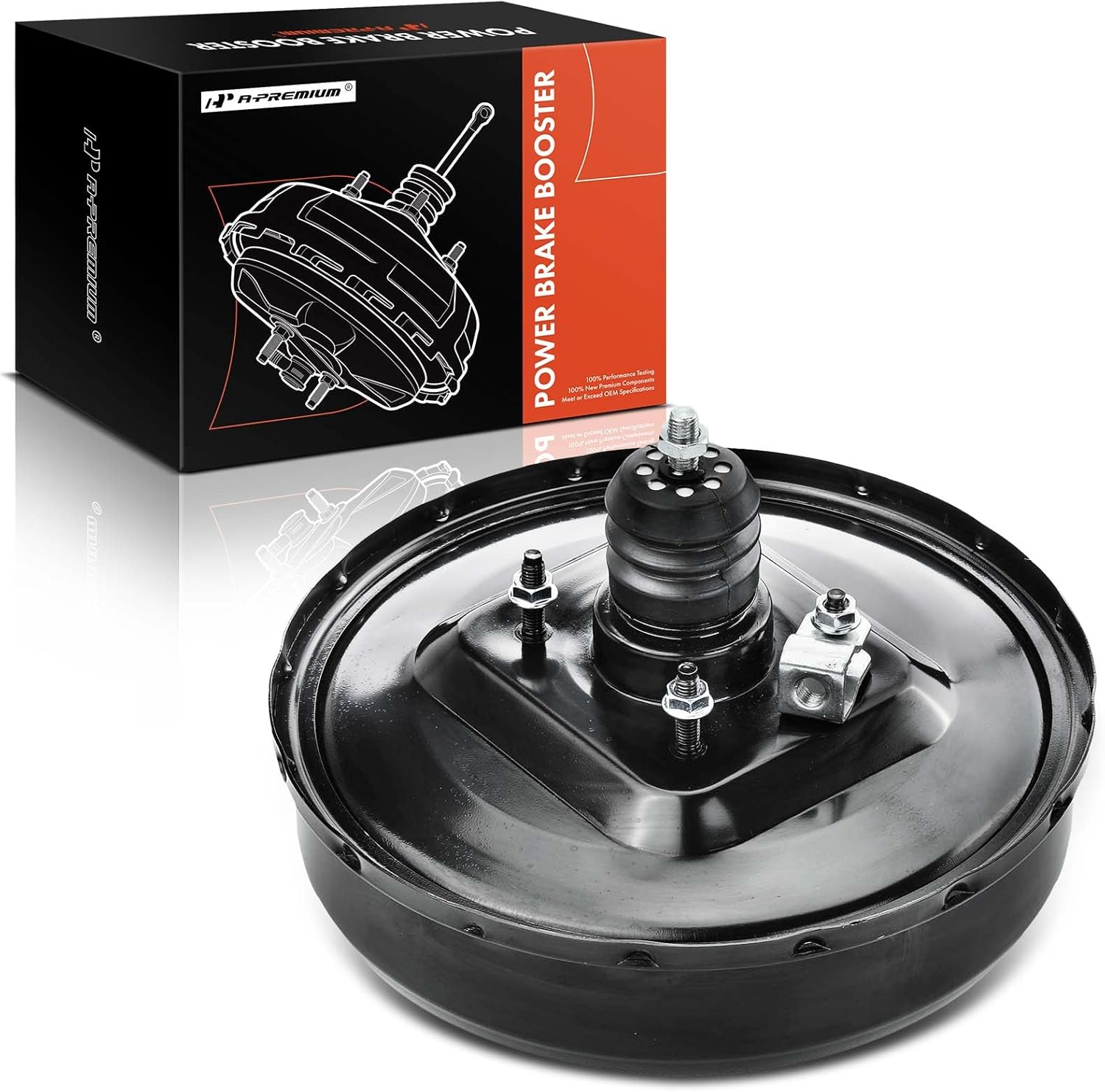
| Compatible Models | Mitsubishi Lancer 2008-2011, Outlander 2007-2010 |
|---|---|
| Master Cylinder Included | No |
| Diaphragm Style | Single |
| Master Cylinder Stud Thread Size | M8x1.25 |
This A-Premium vacuum power brake booster is a direct-style replacement intended to restore power-assist braking on compatible Mitsubishi Lancer and Outlander models. It is used and installed between the brake pedal and master cylinder to reestablish vacuum-assisted braking when the factory unit fails. The unit is steel construction with an anti-rust coating and a single diaphragm design, and it ships without a master cylinder so installers must reuse the factory master or fit a separate unit. Practical benefits include straightforward fitment for the listed model years, corrosion resistance for longer service life, and restored pedal effort and braking confidence when functioning as intended. Limitations are that the master cylinder is not included and there are specific ABS and model-subset fit notes, so confirming exact vehicle configuration is necessary before purchase. Buyers should plan for professional installation or careful DIY work to ensure proper pushrod adjustment and vacuum line connection.
Best for: Risk-averse mainstream buyers who prioritize restoring factory braking feel on a covered Mitsubishi Lancer or Outlander and prefer a direct replacement that emphasizes corrosion protection and straightforward fit.
Less Ideal for: Drivers who want a complete brake assembly out of the box or who are unsure of their vehicle's exact ABS/configuration should consider options that include the master cylinder or verify fitment before buying.
- Direct-fit for specified Mitsubishi Lancer 2008–2011 and Outlander 2007–2010 applications
- Steel construction with anti-rust coating for improved corrosion resistance
- Single-diaphragm vacuum design restores factory-style brake assist
- Includes M8x1.25 stud thread sizing to match factory mounting hardware
- Master cylinder is not included so a separate purchase or reuse is required
- Fitment excludes certain ABS and non-ABS submodels so careful vehicle verification is needed
Verdict: A practical, corrosion-resistant direct replacement brake booster for restoring factory power assist on the specified Mitsubishi Lancer and Outlander models.
Choosing the Right Mitsubishi Lancer Brake Booster: Key Factors to Consider
Vehicle Fitment and Mounting
Accurate fitment is essential because the brake booster must align precisely with the firewall mounting studs, brake pedal pushrod, and master cylinder studs. A unit that does not match the vehicle's mounting pattern can cause misalignment that affects pedal travel and may place stress on the master cylinder connections.
Check that the booster matches the Lancer's bolt pattern, flange thickness, and pushrod location. Small differences in body thickness or stud spacing can complicate installation and require modifications, which can compromise safety and add labor.
Vacuum Diaphragm Quality
The diaphragm is the active component that provides assistance by converting vacuum into mechanical force. Material choice and manufacturing tolerances influence how well the diaphragm holds vacuum and resists cracking or warping over time.
A high-quality diaphragm reduces the risk of a vacuum leak and preserves consistent pedal assist. Look for boosters with robust diaphragm materials and proven sealing designs, because failures here produce soft pedals and increased stopping distances.
Pushrod Length and Adjustment
Correct pushrod length and the ability to fine-tune it are critical for proper pedal height and free play. If the pushrod is too long or too short, the pedal may sit too high, drag the brakes slightly, or leave excess free play before engagement.
A booster with an adjustable pushrod or a factory-correct pre-set simplifies achieving the recommended pedal travel. This affects both comfort and braking system safety since improper pushrod settings can mimic hydraulic issues or cause uneven wear.
Vacuum Leak Resistance and Porting
Resistance to vacuum leaks is vital because any air ingress reduces assist and alters pedal feel. The booster housing, grommets, and vacuum port connections must seal reliably under repeated cycles and temperature changes.
Consider the location and quality of the vacuum port and any included gaskets or fittings. Durable port designs and quality seals help prevent loss of assist due to leaks, which are a common source of intermittent or gradual pedal deterioration.
Durability and Corrosion Resistance
Because the booster mounts at the firewall, it faces heat cycles and potential moisture exposure. Corrosion-resistant finishes and robust housings extend service life and reduce the chance of mounting failures or leaks at seams and fittings.
Evaluate construction details such as plated hardware, corrosion-resistant shells, and reinforced seams. These features matter for long-term reliability and can lower the likelihood of premature replacement in humid or road-salt environments.
Installation Ease and Serviceability
Ease of installation affects labor time and the potential for installation errors. Boosters that provide clear mounting access, standard hardware, and straightforward pushrod attachment reduce installation time and help ensure correct set-up.
Also consider whether replacement requires removal of ancillary components or special tools. Units designed for straightforward replacement minimize garage time and reduce the risk of incorrect assembly, which can impact safety and brake feel.
How We Chose the Best Mitsubishi Lancer Brake Booster
We focused on components designed specifically for the Mitsubishi Lancer and evaluated candidates against real-world repair and performance needs. Core criteria included correct vehicle fitment and mounting alignment, vacuum diaphragm quality and leak resistance, and compatibility with the master cylinder pushrod length and stroke. We also prioritized units with durable internal seals and corrosion-resistant housings to reduce failure risk in varied climates. Ease of installation and clear mounting points were considered to reflect typical DIY and shop workflows. Finally, we reviewed documented longevity and user-reported reliability to favor designs with consistent service life.We excluded units lacking vehicle-specific fit information, universal models without clear adjustment ranges, and products with limited or no documentation about diaphragm materials. The result is a curated list that balances correct fitment, vacuum performance, and long-term durability for Mitsubishi Lancer owners.
Our full evaluation process is outlined in our review methodology.
FAQ
What are common signs of a failing brake booster on a Mitsubishi Lancer?
Common signs often include a hard brake pedal that requires more force to stop, a spongy or inconsistent pedal feel, and a hissing noise near the firewall indicating a vacuum leak. These signs usually appear gradually and may be more noticeable after repeated stops or during cold starts.
How can I test the brake booster to confirm it is the problem?
A simple test is to pump the brake pedal several times with the engine off, then hold firm pressure while starting the engine. If the pedal moves down slightly as the engine starts, the booster is likely holding vacuum and assisting. A lack of change or a hard pedal may indicate a booster issue, though further diagnosis of vacuum supply and check valve function is recommended.
Can I replace the brake booster myself on a Mitsubishi Lancer?
Many mechanically inclined owners can perform the replacement with basic hand tools, but it requires careful attention to pushrod adjustment and secure mounting to the firewall. If you are uncomfortable with brake system components or lack access to torque tools, professional installation reduces the risk of improper setup.
Could a vacuum leak cause brake problems that seem like a bad booster?
Yes, a vacuum leak in the booster assembly or vacuum supply can reduce assistance and mimic booster failure. Inspect vacuum lines, check valve, and the booster gasket area for leaks. Addressing the vacuum source is part of diagnosing pedal-assist problems.
How does the booster relate to the master cylinder on braking performance?
The booster provides vacuum assist to reduce required pedal force, while the master cylinder converts pedal force into hydraulic pressure. A functioning booster changes how hard you must press the pedal, but the master cylinder determines hydraulic pressure. Poor booster function can make pedal effort feel excessive even if the master cylinder is fine.
What should I prioritize when choosing a replacement booster?
Prioritize correct fitment for the Mitsubishi Lancer, reliable vacuum sealing, and a diaphragm design with good longevity. Also consider ease of installation and pushrod adjustability to ensure proper pedal height and operation after installation.
Conclusion
When replacing a Mitsubishi Lancer brake booster, prioritize correct fitment, vacuum integrity, and proper pushrod adjustment. Those factors have the biggest impact on pedal feel, braking consistency, and long-term reliability.Balance corrosion resistance and installation ease against durability needs for your driving conditions. Addressing vacuum supply and verifying correct setup after installation will help ensure predictable braking performance.
Explore More:
- Check out all Mitsubishi Lancer parts & accessories
- Explore Brake Boosters Maintenance & Repair Guides
- Explore Brake System
- Browse all Auto Parts
