

Note: This article contains affiliate links. If you click on these links and make a purchase, I may earn a small commission at no extra cost to you. This helps support my research and content. Read my full affiliate disclosure here.
If your Mazda Mazda3 feels loose through turns or you hear clunks over bumps, the problem may be a failing ball joint. Choosing the right replacement affects steering response, alignment retention, and long-term suspension health. This guide presents seven shortlisted options that meet common buyer needs for durability, correct fitment, and ease of installation. We evaluated each candidate on fit accuracy and construction quality to help you decide which ball joint suits your driving habits and maintenance plans. Read on for the top picks and the criteria used to evaluate them.
Looking for other parts? See all Mazda Mazda3 parts & accessories.
Top Picks at a Glance
| Best overall The best all-around choice for most situations | Detroit Axle Front Lower Control Arms with Ball Joints for Mazda 3 (pair) |  |
| Best quality Built to a higher standard if you want something more solid | ILONPA Front Lower Control Arm Suspension Kit with Ball Joints, Sway Bar End Links and Tie Rod Ends (10 pcs) |  |
| Best Value The sweet spot between price and what you get | Detroit Axle Front Lower Ball Joints (2-piece) for Mazda 3 / CX-5 |  |
| Best budget The cheapest option that still gets the job done reliably | TRQ Front Lower Ball Joint (PSA75062) for Mazda 3 |  |
| Highest Rated A top-rated pick with lots of positive feedback | TRQ Front Lower Driver & Passenger Side Ball Joint Set (2-piece) |  |
| Most popular A crowd favorite that many people choose with confidence | Metrix Premium Chassis Parts Front Left & Right Lower Control Arm with Ball Joint Kit |  |
| Best Seller A high-volume bestseller chosen again and again | SCITOO Front Suspension 10‑Piece Kit with Control Arms, Ball Joints and Tie Rods for Mazda 3 (2010–2013) |  |
1. Detroit Axle Front Lower Control Arms with Ball Joints for Mazda 3 (pair)

| Fit Type | Vehicle Specific Fit |
|---|---|
| Auto Part Position | Front Lower |
| Auto Part Orientation | Drivers Side |
| Manufacturer | Detroit Axle |
These Detroit Axle front lower control arms come as a ready-to-install pair with integrated ball joints to replace worn or damaged front lower control arms on Mazda 3 models. They are vehicle-specific fit components intended to restore correct suspension geometry and eliminate symptoms like uneven tire wear, vibration, or sloppy steering. The assemblies arrive coated to resist corrosion and include the ball joints pressed into the arms so installation is straightforward for a DIY mechanic or a shop. Buyers report good fitment and solid build quality in everyday driving, and the parts undergo impact and fatigue testing during manufacture. Expect a noticeable improvement in steering feel and alignment stability after replacement. Limitations to consider are that the ball joints appear sealed and not serviceable for greasing, so long-term life depends on the initial assembly and boot condition, and some users noted occasional difficulty seating a mounting bracket during installation which may require clamps or light persuasion. These are a practical factory-replacement style option when you want a like-for-like front suspension refresh for a Mazda 3.
Best for: Balanced buyers who want a straightforward, factory-replacement front suspension refresh for their Mazda 3 to restore handling and alignment without chasing individual parts.
Less Ideal for: Drivers seeking fully serviceable ball joints or performance-oriented aftermarket suspension upgrades should consider alternatives designed for rebuildability or enhanced handling.
- Vehicle-specific pair with integrated ball joints for direct replacement on Mazda 3 front lower position
- Factory-style coating to reduce corrosion and improve longevity in wet climates
- Preassembled units simplify installation compared with rebuilding individual components
- Manufactured with impact and fatigue testing to meet consistent performance expectations
- Ball joints are sealed and not serviceable for greasing which can limit long-term maintenance options
- Some installations may require extra tools or clamps to fully seat mounting brackets
Verdict: A practical, ready-to-install pair of front lower control arms with ball joints for Mazda 3 owners who want a reliable, factory-style suspension replacement.
2. ILONPA Front Lower Control Arm Suspension Kit with Ball Joints, Sway Bar End Links and Tie Rod Ends (10 pcs)

| Fit Type | Vehicle Specific Fit |
|---|---|
| Auto Part Position | Front |
| Material Type | Alloy Steel |
| Included Components | Control Arm |
This ILONPA suspension kit supplies the front lower control arms with integrated ball joints plus sway bar end links and outer and inner tie rod ends to refresh the front steering and suspension of compatible Mazda 3 and Mazda 5 models. Designed as direct-fit replacement parts, the kit is typically used when worn control arms, loose ball joints, or failing tie rods are causing play in the steering, uneven tire wear, or poor handling. The included components are manufactured from alloy steel and the seller highlights precision tolerances for easier installation and alignment. In practice the kit lets you address multiple front-end wear items in one job, saving shop time and avoiding piecemeal purchases. Limitations to note are fitment sensitivity — buyers must confirm the exact model year and submodel because some reviewers reported incorrect or partial kits arriving — and the package may not include replacement hardware such as mounting bolts. For performance-focused repairs the parts offer a cost-effective way to restore steering precision, but double-check fitment and inspect incoming parts before installation.
Best for: Performance-oriented buyers who want to restore tight steering and predictable front-end behavior on the specified Mazda 3 and Mazda 5 models and prefer replacing multiple worn suspension components in one service session.
Less Ideal for: Buyers seeking a single-component upgrade, a premium performance aftermarket brand, or those who cannot confirm exact model-year fitment should consider alternate options or ordering individual factory-quality parts.
- Complete 10-piece kit replaces both lower control arms with ball joints plus sway bar end links and tie rod ends so multiple front-end faults can be fixed in one job.
- Manufactured from alloy steel for durability under normal street driving and repeated suspension loads.
- Designed for vehicle-specific fitment to Mazda 3 (2004–2009, 2009 Sport) and Mazda 5 (2006–2017), reducing the need for aftermarket modifications.
- Precision tolerances intended to simplify installation and return steering geometry close to factory alignment.
- Fitment and packing errors reported by users mean you should verify all parts on arrival before starting work.
- Does not include replacement mounting hardware in many cases, so you may need new bolts or fasteners separately.
Verdict: A cost-effective, vehicle-specific front suspension kit that restores steering feel and replaces multiple worn components at once, but confirm fitment and expect to source bolts separately.
3. Detroit Axle Front Lower Ball Joints (2-piece) for Mazda 3 / CX-5

| Compatible vehicles | Mazda 3 Sport (2014-2018) and Mazda CX-5 (2013-2015) listed |
|---|---|
| Kit contents | 2x front lower ball joints |
| Manufacturer | Detroit Axle |
| Manufacturer part number | K500395x2 |
These Detroit Axle front lower ball joints replace the worn lower ball joints on compatible Mazda 3 and CX-5 front suspension assemblies. Sold as a two-piece kit (two lower ball joints), they are intended for a direct replacement during a front suspension service and are typically pressed into the steering knuckle. The parts are manufactured to aftermarket quality standards with testing for impact and fatigue, and include greaseable fittings so you can service them during routine maintenance. In use they restore tighter steering feel and reduce play that causes uneven tire wear. Reported positives from installers include accurate fit and improved handling when match is correct. Important limitations: fitment must be confirmed for your exact Mazda 3 or CX-5 year and submodel because a few buyers have found incorrect fit information or small dimensional differences that prevent proper installation. These are economy aftermarket parts, so installers seeking factory-quality tolerances or who lack a press may prefer a dealer or premium-brand replacement. For a practical, cost-conscious Mazda owner they offer solid value when the fit is verified before installation.
Best for: Practical optimizers who prioritize getting reliable replacement suspension parts at a lower cost and are comfortable verifying fitment and performing or arranging a standard suspension service.
Less Ideal for: Buyers who insist on factory-level tolerances, exact OEM interchange, or who cannot access a press or professional installer should consider premium or dealer-sourced replacements instead.
- Sold as a two-piece kit to replace both front lower ball joints at once
- Greaseable fittings allow periodic lubrication to extend service life
- Built and tested to aftermarket standards for impact and fatigue resistance
- Many buyers report correct fit and improved steering feel when matched to the right Mazda model
- Some listings or parts may have fitment mismatches requiring verification before installation
- May require a press and basic suspension tools for installation, not a bolt-on job for all DIYers
Verdict: A budget-friendly, greaseable front lower ball joint kit that restores steering feel on the listed Mazda models when fitment is confirmed beforehand.
4. TRQ Front Lower Ball Joint (PSA75062) for Mazda 3

| Fitment | Mazda 3 2004–2013 front lower |
|---|---|
| Mounting Type | Press-In |
| Greaseable | No |
| Dust Boot | Included |
This TRQ front lower ball joint is a direct-fit replacement for the Mazda 3 (2004–2013) front lower position. It is supplied pre-assembled with a dust boot and press-in mounting, so it installs like a factory replacement when the knuckle is pressed or pressed back into the car. The part is non-greaseable and not adjustable, which simplifies installation but means you should confirm the internal lubrication before long-term use. TRQ highlights installation videos and compatibility guidance, which is useful for DIYers who plan to remove the knuckle and have the joint pressed in at a shop. Practical benefits include clear fitment for Mazda 3 models, a machined exterior finish, and generally positive buyer reports on fit and value. Limitations to note are that some customers report low internal grease or different internal materials on aftermarket joints, and press-in fitting requires a press or shop service; do not expect a rebuildable OEM-style, greaseable unit. For budget-focused Mazda 3 repairs this part can restore steering feel and alignment without major modification, but buyers who prioritize long-term durability may prefer higher-end options.
Best for: Budget-conscious Mazda 3 owners who prioritize an affordable, direct-fit replacement to get a reliable short- to medium-term repair without modifying suspension geometry.
Less Ideal for: Drivers looking for a rebuildable or greaseable long-life performance joint, or those who prefer OEM-brand suspension parts for extended durability, should consider higher-end alternatives.
- Direct-fit replacement for Mazda 3 front lower position (2004–2013) for straightforward compatibility.
- Pre-assembled with dust boot and machined exterior for an OEM-style appearance and installation.
- Includes manufacturer installation resources and videos to aid DIY repairs.
- Budget-friendly option that restores steering geometry and suspension mounting without modification.
- Non-greaseable press-in design cannot be serviced in-place and may require a shop press for installation.
- Mixed reports in user feedback about internal lubrication and material quality could affect long-term durability.
Verdict: A wallet-friendly, direct-fit front lower ball joint that restores Mazda 3 suspension function quickly but is non-greaseable and may require a press for installation.
5. TRQ Front Lower Driver & Passenger Side Ball Joint Set (2-piece)

| Manufacturer | TRQ |
|---|---|
| Model | TRQ PSA48838 2 Piece Ball Joint Set |
| Position | Front Lower |
| Manufacturer Part Number | PSA48838 |
This TRQ two-piece kit supplies the front lower driver and passenger side ball joints as direct-fit replacements for Mazda 3 (2004–2013) and Mazda 5 (2006–2008, 2012–2015). It is intended for DIY or shop installation and ships with the press-fit joints and required fasteners to complete a standard lower control arm swap. Notable features include machined exterior finish and pre-assembled components that simplify installation and reduce the need for modifications. Practical benefits seen in user reports are improved steering feel, removal of squeaks, and a firmer, more responsive front end after installation. Limitations to note are some inconsistent fit reports where thread length or seating can differ from factory parts, which may require washers or extra attention during torque and cotter-pin installation; compatibility should be double-checked against the vehicle fitment chart before purchase. TRQ also provides installation videos that help guide homeowners through the replacement process.
Best for: Reliability-focused buyers who want a practical, factory-replacement style repair that restores steering response and eliminates suspension noise through a direct replacement strategy.
Less Ideal for: Not the best choice for those seeking premium, heavy-duty performance upgrades or custom suspension work beyond factory-spec restoration.
- Direct-fit replacement for front lower positions on specified Mazda 3 and Mazda 5 model years
- Includes both driver and passenger lower ball joints and necessary fasteners for a standard swap
- Machined exterior and pre-assembled components simplify installation and reduce modification needs
- Access to TRQ installation videos provides step-by-step guidance for DIY repairs
- Some buyers reported dimensional differences versus factory parts that required washers or extra fitting to secure the nut and cotter pin
Verdict: A straightforward, vehicle-specific replacement kit that restores front-lower steering feel and suspension quietness for Mazda 3 and Mazda 5 owners.
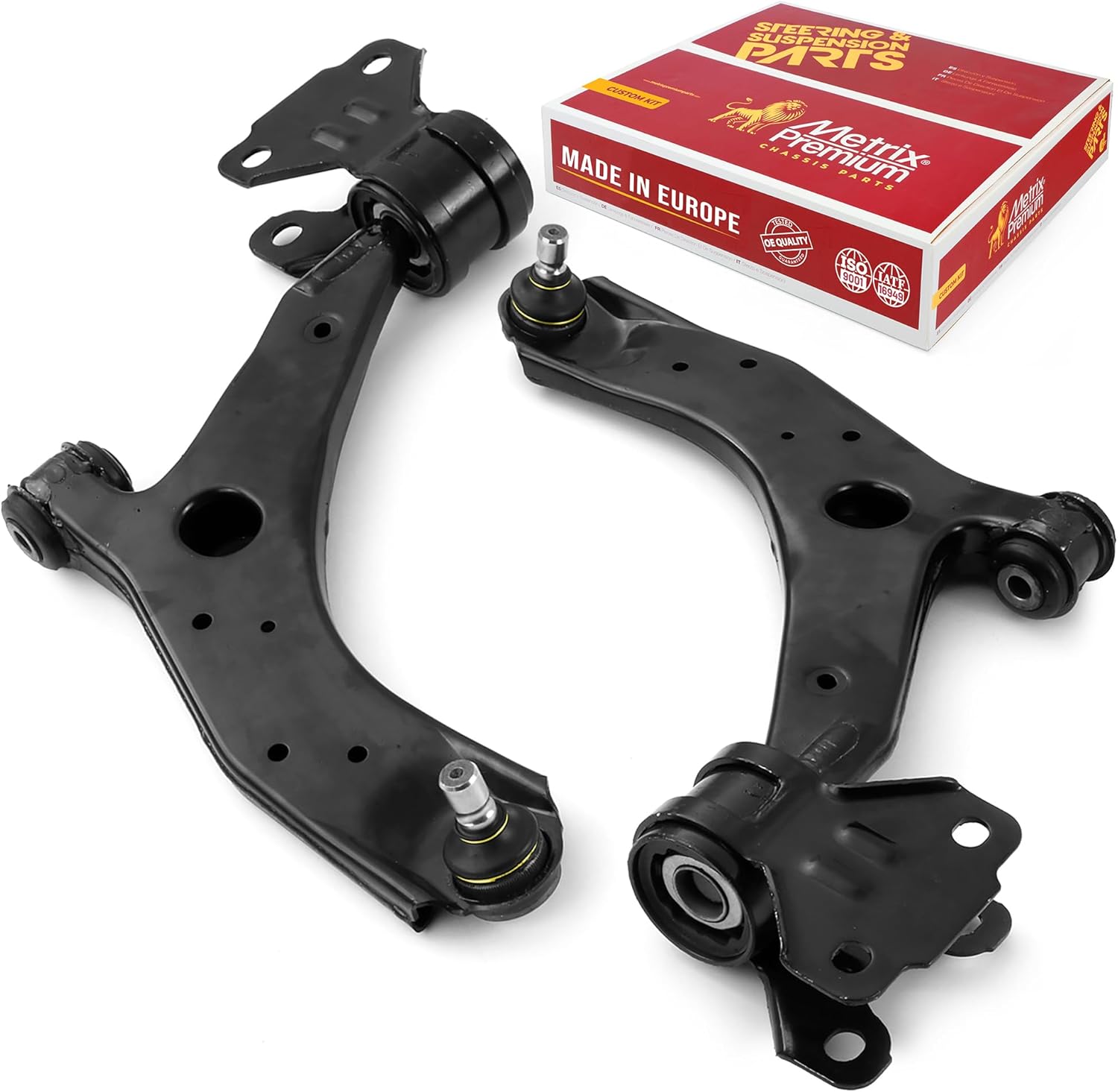
6. Metrix Premium Chassis Parts Front Left & Right Lower Control Arm with Ball Joint Kit
| Fit Type | Vehicle Specific Fit |
|---|---|
| Auto Part Position | Front |
| Material Type | Metal |
| Manufacturer Part Number | 99753MT |
This Metrix kit delivers two front lower control arms with pre-installed ball joints that replace the factory parts on 2010–2013 Mazda 3 and Mazda 3 Sport models. Intended as a direct, vehicle-specific fit, the steel assemblies arrive pre-greased to simplify installation and reduce initial break-in noise. Metrix positions these as premium, factory-quality replacements built to IATF 16949 and ISO 9001 standards and backs them with a three-year/36,000-mile limited warranty, which is useful if you want long-term reassurance. In practice the arms are used to restore front suspension geometry and steering feel after worn original arms cause clunks or loose steering; reviewers report straightforward bolt-in installation and improved front-end stability. Limitations to note are that the ball joints are non-serviceable and there is no mention of adjustable camber features, so alignment may still require shop adjustment after install. Fitment is vehicle specific so verify the part numbers match your Mazda 3 year and engine variant before ordering.
Best for: Reliability-focused buyers who prioritize a factory-quality, vehicle-specific replacement to restore steering precision and front-end stability on a Mazda 3.
Less Ideal for: Drivers looking for performance-tuned or adjustable control arms for alignment tuning should consider aftermarket performance options instead.
- Vehicle-specific direct replacement for 2010–2013 Mazda 3 ensuring correct fit and attachment points.
- Pre-greased joints reduce initial break-in and simplify installation for DIY or pros.
- Manufactured to IATF 16949 and ISO 9001 standards, indicating consistent production quality.
- Includes both left and right control arms with integrated ball joints so both sides can be replaced together.
- Ball joints are non-serviceable which means the entire arm must be replaced when the joint wears.
- No built-in alignment adjustment features, so a professional alignment is recommended after installation.
Verdict: A dependable, factory-quality pair of front lower control arms for 2010–2013 Mazda 3 owners who want a straightforward, warranty-backed replacement to restore steering and suspension stability.
7. SCITOO Front Suspension 10‑Piece Kit with Control Arms, Ball Joints and Tie Rods for Mazda 3 (2010–2013)

| Fitment | 2010–2013 Mazda 3 and Mazda 3 Sport |
|---|---|
| Kit contents | 10-piece front suspension set |
| Position | Front |
| Exterior finish | Electrophoretic Coated |
This SCITOO suspension kit supplies the main front-end wear items needed when rebuilding the front suspension on a 2010–2013 Mazda 3. It includes left and right lower control arms with integrated ball joints, inner and outer tie rod ends, sway bar end links and steering rack boots so you get most components that commonly wear together. Parts come pre-greased and the ball joint sockets have pre-installed boots to keep contaminants out, which reduces installation prep and helps longevity. For a homeowner or independent shop doing a full front suspension refresh, the bundle simplifies sourcing and ensures matched replacement parts. Limitations to consider are that this is an aftermarket kit rather than factory-made components and professional installation is recommended to ensure alignment and steering geometry are correct. The set is a practical choice for restoring steering feel and front-end stability on the specified Mazda 3 years, but expect to follow with a wheel alignment after fitting.
Best for: Risk-averse mainstream buyers looking for a single, bundled solution to restore front suspension function on a Mazda 3 2010–2013 without hunting down individual parts.
Less Ideal for: Buyers seeking OEM factory parts or those who prefer to replace only one specific component at a time rather than a full kit should consider other options.
- Complete 10-piece kit covers control arms, ball joints, inner and outer tie rods, sway bar links and boots so you can replace most front wear parts in one job.
- Parts arrive pre-greased and with pre-installed boots to reduce initial maintenance and limit contamination during service.
- Designed to fit 2010–2013 Mazda 3 models, which simplifies compatibility checks for that vehicle.
- Electrophoretic coating on exposed parts helps resist corrosion for longer service life.
- Aftermarket parts may differ slightly from factory-fit components in materials or tolerances.
- Professional installation and a follow-up wheel alignment are required for correct steering geometry and safe handling.
Verdict: A convenient, pre-greased 10-piece front suspension kit that restores steering and front-end components on 2010–2013 Mazda 3 models but requires professional installation and alignment.
Choosing the Right Mazda Mazda3 Ball Joint: Key Factors to Consider
Fitment and Vehicle Specificity
Correct fitment is critical because a ball joint designed for the Mazda Mazda3 must match the knuckle interface, stud diameter, and mounting orientation. Incorrect geometry can alter suspension kinematics, leading to poor handling or accelerated tire wear. Always verify part numbers and vehicle year or submodel compatibility as small variations change clearance and bolt patterns.
Choosing a part that is explicitly specified for the Mazda Mazda3 reduces the risk of alignment drift after installation and minimizes the need for additional modifications or adapters. Fitment also influences whether you can reuse original hardware or need extra fasteners, which affects installation time and complexity.
Material and Corrosion Protection
Ball joints operate in a harsh environment and are exposed to moisture, road salt, and debris, so material selection matters for longevity. Hardened steel stud surfaces, properly heat-treated bearing components, and robust housings resist wear under repeated load cycles. Corrosion-resistant coatings, plated surfaces, or stainless components help prevent seizure and extend service life.
Poor corrosion protection can lead to frozen joints that are difficult to replace and can damage surrounding suspension parts during removal. Consider parts that specify coatings or treatments designed for the climates you drive in.
Joint Design and Load Capacity
Different ball joint internal designs affect articulation range, friction characteristics, and load distribution. A well-engineered bearing surface and correct pre-load reduce slop and maintain steering precision. Load capacity should match or exceed the original equipment specification to handle dynamic forces during cornering and braking without premature fatigue.
Overly stiff designs can transmit extra noise and harshness, while underspecified joints will wear quickly. Look for parts that balance smooth movement with firmness to preserve predictable handling.
Greaseability and Sealing
Serviceable ball joints feature grease fittings that allow periodic lubrication, which can extend service life and reduce noise. Non-serviceable sealed joints rely on initial factory lubrication and durable seals to keep contaminants out. The quality of the boot or seal is important because a compromised seal lets grit into the bearing surface and accelerates wear.
If you perform routine undercar maintenance, a greasable unit can be advantageous. For sealed units, check that the seal material and retention method are robust enough to resist tears and displacement during suspension travel.
Installation Requirements and Tooling
Some ball joints are direct fit and use existing hardware, while others may require removal of pressed-in units or special tools. Knowing whether a press, puller, or specific socket is needed helps you plan for installation time and potential labor costs. Ease of installation also matters if you intend to DIY; units that minimize labor are often preferable for home mechanics.
Consider whether the design simplifies torqueing to specification and whether replacement hardware or a ball joint kit is recommended. Understanding the installation steps ahead of time prevents surprises and reduces the chance of improper fitting.
Noise, Vibration, and Ride Quality
Worn or poorly designed ball joints can contribute to wheel vibration, audible clunks, and degraded steering feel. The internal clearances and boot retention influence how much noise and vibration transmit into the cabin. Parts that maintain tight tolerances typically reduce road feedback and preserve factory ride characteristics.
When selecting a replacement, prioritize units that are engineered to minimize play and dampen harshness while still allowing the required freedom of movement for suspension travel. This balance affects everyday driving comfort and perceived vehicle refinement.
How We Chose the Best Mazda Mazda3 Ball Joint
We focused on components that restore proper suspension geometry and deliver reliable steering feedback. Key evaluation criteria included fitment accuracy for the Mazda Mazda3, material quality and corrosion protection, joint design and load rating, and manufacturing tolerances that affect alignment and wear life. We also considered the ease of installation, including whether the design allows reuse of factory hardware or requires specific tools, and the availability of replacement hardware or kits. Durability tests or third-party longevity data were considered when available, along with user reports on noise and vibration outcomes. Items excluded from the list were universal or generic ball joints without clear Mazda Mazda3 fitment, products lacking manufacturer specifications, and options with unverified build materials. The result is a focused list of well-specified ball joints appropriate for routine maintenance and repair on the Mazda Mazda3.
Our full evaluation process is outlined in our review methodology.
FAQ
What are common ball joint symptoms on a Mazda Mazda3?
Common signs include excessive play in the front end, clunking noises over bumps, uneven tire wear, and wandering steering. You may also notice a change in steering feel during turns. These symptoms often develop gradually and may be more noticeable at low speeds or during sharp steering inputs.
How long do ball joints usually last on a Mazda Mazda3?
Service life varies with driving conditions, load, and maintenance, but many ball joints last tens of thousands of miles under normal use. Exposure to rough roads, heavy braking, or corrosive environments can shorten lifespan. Regular inspections during suspension service help identify wear before failure.
Can I replace a Mazda Mazda3 ball joint myself?
DIY replacement is possible for mechanically inclined people with the right tools and a safe workspace. Some units are direct-replacement and bolt-in, while others require pressing out the old joint and pressing in a new one. If the job requires a press or specialized puller and you lack the tools, professional installation is a practical option.
Should I grease a new ball joint after installation?
If the replacement is serviceable and includes a grease fitting, periodic greasing according to specifications can extend service life and maintain smooth operation. Sealed units do not require greasing and rely on factory lubrication and durable seals. Follow the installation and maintenance guidance provided with the part.
Will replacing a ball joint fix steering vibration?
Replacing a worn ball joint often reduces or eliminates vibration caused by excessive play, but steering vibration can have multiple causes. It often depends on whether the ball joint was the primary source of movement. A thorough inspection of tires, wheel balance, and other suspension components will determine if further repairs are needed.
Conclusion
When choosing a replacement Mazda Mazda3 ball joint, prioritize correct fitment and construction quality to preserve steering precision and alignment retention. Balance the benefits of serviceable versus sealed designs based on your maintenance habits and local driving conditions.Keep in mind tradeoffs between ease of installation and long-term durability. Inspect seals, verify load ratings, and plan for any special tools needed so the replacement solves symptoms without introducing new issues.
Explore More:
- Check out all Mazda Mazda3 parts & accessories
- Explore Ball Joints Maintenance & Repair Guides
- Explore Suspension & Steering
- Browse all Auto Parts
