

Note: This article contains affiliate links. If you click on these links and make a purchase, I may earn a small commission at no extra cost to you. This helps support my research and content. Read my full affiliate disclosure here.
If your 2004-2015 Nissan Titan is blowing warm air or showing signs of refrigerant loss, replacing the AC condenser is a common and effective repair. The condenser sits at the front of the vehicle and is critical to removing heat from the refrigerant so the system can deliver cold air inside the cabin. Choosing the right condenser matters because incorrect fitment or poor durability can lead to persistent leaks, extra labor, and premature repeat repairs.This guide covers the top shortlisted AC condensers for the 2004-2015 Nissan Titan and explains the practical factors we used to evaluate them, including leak resistance, materials and construction, and how easy each unit is to install. Read on to compare the contenders and find the condenser that best matches your repair goals and installation skills.
Looking for other parts? See all Nissan Titan parts & accessories.
Top Picks at a Glance
| Best Overall The best all-around choice for most situations | AParts A/C Condenser Compatible with Nissan Titan and Related 5.6L Models |  |
| Best Quality Built to a higher standard if you want something more solid | Readair Air Conditioning Condenser Compatible with Infiniti QX56 and Nissan Titan/Armada/Pathfinder (3239) |  |
| Best Value The sweet spot between price and what you get | Evan Fischer A/C Condenser Compatible with 2004–2015 Nissan Titan (with Receiver Drier) |  |
| Best Budget The cheapest option that still gets the job done reliably | TYC 3239 Replacement AC Condenser for 2004–2015 Nissan Titan |  |
| Highest Rated A top-rated pick with lots of positive feedback | A-Premium A/C Condenser Compatible with Nissan Titan 2004-2015, V8 5.6L |  |
| Most Popular A crowd favorite that many people choose with confidence | Orceed A/C Condenser with Receiver Drier and Bracket, Model 3239 |  |
| Best Seller A high-volume bestseller chosen again and again | TRQ A/C Condenser and Receiver Drier Assembly |  |
1. AParts A/C Condenser Compatible with Nissan Titan and Related 5.6L Models

| Brand Name | AParts |
|---|---|
| Part Number | ACondenser3239 |
| Vehicle Fitment | Compatible with Infiniti QX56 2004-2010, Nissan Titan/Armada 2004-2015, Pathfinder Armada 2004 |
| Included Components | Condenser, receiver drier, bracket |
| Customer Reviews | 4.7 out of 5 stars |
This AParts condenser is a direct-replacement aluminum assembly designed for 5.6L Nissan and Infiniti vehicles from the mid 2000s to mid 2010s. It installs where the factory condenser sits and is intended to restore cooling performance after the original unit fails from leaks, corrosion, or clogged fins. The assembly includes a receiver drier and mounting bracket so you get the core hardware needed for a typical condenser swap. Construction uses brazed tubes and high-density, multi-louvered fins to speed heat dissipation and resist corrosion, which helps the system cool more efficiently and keep cabin temperatures down. For DIYers the stated fit, form, and function approach simplifies installation, but expect to evacuate and recharge the refrigerant and follow proper safety procedures. The product carries a two-year unlimited-mileage guarantee from the brand. This is a practical replacement for bringing A/C output back to factory levels, though professional refrigerant service is still required for complete installation.
Best for: Drivers looking for a practical, OEM-style condenser replacement to restore strong A/C performance on late-2000s to mid-2010s 5.6L Nissan/Infiniti vehicles and who value a mostly complete swap kit.
Less Ideal for: Anyone wanting a universal or modified-performance condenser, or those who cannot access professional refrigerant evacuation and recharge services.
- Direct-replacement design aimed at matching factory fit and mounting
- Includes receiver drier and mounting bracket for a more complete install
- Aluminum brazed core with high-density multi-louvered fins for improved heat dissipation
- Two-year unlimited-mileage guarantee from the manufacturer
- Does not include refrigerant or service equipment so A/C system evacuation and recharge are required
- Fitment is limited to specified 5.6L models so verification is necessary before purchase
Verdict: Choose this condenser if you want a factory-style, all-in-one replacement that restores A/C cooling for 5.6L Nissan/Infiniti models with minimal parts chasing.
2. Readair Air Conditioning Condenser Compatible with Infiniti QX56 and Nissan Titan/Armada/Pathfinder (3239)

| Fitment | Infiniti QX56 5.6L 2004-2010; Nissan Titan/Armada/Pathfinder 5.6L 2004-2015 |
|---|---|
| Built-in receiver dryer | Yes |
| Condition | New |
| Manufacturer | Readair |
This Readair condenser is a direct-replacement unit intended to restore or improve A/C cooling on compatible Infiniti and Nissan 5.6L vehicles from 2004 through 2015. It includes a built-in receiver dryer and heavy-gauge mounting brackets to reduce vibration, which makes it suitable for a shop or a competent DIYer replacing a leaking or corroded original condenser. The design aims to match factory fit and function so installation uses existing mounting points and refrigerant/oil connections, and the included receiver dryer helps ensure the system is clean after a repair. Buyers looking for durable replacements will appreciate the reinforced brackets and the manufacturer two-year unlimited-mileage guarantee. Limitations are that the unit does not include a built-in oil cooler and dimensions must be checked against the vehicle since core measurements are provided rather than universal fit; professional evacuation and recharge of the refrigerant are still required. Expect the part to perform like a straightforward factory-style condenser rather than a performance-upgrade unit.
Best for: Buyers who prioritize restoring reliable, factory-quality A/C performance on 2004–2015 Nissan and Infiniti 5.6L vehicles and want a durable, install-friendly replacement part.
Less Ideal for: Drivers seeking a high-capacity or performance-tuned condenser for increased cooling beyond factory levels should look at aftermarket performance units.
- Built-in receiver dryer helps remove moisture and contaminants during installation
- Heavy-gauge mounting brackets reduce movement and vibration for long-term durability
- Designed to match factory fit and mounting points for straightforward replacement
- Two-year unlimited-mileage guarantee from the manufacturer
- No built-in oil cooler, so it may not replace condensers that require integrated oil cooling
Verdict: If you need a durable, factory-style condenser to restore A/C cooling on 2004–2015 Nissan or Infiniti 5.6L models, this Readair unit is a dependable direct-replacement choice.
3. Evan Fischer A/C Condenser Compatible with 2004–2015 Nissan Titan (with Receiver Drier)

| Brand | Evan Fischer |
|---|---|
| Manufacturer Part Number | EVA395022720M124 |
| Fitment Years | 2004-2015 |
| Includes | Receiver drier |
This Evan Fischer condenser is a factory-style replacement meant to restore air conditioning performance on compatible 2004–2015 Nissan Titan vehicles. It installs in place of the original condenser and includes a receiver drier to simplify the service cycle. The unit is built to factory production standards and uses the same mounting points and hose connections as the factory part, so it is typically used during HVAC repairs after leaks, corrosion, or impact damage. Practical benefits include full fitment coverage for the listed model years, a complete condenser assembly that reduces parts hunting, and a finish that resists corrosion for longer life. Expect normal refrigerant and oil handling during installation and standard evacuation and recharge procedures. Limitations are that this is a direct replacement only and does not alter cooling capacity or add performance features, and professional installation is recommended if you do not have HVAC tools or experience with refrigerant service.
Best for: Buyers who want a reliable, no-nonsense replacement that restores factory A/C function with minimal parts sourcing and downtime.
Less Ideal for: People seeking upgraded cooling capacity, performance condensers, or a custom HVAC solution should look at performance-oriented parts instead.
- Direct-fit design for 2004–2015 Nissan Titan to simplify installation
- Includes receiver drier so the assembly is ready for system service
- Engineered to production standards for a factory-style replacement
- Corrosion-resistant finish extends service life in road conditions
- Does not increase cooling performance beyond factory specifications
Verdict: A straightforward, direct-fit condenser that gets a 2004–2015 Nissan Titan A/C system back to factory-level cooling with minimal fuss.
4. TYC 3239 Replacement AC Condenser for 2004–2015 Nissan Titan

| Manufacturer | TYC |
|---|---|
| Position | Front |
| Model | TYC 3239 Replacement Condenser |
| OEM Part Number | 92100-9FF0A |
The TYC 3239 condenser is a direct-fit replacement designed to drop into the front position of 2004–2015 Nissan Titan models and restore the vehicle's air conditioning cooling capacity. It is constructed with louvered aluminum fins and tubes bonded via a high-temperature brazing process for durability and efficient heat transfer. TYC reports that each unit is leak-tested and test-fitted on vehicles to ensure correct mounting points, bracket alignment, and inlet/outlet placement so installation is usually straightforward for a competent DIYer or professional installer. Where applicable the condenser includes an integrated receiver/dryer to simplify replacement and reduce extra parts. Expect factory-comparable performance and a durable aluminum build, but check for required line fittings or O-rings since those service parts are not guaranteed included and professional evacuation and recharge of the system are still required. This unit suits routine condenser replacement when restoring AC function on Titans without upgrading to performance or heavy-duty aftermarket cooling.
Best for: Buyers replacing a failed condenser on a Nissan Titan who prioritize a budget-friendly, factory-like replacement that simplifies installation and restores AC performance.
Less Ideal for: Do not choose this if you want a high-performance cooling upgrade, custom cooling modifications, or a condenser intended for non-Titan vehicles.
- Direct-fit design test-fitted to vehicle mounting points for easier installation
- Louvered aluminum fins and brazed tubes for effective heat transfer and corrosion resistance
- Leak-tested at the factory to reduce early failure risk
- Includes integrated receiver/dryer where applicable to simplify replacement
- May not include small service parts like O-rings or line fittings, which may be needed for installation
Verdict: A practical, factory-style replacement condenser that restores AC function on 2004–2015 Nissan Titan trucks without unnecessary cost.
5. A-Premium A/C Condenser Compatible with Nissan Titan 2004-2015, V8 5.6L

| Built-in Receiver Dryer | Yes |
|---|---|
| Built-in Bracket | Yes |
| Fitting Design | Block Fitting |
| Compatible Engines | V8 5.6L |
This A-Premium A/C condenser is a bolt-in replacement intended to restore air conditioning performance on 2004–2015 Nissan Titan V8 5.6L trucks and compatible sibling vehicles. It includes a built-in receiver dryer and mounting bracket so installation mirrors the stock unit and reduces extra parts or modification. The condenser is engineered for efficient heat dissipation and is presented as meeting factory-quality fit standards, which makes it a practical option when the original condenser fails or leaks. In typical use it replaces the damaged condenser during an AC service, letting the system recover proper refrigerant flow and cooling capacity. The main practical benefits are straightforward fitment, integrated components that simplify installation, and a one-year unlimited-mileage guarantee from the brand. Limitations to keep in mind are that it is an aftermarket part rather than factory-made and proper installation requires flushing the system and correct refrigerant handling to avoid premature issues.
Best for: Drivers who prioritize a dependable, ready-to-install replacement to get their truck AC back to factory-level cooling with minimal modification and downtime.
Less Ideal for: Those seeking an exact factory-manufactured condenser or a long-term OEM parts provenance for show or concours restoration projects.
- Direct bolt-on fitment for 2004–2015 Nissan Titan V8 5.6L and compatible models
- Built-in receiver dryer reduces the number of separate parts to install
- Includes built-in mounting bracket for a simpler replacement process
- Engineered for efficient heat dissipation to restore AC cooling performance
- Aftermarket unit rather than a factory-made condenser
- Proper system flushing and refrigerant handling are required for reliable long-term performance
Verdict: A practical, ready-to-fit condenser that restores AC cooling on 2004–2015 Nissan Titan V8 5.6L trucks with integrated components to simplify installation.
6. Orceed A/C Condenser with Receiver Drier and Bracket, Model 3239
| Compatible vehicles | Nissan Titan 2004-2015 V8 5.6L; Armada 2005-2015; Pathfinder 2004; Infiniti QX56 2004-2010 V8 5.6L |
|---|---|
| Includes | Receiver drier and bracket |
| Material | Aluminum |
| Manufacturer model | 3239 |
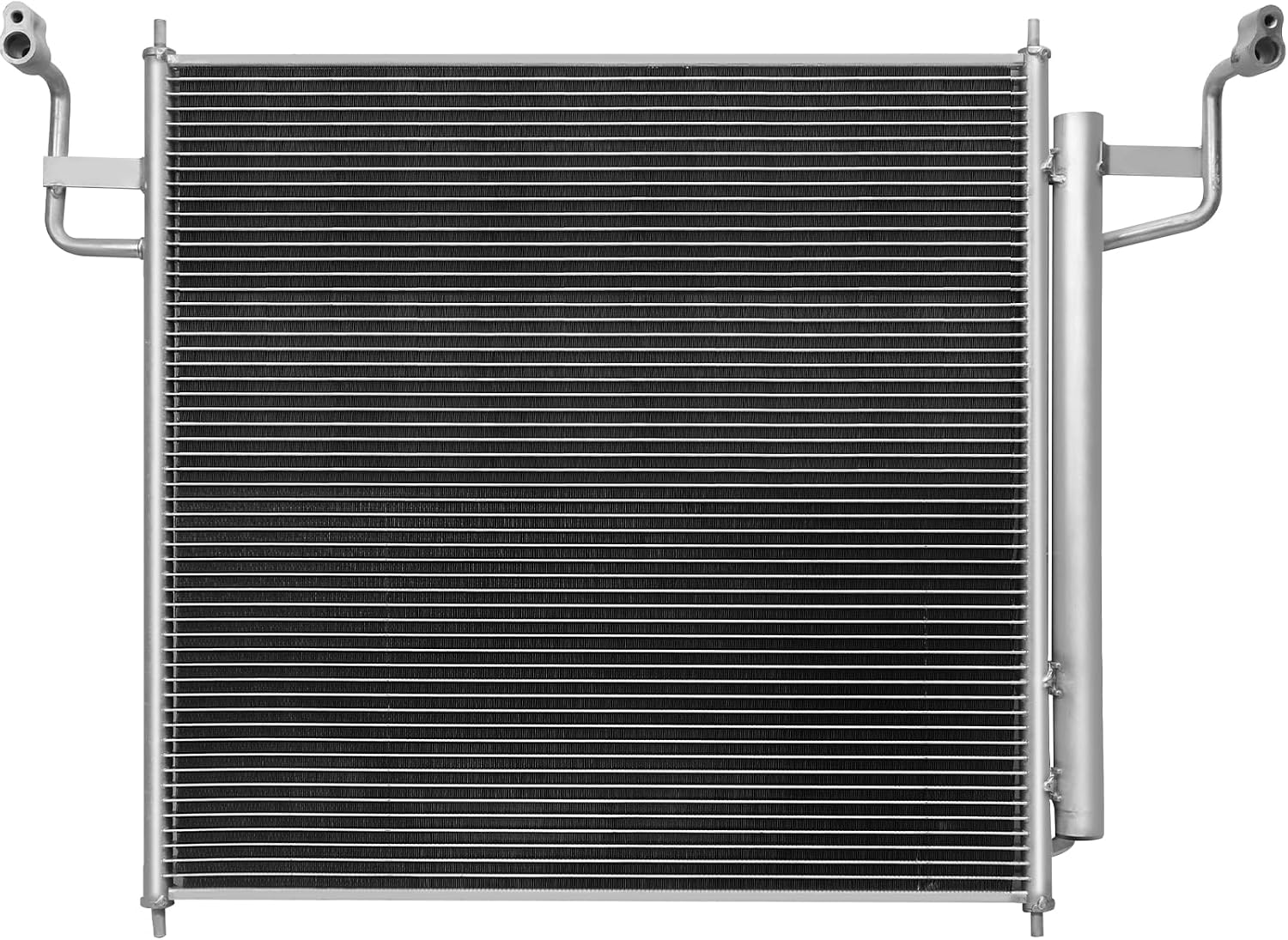
This Orceed condenser is a factory-style replacement designed for 2004–2015 Nissan Titan V8 5.6L applications and compatible siblings. It replaces the original condenser and ships with a receiver drier and mounting bracket to simplify installation. Constructed from aluminum with high-density multi-layered fins, the unit is intended to improve cooling efficiency and speed heat dissipation compared with older or damaged condensers. Gaskets and O-rings are treated for thermal shock resistance to hold up in cold conditions and the condenser follows the original fit, form, and function for a straightforward swap. For a risk-aware buyer the visible strengths are the included hardware and the seller feedback that supports reliability; practical benefits include fewer parts to buy and less time on the bench. The main limitations are the usual considerations with aftermarket condensers: verify exact fitment to your VIN and plan to have the system evacuated and recharged by an AC professional to avoid installation mistakes.
Best for: Buyers who prioritize a straightforward, reliably performing condenser replacement backed by positive seller feedback and prefer a kit that includes necessary mounting hardware.
Less Ideal for: If you are looking for a performance-tuned or custom A/C solution for modified engines or nonstandard installations, this direct-replacement condenser is not the right choice.
- Designed to match factory fit, form, and function for drop-in replacement
- Includes receiver drier and mounting bracket so fewer additional parts are needed
- Aluminum construction with high-density multi-layered fins for improved cooling and heat dissipation
- Gaskets and O-rings treated for thermal shock resistance to improve durability in cold conditions
- Requires professional evacuation and recharge of the A/C system after installation to ensure correct performance
Verdict: A ready-to-install, factory-style aluminum condenser kit that simplifies replacement for 2004–2015 Nissan Titan V8 owners and reduces parts and labor uncertainty.
7. TRQ A/C Condenser and Receiver Drier Assembly

| Core Material | Aluminum |
|---|---|
| Core Thickness | 0.75 in |
| Mounting Hardware Included | Yes |
This TRQ condenser and receiver drier assembly replaces the factory unit with a pre-assembled, direct-fit aluminum core designed for easy installation. Intended to be used as a full replacement when the original condenser fails or leaks, the unit comes with mounting hardware and a factory-style machined exterior to match the original installation points. The integrated receiver drier simplifies service by combining two parts into one and reduces installation time compared with sourcing separate components. Its aluminum core and specified core dimensions indicate a typical heat-exchange capacity for the covered Nissan models. Because it is a direct fit, you should be able to reinstall factory lines and brackets without modification, making it suitable for routine A/C repairs. Limitations to note are that compatibility is model-specific so verifying fit for your exact year and engine is required, and performance depends on proper system evacuation and recharge at installation rather than the part alone.
Best for: Buyers who want a reliable, direct-replacement condenser that minimizes installation uncertainty and reduces time spent on parts sourcing during a standard A/C repair.
Less Ideal for: Users looking for performance-upgrade condensers or those who need a universal multi-vehicle part should consider alternatives tailored to modified systems or broader fitment.
- Direct-fit design intended to match factory mounting points for straightforward replacement
- Integrated receiver drier eliminates the need to buy and install a separate component
- Aluminum core construction for effective heat transfer and corrosion resistance
- Includes mounting hardware to reduce installation time
- Fitment is limited to specific Nissan/Infiniti model years so verification is required
- Requires proper A/C system evacuation and recharge after installation to achieve expected performance
Verdict: A practical, factory-style replacement condenser with an integrated receiver drier that simplifies repair and restores A/C function for covered Nissan models.
Choosing the Right 2004-2015 Nissan Titan AC Condenser: Key Factors to Consider
Fitment and Mounting Accuracy
Proper fitment is crucial for a 2004-2015 Nissan Titan because the condenser must align with OEM mounting points, hose fittings, and the receiver-drier location. Incorrect alignment can cause stress on refrigerant lines, require aftermarket adapters, or force additional disassembly during installation. A condenser that matches factory mounting tabs and inlet/outlet locations reduces installation time and lowers the risk of leaks developing from stressed connections.
When evaluating fitment, confirm that mounting brackets, bolt patterns, and service port positions match the vehicle. Even small differences in the position of the inlet or outlet can change the routing of refrigerant lines and complicate the repair. Good fitment also helps ensure proper airflow through the core by positioning the condenser correctly relative to the radiator and fan shroud.
Core Construction and Materials
The condenser core design—tube-and-fin, microchannel, or parallel flow—affects thermal performance and long-term durability. For the Titan, a robust core with corrosion-resistant coatings or aluminum alloy construction offers a balance of heat rejection and resistance to road debris and salt. Microchannel cores can be compact and efficient but may be more sensitive to clogging from debris; tube-and-fin designs are often easier to repair in limited cases.
Material quality matters because condensers are exposed to stones, salts, and road grime. Look for heavy-gauge fins, reinforced header tanks, and protective coatings that reduce the risk of pitting and corrosion. A sturdier core tends to withstand the thermal cycles and vibration common on trucks, reducing the chance of fatigue cracks over time.
Leak Resistance and Joint Quality
A primary reason for replacing a condenser is refrigerant loss from leaks. Leak resistance stems from the quality of brazing or welding at joints, the design of end tanks, and the integrity of hose connections. Reinforced or molded end tanks and continuous brazed seams are signs of attention to leak-proofing. Poorly finished joints or thin-walled end tanks are more likely to fail under pressure or vibration.
When assessing condenser options, consider whether the unit uses OEM-style crimped fittings or requires aftermarket adapters. Units that replicate the OEM joint methods reduce the number of additional seals and fittings that could become future leak points. Also evaluate the warranty or stated leak testing procedures used by manufacturers as an indirect indicator of confidence in joint integrity.
Thermal Performance and Cooling Capacity
Thermal performance determines how effectively the condenser removes heat from the refrigerant, which translates to how cold the cabin becomes under load. For a pickup like the Titan, which may be used in towing or hot climates, a condenser with higher heat rejection capacity helps maintain comfortable cabin temperatures even when the A/C system is stressed.
Assess designs that increase surface area, improve airflow, or use efficient core geometries. However, higher capacity should not come at the cost of fitment or durability. The best choices balance cooling capacity with the truck's typical duty cycle and expected environmental exposure.
Serviceability and Installation Effort
Serviceability covers how easy it is to remove and install the condenser, access fittings, and replace ancillary parts like the receiver-drier. For many Titan owners, minimizing labor time reduces total repair cost. A condenser that allows for direct bolt-on installation without significant bumper, grill, or radiator removal is preferable.
Also consider whether the unit requires additional steps such as adapter fittings, trimming of plastic shrouds, or modification of the receiver-drier mounts. Clear alignment of service ports and mounting tabs simplifies the evacuation and recharge process and reduces the chance of errors during reassembly.
Compatibility With Refrigerant and System Components
Ensure the replacement condenser is compatible with the refrigerant type used in the vehicle and with the existing receiver-drier, expansion valve, and hoses. Compatibility avoids the need for costly conversions or part swaps. Some condensers are preconfigured for R134a service and for the common service fittings used on the 2004-2015 Nissan Titan.
Check whether the condenser allows for a direct receiver-drier connection or whether a separate adapter is needed. Confirm that the service ports and pressure ratings match the vehicle's A/C system to maintain proper performance and safety during operation.
Signs Your Condenser Needs Replacement
Recognizing condenser failure early can save you from a more expensive compressor or evaporator repair. Common symptoms include reduced cooling performance, the system losing refrigerant without visible hose damage, and oil residue or wet spots on the front of the condenser that indicate a leak.
You may also notice inconsistent cabin temperatures, pressure readings that are abnormally low on the high side during operation, or visible physical damage from road debris. Addressing these signs promptly helps prevent contamination of the entire A/C system.
- Warm or inconsistent airflow from vents
- Visible oil or refrigerant residue on condenser fins
- High-side pressure that quickly drops during operation
- Physical damage to fins or tubes from impact
Preparing Your Titan for Condenser Replacement
Before starting the job, gather vehicle-specific service information including torque specs, recommended refrigerant recovery procedure, and any trim or grille removal steps needed on the Titan. Have necessary tools on hand such as line wrenches, a vacuum pump, manifold gauges, and safety equipment.
Plan to replace or inspect related components like the receiver-drier, O-rings, and expansion valve during the condenser swap. Flushing the system is often required if the old condenser failed catastrophically to prevent debris from damaging the compressor or clogging orifices.
- Recover refrigerant using appropriate recovery equipment before disassembly
- Inspect mounting hardware and plastic shrouds for damage
- Replace O-rings and seals with correct sizes and lubrication
Installation Tips to Minimize Leaks
When installing a replacement condenser, clean mating surfaces and inspect hose ends for corrosion or distortion. Replace O-rings with the correct material and diameter and lightly coat them with refrigerant oil to ensure a good seal. Tighten fittings to the specified torque to avoid over-compressing soft seals or under-tightening.
Avoid bending inlet or outlet tubes during installation and ensure the condenser sits squarely in its mounts. After assembly, perform a vacuum and leak check before recharging the system to confirm integrity and to remove moisture that can reduce system life.
- Use new O-rings and apply refrigerant oil sparingly
- Torque fittings to factory specifications
- Perform vacuum and hold tests before recharging
When To Flush The System Versus Replace Components
Flushing the A/C system is recommended if the old condenser failed in a way that released debris or oil into the lines. For contamination confined to the condenser, a thorough flush of the receiver-drier, condenser lines, and evaporator passages may be adequate. However, if the compressor shows signs of internal damage or metal particles are present, a full-system component replacement is often the safer option.
Decide based on inspection and oil analysis. If you find metal debris or an unusually high amount of varnish or sludge, replace contaminated components rather than relying on flushing alone to avoid repeat failures.
- Flush when debris is limited and compressor appears healthy
- Replace compressor and lines if metal contamination is detected
- Always install a new receiver-drier after major contamination
Common Misconceptions About Condenser Repairs
One common misconception is that any condenser labeled for a vehicle will fit without changes. Fitment tolerances vary and even minor differences can affect hose alignment. Another mistaken belief is that a condenser swap alone will restore cooling if the system has been contaminated; compressors and expansion valves can be damaged by debris and may need attention.
Finally, some owners assume that higher-density fin designs always yield better long-term results. While they can improve heat transfer, dense fins can clog more easily in dirty or salty environments, which is an important consideration for a truck used in off-road or winter conditions.
- Not all vehicle-designated condensers have identical hose or bracket positions
- System contamination can require more than a condenser replacement
- Fin density tradeoffs exist between heat transfer and debris susceptibility
Still looking for the perfect fit?
Select your Nissan Titan configuration to see the most relevant AC Condensers recommendations
How We Chose the Best 2004-2015 Nissan Titan AC Condenser
We focused narrowly on replacement AC condensers specifically for the 2004-2015 Nissan Titan and evaluated candidates against criteria that matter to owners tackling this repair. Our main evaluation points were durability, measured by core and fin construction and corrosion resistance; leak mitigation features such as reinforced end tanks and improved brazing; and fitment precision to ensure hoses, mounting points, and receiver-drier connections align without modification. We also assessed ease of installation, looking for designs that minimize disassembly and match factory hose locations.Additional criteria included thermal performance—how effectively the condenser rejects heat under varied driving conditions—and compatibility with standard refrigerant and OEM service fittings for straightforward service. We gave weight to units that supported common retrofit procedures like an easy receiver-drier swap or simplified evacuation and recharge. Units that required extensive modification, nonstandard hose adapters, or did not support standard repair practices were excluded. Finally, we considered documented durability in road-use conditions and the presence of straightforward warranty coverage for peace of mind.
Our full evaluation process is outlined in our review methodology.
FAQ
How long does an AC condenser last on a Nissan Titan?
Condenser lifespan varies with driving conditions and exposure to road debris and salt. Many operate well for a decade or more if not damaged, but corrosion, impact, or repeated thermal cycling can shorten life. Regular inspection helps identify problems before total failure.
Can I replace the condenser myself on a 2004-2015 Nissan Titan?
A competent DIYer with the right tools can replace the condenser, but the job requires refrigerant recovery and recharge equipment, vacuum testing, and adherence to service procedures. If you lack the required tools or experience with A/C evacuation and charging, professional service is advisable.
Do I need to change the receiver-drier when replacing the condenser?
It is usually recommended to replace or at least inspect the receiver-drier whenever the condenser is replaced, especially if contamination occurred. The receiver-drier helps remove moisture and debris; reusing a contaminated unit can compromise the new condenser and the rest of the system.
What are typical signs of a condenser leak versus a compressor issue?
Condenser leaks often manifest as visible oil or refrigerant residue on the condenser surface and reduced high-side pressure. Compressor issues usually present as noisy operation, clutch engagement problems, or metal particle contamination. Pressure readings and a visual inspection help distinguish between the two.
Is flushing the A/C system always necessary after condenser failure?
Flushing is recommended when the old condenser released debris or oil into the system, but it may not be necessary for clean, intact removals. Inspect the removed unit and lines; if contamination is suspected, flushing or component replacement reduces the risk of damaging the new condenser or compressor.
Will a higher-capacity condenser make my Titan colder in hot weather?
A condenser with higher heat rejection can help maintain cooling under heavy loads or high ambient temperatures, but benefits depend on proper fitment and airflow. If the condenser cannot be mounted correctly or restricts airflow, the theoretical capacity gains may not translate into better cabin temperatures.
Final Verdict
When replacing the AC condenser on a 2004-2015 Nissan Titan, prioritize correct fitment, leak-resistant construction, and core durability. These attributes reduce the chance of repeat repairs and help ensure consistent cooling under the truck's typical operating conditions. Balance thermal performance with installation simplicity and inspect related components such as the receiver-drier and hoses during the swap. By focusing on these tradeoffs, you can select a condenser that restores reliable A/C performance and minimizes future service needs.
Explore More:
- Check out all Nissan Titan parts & accessories
- Explore AC Condensers Maintenance & Repair Guides
- Explore HVAC
- Browse all Auto Parts
