

Note: This article contains affiliate links. If you click on these links and make a purchase, I may earn a small commission at no extra cost to you. This helps support my research and content. Read my full affiliate disclosure here.
If you drive a Mercedes-Benz C-Class, a failing wheel speed sensor can lead to unpredictable ABS warnings and reduced braking system feedback. Choosing the right Mercedes-Benz C-Class ABS wheel speed sensor matters because correct fit and signal accuracy affect both safety systems and drivability. This guide highlights our top shortlisted picks for C-Class owners, each selected for fitment reliability and consistent signal output. Below we explain the criteria we used to evaluate options and what to look for when replacing a sensor.
Looking for other parts? See all Mercedes-Benz C-Class parts & accessories.
Top Picks at a Glance


1. Bosch Wheel Speed Sensor (0986594548) — Front, Magnetic

| Maximum Supply Voltage | 16 Volts |
|---|---|
| Measurement Accuracy | ±1% |
| Mounting Type | Flange Mount |
| Output Type | Push-Pull |
| Upper Temperature Rating | 200 Degrees Fahrenheit |
This Bosch wheel speed sensor reports wheel rotation to ABS, traction control, and stability systems, restoring proper anti‑lock and stability functions when a factory sensor has failed. It is a flange‑mount magnetic sensor with OE‑style connector and harness fitment intended for front left or right installation on compatible Mercedes‑Benz C‑class models. Typical use is straightforward replacement during brake or ABS troubleshooting; installers report the part snaps into the factory location and the connector matches OEM routing so installation is usually quick for someone with basic automotive tools. Notable features include interference‑resistant sensing, push‑pull output, and a stated measurement accuracy of plus or minus 1 percent for consistent speed reporting. Practical benefits are reliable speed data, reduced diagnostic time, and restoring ABS/TCS function without needing hub replacement when the sensor alone is bad. Limitations to note are that it is sold individually and fitment is limited to certain C250/C350 years and trims so confirm vehicle compatibility before ordering.
Best for: Balanced owners who prioritize a reliable, factory‑quality replacement that restores ABS and stability system function without premium performance upgrades. Ideal for DIYers and independent shops seeking a direct, trouble‑free swap for Mercedes‑Benz C‑class brake diagnostics.
Less Ideal for: Drivers who need a full hub or reluctor ring replacement or those seeking multi‑vehicle compatibility should consider other options or additional parts; this is a single front sensor for specific C‑class fitments.
- Factory‑style connector and flange mount for straightforward installation
- Interference resistant magnetic design for stable readings in noisy environments
- High reported measurement accuracy (±1%) for precise wheel speed data
- Upper temperature rating suitable for under‑hood and wheel‑well conditions
- Sold as a single sensor so replacing both sides requires buying two units
Verdict: A factory‑style Bosch front wheel speed sensor that provides accurate, interference‑resistant speed data to restore ABS and stability function on compatible Mercedes‑Benz C250/C350 models.
2. Motoforti ABS Wheel Speed Sensor — 4‑piece set for Mercedes‑Benz CLA/GLA/B models
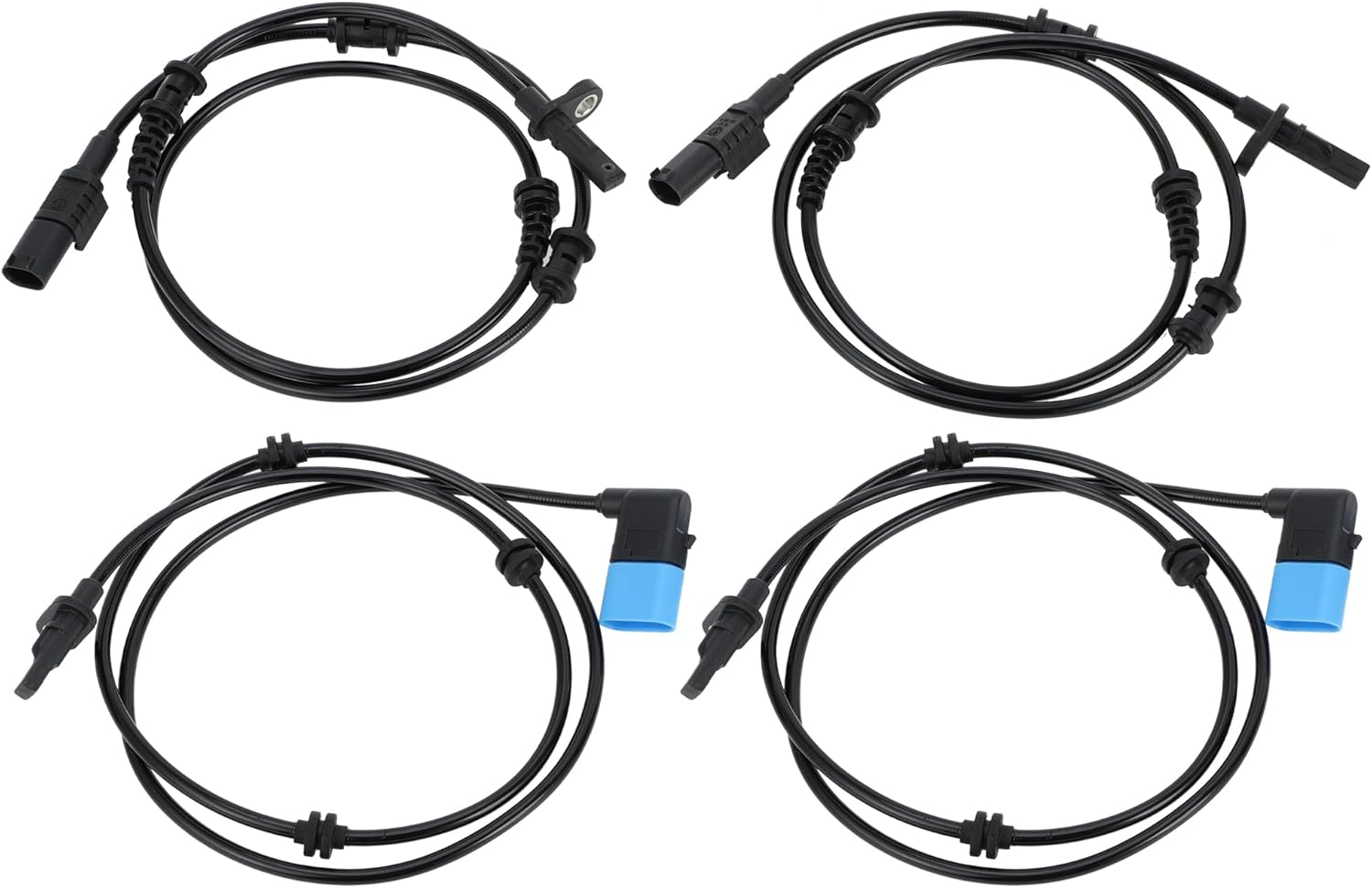
| Maximum Supply Voltage | 12 Volts |
|---|---|
| Mounting Type | Flange Mount |
| Output Type | Digital Signal |
| Upper Temperature Rating | 150 Degrees Celsius |
This Motoforti kit supplies four ABS wheel speed sensors intended as direct replacements for compatible Mercedes‑Benz CLA45, CLA250, GLA250, GLA45 and B‑class electric/B250e models from roughly 2014–2018. Each sensor uses a flange mount and outputs a digital signal that the vehicle ABS and traction systems read to determine wheel speed. The kit is sold as a set of front and rear left/right units and is described as made of metal and plastic with a 12‑volt supply rating and a high upper temperature tolerance. In practice these sensors are used to restore proper ABS and stability control function after an original sensor fails or the wiring is damaged. Notable benefits include direct-fit installation with no special tools and a compact, OEM‑style flange mount that should match factory locations. Limitations to consider are that this is a non‑OEM aftermarket part so fit and long‑term durability may vary versus factory sensors, and buyers must confirm exact year and model fit before installing since multiple Mercedes variants exist within the same range.
Best for: Performance‑oriented buyers who prioritize restoring precise ABS and traction control function on supported Mercedes‑Benz C‑class platform variants and want a ready 4‑sensor kit for immediate replacement.
Less Ideal for: Drivers who require confirmed factory‑specified parts or extended OEM warranties should consider purchasing factory‑quality sensors or sourcing through dealer channels instead.
- Sold as a complete 4‑piece set covering front and rear left/right positions
- Flange mount with digital output matches factory routing and signal type
- Rated for 12 V systems and high temperatures suitable for under‑car environments
- Designed for direct replacement and described as easy to install without special tools
- Aftermarket non‑OEM part so long‑term durability and exact fit can differ from factory sensors
- Product listing covers multiple Mercedes variations so careful part comparison is required before purchase
Verdict: A ready 4‑sensor aftermarket kit that restores ABS wheel speed sensing for select Mercedes‑Benz models with practical direct‑fit installation, but it is not a factory part so expect potential fit or longevity differences.
3. X AUTOHAUX Front ABS Wheel Speed Sensor (2049052905) for Mercedes-Benz C-Class

| OEM Reference Number | 2049052905 |
|---|---|
| Other Part Number | 2049057900 |
| Pin Count | 2 |
| Mounting Type | Flange Mount |
| Specific Uses For Product | Speed |
This X AUTOHAUX sensor is a direct-replacement front wheel speed sensor intended for Mercedes‑Benz C250 and C350 models from 2012 to 2014. It plugs into the factory harness and mounts at the flange to supply wheel speed data to ABS and traction control systems. Typical use is as a service replacement when a sensor fails, triggers fault codes, or disables traction control; installation is a straightforward service job that many owners or independent shops can complete in under 30 minutes per side. The sensor is a non‑OEM aftermarket part made from metal and plastic, with a two‑pin connector and mounting hole sized to match factory locations. Buyers report it clears error codes and restores system function reliably at a fraction of dealer cost. Limitations are that it is not an original Mercedes part, so fit and long‑term durability can vary compared with factory parts, and you should confirm the fit chart for exact model/engine combinations before ordering. Expect a low‑cost, practical repair option rather than an upgraded or lifetime replacement.
Best for: Practical optimizers who prioritize fixing a faulty ABS or traction sensor quickly and affordably without paying dealer prices, and who are comfortable using a quality aftermarket replacement.
Less Ideal for: Buyers seeking guaranteed factory‑quality longevity or those who prefer only original factory parts for full OEM sourcing should consider a manufacturer‑brand sensor instead.
- Direct replacement for front wheel position on specified 2012–2014 Mercedes‑Benz C250 and C350 models.
- Plugs into the existing harness for plug‑and‑play installation without wiring modifications.
- Flange mount and correct pin configuration reduce installation time for DIY or independent shop repairs.
- Low cost compared with factory sensors, making it economical to replace failed units promptly.
- Aftermarket, non‑OEM construction means long‑term durability and corrosion resistance may differ from factory sensors.
- Fitment requires checking the listing chart closely because it covers specific model and engine combinations only.
Verdict: A budget‑minded, plug‑in front wheel speed sensor that restores ABS/traction functionality on specified 2012–2014 Mercedes‑Benz C‑Class models without the dealer price.
4. DAVRPES ABS Wheel Speed Sensor 2049052905 for Mercedes-Benz C-Class (front)

| Maximum Supply Voltage | 12 Volts |
|---|---|
| Mounting Type | Flange Mount |
| Output Type | Digital |
| Harness Length | 27.5" |
This DAVRPES ABS wheel speed sensor is an aftermarket replacement made to fit front left or right positions on select 2012–2015 Mercedes‑Benz C‑Class models. It sends a digital wheel‑speed signal to the vehicle control systems to restore ABS, traction control and speedometer functions when an original sensor fails. The sensor ships with a 27.5 inch harness and a standard bolt‑mount flange, so it installs like a factory part without major wiring changes. Constructed from ABS plastic and designed to match common interchange numbers, it offers a budget‑minded option for owners who need a direct swap without paying dealer prices. Expect a functional, low‑cost repair that clears ABS warnings and restores normal system behavior, though long‑term durability may vary compared with higher-end factory replacements. Confirm part number and vehicle fitment before ordering and be prepared to reset any fault codes after installation.
Best for: Budget‑conscious Mercedes‑Benz C‑Class owners looking for a low‑cost, factory‑style replacement to restore ABS and traction control without a dealer visit.
Less Ideal for: Owners seeking an OEM‑branded sensor with guaranteed long‑term warranty coverage or those who prefer dealer parts and fitment verification.
- Direct fit for specified 2012–2015 Mercedes‑Benz C‑Class front positions with matching interchange numbers.
- Includes a pre‑attached harness sized for typical installations to avoid splicing.
- Digital output and flange mount replicate factory mounting and signal type.
- Low cost option that commonly resolves ABS light and traction control faults.
- Aftermarket construction and materials may not match long‑term durability of factory parts.
- Limited to the specified Mercedes‑Benz C‑Class fitment and not a universal sensor.
Verdict: A wallet‑friendly, factory‑style front ABS wheel speed sensor that fixes ABS and traction control faults on compatible 2012–2015 Mercedes‑Benz C‑Class models.
5. A-Premium ABS Wheel Speed Sensor for Mercedes-Benz C-Class (Front, Driver or Passenger)

| Maximum Supply Voltage | 12 Volts (DC) |
|---|---|
| Output Type | Digital |
| Mounting Type | Flange Mount |
| Upper Temperature Rating | 125 Degrees Celsius |
This A-Premium ABS wheel speed sensor is a direct-fit replacement for the front left or right positions on specified 2012–2015 Mercedes-Benz C-Class models and sends wheel speed data to the vehicle's ABS control module. It is typically used to restore ABS and traction control functions after a failed factory sensor and installs in the existing flange mount using the factory connector. Notable features include full performance testing, a digital output with a two-pin connector, and an upper operating temperature rating listed at 125 C, which suggest stable signal delivery under normal driving conditions. The sensor is molded from ABS plastic and marketed as meeting or exceeding factory specifications, which helps maintain steering stability and braking system performance. Limitations are that it is an aftermarket part so buyers should verify the exact reference number before installation and some users may prefer factory parts for long-term OEM matching; installation may require basic tools or a professional if access is tight.
Best for: Reliability-focused owners who prefer a tested, direct-fit replacement to restore ABS and traction control performance on 2012–2015 Mercedes-Benz C-Class models and want a straightforward swap without modifying wiring.
Less Ideal for: Buyers seeking an exact factory part from Mercedes-Benz or those who need multi-vehicle compatibility should consider an alternative.
- Designed to directly replace front driver or passenger ABS sensor on specified C-Class models
- Digital output and two-pin factory-style connector for straightforward electrical compatibility
- Claimed 100% performance testing and meets or exceeds factory specifications
- Upper temperature rating of 125 C supports reliable operation in high-heat environments
- Aftermarket construction may not exactly match long-term durability of factory sensors
- Limited to the specific C-Class model years listed so fitment must be confirmed
Verdict: A tested, direct-fit aftermarket ABS wheel speed sensor aimed at restoring ABS and stability control function on compatible Mercedes-Benz C-Class models.
6. OCPTY ABS Wheel Speed Sensor Set (Left/Right/Rear) for Mercedes‑Benz C‑Class (2008–2015)

| Mounting Type | Flange Mount |
|---|---|
| Output Type | Digital |
| Specific Uses For Product | Direction,Speed,Wheel Speed |
| Upper Temperature Rating | 250 Degrees Fahrenheit |
| Material Type | Acrylonitrile Butadiene Styrene |
This OCPTY sensor set replaces the wheel speed sensors on select Mercedes‑Benz C250, C300, C350 and C63 AMG model years and is intended as a direct-fit factory-quality replacement. It installs like the original part using flange mounting and outputs a digital signal to the vehicle control systems for wheel-speed monitoring and ABS functions. The construction uses ABS plastic and is rated to operate at temperatures up to 250 degrees Fahrenheit, which supports reliable service under typical engine-bay and wheel-well conditions. In practice the sensors restore proper wheel rotation readings and can clear ABS and traction faults when the original sensor has failed. Limitations include the need to confirm exact OEM part numbers for fitment because Mercedes models and drivetrains can require specific part variants, and some buyers reported fit issues on 4MATIC configurations. Overall the product suits straightforward replacements but verify fitment before installation to avoid returns or wasted labor.
Best for: Convenience-driven buyers who want an affordable, ready-to-install replacement to restore ABS and traction system function quickly without sourcing dealer parts.
Less Ideal for: Owners who cannot confirm their exact OEM part number or who need guaranteed fit for 4MATIC or other specific drivetrain variants should consider dealer or verified OEM replacements.
- Direct-fit design intended to match factory sensor mounting and function
- Digital output for accurate wheel-speed data to ABS and traction systems
- Upper temperature rating supports durability in wheel-well environments
- May not fit all drivetrain variants such as some 4MATIC configurations without verifying OEM part number
- Made from ABS plastic rather than metal-bodied sensor housings
Verdict: A convenient direct-fit replacement that restores wheel-speed sensing for specified Mercedes‑Benz C‑Class models so you can quickly clear ABS and traction faults.
7. OCPTY ABS Wheel Speed Sensor Set (4) for Mercedes‑Benz C‑Class (Fits listed C250/C300/C350/C63 AMG)

| Maximum Supply Voltage | 12 Volts |
|---|---|
| Measuring Range | 0-2500 RPM |
| Mounting Type | Flange Mount |
| Output Type | Digital |
This OCPTY kit supplies four wheel speed sensors intended to replace front and rear sensors on the listed Mercedes‑Benz C‑Class models. Each sensor is a digital flange‑mount type with a 12 V maximum supply and is offered as a matched set to restore wheel speed signals to the ABS system. In practice you would use the set to replace failed sensors that produce ABS warnings or inconsistent speed readings; the listing says the sensors match OEM connector and mounting locations to simplify installation. The sensors are made from ABS plastic and claim factory‑spec dimensions and connector length to reduce fitment issues. Real‑world reports are mixed: some buyers install them successfully and the ABS system returns to normal, while others report fitment or signal problems on certain model years that required returning the parts. If they fit, the set is a straightforward option to get a non‑specialty replacement without sourcing individual OEM parts, but verify fit and part numbers before buying to avoid installation and compatibility headaches.
Best for: Risk‑averse mainstream buyers who prioritize restoring safe, factory‑like ABS operation on a C‑Class and want a ready‑made full set rather than sourcing individual sensors.
Less Ideal for: Owners who need guaranteed factory‑exact replacements for a specific model year without any risk should consider verified factory‑quality parts or dealer replacements instead.
- Sold as a matched four‑piece set covering front and rear to simplify full replacement
- Designed to match factory connector and mounting locations for easier installation
- Digital output and flange mount style follow common factory sensor conventions
- Multiple customer reports of incorrect fit or no signal on some C‑Class model years
- Constructed from ABS plastic which may be less durable than higher‑grade materials
Verdict: A convenient four‑piece replacement sensor set marketed to match factory connectors and mounting for Mercedes‑Benz C‑Class models, useful when fitment is confirmed.
Choosing the Right Mercedes-Benz C-Class ABS Wheel Speed Sensor: Key Factors to Consider
Fitment and Mounting Compatibility
Correct physical fit is fundamental because the sensor must mount securely in the hub or knuckle to sense the tone ring reliably. Mismatched mounting holes, incorrect sensor length, or wrong connector orientation can lead to improper alignment, false readings, or premature failure.
When assessing fitment, verify the sensor's mounting style, bolt pattern, and connector type against the vehicle's factory specifications. Even small differences in length or bracket position can change the air gap to the tone ring and affect output amplitude. Choosing a unit that mirrors factory geometry reduces installation time and the risk of needing additional brackets or wiring modifications.
Signal Accuracy and Noise Resistance
The wheel speed sensor must produce a clean, consistent electrical signal that the ABS module can interpret across a wide range of speeds. Poor signal quality can cause intermittent ABS warnings, erratic speed readings, or degraded traction control performance.
Look for sensors with proven magnetic or Hall-effect elements and shielding that mitigate electromagnetic interference from alternators, ignition systems, or other electronics. Reliable signal amplitude and clean waveform shape help the vehicle computer maintain accurate wheel speed calculations and reduce false fault codes.
Sealing and Environmental Durability
Sensors sit close to the wheel and are exposed to water, road salt, dirt, and temperature cycles. Robust seals and corrosion-resistant materials prevent moisture ingress and electrical shorts that commonly cause failures.
Consider sensors with high-quality o-rings, molded housings, and corrosion-resistant terminals. Durable construction extends service life in winter and wet climates and reduces the likelihood of intermittent faults caused by corrosion at the connector or mounting surface.
Electrical Connector and Wiring Integrity
A sound electrical connection is as important as the sensor element itself. Loose terminals, brittle wiring, or poor crimps can create high resistance or intermittent contact that mimics a failed sensor.
Inspect connector design for positive locking features and protected pins. Where possible, choose sensors that include replacement pigtails or exhibit robust strain relief at the cable entry. Good wiring integrity reduces failure modes related to vibration and steering movement.
Compatibility With Diagnostic and Safety Systems
Wheel speed sensors feed multiple vehicle systems beyond ABS, including traction control and speedometer inputs in some configurations. A sensor that does not deliver expected signal characteristics can trigger a range of fault codes.
Ensure the replacement sensor supports the expected voltage and waveform characteristics used by the vehicle control modules. Compatibility helps prevent recurring ABS warnings, reduces diagnostic time, and keeps dependent safety systems functioning as designed.
Serviceability and Availability
Ease of replacement affects total downtime and potential repair complexity. Readily available sensors and replacement harnesses shorten repair time, while clear installation instructions lower the chance of installation error.
Consider how easy it is to source the part, whether repair connectors or pigtails are provided, and whether the sensor can be installed with common tools. Parts that are widely available and straightforward to fit help you complete repairs promptly and reduce vehicle downtime.
How We Chose the Best Mercedes-Benz C-Class ABS Wheel Speed Sensor
We focused on components that meet Mercedes-Benz C-Class fitment requirements and provide reliable speed signal output under typical driving conditions. Key evaluation criteria included connector and mounting compatibility to ensure proper fit, signal accuracy and noise resistance to support ABS and traction control, build quality and sealing to resist moisture and road contaminants, and electrical stability across operating temperatures. We also considered ease of installation, availability of replacement harnesses or terminals, and documented reliability in service records. Units that required vehicle-specific modification or lacked clear compatibility information were excluded. Our list favors parts that minimize installation time and restore original sensor function without altering other vehicle systems.
Our full evaluation process is outlined in our review methodology.
FAQ
What are common ABS sensor symptoms on a Mercedes-Benz C-Class?
Common symptoms often include an illuminated ABS warning lamp, occasional traction control activation, or inconsistent speedometer readings. You may also notice ABS intervention at low speeds when it should not occur. These signs usually indicate a weak or intermittent wheel speed signal rather than a mechanical brake issue.
Where is the ABS wheel speed sensor located on a C-Class?
On the Mercedes-Benz C-Class the wheel speed sensor is typically mounted at the wheel hub or steering knuckle near the tone ring. Access usually requires lifting the vehicle and removing the wheel. Exact placement depends on front or rear location but remains on the hub assembly for each wheel.
How do I diagnose a faulty ABS sensor?
Diagnosis often starts with a visual check of the sensor and wiring for damage or corrosion, followed by reading ABS fault codes with a scanner. A multimeter can confirm sensor resistance and output, while a scope or test meter can show waveform quality. Intermittent faults often point to wiring or connector issues rather than the sensor element itself.
Can I replace the wheel speed sensor myself?
Many owners can replace a C-Class wheel speed sensor with basic tools, a jack, and safety stands. The job usually involves removing the wheel, accessing the sensor mounting bolt, and disconnecting the electrical connector. Take care with connectors and mounting torque, and follow manufacturer service instructions when available.
Will replacing the sensor clear ABS sensor code P0500?
Code P0500 is a general vehicle speed sensor code and may be related to the wheel speed sensor signal. Replacing a sensor that is confirmed faulty can resolve the code, but the underlying wiring, tone ring damage, or module issues should be checked if the code persists after replacement.
Should I choose OEM or aftermarket sensors?
Both OEM and quality aftermarket sensors can restore proper function, but differences in fitment, connector quality, and long-term durability exist. Consider whether the part matches factory mounting and electrical characteristics. Where uncertain, evaluate build quality and documented reliability rather than relying solely on labeling.
Conclusion
When replacing a Mercedes-Benz C-Class ABS wheel speed sensor prioritize correct fitment, clean signal output, and durable sealing. Those elements have the biggest impact on safety systems and long-term reliability. Balance ease of installation and wiring integrity against durability tradeoffs to find a solution that restores consistent ABS and traction control behavior.Address wiring or tone ring issues during replacement to avoid recurring faults. Focusing on the factors above will help you select a sensor that minimizes diagnostic time and keeps vehicle safety systems operating as intended.
Explore More:
- Check out all Mercedes-Benz C-Class parts & accessories
- Explore ABS Wheel Speed Sensors Maintenance & Repair Guides
- Explore Electrical System
- Browse all Auto Parts
