

Note: This article contains affiliate links. If you click on these links and make a purchase, I may earn a small commission at no extra cost to you. This helps support my research and content. Read my full affiliate disclosure here.
If your Honda Fit is showing ABS warnings or inconsistent braking behavior, the issue often traces to a faulty wheel speed sensor. Choosing the right Honda Fit ABS wheel speed sensor matters because correct fitment and reliable signal output directly affect ABS function, traction control, and vehicle safety. This guide highlights seven shortlisted sensors that meet the needs of Fit owners, focusing on compatibility, signal accuracy, and durability. Below we explain the evaluation criteria and help you identify which sensor attributes matter most before you proceed to replacement.
Looking for other parts? See all Honda Fit parts & accessories.
Top Picks at a Glance
| Best Overall The best all-around choice for most situations | A-Premium ABS Wheel Speed Sensor 2-Piece Set for Honda Fit (2015–2020) |  |
| Best Quality Built to a higher standard if you want something more solid | A-Premium Front Right ABS Wheel Speed Sensor (Fits Honda Fit/CR-Z/Insight) |  |
| Best Value The sweet spot between price and what you get | Dcmr 2-Pack Rear Left and Right ABS Wheel Speed Sensors for Honda Fit (2015–2020) |  |
| Best Budget The cheapest option that still gets the job done reliably | RATCHROLL Front Right ABS Wheel Speed Sensor for Honda Fit/City 1.5L (2015–2019) |  |
| Highest Rated A top-rated pick with lots of positive feedback | A-Premium Front Right ABS Wheel Speed Sensor for Honda Fit 2015–2020 |  |
| Most Popular A crowd favorite that many people choose with confidence | A-Premium ABS Wheel Speed Sensor, Front Left Driver Side (57455-TF0-003) |  |
| Best Seller A high-volume bestseller chosen again and again | A-Premium ABS Wheel Speed Sensor Set for 2007-2008 Honda Fit (Front Left & Right) |  |
1. A-Premium ABS Wheel Speed Sensor 2-Piece Set for Honda Fit (2015–2020)

| Vehicle Fitment | Honda Fit 2015-2020 L4 1.5L Hatchback |
|---|---|
| Location | Front Left and Right |
| Connector Pins | 2 Pins |
| Mounting Type | Flange Mount |
| Material Type | Acrylonitrile Butadiene Styrene |
This two-piece A-Premium ABS wheel speed sensor set replaces the front left and right sensors on 2015–2020 Honda Fit 1.5L hatchbacks. It mounts with a flange and uses a two-pin push-pull connector to interface directly with the vehicle harness, so installation follows the same basic steps as a factory sensor swap. The sensors are molded from ABS plastic and are marketed to meet or exceed factory specifications, which should restore wheel speed input for ABS and traction control systems and clear related warning lights when the original sensors fail. Practical benefits include getting both front sensors in one purchase and a stated one-year unlimited-mileage guarantee for part replacement. Important limitations are that the parts are aftermarket so fit and long-term durability can vary compared with factory parts, and professional installation may be required if access or corroded fasteners are present.
Best for: Balanced buyers who want a direct replacement to restore ABS and traction control function on a 2015–2020 Honda Fit without seeking premium OEM pricing and who value getting both front sensors together.
Less Ideal for: Owners seeking an exact factory-manufactured sensor or the highest-end long-term durability should consider factory replacement options or OEM sensors instead.
- Sold as a matched two-piece front sensor set for convenience when replacing both sides
- Designed to use the factory-style flange mount and two-pin connector for straightforward wiring compatibility
- Manufacturer states construction and testing to meet or exceed factory specifications
- Includes a one-year unlimited-mileage guarantee covering the part cost
- Aftermarket ABS plastic construction may not match long-term durability of factory parts
- Fitment and connector condition depend on vehicle harness state and may require additional cleaning or minor modification
Verdict: A convenient matched two-piece front sensor set that restores ABS wheel-speed sensing on 2015–2020 Honda Fit models.
2. A-Premium Front Right ABS Wheel Speed Sensor (Fits Honda Fit/CR-Z/Insight)

| Mounting Type | Flange Mount |
|---|---|
| Output Type | NPN, PNP |
| Specific Uses For Product | Speed Sensor |
| Material Type | Acrylonitrile Butadiene Styrene |
This A-Premium sensor replaces the front right wheel speed sensor on compatible Honda Fit, CR-Z, and Insight hatchbacks to restore ABS and traction control signals. It mounts via a flange and uses standard NPN/PNP output types so it plugs into the factory harness and bolts into the original location for a straightforward swap. The sensor is molded from ABS plastic and shipped with a one-year warranty, and many users report bolt-on fitment with reliable operation when it is properly installed. Practical benefits include restoring ABS/traction function quickly without the need for expensive dealer parts and keeping speed-sensor diagnostics simple. Limitations to note are that longevity can vary compared with higher-end OE suppliers and a few reviews report unit failures or DOA arrivals, so careful inspection before installation is wise. If your vehicle requires the specific reference numbers listed, this sensor is a cost-effective, performance-oriented replacement for getting the system back to factory operation.
Best for: Performance-oriented buyers who prioritize restoring precise ABS and traction inputs quickly and at lower cost, and who expect a bolt-on replacement to return braking system control to factory behavior.
Less Ideal for: Drivers seeking long-term OEM-tier durability under heavy use or extreme conditions should consider higher-end factory-quality parts or dealer replacements instead.
- Direct-fit design for front right wheel on specified Honda models for easy installation
- Flange mount and standard NPN/PNP output for plug-and-play connection with factory wiring
- One-year unlimited-mileage guarantee provides short-term assurance
- Molded construction intended to meet factory replacement form and function
- Made from ABS plastic which may not match durability of metal-bodied factory sensors
- Some customers reported defective units or out-of-box failures
Verdict: A-Premium’s front right ABS speed sensor offers a direct-fit, plug-and-play replacement to quickly restore ABS and traction control on compatible Honda hatchbacks.
3. Dcmr 2-Pack Rear Left and Right ABS Wheel Speed Sensors for Honda Fit (2015–2020)

| Maximum Supply Voltage | 12 Volts (DC) |
|---|---|
| Mounting Type | Flange Mount |
| Output Type | Push-Pull |
| Material Type | Acrylonitrile Butadiene Styrene, Copper |
These Dcmr ABS wheel speed sensors are a direct-replacement pair for the rear left and right positions on 2015–2020 Honda Fit models. They monitor wheel rotation and send speed data to the vehicle skid control module so the ABS system can modulate braking to prevent wheel lock. Typical use is as a factory-style replacement when the ABS light is triggered, when a sensor fails resistance tests, or during hub work; they mount to the flange and connect to the existing wiring harness. Notable features include push-pull output, a 12 V supply rating, and construction using ABS plastic and copper for the electrical path. In practice these sensors restore ABS function and steering control in emergency braking and allow the vehicle computer to properly compensate wheel speeds. Limitations to consider are that they are an aftermarket part so fit and long-term durability may vary from factory parts and installation requires basic mechanical access to the rear hubs and electrical connector care to avoid damage.
Best for: Practical owners who prioritize value and want a ready-to-install replacement to restore ABS function on a 2015–2020 Honda Fit without paying for OE parts.
Less Ideal for: Buyers seeking an OEM-branded sensor with documented long-term durability or those who prefer dealer installation and warranty-backed parts should consider other options.
- Sold as a matched pair for left and right rear replacements
- Specifically listed to replace Honda Fit rear sensor part numbers 57470T5R023 and 57475T5R033
- Push-pull output and 12 V compatibility match typical vehicle electrical systems
- Includes common materials (ABS plastic and copper) for standard sensor construction
- Aftermarket fit may not match factory longevity or exact tolerance
- Requires mechanical access to rear hub and careful connector handling for installation
Verdict: A practical, budget-focused pair of rear ABS wheel speed sensors that restore ABS operation on 2015–2020 Honda Fit models.
4. RATCHROLL Front Right ABS Wheel Speed Sensor for Honda Fit/City 1.5L (2015–2019)

| Compatibility | Honda City/Fit 1.5L 2015-2019 |
|---|---|
| Placement on Vehicle | Front Right |
| Pin Number | 2 |
| Material Type | Rubber,Plastic,Metal |
This RATCHROLL front right wheel speed sensor is a budget replacement designed for Honda Fit and City 1.5L models from 2015 through 2019. It replaces the factory sensor at the front right wheel and sends wheel speed information to the vehicle ABS controller. The sensor uses plastic and metal construction with a two-pin connector and ships as a single unit ready for bolt-in installation after removing the wheel and unplugging the old sensor. For basic repairs it provides accurate, rapid signal measurement to restore ABS and traction control functions and helps prevent wheel lockup during emergency braking. Being a non-OEM aftermarket part, fit and long-term durability may vary compared with factory items, and high-mileage cars with corroded connectors may require additional cleaning or hardware. This unit is a pragmatic, low-cost option when you need a working replacement sensor quickly without paying for a branded OEM part.
Best for: Budget-conscious owners seeking a low-cost, functional replacement to restore ABS operation on a 2015–2019 Honda Fit or City without paying for a branded sensor.
Less Ideal for: Drivers who prioritize long-term durability or need a guaranteed factory-quality match should consider a higher-end or OEM replacement instead.
- Direct-fit replacement for front right wheel on 2015–2019 Honda Fit/City
- Two-pin connector matches factory-style electrical plug for straightforward swap
- Made from plastic and metal for basic road durability
- Sold as a single unit so you can replace one failed sensor without buying extras
- Aftermarket non-OEM construction may not match long-term durability of a factory sensor
- May require connector cleaning or hardware attention on corroded or high-mileage vehicles
Verdict: A pragmatic, low-cost front right ABS wheel speed sensor that restores ABS function on 2015–2019 Honda Fit and City models.
5. A-Premium Front Right ABS Wheel Speed Sensor for Honda Fit 2015–2020

| Compatible vehicles | Honda Fit 2015-2020 L4 1.5L Hatchback |
|---|---|
| Location | Front Right Passenger Side |
| Connector pins | 2 Pins |
| Manufacturer part number | APABS0826 |
This A-Premium front right ABS wheel speed sensor is a direct-fit replacement for the Honda Fit 2015–2020 L4 1.5L hatchback and supplies the vehicle with the wheel speed signal used by the ABS and traction control systems. Installation is straightforward because it mounts in the factory location and uses the same two-pin connector as the original, so most owners or a technician can swap it in without modification. The manufacturer says each unit is 100% performance tested and the sensor offers stable output and fast response, which helps the vehicle maintain proper ABS and stability control behavior. Materials and flange mounting are typical for aftermarket sensors, and the part includes common OEM reference numbers for cross-checking fit. Limitations are the usual ones for aftermarket sensors: longevity can vary with driving conditions and exposure to road contaminants, and diagnosing intermittent faults may still require professional testing. The product comes with a one-year unlimited-mileage guarantee for added confidence.
Best for: Reliability-focused buyers who want a tested, direct-fit replacement to restore ABS and traction control performance on a Honda Fit 2015–2020 without custom wiring or adapters.
Less Ideal for: Drivers who prioritize an established brand pedigree or want dealer-sourced factory parts for warranty continuity should consider alternatives.
- Direct-fit for Honda Fit 2015–2020 front right position using the factory two-pin connector
- Manufacturer states 100% performance testing for consistent output and fast response
- Meets or exceeds OEM specifications according to product listing
- Flange mount design and common OEM reference numbers simplify installation and verification
- Aftermarket build quality and long-term durability can vary with road exposure
- Limited field service history compared with long-established sensor brands
Verdict: A practical, tested direct-fit replacement sensor for Honda Fit owners who want reliable ABS signal restoration without wiring changes.
6. A-Premium ABS Wheel Speed Sensor, Front Left Driver Side (57455-TF0-003)

| Maximum Supply Voltage | 12 Volts |
|---|---|
| Mounting Type | Flange Mount |
| Output Type | Physical |
| Material Type | Acrylonitrile Butadiene Styrene |
This A-Premium ABS wheel speed sensor is a direct-fit replacement for the front left driver side on compatible Honda Fit, CR-Z, and Insight models and is intended to restore ABS and traction functions after a failed sensor. It mounts using the factory-style flange and plugs into the vehicle harness so installation is straightforward for someone comfortable with basic brake-assembly work or a quick shop visit. The sensor is molded from ABS plastic with a factory-style output and is tested to meet original-fit performance, which reviewers report clears ABS error codes and reports reliable operation on initial install. Practical benefits include an affordable price, included one-year unlimited-mileage guarantee, and a part that fits without modification. Limitations are typical of budget aftermarket sensors: longevity can vary by operating conditions and a small number of users reported early failures, so monitoring after installation is advised.
Best for: Buyers who prioritize convenience and low-cost repairs and want a ready-fit replacement that restores ABS function quickly without sourcing dealer parts.
Less Ideal for: Drivers seeking the longest-term durability under heavy-duty use or who prefer OEM-sourced parts should consider factory replacements or higher-end aftermarket options.
- Direct-fit front left sensor for specified Honda models, so no modification required
- Factory-style flange mounting and plug-in output simplify installation
- Low-cost alternative to dealer parts while restoring ABS/traction functions
- One-year unlimited-mileage guarantee provided by the brand
- Some buyers report variable long-term durability compared with factory parts
Verdict: A budget-friendly, ready-fit front-left ABS wheel speed sensor that makes it easy to clear ABS faults on supported Honda Fit models.
7. A-Premium ABS Wheel Speed Sensor Set for 2007-2008 Honda Fit (Front Left & Right)
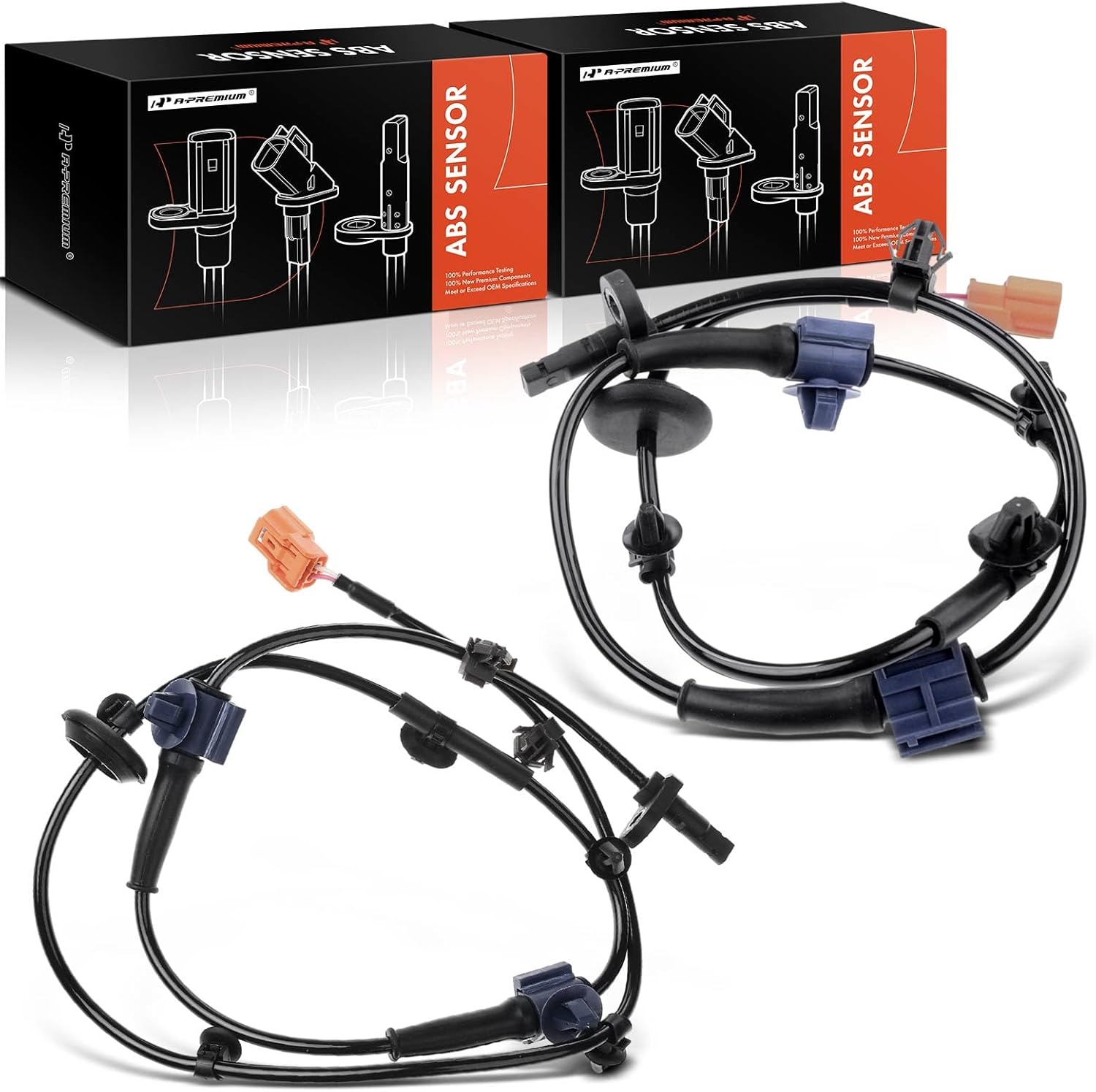
| Vehicle Fitment | 2007-2008 Honda Fit L4 1.5L |
|---|---|
| Location | Front Driver and Passenger Side |
| Connector Pins | 2 Pins |
| Mounting Type | Flange Mount |
| Material Type | Acrylonitrile Butadiene Styrene |
This A-Premium two-piece ABS wheel speed sensor set replaces both front left and right sensors on 2007–2008 Honda Fit 1.5L vehicles. It provides wheel speed data to the ABS and traction control systems via a two-pin push-pull connector and mounts with a flange-style fitment intended to match factory placement. Buyers will appreciate that the sensors are sold as a matched pair and are described to meet OEM specifications while using ABS plastic housings to resist corrosion and debris. In practice these are a straightforward component-level replacement for an ageing or damaged sensor and can be installed by a competent DIYer or a shop. Some owners report firmer wiring jackets compared with factory parts which can make routing and connector seating slightly harder, and a minority of units have produced faults after installation. The included one-year unlimited-mileage guarantee covers the part itself but not labor or related expenses. For a cautious buyer seeking a budget-friendly, vehicle-specific replacement, this delivers the expected function with occasional quality variance to inspect at installation.
Best for: Risk-averse mainstream buyers who prioritize restoring reliable ABS and traction control function on a 2007–2008 Honda Fit without paying OEM prices.
Less Ideal for: Buyers who require guaranteed factory-identical cable flexibility or who prefer manufacturer-direct parts with full labor coverage should consider other sources.
- Sold as a matched front left and right pair for complete replacement
- Designed to match OEM fit and connector type for 2007–2008 Honda Fit 1.5L
- Plastic housing resists corrosion and common road debris
- Two-pin push-pull connector mirrors factory electrical interface
- Wiring jacket is stiffer than some factory parts which can make installation harder
- Some buyers reported defective units resulting in ABS faults
Verdict: A budget-friendly matched front sensor pair that restores wheel-speed sensing on 2007–2008 Honda Fit models while closely following factory fitment.
Choosing the Right Honda Fit ABS Wheel Speed Sensor: Key Factors to Consider
Fitment and Connector Compatibility
Correct fitment ensures the sensor mounts securely and aligns with the tone ring or ABS reluctor. If the sensor body length, mounting tab orientation, or connector type does not match the vehicle, the sensor can be prone to mechanical stress or poor electrical contact.
Connector compatibility matters because an improper plug can lead to intermittent signals or require wiring modifications. Confirming OEM-style connectors and harness lengths reduces installation time and the risk of wiring faults during service.
Signal Accuracy and Response Time
Wheel speed sensors must produce a clean, consistent signal across a range of wheel speeds for the ABS module to interpret. Sensors with stable voltage or frequency output reduce false ABS activations and improve traction control performance.
Faster sensor response helps the control unit detect rapid changes in wheel speed during hard braking or low-traction events. Look for sensors with documented output characteristics and minimal signal noise to ensure reliable system behavior.
Durability and Environmental Resistance
Sensors operate in harsh wheel-well environments exposed to water, salt, road debris, and wide temperature swings. Housings and seals that resist corrosion and ingress protect internal electronics and prolong service life.
Choose sensors with robust materials and proven sealing methods to avoid early failure. Durable sensors reduce the chance of intermittent faults that can trigger warning lights and require repeated replacements.
Mounting Hardware and Installation Ease
Some sensors include replacement mounting bolts, clips, or gaskets which can simplify installation. Correct hardware keeps the sensor seated and aligned, preventing vibration or movement that degrades signal quality.
Sensors that mirror OEM mounting dimensions and include necessary fasteners reduce the need for additional parts. Ease of installation also matters for DIY repairs, as straightforward fitment reduces the risk of damage during replacement.
Electrical and Wiring Considerations
The sensor-to-module wiring path can be a failure point. Inspecting harness length, strain relief, and connector sealing helps ensure a reliable electrical connection. Solder-free connectors and proper terminal plating improve long-term conductivity.
Consider whether the sensor's wiring is protected against chafing and heat. Properly routed and secured wiring reduces the likelihood of intermittent faults or open circuits that cause ABS warnings.
Service Life and Maintenance Factors
Consider expected service life based on construction and user-reported longevity. Sensors designed for easy inspection or replacement of sealing components can lower lifetime maintenance effort.
Also factor in whether the sensor design allows cleaning of the mating surfaces without full replacement. Longer-lasting sensors and those that tolerate routine cleaning help minimize downtime and repeated repairs.
How We Chose the Best Honda Fit ABS Wheel Speed Sensor
We prioritized factors that directly affect safety and long-term performance for Honda Fit drivers. Key evaluation criteria included sensor fitment accuracy to ensure proper mounting and connector compatibility with the Fit's wiring harness; signal fidelity and response time because consistent wheel-speed data is critical for ABS and traction systems; environmental durability, covering resistance to moisture, dirt, and temperature swings common in wheel wells; materials and housing design that reduce corrosion and mechanical damage; and ease of installation, including harness length and mounting hardware considerations.Items were excluded if they lacked clear fitment information for Honda Fit models, if they had inconsistent technical specs for signal output, or if durability details were absent. We did not include products only suitable for other vehicle families or those without documented electrical compatibility. The shortlist reflects sensors that meet practical fit, electrical, and durability thresholds relevant to real-world Honda Fit use.
Our full evaluation process is outlined in our review methodology.
FAQ
What are common symptoms of a failing wheel speed sensor on a Honda Fit?
Typical signs include an illuminated ABS warning light, sporadic traction control behavior, or ABS activation when not required. You may also notice altered braking feel or stability system alerts. Symptoms can vary, so combine visual inspection with diagnostic trouble codes for a clearer diagnosis.
Where is the ABS wheel speed sensor located on a Honda Fit?
Wheel speed sensors are usually mounted near the wheel hub or wheel bearing assembly, positioned to read the tone ring on the axle or hub. Location can vary front to rear, so inspect close to the wheel hub and follow the wiring harness into the wheel well to find the sensor body.
Can I run an ABS sensor wiring test myself?
You can perform basic checks using a multimeter to measure continuity and resistance, and an oscilloscope or frequency meter to observe signal output while spinning the wheel. Take safety precautions and consult a wiring diagram for connector pinouts. For complex electrical faults, professional diagnostics are usually more reliable.
Does an ABS sensor fault always trigger a specific code like P0500?
Not always. Certain sensor faults can produce ABS-specific codes or speed-sensor related codes, while other faults may not map neatly to a single generic code. P0500 relates to vehicle speed sensor input in some systems, but code definitions can vary by vehicle and diagnostic tool. Use a full ABS-capable scanner for accurate identification.
How do I decide between OEM and aftermarket wheel speed sensors?
Consider fitment accuracy, connector type, and build quality. OEM-style sensors often match original specifications closely, while reputable aftermarket options can offer comparable performance and durability. Evaluate manufacturer documentation on fit and signal output, and prioritize sensors with clear compatibility information.
What should I inspect before replacing a wheel speed sensor?
Check the sensor connector for corrosion, wiring for chafing or damage, and the tone ring or reluctor for missing teeth or heavy contamination. Cleaning mounting surfaces and correcting wiring issues can resolve some faults without replacement. If the sensor is physically damaged or produces erratic signals, replacement is appropriate.
Conclusion
When choosing a Honda Fit ABS wheel speed sensor, prioritize correct fitment and reliable signal output because those attributes directly affect ABS and stability performance. Also weigh durability and proper connector compatibility to reduce the chance of repeat repairs.Balancing installation ease, wiring protection, and proven environmental resistance will help you select a sensor that restores normal ABS operation and minimizes future troubleshooting. Focus on the factors discussed above to match a sensor to your driving conditions and maintenance preferences.
Explore More:
- Check out all Honda Fit parts & accessories
- Explore ABS Wheel Speed Sensors Maintenance & Repair Guides
- Explore Electrical System
- Browse all Auto Parts
