

Note: This article contains affiliate links. If you click on these links and make a purchase, I may earn a small commission at no extra cost to you. This helps support my research and content. Read my full affiliate disclosure here.
If you own a BMW X1, a healthy ABS wheel speed sensor keeps stability control and anti-lock braking behaving correctly. Faulty sensors can cause inconsistent speed readings, unexpected warning lights, or degraded braking assistance in slippery conditions, so choosing the right replacement matters.This guide covers seven shortlisted ABS wheel speed sensors selected for fit and electrical reliability. We evaluated each option for installation fitment, signal consistency, and build quality to help you identify the most suitable replacements for your X1. Read on for the factors we used to pick these top choices and what to check before you install.
Looking for other parts? See all BMW X1 parts & accessories.
Top Picks at a Glance
| Best Overall The best all-around choice for most situations | VekAuto ABS Wheel Speed Sensor for BMW X1 (Left or Right Rear) |  |
| Best Quality Built to a higher standard if you want something more solid | A-Premium ABS Wheel Speed Sensor (4-pack) for BMW F48 X1 / Mini F54 F60 |  |
| Best Value The sweet spot between price and what you get | VekAuto ABS Wheel Speed Sensor for BMW X1 F48 (2018–2022) Front Left/Right |  |
| Best Budget The cheapest option that still gets the job done reliably | VekAuto ABS Wheel Speed Sensor for BMW X1 (2016–2019) Rear |  |
| Highest Rated A top-rated pick with lots of positive feedback | A-Premium Front ABS Wheel Speed Sensor (ALS3140) for BMW X1/X2 and Mini Cooper Countryman |  |
| Most Popular A crowd favorite that many people choose with confidence | A-Premium ABS Wheel Speed Sensor for BMW X1 (Front, Driver or Passenger) |  |
| Best Seller A high-volume bestseller chosen again and again | A-Premium Front ABS Wheel Speed Sensor Set (Pack of 2) for BMW/Mini Compatible Models |  |
1. VekAuto ABS Wheel Speed Sensor for BMW X1 (Left or Right Rear)

| Fitment | BMW X1 2014-2020 |
|---|---|
| Placement on Vehicle | Left Rear, Right Rear |
| OE Number | 34526858467/0265008850/34526850764 |
| Material Type | Plastic, Rubber, Metal |
This VekAuto ABS wheel speed sensor is an aftermarket replacement for the rear left or right wheel on BMW X1 (2014–2020). It monitors wheel rotation and sends speed signals to the vehicle's ABS controller to support anti-lock braking and traction control. The sensor is molded from plastic, rubber, and metal and ships as a single unit that installs by removing the wheel, unplugging the old sensor, and swapping in the new part. Practical benefits include restored ABS function after sensor failure, a reinforced design intended to resist road exposure, and compatibility with listed OEM part numbers to help ensure fit. Limitations are that it is a non-OEM aftermarket component so fit and long-term durability can vary compared with factory parts, and you should verify vehicle fitment before ordering. Installation requires basic mechanical access to the rear wheel area and may be easier with the wheel removed.
Best for: Balanced buyers who want a cost-conscious, practical replacement to restore ABS and traction control on a BMW X1 2014–2020 without seeking factory-branded parts.
Less Ideal for: Drivers who prioritize factory-branded parts, extended OEM-backed warranties, or who prefer to replace both sensors as a matched pair in a single purchase.
- Direct replacement for left or right rear positions on BMW X1 2014–2020 based on listed fitment.
- References common OEM part numbers to aid correct selection.
- Reinforced design and metal components intended to withstand road conditions.
- Simple swap-in installation that only requires unplugging the old sensor and fitting the new unit.
- Aftermarket, non-OEM part so long-term durability and exact fit may vary compared with factory sensors.
- Sold as a single sensor so replacement of the opposite side requires a separate purchase.
Verdict: Simple, reinforced aftermarket replacement to restore rear ABS speed sensing on BMW X1 models from 2014 to 2020.
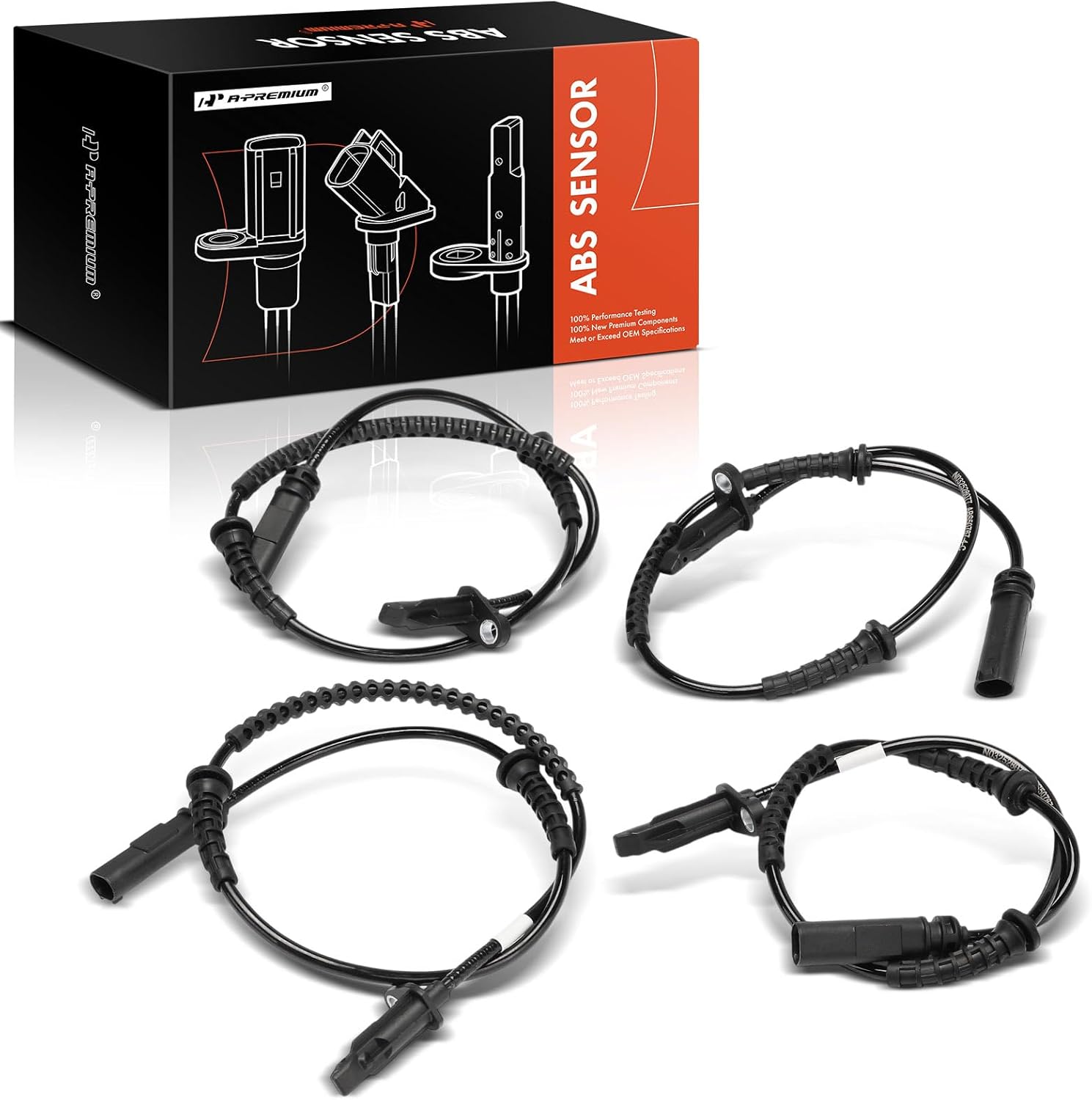
2. A-Premium ABS Wheel Speed Sensor (4-pack) for BMW F48 X1 / Mini F54 F60
| Brand | A-Premium |
|---|---|
| Manufacturer Part Number | APABS3953 |
| OEM Part Number | 5S17247, V20725278, V20725283 |
| Compatible Models | BMW F48 X1 2016-2017; Mini F54 2016-2017; F60 2017 |
This four-piece A-Premium ABS wheel speed sensor kit replaces front and rear sensors on BMW F48 X1 (2016-2017) and Mini F54/F60 models listed. Each sensor connects to the factory harness and measures wheel rotational speed so the ABS and stability systems can function correctly. The kit is presented as a direct-fit factory-style replacement and the listing highlights OEM reference numbers for cross-checking fitment. In use the parts simplify a standard wheel-sensor replacement: remove the faulty sensor, plug in the new unit and torque the mounting hardware to factory values. Practical benefits include matched sensors for all four corners in one purchase and a claimed one-year unlimited-mileage guarantee for peace of mind. Limitations are that fitment is restricted to the specific BMW/Mini models listed and buyers should verify reference numbers against their vehicle before ordering; the listing does not provide detailed test data or brand performance history beyond standard manufacturing claims.
Best for: Performance-oriented owners who prioritize restoring proper ABS and stability function with a matched, ready-to-install sensor set and want a factory-style replacement for targeted BMW X1 and Mini models.
Less Ideal for: Drivers who need universal or multi-vehicle compatibility, or who prefer sensors with verified aftermarket performance data and lab-tested results should consider other options.
- Sold as a matched 4-piece set to replace front and rear sensors in one service event
- Direct-fit design with listed OEM reference numbers for easier vehicle matching
- Manufacturer offers a one-year unlimited-mileage guarantee
- Appears to follow factory-style connector and mounting for straightforward installation
- Fitment limited to the specific BMW F48 X1 and Mini F54/F60 model years listed
- No independent performance testing or certification data provided in the listing
Verdict: A matched four-piece, factory-style wheel speed sensor kit intended to restore ABS and stability system function on specified BMW X1 and Mini models.
3. VekAuto ABS Wheel Speed Sensor for BMW X1 F48 (2018–2022) Front Left/Right
| Fitment | BMW X1 F48 2018-2022 |
|---|---|
| Placement | Front Left or Front Right |
| OE Numbers | 34526895881 / 34526880755 |
| Package Content | 1 Pc ABS Wheel Speed Sensor |
| Material Type | Plastic, Rubber, Metal |
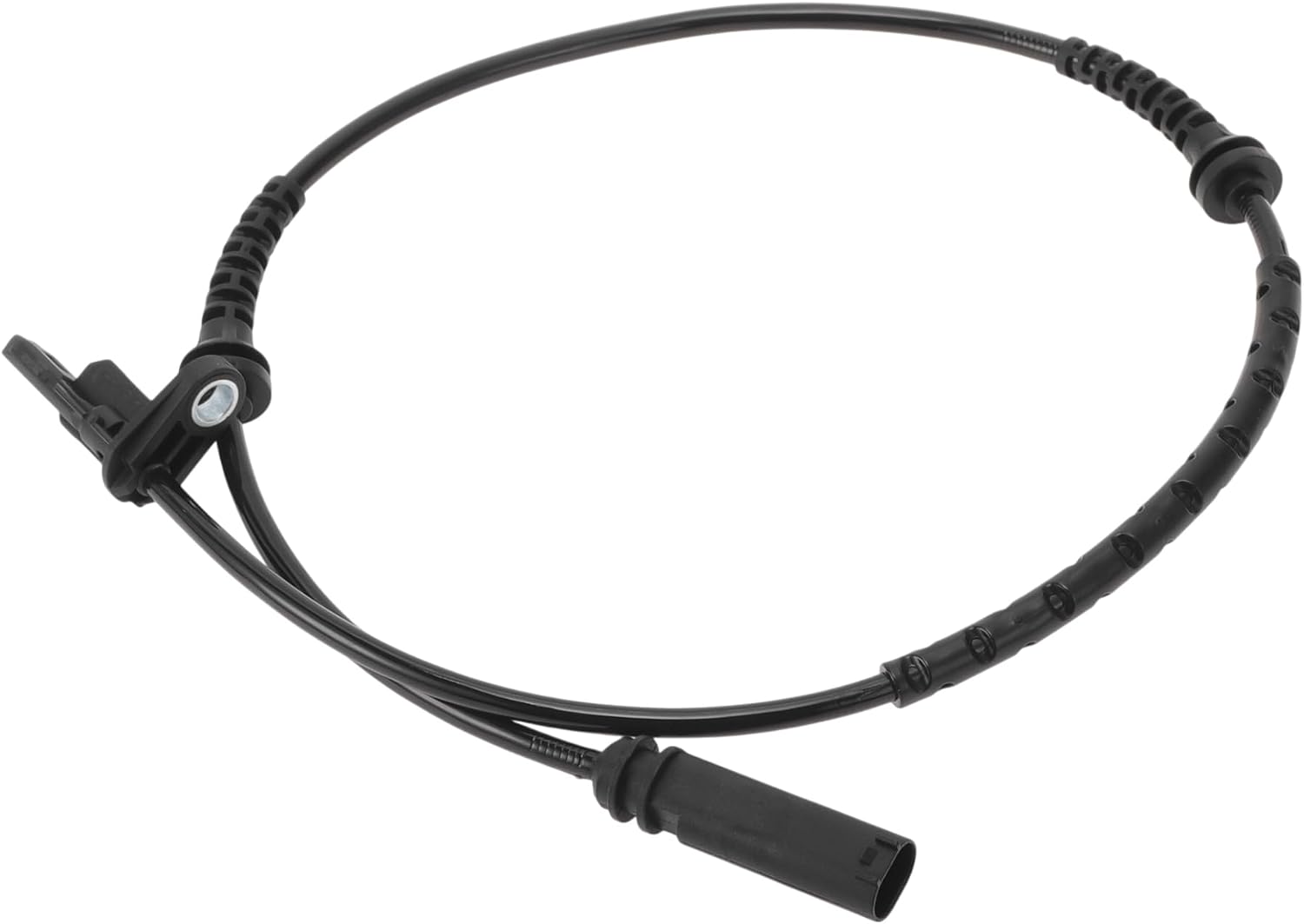
This VekAuto ABS wheel speed sensor is an aftermarket replacement for the front left or front right position on BMW X1 F48 (2018–2022). It monitors wheel rotation and sends speed signals to the vehicle ABS controller to support traction and braking systems. The sensor is built from plastic, rubber, and metal and ships as a single unit intended for straightforward swap-in installation after removing the wheel and unplugging the old connector. In practice it offers accurate and rapid signal measurement to restore proper ABS and stability function without special tooling. Because it is a non-OEM part, fit and finish may vary slightly versus factory items and buyers should verify OE part numbers 34526895881 or 34526880755 before ordering. The simple design keeps cost low and makes it a sensible repair option for owners who need an economical replacement sensor rather than a dealer-sourced unit.
Best for: Practical owners who want a cost-conscious, functional replacement sensor to get ABS and traction systems working again without paying dealer prices.
Less Ideal for: Buyers seeking a factory-sourced sensor or those who prefer buying both side sensors at once should consider OEM or paired options instead.
- Direct replacement for front left or front right on BMW X1 F48 (2018–2022) per listed fitment
- Constructed from plastic, rubber, and metal for durability in road conditions
- Simple one-piece design allows straightforward installation without specialty tools
- Provides rapid wheel speed signal measurement to restore ABS and traction control function
- Aftermarket non-OEM part so fitment and connector quality can differ from factory units
- Sold as a single sensor rather than a pair
Verdict: A budget-friendly aftermarket front wheel speed sensor that restores ABS and traction function on BMW X1 F48 models with quick, simple installation.
4. VekAuto ABS Wheel Speed Sensor for BMW X1 (2016–2019) Rear

| Fitment | BMW X1 2016-2019 |
|---|---|
| Placement on Vehicle | Rear Left Rear Right |
| OE Number | 34526858466/34526850762 |
| Package Content | 1 Pc ABS Wheel Speed Sensor |
| Material Type | Plastic, Rubber, Metal |
This VekAuto ABS wheel speed sensor is a budget aftermarket replacement intended for the rear left or rear right wheel of BMW X1 (2016–2019). It monitors wheel rotation and sends speed signals to the vehicle ABS controller to support anti-lock braking and traction control. The sensor is made of plastic, rubber, and metal and comes as a single-piece unit labeled to match BMW part numbers 34526858466 and 34526850762, which simplifies identification when swapping a failed sensor. Installation is straightforward for anyone comfortable removing a wheel and unplugging the existing sensor harness. As a non-factory replacement, the sensor offers an economical fix but may vary in long-term durability and exact fit compared with factory-quality parts. For budget repairs where quick restoration of ABS function is the priority, this sensor provides an affordable, easy-to-install solution, though buyers seeking guaranteed factory-fit and longevity may prefer a higher-end or OEM option.
Best for: Budget-conscious BMW X1 owners who need a low-cost, quick repair to restore ABS function without prioritizing factory-fit longevity.
Less Ideal for: Buyers who prioritize guaranteed factory fit, maximum longevity, or those restoring vehicles to factory-spec standards should consider higher-end or OEM-equivalent sensors instead.
- Direct replacement for rear left or rear right on BMW X1 2016–2019
- Matches common BMW part numbers for easier identification
- Simple installation that requires basic wheel removal and connector swap
- Lower-cost alternative to factory replacement parts
- Aftermarket unit so long-term durability and exact fit may vary from factory-quality parts
Verdict: Economical aftermarket ABS sensor that restores rear-wheel speed sensing on BMW X1 (2016–2019) with easy installation.
5. A-Premium Front ABS Wheel Speed Sensor (ALS3140) for BMW X1/X2 and Mini Cooper Countryman

| Mounting Type | Wheel Mount |
|---|---|
| Output Type | Push-Pull |
| Terminal Quantity | 2 Blades |
| Location | Front Left or Right |
This A-Premium front ABS wheel speed sensor is a direct-fit replacement for select BMW X1/X2 and Mini Cooper Countryman models and installs at the front left or right wheel. It transmits wheel speed through a two-terminal connector to the vehicle anti-lock brake system so the ABS module can modulate braking and stability controls. The sensor is sold as a wheel-mount, push-pull output unit and is presented as an OEM-style replacement with compatible reference numbers (ALS3140, 34526850765, 0265008847). In practice it offers straightforward installation for a replacement job and is useful when a failed sensor triggers ABS or traction control warnings or causes erratic speed readings. The listing highlights stable output and fast response, which matter for consistent ABS performance and steering stability. The product comes with a one-year unlimited-mileage guarantee limited to the part cost, so buyers should plan for professional labor separately if needed.
Best for: Reliability-focused buyers who prioritize restoring factory braking and stability function with a cost-effective, direct-replacement sensor for specified BMW X1/X2 and Mini Countryman models.
Less Ideal for: Buyers seeking a lifetime or comprehensive labor-backed warranty or those who need sensors compatible with automated parking assist features should consider other options.
- Direct-fit for specified BMW F48/F39 and Mini F60 front wheel locations, simplifying replacement.
- Push-pull output and two-blade terminal match factory connector style for plug-and-play electrical hookup.
- Advertised stable output and fast response which support reliable ABS and traction control behavior.
- One-year unlimited-mileage part guarantee gives limited post-purchase protection for the sensor itself.
- Guarantee covers only the cost of the part and excludes installation or related expenses.
- Fitment excludes vehicles with automated parking assist per the listing, limiting applicability.
Verdict: A straightforward, factory-style front ABS wheel speed sensor replacement aimed at restoring reliable ABS and traction control performance on specified BMW X1/X2 and Mini Countryman models.
6. A-Premium ABS Wheel Speed Sensor for BMW X1 (Front, Driver or Passenger)

| Compatible Vehicles | BMW X1 E84 2013-2015 L4 2.0L / L6 3.0L |
|---|---|
| Location | Front driver or passenger side |
| Connector Pins | 2 Pins |
| Mounting Type | Flange Mount |
| Upper Temperature Rating | 246 Degrees Celsius |
This A-Premium ABS wheel speed sensor is a direct-replacement sensor for the front left or right position on 2013–2015 BMW X1 E84 models with 2.0L or 3.0L engines. It plugs into the factory harness using a two-pin connector and transmits wheel speed information to the ABS control module to support traction and braking systems. The sensor is made from ABS plastic, rated to operate at elevated temperatures, and is sold as a new premium component with claimed OEM-equivalent fitment and tested output performance. For a convenience-minded buyer the unit is straightforward to swap in place of a failed sensor and should restore stable wheel-speed signals and ABS responsiveness without calibration beyond standard system checks. Limitations include reliance on correct installation and connector condition for reliable operation and the part is an aftermarket replacement rather than a factory-branded unit, so long-term durability may vary compared with higher-end options.
Best for: A convenience-driven buyer who wants a simple, ready-to-install replacement to restore ABS and traction control function on a 2013–2015 BMW X1 without extra calibration or modification.
Less Ideal for: Drivers who prioritize factory-branded parts or need a sensor with documented long-term OEM-level warranty and service support should consider alternative options.
- Direct-fit replacement for BMW X1 E84 front left or right to simplify installation
- Two-pin connector compatible with the vehicle harness for plug-and-play swap
- Built and tested as a new component to provide stable wheel-speed output
- Rated for high temperatures to withstand under-hood conditions
- Aftermarket part rather than factory-branded which may affect long-term durability
Verdict: An easy, plug-and-play front ABS speed sensor that restores wheel-speed signaling for 2013–2015 BMW X1 models.
7. A-Premium Front ABS Wheel Speed Sensor Set (Pack of 2) for BMW/Mini Compatible Models
| Mounting Type | Flange Mount |
|---|---|
| Output Type | Analog |
| Upper Temperature Rating | 250 Degrees Fahrenheit |
| Material Type | Acrylonitrile Butadiene Styrene |
| Quantity Sold | Pack of Two Pieces |
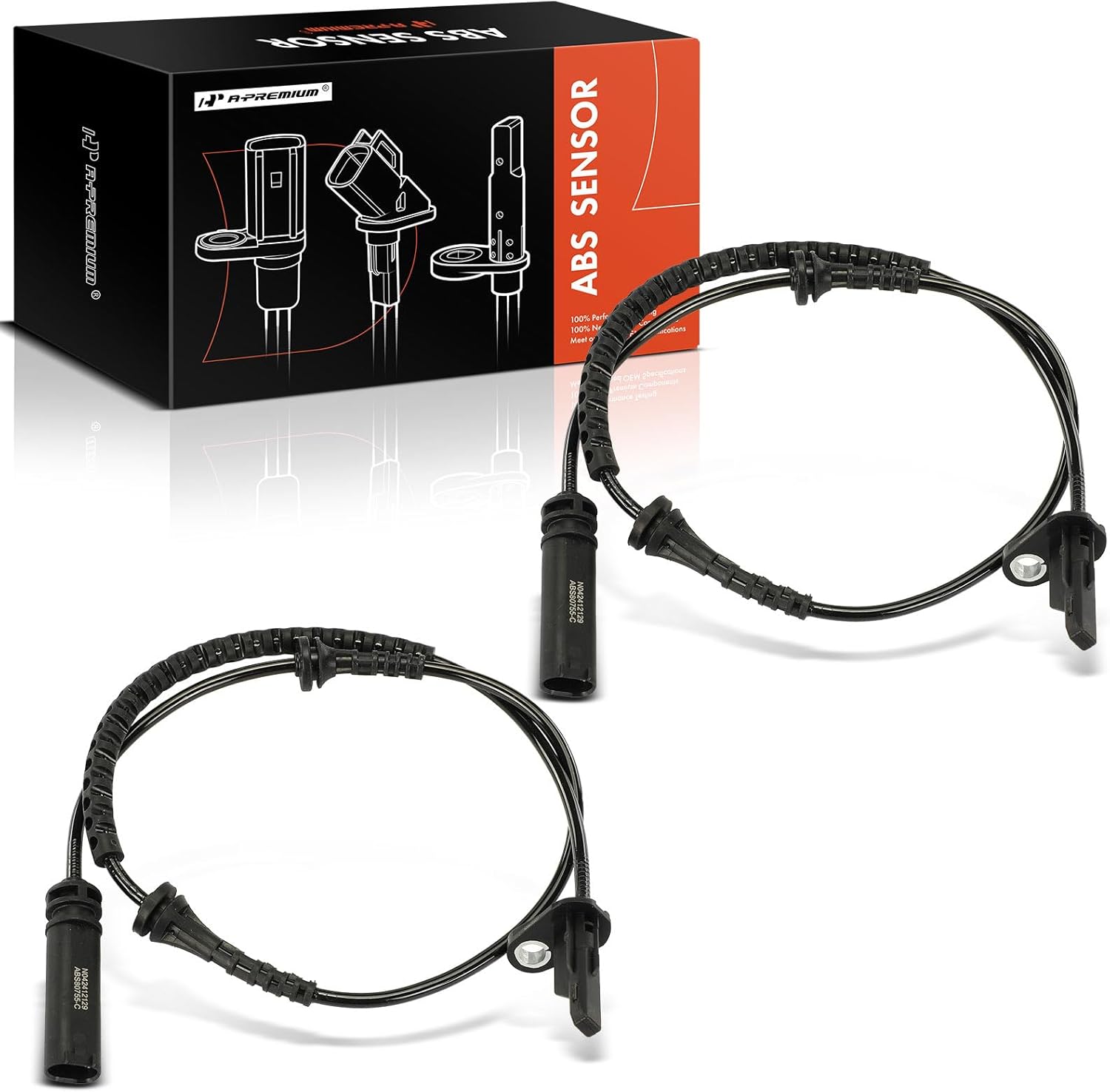
This A-Premium two-piece ABS wheel speed sensor set replaces the front left and right sensors on compatible BMW X1 and selected Mini and Gran Coupe models. It is designed as a direct-fit factory-quality replacement to restore wheel speed signals used by ABS, traction control, and stability systems. Typical installation replaces failed or damaged sensors that trigger ABS or traction warnings and requires accessing the front wheel hub and electrical connector. Notable features include flange-mount design, analog output, and an advertised upper temperature rating of 250 F; the set is molded from ABS plastic and includes two terminals per sensor. In practice the sensors offer a straightforward swap for routine repairs and help return proper wheel-speed feedback without modifying vehicle electronics. Limitations are that fitment is specific to certain engine and brake configurations, so buyers must confirm vehicle compatibility, and aftermarket construction may not match every factory part detail or long-term durability of higher-end OE-equivalent options.
Best for: Practical, risk-averse BMW X1 owners who prioritize restoring factory safety systems reliably and prefer a direct-fit replacement over custom or performance parts.
Less Ideal for: Drivers who need sensors for modified braking systems or who prioritize the longest-term, premium OE-metal-bodied sensors should consider higher-end alternatives or dealer parts.
- Sold as a front left and right two-piece set for one-step replacement
- Flange-mount design matches factory-style installation points
- Analog output compatible with original wheel speed signal systems
- Built to operate at elevated temperatures with a 250 F upper rating
- Fitment excludes models with certain performance brakes or automated parking assist and must be verified before purchase
- Made from ABS plastic which may be less durable than metal-bodied sensor variants
Verdict: A straightforward two-piece front sensor set that restores factory wheel-speed input for compatible BMW X1 and related models.
Choosing the Right BMW X1 ABS Wheel Speed Sensor: Key Factors to Consider
Fit and Mounting Compatibility
Physical fit matters because the sensor must align precisely with the tone ring and secure to the vehicle without modification. Incorrect mounting can cause rubbing, poor signal pickup, or premature failure.
Check the mounting flange, bolt pattern, and connector orientation. A sensor that matches the original mounting points reduces installation time and lowers the risk of mechanical damage during driving.
Electrical Signal Consistency
The sensor's ability to produce a stable, noise-free signal directly affects ABS and traction systems. Fluctuating or weak output can trigger warnings or intermittent ABS behavior.
Look for parts with documented output ranges and stable waveform characteristics. Consistent signal amplitude across speed ranges helps ensure accurate wheel speed calculation by the control module.
Connector and Wiring Integrity
The connector type and cable routing determine how well the sensor resists corrosion and mechanical wear. Poorly fitted connectors or exposed wiring frequently cause open circuits or intermittent faults.
Assess whether the connector matches the vehicle harness, the quality of terminal crimps, and the presence of strain relief. Durable insulation and secure locking tabs reduce the chance of water ingress and connector loosening.
Environmental Durability
Sensors are exposed to water, salt, heat, and debris, so materials and seals matter for longevity. A sensor with weak sealing or low-grade materials will corrode or fail sooner in real-world driving conditions.
Consider sensors with robust housings, gaskets, and protective coatings. Resistance to thermal cycling and road chemicals helps maintain performance across seasons.
Electrical Specifications and Testing
Knowing expected resistance, output voltage, and diagnostic behavior helps diagnose faults and confirm replacement correctness. Parts that match OEM electrical specs reduce the chance of diagnostic codes or degraded system performance.
Verify documented resistance ranges, expected waveform behavior during an ABS wiring test, and compatibility with common diagnostic codes. Clear specifications make post-installation verification straightforward.
Installation and Serviceability
Ease of installation affects how quickly you can return the vehicle to normal operation and whether special tools or programming are needed. Sensors that install without modifying surrounding components reduce labor and potential for error.
Look for sensors with accessible mounting hardware, clear connector access, and minimal requirement for sensor relearning or module coding. Parts that facilitate straightforward replacement lower the overall time and complexity of service.
How We Chose the Best BMW X1 ABS Wheel Speed Sensor
We focused on items designed specifically for BMW X1 fitment and electrical compatibility to reduce installation issues and ensure correct wheel speed signals. Key evaluation criteria included connector and mounting fit, sensor signal stability under load, resistance and voltage within expected ranges, and build durability for exposure to road debris and moisture. We also considered ease of installation, including whether sensors require special adapters or programming, along with wiring integrity and sealing against contaminants.We excluded parts that were generically listed for many vehicle families without clear X1-specific fit data, components lacking documentation on electrical specs, and sensors with repeatedly reported connector or housing mismatches. Our selections emphasize dimensional fit, consistent output, and robust environmental protection to minimize repeat failures and diagnostic ambiguity.
Our full evaluation process is outlined in our review methodology.
FAQ
What are common symptoms of a failing ABS wheel speed sensor on a BMW X1?
Common symptoms often include an illuminated ABS or traction control light, inconsistent speedometer readings, or unexpected ABS intervention. You may also notice reduced stability control performance or a diagnostic code related to wheel speed input.
Where is the ABS wheel speed sensor located on a BMW X1?
On the BMW X1, wheel speed sensors are mounted at each wheel hub area near the tone ring, typically close to the brake rotor. Location can vary slightly between front and rear hubs, but they are usually accessible from the wheel well.
How do I diagnose whether the ABS sensor is faulty or the wiring is the problem?
Start with a visual inspection of the connector and wiring for damage or corrosion. Use a multimeter to check resistance and an oscilloscope or scan tool to view the signal while spinning the wheel. If wiring and connectors test good but the signal is absent or erratic, the sensor is likely at fault.
Can I replace a BMW X1 ABS wheel speed sensor myself?
Many owners can perform the replacement with basic hand tools and a jack, provided the sensor is easily accessible. However, some vehicles may require specific torque values, careful routing of wiring, or a relearn procedure, so be prepared to follow service instructions.
Will replacing the wheel speed sensor clear an ABS sensor code P0500?
Code P0500 specifically refers to vehicle speed sensor input and can be caused by sensor issues, wiring faults, or module problems. Replacing a faulty sensor can resolve the code, but it is important to verify wiring and related systems before concluding the sensor is the sole cause.
Should I choose an OEM or aftermarket wheel speed sensor for a BMW X1?
Both OEM and reputable aftermarket sensors can be acceptable. The priority is fit, correct electrical specifications, and quality sealing. The best choice depends on documented compatibility and the supplier's reputation for consistent parts.
Conclusion
When replacing an ABS wheel speed sensor on a BMW X1, prioritize fitment and electrical compatibility to avoid diagnostic headaches and ensure stable ABS operation. Consider connector match, signal characteristics, and environmental durability as the primary decision points.Balance ease of installation and documented specifications against long-term reliability. Verifying wiring and performing a post-installation signal test helps confirm the replacement resolves the original fault without introducing new issues.
Explore More:
- Check out all BMW X1 parts & accessories
- Explore ABS Wheel Speed Sensors Maintenance & Repair Guides
- Explore Electrical System
- Browse all Auto Parts
