

Note: This article contains affiliate links. If you click on these links and make a purchase, I may earn a small commission at no extra cost to you. This helps support my research and content. Read my full affiliate disclosure here.
If you own a 1995-2004 Toyota Tacoma, keeping transmission temperatures in check is one of the most effective ways to extend gearbox life and maintain consistent shifting under load. Whether you tow, haul, or put miles on mixed terrain, an aftermarket transmission cooler can reduce operating temperature, lower wear on seals and clutch packs, and cut the risk of heat-related failures.This guide covers the top shortlisted transmission coolers sized and chosen for the 1995-2004 Tacoma. We evaluated options that include standalone external coolers, stacked-radiator designs, and kits with necessary lines and fittings. Below you will find practical decision criteria and installation considerations to help you pick the right cooler for your driving needs, followed by the top-rated units that met our editorial filters.
Looking for other parts? See all Toyota Tacoma parts & accessories.
Top Picks at a Glance
| Best Overall The best all-around choice for most situations | DWVO Complete Radiator Compatible with 1995-2004 Tacoma 2.7L/3.4L |  |
| Best Quality Built to a higher standard if you want something more solid | DNA Motoring OE-Style 1-Row Aluminum Core Radiator for 1995–2004 Toyota Tacoma (Automatic) |  |
| Best Value The sweet spot between price and what you get | Four Seasons Rapid-Cool Transmission Oil Cooler (53006) |  |
| Best Budget The cheapest option that still gets the job done reliably | A-Premium 8-Pass Aluminum Transmission Oil Cooler Kit |  |
| Highest Rated A top-rated pick with lots of positive feedback | Hayden Automotive 699 Transmission Oil Cooler |  |
| Most Popular A crowd favorite that many people choose with confidence | AUTOSAVER88 Radiator for 1995–2004 Toyota Tacoma (2.7L/3.4L) |  |
| Best Seller A high-volume bestseller chosen again and again | KOROP LPD47391 40K Low-Pressure-Drop Transmission Oil Cooler Kit |  |
DWVO Complete Radiator Compatible with 1995-2004 Tacoma 2.7L/3.4L

| Compatible engines | 2.7L L4, 3.4L V6 |
|---|---|
| OEM part numbers | TO3010178, TO3010179, 164100C031, 164100C032, 164100C041 |
| Core material | Aluminum |
| Mounting | Direct replacement, includes transmission oil cooler |
This DWVO complete radiator replaces the original cooling assembly for 1995–2004 Toyota Tacomas with 2.7L four-cylinder or 3.4L V6 engines. It installs in the factory location and includes an aluminum core with high-density multi-louvered fins plus an integrated transmission oil cooler to help keep engine and transmission temperatures in check. The unit uses TIG-welded inlet/outlet tanks and a treated coating intended to resist corrosion and leaks, and it ships with foam protection to prevent shipping damage. In practice the radiator is aimed at DIY mechanics and budget-conscious owners who need a reliable, OEM-style fit without paying dealer prices. Some buyers report slightly thinner plastic tanks and occasional mismatches with shrouds or oil cooler fittings, so expect to reuse some original mounting hardware and check transmission line fittings during installation. The radiator does not include a cap or sensors, and professional installation is recommended if you are not comfortable with cooling system bleeding and line connections.
Best for: Buyers who want an affordable, factory-style radiator replacement for a 1995–2004 Tacoma and prioritize a straightforward, cost-effective repair with decent cooling performance.
Less Ideal for: Anyone needing a lifetime upgrade or heavy-duty racing/transmission cooling beyond factory capacity should consider purpose-built performance coolers instead.
- Direct-fit design for 1995–2004 Tacoma 2.7L and 3.4L applications so minimal modifications are usually required
- Aluminum core with high-density multi-louvered fins improves cooling efficiency
- Integrated aluminum transmission oil cooler adds transmission temperature control
- TIG-welded inlet/outlet tanks and protective coating intended to reduce leaks and corrosion
- Secure packaging and foam protection reduce risk of shipping damage
- Radiator cap and sensors are not included so you must reuse originals or source replacements
- Some users report fitment tweaks required for fan shrouds or slightly thin plastic tank material
- Transmission oil cooler fittings may require careful tightening or remaking to avoid leaks
Verdict: A budget-friendly, direct-fit replacement that restores factory-style engine and transmission cooling for 1995–2004 Tacomas without the dealer markup.
DNA Motoring OE-Style 1-Row Aluminum Core Radiator for 1995–2004 Toyota Tacoma (Automatic)

| Fitment | 1995–2004 Toyota Tacoma (Automatic) |
|---|---|
| Core Rows | 1 |
| Core Material | T-6061 Aluminum |
| Transmission Oil Cooler | Yes |
| Inlet/Outlet Diameter | 1-3/8" |
This DNA Motoring radiator is a one-row, T-6061 aluminum core replacement built to bolt into 1995–2004 Toyota Tacoma models with automatic transmission. It is used as a like-for-like factory-style radiator to remove engine heat and add a transmission oil cooler port, so it is appropriate when the original unit is leaking, clogged, or running hot. Notable features include a full aluminum tube-and-fin core for faster heat transfer, plastic end tanks for mounting, and direct bolt-on fitment advertised for a straightforward swap. In real-world use it typically lowers operating temperatures and is noticeably lighter than older cast-iron or heavy OEM units, which helps handling and ease of installation for a competent DIYer or mechanic. Be aware some owners report fitment clearance issues on non-Tacoma vehicles and a small number report leaks after several months, so inspect mounting clearances and pressure-test before installation. Installation instructions are not included, and professional installation is recommended if you are not experienced with cooling systems.
Best for: Buyers who want a performance-minded replacement that reduces operating temperatures and is intended to be a direct-fit swap on a 1995–2004 Tacoma automatic, especially those who prioritize improved cooling over factory-original materials.
Less Ideal for: If you need a heavy-duty or long-life racing radiator or an all-aluminum tank design for extreme use, consider purpose-built performance radiators instead.
- Full T-6061 aluminum tube-and-fin core for improved heat dissipation compared with older cores
- Direct bolt-on design intended for 1995–2004 Toyota Tacoma automatics for easier replacement
- Includes transmission oil cooler port for vehicles with AT and integrated cooling needs
- Lightweight construction makes handling and installation easier
- Multiple customer reports of good fit and reliable short-term performance
- Some reviewers reported bottom-tank leaks after months of use in rare cases
- Plastic end tanks may be less durable long term compared with all-aluminum tanks
Verdict: Choose this radiator if you want a lightweight, aluminum-core direct-replacement that lowers engine and transmission temperatures on a 1995–2004 Tacoma automatic.
Four Seasons Rapid-Cool Transmission Oil Cooler (53006)
| Brand | Four Seasons |
|---|---|
| Part Number | 53006 |
| Item Form | Oil |
| Liquid Volume | 0.12 Liters |
The Four Seasons Rapid-Cool transmission oil cooler is a small, tube-and-fin aftermarket cooler intended to lower transmission fluid temperatures when added in-line or as a replacement unit. Typical use is as an auxiliary or upgraded cooler for vehicles that tow, haul, or run hot transmissions; it installs in-line with existing transmission lines and mounts to a bracket or frame. The unit’s compact footprint makes it easy to hide behind bumpers or radiators and simplifies mounting in tight spaces. Real-world benefits include reduced fluid temperature under sustained loads and a simpler retrofit compared with large plate coolers. Limitations are its modest heat-sinking area compared with larger coolers, so it may not provide enough capacity for heavy towing or extreme use unless paired in parallel or supplemented by additional cooling. Some buyers also report needing minor bracket or line modifications during installation because fitment is generic rather than vehicle-specific.
Best for: Buyers looking to modestly improve transmission cooling on a budget and who prioritize an easy-to-fit, compact cooler that can be tucked into tight spaces while still reducing fluid temperatures during everyday towing or hauling.
Less Ideal for: Drivers who plan heavy duty towing, frequent steep-grade pulls, or high-performance use should choose a larger multi-row cooler or a purpose-built heavy-capacity kit instead.
- Compact size fits tight mounting locations and is easy to conceal.
- Simple tube-and-fin design offers straightforward cooling performance for moderate loads.
- Generic mounting makes it adaptable to different install positions without vehicle-specific brackets.
- Lightweight unit simplifies handling during installation.
- Smaller core area limits cooling capacity compared with larger or multi-row coolers.
Verdict: A compact, easy-to-install aftermarket cooler that provides sensible cooling upgrades for modest towing and tight install locations on a 1995–2004 Tacoma.
A-Premium 8-Pass Aluminum Transmission Oil Cooler Kit

| Material | Aluminum |
|---|---|
| Core Style | 8-pass tube and fin |
| Reference Number | 1405, 405, 53003 |
The A-Premium 8-pass aluminum transmission oil cooler is a universal add-on designed to reduce transmission fluid temperatures when towing or under sustained load. It is typically mounted in front of or alongside the condenser and plumbed inline with the factory transmission lines to provide extra cooling capacity for higher-stress use. Notable features include an 8-row tube-and-fin core for strong heat transfer, supplied silicone hose, multiple mounting tabs and zip-tie anchors, and a one-year unlimited-mileage guarantee. In practice the cooler consistently lowers fluid temps according to owner reports and fits into tight spaces because of its relatively compact profile. Installation requires basic mechanical skills and some extra fittings or clamps in certain applications since the kit does not include every possible adapter or OEM-style clamps. For a budget-conscious buyer the cooler delivers solid cooling performance and good build quality, but expect to source a few additional fittings and use proper constant-tension clamps for a leak-free, long-term install.
Best for: Owners looking for an affordable aftermarket transmission cooler to reduce fluid temperature during towing or sustained heavy use on older trucks, and who are comfortable sourcing small fittings and doing a hands-on install.
Less Ideal for: Buyers who want a direct bolt-in, vehicle-specific cooler with all factory-style fittings included or who prefer professional installation without modifying hoses or adding adapters.
- 8-pass aluminum tube-and-fin core offers strong heat rejection for towing and heavy use
- Includes silicone hose and multiple mounting options for flexible placement
- Compact size fits into tight front-end locations without major fabrication
- One-year unlimited-mileage guarantee provides post-purchase reassurance
- Does not include a comprehensive set of fittings or OEM-style clamps so additional parts are often needed
- May require moderate fabrication or custom adapters for a clean, factory-like installation
Verdict: A budget-friendly, compact 8-pass aluminum cooler that meaningfully lowers transmission temperatures for towing when you're willing to source a few extra fittings and install it yourself.
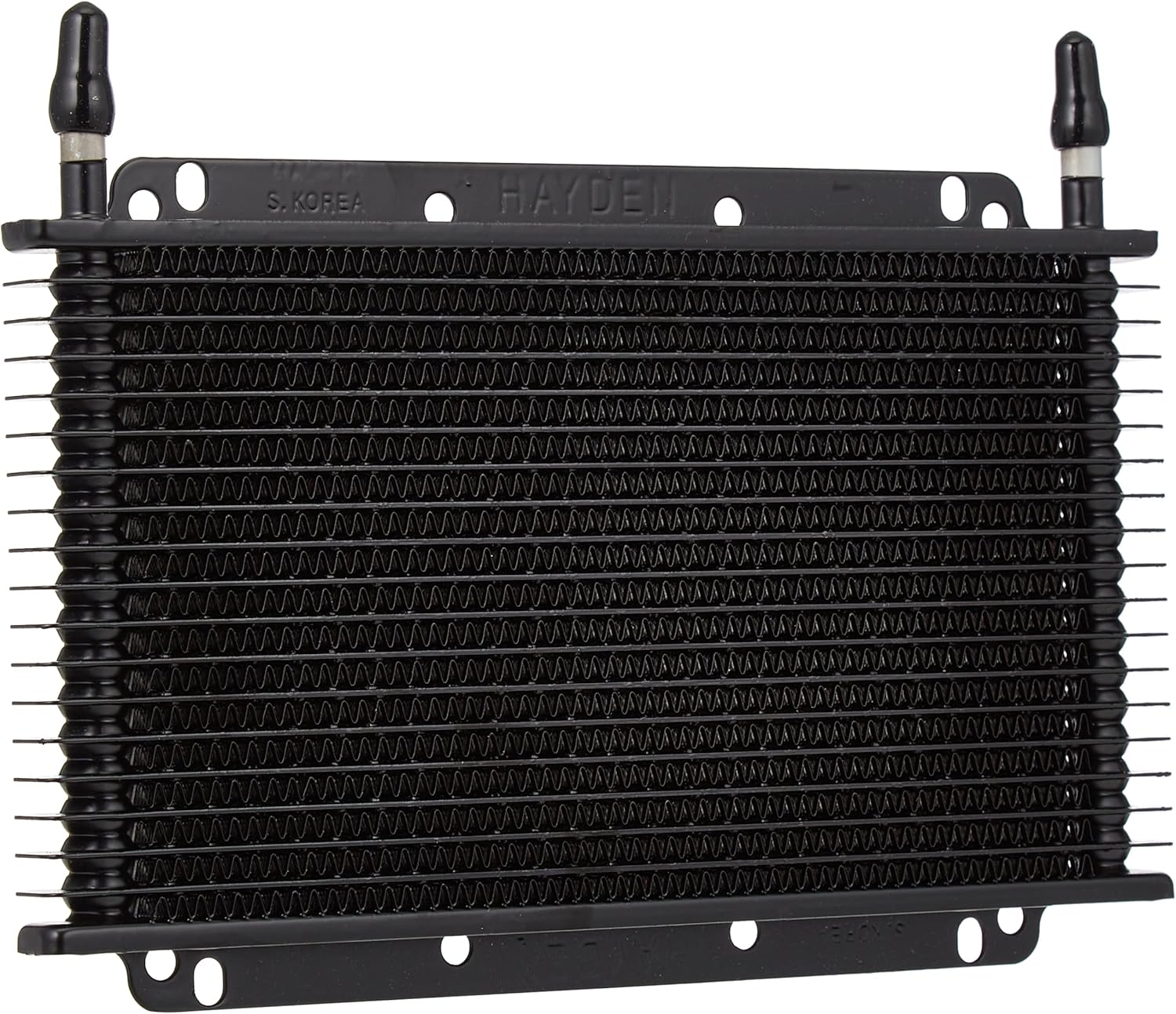
Hayden Automotive 699 Transmission Oil Cooler

| Model | Trans Oil Cooler |
|---|---|
| Manufacturer | Hayden Automotive |
| Exterior | Machined |
| Item model number | 699 |
The Hayden 699 is a compact, machined transmission oil cooler intended as an auxiliary unit to lower ATF temperatures when towing, climbing hills, or in stop-and-go traffic. It is typically mounted in front of the radiator or condenser and plumbed into the transmission return lines using aftermarket fittings or a hose kit. Buyers report it brings significant temperature drops compared with smaller or factory units, and the machined construction appears durable with no widespread leak reports. Installation is moderately involved: expect custom routing, cutting or adapting lines, and additional fittings or clamps for a secure connection. The cooler does not come with a universal plug-and-play harness so plan for a day of work and a few specialty adapters if your vehicle has hardlines. For reliability-focused owners it offers predictable cooling performance that can extend transmission life under load, but installation complexity and the need for proper fittings are the main practical caveats to budget for.
Best for: Buyers who prioritize extending transmission life and steady operating temperatures during towing or heavy-duty use and who are willing to perform or pay for a careful custom installation.
Less Ideal for: Casual drivers who want a plug-and-play factory-style replacement or anyone unwilling to modify lines or source fittings and clamps should consider simpler bolt-in options.
- Effective cooling that users report lowering transmission fluid temperatures by 20–30 degrees in demanding conditions
- Machined exterior and solid build quality reduce risk of early failure or leaks
- Compact footprint fits ahead of radiator or condenser for flexible mounting locations
- Compatible with conventional transmission plumbing when appropriate adapters and hose kits are used
- Requires custom plumbing and fittings for many installations which increases install time and cost
- Does not include universal mounting or hose kit so additional parts may be needed
Verdict: A rugged, compact aftermarket cooler that reliably lowers ATF temps for reliability-focused owners willing to handle a custom installation.
AUTOSAVER88 Radiator for 1995–2004 Toyota Tacoma (2.7L/3.4L)

| Compatible engines | 2.7L L4 and 3.4L V6 |
|---|---|
| Fitment years | 1995-2004 |
| Core material | Aluminum core |
| Tank material | Plastic tank |
This AUTOSAVER88 radiator is a direct-fit replacement for 1995–2004 Toyota Tacoma 2.7L and 3.4L engines intended to restore cooling performance without major modification. It installs like a factory unit and is built with a high-density multi-louvered aluminum core and plastic tanks that are leak-tested before shipping. Typical use is a full radiator swap during a coolant service or when the original unit fails; the package includes the complete radiator and a user manual but not a radiator cap. Buyers report generally easy installation and good fitment on older Tacomas, and the higher fin density compared with basic aftermarket cores helps with heat rejection in stop-and-go driving. Trade-offs to note are mixed reports on long-term durability and slightly lower core row count or thickness versus some OEM units, so monitoring for leaks after installation is prudent. Professional installation is recommended if you want proper alignment and to avoid coolant-system issues.
Best for: Buyers who prioritize a budget-minded, direct-fit replacement that restores cooling quickly and prefer options with plenty of user feedback to gauge real-world fit and performance.
Less Ideal for: Drivers looking for a heavy-duty or upgraded high-capacity cooler for towing, racing, or severe-duty use should consider purpose-built performance coolers instead.
- Direct-fit design that matches factory mounting for 1995–2004 Tacoma 2.7L and 3.4L
- High-density multi-louvered aluminum core aimed at improved cooling efficiency
- Leak-tested assembly using a plastic tank and aluminum core
- Includes complete radiator with user manual for a straightforward replacement
- Core row count and thickness may be less than some factory radiators, which could affect long-term heat capacity
- Mixed long-term durability reports from other buyers mean lifespan is uncertain
- Radiator cap is not included, requiring a separate purchase if needed
Verdict: A cost-effective, direct-fit radiator for 1995–2004 Tacomas that restores factory-style cooling with straightforward installation and broad user feedback to inform risk-aware buyers.
KOROP LPD47391 40K Low-Pressure-Drop Transmission Oil Cooler Kit

| Material | Alloy Steel, Aluminum |
|---|---|
| Connector Type | Flare |
| Thread Size | 3/8 |
| Thread Type | NPT |
This KOROP LPD47391 transmission cooler is a brazed-aluminum, low-pressure-drop unit intended to lower transmission fluid temperatures during towing and heavy-duty operation. It installs as an auxiliary cooler and comes with a full mounting hardware kit and flare/NPT fittings to route fluid away from the radiator for better thermal control. In real-world use the cooler delivers noticeably lower temps on long drives and towing runs, which helps reduce clutch and fluid wear and can improve transmission longevity. Installation is straightforward for someone comfortable with basic hand tools, though you may need to drill new bracket holes and adapt fittings for nonstandard lines. Buyers should note the kit uses 3/8 inverted-flare style connections and supplied hoses that some users have reported occasional failures, so checking hose routing and tightening fittings during first runs is prudent. The product targets aftermarket cooling rather than a direct factory plug-in, so expect minor fitment work to adapt it to a 1995–2004 Toyota Tacoma frame and mounting points.
Best for: Tacoma owners wanting a conservative, proven way to lower transmission temps when towing or hauling and who prefer a bolt-up kit they can adapt with modest fabrication.
Less Ideal for: If you need a direct-fit, vehicle-specific cooler with no drilling or line changes, this universal-style kit is not the best choice and a truck-specific cooler would be better.
- Brazed aluminum construction for efficient, durable heat transfer
- Low-pressure-drop design improves cooling without stressing the transmission pump
- Comes with a complete mounting hardware kit to simplify installation
- Includes variety of fittings to adapt to different line arrangements
- Uses 3/8 inverted-flare/NPT fittings that may require adapters for some line setups
- Some buyers reported hose failures so supplied hoses may require inspection or replacement
Verdict: Choose this cooler if you want a durable, low-pressure-drop aftermarket kit that reliably reduces transmission temperatures for towing on a 1995–2004 Toyota Tacoma.
Choosing the Right 1995-2004 Toyota Tacoma Transmission Cooler: Key Factors to Consider
Cooling Capacity and Temperature Reduction
Cooling capacity is the single most important factor because the primary job of a transmission cooler is to lower fluid temperature during demanding use. Look for units with a measurable temperature drop under load; even a 20 to 30 degree Fahrenheit reduction can substantially extend fluid and component life. Cooling capacity depends on core size, tube density, and airflow exposure, so larger cores or multi-pass designs often perform better.
For the 1995-2004 Tacoma, consider your typical load. Daily driving with occasional towing needs a modest cooler that fits ahead of the radiator or AC condenser. Frequent towing or heavy off-road use benefits from a larger external cooler mounted where it gets steady airflow. Keep in mind that more cooling typically means a larger unit and potentially more complex mounting, so weigh thermal performance against installation constraints.
Fitment and Mounting Locations
Correct fitment is essential for a clean installation and reliable operation. The 1995-2004 Tacoma has limited frontal space, especially on trucks with aftermarket bumper or winch setups, so verify clearance for the cooler core, lines, and brackets. Some coolers are designed as stacked-radiator style units that sit in front of the existing radiator; others are remote external cores that mount to the frame or behind the grille.
Consider available mounting points and whether the kit includes vehicle-specific brackets or universal mounts. A cooler that requires minimal trimming or drilling will reduce installation time and the chance of error. Also check the core thickness—thicker cores may offer better cooling but can be harder to fit in constrained spaces.
Line Compatibility and Fittings
Transmission cooler performance and reliability depend on leak-free connections. Many kits include transmission cooler lines or adapters sized to match the Tacoma's factory fittings. Inspect the fittings provided and confirm they match the vehicle's transmission outlet and inlet threads or hose sizes.
Line routing matters for both protection and serviceability. Keep lines away from sharp edges, hot exhaust components, and moving suspension parts. If the kit requires you to use existing lines, ensure clamps and crimps meet pressure requirements for transmission fluid systems. Durable, properly routed lines reduce the chance of chafing and leaks that can lead to fluid loss and transmission damage.
Core Construction and Corrosion Resistance
The style and materials of the heat exchanger affect longevity. Aluminum cores are common for their light weight and good thermal transfer, while some designs use copper-brass cores for repairability. Look for brazed or welded joints rather than crimped assemblies, and consider anti-corrosion finishes or coatings, especially if you drive in salty or humid environments.
Mounting hardware should also resist corrosion; stainless-steel brackets or zinc-plated hardware last longer near road spray. A more robust build reduces the chance of leaks and maintains cooling performance over time.
Installation Complexity and Included Hardware
Installation difficulty ranges from simple bolt-on kits to setups requiring new lines, crimping tools, or modifications. Owners who plan to install the cooler themselves should prefer kits that include vehicle-compatible brackets, hoses, clamps, and detailed instructions. If the kit requires specialized tools or custom lines, factor in the cost and time of shop labor.
Consider whether the kit provides step-by-step guidance for routing and bleeding the transmission cooler loop. A kit that anticipates common Tacoma layout issues—such as limited grille clearance or frame-direct mount locations—will save effort and reduce the risk of installation mistakes that could cause leaks or poor cooling.
Serviceability and Repair Options
A cooler that is easy to service will lower lifetime ownership costs. Units with replaceable fittings, accessible mounting points, and standard hose sizes simplify future repairs. If the cooler uses a stacked design integrated into a radiator assembly, consider how easily you can access it for inspection or replacement.
Also evaluate warranty coverage and the availability of replacement components like fins, end tanks, or hoses. For owners who operate in harsh conditions, the ability to swap damaged lines or cores quickly is valuable and reduces downtime.
Why Transmission Cooling Matters on the 1995-2004 Tacoma
The Tacoma's transmission was designed for reliable everyday use, but heat remains the primary enemy of transmission components and fluid. Excessive temperature accelerates fluid breakdown, increases wear on clutch plates and seals, and can lead to erratic shifting or premature failure. Adding an auxiliary cooler helps maintain a lower, more stable fluid temperature under sustained loads.
Owners who tow light trailers, carry heavy loads, or frequently drive in hot climates will see the largest benefit because the stock cooling capacity can be pushed hard in these conditions. Even casual drivers gain a margin of protection in stop-and-go traffic or during long mountain descents.
- Lower fluid temps improve shift consistency and clutch life
- Auxiliary coolers reduce stress during towing and hill driving
- Better cooling can extend intervals between transmission services
Common Installation Locations and Their Tradeoffs
There are a few common mounting locales for transmission coolers on the 1995-2004 Tacoma: in front of the radiator/condenser, behind the grille, or along the frame rail. Each location offers tradeoffs in airflow, protection, and ease of routing lines.
Mounting the cooler in front of the radiator exposes it to maximum airflow but increases risk of damage from road debris. Behind the grille provides some protection but less direct airflow. Frame-rail mounts are sheltered but must be positioned to get sufficient passing air or use a fan-assisted arrangement.
- Front-of-radiator: best cooling, higher debris exposure
- Behind-grille: balanced protection and airflow
- Frame-rail: protected but may need larger core or fan for equivalent cooling
Bleeding, Fluid Capacity, and Maintenance Tips
Installing an auxiliary transmission cooler can change the fluid circuit and slightly increase total fluid capacity. It is important to fill and bleed the system according to transmission service procedures to avoid air pockets that cause poor shifting or overheating. After installation, monitor fluid level and condition during the first few hundred miles to confirm proper operation.
Regularly inspect cooler lines and fittings for leaks and routing chafe points. Clean the cooler fins periodically if road grime or insects reduce airflow. For trucks used in dusty or salty environments, more frequent checks will catch corrosion or clogging before they affect cooling performance.
- Check and top fluid after initial installation run-in
- Inspect lines for chafe and fittings for leaks every few months
- Keep fins clear of debris to preserve heat transfer
When a Cooler Is Essential Vs. Optional
A transmission cooler is essential if you routinely tow trailers, carry heavy payloads, or perform frequent low-speed work that keeps the transmission under high load. Those conditions cause sustained transmission temperatures that the stock system may not handle well over long periods.
For light-duty daily driving with no towing, an auxiliary cooler is optional but still beneficial as an insurance policy against heat spikes during summer traffic or long highway grades. Assess your use pattern and choose a cooler sized to match your most demanding scenarios rather than worst-case corner cases.
- Essential for regular towing or heavy payloads
- Highly recommended for frequent off-road or mountain driving
- Optional for light-duty commuting but still protective
Upgrading Lines and Fittings for Long-Term Reliability
Upgrading to heavier-duty transmission cooler lines and quality fittings is a worthwhile companion upgrade for any cooler installation. OEM rubber hoses are adequate for stock operation but can soften or swell under increased temperatures and pressure. Reinforced lines and crimped or threaded fittings improve reliability and reduce the chance of a sudden leak.
When routing new lines, protect them with sleeves where they pass through tight openings and avoid sharp bends. Use proper clamps and torque values on fittings, and verify compatibility with the Tacoma's transmission ports to ensure a leak-free connection.
- Consider braided or reinforced hoses for repeated high-heat use
- Use sleeves and proper clamps at contact points
- Verify thread types and torque on all fittings before road testing
Still looking for the perfect fit?
Select your Toyota Tacoma configuration to see the most relevant Transmission Coolers recommendations
How We Chose the Best 1995-2004 Toyota Tacoma Transmission Cooler
We focused on attributes that matter specifically for the 1995-2004 Toyota Tacoma's transmission system and typical use cases like towing light trailers, off-road driving, and frequent stop-and-go loads. Primary evaluation criteria included: cooling capacity measured as temperature drop under simulated load conditions; fitment and compatibility with the 1995-2004 Tacoma chassis and available mounting points; build quality of the heat exchanger and fittings, including brazed or welded cores and corrosion-resistant materials; included installation hardware and whether the kit provided transmission cooler lines or required additional parts; serviceability, such as replaceable fittings and accessible mount locations; and pressure and leak resistance under operational PSI ranges typical for this vehicle.We excluded units that lacked clear fitment information for the 1995-2004 Tacoma or that required extensive custom fabrication beyond basic bracket adjustments. Products with poor user-reported durability or unclear warranty terms were also removed. The resulting list prioritizes effective heat rejection, reliable sealing, and straightforward installation for owners who want consistent performance without major chassis modification.
Our full evaluation process is outlined in our review methodology.
FAQ
How much temperature drop can I expect after adding an auxiliary cooler?
Temperature reduction varies with cooler size, placement, and airflow. Under load you can often see a 15 to 40 degree Fahrenheit drop. Larger external cores and front-of-radiator mounts tend to produce the biggest decreases.
Will adding a cooler change how much transmission fluid my Tacoma needs?
Yes. Adding an auxiliary cooler slightly increases the total fluid circuit volume. After installation you should check and adjust fluid level per the service procedure and recheck after the first few heat cycles to ensure proper level and avoid air in the system.
Can I install a transmission cooler myself on a 1995-2004 Tacoma?
Many owners can install a cooler with basic tools if the kit includes vehicle-specific brackets and fittings. Installation complexity increases if custom hoses or hard-line replacements are required. If you are unsure about bleeding procedures or line fittings, consider professional installation.
Are universal transmission coolers suitable for this Tacoma?
Universal coolers can work but require careful selection of core size and attention to mounting and line adapters. Choose a universal unit only if it fits the Tacoma's space constraints and you are comfortable routing lines and installing compatible fittings.
How should I protect cooler lines from damage during off-road use?
Route lines close to the frame and behind guards where possible, use protective sleeves at contact points, and keep lines away from the exhaust and sharp edges. Secure lines with clamps at regular intervals to prevent movement and chafing.
What are common signs of transmission cooler problems?
Common symptoms include transmission fluid leaks around fittings or lines, rising transmission temperatures under load, a sudden change in shift quality, or fluid contamination. Regular inspections will catch early issues before major transmission damage occurs.
Final Verdict
When choosing a transmission cooler for a 1995-2004 Toyota Tacoma, prioritize cooling capacity and fitment that match how you use the truck. If you tow, haul, or subject the transmission to sustained loads, pick a cooler with a larger core and direct airflow mounting. For light-duty driving, a more compact unit that fits easily behind the grille can provide useful protection without complex installation.Balance thermal performance, line compatibility, and ease of installation when making your choice. Focus on durable core construction and quality fittings to minimize leaks and maintenance. With the right cooler installed and properly bled, you will reduce transmission temperatures and protect shifting performance over the long run.
Explore More:
- Check out all Toyota Tacoma parts & accessories
- Explore Transmission Coolers Maintenance & Repair Guides
- Explore Transmission & Drivetrain
- Browse all Auto Parts
