

Note: This article contains affiliate links. If you click on these links and make a purchase, I may earn a small commission at no extra cost to you. This helps support my research and content. Read my full affiliate disclosure here.
If you own a Ford Focus, the intake manifold plays a central role in engine breathing, fuel distribution, and idle stability. Choosing the right intake manifold matters because a proper fit and reliable sealing directly affect drivability, fuel economy, and the risk of vacuum-related issues. This guide highlights six shortlisted intake manifolds for Ford Focus that stood out during our selection process. We evaluated candidates for fitment accuracy, sealing and leak resistance, material quality, and ease of installation. Read on to see which options met those criteria and why those factors matter for daily driving and maintenance.
Looking for other parts? See all Ford Focus parts & accessories.
Top Picks at a Glance
| Best Overall The best all-around choice for most situations | Brock Replacement Intake Manifold for 2012–2018 Ford Focus 2.0L (Non‑Turbo) |  |
| Best Value The sweet spot between price and what you get | Zditumi Intake Manifold 3S4Z-9424-AM for 2.3L Ford Focus/Fusion/Mercury Milan |  |
| Best budget The cheapest option that still gets the job done reliably | Brock Replacement Intake Manifold with Gaskets for 2005–2007 Ford Focus 2.0L |  |
| Most Popular A crowd favorite that many people choose with confidence | Marketplace Auto Parts Intake Manifold with Gaskets for 2005–2007 Ford Focus 2.0L |  |
| Best Seller A high-volume bestseller chosen again and again | A-Premium Intake Manifold Assembly for Ford 2.0L L4 (Direct Replacement) |  |
1. Brock Replacement Intake Manifold for 2012–2018 Ford Focus 2.0L (Non‑Turbo)

| Manufacturer | Brock |
|---|---|
| Model | Engine Intake Manifold 3772-0009 |
| Position | Front |
| Special Features | OE Fit, OE Function |
| Voltage | 12 Volts |
This Brock intake manifold is an aftermarket replacement engineered to fit 2.0L non‑turbo Ford Focus engines from the 2012–2018 model years. It replaces the factory manifold to restore correct air and fuel distribution to each cylinder, which helps resolve symptoms like misfires, loss of power, and poor fuel economy. The unit is machined for a precise fit and explicitly lists OEM part number compatibility, so installation is straightforward for a technician familiar with intake swaps; a few buyers noted minor alignment fiddling when positioning mounting holes. Because it is a direct replacement with factory‑matching function, the manifold suits routine repairs or engine rebuilding projects where you want reliable operation without performance tuning. Limitations are typical of aftermarket cast manifolds: it is a like‑for‑like replacement rather than an upgraded performance manifold and requires correct reinstall of hoses and vacuum fittings to avoid leaks.
Best for: Balanced owners focused on restoring reliable, factory‑level operation after a failing intake manifold who prioritize a straightforward replacement over performance modifications.
Less Ideal for: Drivers seeking increased airflow or aftermarket performance gains should choose a purpose‑built performance manifold instead of this direct replacement.
- Designed to match factory fit and function for straightforward replacement
- Machined exterior and precision engineering reduce fitment issues
- Restores proper air/fuel distribution to address misfires and power loss
- Lists a compatible OEM part number to simplify parts matching
- Not a performance upgrade; intended as a direct replacement rather than an airflow‑enhancing manifold
- May require minor adjustment to align mounting holes during installation
Verdict: A factory‑style replacement that restores engine performance and fitment on 2.0L non‑turbo Ford Focus models without adding performance modifications.
2. Zditumi Intake Manifold 3S4Z-9424-AM for 2.3L Ford Focus/Fusion/Mercury Milan

| Brand | Zditumi |
|---|---|
| Manufacturer Part Number | 3S4Z-9424-AM |
| Compatible Engines | 2.3L 4-cylinder |
This Zditumi intake manifold is sold as a direct-fit replacement for 2.3L Ford engines (Focus, Fusion) and the Mercury Milan, intended to replace a cracked or malfunctioning factory manifold. It installs like a factory unit and is typically used when the original manifold has vacuum leaks, broken runner actuators, or physical damage. Notable features include claimed factory-style fitment and a pretested assembly at the factory. In real-world use buyers report it can restore engine vacuum integrity and stop check-engine lights when it fits and its sensors are transferred over. However quality control appears inconsistent: several users found nonworking actuator solenoids, misaligned mounting holes, or vacuum sealing problems that required additional parts or rework. Expect to swap or reuse your original sensors, confirm the vacuum/electrical connections before final installation, and have basic shop tools and time available. For a budget-minded repair it can be a workable value if you are prepared to troubleshoot sensor or sealing issues.
Best for: Practical optimizers who need a low-cost replacement manifold and are willing to inspect and swap sensors or do light troubleshooting to get a working installation.
Less Ideal for: Buyers seeking a guaranteed plug-and-play factory-quality replacement without any rework or those who prefer fully vetted aftermarket performance upgrades.
- Direct-fit replacement marketed for 2.3L Ford engines to simplify swap-in repairs
- Sold new so you avoid corrosion or warpage common with used manifolds
- Pretested at the factory according to the seller to improve out-of-box reliability
- Includes intake runner assembly integrated to replace a damaged unit without machining
- Inconsistent quality control reported including faulty actuator/solenoid assemblies
- Some units exhibit vacuum leaks or imperfect sealing that require additional work
- Occasional misaligned mounting holes or incorrect electrical connectors reported
Verdict: A budget-friendly, direct-fit intake manifold that can restore a 2.3L Ford's function if you are prepared to inspect and swap sensors and address occasional quality issues.
3. Brock Replacement Intake Manifold with Gaskets for 2005–2007 Ford Focus 2.0L

| Fitment | 2005–2007 Ford Focus 2.0L DOHC |
|---|---|
| Includes | Manifold with gaskets |
| Position | Front |
| Voltage | 12 Volts |
This Brock replacement intake manifold restores air and vacuum routing for the 2.0L DOHC Focus and ships with gaskets for a full install. It is intended as a direct-fit aftermarket replacement so installers will typically remove the old manifold, transfer any sensors or hardware, and bolt this unit in place with no major modifications. The listing emphasizes factory-style fit and function and reviewers report straightforward installation and correct vacuum nipple locations. Practical benefits include returning engine drivability when the original manifold is cracked or leaking and providing access to replace the common PCV hose and related parts while the manifold is out. Limitations are typical of budget aftermarket parts: some connectors or runner-valve components may need minor trimming or adjustment to seat perfectly, and long-term durability beyond initial miles is less documented than with OEM units. The part comes from a long-established aftermarket brand and includes a one-year limited warranty, which helps offset uncertainty for cost-conscious buyers.
Best for: Practical, budget-conscious owners focused on restoring drivability without paying OEM prices; ideal for DIYers or independent shops replacing a leaking or cracked manifold on a 2005–2007 Focus 2.0L.
Less Ideal for: Those seeking an exact factory-branded part with extensive long-term service history or buyers unwilling to make small on-car adjustments during installation.
- Designed as a direct-fit replacement for 2005–2007 Ford Focus 2.0L DOHC engines
- Includes gaskets for a complete manifold swap
- Factory-style fit and function to restore air/fuel distribution and vacuum routing
- Backed by a one-year limited warranty from the manufacturer
- Long-term durability not as well documented as factory parts
- Minor fitment adjustments reported for some electrical connectors or runner-valve fittings
Verdict: A cost-effective, direct-fit intake manifold option to restore drivability on 2005–2007 Ford Focus 2.0L engines, with typical budget-part caveats about long-term durability.
4. Marketplace Auto Parts Intake Manifold with Gaskets for 2005–2007 Ford Focus 2.0L
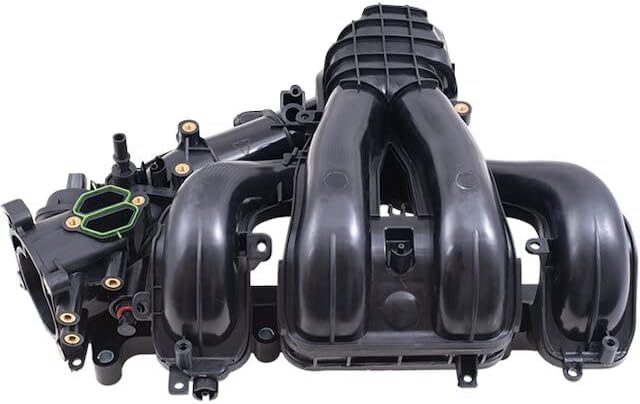
| Compatible Models | 2005–2007 Ford Focus 2.0L 4-Cyl |
|---|---|
| Includes | Intake manifold with gaskets |
| Engine Type | Naturally aspirated DOHC GAS 2.0L |
| Brand | Marketplace Auto Parts |
This intake manifold kit replaces the factory manifold on 2005–2007 Ford Focus 2.0L engines and ships with the required gaskets for a single-install replacement. It is typically used when the original manifold cracks, leaks vacuum, or the runner actuator fails; buyers can drop the old unit and install this to restore proper air routing and idle behavior. The kit includes the intake body and gaskets and appears to replicate the mounting points and ports so it bolts in without modification in most cases. Practical benefits include having all seals included, saving a separate gasket purchase, and generally restoring drivability and vacuum integrity. Some customers reported the intake runner actuator or valve arriving nonfunctional and a MAP sensor screw hole that needed a larger fastener, so expect minor fitment checks during installation and a possible small parts swap. When installed correctly this manifold returns normal idle and engine response for daily driving with minimal fuss.
Best for: Convenience-driven owners who want a single-purchase replacement to quickly restore a 2005–2007 Ford Focus 2.0L to reliable everyday use with minimal parts-sourcing hassle.
Less Ideal for: Users seeking exact factory parts validation for professional restorations or those unwilling to swap small components if an actuator or fastener is imperfect.
- Includes intake manifold and all gaskets for a one-stop replacement
- Made to fit 2005–2007 Ford Focus 2.0L applications for straightforward bolt-in installation
- Restores vacuum integrity and air routing to fix idle and drivability issues
- Generally lower cost alternative to factory replacement
- Some reports of the intake runner actuator/valve arriving nonfunctional
- Minor fitment issues noted such as a larger MAP sensor screw hole requiring a different fastener
Verdict: A convenient, all-in-one replacement manifold and gasket kit to get a 2005–2007 Ford Focus 2.0L back to normal operation quickly.
5. A-Premium Intake Manifold Assembly for Ford 2.0L L4 (Direct Replacement)

| Fitment | Ford EcoSport 2018-2020; Focus 2012-2018 |
|---|---|
| Engine compatibility | L4 2.0L DOHC |
| Material | Strong Plastic |
| Fitment type | Direct Replacement |
This A-Premium intake manifold is a direct replacement designed to restore proper air delivery for Ford 2.0L DOHC engines used in Focus and EcoSport models. It installs in place of the factory unit and is typically used when the original manifold is cracked, leaking, or causing rough idle and reduced fuel economy. The part is molded from reinforced plastic and features a smooth internal surface intended to promote steady airflow. Buyers report straightforward installation and improved drivability after fitment, with some noting better fuel economy and resolution of stalling or hesitation. The unit comes packaged as a complete assembly with sealing components and is marketed as a direct fit to common OEM reference numbers. Limitations to expect are typical of aftermarket plastic manifolds: final fitment can require minor adjustments and it may not match factory finish or long-term durability of higher-end metal replacements, so careful inspection at install is advised.
Best for: Risk-averse mainstream buyers who want a straightforward, factory-style replacement to restore drivability and avoid extended diagnostic downtime.
Less Ideal for: Drivers seeking a long-term high-performance upgrade or heavy-duty commercial use should consider higher-end metal or engineered performance manifolds instead.
- Direct-replacement fit for specified Ford 2.0L DOHC models, matching common OEM reference numbers.
- Smooth internal surface designed to improve airflow and reduce intake turbulence.
- Ships as a complete assembly with seals to simplify install and reduce sourcing extra parts.
- Reinforced plastic construction keeps weight down and resists corrosion compared with metal components.
- Made from plastic so long-term durability may be lower than premium metal manifolds.
- Some buyers reported minor fitment adjustments required during installation.
Verdict: A practical direct-replacement intake manifold that restores air delivery and drivability for Ford 2.0L DOHC Focus and EcoSport models.
Choosing the Right Ford Focus Intake Manifold: Key Factors to Consider
Fitment and Port Alignment
Correct fitment is the most immediate concern because the manifold must match the intake port geometry and mounting points on a Ford Focus engine. Poor alignment can cause uneven airflow, create stress on mounting bolts, and lead to gasket failure. Ensuring the manifold matches the engine's flange dimensions reduces the chance of vacuum leaks and simplifies installation.
Port shape and runner length also influence airflow behavior. While you do not need race-spec geometry for daily driving, a manifold that closely mirrors the engine's original port profile will maintain predictable throttle response and avoid introducing drivability issues.
Sealing Surface and Gasket Compatibility
The condition and design of sealing surfaces determine how well the manifold resists leaks. Look for manifolds with smooth, flat flange faces and accepted gasket interface designs. Gasket compatibility matters because replacement gaskets are a routine maintenance item; using a manifold that accepts common gasket types makes servicing easier.
Materials and surface finish affect sealing longevity. A robust sealing surface combined with proper torque sequencing minimizes the risk of intake manifold leak and prevents common symptoms like rough idle or vacuum-related diagnostic codes.
Material and Durability
Manifolds come in different materials, each with tradeoffs in weight, heat tolerance, and resistance to warping. Durable materials help the manifold withstand thermal cycling and chemical exposure from intake air and engine vapors. A manifold that resists cracking and distortion will hold torque longer and preserve sealing integrity over time.
Consider how the material choice impacts maintenance: more stable materials reduce the need for frequent gasket replacement and lower the likelihood of vacuum leak diagnosis visits. Durability also affects the long-term reliability of the intake-metering and idle systems connected to the manifold.
Ease of Installation and Serviceability
Installation complexity affects labor time and the chance of installation-related faults. Manifolds that align easily with bolt holes, accept standard torque settings, and allow access to sensors and vacuum lines make both initial installation and later maintenance simpler. Clear access to mounting points reduces the likelihood of cross-threading and incorrect torque application.
Serviceability also includes how straightforward it is to perform intake manifold cleaning or replace the intake manifold gasket. Designs that let you reach key ports and passages without removing unrelated components save time and reduce repair risk.
Sealing Under Pressure and Vacuum Performance
A manifold must maintain a seal under both intake vacuum and occasional boost or pressure fluctuations, depending on engine operation. Good vacuum sealing prevents performance-degrading air leaks and reduces diagnostic issues caused by unmetered air. The ability to hold vacuum directly affects idle quality, throttle response, and emissions-related sensors.
Evaluate how the manifold manages gasket compression and whether it maintains consistent torque on bolts during thermal cycles. A manifold that tolerates pressure changes will generally show fewer symptoms of intake manifold vacuum leak over its service life.
Compatibility With Maintenance Procedures
Think about routine tasks such as intake manifold cleaning, replacing the intake manifold gasket, or checking manifold torque specs. A design that accommodates easy access to passages and mounting hardware simplifies these jobs. Manifolds that require minimal disassembly of surrounding components reduce labor and the chance of introducing new issues during service.
Compatibility also means documentation and clear torque recommendations are available so you can follow proper procedures during installation and when diagnosing intake manifold symptoms.
How We Chose the Best Ford Focus Intake Manifold
We focused on intake manifolds that specifically fit the Ford Focus engine families and that offer reliable sealing and consistent airflow. Selection centered on four to six measurable attributes: correct OEM-equivalent fitment to intake ports and mounting points, gasket and flange sealing performance under typical engine conditions, material and construction quality to resist warping and vacuum leaks, and compatibility with common maintenance tasks such as gasket replacement and cleaning. We also considered manifolds that ease installation by matching intake manifold torque specs and bolt patterns, and those designed to reduce common symptoms like rough idle or check-engine lights related to vacuum loss. Exclusions included manifolds intended for racing-only applications, one-off custom fabrication, or units lacking compatibility documentation for Ford Focus models. The final list prioritizes practical reliability, predictable fitment, and reduced maintenance burden for everyday use.
Our full evaluation process is outlined in our review methodology.
FAQ
How do I know if my Ford Focus intake manifold has a leak?
Common signs include a rough or fluctuating idle, poor throttle response, and diagnostic trouble codes related to fuel trim or manifold absolute pressure. You may also notice hissing noises from the engine bay under load. Diagnosis usually involves a visual inspection, smoke testing, or a vacuum leak diagnosis to confirm whether the intake manifold is the source.
Can I replace the intake manifold gasket myself on a Ford Focus?
Replacing the intake manifold gasket can be a do-it-yourself job if you have basic mechanical skills, the right tools, and access to the specified torque specs. It usually requires removing ancillary components and cleaning sealing surfaces carefully. If you are unsure about torque procedures or port alignment, professional assistance can help avoid leaks and rework.
How important are torque specs when installing an intake manifold?
Adhering to the correct intake manifold torque specs is important because it ensures even clamping pressure across the gasket and sealing surfaces. Incorrect torque can lead to warping, gasket failure, or persistent vacuum leaks. Use a calibrated torque wrench and follow the recommended sequence to minimize installation problems.
Does intake manifold cleaning help with performance issues?
Cleaning carbon buildup and deposits from intake passages can restore airflow uniformity and improve idle quality and throttle response in many cases. It often helps with symptoms like hesitation or uneven idle, but cleaning will not fix underlying gasket or sealing failures. Consider cleaning as part of routine maintenance or when replacing the manifold gasket.
When should I consider a performance-oriented intake manifold?
A performance-oriented intake manifold may be appropriate if you are modifying the engine for higher airflow or power, but these often change torque requirements and may alter low-end drivability. For most daily-driven Ford Focus vehicles, prioritize correct fitment and sealing first. Performance upgrades should align with other supporting modifications and a clear objective for drivability or power gains.
Conclusion
Prioritize fitment, sealing quality, and material durability when choosing an intake manifold for a Ford Focus. These factors most directly impact vacuum integrity, idle stability, and long-term reliability. Balance ease of installation and serviceability against any performance goals. Addressing common failure points such as gasket sealing and correct torque application will reduce symptoms and maintenance frequency.
Explore More:
- Check out all Ford Focus parts & accessories
- Explore Intake Manifolds Maintenance & Repair Guides
- Explore Engine
- Browse all Auto Parts
