

Note: This article contains affiliate links. If you click on these links and make a purchase, I may earn a small commission at no extra cost to you. This helps support my research and content. Read my full affiliate disclosure here.
If you own a 2000-2004 Subaru Outback, a failing catalytic converter can affect performance, trigger the check engine light, and cause your vehicle to fail emissions testing. Choosing the right 2000-2004 Subaru Outback catalytic converter matters because fitment, emissions efficiency, and durability all influence whether the repair actually solves those problems without recurring issues.This guide presents the top shortlisted catalytic converters for the 2000-2004 Outback and explains the decision factors used to evaluate them, including fitment accuracy, emissions effectiveness, construction quality, and installation practicality. Read on to understand what to prioritize and how these criteria translate to real-world reliability and inspections.
Looking for other parts? See all Subaru Outback parts & accessories.
Top Picks at a Glance
| Best Quality Built to a higher standard if you want something more solid | Walker Ultra 54562 Direct-Fit Catalytic Converter |  |
| Best Value The sweet spot between price and what you get | pulcherflow Direct-Fit Catalytic Converter for 2000–2005 Subaru Outback 2.5L (EPA Compliant) |  |
| Best Budget The cheapest option that still gets the job done reliably | FortunaFlow Catalytic Converter Compatible with Subaru 2.5L (direct-fit) |  |
| Highest Rated A top-rated pick with lots of positive feedback | KAX Catalytic Converter for Subaru 2.5L (Front or Rear) |  |
| Most Popular A crowd favorite that many people choose with confidence | PHILTOP Direct-Fit Catalytic Converter Kit for Subaru 2.5L (1999–2005) EPA Compliant |  |
| Best Seller A high-volume bestseller chosen again and again | PTPDRH Catalytic Converter for Subaru 2.5L 1999–2006 (EPA Compliant) |  |
1. Walker Ultra 54562 Direct-Fit Catalytic Converter

| Manufacturer | Walker Exhaust |
|---|---|
| Item model number | 54562 |
| Compatibility years | 2000-2005 Subaru Outback/Legacy |
| EPA compliance | For OBDII (1996 and newer) vehicles |
The Walker Ultra 54562 is a direct-fit catalytic converter intended as a factory-style replacement for 2000–2005 Subaru Outback and Legacy applications listed by the manufacturer. It installs using OE-style hangers, flanges, brackets and heat shields so most shops can bolt it in without cutting or welding. Walker says the internal washcoat and precious metal loading are tuned to meet EPA emissions requirements for OBDII vehicles while restoring exhaust flow and emissions control. The aluminized heat shields and thicker flanges add durability and corrosion resistance compared with cheaper universal converters. Because it is built to be a direct replacement, the unit focuses on reliable emissions performance rather than increasing power; drivers seeking measurable horsepower gains should look at full exhaust upgrades instead. This part suits owners wanting a straightforward, legally compliant replacement that fits like the factory piece and minimizes installation time.
Best for: Buyers who need a reliable, factory-style replacement that restores emissions control and minimizes installation time on covered Subaru models.
Less Ideal for: Drivers focused on extracting extra horsepower or tuning the exhaust system for performance gains should consider aftermarket performance exhaust components instead.
- Direct-fit design with OE-style hangers and flanges for bolt-on installation
- Constructed to meet EPA standards for OBDII vehicles ensuring emissions compliance
- Aluminized heat shields and thicker flanges for improved durability and corrosion resistance
- Factory-style washcoat and precious metal load aimed at restoring proper emissions control
- Not designed to increase engine power or improve performance beyond factory levels
Verdict: Choose this Walker direct-fit converter when you want a straightforward, factory-style replacement that restores emissions compliance with minimal installation effort.
2. pulcherflow Direct-Fit Catalytic Converter for 2000–2005 Subaru Outback 2.5L (EPA Compliant)

| Vehicle Fitment | 2000-2005 Outback 2.5L (non-turbo) listed among compatible models |
|---|---|
| Compliance | EPA Compliant (federal) |
| Shell Material | Stainless steel |
| Manufacturer Part Number | SRCZ007 |
| Interchange Part Number | 1741037160 |
This pulcherflow catalytic converter is a direct-fit replacement for 2.5L Subaru models, designed to swap in using the vehicle’s existing mounting points and included gaskets and hardware. It uses a larger honeycomb substrate and increased precious metal loading to improve conversion efficiency and reduce tailpipe emissions, and the stainless steel shell with mandrel-bent tubing aims to resist corrosion and high temperatures for longer service life. Typical use is a factory-style replacement when an original unit fails or to restore emission control before inspection. Notable features include EPA certification for federal emissions models, pre-attached installation holes and hardware for quicker fitting, and a polished stainless exterior for durability. Limitations are that it is not legal for sale or use in certain states with stricter emissions rules and that fitment is limited to specific 2.5L non-turbo Subaru applications, so confirm vehicle compatibility before buying.
Best for: Buyers who want a straightforward, factory-style replacement to restore emissions performance and pass federal inspections while minimizing installation time and fuss.
Less Ideal for: Drivers in states with stricter emissions regulations or owners of turbocharged 2.5L models should look for a state-legal unit or a model that specifically lists turbo fitment.
- Direct-fit design with pre-attached mounting holes and hardware simplifies installation
- EPA compliant for federal emissions models and uses enlarged substrate for better conversion
- Stainless steel shell and mandrel-bent construction improve corrosion and heat resistance
- Not legal for sale or use in California, Colorado, New York, or Maine emissions-controlled vehicles
Verdict: Choose this direct-fit, EPA-compliant converter if you need a practical, durable factory-style replacement to restore emissions control on a 2.5L Subaru Outback.
3. FortunaFlow Catalytic Converter Compatible with Subaru 2.5L (direct-fit)

| Compatible vehicles | Subaru Baja 2003-2006, Forester 1999-2005, Impreza 2002-2005, Legacy 2000-2005, Outback 2000-2005 (2.5L models) |
|---|---|
| Manufacturer | FortunaFlow |
| Item model number | SB032.5 |
| Exterior | Metallic Finish |
This FortunaFlow catalytic converter is a direct-fit replacement intended for Subaru 2.5L models from the early 2000s and similarly configured vehicles. It replaces the factory unit with a preflanged assembly that includes gaskets and hardware to simplify installation, and the seller says the flange and bolt patterns match factory specifications to avoid modification. Constructed from stainless-steel with CNC MIG welding, the unit emphasizes durability and heat resistance so it can handle exhaust temperatures without deforming. The listing states it can clear P0420/P0430 codes and help the vehicle pass OBD-II readiness checks when the part and installation are appropriate. Important limitations are regional sale restrictions—this item cannot be shipped to certain states—and the listing does not provide full tube outlet dimensions up front, so verify fitment details before buying. For a budget replacement this offers a straightforward path back to emissions compliance, but expect variation in long-term longevity compared with higher-end branded converters.
Best for: Buyers looking for a lower-cost, drop-in replacement to restore emissions compliance on early 2000s Subaru 2.5L vehicles who prioritize getting a functional, ready-to-install unit over premium brand longevity.
Less Ideal for: Drivers in states with stricter emissions rules or buyers wanting a long-term premium catalytic solution should consider higher-end or state-compliant alternatives.
- Direct-fit flange and bolt pattern with included gaskets and hardware for easier installation
- Stainless-steel construction with CNC MIG welding for better heat and structural resistance
- Intended to resolve P0420/P0430 codes and restore OBD-II readiness when correctly matched and installed
- Cannot be shipped to or used in certain states due to local emissions regulations
- Listing lacks full outlet/tube dimensions in the main description, requiring verification for exact fitment
Verdict: A cost-minded direct-fit replacement that gets early 2000s Subaru 2.5L models back to emissions compliance with minimal installation hassle.
4. KAX Catalytic Converter for Subaru 2.5L (Front or Rear)
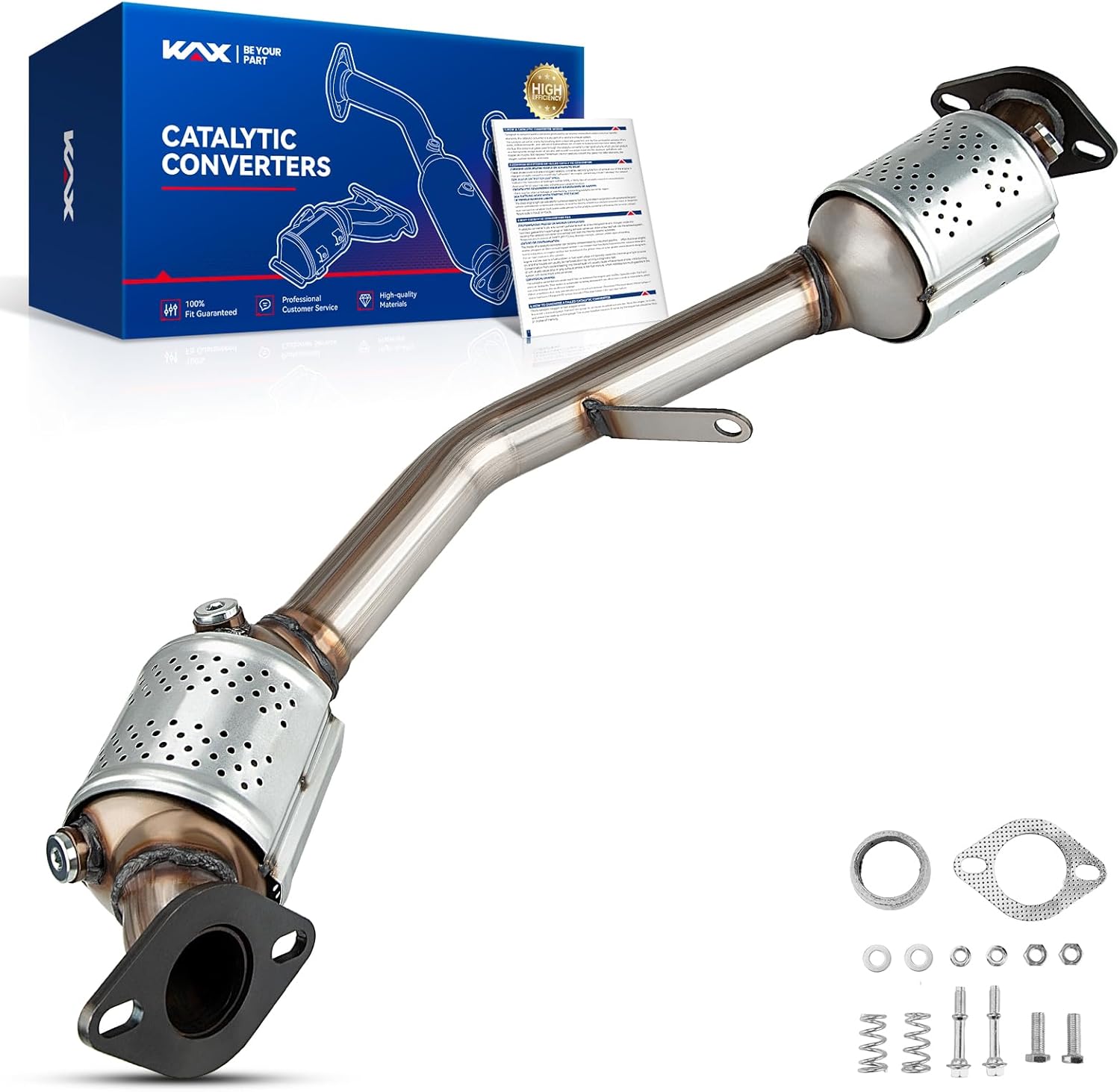
| Manufacturer | KAX |
|---|---|
| Position | Front, Rear |
| Compatible engines | 2.5L models (Subaru) |
This KAX catalytic converter is a direct-fit replacement designed for Subaru 2.5L models from roughly 1999–2006 and is offered as either a front or rear unit. It uses a high-flow honeycomb ceramic substrate with rare-earth CeO2 stabilization to increase conversion area and lower backpressure, which can help the engine breathe better and maintain emissions compliance on federal-standard vehicles. The listing says it includes OE-style gaskets and hardware for a bolt-on installation in about 3–4 hours, making it practical for a DIYer or independent shop. In use you can expect quieter operation if the old converter was failing and a modest improvement in throttle response compared with a clogged unit. Limitations include the federal-emissions designation only, so it is not for states with stricter rules, and fitment should be double-checked against your vehicle VIN since multiple Subaru submodels and positions are referenced. Overall it is a straightforward replacement option for restoring emissions control and drivability on older Subaru 2.5L cars when factory-quality fit is the priority.
Best for: Buyers who want a reliable, factory-quality replacement to restore emissions performance and reduce exhaust noise on an early-2000s Subaru 2.5L and prefer a straightforward bolt-on solution.
Less Ideal for: Do not choose this if your vehicle is registered in a state with stricter emissions rules or if you need a part certified for California or similar jurisdictions.
- Direct-fit design for Subaru 2.5L front or rear positions to simplify installation.
- High-flow honeycomb ceramic substrate aimed at improving conversion efficiency and reducing backpressure.
- Includes OE-style gaskets and hardware so no modification should be needed for proper mounting.
- Meets federal emissions only and is not legal for sale in some states with stricter regulations.
- Product covers multiple Subaru models and years so buyers must verify exact fitment by VIN before purchase.
Verdict: Choose this KAX unit when you need a dependable, direct-fit replacement to restore emissions control and drivability on an early-2000s Subaru 2.5L.
5. PHILTOP Direct-Fit Catalytic Converter Kit for Subaru 2.5L (1999–2005) EPA Compliant

| Compatible engines | Subaru 2.5L models 1999–2005 |
|---|---|
| Certification | EPA compliant (federal) |
| Material | Stainless steel |
| Includes | OE-style gaskets and mounting hardware |
This PHILTOP catalytic converter is a direct-replacement kit built for Subaru 2.5L applications from the 1999–2005 era and is intended to restore emissions control and exhaust flow without custom work. It uses a high-flow ceramic honeycomb substrate to lower backpressure and aims to recover engine responsiveness compared with a clogged or damaged original unit. The kit includes OE-style gaskets and mounting hardware so most owners and independent shops can complete the swap in a few hours without welding or cutting. The converter is described as stainless steel with welded seams for corrosion and heat resistance and is EPA compliant for federal emissions areas. Note this federal compliance means it is not legal for sale or installation in some states with stricter rules. Fitment is specific to the listed Subaru models, so confirm exact vehicle match before buying. For drivers replacing a noisy, clogged, or failed converter this provides a ready-to-install option that balances flow and emissions compliance, while those requiring California-compliant parts will need a different unit.
Best for: Buyers who want a ready-to-install replacement that restores emissions control and engine breathing on older Subaru 2.5L models and who prioritize a balance of emissions compliance and improved flow.
Less Ideal for: Do not choose this if you need a catalytic converter certified for states with unique emissions rules or if you require a custom-fit or performance-only aftermarket unit.
- Direct-fit kit with OE-style gaskets and hardware for bolt-on installation
- High-flow ceramic honeycomb substrate designed to reduce backpressure and help restore engine performance
- Stainless steel construction with welded seams for improved heat and corrosion resistance
- EPA-compliant federal model is not legal for sale or installation in certain states with stricter emissions rules
Verdict: A practical, direct-fit replacement that restores emissions function and improves exhaust flow for 2.5L Subaru owners who need a bolt-on, EPA-compliant converter.
6. PTPDRH Catalytic Converter for Subaru 2.5L 1999–2006 (EPA Compliant)

| Manufacturer | PTPDRH |
|---|---|
| Model | PTPDRH81698 |
| Exterior | Stainless Steel |
| EPA Certification | Compliant |
This PTPDRH catalytic converter is a direct-fit replacement engineered for Subaru 2.5L models from the early 2000s and is sold as an EPA-compliant unit for federal emissions programs. It installs as a drop-in replacement with no programming or calibration required, making it suitable for routine exhaust repairs or restoring emissions performance. The unit uses a three-way catalytic process and ceramic substrate housed in stainless steel to resist thermal stress and cracking, which should translate to predictable emissions control and decent longevity under normal driving. It is explicitly not CARB-approved, so it cannot be used where state-specific approvals are required. Fitment notes and OEM cross-reference numbers are provided, which helps confirm compatibility before purchase. For a buyer who wants a straightforward, factory-style replacement that meets federal emissions rules, this offers a practical and durable solution; buyers in states with stricter rules will need a CARB-compliant alternative.
Best for: A conservative buyer who wants a factory-style, legally compliant federal emissions replacement for a Subaru 2.5L from the 1999–2006 era and values straightforward installation and predictable performance.
Less Ideal for: Drivers in states that require CARB or other state-specific approvals or buyers who need a converter certified for those stricter regions.
- EPA-certified for compliance with U.S. federal emissions standards
- 100% direct-fit design intended for straightforward drop-in installation
- Stainless steel construction and ceramic substrate for improved thermal resistance
- Includes OEM cross-reference numbers to help verify fitment
- Not approved for use in California, Colorado, Maine, or New York where stricter state rules apply
Verdict: Choose this EPA-certified PTPDRH direct-fit unit when you need a reliable, factory-style catalytic converter replacement for Subaru 2.5L models outside CARB-restricted states.
Choosing the Right 2000-2004 Subaru Outback Catalytic Converter: Key Factors to Consider
Fitment and Pipe Configuration
Correct fitment is the single most important factor for the 2000-2004 Subaru Outback. The converter must match the factory flange types, pipe diameters, and mounting points so it can be bolted into place without cutting or custom adapters. Mismatched fitment increases installation time and expense and may introduce exhaust leaks that trigger a check engine light.
When assessing fitment, verify the inlet and outlet orientation relative to the vehicle frame, the number and spacing of bolt holes on the flanges, and any integral hangers or brackets. A converter that sits slightly off-angle can stress gaskets and exhaust joints, accelerating failure. For many owners, choosing a direct-fit unit reduces labor and ensures the unit meets the vehicle's backpressure characteristics.
Emissions Conversion Efficiency
Emissions efficiency determines how effectively the catalytic converter reduces hydrocarbons, carbon monoxide, and nitrogen oxides. For a 2000-2004 Subaru Outback, look for converter designs that specify catalyst substrate type and cell density, as these affect conversion rates. A properly matched catalyst helps resolve emissions-related check engine light codes and improves the likelihood of passing state inspections.
Higher cell density substrates usually provide better conversion but may increase exhaust backpressure if not properly sized. Balance conversion efficiency with the vehicle's engine characteristics to maintain drivability while meeting emissions targets.
Material and Construction Durability
Underbody components are exposed to road salt, moisture, and heat cycles, so material choice influences service life. Converters built with corrosion-resistant stainless steel housings and robust internal welds resist rust and cracking better than cheaper alternatives. Heat-resistant coatings and solid mounting flanges also help prevent premature failure.
Consider the quality of the internal honeycomb substrate protection and the integrity of weld seams. A well-constructed unit reduces the chance of rattling, cracking, or catalyst substrate breakage, all of which can cause emissions problems and additional repairs.
Installation and Maintenance Practicality
Some catalytic converters are designed for straightforward direct replacement, while others require additional hardware, gaskets, or cutting of the old pipe. For owners planning a DIY replacement on a 2000-2004 Outback, a unit that aligns with factory mounting points and uses standard gasket sizes significantly reduces complexity.
Consider also how accessible the converter location is under the Outback and whether heat shields or other components must be removed first. Units that include clear fitment notes and necessary fasteners minimize shop time and lower the risk of installation errors that could lead to exhaust leaks or check engine light recurrence.
Warranty and Longevity Expectations
A credible warranty signals manufacturer confidence and provides protection against early failures. Check warranty terms related to corrosion, substrate failure, and emissions performance. Longer coverage periods are valuable for owners who expect to keep the 2000-2004 Outback for multiple years.
Warranty claims often require proof of proper installation, so documented installation practices and receipts can be important. Consider how the warranty addresses road conditions typical for your area, such as exposure to salt or frequent short-trip driving that can affect converter life.
Compatibility With Emissions Equipment
The catalytic converter must work harmoniously with the Outback's oxygen sensors and exhaust backpressure characteristics. Some converters include provisions for upstream or downstream sensor ports in the correct locations; missing or poorly placed sensor ports can lead to inaccurate oxygen readings and persistent diagnostic trouble codes.
Confirm that sensor bung locations match the factory positions so the vehicle's engine management system receives accurate feedback. Proper sensor integration helps avoid false check engine light triggers and maintains fuel trim and performance.
Common Symptoms That Point to a Failing Converter
A failing catalytic converter on a 2000-2004 Subaru Outback often presents with several recognizable symptoms. The most common sign is a persistent check engine light, frequently accompanied by emissions-related fault codes. Other symptoms include reduced engine power, hesitation on acceleration, and unusual exhaust odors that suggest incomplete combustion.
Rattling noises from underneath the vehicle can indicate a broken catalyst substrate, while worsening fuel economy and failed emissions tests are additional indicators. Being aware of these symptoms can help you identify a converter issue early and choose the right replacement before collateral damage to sensors or the exhaust system occurs.
- Persistent check engine light with emissions codes
- Reduced acceleration or stalling
- Strong sulfur or rotten-egg exhaust odor
- Rattling from the converter area at idle or over bumps
- Poor fuel economy and failed emissions inspections
How Fitment Notes Affect Installation Time
Detailed fitment notes that confirm flange type, pipe diameter, and exact model-year coverage will shorten installation time. For the 2000-2004 Outback, direct-fit converters that replicate factory brackets and sensor ports typically install in a single afternoon at home or in a shop.
If a converter requires adapters or cutting, plan for additional labor and possible welding. Confirm whether the replacement includes necessary gaskets or new hardware. Preparing the right replacement parts beforehand reduces the risk of unexpected delays during installation.
- Direct-fit units reduce installation complexity
- Adapters or cutting add labor and potential leak points
- Verify included hardware and gasket requirements
Sensor Placement and Diagnostic Implications
Oxygen sensor placement relative to the converter determines how the engine control unit interprets exhaust composition. On the 2000-2004 Outback, a replacement that leaves sensor bung positions unchanged avoids false oxygen readings and persistent diagnostic trouble codes.
If a converter lacks the correct sensor ports, you may need to relocate sensors or use bung extensions, which can complicate diagnostics. Ensuring correct sensor placement helps maintain accurate fuel trim and reduces the chance of a recurring check engine light related to emissions performance.
- Match upstream and downstream sensor bung locations
- Incorrect sensor placement can produce persistent codes
- Proper placement maintains fuel trim and drivability
Preparing for a DIY Replacement
If you plan to replace the catalytic converter yourself on a 2000-2004 Outback, gather the correct gaskets, replacement bolts, and basic tools like penetrating oil, a torque wrench, and jack stands. Inspect adjacent components such as heat shields and hangers for corrosion before removing the old unit.
Take photos of the exhaust layout before disassembly to aid reassembly, and consider replacing rusted mounting hardware to prevent future leaks. Follow safe lifting practices and work on a cool exhaust system to avoid burns.
- Bring new gaskets and replacement fasteners
- Use penetrating oil on rusted bolts and let it soak
- Support the exhaust when removing mounts to avoid strain
Emissions Testing and Legal Considerations
State and local emissions requirements can affect which converter options are acceptable for the 2000-2004 Subaru Outback. Some regions require converters that meet specific emissions certifications or are CARB-compliant for the vehicle's model years. Make sure replacement choices meet your local inspection standards.
Retaining correct sensor locations and using the appropriate catalyst substrate helps ensure the vehicle will pass inspections. When in doubt, consult local emissions regulations before purchasing a replacement to avoid failing a required test after installation.
- Check local emissions certification requirements
- Correct sensor placement helps pass inspections
- Documentation of installation can be useful during testing
Still looking for the perfect fit?
Select your Subaru Outback configuration to see the most relevant Catalytic Converters recommendations
How We Chose the Best 2000-2004 Subaru Outback Catalytic Converter
We evaluated candidates based on criteria that matter specifically for 2000-2004 Subaru Outback owners. Key evaluation dimensions included fitment accuracy, emissions conversion efficiency, material and build quality, inlet/outlet configuration, and ease of installation for typical DIY or shop replacement.Fitment accuracy was treated as a gatekeeper requirement. Only converters with matching flange types and pipe diameters for the 2000-2004 Outback were considered. Emissions conversion efficiency was assessed via stated catalyst substrate type and cell density information; higher conversion potential helps address failed emissions tests and persistent check engine light codes.Build quality considerations focused on corrosion-resistant materials, welded construction, and robust heat shields to withstand undercarriage exposure. Installation practicality looked at weight, mounting point alignment, and whether adapters or additional gaskets are commonly required. We also considered warranty terms and documented durability reports.Excluded items included universal-fit units that require significant modification, components intended for other model years, and options with ambiguous fitment data. The result is a shortlist of six converters that meet fitment requirements and offer balanced emissions performance and longevity for the 2000-2004 Subaru Outback.
Our full evaluation process is outlined in our review methodology.
FAQ
What codes indicate a catalytic converter problem on my Outback?
Emissions-related OBD-II codes, especially those referencing catalyst efficiency or oxygen sensor readings, often point to converter issues. Codes that indicate low conversion efficiency or inconsistent upstream/downstream sensor comparisons are commonly associated with a failing converter.
Can I replace the catalytic converter myself on a 2000-2004 Outback?
Many owners can perform a direct-fit replacement with standard tools if the converter matches factory mounting points. Expect additional time and tools if bolts are rusted or cutting and welding are required. Follow safety precautions and ensure proper torque on exhaust fasteners.
Will replacing the converter clear the check engine light?
Replacing a faulty catalytic converter often resolves emissions-related trouble codes, but the light may not clear until the vehicle completes the required drive cycles or the code is reset with a scanner. If underlying sensor damage exists, additional repairs or sensor replacements may be necessary.
How long should a replacement converter last on this Outback?
Longevity depends on material quality, driving conditions, and exposure to corrosive environments. A well-built converter installed correctly can last many years, while units exposed to heavy road salt or frequent short trips may fail sooner. Warranty terms can provide a useful lifespan indication.
Do I need new gaskets and hardware when replacing the converter?
It is advisable to use new gaskets and replacement hardware to ensure leak-free joints. Rusted bolts and compressed gaskets are common causes of exhaust leaks after installation, so replacing these items reduces the risk of returning problems.
How does a bad catalytic converter affect fuel economy?
A failing converter can disrupt exhaust flow and oxygen sensor readings, which may lead to inefficient combustion and reduced fuel economy. Owners often notice a moderate drop in MPG when the converter is clogged or the substrate is damaged.
Final Verdict
For the 2000-2004 Subaru Outback, prioritize direct-fit converters that match factory flanges and sensor locations. Focus on units with documented catalyst efficiency, corrosion-resistant construction, and straightforward installation to minimize labor and reduce the chance of recurring emissions faults.Weigh tradeoffs between higher conversion performance and potential backpressure changes, and verify certifications required by local emissions inspections. Choosing a properly matched, well-built converter will restore drivability, clear emissions-related trouble codes, and increase the likelihood of passing inspections with minimal follow-up repairs.
Explore More:
- Check out all Subaru Outback parts & accessories
- Explore Catalytic Converters Maintenance & Repair Guides
- Explore Exhaust & Emissions
- Browse all Auto Parts
