

Note: This article contains affiliate links. If you click on these links and make a purchase, I may earn a small commission at no extra cost to you. This helps support my research and content. Read my full affiliate disclosure here.
Replacing a failing Honda Odyssey AC condenser can restore cabin comfort and protect the rest of your vehicle air conditioning system. You want a unit that cools efficiently, resists corrosion, and fits correctly so you avoid repeated repairs or refrigerant loss. This guide shortlists the top options for the Honda Odyssey and explains the practical factors we considered, including build durability, thermal performance, and installation fitment. Read on to see the selected top picks and what to watch for when choosing a replacement.
Looking for other parts? See all Honda Odyssey parts & accessories.
Top Picks at a Glance
| Best overall The best all-around choice for most situations | Spectra Premium A/C Condenser 7-3246 for 2005–2010 Honda Odyssey 3.5L |  |
| Best Quality Built to a higher standard if you want something more solid | TRQ A/C Condenser and Receiver Drier Assembly for 2005–2010 Honda Odyssey |  |
| Best Value The sweet spot between price and what you get | SCITOO A/C Condenser Compatible with 2005–2010 Honda Odyssey 3.5L |  |
| Best budget The cheapest option that still gets the job done reliably | CM Compressor A/C Condenser for Honda Odyssey (2005–2010) |  |
| Highest Rated A top-rated pick with lots of positive feedback | OCPTY Condenser Replacement for 2011–2017 Honda Odyssey 3.5L |  |
| Best Seller A high-volume bestseller chosen again and again | Orceed A/C Condenser Compatible with Honda Odyssey 2011–2017 (Model 3892) |  |
1. Spectra Premium A/C Condenser 7-3246 for 2005–2010 Honda Odyssey 3.5L

| Vehicle fit | 2005-2010 Honda Odyssey 3.5L |
|---|---|
| Model | 7-3246 |
| Manufacturer part number | 73246 |
| OEM part numbers | 80110SHJA01; 80110SHJ305; 80110SHJA02 |
This Spectra Premium condenser replaces the factory unit on 2005–2010 Honda Odyssey 3.5L vans and is intended for full A/C system repairs. It installs in the front of the vehicle where refrigerant gas is condensed to liquid, and it is used when the original condenser is damaged or leaking. Notable features include high-density fins for improved heat exchange, heavy-gauge mounting brackets to reduce vibration, and nitrogen leak testing prior to shipment to lower the chance of installation problems. In practical terms that means faster cooling recovery after a charge and a secure mounting that reduces rattle. Some buyers reported straightforward bolt-on installation while one did encounter a clogged core on arrival, so a quick pre-install inspection is prudent. The unit does not appear to include mounting bushings or extra hardware, so plan to reuse factory fittings or source small parts separately. For a balanced buyer seeking a factory-quality replacement that restores A/C performance, this condenser covers the essentials with few surprises.
Best for: Buyers who want a reliable, factory-style replacement to restore A/C performance on a 2005–2010 Honda Odyssey 3.5L while balancing quality and value.
Less Ideal for: Users looking for a plug-and-play kit that includes every mounting bushing and accessory or those unwilling to inspect parts before installation should consider alternatives or local parts sources.
- Designed as a direct factory-quality replacement for Honda Odyssey 2005–2010 3.5L for straightforward fitment
- High-density fins for improved heat exchange and quicker cooling recovery after system recharge
- Nitrogen leak-tested to reduce chance of shipping damage or immediate leaks at installation
- Heavy-gauge mounting brackets help limit movement and vibration once installed
- Does not include small mounting bushings or additional hardware that some installations require
- Occasional reports of occluded or damaged cores on arrival mean you should inspect the part before installation
Verdict: A practical factory-style condenser that restores A/C cooling for 2005–2010 Odyssey 3.5L with good cooling design but may require sourcing minor hardware separately.
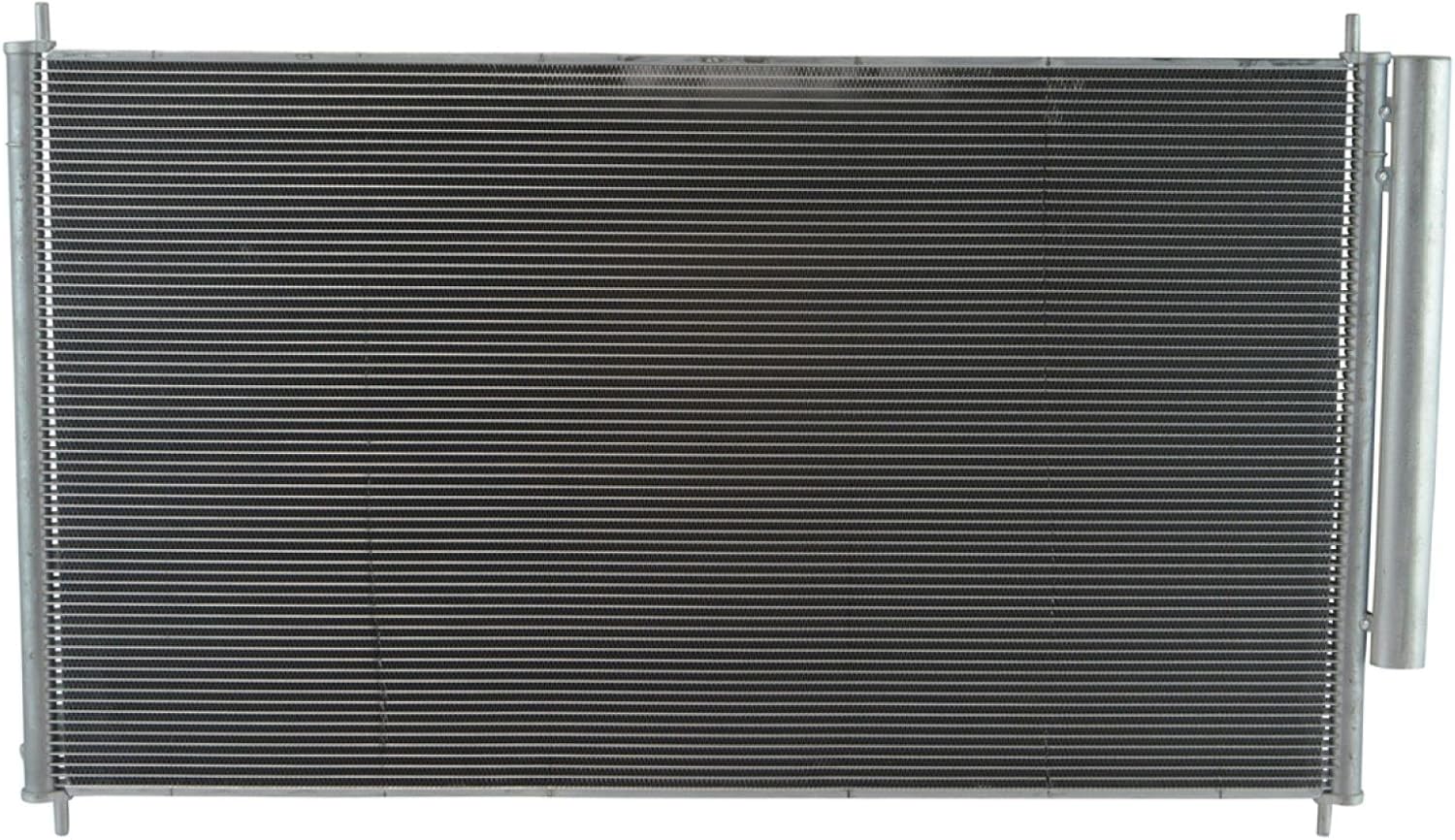
2. TRQ A/C Condenser and Receiver Drier Assembly for 2005–2010 Honda Odyssey
| Fitment | 2005-2010 Honda Odyssey |
|---|---|
| Core Material | Aluminum |
| Core Thickness | 0.63 in |
| Mounting Hardware Included | Yes |
This TRQ condenser comes pre-assembled with the receiver drier and mounting hardware to replace the factory unit on Honda Odyssey 2005–2010 models. It is intended for performance-oriented buyers who want a dependable, direct-fit replacement that restores cooling capacity without modification. The core is aluminum and specified core dimensions match common factory-style units, and the included receiver drier simplifies installation and system evacuation. Typical use is a full condenser replacement when the original is leaking, clogged, or damaged by debris. Practical benefits are straightforward fitment, reduced bench work thanks to the pre-assembled design, and compatibility with standard service procedures for recharge and leak testing. Limitations are that it is a vehicle-specific part so fit must be confirmed for the exact year and sub-model, and purchasers should still follow proper A/C evacuation and recharge steps; the listing does not replace professional diagnostic steps for compressor or orifice issues. Overall the unit targets owners looking to restore or improve A/C performance with a near-factory replacement that is service-ready.
Best for: Performance-oriented owners who prioritize restoring strong A/C cooling and want a factory-replacement style condenser that minimizes modification and installation time.
Less Ideal for: Buyers seeking a universal or multi-vehicle condenser solution or those who prefer a complete A/C service kit that includes refrigerant and professional installation.
- Pre-assembled condenser and receiver drier reduces installation steps and risk of contamination.
- Direct-fit design intended to match factory mounting points for 2005–2010 Honda Odyssey models.
- Aluminum core offers good thermal conductivity for efficient heat rejection.
- Mounting hardware included so fewer additional purchases are required.
- Fitment variations reported by some buyers; confirm orientation of inlet/outlet on your vehicle before installation.
- Does not include refrigerant or service; professional evacuation and recharge are still required.
Verdict: A near-factory direct-fit condenser assembly that simplifies replacement and restores A/C cooling performance on 2005–2010 Honda Odyssey models.
3. SCITOO A/C Condenser Compatible with 2005–2010 Honda Odyssey 3.5L

| Vehicle fitment | 2005–2010 Honda Odyssey 3.5L |
|---|---|
| Built-in receiver/dryer | Yes |
| Position | Front |
| OEM part reference | AC3246 |
This SCITOO condenser is a replacement unit intended for the 2005–2010 Honda Odyssey 3.5L and includes a built-in receiver/dryer for a more complete assembly. It is typically used to restore or improve the vehicle's air conditioning performance after a failed or leaking factory condenser. The unit is model-specific which simplifies installation for mechanically comfortable owners or technicians, and several buyers report it fits and cools effectively when properly aligned. Packaging and some fitment issues have been noted, including missing rubber supports in a few packages and occasional misalignment that can make mounting the bushings difficult. Build quality varies by batch; some customers found the finish and fittings to be comparable to or better than factory parts while others reported welding or alignment defects. For someone replacing a failed condenser who wants a lower-cost, complete condenser with receiver/dryer, this offers a reasonable value, but expect to check fitment carefully and be prepared to address minor alignment or missing hardware during installation.
Best for: A practical optimizer who wants a budget-friendly, model-specific condenser to get an older Odyssey's A/C working again without paying factory-brand prices; suitable for DIYers or independent shops comfortable verifying fit and addressing minor issues.
Less Ideal for: Buyers who want guaranteed perfect factory-fit parts with full premium quality control or a plug-and-play OEM experience should consider a factory-brand condenser instead.
- Made for 2005–2010 Honda Odyssey 3.5L so vehicle-specific fitment simplifies selection
- Includes built-in receiver/dryer so you get a more complete replacement assembly
- Multiple buyers report it restores A/C performance effectively
- Lower-cost alternative to factory-brand condensers for budget-conscious repairs
- Some units arrive with alignment or welding defects that complicate mounting
- Occasional missing rubber support pieces require sourcing hardware separately
- Quality control appears inconsistent between batches
Verdict: A cost-effective, model-specific condenser that restores A/C performance for 2005–2010 Honda Odyssey owners but requires careful fit verification due to variable quality control.
4. CM Compressor A/C Condenser for Honda Odyssey (2005–2010)

| Manufacturer | CM Compressor |
|---|---|
| Product Type | Auto A/C Condenser |
| OEM Part Number | 1020431, 1050431, 477-0618, 80110SHJA01, PC3246P, FCN31-3246P |
This CM Compressor condenser is a budget-focused replacement for 2005–2010 Honda Odyssey air conditioning systems. It functions as the heat exchanger that converts refrigerant from gas to liquid before it reaches the evaporator, restoring the vehicle's cooling performance. The unit is aluminum construction with claimed corrosion resistance and has been tested for leakage, vibration, and durability to reduce noise and increase service life. Installation is typical for a condenser swap and will usually require removal of front-end components and recharging the A/C system by a qualified technician. Practical advantages include factory-style fitment for the specified Odyssey years and a lightweight aluminum build that resists corrosion in humid climates. Limitations are typical of budget aftermarket parts: long-term durability and exact fitment tolerances can vary versus factory parts, and professional installation and system evacuation/recharge are required for safe, effective operation.
Best for: Budget-conscious buyers who need a straightforward, lower-cost condenser replacement to restore A/C cooling on a 2005–2010 Honda Odyssey and prioritize value over OEM provenance.
Less Ideal for: Buyers seeking the highest-end, long-term factory-quality replacement or those who want a plug-and-play swap without professional A/C service should consider other options.
- Designed to fit Honda Odyssey model years 2005–2010 for straightforward replacement
- Aluminum construction improves corrosion resistance compared with older materials
- Tested for leakage, vibration, and durability to help reduce noise and premature failure
- Restores core A/C function by converting refrigerant gas to liquid for cabin cooling
- Long-term durability and exact fitment may not match factory-quality parts
- Requires professional A/C evacuation and recharge after installation
Verdict: A budget-friendly condenser that restores A/C cooling for 2005–2010 Honda Odyssey owners who want value over exact factory-level longevity.
5. OCPTY Condenser Replacement for 2011–2017 Honda Odyssey 3.5L

| Fitment | 2011–2017 Honda Odyssey 3.5L |
|---|---|
| Material | Aluminum |
| OEM Part Number | 3892 |
This OCPTY condenser is an aftermarket replacement intended to restore A/C cooling on 2011–2017 Honda Odyssey 3.5L vehicles. It installs in place of the factory condenser and is built from aluminum with parallel flow construction, which helps deliver consistent refrigerant flow and heat rejection. Typical use is a dealer- or DIY-level condenser swap after a failure or during A/C system overhaul; the unit is presented as a direct-fit replacement for the listed Odyssey models and includes standard mounting points to match factory locations. Benefits include simplified fitment for the specified vehicle, corrosion-resistant aluminum construction, and a design aimed at restoring cooling performance to OEM-like levels. Limitations are that it is an aftermarket part so finish and exact fit can vary compared with factory parts, and installation may require A/C system evacuation, refrigerant recharge, and professional handling of fittings. Buyers should also confirm model-year fit before ordering to avoid mismatches.
Best for: Reliability-focused buyers who prioritize restoring factory cooling and reducing repeat repairs will appreciate a purpose-built, vehicle-specific condenser for the Odyssey.
Less Ideal for: Shoppers seeking an exact factory-branded part, those who want a bundled install package including refrigerant and fittings, or buyers unsure of model-year compatibility should consider alternatives.
- Made from aluminum with parallel flow design for effective heat rejection
- Sold as a direct-fit replacement for 2011–2017 Honda Odyssey 3.5L to simplify installation
- Corrosion-resistant construction improves long-term durability compared with untreated metals
- Aftermarket fit and finish can differ from factory parts which may require minor adjustment during install
- Does not include refrigerant service or installation hardware beyond the condenser itself
Verdict: A practical, vehicle-specific aftermarket condenser aimed at reliability-focused Odyssey owners who need to restore A/C cooling without replacing the entire system.
6. Orceed A/C Condenser Compatible with Honda Odyssey 2011–2017 (Model 3892)

| Compatible Vehicle | Honda Odyssey 2011-2017 |
|---|---|
| Replacement Part Number | 3892, 3892C, CN3892PFC, 7-3892, 40353 |
| Core Material | Aluminum |
| Includes | Receiver Drier |
This Orceed condenser is a factory-style replacement built for the Honda Odyssey 2011–2017. It replaces the original condenser and ships with a receiver drier, using an aluminum core and high-density multi-layered fins to improve cooling efficiency and heat dissipation. Installation is intended as a straightforward drop-in swap thanks to the OE-style fit and mounting points, which makes it suitable for DIYers and independent shops tackling a common A/C failure. In practice the condenser delivers cold air once installed and several user reports note good fitment and leak-free performance after months of service. Limitations to expect are occasional variation in finish and the package may not always include the bracket referenced in the listing, so verify included hardware before starting the job. Also some buyers reported surface paint or cosmetic signs that suggest the part may be refurbished, which does not affect function but is worth noting for buyers seeking factory-new appearance.
Best for: Risk-averse mainstream buyers who want a near-factory replacement for an Odyssey's A/C system and value straightforward fitment and proven cooling performance over aftermarket styling.
Less Ideal for: Buyers seeking pristine, brand-new cosmetic appearance or a condenser with included mounting bracket and hardware should consider alternatives or confirm package contents before purchase.
- Vehicle-specific fit for Honda Odyssey 2011–2017 for easier installation
- Aluminum core with multi-layered fins for improved cooling performance
- Includes receiver drier to simplify replacement of the A/C circuit
- OE-style design aims for precise fit and direct swap-in
- Bracket may be omitted from some shipments requiring separate purchase or fabrication
- Some units show a repainted or used appearance on arrival
Verdict: A practical, vehicle-specific condenser that restores A/C cooling with OEM-style fit and improved heat dissipation.
Choosing the Right Honda Odyssey AC Condenser: Key Factors to Consider
Thermal Transfer Efficiency
How quickly a condenser moves heat from refrigerant to the outside air affects cooling performance and compressor workload. Higher efficiency typically means faster cool-down times and steadier cabin temperatures during high ambient heat.
Efficiency depends on core design, fin density, and the quality of the tubing and brazing. When efficiency is higher, the system can maintain lower pressures and reduce strain on other AC components, which often extends overall system life.
Corrosion Resistance and Coating
Condensers are exposed to road salts, moisture, and debris that promote corrosion and eventual leaks. A durable protective coating or corrosion-resistant alloy helps prevent pitting and prolongs service life.
Buyers should consider the climate and driving environment. In areas with heavy road salt or coastal exposure, stronger corrosion protection is especially important to avoid premature failure and refrigerant loss.
Fitment and Mounting Accuracy
Correct AC condenser part fitment ensures the unit mounts securely, aligns with refrigerant lines, and mates properly with condenser fans and brackets. Poor fitment can lead to installation complications, stress on connections, and potential leaks.
Look for condensers with explicit vehicle application data and matching port types. Consistent fitment reduces installation time, avoids additional bracket fabrication, and helps preserve original airflow patterns through the condenser core.
Durability of Construction
Core construction quality, brazing methods, and header tank strength determine how well a condenser withstands vibration, thermal cycling, and minor impacts. Robust construction reduces the chance of hairline cracks and brazed-joint failures over time.
A well-built condenser also tolerates repeated pressure cycles during operation and service. Prioritizing durability helps reduce the likelihood of future AC condenser leak repair and the need for early replacement.
Serviceability and Installation Requirements
Consider how easy the condenser is to install and service, including access to ports, availability of replacement fittings, and whether the unit requires additional parts for a complete swap. Some installations may benefit from options that minimize extra line disassembly.
Also factor in whether standard shop tools and common service procedures like AC condenser flush and install are supported. Clear installation guidelines reduce labor time and the risk of contaminated refrigerant circulation after replacement.
Compatibility With System Maintenance
A replacement condenser should be compatible with typical maintenance tasks such as leak detection, pressure testing, and system evacuation. Ports and fittings that match OEM specifications simplify diagnostic work and reduce adapter usage.
Compatibility influences long-term upkeep costs and the ease of addressing AC condenser symptoms. When a condenser integrates smoothly with standard maintenance workflows, repairs and troubleshooting are usually faster and more reliable.
How We Chose the Best Honda Odyssey AC Condenser
We focused on attributes that directly affect real-world reliability and cooling for the Honda Odyssey. Key evaluation criteria included thermal transfer efficiency to measure how well condensers shed heat under load, corrosion resistance and coating to withstand road salt and moisture, and core construction quality such as tube-and-fin density and brazing integrity. We also prioritized proper mounting and port alignment to ensure straightforward AC condenser part fitment, compatibility with standard refrigerant line sizes, and overall build durability to reduce the chance of leaks.Products were excluded if they lacked clear fitment data for the Honda Odyssey, used ambiguous materials specifications, or had insufficient evidence of corrosion protection. We did not include units intended only for racing or extreme modification where OEM-style performance and fit are not maintained. The final list balances thermal performance, longevity, and installation practicality for typical ownership scenarios.
Our full evaluation process is outlined in our review methodology.
FAQ
What are common AC condenser symptoms that indicate replacement is needed?
Common signs include reduced cooling capacity, visible refrigerant oil or wetness around the condenser, and unusually warm air from the vents even when the compressor runs. You may also notice higher cabin temperatures during idling or a rise in compressor cycling frequency. These symptoms often point to restricted airflow, internal blockage, or a refrigerant leak.
Can I replace the condenser myself, or should I use a professional?
Replacing a condenser involves refrigerant handling, proper evacuation, and recharging, which usually requires certified equipment and knowledge. If you have mechanical experience and access to the right tools, you can perform the swap, but many owners prefer professional service to ensure leak-free connections and correct system evacuation. Safety and local regulations around refrigerant handling are important factors.
How do technicians detect a vehicle condenser leak?
Technicians often use UV dye with a UV light, electronic leak detectors, or pressurize the system with dry nitrogen to find bubbles at leak points. A thorough inspection also checks for visible corrosion, bent fins, and oil stains that indicate refrigerant escape. Multiple methods are used together for reliable vehicle condenser leak detection.
Is there a difference between a condenser and a radiator?
Yes. While both are heat exchangers mounted at the front of the vehicle, a condenser removes heat from refrigerant in the air conditioning system, and a radiator dissipates engine coolant heat. They have different internal designs and plumbing and require separate maintenance. The common typo condensor vs radiator can cause confusion, but their functions are distinct.
Will replacing the condenser fix an AC system that smells or makes noise?
Smells are often due to contaminants, mold, or a failing evaporator and may not be resolved by condenser replacement alone. Noise can stem from loose mounting, damaged fins, or other AC components such as the compressor or blower. Replacing a leaking or damaged condenser can address some issues, but a full diagnostic will identify other possible causes.
Does replacing the condenser require flushing the system?
Flushing is recommended when debris, oil contamination, or a compressor failure has occurred to prevent debris from circulating and damaging the new condenser. In many cases, a flush and install procedure reduces the risk of future failures, but the need depends on the condition of the existing system and the cause of failure.
Conclusion
When selecting a Honda Odyssey AC condenser, prioritize correct fitment, corrosion resistance, and thermal transfer efficiency. These factors most directly affect cooling performance, ease of installation, and long-term reliability.Balance durability against installation complexity and maintenance compatibility. Address any system contamination before installing a new condenser to protect the replacement and minimize the chance of repeat service.
Explore More:
- Check out all Honda Odyssey parts & accessories
- Explore AC Condensers Maintenance & Repair Guides
- Explore HVAC
- Browse all Auto Parts
