
Note: This article contains affiliate links. If you click on these links and make a purchase, I may earn a small commission at no extra cost to you. This helps support my research and content. Read my full affiliate disclosure here.
If your Civic EP3 is hesitating, idling roughly, or lacking throttle snap, the throttle body is a common source of those drivability problems. Choosing the right throttle body replacement can restore consistent idle control, improve throttle response, and reduce throttle position issues without other engine changes.This guide covers six vetted throttle bodies suitable for the Honda Civic EP3 and explains the key specs and features that matter for this chassis. We evaluated fitment, airflow precision, and build quality to produce a shortlist of reliable options. Read on to understand which attributes affect performance and drivability, and what to check before you install a new unit.
Looking for other parts? See all Honda Civic parts & accessories.
Top Picks at a Glance
| Best Overall The best all-around choice for most situations | GGMFLNCKX 70mm Throttle Body with TPS for K-Series (K20/K20A) |  |
| Best Quality Built to a higher standard if you want something more solid | Bull Boost Performance 90mm Billet Throttle Body for K-Series (Cable Throttle) |  |
| Best Value The sweet spot between price and what you get | ROADFAR 70mm Electric Throttle Body (309051050) |  |
| Best Budget The cheapest option that still gets the job done reliably | Bull Boost Performance Billet 70mm Throttle Body for K-Series |  |
| Highest Rated A top-rated pick with lots of positive feedback | AdlerSpeed 70mm Billet Throttle Body |  |
| Most Popular A crowd favorite that many people choose with confidence | Tektall 70mm Billet Throttle Body for K-Series K20/K24 |  |
1. GGMFLNCKX 70mm Throttle Body with TPS for K-Series (K20/K20A)

| Fitment | Acura RSX DC5; Honda Civic Si EP3 FG FA |
|---|---|
| Bore size | 70mm |
| Material | CNC 6061-T6 Aluminum |
| Includes | Throttle Position Sensor |
This bolt-on 70mm throttle body replaces the factory unit on K-series K20/K20A engines and includes a matched throttle position sensor for plug-and-play installation. Machined from 6061-T6 aluminum and anodized for durability, the larger bore increases airflow which can improve throttle response and support higher horsepower with supporting modifications. The included TPS keeps the factory sensor interface intact, so most installations only require basic hand tools and minor tuning adjustments on some ECUs. You get a performance-oriented upgrade without complex fabrication, and the CNC construction feels solid and precise. Expect more responsive throttle at mid to high RPMs, though idle stability can require ECU tuning depending on the rest of the intake and engine setup. This is best as part of a broader intake or tune package rather than a standalone power solution, and size makes it suited to K-series fitment only.
Best for: Buyers seeking a reliable, bolt-on airflow upgrade for a K-series Civic or RSX who prioritize a balance of drivability and modest performance gains and plan to pair it with basic supporting mods or tuning.
Less Ideal for: Drivers who want a purely stock replacement with no tuning or those seeking the highest possible power gains without additional intake, fueling, or engine modifications.
- 70mm CNC-machined 6061-T6 aluminum bore for increased airflow and precise fit
- Includes throttle position sensor for direct electrical compatibility with factory wiring
- Anodized surface finish improves corrosion resistance and durability
- Bolt-on design simplifies installation without major modifications
- Larger bore may require ECU tuning to maintain smooth idle and optimal fueling
Verdict: A durable, plug-and-play 70mm upgrade that gives K-series Civic and RSX owners better throttle response and airflow while keeping factory sensor compatibility.
2. Bull Boost Performance 90mm Billet Throttle Body for K-Series (Cable Throttle)

| Manufacturer | Bull Boost Performance |
|---|---|
| Model | SILVER 90MM |
| Exterior | Machined |
| Includes | 70mm to 90mm adapter plate |
This Bull Boost 90mm billet throttle body is a high-flow upgrade for K-series Honda engines that use a cable-operated throttle. It replaces a 70mm throttle opening using the supplied adapter plate and bolts to intake hardware after removing manifold studs. Built from CNC-machined aluminum with a silver anodized finish, it is aimed at high-horsepower street and track builds where improved airflow and crisper throttle response matter. Typical use is on naturally aspirated or forced-induction K20/K24 setups with compatible intake manifolds; installation requires some mechanical work and the vendor recommends professional fitting. The design supports increased top-end power and faster throttle transitions but requires verifying cable-throttle compatibility because it will not work on drive-by-wire K20 engines. Practical benefits include durable construction and a direct upgrade path from smaller throttle bores, while limitations are the need to remove intake studs and potential additional tuning to optimize performance after installation.
Best for: Drivers building high-performance K-series Civics who prioritize increased top-end power and sharper throttle response and who have a cable-operated throttle and compatible intake manifold.
Less Ideal for: Casual daily drivers wanting a simple bolt-on with no tuning or modification or anyone with a drive-by-wire K20 application should look elsewhere.
- Large 90mm bore increases airflow for high-horsepower K-series builds
- CNC-machined aluminum construction for durability and precise fit
- Includes 70mm-to-90mm adapter plate, gasket, and mounting bolts for a more complete upgrade
- Silver anodized finish resists corrosion and looks finished under the hood
- Not compatible with drive-by-wire (DBW) K20 applications so it only fits cable-throttle setups
- Installation requires removal of intake manifold studs and may need professional installation
Verdict: Choose this 90mm billet throttle body when you need a durable, high-flow upgrade to extract more power and sharper throttle response from a cable-throttle K-series Honda.
3. ROADFAR 70mm Electric Throttle Body (309051050)

| Applicable models | 1990-2001 Acura Integra; 1992-2000 Honda Civic; 1993-2001 Honda Prelude; 2000-2003 Honda S2000 |
|---|---|
| OEM reference numbers | 309051050, 309-05-1050, 309-051050 |
| Mounting Type | Flange Mount |
| Output Type | NPN |
This ROADFAR 70mm electric throttle body is a direct-replacement style unit offered for older Acura Integra, Honda Civic, Prelude, and S2000 models. It replaces the factory throttle assembly and uses upgraded sensors and a factory-quality motor to control the throttle flap electronically. In everyday use it aims to restore idle stability and throttle response or add a bit more top-end airflow on engines that can accept a larger bore. The unit ships with the throttle body assembly, gasket, sensors, and mounting hardware and includes a self-learning throttle calibration procedure. Practical benefits include reinforced aluminum construction that resists wear and reportedly improved acceleration and responsiveness after installation. Limitations to be aware of are fitment differences on some years and models where fast-idle control ports or intake plumbing differ, and occasional variability in out-of-box electronics that may require recalibration or replacement. Expect some vehicles to need intake tube or adapter changes if the larger diameter does not match the stock pipe.
Best for: Buyers who want a cost-effective replacement or modest performance upgrade for older Honda/Acura engines and are comfortable checking fitment and performing throttle relearn procedures.
Less Ideal for: Do not choose this if you need a guaranteed bolt-in for every year or a plug-and-play solution for heavily modified intake systems without planning for adapter pieces or custom plumbing.
- Designed to replace factory throttle bodies for the listed Acura and Honda models
- Reinforced aluminum housing intended to reduce wear compared with older units
- Includes sensors, gasket, and mounting hardware for a mostly complete install
- Upgraded sensors and factory-quality motor aim to improve throttle response and engine control
- May not bolt up to every year/model without modification due to differences like fast-idle valve mounting or larger bore size
- Some units have reported inconsistent electronics out of the box requiring recalibration or a second unit
Verdict: A budget-friendly replacement that can restore throttle response or add airflow for older Honda/Acura engines when fitment is confirmed and recalibration is acceptable.
4. Bull Boost Performance Billet 70mm Throttle Body for K-Series
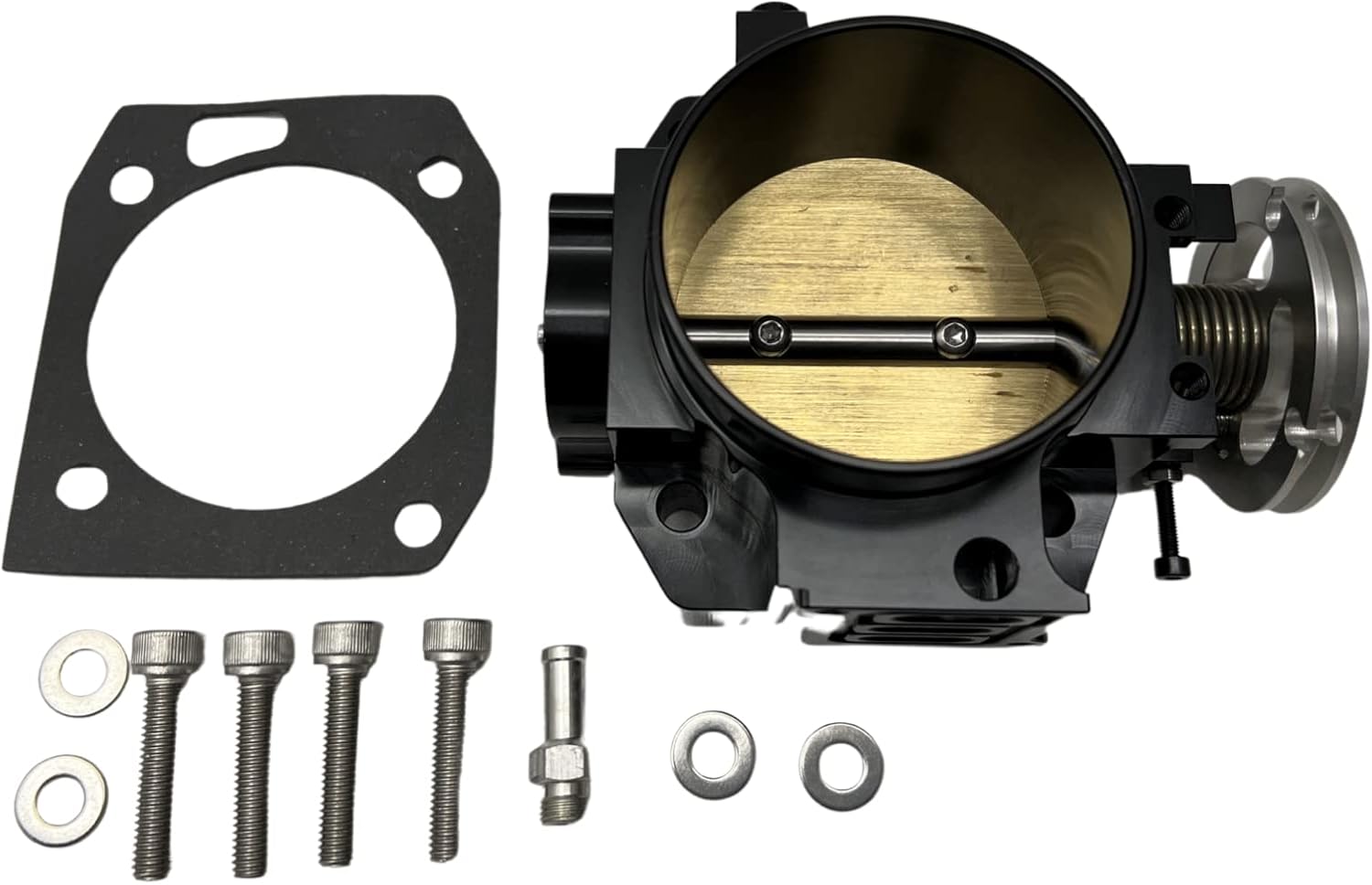
| Brand | Bull Boost Performance |
|---|---|
| Bore size | 70mm |
| Construction | CNC Aluminum |
| Fitment | K-series engines (e.g. K20 K24) |
This Bull Boost Performance billet 70mm throttle body is a straightforward replacement for K-series engines used on builds like the EP3 Civic. Machined from CNC aluminum, it is intended to increase intake airflow compared with many stock throttle bodies and bolts up to a standard intake manifold using the supplied gasket and hardware. Installation is typical for an intake component: remove the factory throttle body, transfer any sensors, and secure the unit with the included bolts. The 70mm bore helps support higher-flow needs on mildly to moderately modified engines and can make throttle response feel sharper when paired with supporting intake and tune. The part is painted for a finished look but keep in mind this is a single-piece throttle body, not a fully assembled plug-and-play OEM unit, so expect basic installation work and possible sensor swaps. It is a budget-oriented option that offers performance-minded airflow at a low entry cost but buyers seeking a fully integrated, brand-name calibrated unit may prefer higher-end alternatives.
Best for: Buyers looking for an inexpensive airflow upgrade for a K-series Civic EP3 who prioritize cost and improved midrange throttle response over a factory-style, fully integrated unit.
Less Ideal for: Drivers seeking a direct factory-quality replacement with complete plug-and-play sensor integration or those with heavily modified high-horsepower builds that need matched intake and tuning hardware.
- CNC aluminum construction for improved airflow and durability
- 70mm bore supports higher-flow builds and sharper throttle response
- Includes gasket and bolts for straightforward installation
- Painted finish provides a cleaner appearance under the hood
- Not a plug-and-play factory-quality assembly so sensor transfer or minor modification may be required
- Limited fitment scope to K-series engines only
Verdict: A budget-friendly billet 70mm throttle body that delivers noticeable airflow and throttle response improvements for K-series EP3 Civic builds.
5. AdlerSpeed 70mm Billet Throttle Body

| Material | 6061-T6 aluminum |
|---|---|
| Bore size | 70mm |
| Fitment | Honda/Acura B F H series engines |
| Finish | Mirror polished anodized |
This AdlerSpeed 70mm billet throttle body is a direct-fit replacement for Honda/Acura B, F and H series engines intended for use with aftermarket or factory intake manifolds. Constructed from 6061-T6 aluminum with a polished anodized finish, it accepts stock throttle cables and MAP sensors so installation is straightforward for someone swapping into an EP3 setup. The large 70mm bore is aimed at improving airflow on modified naturally aspirated builds and can also support added breathing needs on boosted applications. For a reliability-focused owner the billet construction and simple bolt-on fitment reduce failure points compared with complex adapters, but note larger bores can worsen low-rpm drivability if the rest of the intake and tuning are not matched. Expect a usable power response once paired with the correct intake and an ECU tune; this part is best as a component in a coordinated build rather than a standalone performance fix.
Best for: Buyers wanting a durable, factory-compatible throttle body for a Civic EP3 build who prioritize long-term dependability and straightforward installation over out-of-the-box street manners.
Less Ideal for: Drivers seeking a drop-in, stock-like driving feel without additional intake or ECU tuning should consider retaining the factory unit or choosing a smaller bore option.
- Billet 6061-T6 aluminum construction for strength and corrosion resistance
- Direct-fit design that uses stock throttle cable and MAP sensor for easier installation
- Large 70mm bore increases airflow for modified naturally aspirated or boosted setups
- Mirror-polished anodized finish resists corrosion and looks factory-quality
- 70mm bore may reduce low-end throttle response if intake and tuning are not upgraded
Verdict: Choose this billet 70mm throttle body if you want a strong, direct-fit unit that reliably increases airflow for a performance-focused EP3 build when combined with proper intake and tuning.
6. Tektall 70mm Billet Throttle Body for K-Series K20/K24

| Bore size | 70mm |
|---|---|
| Material | Alloy |
| Manufacture | CNC machined |
This Tektall 70mm billet throttle body is a direct-replacement style intake component aimed at K-series engines such as the RSX DC5 and Civic EP3. It replaces the factory throttle body with a CNC-machined alloy unit sized to increase airflow and comes with a gasket, dirt cleaner tool, and installation kit so you get everything needed for a straightforward swap. The dual bolt pattern covers PRB/PRC and RBC/RRC manifolds, and the idle air control valve can be plugged using the supplied 1/8 NPT plugs when not required. In practice this part is useful for builds needing a larger 70mm throat to help breathing at higher RPM or with moderate bolt-on modifications. It is ethanol resistant and finished for durability, but it does require using sensors from a 2002 RSX Type-S per the listing and may need sensor changes or minor wiring/adaptation during install. Fitment details are important to confirm before purchase since compatibility is limited to K-series applications.
Best for: Buyers who want a durable, higher-flow throttle body for a K-series Civic EP3 or RSX build and who prioritize parts with included hardware and clear fitment patterns.
Less Ideal for: Casual owners seeking a stock-replacement without any sensor or wiring changes; also not the best choice for someone who needs guaranteed bolt-on compatibility across multiple Honda models.
- CNC-machined alloy construction for strength and consistent finish
- 70mm bore increases airflow for higher-RPM performance
- Includes gasket, cleaner tool, and installation accessories for a complete kit
- Dual bolt pattern supports PRB/PRC and RBC/RRC manifold flanges
- Requires using specific sensors from a 2002 RSX Type-S which may need sourcing or wiring changes
- Not a plug-and-play swap for all K-series cars; verify exact fitment before buying
Verdict: Choose this Tektall 70mm billet throttle body when you need a complete, higher-flow K-series upgrade with durable CNC-machined construction and included installation hardware.
Choosing the Right Honda Civic EP3 Throttle Body: Key Factors to Consider
Fitment And Mounting Accuracy
Correct fitment is the first priority for the EP3 because the throttle body must align with the intake manifold, throttle cable or linkage geometry, and the ECU's expected sensor positions. Even small deviations in flange shape or bolt hole spacing can cause vacuum leaks or require adapter plates.
Mounting accuracy also affects throttle blade centering. A misaligned plate can cause inconsistent idle or rubbing that accelerates wear. Before buying, verify bolt pattern, gasket type, and whether the unit is designed for the EP3's intake manifold contour. If an adapter is needed, factor in the potential for added leak points and extra installation work.
Throttle Plate And Bore Dimensions
The internal bore diameter and throttle plate profile determine airflow at a given pedal position and influence throttle sensitivity. For the EP3, matching or modestly increasing bore size can improve response, but excessive oversizing may reduce low-end drivability and cause vacuum-based accessory issues.
Consistent bore roundness and a smooth plate edge reduce turbulence and allow the ECU to manage fuel and timing more predictably. Look for specifications showing true bore size and manufacturing tolerances. If the component offers a larger bore, check whether tuning or ECU adjustments are necessary to restore proper idle and transient fueling.
Throttle Position Sensor Compatibility
The throttle position sensor (TPS) provides the ECU with blade angle data used for fueling and idle control, so sensor compatibility is critical. The EP3's wiring and voltage ranges must match the replacement TPS to avoid inaccurate throttle angle readings that lead to surging or limp-home behavior.
Some aftermarket units include a pre-installed TPS, while others require transferring the factory sensor. Confirm connector type, signal range, and mechanical indexing so the ECU reads calibrated values. If calibration is required after installation, plan for the necessary adjustments or a scan-tool step to reset throttle learned values.
Idle Control And Return Mechanism
Stable idle on the EP3 depends on both the throttle plate close geometry and any integrated idle air control features. Units with smooth return springs and consistent shaft bearings reduce the chance of sticking and help prevent idle surge.
Evaluate how the unit handles return-to-closed position under varying temperatures and whether it maintains consistent idle without repeated throttle blipping. If the original idle air control system is integrated into the intake track, ensure the replacement does not block or misroute idle passages. Consider units that provide documented behavior for idle stability.
Build Quality And Materials
Materials affect thermal expansion, corrosion resistance, and long-term wear. Aluminum or die-cast housings are common and typically provide good heat dissipation and dimensional stability for EP3 service conditions. Plated or stainless shafts and quality bearings reduce play and preserve throttle centering over high mileage.
Check for machining quality around the bore and plate seat. Poorly finished bores can create hotspots for carbon buildup and cause uneven sealing. Fastener quality and included gaskets or O-rings should match OEM specifications to avoid premature leaks or failure.
Serviceability And Parts Availability
Consider how easy it will be to maintain the throttle body over time. Units that allow the TPS to be swapped without disassembly or that accept the factory sensor simplify repairs. Availability of replacement seals, bearings, or rebuild kits keeps the component serviceable without full replacement.
If you intend to clean the throttle body periodically, check whether the design permits safe access to the plate and bore without disturbing sensor alignment. Where rebuild kits are available, long-term ownership costs are typically lower and reliability can be extended with routine maintenance.
Signs The Throttle Body Needs Attention On An EP3
Several drivability clues point to throttle body issues on the Honda Civic EP3. Hesitation or stumbling during acceleration, a rough or fluctuating idle, and inconsistent throttle response when coming off idle are classic signals. You may also notice check-engine lamp codes related to throttle position or airflow.
Carbon or dirt buildup around the throttle plate can mechanically impede movement and create sticky response, while an electrical fault in the throttle position sensor will send incorrect signals to the ECU. Observing these symptoms under different conditions, such as when cold versus warm, helps narrow whether the problem is mechanical, electrical, or both.
- Rough or unstable idle
- Hesitation or lack of throttle response
- Check-engine codes for throttle position or airflow
- Physical carbon buildup visible on the throttle plate
Routine Maintenance Practices For Longevity
Regular inspection and cleaning prevent many common throttle body problems on the EP3. Cleaning focused on the bore and plate area removes deposits that cause sticking and poor sealing. When cleaning, use methods that do not disturb sensor alignment or damage seals.
Also inspect the throttle shaft for play and the return spring for consistent tension. Check gasket surfaces for flatness to prevent vacuum leaks after reinstallation. Periodic wiring inspections of the TPS connector can catch corrosion or looseness that would otherwise lead to intermittent electronic faults.
- Visual inspection every 12 months or 12,000 miles depending on use
- Gently clean plate and bore with appropriate cleaners and nonabrasive tools
- Inspect TPS connector for tight fit and corrosion
- Replace mounting gaskets if distorted or brittle
Installation Tips Specific To The EP3 Chassis
When replacing the throttle body on the Civic EP3, take care to follow correct torque sequences and use OEM-specified torque values on mounting bolts to avoid warping the flange. Confirm the throttle cable or linkage routing is free of binding and that the throttle returns smoothly through its full arc before reconnecting the ECU.
After installation, perform throttle relearn or idle adaptation procedures recommended for the EP3 so the ECU can recalibrate throttle angle and idle control. Verify there are no vacuum leaks at the intake interface and that the TPS is indexed and secured to prevent drift. A final road test under varied loads will reveal any residual issues.
- Use correct bolt torque and torque sequence
- Verify cable/linkage routing and free movement
- Perform ECU throttle relearn or idle adaptation
- Check for vacuum leaks at mounting surfaces
When To Consider Rebuilding Versus Replacing
A rebuild is often viable if the throttle housing is undamaged and the issues stem from worn bearings, a sticking shaft, or degraded seals. Rebuild kits for the EP3-compatible units typically include new bearings, seals, and sometimes a replacement spring. Rebuilding preserves the original sensor alignment and housing fit, which can simplify reinstallation and calibration.
Replace the whole unit if the housing or bore is scored, if the mounting flange is distorted, or if the TPS is integrated and nonserviceable. Also consider replacement when aftermarket units offer improved airflow characteristics specifically matched to the EP3 engine and intake geometry that are not achievable by mere rebuilds.
- Rebuild when housing and flange are intact
- Replace if bore or flange is damaged
- Rebuild kits often include bearings and seals
- Integrated nonserviceable TPS favors replacement
Impact Of Throttle Upgrades On Fueling And Emissions
Increasing throttle bore or changing plate geometry alters the airflow characteristics the ECU sees at given pedal angles. On the EP3, this can change transient fueling demands and affect closed-loop idle control. While moderate changes may improve responsiveness, larger alterations could necessitate fueling adjustments to avoid lean or rich conditions under certain loads.
Be mindful of emissions systems that rely on stable idle and accurate airflow signals. Any change that affects idle stability or creates inconsistent TPS readings can trigger emission-related fault codes. If you plan an upgrade, consider whether the vehicle will need tuning or ECU adaptation to maintain compliant fueling behavior.
- Moderate bore increases can improve throttle response
- Larger changes may require fueling adjustments
- Unstable TPS readings can trigger emissions faults
- Plan for ECU adaptation after major changes
Still looking for the perfect fit?
Select your Honda Civic configuration to see the most relevant Throttle Bodies recommendations
How We Chose the Best Honda Civic EP3 Throttle Body
We focused on components that match the mechanical and electronic requirements of the Honda Civic EP3 chassis and prioritized units that deliver reliable throttle response and long service life. Selection criteria included precise bore dimensions and throttle plate tolerance to ensure consistent airflow characteristics for the EP3 engine. We also assessed sensor compatibility, including correct throttle position sensor alignment and connector patterns, to avoid electrical recalibration or fitment issues.Durability factors such as housing material and bearing quality were considered because they influence return-to-idle behavior and long-term wear. We checked for proper idle control porting and smooth butterfly action to reduce stiction and idle surge. Mounting flange conformity and gasket fit were verified to prevent vacuum leaks. Units that required extensive modification, lacked clear compatibility with the EP3 wiring, or showed poor manufacturing tolerances were excluded. Our shortlist reflects components that balance factory-like control with improved airflow where applicable.
Our full evaluation process is outlined in our review methodology.
FAQ
What are the common throttle body symptoms on a Civic EP3?
Common symptoms include rough or fluctuating idle, hesitation on acceleration, and check-engine codes related to throttle position or airflow. Mechanical sticking from carbon buildup and electrical faults in the TPS are frequent causes.
Can I clean the EP3 throttle body myself?
Yes, you can clean it yourself if you follow safe procedures: disconnect the battery, avoid damaging the TPS, use a nonabrasive throttle body cleaner, and do not force the plate. If the TPS must be removed, note its mechanical indexing to preserve calibration.
How do I know if the TPS is failing or the plate is sticking?
If the problem is electrical, you may see erratic voltage readings or ECU codes without significant physical deposits. Mechanical sticking usually presents as visible carbon buildup, a sticky or delayed return, and symptoms that vary with temperature. Diagnosing with a multimeter and visual inspection helps separate the two.
Does replacing the throttle body require ECU recalibration on the EP3?
Often the ECU will relearn throttle position over time, but some installations benefit from a formal throttle relearn or idle adaptation routine to restore precise idle and throttle response. If the replacement uses a different TPS or requires mechanical indexing, a relearn is recommended.
How often should I inspect or service the throttle body on this model?
Inspect the throttle plate and bore annually or around 12,000 miles depending on driving conditions. More frequent checks are wise for vehicles in dusty or stop-and-go environments where deposits build faster.
Are rebuild kits a good option for the Civic EP3 throttle body?
Rebuild kits are a practical option when the housing and flange are in good condition. Kits that include new bearings, seals, and springs can restore smooth operation and extend service life while maintaining original sensor alignment.
Final Verdict
When choosing a throttle body for the Honda Civic EP3, prioritize correct fitment, TPS compatibility, and the internal bore and plate quality because these factors most directly affect idle stability and throttle feel. Balanced upgrades can sharpen response without sacrificing low-speed drivability, but major bore changes may require fueling adjustments or ECU relearn procedures. Consider rebuild kits when the housing is sound and replacement when the flange or TPS is nonserviceable. By focusing on fit, sensor match, and build quality, you can restore reliable idle behavior and confident throttle response on the EP3.
Explore More:
- Check out all Honda Civic parts & accessories
- Explore Throttle Bodies Maintenance & Repair Guides
- Explore Engine
- Browse all Auto Parts
