

Note: This article contains affiliate links. If you click on these links and make a purchase, I may earn a small commission at no extra cost to you. This helps support my research and content. Read my full affiliate disclosure here.
Maintaining the right coolant in a 2007-2011 Honda CR-V keeps engine temperatures stable, prevents corrosion, and helps avoid overheating-related repairs. For CR-V owners the correct coolant chemistry and service life matter as much as freeze and boil protection. This guide covers the top shortlisted coolant options that match the 2007-2011 CR-V coolant requirements and service intervals.We evaluated candidates for compatibility with Honda cooling systems, corrosion inhibitors, and expected service life to highlight options suited for routine maintenance or a full coolant refresh. Read on to see which formulations meet the common needs of CR-V owners and which properties to consider when selecting coolant for your vehicle.
Looking for other parts? See all Honda CR-V parts & accessories.
Top Picks at a Glance
| Best Overall Coolant The best all-around coolant balancing protection, convenience, and value | Honda Type 2 Extended Life Antifreeze/Coolant 50/50 Pre-Diluted, 1 Gallon |  |
| Best Budget Coolant A low-cost, reliable formula that meets basic cooling needs | Prestone MAX Asian Green 50/50 Antifreeze Coolant (Pre-mixed) |  |
| Best Long-Life Coolant Formulated for extended service intervals and longer inhibitor life | Zerex Asian Vehicle Green 50/50 Ready-to-Use Antifreeze/Coolant, 1 Gallon |  |
| Best Concentrated Coolant Undiluted concentrate you mix to the desired freeze/boil protection | PEAK Global Lifetime Concentrate Antifreeze and Coolant (1 gal) |  |
| Best Pre-Mixed Coolant Ready-to-use formula that eliminates mixing and ensures correct dilution | Zerex Asian Vehicle Blue 50/50 Prediluted Antifreeze/Coolant, 1 Gallon |  |
| Best High-Performance Coolant Higher-spec formula for heavy duty, high-heat, or performance engines | PEAK Titanium 50/50 Prediluted Antifreeze & Coolant, 1 gal |  |
| Best Corrosion-Resistant Coolant Focused on maximum protection for radiators, aluminum, and alloys | Valvoline Zerex G48 Concentrate Antifreeze/Coolant 1 gal |  |
1. Honda Type 2 Extended Life Antifreeze/Coolant 50/50 Pre-Diluted, 1 Gallon
Best Overall Coolant

| Brand | Honda |
|---|---|
| Model | Type 2 Antifreeze/Coolant |
| Pre-mixed | 50/50 ready to use |
| Service interval | Up to 5 years or 60,000 miles |
| Base | Ethylene glycol |
This Honda Type 2 extended-life coolant is a factory-quality, ready-to-use 50/50 formula that matches the long-life blue coolant originally filled in many Honda vehicles. It is typically used when flushing and refilling the cooling system or topping off during service and requires no dilution, which reduces mixing errors. The ethylene glycol base and manufacturer-formulated corrosion inhibitors are designed to protect both metal and non-metal components and to provide freeze and boil-over protection across seasonal extremes. Honda specifies long service intervals—up to five years or roughly 60,000 miles—so it is convenient for owners who prefer less frequent coolant changes. A bittering agent is included for safety. The main limitations are that this is a vehicle-specific factory coolant intended for Honda systems requiring Type 2 formulation and the price is higher than many aftermarket alternatives, so cost-conscious buyers may prefer generic coolants that meet comparable specifications.
Best for: Buyers who want a ready-to-use, factory-matching coolant that minimizes maintenance frequency and ensures compatibility with Honda cooling systems for routine service on a 2007–2011 Honda CR-V.
Less Ideal for: Shoppers strictly prioritizing low purchase cost or those who need a universal coolant for multiple vehicle makes should consider lower-cost aftermarket options designed for broader vehicle coverage.
- Factory-approved pre-mixed 50/50 formula eliminates dilution mistakes
- Long-life corrosion inhibitors designed for both metal and non-metal cooling system parts
- Ready-to-use gallon size covers most coolant changes for compact SUVs
- Manufacturer specifies long service interval up to 5 years or 60,000 miles
- Higher cost compared with many aftermarket universal coolants
Verdict: The best all-around coolant for most buyers, offering balanced freeze/boil protection, corrosion inhibitors, and easy mixing or pre-fill convenience.
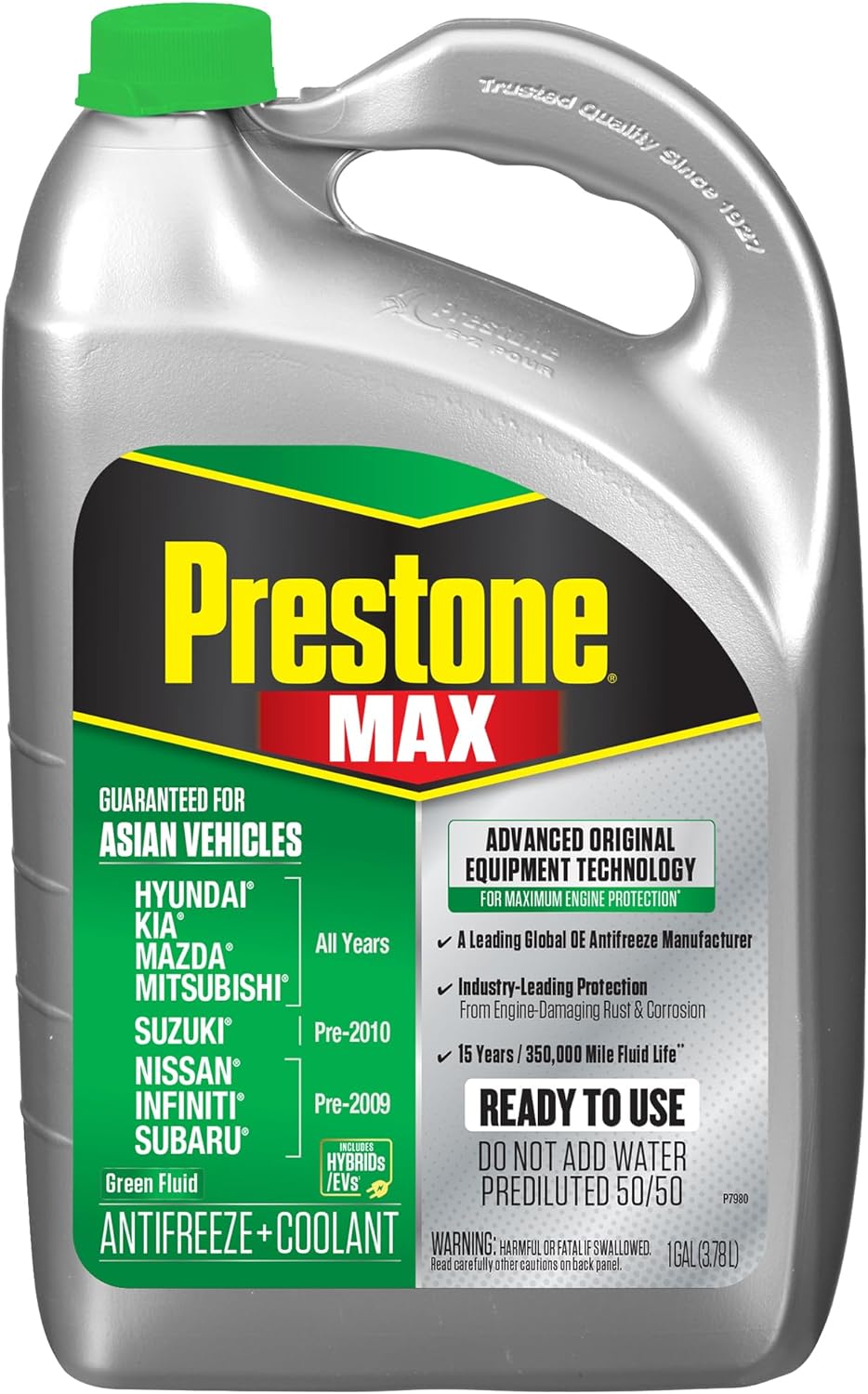
2. Prestone MAX Asian Green 50/50 Antifreeze Coolant (Pre-mixed)
Best Budget Coolant
| Brand | Prestone |
|---|---|
| Model | AF6610/F |
| Mixture | 50/50 pre-mixed |
| Type | Asian green antifreeze/coolant |
This pre-mixed Prestone MAX Asian Green 50/50 coolant is designed to replace factory-spec green coolants used by many Asian vehicles. Sold ready to use, it removes the need to mix with water and is convenient for routine top-offs and full drain-and-refill jobs. The formula advertises temperature protection for both cold and hot conditions and includes corrosion inhibitors to help extend the life of the cooling system. Practical benefits are straightforward: easy, no-fuss installation, consistent concentration for correct freeze and boil protection, and compatibility with vehicles that require green Asian-style coolant. It does not claim extended long-life intervals or specialty additives found in some OEM long-life formulas, so you should plan on following your vehicle maker's recommended service interval rather than expecting multi-year protection. Overall it is a cost-conscious, ready-to-use option for routine maintenance on compatible Asian cars and SUVs within the specified model scope.
Best for: Buyers looking for an inexpensive, ready-to-use coolant that matches green Asian-style factory chemistry and simplifies routine maintenance on the 2007–2011 CR-V.
Less Ideal for: Drivers who want extended service intervals, specialty performance additives, or a coolant specified explicitly by Honda should consider Honda-specified or long-life alternatives.
- Pre-mixed 50/50 concentration requires no measuring or distilled water
- Formulated for Asian green coolant specs so it matches factory-style systems
- Contains corrosion inhibitors to protect cooling system metals
- Bitterant added to discourage accidental ingestion
- Not advertised as a long-life or extended-interval formula compared with specialty coolants
Verdict: The best low-cost coolant that still delivers adequate freeze/boil protection and corrosion control for routine maintenance without extra additives or premium claims.
3. Zerex Asian Vehicle Green 50/50 Ready-to-Use Antifreeze/Coolant, 1 Gallon
Best Long-Life Coolant

| Brand | Zerex |
|---|---|
| Model | Asian Vehicle Green |
| Mix | 50/50 ready-to-use |
| Technology | Hybrid Organic Acid Technology (HOAT) |
Zerex Asian Vehicle Green is a ready-to-use 50/50 antifreeze made with Hybrid Organic Acid Technology and a phosphate additive to protect aluminum and other cooling system metals. It is sold as a one-gallon premix for topping off or full system fills and is marketed to match manufacturer specifications for many Asian cars and small trucks. In practice the formula resists corrosion, scale and rust while protecting water pumps, radiators and hoses, and it is free of silicates and borates that some Asian manufacturers avoid. The premixed format simplifies installation but means you cannot concentrate the product when a stronger mix is needed after a partial flush. Buyers who want long drain intervals will appreciate the HOAT inhibitor package and the brand pedigree, though those needing a concentrate for precise mixing during system flushes should look elsewhere. Expect reliable freeze and boil protection and manufacturer-grade corrosion inhibitors appropriate for routine maintenance and extended drain schedules.
Best for: Drivers who prioritize long service intervals and corrosion-resistant inhibitor chemistry and want a ready-to-use coolant matched to Asian vehicle specifications.
Less Ideal for: Technicians or DIYers who need a concentrated concentrate to fine-tune mix ratios after a partial flush or for custom cooling system setups should consider a concentrated product instead.
- Factory-approved HOAT formula tuned for Asian vehicle coolant specs
- Pre-mixed 50/50 ready-to-use solution that removes mixing guesswork
- Phosphate additive and no silicates or borates to protect aluminum and reduce corrosion
- Designed to protect against freezing and boiling across a wide temperature range
- Sold only as a premixed 50/50 solution so you cannot add concentrated coolant to compensate for residual water after a flush
Verdict: The best long-life coolant for owners who prefer extended drain intervals and robust inhibitor packages that resist breakdown over many miles.
4. PEAK Global Lifetime Concentrate Antifreeze and Coolant (1 gal)
Best Concentrated Coolant

| Formulation | Ethylene glycol concentrate |
|---|---|
| Corrosion inhibitor | Phosphate-enhanced Organic Acid Technology (POAT) |
| Compatibility | All American, Asian, and European vehicles (when mixed) |
| Available as | Concentrate and 50/50 prediluted |
PEAK Global Lifetime Concentrate is a one-gallon concentrated coolant you dilute to the strength you need, which makes it useful when you want precise freeze and boil protection or to save space when buying and shipping fluid. It uses a phosphate-enhanced organic acid technology to protect aluminum and other cooling-system metals from rust and corrosion and is free of silicate, borate, nitrite, and amines. The amber concentrate is safe for topping off and is marketed for compatibility with American, Asian, and European vehicles when mixed per instructions. In practice this product is convenient for DIY maintenance and for technicians who mix custom 50/50 or alternative ratios for seasonal needs, but it does require correct dilution before use and a proper system flush for long-term protection. It is not vehicle-specific, so if a manufacturer recommends a particular factory-quality formula, you should confirm compatibility for the 2007–2011 Honda CR-V before replacing a vehicle-specific coolant. The concentrate format reduces packaging waste and simplifies storing extra fluid for future top-offs or full fills.
Best for: Buyers who want control over coolant concentration and seasonal protection levels, or who prefer to buy a single concentrated jug to mix on demand for service and top-offs.
Less Ideal for: People who need a vehicle-specific factory-replacement coolant or prefer pre-diluted ready-to-use fluid should consider alternatives tailored to that specification.
- Concentrate lets you mix to exact freeze/boil targets and save storage space
- Formulated with POAT inhibitors for long-lasting corrosion protection on aluminum and other metals
- Compatible for topping off without changing existing coolant color, simplifying repairs
- Free of silicates, borates, nitrites, and amines which reduces abrasive additives
- Requires proper dilution and a full flush for guaranteed long-term protection
Verdict: The best concentrated coolant for buyers who want to control coolant strength, save on shipping volume, or meet specific freeze/boil target ratios.
5. Zerex Asian Vehicle Blue 50/50 Prediluted Antifreeze/Coolant, 1 Gallon
Best Pre-Mixed Coolant

| Brand | Zerex |
|---|---|
| Model | Asian Vehicle Blue |
| Formulation | 50/50 prediluted HOAT |
| Quantity | 1 gallon |
| Silicate/Borate | Free |
Zerex Asian Vehicle Blue comes premixed at 50/50 so you can pour it straight into the cooling system without measuring or diluting. It uses a phosphate-modified HOAT chemistry that is silicate and borate free and is aimed at Asian vehicles that call for a blue formula. In practical use this means reliable freeze and boil protection plus corrosion control for aluminum radiators, water pumps and other cooling system metals. The 1 gallon container is convenient for a single full flush or several top-offs, and the premixed form reduces the chance of incorrect concentration compared with concentrate bottles. Important limitations are that this formula is tailored to Asian OEM specifications, so it is not a universal coolant for every vehicle, and if your service manual calls for a different chemistry you should follow the manual. Also, because it is premixed you cannot adjust the concentration yourself for extreme climates. For drivers who want a clean, ready-to-pour replacement that matches factory-style blue HOAT specifications, Zerex is a practical choice.
Best for: Drivers who prioritize convenience and consistent, factory-style cooling performance and want a ready-to-pour coolant that matches Asian manufacturer blue HOAT specifications.
Less Ideal for: Drivers who need a coolant formulated for non-Asian specifications or who want to mix concentrate to tune freeze/boil protection for extreme climates.
- Ready-to-use 50/50 premix eliminates measuring and dilution errors
- Formulated with phosphate HOAT chemistry for long-life corrosion protection
- Silicate-free and borate-free to match Asian vehicle coolant recommendations
- 1 gallon size suits a full system flush or multiple top-offs
- Not suitable if your vehicle requires a different coolant chemistry or color
Verdict: The best pre-mixed coolant for drivers who prefer the convenience of a ready-to-pour solution with consistent performance and no measuring required.
6. PEAK Titanium 50/50 Prediluted Antifreeze & Coolant, 1 gal
Best High-Performance Coolant

| Formulation | 50/50 prediluted |
|---|---|
| Volume | 1 gal |
| Compatibility | Compatible with all coolant colors and technologies |
| Standards | Meets ASTM D6210, D3306 and D4985 |
PEAK Titanium 50/50 comes ready to use and is designed to protect and cool engine systems for many years without mixing. It is typically used to top off or refill the cooling system and is compatible with a wide range of existing coolants, which makes swaps and top-ups simple. Notable features include a prediluted 50/50 formula for immediate use, proprietary chemistry claimed to clean component surfaces and reduce heat-insulating deposits, and industry-standard water pump protection performance. The practical benefits are straightforward: easy, mess-free topping off, improved resistance to overheating from restored coolant levels, and longer service life between fluid changes. The product is marketed for extended-life protection and meets multiple ASTM performance specs. Limitations to consider are that this is a universal prediluted formula rather than a vehicle-specific concentrate, so it is intended as a direct replacement or top-off rather than a tuned performance coolant for racing; users needing custom concentration or specialty formulations should choose a concentrate or motorsport-specific product.
Best for: Drivers who want a reliable, long-lasting all-purpose coolant that is easy to use for maintenance and top-offs and who prioritize thermal stability and component protection over custom concentrate tuning.
Less Ideal for: Enthusiasts running sustained track sessions or heavily modified engines that require a high-concentration or motorsport-specific coolant should consider a dedicated performance concentrate instead.
- Prediluted 50/50 formula is ready to use for quick, mess-free top-offs
- Claims long service life with protection designed for 15+ years or 500,000+ miles with proper maintenance
- Designed to clean components and resist heat-insulating deposits that reduce cooling efficiency
- Earned top marks in water pump protection testing and meets multiple ASTM specifications
- Not a concentrated or specialty racing formula, so it cannot be customized for extreme track use
Verdict: The best high-performance coolant for enthusiasts and demanding applications that need superior heat transfer, high boiling point, and enhanced stability under stress.
7. Valvoline Zerex G48 Concentrate Antifreeze/Coolant 1 gal
Best Corrosion-Resistant Coolant

| Brand | Valvoline |
|---|---|
| Formulation | Hybrid carboxylate organic acid |
| Volume | 1 gal |
| Manufacturer | Valvoline |
Valvoline Zerex G48 is a 100% concentrate coolant built around a hybrid carboxylate formulation and organic acid technology designed to protect aluminum and other cooling system metals. It is typically used when flushing and refilling a vehicle cooling system or topping off after service; because it is a concentrate it must be mixed to the required ratio before use. Notable features include extended service life inhibitors aimed at minimizing corrosion in radiators, water pumps, and mixed-metal systems, and a formulation developed in partnership with BASF. For a 2007–2011 Honda CR-V this product offers factory-replacement level corrosion protection and long-lasting inhibitor performance that reduces the frequency of coolant changes compared with older IAT-type fluids. The main limitations are that it is a concentrate requiring correct dilution and that you must confirm compatibility with Honda specifications before switching from an existing factory coolant to avoid mixing incompatible chemistries.
Best for: Buyers who prioritize long-term corrosion protection for aluminum radiators, water pumps, and mixed-metal cooling systems and want a coolant with durable inhibitor chemistry.
Less Ideal for: Users wanting a ready-to-use pre-diluted coolant or those unwilling to verify coolant specification compatibility with their vehicle should consider alternatives.
- Hybrid carboxylate formulation targets corrosion on aluminum and mixed-metal components.
- Designed for extended service life, reducing how often the cooling system needs full replacement.
- Concentrate format lets you mix to the correct freeze/boil protection for regional needs.
- Formulation developed with established chemical partner for consistent inhibitor chemistry.
- Requires proper dilution and handling since it is sold as a concentrate.
- Must confirm Honda compatibility before mixing with an existing coolant to avoid chemistry conflicts.
Verdict: The best corrosion-resistant coolant for owners prioritizing long-term protection of aluminum radiators, water pumps, and mixed-metal cooling systems with strong inhibitor chemistry.
Choosing the Right 2007-2011 Honda CR-V Coolant: Key Factors to Consider
Coolant Chemistry and Compatibility
Different coolant chemistries use distinct inhibitor packages such as inorganic additive technology, organic acid technology, or hybrid formulas. For the 2007-2011 Honda CR-V, compatibility with aluminum radiators, cylinder heads, and soldered joints is essential. Using a chemistry that is incompatible can accelerate corrosion or deplete inhibitors prematurely.
Always verify the coolant's technical specifications and manufacturer guidance to ensure it matches the CR-V's requirements. If you top up or perform a full flush, choose a coolant or concentrate that lists compatibility with Honda or that specifies it is safe for aluminum engines. When mixing with existing fluid, understand how the inhibitor packages interact since mixing different types can shorten service life.
Concentration and Freeze/Boil Protection
Coolant is commonly used as a concentrate to be mixed with water at specific ratios. The concentration determines freeze protection in winter and boil protection under high load. For the CR-V owner, selecting a coolant that achieves the right freeze/boil performance at recommended dilution is a practical safety measure.
Consider local climate and driving patterns when choosing a target mix. Using premixed solutions simplifies installation and avoids concentration errors, while concentrates allow tailoring protection but require careful mixing with distilled water to prevent scaling and mineral deposits in the cooling system.
Service Life and Maintenance Intervals
Service life varies by inhibitor package and manufacturer claims. Long-life coolants reduce the frequency of full coolant changes, which lowers maintenance time and waste disposal. For owners who prefer lower maintenance frequency, choosing a coolant with a documented extended service interval can be beneficial.
Keep in mind that actual service life depends on system condition and whether a proper flush was performed before switching chemistries. Follow inspection of color, contamination, or pH as part of routine checks to confirm the coolant still provides protection between scheduled changes.
Corrosion Inhibition and Additives
Robust corrosion inhibitors protect aluminum surfaces, cast iron components, and soldered joints found in the CR-V cooling system. Effective inhibitor packages also slow cavitation and pitting that can occur around water pump seals and cylinder liners.
Look for clear technical data on inhibitor content and protection testing. Avoid fluids with minimal or unspecified inhibitor packages when the vehicle has higher mileage or when the cooling system has previously shown signs of corrosion or contamination.
Seal, Hose, and Component Compatibility
Coolant interacts with rubber hoses, gaskets, and plastic components. Some formulas can harden or swell certain elastomers over time which leads to leaks. For the 2007-2011 CR-V, compatibility with OEM hoses and radiator plastics is important to prevent premature component failure.
Select coolants that state compatibility with common automotive elastomers or list usage in passenger gasoline engines. When in doubt, inspect seals and hoses after the first service interval following a coolant change to confirm there are no adverse effects.
Contamination Resistance and Deposit Control
Deposits from degraded coolant and mineral-laden water can reduce heat transfer and clog heater cores or radiators. A coolant with good deposit control and stable chemistry helps maintain thermal efficiency and reduces the need for frequent flushes.
If the cooling system has visible rust, sludge, or scale, a thorough flush may be required before adding new coolant. Choosing a formulation with proven deposit-control additives will help keep passages clean and support consistent engine temperatures over time.
Why the 2007-2011 CR-V Cooling System Needs Specific Attention
The 2007-2011 CR-V uses an aluminum-intensive cooling system where correct inhibitor chemistry and condition matter. Heat transfer components and the water pump can be sensitive to coolant acidity and depleted inhibitors, so maintaining the right fluid balance helps avoid localized corrosion and overheating.
Owners who drive in climates with pronounced winter or summer extremes should pay particular attention to freeze and boil protection, while those with higher-mileage CR-Vs should monitor for early signs of corrosion or seal degradation.
- Aluminum radiator and alloy engine components require compatible inhibitors.
- Thermal performance can decline if deposits form in passages.
- Service life and change intervals affect maintenance planning.
When to Do a Coolant Flush on a 2007-2011 CR-V
A coolant flush is recommended if the current fluid shows discoloration, debris, or a sour odor, or if service records are unknown. For vehicles with routine maintenance history, follow the vehicle's recommended intervals adjusted by the coolant's stated service life.
Perform a full system flush before switching inhibitor types to avoid mixing incompatible chemistries. After a flush, refill with the chosen coolant at the correct concentration and bleed trapped air from the system following manufacturer bleed procedures.
- Flush if the coolant is dark, cloudy, or has visible particles.
- Flush before changing coolant chemistry types.
- Top up with the correct mix and bleed the system to remove air pockets.
Mixing Concentrates Versus Using Premixed Coolant
Using a premixed coolant removes the chance of incorrect dilution and is convenient for quick top-ups. However, concentrates allow you to set the exact freeze and boil protection needed for your driving environment. For the CR-V, if you choose a concentrate, mix with distilled water to minimize scaling.
If you are topping up rather than replacing the system fluid, match the existing coolant type and color as closely as possible to avoid chemical incompatibilities. When in doubt, consider a full drain and refill to reset the inhibitor package.
- Premixed: safer for correct protection out of the bottle.
- Concentrate: customizable protection, requires distilled water.
- Always match chemistry when topping up.
Signs of Cooling System Trouble to Watch For
Pay attention to elevated operating temperature, persistent low coolant level, visible coolant leaks, or a sweet exhaust odor. Those symptoms can indicate a failing component or a compromised coolant that no longer protects against corrosion or overheating.
Regular inspection of hoses, clamps, and the radiator cap will catch many small issues before they lead to larger failures. If you notice foaming or oil contamination, have the system inspected to rule out internal engine issues or head gasket concerns.
- Check for coolant color change, foaming, or debris.
- Monitor temperature gauge and heater performance.
- Inspect hoses and clamps for softening or swelling.
Environmental and Disposal Considerations
Used coolant contains additives and corrosion products that are hazardous to the environment and should be collected for proper disposal. Plan for responsible handling when doing a flush or full drain, using sealed containers and following local regulations for hazardous fluid disposal.
Consider longer-life formulations to reduce the frequency of disposal events, but never dispose of coolant down drains or into the ground. Recycling centers or service shops often accept used coolant for safe processing.
- Store used coolant in sealed containers for proper disposal.
- Longer service intervals reduce disposal frequency.
- Follow local regulations for hazardous waste handling.
Still looking for the perfect fit?
Select your Honda CR-V configuration to see the most relevant Coolants recommendations
How We Chose the Best 2007-2011 Honda CR-V Coolant
We focused on properties and performance characteristics that directly affect the cooling system longevity and protection in a 2007-2011 Honda CR-V. Primary evaluation criteria included chemical compatibility with Honda-approved formulations, corrosion inhibition for aluminum components and solder joints, and expected service life or extended-drain capability. We also considered freeze and boil protection at typical dilution ratios, deposit control to reduce radiator and heater core clogging, and compatibility with common hoses and seals used in this generation of CR-V.To keep the list practical we filtered out products that lacked clear specification data, contained ambiguous inhibitor packages, or were formulated specifically for heavy-duty diesel applications rather than passenger gasoline engines. We excluded formulations that explicitly advise against use in Asian-manufacturer vehicles. Our process prioritized transparent specifications and manufacturer technical data so that recommendations reflect real-world fit and maintenance cycles for the 2007-2011 CR-V cooling system.
Our full evaluation process is outlined in our review methodology.
FAQ
Can I mix different coolant types in my 2007-2011 CR-V?
Mixing different inhibitor chemistries is not recommended because interactions can reduce corrosion protection and shorten service life. If the current coolant type is unknown or mixing has occurred, a full flush and refill with a single compatible coolant chemistry is the safest approach.
How often should I change coolant in a 2007-2011 CR-V?
Interval depends on the coolant formulation and system condition. Many extended-life formulas advertise longer intervals, but actual timing should be based on coolant condition, vehicle records, and inspection for contamination or loss of inhibitor effectiveness.
Is distilled water necessary when mixing coolant concentrate?
Yes. Distilled water minimizes mineral deposits and scaling that can reduce heat transfer and clog passages. Using tap water can introduce calcium and magnesium that accelerate deposit formation in the cooling system.
What color should coolant be in the CR-V?
Color varies by formulation and is not a reliable sole indicator of condition. Look for clarity and absence of particulate contamination; darkening, cloudiness, or visible particles suggest the fluid needs attention regardless of color.
Will switching to a long-life coolant harm an older CR-V?
Switching to a long-life coolant can be beneficial if the cooling system is clean and compatible, but it is best to perform a proper flush beforehand. If corrosion or contamination is present, address those issues first to prevent trapping deposits that can reduce inhibitor effectiveness.
How do I bleed air from the CR-V cooling system after a refill?
Bleeding typically involves running the engine with the heater on high and the radiator cap off or using designated bleed ports until the thermostat opens and air bubbles stop. Consult the vehicle's service procedure for the correct steps and follow safety precautions to avoid burns.
Final Verdict
Prioritize coolant chemistry compatibility, corrosion protection, and correct concentration when choosing fluid for a 2007-2011 Honda CR-V. Consider system condition and whether a full flush is needed before switching formulations, and use distilled water when mixing concentrates to avoid deposits. For most owners, balancing service life with proven inhibitor protection and regular inspections delivers reliable cooling performance and reduces the risk of corrosion-related failures.
Explore More:
- Check out all Honda CR-V parts & accessories
- Explore Fluids & Chemicals
- Browse all Accessories
