

Note: This article contains affiliate links. If you click on these links and make a purchase, I may earn a small commission at no extra cost to you. This helps support my research and content. Read my full affiliate disclosure here.
Upgrading the cat-back exhaust system on a 2004-2008 Ford F-150 can noticeably change throttle response, exhaust note, and long-term durability. Because the F-150 sees a lot of load and wide-ranging driving conditions, choosing the right system matters for day-to-day usability and longevity.This guide presents five shortlisted cat-back exhaust systems selected for fitment and materials, evaluating how they affect sound, flow, and corrosion resistance on the 2004-2008 F-150. Read on for the criteria we used and practical notes on installation and expected tradeoffs before the detailed product blocks.
Looking for other parts? See all Ford F-150 parts & accessories.
Top Picks at a Glance
| Best Overall The best all-around choice for most situations | Flowmaster Force II 817403 Cat-Back Exhaust System |  |
| Best Quality Built to a higher standard if you want something more solid | Flowmaster 17418 Force II Cat-Back Exhaust System with Dual Rear/Side Exit |  |
| Best Value The sweet spot between price and what you get | BRExhaust Replacement Cat-Back Exhaust System Kit (106-0697) |  |
| Best Budget The cheapest option that still gets the job done reliably | Northeastern Exhaust Stainless Steel Intermediate Pipe, Tail Pipe & Muffler Kit for Ford F-150 (2004–2008) |  |
| Most Popular A crowd favorite that many people choose with confidence | MagnaFlow Street Series Cat-Back Exhaust System (Part 16520) |  |
Flowmaster Force II 817403 Cat-Back Exhaust System

| Automotive Fit Type | Vehicle Specific Fit |
|---|---|
| Material Type | Stainless Steel |
| Tip Diameter | 3.50-inch |
| Muffler Series | Super 50 Series |
This Flowmaster Force II cat-back replaces the section of exhaust behind the catalytic converter with mandrel-bent 16-gauge stainless steel piping, a Super 50 series muffler, and a large 3.5-inch polished 304 stainless tip for a sportier look and sound. It installs using factory hanger locations and ships with hangers and hardware, which simplifies bolt-on fitment for the 2004 to 2008 F-150. In use the system produces a moderate exterior tone with minimal interior drone, so daily driving and towing remain comfortable while adding a noticeably fuller exhaust note and slightly improved flow. The construction materials resist corrosion and the single-side exit keeps routing straightforward. Buyers should note the sound level is noticeably louder than stock, so it is better for those who want an audible performance presence rather than a near-silent upgrade. Overall this is a practical upgrade for drivers seeking improved exhaust flow, a deeper tone, and durable stainless construction without extreme loudness or complex installation.
Best for: Buyers who want a balanced aftermarket exhaust that adds a fuller, performance-oriented sound and modest flow gains while remaining comfortable for daily driving and towing.
Less Ideal for: Drivers seeking a barely audible or strictly OEM-quiet replacement should consider quieter muffler options or a different system focused solely on noise reduction.
- Vehicle-specific fit for 2004–2008 Ford F-150 using factory hanger locations for straightforward installation
- Mandrel-bent 16-gauge stainless steel tubing improves flow and resists corrosion
- Super 50 series muffler is tuned for a fuller exterior tone with minimal interior drone
- Large 3.5-inch polished 304 stainless tip provides a durable finished appearance
- Noticeably louder than stock, which may be too vocal for noise-sensitive drivers
Verdict: A durable, vehicle-specific stainless cat-back that adds a fuller, tow-capable sound and improved flow for 2004–2008 F-150 owners seeking a balanced performance upgrade.
Flowmaster 17418 Force II Cat-Back Exhaust System with Dual Rear/Side Exit
| Automotive Fit Type | Vehicle Specific Fit |
|---|---|
| Item Type Name | Cat-back System – Dual Rear/Side Exit – Force II |
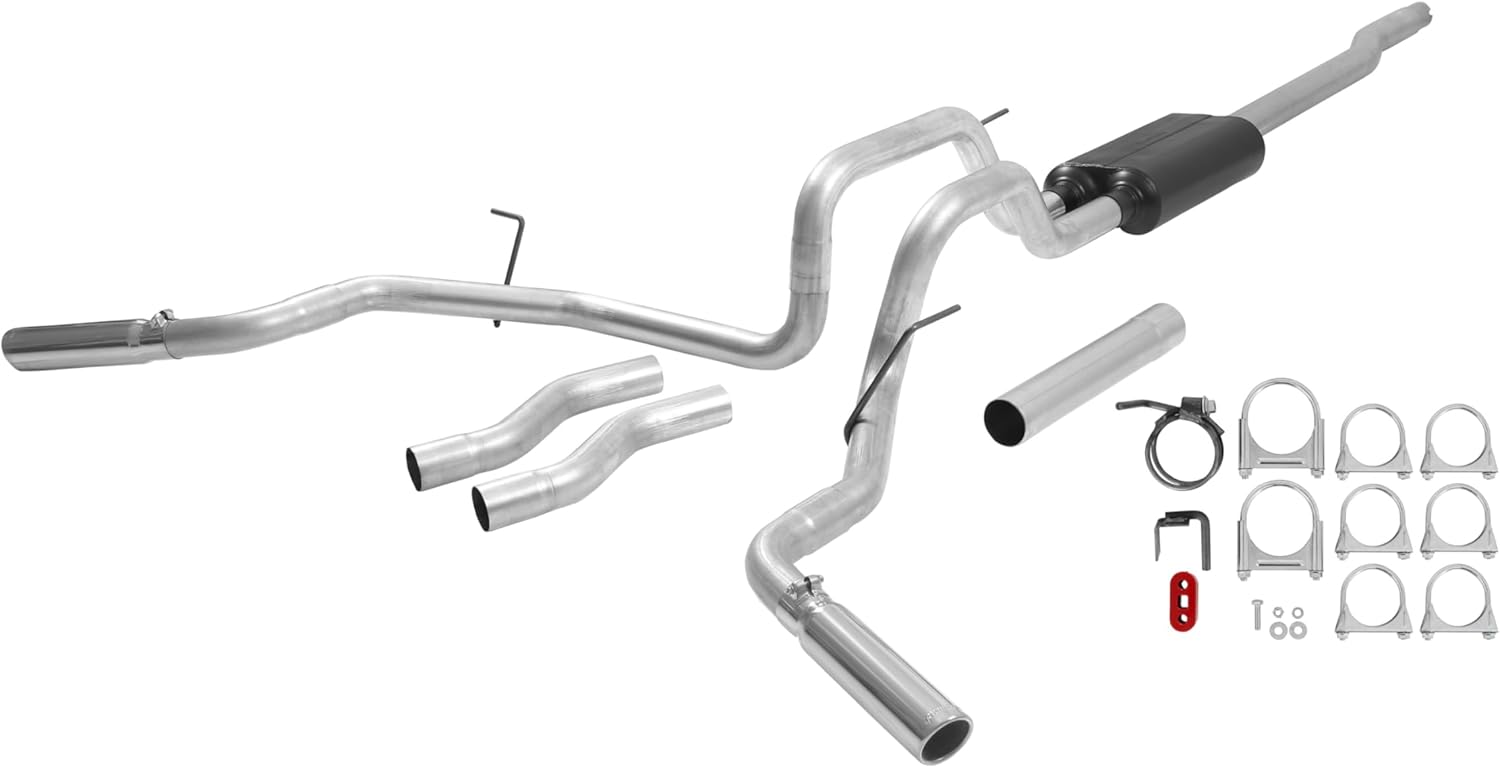
| Tubing | Mandrel-bent 2.5 inch aluminized steel |
| Muffler | Super 50 Series Performance Muffler |
| Tips | 3 inch Polished 304 Stainless Steel |
The Flowmaster 17418 Force II cat-back replaces the factory rear section with mandrel-bent 2.5 inch aluminized tubing, a Super 50 series performance muffler, and polished 3 inch stainless tips for a dual rear/side exit setup. It is typically used to improve exhaust flow, add a deeper but not aggressive note, and preserve quiet interior sound on daily-driven 2004–2008 F-150s. The system uses factory hanger locations and includes hangers and hardware to simplify installation for DIYers or shops. Dyno tuning and the Super 50 muffler aim to balance torque gains with minimal drone on long cruises. Material choices favor aluminized steel for corrosion resistance at a lower cost, while the stainless tips offer a cleaner look. Some owners report excellent fit and tone, though there are isolated complaints about premature corrosion on the muffler assembly, so longevity may vary with climate and use. This kit is a practical mid-level performance upgrade if you want a noticeable, truck-friendly rumble without a loud aftermarket soundtrack.
Best for: Buyers wanting a sensible performance upgrade that adds a deeper, truck-friendly exhaust note and modest flow gains while retaining comfortable interior sound and easy installability.
Less Ideal for: Those seeking maximum durability in salt-belt climates or a very aggressive, loud exhaust tone should consider full stainless systems or more aggressive muffler series instead.
- Vehicle-specific fit for 2004–2008 Ford F-150 for straightforward installation
- Mandrel-bent 2.5 inch aluminized steel tubing for improved exhaust flow
- Super 50 series muffler tuned for a deeper tone with minimal interior drone
- Includes hangers and hardware and uses factory hanger locations for easier install
- Polished 3 inch stainless tips provide a clean finished look
- Primary tubing is aluminized rather than full stainless which can corrode faster in harsh climates
Verdict: A practical mid-level cat-back for 2004–2008 F-150s that delivers a refined, deeper exhaust tone and easier installation without turning your truck into a neighborhood nuisance.
BRExhaust Replacement Cat-Back Exhaust System Kit (106-0697)

| Compatible Vehicle | 2004-2008 Ford F-150 / 2006-2008 Lincoln Mark LT |
|---|---|
| Installation Type | Bolt-On |
| Material Type | Alloy Steel |
| Included Components | Clamps, gaskets, nuts, bolts (5 2.5in. U-Bolt Clamps) |
This BRExhaust cat-back kit replaces the exhaust from just behind the last catalytic converter and is built as a bolt-on, multi-piece system to match factory routing. Typical use is a full replacement of a worn or damaged rear exhaust on a 2004–2008 F-150; the mandrel-bent sections and adjustable joints let installers fit around axles and brackets without cutting or welding. The package includes clamps, gaskets, nuts, and bolts so you get a single-box solution ready for DIY or professional install. Material is aluminized alloy steel for improved corrosion resistance versus basic steel, and the kit preserves emissions equipment by leaving catalysts and sensors in place. Expect a stock or mildly quieter tone rather than a performance bark since this is a direct-fit replacement focused on fit and durability rather than power gains. Warranty coverage is two years for the aluminized finish, and installation is straightforward for anyone comfortable with underbody work but may require basic tools and a lift for easier access.
Best for: Buyers wanting a straightforward, factory-quality replacement that restores correct routing and sound on a 2004–2008 F-150 while keeping installation simple and emissions equipment intact.
Less Ideal for: Drivers seeking a louder performance exhaust note or maximum long-term corrosion resistance should consider performance or stainless systems instead.
- Vehicle-specific direct-fit design that installs around axles and brackets for good alignment
- Complete kit includes clamps, gaskets, and hardware in one box for simpler installation
- Mandrel-bent tubing and multi-piece joints aid fitment and reduce exhaust restrictions compared with crude bends
- Aluminized alloy steel construction offers improved corrosion resistance over plain steel
- Aluminized steel is not as corrosion resistant long-term as stainless steel for coastal or salted-road climates
Verdict: Choose this kit if you want a direct-fit, all-in-one factory-style cat-back replacement that simplifies installation and restores correct fit and sound on a 2004–2008 F-150.
Northeastern Exhaust Stainless Steel Intermediate Pipe, Tail Pipe & Muffler Kit for Ford F-150 (2004–2008)

| Compatible vehicles | Ford F-150 2004–2008; Lincoln Mark LT 2006–2008 |
|---|---|
| Material | 409 Grade Stainless Steel |
| Includes | Intermediate pipe, tail pipe, muffler, clamps |
| Item model number | 650090 |
| Manufacturer Part Number | NE89827K |
This Northeastern Exhaust kit provides a direct-fit replacement for the intermediate pipe, tail pipe, and muffler on compatible 2004–2008 Ford F-150 and 2006–2008 Mark LT models. Built from 409-grade stainless steel, the kit is aimed at long-term corrosion resistance and includes the clamps needed for installation, so many owners can have it bolted in without welding. The pipe and muffler design is intended to improve exhaust flow and reduce backpressure, which can modestly help drivability and throttle response on older trucks. As a budget-focused cat-back solution, the kit balances cost and durability rather than premium finish or high-performance tuning. Expect factory-style fitment and a deeper but not aggressive exhaust note. Confirm exact year and engine fitment before buying, and be aware 409 stainless is more corrosion resistant than aluminized steel but less rustproof than higher grade stainless options. Professional installation simplifies alignment and hanger work on the rear sections.
Best for: Buyers who want an affordable, factory-style replacement that improves exhaust flow and durability without costly performance upgrades; good for restoring function and sound on older F-150s.
Less Ideal for: Drivers seeking a high-end polished finish, maximum corrosion resistance, or an aggressively tuned performance exhaust should consider higher-grade or performance-specific systems.
- Direct-fit kit covering intermediate pipe, tail pipe, and muffler for specified F-150 and Mark LT years
- 409-grade stainless steel construction for improved corrosion resistance over aluminized parts
- Includes clamps for installation so fewer extra parts are needed
- Designed to optimize exhaust flow and reduce backpressure for modest performance gains
- Uses 409-grade stainless rather than higher-grade 304, so ultimate long-term corrosion resistance is lower
Verdict: A cost-conscious direct-fit stainless exhaust kit that restores rear exhaust components and improves flow for 2004–2008 F-150s without premium pricing.
MagnaFlow Street Series Cat-Back Exhaust System (Part 16520)

| Main piping diameter | 3" |
|---|---|
| Tip diameter | 3.5" |
| Tip finish | Polished |
| Muffler type | Straight-Through |
| Inlet connection type | Clamp-On |
The MagnaFlow Street Series cat-back replaces everything downstream of the catalytic converter with mandrel-bent 3" piping, a straight-through stainless muffler and polished 3.5" dual rear tips to give a deeper, fuller exhaust note and reduced backpressure. Installation is intended as a bolt-on fitment and most buyers report a straightforward install when hangers and frame clearance line up, though some owners needed minor adjustments or welding on rear hanger brackets for a precise fit. The system is built from stainless components and CNC-formed parts that resist corrosion and provide a polished appearance. In use the sound is pronounced under throttle yet reasonably civil at idle, and the free-flowing design is dyno-proven to add modest performance. Expect a strong factory-quality finish and durable materials, but be prepared to address occasional fitment quirks on trucks with tow packages or altered underbody shields and to add a resonator if you want to reduce drone or overall volume further.
Best for: Buyers who want a durable, factory-quality cat-back that gives a deeper, performance-oriented sound and modest measured gains while keeping interior noise manageable and who value proven engineering and fitment for the specified F-150/Mark LT years.
Less Ideal for: Drivers seeking a completely silent or ultra-mild upgrade or those unwilling to do minor shop work if hangers or clearance need adjustment should consider alternative systems or professional installation.
- Stainless steel mandrel-bent main piping for improved flow and corrosion resistance.
- Straight-through muffler design that preserves a deep MagnaFlow tone without excessive cabin noise.
- Polished 3.5" dual exit tips that improve rear appearance.
- Designed and dyno-tested for power gains over stock calibration.
- Includes clamp-on inlet and hardware intended for bolt-on installation.
- Some units require modification or welding of rear hanger brackets for proper fitment on certain trucks.
- Reports of surface rust on non-polished pipes in a few customer cases despite stainless construction.
Verdict: Choose this MagnaFlow Street Series kit if you want a durable, dyno-proven cat-back that delivers a deep, authoritative tone and measurable flow improvements for 2004–2010 F-150 and 2006–2008 Mark LT trucks.
Choosing the Right 2004-2008 Ford F-150 Cat-back Exhaust System: Key Factors to Consider
Material and Corrosion Resistance
Material grade determines how well a cat-back will resist rust and hold up to road salt, moisture, and heat exposure on a 2004-2008 Ford F-150. Higher-grade stainless steels provide the best long-term resistance, reducing the likelihood of perforation at hangers and flanges. Surface finishes and coatings also matter because polished or ceramic-coated components shed grime and slow rust formation.
Corrosion resistance affects life-cycle cost and appearance. Trucks often see winter driving and exposure to corrosive agents, so a more durable material can avoid early replacement. When assessing options, check for clear markings or specifications for stainless grade and whether hardware is similarly protected to avoid weak points.
Fitment and Mounting Design
Accurate fitment for the 2004-2008 F-150 is essential to avoid exhaust leaks, rattles, and hanger stress. A well-designed kit uses factory-friendly hangers, properly sized flanges, and exhaust routing that clears suspension and underbody components. Poor fitment can lead to premature failures or the need for modifications that increase installation time.
Consider whether the system is labeled for specific cab and bed configurations within the 2004-2008 range. Even if a system claims universal fit, verify included hardware and instructions. Good fitment reduces exhaust leaks and preserves ground clearance and backing plate clearances critical for a pickup truck.
Muffler Design and Sound Profile
The muffler defines the exhaust character more than any other component. Different internal designs produce distinct tones, from deep mellow notes to a more aggressive bark under acceleration. For a 2004-2008 F-150, consider how loudness and frequency will affect daily driving, towing, and cabin comfort.
Owners who tow or use the truck for commuting may prefer a balanced sound that minimizes drone, while performance-oriented drivers may accept louder tones for improved flow. Also evaluate the expected cabin resonance and whether manufacturers provide sound clips or decibel data that reflect real-world operating conditions.
Piping Diameter and Flow Characteristics
Piping diameter and whether the system uses mandrel bends influence backpressure and flow efficiency. Oversized piping can reduce low-end torque, while undersized piping can restrict performance. For the 2004-2008 F-150 engine options, choose a diameter that balances improved flow with maintained torque where you need it most.
Mandrel-bent tubing retains a consistent internal diameter through curves, improving scavenging and reducing turbulence. Evaluate whether the kit maintains smooth transitions at joints and whether any adapters are required to mate to the factory downpipe or catalytic converter area.
Installation Complexity and Included Hardware
Installation ease affects whether you can perform the upgrade yourself or should plan for professional help. Kits that include all necessary clamps, gaskets, and hangers reduce uncertainty and installation time. Check whether the system uses slip-fit connections or requires welding for a permanent seal.
Assess whether instructions are clear and if any special tools are needed. For owners working in a driveway, fewer alignment steps and reusable hangers make the process more straightforward. Also consider weight and access under the truck when planning the job; lighter assemblies are easier to hold in place during fit-up.
Finish and Maintenance Requirements
The visible finish influences corrosion resistance and the truck's aesthetic. Polished or brushed stainless surfaces look better longer, while coatings such as high-temperature ceramic can protect against discoloration. Finishes also affect how much routine maintenance is needed to keep the system looking new.
Consider whether the system requires periodic polishing or special cleaners, and whether the finish will tolerate regular off-road use or exposure to road chemicals. A finish that masks minor surface rust without hiding structural corrosion can be beneficial for long-term ownership.
Sound Expectations and Reducing Cabin Drone
Expect different cat-back designs to trade loudness for character. Muffled, chambered designs emphasize a deep, refined tone while straight-through designs push volume and higher-frequency notes. For the 2004-2008 F-150, cabin drone at cruising speeds is a common complaint with louder systems, so prioritize muffler types and internal packing that attenuate steady-state frequencies.
If you are sensitive to in-cabin resonance, look for systems with resonators placed to target the most common cruise RPM range. In many cases a system that is slightly quieter under steady throttle but louder on acceleration offers the best everyday balance.
- Chambered mufflers: deeper, mellow tones and less drone
- Straight-through mufflers: louder, freer flow, potential cabin resonance
- Resonators: tune out specific frequencies at cruise speeds
Installation Tips for a Smooth Swap
Prepare the truck by supporting the body and using jack stands to safely access the exhaust area. Loosen bolts and hangers before removing the old system to reduce strain on components. Penetrating oil on rusted fasteners and a heat source if available will ease removal on older F-150s.
During installation, loosely assemble the system first, align hangers and check for sufficient clearance around suspension and heat-sensitive parts, then tighten clamps and flange bolts. Verify alignment with the truck at normal ride height to avoid sagging or contact under load.
- Check downpipe mating surface for flatness and gasket condition
- Use new gaskets and hardware where applicable
- Hand-tighten then torque bolts after final alignment
Material Choices: What Works Best on a Pickup
For a truck that sees year-round use, higher-grade stainless steel often offers the best value by resisting corrosion in wet and salty conditions. Mild steel systems with protective coatings can be lower initial cost but may require more maintenance and have shorter lifespans. Consider the local climate and anticipated mileage when choosing material.
Also assess whether clamps and hangers are similarly corrosion resistant. The weakest link in many exhaust systems is the fasteners and mounting hardware, so kits that include stainless hardware or coated bolts reduce future maintenance and failures.
- 304 stainless: good corrosion resistance and longevity
- Aluminized mild steel: lower cost, more maintenance
- Coated hardware extends usable life
Legal and Emissions Considerations
Some jurisdictions restrict modifications that alter emissions controls. For the 2004-2008 F-150, confirm that the cat-back system does not remove or disable required emissions equipment. Many cat-back systems begin rearward of the catalytic converter, which preserves emissions controls, but check local regulations to ensure compliance.
Where emissions testing is required, choose a system that maintains the location and function of sensors and converters. Retaining factory mounting points and sensor ports simplifies inspections and reduces the risk of failing an emissions test.
- Ensure system does not require removal of catalytic converters
- Maintain O2 sensor locations where applicable
- Verify local modification laws before purchasing
Towing and Payload Implications
If you frequently tow or carry heavy payloads with your 2004-2008 F-150, consider how exhaust routing and clearance affect hitch use and underbody heat. A well-routed system avoids heating sections near the bed or wiring and preserves ground clearance for loaded conditions.
Also note that some exhaust designs change torque delivery slightly. Choose a system with piping and muffler choices that preserve low-end torque for towing rather than optimizing exclusively for peak horsepower.
- Check clearance near hitch and spare tire areas
- Avoid routing that concentrates heat under the bed
- Prioritize low-end torque where towing is frequent
Appearance and Tailpipe Options
Tailpipe tip styles and finishes affect the truck's visual stance. Rolled, slash-cut, or dual-tip designs present different looks and may require trimming or different bumper cutouts. Choose a style that complements the truck without interfering with bed loading or trailer hookups.
Finishes such as polished stainless or black-coated tips change maintenance needs and durability. Black-coated tips can hide discoloration but may flake over time if exposed to high temperatures.
- Single vs dual tips: visual impact and potential sound change
- Tip finish: polished, brushed, or coated
- Consider bumper clearance and bed access
Still looking for the perfect fit?
Select your Ford F-150 configuration to see the most relevant Cat-back Exhaust Systems recommendations
How We Chose the Best 2004-2008 Ford F-150 Cat-back Exhaust System
We focused on selecting cat-back exhaust systems that meet the specific fitment and usage patterns of 2004-2008 Ford F-150 trucks. Our evaluation emphasized real-world durability, corrosion resistance, and fitment accuracy for the 2004-2008 F-150 chassis. We prioritized systems with clear material specifications, weld quality, and hardware that supports bolt-on installation without major modifications.Concrete evaluation criteria included: material grade and corrosion protection, overall flow design and mandrel-bent piping, muffler type and its expected sound profile, fitment accuracy and included mounting hardware, and thermal and finish treatments that affect longevity.We excluded one-off custom fabrications, systems that require extensive cutting or frame modification, and kits lacking clear fitment documentation for the 2004-2008 F-150. The resulting shortlist balances durability, achievable sound goals, and straightforward installation for owners who want reliable upgrades without complicated fabrication.
Our full evaluation process is outlined in our review methodology.
FAQ
Will a cat-back exhaust improve fuel economy on my 2004-2008 F-150?
A cat-back can slightly improve efficiency by reducing backpressure, but gains are usually modest and depend on engine tune and driving style. Expect the biggest benefits in throttle response rather than large fuel economy jumps.
Can I install a cat-back exhaust myself?
Many owners can perform the swap with basic tools and safe lifting equipment, especially when the kit includes all hardware. Rusted fasteners and tight clearances may require extra tools or professional help.
Will changing to an aftermarket cat-back affect towing performance?
Some systems can alter low-end torque characteristics slightly. Choose a configuration that maintains or improves mid-range and low-end flow if you tow frequently. Avoid oversized piping that can reduce low-RPM torque.
How long should a stainless steel cat-back last on an F-150?
High-quality stainless systems often last many years with normal use and exposure, while coated mild-steel systems may show corrosion sooner. Lifespan depends on climate, road salt exposure, and maintenance.
Does a cat-back affect emissions on the 2004-2008 F-150?
A cat-back that starts downstream of the catalytic converter typically does not alter emissions function. Ensure O2 sensor ports and converter locations remain intact to avoid emissions issues and inspection failures.
How loud will a performance cat-back be in the cabin?
Loudness varies by muffler design and piping. Straight-through designs are louder and may produce more drone at cruising RPMs, while chambered or baffled mufflers provide a more controlled tone with less cabin resonance.
Final Verdict
Prioritize fitment, material quality, and muffler design when choosing a cat-back exhaust for your 2004-2008 Ford F-150. Durable materials and accurate hangers reduce long-term maintenance, while muffler choice determines the tradeoff between sound and cabin comfort. Consider your typical use, whether towing or commuting, and select a system that balances low-end response with the sound profile you prefer.Focus on corrosion resistance and proper fitment as primary decision drivers. With those priorities in mind, you can confidently choose an option that delivers the desired sound and performance without unexpected installation or longevity issues.
Explore More:
- Check out all Ford F-150 parts & accessories
- Explore Cat-back Exhaust Systems Maintenance & Repair Guides
- Explore Exhaust & Emissions
- Browse all Auto Parts
