

Note: This article contains affiliate links. If you click on these links and make a purchase, I may earn a small commission at no extra cost to you. This helps support my research and content. Read my full affiliate disclosure here.
If you own a 1999-2004 Jeep Grand Cherokee, choosing the right fuel injector matters for drivability and long-term engine health. Worn or clogged injectors can lead to rough idle, poor throttle response, reduced fuel economy, and stress on catalytic systems. This guide focuses on the 1999-2004 (WJ) Grand Cherokee and covers a short list of vetted replacement injectors matched to that platform.The shortlisted injectors were evaluated for flow consistency, spray pattern, electrical compatibility, and durability under typical Jeep operating conditions. Read on to understand the criteria used and practical steps to spot injector issues before you install replacements.
Looking for other parts? See all Jeep Grand Cherokee parts & accessories.
Top Picks at a Glance
| Best Overall The best all-around choice for most situations | MACAX Set of 6 Fuel Injectors (0280155784) for 4.0L Jeep 1999–2004 |  |
| Best Quality Built to a higher standard if you want something more solid | AAP Re-Manufactured Set of 6 Fuel Injectors (04854181) |  |
| Best Value The sweet spot between price and what you get | AZQOP Fuel Injectors 0280155784 — Set of 6, Upgraded 4-Hole |  |
| Best Budget The cheapest option that still gets the job done reliably | gohantee 4-Hole Fuel Injectors (6-Pack) Compatible with 1999–2004 Jeep 4.0L |  |
| Highest Rated A top-rated pick with lots of positive feedback | TRQ 6-Piece Fuel Injector Set for 1999–2004 Jeep 4.0L |  |
| Most Popular A crowd favorite that many people choose with confidence | Gledewen Fuel Injector (4-Hole) — Replacement for 1999–2004 Jeep 4.0L / 2000–2003 Dodge 5.2L |  |
| Best Seller A high-volume bestseller chosen again and again | YZHIDIANF High Performance Fuel Injectors 0280155784 (6-Pack) |  |
MACAX Set of 6 Fuel Injectors (0280155784) for 4.0L Jeep 1999–2004

| Compatible Engines | 4.0L L6 (1999–2004 Jeep) |
|---|---|
| Replaces Part Numbers | 0280155784, 4669938, RL669938AB and others |
| Connection Type | O-ring inlet and outlet |
| Material Type | Composite |
This MACAX six-injector kit is a direct-replacement style set aimed at 4.0L Jeep engines from the 1999–2004 era. It installs into the factory fuel rail and uses viton O-rings and composite bodies to resist corrosion and heat. In normal use the injectors restore balanced fuel delivery and can improve idle smoothness and drivability compared with worn originals, making them suitable for engine refresh jobs. The kit is engineered to match factory connection types, and the listing includes installation tips so a competent DIYer or technician can fit them quickly. However quality control appears mixed across user reports: several buyers found fitment variance, rough molding that can damage O-rings, or premature internal failure on a few units, while others report good performance and big savings compared with brand-name replacements. Expect to inspect and lightly sand mating surfaces, verify O-rings before installation, and consider keeping a spare or having a shop bench-test them if you want added confidence. The product comes with a one-year warranty from the maker.
Best for: Buyers looking for an affordable, full-set replacement to refresh fuel delivery on a 1999–2004 4.0L Jeep who prioritize cost savings and are comfortable inspecting or having a shop verify parts before installation.
Less Ideal for: Drivers who need guaranteed long-term reliability without inspection or who prefer guaranteed factory-brand components and professional bench-tested injectors.
- Sold as a complete six-piece set covering all cylinders for the 4.0L Jeep application
- Uses corrosion-resistant composite bodies and high-temp viton O-rings for durability
- Designed to match factory-style inlet and outlet O-ring connections for straightforward installation
- Noticeably cheaper than many OEM or brand-name injectors, lowering replacement cost
- Mixed quality control reported including rough molding and occasional internal failures
- Some users noted fitment variance requiring mechanic adjustment or extra work
Verdict: A budget-friendly full set for refreshing fuel delivery on 1999–2004 4.0L Jeeps for buyers who will inspect and verify parts before installation.
AAP Re-Manufactured Set of 6 Fuel Injectors (04854181)

| Compatible engines | 4.0L 1999–2004 Jeep |
|---|---|
| Unit count | Set of 6 |
| Flow tolerance | Flow matched ±1% |
| Material type | Rubber |
These are remanufactured factory-spec fuel injectors sold as a complete set of six for 4.0L Jeep engines from 1999–2004. Each injector is cleaned, flow-matched within plus or minus 1 percent, and reassembled with new O-rings, seals, filters, and pintle caps so they function like a refreshed factory unit. In practice the kit is a direct replacement intended to cure misfires, rough idle, or leaking injectors without replacing the entire fuel rail or harness. Installation is the same as stock injectors and several owners report straightforward plug-and-play swaps and improved smoothness and power after fitment. Because these are remanufactured rather than new-built, longevity can vary with prior core condition, but the flow matching and new sealing components reduce the common failure modes that cause P030x codes. Expect a balance between cost savings and restored factory-level performance rather than an aftermarket high-flow upgrade for modified engines.
Best for: Buyers looking to restore factory-level fueling and eliminate misfires on a 1999–2004 4.0L Jeep who prioritize reliable, direct-replacement parts over high-flow performance upgrades.
Less Ideal for: Drivers building a performance or high-horsepower 4.0L setup who need higher flow rates or purpose-built performance injectors should look at aftermarket options.
- Complete set of six for full-bank replacement
- Flow matched to ±1% for balanced cylinder fueling
- Rebuilt with new seals, O-rings, filters and pintle caps to address leaks
- Direct-fit for 1999–2004 4.0L Jeep engines for simple installation
- Remanufactured units so lifespan depends on original core condition
Verdict: A cost-effective remanufactured six-pack that restores factory fueling and fixes misfires on 1999–2004 4.0L Jeeps.
AZQOP Fuel Injectors 0280155784 — Set of 6, Upgraded 4-Hole

| Inlet Connection Type | Threaded |
|---|---|
| Outlet Connection Type | Snap-In |
| Number of Ports | 4 |
| Material Type | Metal |
These AZQOP fuel injectors are sold as a set of six factory-style replacements intended for 4.0L Jeep Cherokee/Grand Cherokee/Wrangler (1999–2004) and some 5.2L Dodge Ram models. They swap in like standard injectors and use threaded inlet and snap-in outlet connections for direct replacement where the 0280155784 number applies. Notable features include four-hole nozzles for finer fuel atomization and high-temperature Viton o-rings to improve sealing under heat. In real-world use they tend to smooth idle and can improve throttle response and fuel economy when replacing worn injectors, though some buyers report fitment quirks with electrical plugs or clips. Installation requires care, proper tools, and a clean work area to avoid contamination; the listing includes fitment notes and a reminder to verify injector part numbers. If you need a cost-effective, performance-minded replacement for a full set of injectors on a covered Jeep, these provide an approachable option, but expect to double-check connector compatibility and follow careful installation procedures.
Best for: Buyers who want an affordable, performance-minded full replacement set to restore smooth idle and improve fuel delivery on covered 4.0L Jeep Grand Cherokee models and prioritize value and improved atomization over factory-brand parts.
Less Ideal for: Drivers who need exact OEM-branded injectors or prefer buying individual injectors for selective cylinder replacement should consider alternatives or verify availability of single units.
- Upgraded four-hole nozzle design improves fuel atomization for smoother idle and better combustion
- High-temperature Viton o-rings enhance seal longevity under elevated engine temperatures
- Made to match common replacement number 0280155784 for direct-fit service on specified engines
- Comes as a complete set of six so all injectors can be replaced at once for consistent performance
- Some users report plug or clip fitment issues requiring minor adjustments
- Not a drop-in across all vehicle variants — must confirm injector part number before purchase
Verdict: A cost-effective upgraded set of six injectors that improves atomization and restores smooth running for 4.0L Jeep Grand Cherokee engines when the 0280155784 part fits.
gohantee 4-Hole Fuel Injectors (6-Pack) Compatible with 1999–2004 Jeep 4.0L

| Connector Type | EV6 USCAR |
|---|---|
| Number of Ports | 4 |
| Flow Rate | 250 CC/Min @ 43.5 PSI |
| Resistance | 12 ohms |
| Maximum Pressure | 100 Pound per Square Inch |
These gohantee injectors replace the factory units with a four-hole nozzle and EV6/USCAR connector, sold as a set of six for inline-six Jeep 4.0L engines. They are intended to be a direct swap and use stainless steel internal slides, high-temperature Viton o-rings, and a basket inlet filter to resist corrosion and extend seal life. In use they aim to restore smooth idle, improve throttle response, and provide a consistent flow rate (about 250 cc/min @ 43.5 PSI) with a stated 2% flow match. Installation is typical for upper-engine fuel injector replacement and benefits from careful cleanliness and light O-ring lubricant. Practical advantages are improved drivability on older, high-mileage engines at a much lower cost than branded replacements. Limitations are variable quality control reported by some users and occasional harness/connector fit issues on certain vehicles, so expect to verify connector compatibility before installation and be prepared to replace a single unit if one fails early.
Best for: A budget-minded Jeep owner looking to refresh all six injectors at once to cure misfires, rough idle, or poor throttle response without paying OEM prices.
Less Ideal for: Drivers who prioritize guaranteed long-term reliability or require manufacturer-backed parts should choose a well-known branded or factory replacement instead.
- Sold as a complete six-pack to replace all cylinders at once
- Stainless steel calibrated slide and spring to resist internal corrosion
- High-temperature Viton O-rings for improved sealing under heat
- Flow-matched design (approx. 250 cc/min @ 43.5 PSI) for balanced delivery
- Inconsistent quality control reported by some buyers leading to early failures
- Not a genuine factory part so longevity may vary compared with OEM units
Verdict: A cost-effective six-pack option to restore smooth running and throttle response on 1999–2004 Jeep 4.0L engines when you want replacement performance without OEM pricing.
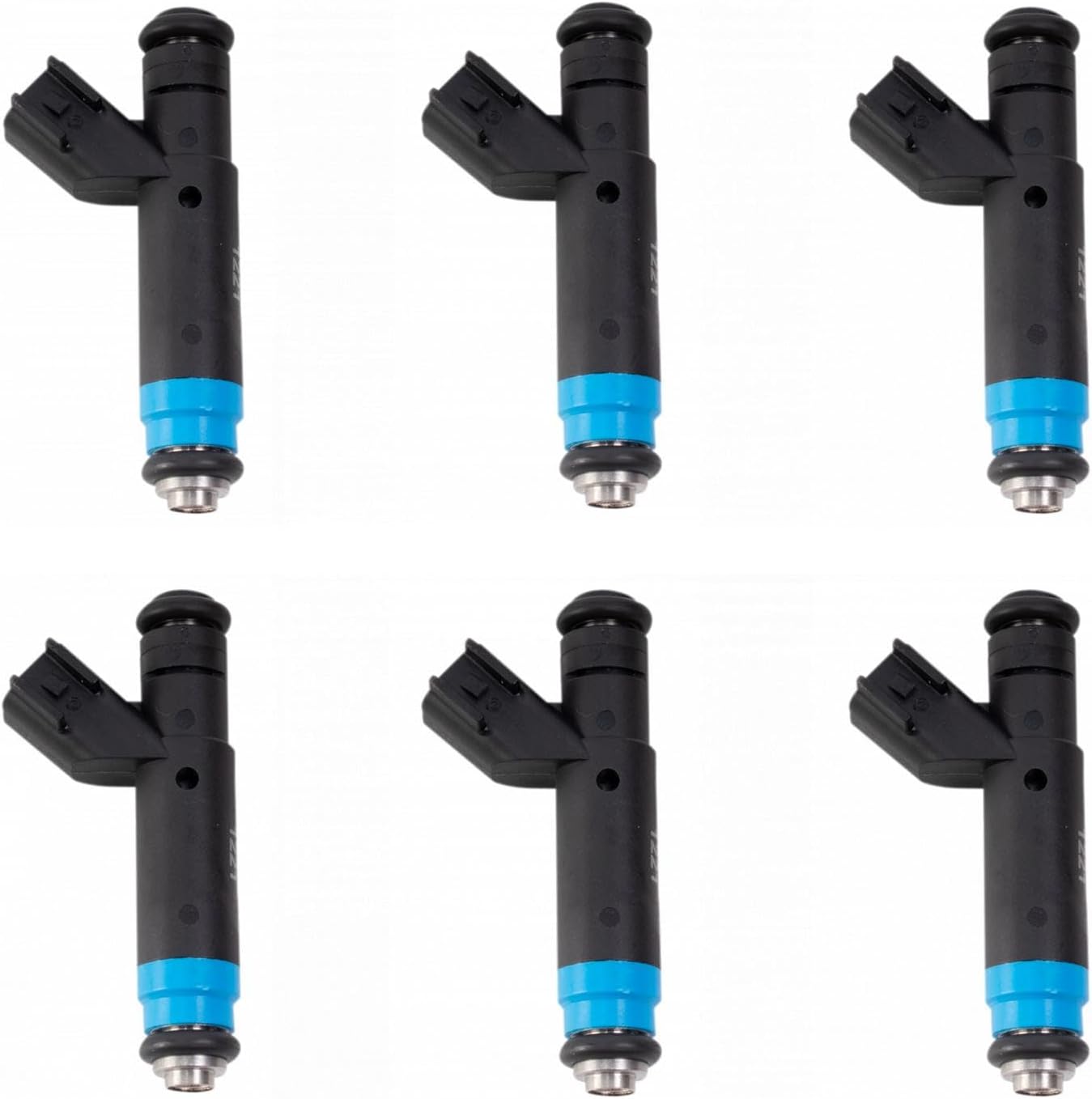
TRQ 6-Piece Fuel Injector Set for 1999–2004 Jeep 4.0L
| Brand Name | TRQ |
|---|---|
| Number of Pieces | 6 |
| Material Type | Metal |
| Thread Size | 18mm |
| Specification Met | oe |
This TRQ fuel injector kit supplies six direct-fit injectors intended for Jeep 4.0L engines used in late 1990s and early 2000s Cherokee, Grand Cherokee, and Wrangler models. Installation is typical for a full-bank replacement: remove the rail and old injectors, fit the TRQ units, and reconnect the fuel and electrical connections. Notable features include a machined metal finish, threaded inlet connections, and SAE outlet fittings that match factory fuel rails. In practice the kit can restore throttle response and eliminate misfires caused by leaking or clogged injectors, and many DIYers will appreciate TRQ's installation videos and broad fitment references. Keep in mind the set ships without injector seals or O-rings in some cases, so you may need to source gaskets separately before starting the job. A few users also report occasional durability or warranty hassles, so plan for careful inspection after installation and keep records if you need support.
Best for: A Jeep owner who prioritizes restoring reliable engine operation and prefers a direct-fit replacement they can install themselves or with a local shop.
Less Ideal for: If you want a plug-and-play lifetime performance upgrade or need a kit that includes all seals and hardware, consider a complete OEM-style kit or a professional remanufactured injector option instead.
- Direct-fit design for 4.0L Jeep applications simplifies installation
- Machined metal construction and standard threaded/SAE connections match factory interfaces
- Includes six injectors for full-bank replacement to address multiple misfires
- TRQ provides video installation resources useful for DIY mechanics
- O-rings and seat seals may not be included and often must be bought separately
- Some buyers reported isolated durability problems and limited resolution from seller support
Verdict: Choose this TRQ six-piece injector set when you need a direct-fit replacement to restore reliable running on a 1999–2004 Jeep 4.0L engine.
Gledewen Fuel Injector (4-Hole) — Replacement for 1999–2004 Jeep 4.0L / 2000–2003 Dodge 5.2L

| Inlet Connection Type | Barb |
|---|---|
| Number of Ports | 1 |
| Valve Type | Injector Valve |
| Material Type | composite material |
These Gledewen fuel injectors are intended as direct-replacement injectors for 4.0L Jeep and 5.2L Dodge applications from the specified years. They use a 4-hole nozzle pattern and composite construction with Viton-style O-rings to reproduce a factory-style spray and sealing performance. Typical use is one-for-one replacement during a tune-up or when injectors are leaking, misfiring, or causing poor fuel economy; installers report smoother idle and improved throttle response when the parts seat correctly. The composite body resists corrosion and the injectors undergo basic bench tests for leakage and spray uniformity. Real-world feedback is mixed: many buyers see quick improvements in drivability and MPG, but a notable minority report poor O-ring fit or leaking units out of the box, so expect to check seals and consider using aftermarket Viton O-rings during install. These are a budget-friendly option that can restore performance, but cautious buyers should inspect each injector and be prepared to swap O-rings or return units that leak.
Best for: Buyers who want a cost-effective, bolt-in injector to restore drivability and fuel economy on a specific older Jeep or Dodge engine and who prefer to rely on other owners' experience when choosing parts.
Less Ideal for: People wanting a guaranteed long-term OEM-grade replacement without inspecting or changing seals should consider higher-end branded injectors or professional remanufactured units instead.
- Direct-fit design for 1999–2004 Jeep 4.0L and 2000–2003 Dodge 5.2L engines
- 4-hole nozzle for improved atomization and smoother throttle response
- Composite construction resists corrosion for longer service life
- Many users report improved idle smoothness and better fuel economy after installation
- Some units arrive with poor-quality O-rings that may not seal without replacement
- Customer reports include occasional leaking or early failures, suggesting variable quality control
Verdict: A budget-friendly, direct-fit injector that can quickly restore smoothness and fuel economy for 1999–2004 Jeep 4.0L and 2000–2003 Dodge 5.2L engines when installers check seals and swap O-rings if needed.
YZHIDIANF High Performance Fuel Injectors 0280155784 (6-Pack)

| Model | 0280155784 |
|---|---|
| Manufacturer | YZHIDIANF |
| Fitment | 1999–2004 4.0L Jeep engines |
| Included parts | 6 injectors with O-rings preinstalled |
These YZHIDIANF injectors are sold as a six-pack of direct-fit replacements for the 4.0L six-cylinder Jeep engines used in Cherokee, Grand Cherokee, and Wrangler from 1999–2004. They arrive with upper and lower O-rings preinstalled and are intended to match factory fit, form, and function so installation is straightforward for a competent DIYer or mechanic. The injectors use composite bodies and high-temperature Viton O-rings to resist corrosion and heat, which should help longevity and reduce leak risk. Practical benefits reported by owners include clearer idling, improved throttle response, and correction of misfire codes when defective original units are the cause. Some buyers noted significant fuel economy gains after replacement. Limitations to keep in mind are variable long-term durability reports and isolated early leaks reported by a few users, so careful pre-install inspection and cleaning of injector bores is recommended. The seller provides after-sales support and replacement options if problems appear.
Best for: Buyers who want a straightforward, full-bank replacement to address misfires, rough idle, or weak throttle on a 1999–2004 4.0L Jeep and prefer a ready-to-install aftermarket set with seller support.
Less Ideal for: If you need an exact factory-branded injector or the longest-term proven durability for heavy-duty use, consider dealer-sourced factory replacements or higher-end remanufactured injectors instead.
- Direct-fit design for 1999–2004 4.0L Jeep six-cylinder engines simplifies installation
- Comes with upper and lower O-rings preinstalled to save time and reduce parts hunting
- Composite injector body and Viton O-rings for improved corrosion and heat resistance
- Pack of six covers all cylinders for full-bank replacement and consistent performance
- Some users reported early failures or leaking injectors, so longevity may vary
- Not OEM brand so occasional fit or performance differences compared with factory parts
Verdict: A complete six-pack of direct-fit aftermarket injectors that offers an easy way to fix misfires and restore throttle response on 1999–2004 4.0L Jeep engines.
Choosing the Right 1999-2004 Jeep Grand Cherokee Fuel Injector: Key Factors to Consider
Flow Rate and Matching
Flow rate directly controls the amount of fuel delivered at a given injector pulse width and is critical for preserving the WJ's calibrated air/fuel ratio. When replacing a single injector or a bank, you should match the flow rate to the other injectors or replace all injectors to avoid imbalance. Mismatched flow can lead to one cylinder running rich or lean, causing misfire codes, rough idle, and uneven power delivery.
Manufacturers list flow in cc/min or lb/hr; the important part for you is consistency across the set. During selection, look for units with tight flow tolerances and documented test procedures. If you plan performance modifications that change fueling needs, pick injectors with higher flow that remain within the engine management limits or that are compatible with intended tuning.
Spray Pattern and Atomization
How the injector atomizes fuel affects combustion efficiency, cold-start behavior, and emissions. A well-atomized spray forms a fine mist that mixes readily with intake air, supporting smoother idle and cleaner burn in the WJ engine. Poor spray results in larger droplets that can condense on intake runners, contributing to rough idle and carbon buildup.
Choose injectors designed to replicate or improve the original spray pattern for your Grand Cherokee's port-injection setup. For engines with intake deposits, a slightly finer atomization can help, but only if the flow rate and fuel trim capabilities are suitable for your ECU settings.
Electrical Compatibility and Resistance
Injector coil resistance affects how the ECU drives the injector and whether the injector will function correctly with the stock wiring. Low-impedance vs high-impedance injectors require different driver strategies; selecting the correct resistance prevents overheating of driver circuits and avoids unreliable operation.
Confirm that replacement injectors match the electrical specs of the original units or that the installation plan includes the necessary resistors or drivers. Connector shape and terminal spacing must align with the harness on the 1999-2004 Grand Cherokee to avoid splicing or adaptor use, which can introduce failure points.
Seal and O-Ring Quality
Proper sealing at both the fuel rail and intake port is essential to prevent injector leaks and vacuum loss. Durable O-rings and high-quality pintle seals reduce the chance of external fuel leaks or internal vacuum leaks that upset fuel trim and idle.
Selecting injectors with compatible, high-grade seals reduces the need for immediate replacement of soft or brittle factory O-rings. When replacing injectors, inspect and often replace the O-rings and upper seals to ensure a reliable seal and to prevent leak symptoms that can be mistaken for other issues.
Durability and Materials
Materials used in the injector body, pintle, and internal filters determine how resistant the unit is to corrosion and particulate wear. Injectors that use higher-quality internal components and corrosion-resistant finishes are less likely to suffer flow drift or sticking under typical fuel conditions.
Durability matters for long-term ownership of a Grand Cherokee, where periods of varied fuel quality and infrequent short trips can accelerate injector wear. Prefer injectors with documented lifespan expectations or those manufactured with robust internal filters to extend service intervals.
Serviceability and Support
Ease of installation and availability of replacement seals or repair kits affects long-term maintenance. Injectors that come with clear installation guidance and standard sealing components reduce the chance of installation errors on the WJ's engine.
Also consider parts support and documentation. If you plan to have injectors professionally cleaned or bench-tested, choose units with accessible spec sheets and known test procedures to simplify service and diagnostics down the road.
Common Symptoms That Point to a Bad Injector
Recognizing injector-related faults early helps avoid collateral engine damage. Typical signs include a rough idle that improves when the suspected injector is unplugged, intermittent misfires, poor throttle response, and reduced fuel economy. You may also notice a persistent fuel odor near the intake if seals leak or an injector drips.
Electrical symptoms can include an engine code indicating a cylinder misfire or a specific injector circuit fault. Mechanical symptoms include hesitation under acceleration and increased crank time during cold starts. Documenting when symptoms occur — cold vs hot engine, steady throttle vs load — helps narrow diagnosis.
- Rough idle or misfire on one cylinder
- Poor acceleration or stumbling under load
- Strong fuel smell around the intake manifold
- Engine codes for misfires or injector circuits
Diagnosing Injectors on the WJ Platform
A structured approach helps separate injector faults from ignition, compression, and fuel delivery problems. Start with a fuel pressure check to ensure the rail is within spec; incorrect pressure can mimic injector problems. Next, use injector testing methods appropriate for the Grand Cherokee: resistance checks, listening tests with a scope or stethoscope, and flow testing when feasible.
If you have access to a noid light or pulse tester, confirm the injector receives a consistent signal from the ECU. For precise diagnosis, remove injectors and perform bench flow or balance testing to measure actual flow differences between cylinders. Keep records of resistance and flow values to compare against expected ranges.
- Check fuel rail pressure before replacing injectors
- Use resistance tests and pulse checks to verify electrical drive
- Listen for consistent injector operation across cylinders
- Bench flow testing gives definitive flow comparison
Cleaning Vs Replacement: When to Save and When to Swap
Cleaning injectors can restore performance if the issue is primarily varnish or light deposits. Ultrasonic cleaning with appropriate solvents and subsequent flow verification can be effective for slightly clogged units. However, cleaning does not restore worn internals, poor seals, or units that have drifted in flow beyond specification.
Replace injectors when you find physical wear, corrosion, leaking seals, or when flow imbalance exceeds acceptable limits. For the WJ engine, where accessibility is moderate, replacing a set of injectors can be more cost-effective long term if multiple units show degradation. Consider the vehicle's mileage and maintenance history when deciding whether to clean or replace.
- Clean if flow drift is mild and seals are intact
- Replace if seals leak, flow is out of spec, or internals are corroded
- Document pre- and post-clean flow to confirm effectiveness
- Consider replacing other wear items like O-rings during service
Installation Tips Specific to 1999-2004 Grand Cherokee
Prepare the work area by relieving fuel pressure and disconnecting the battery. Label or photograph harness connectors before unplugging to avoid misrouting. When removing injectors, keep track of any spacers or insulators and be gentle with the fuel rail to prevent warping or stress on mounting studs.
Use new upper and lower seals during installation to ensure proper sealing. Lubricate O-rings lightly with fuel-safe lubricant to ease installation and prevent pinching. After installation, perform a fuel-leak check and clear any codes before starting the engine. Allow the ECU to relearn idle trims through normal operation or follow a documented relearn procedure if available.
- Relieve fuel pressure and disconnect the battery first
- Replace upper and lower injector seals on every install
- Lubricate O-rings to avoid damage during insertion
- Check for leaks and clear codes after installation
When to Consider Upgrading Injectors for Performance
If you are modifying intake, exhaust, or adding forced induction components, higher-flow injectors may be necessary to maintain proper fueling. Upgrading injectors should be part of a coordinated plan that includes tuning the engine management system to account for increased fuel delivery. Over-sizing injectors without proper calibration can cause poor drivability and emissions issues.
For modest performance upgrades on the WJ, select injectors that increase flow within a range the stock ECU can adapt to, or plan for an ECU recalibration. Always verify electrical compatibility and ensure the injector's atomization supports your intended combustion characteristics.
- Match injector flow to planned power and fuel system changes
- Plan for ECU tuning when increasing injector capacity
- Prioritize spray quality, not just flow, for efficient combustion
Still looking for the perfect fit?
Select your Jeep Grand Cherokee configuration to see the most relevant Fuel Injectors recommendations
How We Chose the Best 1999-2004 Jeep Grand Cherokee Fuel Injector
We prioritized criteria that directly affect fitment, drivability, and longevity on the 1999-2004 Jeep Grand Cherokee. First, flow rate consistency was a key filter because mismatched or inconsistent flow alters air/fuel ratios and causes drivability issues on the WJ's engines. Second, nozzle spray pattern and atomization were evaluated for how well they support cold starts, smooth idling, and midrange throttle response. Third, electrical and connector compatibility was required to match the original injector pins, resistance range, and wiring harness to avoid additional modifications. Fourth, materials and sealing quality were considered to reduce leak risk and resist common fuel-system contaminants. Fifth, durability and expected service life were factored in based on typical usage profiles for this vehicle.We excluded injectors that required significant ECU recalibration, nonstandard adapters, or that lacked documentation for the WJ platform. We also avoided units with inconsistent build details or unverified flow specifications. The final selections balanced practical replacement needs with attention to the parts that most directly affect performance and emissions on the Grand Cherokee.
Our full evaluation process is outlined in our review methodology.
FAQ
How long do fuel injectors typically last on a 1999-2004 Grand Cherokee?
Injector life depends on fuel quality and driving habits but often lasts many years. Many owners see reliable service beyond 100,000 miles, though signs of wear or clogging may appear earlier if contaminated fuel or frequent short trips are common.
Can I clean my Grand Cherokee injectors instead of replacing them?
Yes, cleaning can restore injectors suffering from light deposits, and ultrasonic cleaning followed by flow testing is effective in many cases. Replace injectors when cleaning does not restore flow or when seals and internals show wear.
What are the most common symptoms of a failing injector on the WJ?
Common symptoms include rough idle, a misfire on one cylinder, reduced acceleration, and increased fuel smell near the intake. Electrical fault codes for misfires or injector circuits may also appear.
Do I need to replace O-rings when swapping injectors?
Yes. Replace both upper and lower O-rings whenever you remove injectors to ensure a proper seal and prevent fuel or vacuum leaks that can cause drivability issues.
Will replacing a single injector help if only one cylinder misfires?
Replacing a single injector can help if diagnostics confirm that injector is faulty and flow or resistance is out of range. However, if other injectors show similar wear or flow drift, replacing the whole set helps maintain balance across cylinders.
How do I test an injector on my Grand Cherokee?
Begin with a resistance check to compare against specification and use a noid light or oscilloscope to confirm injector pulse. For definitive results, bench flow testing measures actual fuel delivery and helps identify imbalances between injectors.
Final Verdict
For the 1999-2004 Jeep Grand Cherokee, prioritize injectors that match flow and electrical characteristics of the original units while offering durable seals and consistent spray patterns. Balance the decision between cleaning and replacement based on measured flow differences, seal condition, and expected service life. If you run performance upgrades, plan injector upgrades alongside tuning to avoid drivability problems. With measured diagnostics and attention to fitment and sealing, you can restore smooth idle and reliable fueling on the WJ Grand Cherokee.
Explore More:
- Check out all Jeep Grand Cherokee parts & accessories
- Explore Fuel Injectors Maintenance & Repair Guides
- Explore Fuel System
- Browse all Auto Parts
