

Note: This article contains affiliate links. If you click on these links and make a purchase, I may earn a small commission at no extra cost to you. This helps support my research and content. Read my full affiliate disclosure here.
Picking the right brake rotors for your Mercedes-Benz E-Class matters for safety, pedal feel, and long-term component life. The wrong rotor can cause vibration, uneven pad wear, or noisy stops, while the right choice restores consistent braking performance.This guide covers seven shortlisted brake rotors that meet common fitment and quality expectations for the E-Class. We evaluated each option for material construction and dimensional accuracy, plus factors that affect installation and longevity. Read on to understand the criteria we used and what to look for when selecting rotors for your vehicle.
Looking for other parts? See all Mercedes-Benz E-Class parts & accessories.
Top Picks at a Glance
| Best overall The best all-around choice for most situations | Detroit Axle Brake Kit with Drilled & Slotted Rotors and Ceramic Pads for Mercedes-Benz E-Class/CLK |  |
| Best Quality Built to a higher standard if you want something more solid | Brembo Co‑cast Pillar‑Vented Drilled Brake Rotor (09.D524.13) |  |
| Best Value The sweet spot between price and what you get | Detroit Axle Front Brake Kit for Mercedes-Benz E320/E350 (Front Rotors & Ceramic Pads) |  |
| Best budget The cheapest option that still gets the job done reliably | BOSCH QuietCast Premium Front Disc Brake Rotor (36010991) |  |
| Highest Rated A top-rated pick with lots of positive feedback | Detroit Axle Front and Rear Brake Kit with Ceramic Pads and Rotors for Mercedes-Benz (Sport Package) |  |
| Most popular A crowd favorite that many people choose with confidence | Detroit Axle Rear Drilled & Slotted Brake Rotors (Rear, 11.81") |  |
| Best Seller A high-volume bestseller chosen again and again | PowerStop K7830 Z23 Carbon-Fiber Ceramic Brake Pad and Drilled & Slotted Rotor Kit |  |
1. Detroit Axle Brake Kit with Drilled & Slotted Rotors and Ceramic Pads for Mercedes-Benz E-Class/CLK

| Front rotor diameter | 11.81 inch (300mm) |
|---|---|
| Rear rotor diameter | 11.42 inch (290mm) |
| Pad type | Ceramic |
| Includes | Front and rear rotors, front and rear pads, brake cleaner, brake fluid |
This Detroit Axle brake kit bundles front and rear drilled-and-slotted rotors with matching ceramic pads and a few service items so you can replace the worn components in one job. It is intended for the specified Mercedes‑Benz E‑Class and CLK fitments and is typically used by DIYers or shops replacing both rotors and pads to restore braking performance and reduce noise. Notable features include vented, drilled-and-slotted rotors for better heat dissipation, zinc plating to resist corrosion, and machined locating holes for straightforward alignment to the hub. The kit also ships with brake cleaner and a small bottle of brake fluid to finish the job. In practice the combination delivers stronger initial bite and confident stopping compared with many worn OEM rotors, and buyers report easy alignment and a mostly straightforward install. Expect some noise with drilled rotors under certain conditions and inspect included hardware since accessory clips or pads may occasionally be mismatched; a modest level of mechanical skill and common tools are needed. The kit is a practical, cost-effective option if you want a complete axle-to-axle refresh sized for the listed Mercedes models.
Best for: Balanced buyers who want a complete, vehicle-specific refresh of their Mercedes braking system without paying premium brand prices and who value straightforward installation and improved stopping performance.
Less Ideal for: Drivers seeking a quiet, strictly OEM-feel replacement or those who prefer performance rotors designed for track use should consider other options.
- Complete front and rear kit includes rotors, ceramic pads, brake cleaner, and brake fluid for one-stop replacement.
- Drilled and slotted vented rotors improve cooling and help reduce brake fade during repeated stops.
- Zinc plating and machined locating holes simplify fitment and offer corrosion protection compared with bare rotors.
- Drilled rotors can produce more brake noise in some driving conditions compared with plain rotors.
- Some buyers reported occasional mismatched or poor-fitting small hardware in the accessory bag.
- No printed, detailed installation instructions included in the package.
Verdict: A practical, full front-and-rear brake kit that upgrades cooling and stopping for the specified Mercedes models while keeping cost and installation simplicity front and center.
2. Brembo Co‑cast Pillar‑Vented Drilled Brake Rotor (09.D524.13)

| Manufacturer Part Number | 09.D524.13 |
|---|---|
| OEM Equivalent Part Number | A0004212312 |
| Material Type | Cast Iron |
| Exterior Finish | Machined, Coated, Drilled |
| Automotive Fit Type | Vehicle Specific Fit |
This Brembo rotor is a performance-focused, vehicle-specific replacement designed to match or exceed factory material specs for Mercedes‑Benz E‑Class applications. It uses a cast iron braking ring with a lighter steel hat and Brembo’s patented Pillar Vented Technology to improve cooling and reduce crack risk, while higher carbon content helps shorten cooling time and lower vibration and noise. The drilled, machined, and coated finish gives better initial bite and slows surface rust for a cleaner look over time. Hardware for installation is included so a single-rotor swap is straightforward for a mechanically competent DIYer or a shop. Expect improved thermal management and a firmer brake feel under spirited driving, but note this listing is for one rotor only so you will need to purchase pairs, and the drilled face can be more prone to wear under extreme track use compared with dedicated race rotors.
Best for: Performance-oriented owners who prioritize stopping power, thermal stability, and factory-quality replacements for Mercedes‑Benz E‑Class driving on road and occasional spirited runs.
Less Ideal for: Buyers seeking a dedicated track-only rotor or those who want to replace both sides with a single purchase should consider options sold and specified as pairs or with different race-focused designs.
- Pillar Vented Technology improves cooling and increases resistance to cracking
- High carbon cast iron reduces vibration and shortens cooling time for more consistent pedal feel
- Coated and machined, drilled finish resists surface corrosion and restores initial braking bite
- Includes required installation hardware for immediate fitment
- Sold as a single rotor rather than a pair
- Drilled surface may not be ideal for very aggressive track use where slotting or different constructions perform better
Verdict: A Brembo pillar‑vented, high‑carbon cast iron rotor that delivers factory‑quality thermal control and refined braking performance for Mercedes‑Benz E‑Class owners.
3. Detroit Axle Front Brake Kit for Mercedes-Benz E320/E350 (Front Rotors & Ceramic Pads)
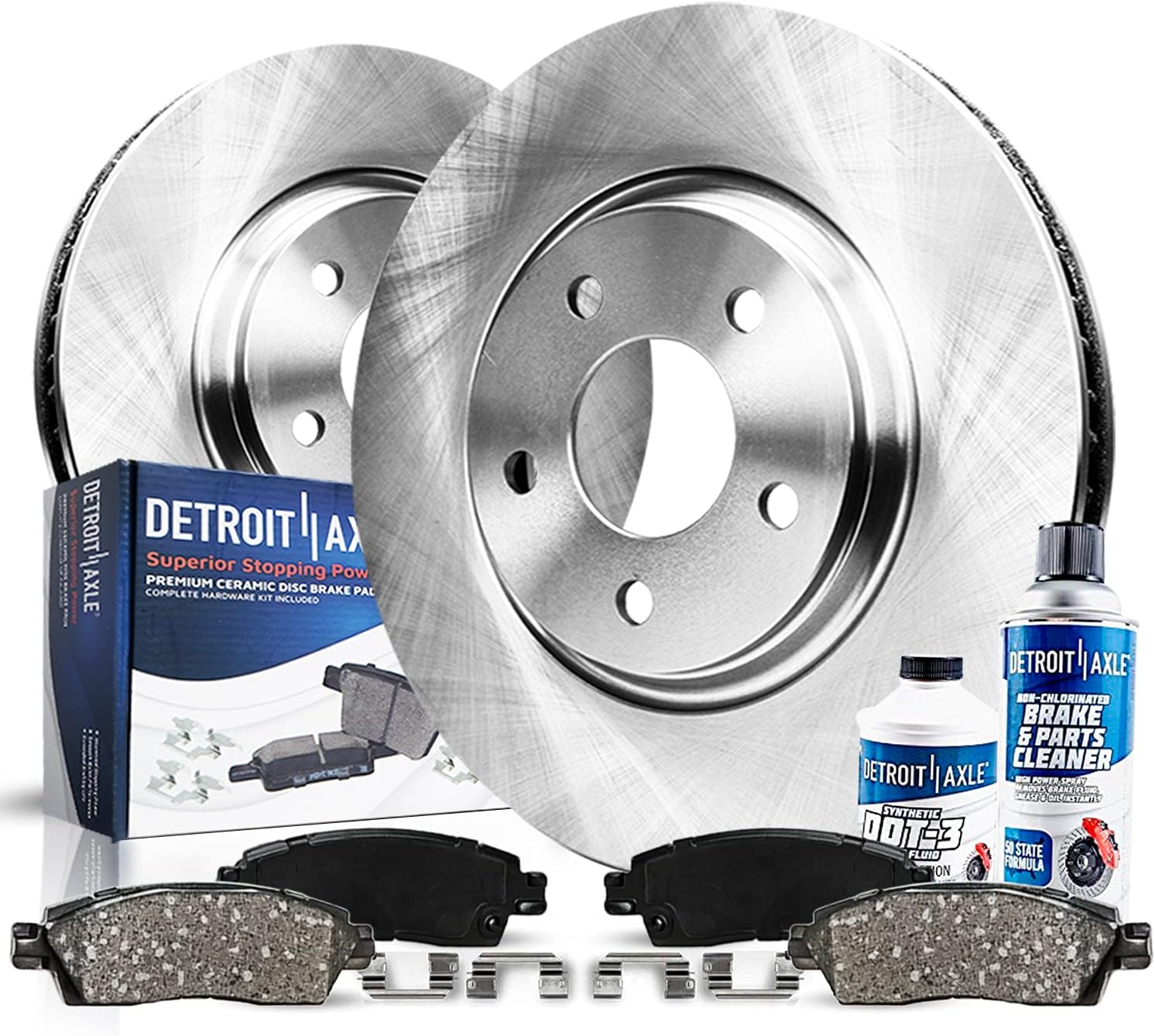
| Brand Name | Detroit Axle |
|---|---|
| Manufacturer Part Number | 6PR1900402 |
| Automotive Fit Type | Vehicle Specific Fit |
| Orientation | Front |
This Detroit Axle front brake kit supplies everything needed for a front brake service on E‑Class models that use 11.61 inch (295 mm) rotors, excluding 4Matic and Sport submodels. The package includes two vented, zinc‑plated rotors, four ceramic pads with hardware, a small bottle of DOT3 brake fluid and a can of brake cleaner. The coated rotors and zinc plating help reduce surface corrosion in salted climates and the vents improve cooling under repeated stops. Ceramic pads are quiet and produce less dust than semi‑metallic compounds, which makes them practical for daily driving. Fitment is vehicle specific and the locating holes are machined for direct installation on the listed Mercedes models, so installation is straightforward for DIYers or shops. Limitations are that this kit is for specific E320/E350 non‑4Matic configurations only, and the supplied fluid and cleaner are consumable trial sizes rather than shop quantities. Buyers who expect high‑performance track stopping or heavy towing should consider higher‑grade rotors and pads tailored for those demands.
Best for: Practical optimizers who want a budget‑minded, all‑in‑one front brake service solution for the Mercedes‑Benz E320/E350 non‑4Matic models and value straightforward fit and ease of installation.
Less Ideal for: Drivers who need track‑oriented braking performance, heavy towing capacity, or owners of 4Matic or Sport E‑Class variants should look for performance or model‑specific alternatives.
- Complete kit includes rotors, ceramic pads, mounting hardware, brake cleaner and DOT3 fluid for a ready-to-install front brake job.
- Zinc‑plated, vented rotors resist corrosion and help cooling for more consistent braking in everyday use.
- Vehicle‑specific machining and locating holes allow direct fitment to the listed Mercedes E‑Class models without modification.
- Compatible only with Mercedes E models that use the 11.61 inch front rotor and excludes 4Matic and Sport submodels.
- Included brake fluid and cleaner are small, single‑use sizes not intended to replenish a full shop supply.
Verdict: A complete, budget‑friendly front brake kit that fits the specified Mercedes‑Benz E‑Class models and offers corrosion resistance and quiet operation, but it is not intended for 4Matic/Sport variants or high‑performance use.
4. BOSCH QuietCast Premium Front Disc Brake Rotor (36010991)

| Brand | Bosch |
|---|---|
| Item Type Name | Brake Rotor |
| Exterior Finish | Zinc |
| Material Type | Cast Iron, Application Specific |
This Bosch QuietCast front rotor is sold as a single replacement rotor intended for Mercedes-Benz applications and is built to be a direct-style, factory-quality replacement. It is typically used when a worn or warped front rotor is producing vibration, noise, or reduced braking feel. Notable features include factory mill balancing to minimize pedal pulsation, OEM-style vane design for improved heat dissipation, an aluminum/zinc coating to resist rust, and an engraved discard thickness to indicate end of life. In practice the rotor delivers quiet, consistent stops and stays cleaner-looking on open-wheel designs compared with uncoated cast iron rotors. The product works well for routine street driving and restores original-style braking performance without requiring upgraded calipers or pads. Limitations to consider are fitment sensitivity—this listing is for a front rotor only and fitment varies by E-Class year and trim—so confirm compatibility before ordering, and Bosch provides the rotor singly rather than as a paired kit which means buyers will usually replace both sides together for even wear.
Best for: Budget-conscious Mercedes-Benz E-Class owners who prioritize a factory-quality, quiet replacement rotor to restore everyday braking performance without paying for premium sport or performance upgrades.
Less Ideal for: Drivers seeking high-performance or track-focused rotors with greater cooling capacity or directional drilling should consider performance-specific aftermarket options instead.
- Factory mill precision balancing to reduce pedal pulsation and vibration.
- Aluminum/zinc coating provides corrosion resistance and a cleaner appearance.
- OEM-style vane configuration improves heat dissipation for steadier braking under load.
- Engraved discard thickness on the rotor allows easy serviceability checks.
- Sold as a single front rotor rather than a matched pair.
- Fitment varies by model year and trim so incorrect selection can lead to incompatibility issues.
Verdict: A cost-conscious, factory-style front rotor that restores quiet, reliable braking for Mercedes-Benz E-Class daily driving when you confirm exact fitment.
5. Detroit Axle Front and Rear Brake Kit with Ceramic Pads and Rotors for Mercedes-Benz (Sport Package)
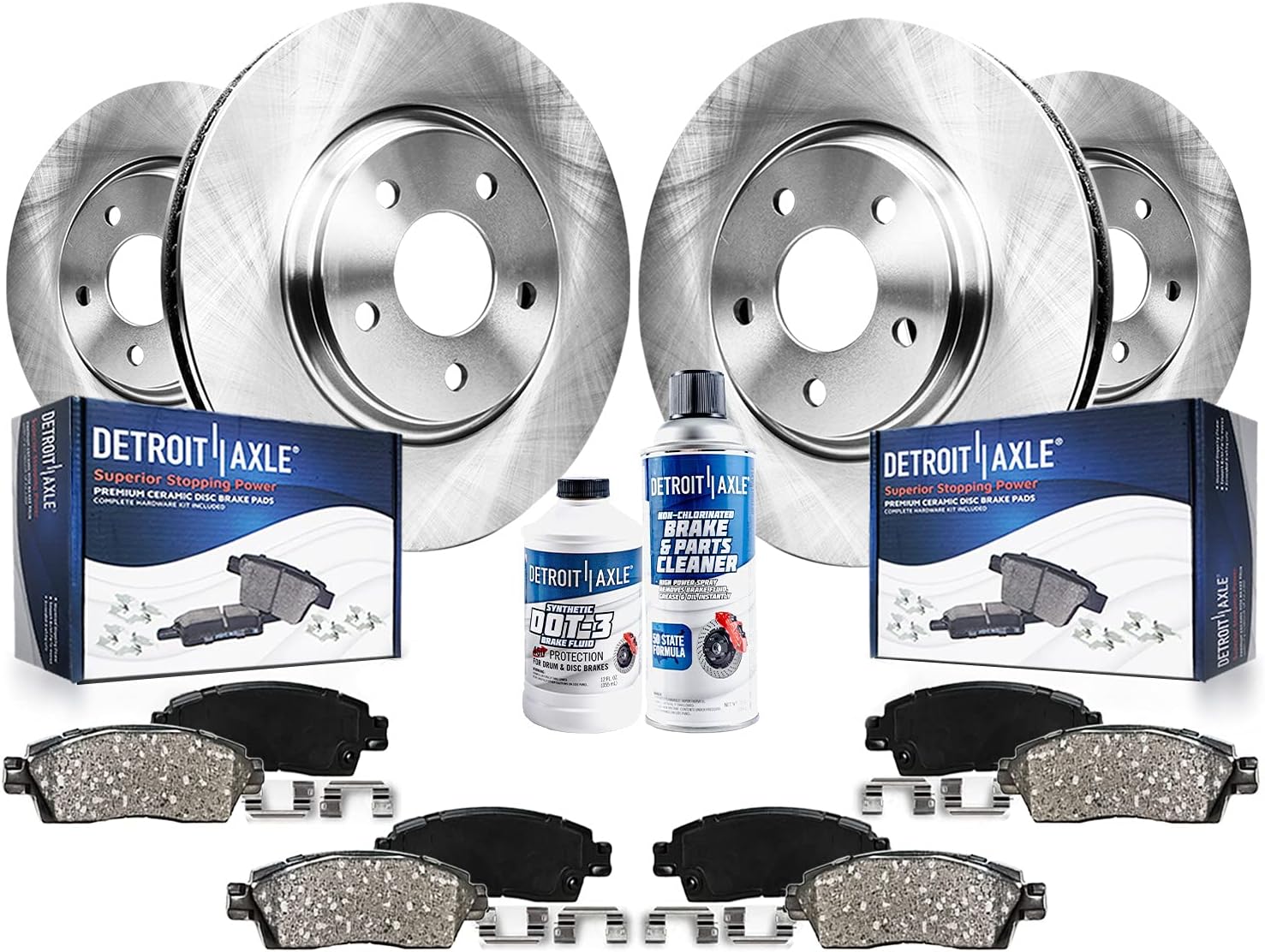
| Fitment rotor sizes | Front 12.68 in / Rear 11.81 in |
|---|---|
| Pad type | Ceramic |
| Includes | Front and rear rotors, front and rear pads, hardware, brake cleaner, brake fluid |
| Rotor feature | Vented with zinc plating |
This Detroit Axle brake kit supplies both front and rear rotors plus matching ceramic pads, hardware, a 10oz brake cleaner, and a 12oz bottle of brake fluid so you can replace the whole braking set in one service. It is intended for Mercedes-Benz E350 and C350 models equipped with the Sport Package and the specified 12.68 inch front and 11.81 inch rear rotors. The rotors are vented and zinc plated to help cooling and resist surface corrosion while the pads are ceramic to reduce dust and deliver quiet operation. Included locating holes and factory-style machining make installation straightforward for a competent DIYer or a shop, and the package aims to meet factory-spec fit and finish. Buyers should expect a budget-oriented aftermarket option: some users report surface rusting quickly or occasional squeal, so finish and long-term corrosion resistance are not at premium levels compared with higher-end rotors. The kit is useful for restoring stopping performance and convenience, but not aimed at performance braking or show-quality appearance.
Best for: Reliability-focused buyers who prioritize a complete, ready-to-install brake replacement that restores safe stopping without premium pricing or cosmetic emphasis.
Less Ideal for: Buyers seeking high-performance track braking, show-quality rotors, or the longest-lasting corrosion protection should consider higher-end or specialty rotor options instead.
- Complete kit includes front and rear rotors, ceramic pads, installation hardware, brake cleaner, and brake fluid for a single purchase.
- Vented rotors and machined locating holes support cooling and straightforward, factory-style fitment during installation.
- Zinc plating on the rotors helps reduce visible corrosion and wheel-surface contamination compared with plain raw rotors.
- Budget-oriented finish may show surface rust quickly and is not cosmetic-grade.
- Some users have reported squeal or noise with the pads on a subset of installations.
Verdict: A turnkey, reliability-minded brake kit that replaces front and rear rotors and pads to restore safe, factory-style braking on specified Mercedes-Benz Sport Package models.
6. Detroit Axle Rear Drilled & Slotted Brake Rotors (Rear, 11.81")

| Fitment | Vehicle specific fit for select Mercedes‑Benz C300/C350e/C400/E300/E350 (rear) |
|---|---|
| Rotor Type | Drilled & slotted, vented |
| Diameter | 11.81 inch (300mm) rear rotor diameter |
| Material Type | Ceramic |
These Detroit Axle rear drilled and slotted rotors are a direct replacement option for compatible Mercedes‑Benz E‑Class and C‑Class rear applications. Sold as a two‑piece kit, the rotors use vented construction and drilled plus slotted faces to help dissipate heat and clear water or debris during repeated stopping. Zinc plating reduces visible corrosion and wheel dust, while machined locating holes are intended to drop into place without modification. In practice this makes them convenient for a DIY brake job or quick shop swap: they bolt on like factory pieces, seat quickly with new pads, and offer improved cooling under heavier braking compared with plain rotors. Limitations to note are typical of performance‑style rotors: drilled surfaces can be more prone to cracking under extreme track use and they may squeal more with some pad compounds. Also they are a rear specific fit so front braking upgrades require different parts.
Best for: Convenience‑driven owners who prioritize an easy, factory‑style replacement that improves cooling and installs quickly without extensive modification.
Less Ideal for: Enthusiasts who need track‑rated, high‑cycle rotors or buyers looking for a front/rear matched performance package in one purchase.
- Drilled and slotted face improves cooling and helps evacuate gas, water, and debris for more consistent braking under load.
- Zinc plating resists surface corrosion and reduces noticeable wheel dust for a cleaner appearance over time.
- Vented construction and OEM‑style locating holes aim for straightforward fitment and quicker installation.
- Sold as a two‑rotor kit so both rear wheels are updated together for balanced braking.
- Drilled rotors are less suitable for extreme track or heavy repeated high‑heat use due to higher cracking risk.
- May produce more brake noise with certain pad compounds compared with plain rotors.
Verdict: A convenient, factory‑style drilled and slotted rear rotor kit for Mercedes‑Benz that improves cooling and fitment for DIY or quick shop replacements, but not intended for extreme track use.
7. PowerStop K7830 Z23 Carbon-Fiber Ceramic Brake Pad and Drilled & Slotted Rotor Kit

| Fits Vehicles | Mercedes‑Benz E350 and E400 (listed years with OE drilled rotors) |
|---|---|
| Pad Type | Z23 Carbon-Fiber Ceramic |
| Rotor Style | Drilled & Slotted, zinc plated |
| Included Components | Front and rear rotors, front and rear pad sets, hardware, sensors |
This PowerStop K7830 kit combines Z23 carbon-fiber ceramic brake pads with drilled and slotted rotors and all necessary stainless-steel hardware to replace both front and rear brakes on compatible Mercedes‑Benz E‑Class models. It is intended as a bolt-on upgrade: the kit includes pads, rotors, rubberized shims, sensors, and installation hardware so you can swap the factory components without modifications. The Z23 pad formula is designed for lower dust and quiet operation while still improving stopping performance over factory parts, and the drilled and slotted rotors help dissipate heat and clear debris for more consistent braking under heavier use. Zinc plating on the rotors reduces visible corrosion over time. Because the kit is a complete set, it simplifies service and avoids hunting for matching parts. Expect a significant improvement in feel and cooling over stock brakes, particularly for drivers who occasionally demand more from their E‑Class without moving to full track compounds. This is not a race-only kit, so extreme track users may prefer higher-temperature dedicated performance rotors and pads.
Best for: Risk-averse mainstream buyers who want a reliable, factory-quality brake upgrade for Mercedes‑Benz E‑Class that improves stopping and reduces dust without radical changes to daily drivability.
Less Ideal for: Drivers seeking purpose-built track components or those who need aftermarket parts for vehicles outside the specified E350/E400 model years should consider other options.
- Complete front-and-rear kit includes pads, rotors, sensors, shims, and stainless-steel hardware for straightforward bolt-on installation
- Z23 carbon-fiber ceramic pads reduce brake dust and noise while improving stopping performance over factory pads
- Drilled and slotted rotors improve cooling and help clear gas and debris for more consistent braking
- Zinc plating on rotors offers corrosion resistance to help maintain appearance over time
- Not optimized for extreme track use where specialized high-temperature materials would perform better
- Kit fitment is specific to certain E350 and E400 model years and rotor types so checking compatibility is required
Verdict: A turnkey, lower-dust brake upgrade for Mercedes‑Benz E350/E400 owners who want improved stopping and cooling without sacrificing daily comfort.
Choosing the Right Mercedes-Benz E-Class Brake Rotors: Key Factors to Consider
Material and Casting Method
Rotor material and how it is cast determine thermal conductivity, strength, and susceptibility to cracking. High-quality castings with uniform grain structure tend to dissipate heat more evenly, which reduces the chance of hot spots that lead to warping or cracking. Certain alloy formulations offer better resistance to thermal fatigue in repeated stop-and-go situations.
Also consider whether the rotor has been stress-relieved after casting. Stress relief reduces internal tensions that can cause uneven wear or early failure. While material choice does not eliminate wear entirely, it significantly affects how long a rotor maintains flatness and consistent performance under normal driving conditions.
Dimensional Accuracy and Runout
Accurate diameter, thickness, and mounting bore dimensions are essential for a proper fit and to prevent vibration. Excessive lateral runout or incorrect hub bore sizing can transmit uneven forces to pads and bearings, causing pulsation at the brake pedal or steering wheel. Measuring tolerances for runout and thickness variance indicates manufacturing quality.
Look for rotors specified to OEM tolerances or with published runout figures. Consistent dimensions also simplify installation and reduce the need for resurfacing or additional machining. If you rely on a shop for installation, accurate rotors reduce labor time and alignment issues during the brake service.
Surface Design and Finish
The rotor contact surface and overall finish influence initial bedding, pad mating, and corrosion resistance. Smooth, machined surfaces typically promote predictable pad transfer and steady braking feel. Some surface treatments or coatings protect mating surfaces from rust, which can make future removal easier and preserve balanced braking forces across the rotor face.
When selecting a rotor, consider whether the surface is plain, slotted, or has a specific pattern, and how that interacts with common pad materials. A high-quality finish reduces the chance of uneven pad deposits that cause judder or noise during braking.
Ventilation and Heat Dissipation
For vehicle safety and consistent performance, rotors must shed heat efficiently during repeated braking. Ventilated rotors have internal vanes that channel air to cool the rotor core; the design and vane profile influence cooling effectiveness. Poor heat dissipation raises the risk of brake fade and accelerates wear of both rotors and pads.
Consider driving patterns: frequent highway braking, towing, or spirited driving raises thermal demand. In such cases, rotors with robust ventilation or higher thermal mass can sustain braking performance longer between maintenance intervals. However, increased mass may affect unsprung weight and feel, so balance cooling needs with overall vehicle dynamics.
Compatibility With Brake Pads and Hardware
Rotors must be compatible with the pad compounds typically used on Mercedes-Benz E-Class applications and with the existing caliper hardware. Some rotor finishes or designs work better with organic, semi-metallic, or ceramic pads in terms of bedding and noise. Mismatched rotor-pad pairings can lead to accelerated wear, poor initial bite, or squeal.
Also verify that the rotor accepts existing retaining hardware and that any additional shims or anti-rattle clips are supported. Choosing rotors designed for the vehicle's caliper configuration helps avoid rework during installation and preserves braking balance across all wheels.
Maintenance, Resurfacing, and Longevity
Understanding maintenance needs and the rotor's resurfacing limits helps plan long-term ownership costs. Many rotors have a minimum service thickness below which they must be replaced. Knowing how to measure rotor thickness and what constitutes acceptable wear protects against unsafe operation. Resurfacing can restore a rotor surface in some cases, but repeated machining reduces thickness and shortens service life.
Assess corrosion protection and whether the rotor uses replaceable hats or hardware that can extend usable life. Consider environmental factors like road salt and frequent moisture, as these will accelerate rust and may necessitate more frequent inspection and replacement.
How We Chose the Best Mercedes-Benz E-Class Brake Rotors
We prioritized rotors that match Mercedes-Benz E-Class factory dimensions and mounting interfaces to ensure correct fitment without modification. Material construction was a core filter, focusing on alloys and casting methods that offer consistent heat dissipation and resistance to warping under typical driving conditions. Balance and runout tolerances were considered to reduce vibration and steering feedback after installation. We also evaluated rotor surface treatments and coatings that limit corrosion in climates prone to road salt or humidity.Additional criteria included compatibility with common pad compounds and brake hardware, consistent thickness within manufacturer tolerances, and availability of replacement mounting components. We excluded options that require custom machining, significant hub modification, or that lack documented dimensional specifications. Products without clear fitment data for specific Mercedes-Benz E-Class model years were not considered. The resulting list highlights rotors that combine reliable material quality, accurate fitment, and practical durability for everyday driving demands.
Our full evaluation process is outlined in our review methodology.
FAQ
How do I know when Mercedes-Benz E-Class brake rotors need replacement?
Brake rotor wear often shows up as vibration at the pedal or steering wheel during braking, uneven pad wear, or visible scoring on the rotor surface. You can measure rotor thickness with a micrometer and compare it to the vehicle's minimum service specification. If vibration persists after pad replacement or the rotor is below minimum thickness, replacement is usually necessary.
Can I resurface E-Class rotors instead of replacing them?
Resurfacing can be appropriate when rotors are within thickness limits and have only minor scoring or runout. However, each resurfacing removes material and reduces the rotor's usable life. If the rotor is near its service limit, has significant heat cracking, or structural defects, replacement is the safer option. Follow the vehicle's minimum thickness specification when deciding.
Are slotted or drilled rotors better for everyday Mercedes-Benz E-Class driving?
For everyday driving, plain or lightly slotted rotors typically offer predictable bedding and low noise. Slotted or drilled designs can aid initial pad cleaning and water evacuation, but they may increase pad wear or be more susceptible to cracking under extreme thermal stress. Choose a surface design that aligns with your driving style and braking demands.
How should I measure rotor thickness correctly?
Use a precision micrometer or caliper to measure the rotor at multiple points on the friction surface, avoiding the hat or ventilation vanes. Record several measurements and use the lowest value to compare with the vehicle's minimum service thickness. Measure after cleaning the surface and with the wheel removed for access and accuracy.
Will changing rotors affect brake feel or pedal travel?
Installing rotors with accurate runout and the correct thickness restores a firm, consistent pedal and reduces vibration. However, differences in rotor mass or surface finish can slightly alter pedal modulation and brake bite. Proper bed-in of pads to the new rotor surface typically evens out feel after installation.
Do I need new hardware when replacing rotors on an E-Class?
Inspect retaining clips, anti-rattle hardware, and wheel hub mating surfaces during a rotor job. Some installations benefit from replacing worn hardware to ensure correct alignment and prevent noise. While not always mandatory, fresh hardware reduces the chance of installation-related issues and helps maintain consistent brake performance.
Conclusion
Choosing the right rotors for a Mercedes-Benz E-Class comes down to matching accurate fitment, suitable material construction, and the surface design that meets your driving demands. Prioritize rotors that meet OEM dimensional tolerances, offer adequate heat dissipation for your usage pattern, and pair well with your chosen pad compound.Balance longevity and maintenance needs against thermal performance. If you drive in harsh environments or perform frequent hard braking, favor rotors with robust ventilation and corrosion-resistant finishes. For typical daily driving, focus on accurate fitment and a stable surface finish to maintain predictable braking feel.
Explore More:
- Check out all Mercedes-Benz E-Class parts & accessories
- Explore Brake Rotors Maintenance & Repair Guides
- Explore Brake System
- Browse all Auto Parts
