

Note: This article contains affiliate links. If you click on these links and make a purchase, I may earn a small commission at no extra cost to you. This helps support my research and content. Read my full affiliate disclosure here.
If you drive a Hyundai Santa Fe, the transmission cooler line is a small component that plays a big role in transmission health. A properly functioning cooler line keeps fluid temperatures in a safe range, reduces wear, and lowers the risk of premature transmission problems. This guide covers seven shortlisted transmission cooler lines chosen for durability, ease of installation, and leak resistance. Below you will find what we evaluated and the key features to consider before you replace or repair a cooler line.
Looking for other parts? See all Hyundai Santa Fe parts & accessories.
Top Picks at a Glance
| Best overall The best all-around choice for most situations | Generic 6AN 70" Stainless Steel Braided Transmission Cooler Line Kit |  |
| Best Quality Built to a higher standard if you want something more solid | H-Jun Transmission Cooler Oil Tube Connector Set (Thread M16x1.5) for Hyundai Santa Fe / Kia Sorento |  |
| Best Value The sweet spot between price and what you get | Generic 52" Stainless Steel Braided AN6 Transmission Cooler Line Kit |  |
| Most Popular A crowd favorite that many people choose with confidence | EVIL ENERGY 3/8" Transmission Oil Cooler Hose, 5 ft, SAE J1532 |  |
| Best Seller A high-volume bestseller chosen again and again | EVIL ENERGY 3/8" Transmission Oil Cooler Hose, 10 ft, SAE J1532 |  |
1. Generic 6AN 70" Stainless Steel Braided Transmission Cooler Line Kit

| Material | Stainless Steel braided with PTFE core |
|---|---|
| Length | 70 Inches |
| Fitting size | AN6 |
| Includes | 90-degree fittings and swivel ends |
This kit supplies two 70-inch PTFE inner hose lines with stainless steel braid and AN6 fittings so you can route aftermarket or replacement transmission cooler lines. Installers use it to rebuild hard-to-find factory lines or to add an auxiliary cooler for towing and heavy use. The braided stainless exterior offers abrasion and heat resistance while the PTFE core keeps fluid flow smooth; the kit also includes 90-degree fittings and swivel ends for easier routing around tight chassis areas. In practice the lines are flexible enough to shape through engine bays yet hold pressure well when properly tightened. Quality control appears mixed across units so expect to check fittings and threads before install and keep thread sealant or matching adapters on hand for some factory connections. Because this is a universal AN6 setup you may need additional adapter fittings to match Hyundai Santa Fe factory ports or to preserve original quick-disconnect plumbing. For buyers who want a durable, serviceable replacement or an upgrade for towing cooling, the kit delivers value, but those seeking a vehicle-specific, drop-in OE-style hose may prefer a purpose-made Santa Fe line instead.
Best for: Balanced all-round buyers who want a cost-effective, durable way to replace worn transmission lines or add an auxiliary cooler for towing and everyday driving and who are comfortable fitting adapters or doing moderate plumbing work.
Less Ideal for: Buyers seeking a factory-style, vehicle-specific direct replacement for a Hyundai Santa Fe with no modification or extra fittings should consider a purpose-built Santa Fe kit instead.
- Stainless steel braid and PTFE core resist abrasion, heat, and corrosion.
- Includes swivel ends and 90-degree AN6 fittings to simplify routing in tight spaces.
- Long 70-inch length accommodates longer runs or custom routing for auxiliary coolers.
- Holds high hydraulic pressure when fittings are correctly installed.
- Universal AN6 fittings make the kit adaptable with common adapters and aftermarket coolers.
- Universal AN6 sizing means additional adapters or fittings are often required to mate with factory ports.
- Some buyers report inconsistent quality control and occasional damaged or previously used parts on arrival.
- Not a vehicle-specific, drop-in assembly so extra measuring and fitting work is usually needed.
Verdict: A versatile, durable AN6 braided cooler line kit that works well for custom routing or adding an auxiliary cooler but requires adapters and fitment work for a Hyundai Santa Fe.
2. H-Jun Transmission Cooler Oil Tube Connector Set (Thread M16x1.5) for Hyundai Santa Fe / Kia Sorento

| Thread | M16x1.5 |
|---|---|
| Fitment | Hyundai Santa Fe 2010-2014, Kia Sorento 2011-2013 |
| Quantity | 2 pieces |
| Material | Brass |
This H-Jun connector set replaces the transmission oil cooler line fittings on specified Hyundai Santa Fe and Kia Sorento models and is supplied as a pair. Made from brass, the fittings are intended as direct factory-quality replacements when a damaged or mismatched cooler line connector needs swapping, and they install inline with the vehicle's existing cooler hoses and fittings. The listing highlights compatibility with several model years and includes a size chart to confirm the M16x1.5 thread fits your vehicle or aftermarket radiator. Practical benefits are corrosion resistance and mechanical durability from the brass construction plus the convenience of receiving both connectors in one package. Limitations are that fit depends on verifying the thread size and that changes to an aftermarket radiator or line routing may require a different fitting size, so measure before ordering. The product is straightforward for a competent DIYer or technician to install but offers no additional adapters or seals beyond the two connectors.
Best for: Performance-oriented buyers who prioritize reliable, factory-quality replacement parts to maintain or restore transmission cooling on tuned or regularly driven Santa Fe and Sorento vehicles.
Less Ideal for: Shop owners or owners with extensively modified cooling systems who need a universal adapter solution or aftermarket-specific fittings should consider other options.
- Brass construction provides corrosion resistance and good wear durability
- Sold as a pair so both cooler line connections can be serviced at once
- Manufactured to match factory thread M16x1.5 for direct replacement on listed models
- Includes a size chart to confirm fit with replaced radiators or aftermarket lines
- Compatibility depends strictly on matching thread size so it may not fit vehicles with modified or aftermarket radiators
- Does not include extra seals, adapters, or hoses that some repairs may require
Verdict: A durable brass, factory-style two-piece connector set that restores correct transmission cooler line fittings for the listed Santa Fe and Sorento models.
3. Generic 52" Stainless Steel Braided AN6 Transmission Cooler Line Kit
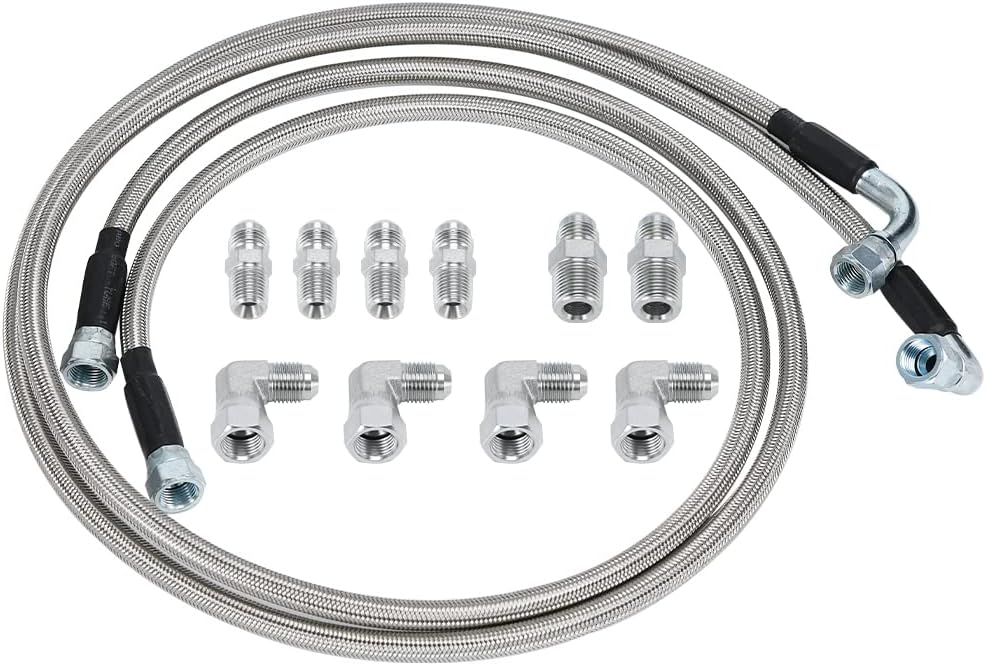
| Material | Stainless Steel and PTFE |
|---|---|
| Size | 52inch |
| Fitting Type | AN6 adapters and 90-degree fittings |
| Compatible Transmissions | Turbo 350, Turbo 400, Turbo 200/200R4, Power Glide, 700R4, 4L60/4L60E/4L65E, 4L80E, Ford C4/C6/AOD |
This kit supplies stainless steel braided PTFE lines, AN6 fittings and several 90-degree adapters to create a transmission cooler circuit where one is missing or to replace worn factory lines. Typical use is routing the two hoses from the transmission to an external cooler or radiator cooler and connecting with the included adapters and inserts. The stainless braid and PTFE core deliver good flexibility and abrasion resistance while the swivel fittings simplify routing in tight engine bays. Practical benefits include improved cooling capacity for towing or heavy driving and a relatively low-cost way to refresh deteriorated hard lines or add an aftermarket cooler. Limitations are its universal AN6 focus and mixed quality control reported by users; some installers needed additional adapter fittings for exact-fit connections and a few received items with damaged threads or incorrect lengths. The kit is best for someone comfortable verifying fittings and adding small adaptor parts during installation rather than expecting a guaranteed bolt-in replacement for a specific vehicle.
Best for: Practical optimizers who want an affordable way to add a transmission cooler or replace degraded cooler lines and who are willing to adapt fittings during installation to get a working system.
Less Ideal for: Buyers seeking a guaranteed direct-fit, factory-quality replacement for a specific model without sourcing any extra adapters or hoses should choose a model-specific kit or dealer-supplied lines instead.
- Stainless steel braid over PTFE core for abrasion and heat resistance.
- Includes multiple AN6 swivel fittings and 90-degree adapters to aid routing.
- Long 52-inch hose length suits many routing paths without splicing.
- Helps add or improve transmission cooling for towing and heavy use.
- Relatively low-cost option to replace rotted or leaking lines.
- Universal AN6 fittings may require additional adapters to match factory connections.
- Quality control varies between batches with occasional damaged threads or wrong lengths.
- Not a guaranteed bolt-in kit for specific vehicle models.
Verdict: A budget-friendly stainless braided AN6 line kit that works well if you can adapt fittings and accept occasional QC issues rather than expecting a vehicle-specific bolt-in fit.
4. EVIL ENERGY 3/8" Transmission Oil Cooler Hose, 5 ft, SAE J1532

| Material Type | Chlorinated Polyethylene (Cpe) |
|---|---|
| Specification | SAE J1532 |
| Working Pressure | 250psi |
| Burst Pressure | 1000psi |
| Temperature Range | -40°F to 257°F |
This EVIL ENERGY 3/8" transmission oil cooler hose is a flexible replacement line intended to connect an oil cooler to a transmission or cooler loop. Made from chlorinated polyethylene (CPE) and built to SAE J1532, it is rated for a 250 psi working pressure and a 1000 psi burst pressure, so it suits typical passenger-car cooler circuits. The hose tolerates a wide temperature range from -40°F to 257°F and resists oil and heat, which helps maintain service life under everyday driving and light towing. Its 85.5 mm minimum bend radius lets you route the line in tight engine bays without kinking if installed with reasonable radii. Trade-offs are that this is a raw hose without fittings or preformed ends, so installation requires clamps or fittings and some trimming for a proper fit, and the generic fit means you must verify connectors for a Scion xB application. For reliability-focused buyers who want a durable, factory-quality replacement hose, this is a straightforward, well-specified option when paired with the correct fittings and careful installation.
Best for: Reliability-focused DIY owners who prioritize a durable, factory-spec replacement hose for oil cooler circuits and are comfortable adding fittings and making precise installations.
Less Ideal for: Buyers seeking a complete plug-and-play assembly with factory-matched fittings or a vehicle-specific preformed line should consider purpose-made kits instead.
- Constructed from CPE for good oil and heat resistance.
- SAE J1532 specification with 250 psi working and 1000 psi burst pressure.
- Wide operating temperature range for durability in varied climates.
- 5-foot length provides flexibility for routing and replacements.
- Sold as bare hose without fittings or preformed ends, requiring additional clamps or connectors.
- Generic hose requires checking connector compatibility for Scion xB applications.
Verdict: A heavy-duty, SAE-rated 3/8" oil cooler hose built for reliable, heat- and oil-resistant service when fitted correctly.
5. EVIL ENERGY 3/8" Transmission Oil Cooler Hose, 10 ft, SAE J1532

| Material Type | Chlorinated Polyethylene (CPE) |
|---|---|
| Item Length | 10 Feet |
| Inner Diameter | 3/8 inch (9.5mm) |
| Working Pressure | 250 psi |
| Burst Pressure | 1000 psi |
This EVIL ENERGY 3/8" transmission oil cooler hose is a flexible replacement line intended for connecting an oil cooler to a transmission. Made from chlorinated polyethylene (CPE) and produced to SAE J1532 guidance, it is rated for 250 psi working pressure and a 1000 psi burst pressure, which suits normal transmission cooling circuits. The 10-foot length and 3/8" internal diameter make it practical for routing and trimming during installation; its temperature range (-40°F to 257°F) and oil and heat resistance mean it will withstand underhood conditions. Installers will appreciate the nominal wall thickness and minimum bend radius information for avoiding kinks when routing. The hose is a simple, service-friendly replacement but lacks built-in fittings or pre-installed ends, so buyers must supply clamps or connectors and be comfortable cutting and flaring as needed. It is intended as a direct flexible line rather than a complete kit, so professional installation or solid DIY skills are recommended for a leak-free result.
Best for: Risk-averse mainstream buyers seeking a reliable, factory-quality replacement hose for routine transmission cooler repairs who prioritize documented specifications and service durability.
Less Ideal for: Buyers wanting a ready-to-install kit with fittings and clamps or those who prefer a pre-formed, vehicle-specific hose should consider alternatives that include end connectors or vehicle-specific assemblies.
- Constructed from CPE for oil and heat resistance suitable for transmission cooling circuits
- SAE J1532 specification with 250 psi working and 1000 psi burst pressure for typical service conditions
- Long 10 ft length allows flexible routing and trimming to fit different installations
- Wide temperature range (-40°F to 257°F) supports cold starts and high underhood temperatures
- Ships as hose only with no pre-attached fittings or clamps included
- Minimum bend radius requires care when routing to avoid kinks
Verdict: A long, SAE-grade CPE transmission hose built for reliable, serviceable oil cooler connections.
Choosing the Right Hyundai Santa Fe Transmission Cooler Line: Key Factors to Consider
Material and Corrosion Resistance
The base material and any protective coating determine how well a cooler line stands up to road salt, moisture, and heat cycles. Metal lines with robust corrosion-resistant plating or stainless steel construction generally last longer than untreated metals. Rubber or braided hose sections should use materials rated for transmission fluid exposure and high temperatures to prevent swelling or breakdown.
Corrosion leads to pitting and eventual leaks, so prioritize materials and finishes that match your local climate and driving conditions. If you live in an area with heavy road salt use, a more corrosion-resistant option will reduce the likelihood of premature failure and the need for frequent replacements.
Fittings and Connection Integrity
Secure, properly sized fittings are critical to prevent seepage at junctions. Look for lines with factory-style fittings or clearly specified adapter types to ensure a tight seal without excessive force. Flare fittings, O-ring seals, and crimped ferrules each behave differently under pressure and heat, so choose the connection style that aligns with the vehicle's original system.
Poorly designed or mismatched fittings can cause slow leaks that are hard to detect until they cause low fluid levels. A reliable fitting design reduces the risk of fluid loss, keeps system pressure stable, and simplifies installation or repairs.
Flexibility and Routing Requirements
Transmission cooler lines may need to navigate tight engine bays and withstand vibration. A line that is too stiff can be difficult to install or may rub against nearby components, causing wear. Conversely, a line that is too flexible might balloon under pressure or fail to hold a secure connection.
Consider the routing path on the Hyundai Santa Fe and choose a line with appropriate bendability and length. Pre-formed hard lines can save installation time when they match factory routing, while hose sections may be preferable where movement and vibration are factors.
Heat and Pressure Ratings
Transmission systems operate at elevated temperatures and pressures, so a cooler line must be rated to handle both. Check manufacturer-specified temperature ranges and maximum working pressures to ensure the line will not degrade or swell under normal and heavy-load conditions. Higher heat tolerance reduces the risk of fluid breakdown and component fatigue.
A line with inadequate ratings can fail when the transmission is under stress, causing overheating and potential internal damage. Choose lines built to handle the peak conditions your driving habits generate, such as towing or frequent stop-and-go traffic.
Leak Detection and Maintenance Ease
Some lines and fittings are designed to make leaks easier to spot and to simplify routine checks. Features like clear routing away from high-heat areas, visible fittings, or included inspection ports can reduce diagnostic time. Additionally, consider how easy it is to access and service the line without removing major components.
Easier maintenance lowers downtime and labor when a leak repair or replacement is needed. If regular inspections are part of your maintenance routine, pick a solution that keeps fittings and sections accessible and minimizes disassembly.
Installation Requirements and Tooling
Installation complexity influences both labor time and the chance of installation-related problems. Some cooler lines are direct-fit with factory connectors, enabling straightforward replacement. Others may require flaring, crimping, or specialty tools for secure attachment.
If you plan to install the line yourself, select options that match the tools you have or include hardware that simplifies the process. Professional installers will weigh tool requirements against labor costs, but minimizing specialized steps reduces the likelihood of improper installation that can lead to leaks.
How We Chose the Best Hyundai Santa Fe Transmission Cooler Line
We evaluated options that specifically fit the Hyundai Santa Fe and focused on attributes that matter most for long-term transmission performance. Our selection criteria prioritized material and construction quality, such as corrosion resistance and wall thickness, to reduce the chance of rupture or seepage. We also assessed connector types and fitting standards to ensure secure, leak-free joints and compatibility with factory ports. Ease of installation was a factor, including whether the line required special tools or complex routing. Finally, we considered warranty coverage and documented manufacturing quality controls. We excluded any items that did not specify compatibility with the Hyundai Santa Fe or that lacked clear materials and fitting specifications. Products with known fitment issues or inadequate sealing designs were not considered. The resulting list reflects units that met our practical standards for durability, leak resistance, and straightforward replacement or repair scenarios.
Our full evaluation process is outlined in our review methodology.
FAQ
How do I know if my Hyundai Santa Fe transmission cooler line is leaking?
Common signs include low transmission fluid levels, a visible drip or wetness near the line connections, or transmission fluid stains under the vehicle. You may also notice a burning smell if fluid contacts hot components. Inspect the routing and fittings for wetness and check fluid levels regularly to confirm a leak.
Can I replace a transmission cooler line myself on a Hyundai Santa Fe?
Many cooler line replacements are possible for a competent DIYer with basic mechanical skills. You will need the correct replacement line, the right fittings, and possibly flaring or crimp tools depending on the design. Ensure you have adequate access, support the vehicle safely, and follow proper fluid handling and disposal procedures.
When should I choose a hose section versus a hard line for the cooler circuit?
Hose sections offer flexibility and can absorb vibration and movement, which helps in areas with engine motion. Hard lines provide durability and are less prone to abrasion when routed along fixed paths. The best choice depends on the specific routing and whether the area needs flexibility or long-term abrasion resistance.
What maintenance helps prevent transmission cooler line failures?
Regularly inspect lines and fittings for signs of wear, corrosion, or seepage, and monitor transmission fluid levels and condition. Keep routing clear of sharp edges and replace protective clips or grommets as needed. Address any minor leaks promptly to avoid contaminating the cooling system or losing significant fluid.
Are aftermarket cooler lines reliable for a Hyundai Santa Fe?
Aftermarket lines can be reliable when they match the vehicle's specifications and use quality materials and fittings. Check for clear fitment information, appropriate pressure and temperature ratings, and positive manufacturing quality indicators. Avoid components that lack documentation about materials or connector types.
Conclusion
Choosing the right transmission cooler line for a Hyundai Santa Fe means balancing durability, proper fittings, and suitable routing. Prioritize corrosion-resistant materials and secure connector designs to reduce the chance of leaks, and match heat and pressure ratings to your driving demands. Consider whether pre-formed hard lines or flexible hose sections better suit the routing on your vehicle, and factor installation complexity into your decision. Regular inspection and prompt repair of any leaks will extend transmission life and reduce the risk of more serious damage.
Explore More:
- Check out all Hyundai Santa Fe parts & accessories
- Explore Transmission Cooler Lines Maintenance & Repair Guides
- Explore Transmission & Drivetrain
- Browse all Auto Parts
