

Note: This article contains affiliate links. If you click on these links and make a purchase, I may earn a small commission at no extra cost to you. This helps support my research and content. Read my full affiliate disclosure here.
If you own a Dodge Challenger, the right fuel injector can noticeably affect drivability, throttle response, and fuel metering. Faulty or worn injectors can cause hesitation, rough idle, or lower performance, while correct replacements restore consistent fuel delivery and engine smoothness. This guide highlights seven shortlisted fuel injectors chosen for fitment and flow reliability and explains the practical factors that matter when selecting units for your Challenger. Read on for the evaluation criteria and what to look for when choosing an injector for reliable day-to-day performance.
Looking for other parts? See all Dodge Challenger parts & accessories.
Top Picks at a Glance
| Best Reviewed A top-rated pick with lots of positive feedback | YLB.&co Replacement Fuel Injectors (6-pack) for Dodge Challenger 3.6L |  |
| Most Popular A crowd favorite that many people choose with confidence | RLP Fuel Injectors 0280158233 Compatible with 3.6L Dodge Challenger (set) |  |
| Best Quality Built to a higher standard if you want something more solid | SHOCKENT Upgraded Fuel Injectors (05037479AA) — 8‑pack for 5.7L HEMI |  |
| Best Budget The cheapest option that still gets the job done reliably | Yongtoparts 0280158233 Replacement Fuel Injectors 6-Pack |  |
| Most Sold A high-volume bestseller chosen again and again | Bosch 62410 Fuel Injector (single) |  |
| Best Value for Money The sweet spot between price and what you get | TAUTOY FJ732 Fuel Injectors (8-Pack) for 5.7L Dodge Challenger |  |
| Best Overall The best all-around choice for most situations | A-Premium Fuel Injectors (0280158233) Compatible with Dodge Challenger 3.6L |  |
1. YLB.&co Replacement Fuel Injectors (6-pack) for Dodge Challenger 3.6L

| Compatible Engine | 3.6L V6 |
|---|---|
| Quantity | 6 pieces |
| Replaces Part Numbers | 0280158233, 800-2183N, 5184085AD, FJ1147 |
| Inlet/Outlet Connection | Threaded 0.75 Inches |
These YLB.&co fuel injectors are a direct-replacement style unit sold as a six-pack for the 3.6L V6 used in Dodge Challengers. They are intended to restore proper fuel spray by using laser-drilled multi-porous tips for finer atomization and include fluororubber seals to reduce the chance of leaks in the engine bay. In practical use they replace worn or leaking injectors to eliminate misfires, rough idle, and hesitant throttle response and can be installed as a batch when doing a tune-up or fuel system refresh. The injectors are offered as compatible replacements for the factory part number listed on Challengers from the 2011 to 2017 model years. Expect modest improvements in idle smoothness and throttle feel if the originals were degraded, but fitment depends on confirming the original part number and the included O-ring sizing may need attention during installation. These are aftermarket replacements aimed at getting a 3.6L Challenger back to reliable running rather than a performance upgrade or calibrated high-end injector set.
Best for: Reliability-focused Challenger owners who prioritize restoring factory drivability and stopping misfires by replacing aging injectors with a budget-conscious, full-set solution.
Less Ideal for: Drivers seeking performance-tuned injectors, bespoke flow matching, or motorsport upgrades should look for purpose-built high-flow options or professional calibration instead.
- Sold as a complete six-injector set to replace all cylinders at once
- Laser-drilled multi-porous tips for finer fuel atomization
- Fluororubber sealing rings designed for long-term oil and heat resistance
- Advertised to match common factory replacement part numbers for the 3.6L V6
- Aftermarket unit so flow characteristics may vary slightly from factory parts
- O-rings on some units may require swapping or adjustment during install
- Not a calibrated high-flow or performance injector—intended for restoration, not tuning
Verdict A practical, reliability-oriented six-pack replacement for Challenger 3.6L injectors that restores factory-style fuel delivery but is not a performance upgrade.
2. RLP Fuel Injectors 0280158233 Compatible with 3.6L Dodge Challenger (set)

| Coil Resistance | 12±1 Ohms |
|---|---|
| Static Flow Rate | 207.8±4% g/min |
| Orifice Type | 4 Holes |
| Sealing Performance | 0.4Mpa leakage<3ml/min |
These RLP fuel injectors are sold as a replacement set for 3.6L Dodge Challenger engines and are intended to restore lost power, eliminate misfires, and improve fuel atomization. They install like a factory replacement and are used in routine repairs when original injectors wear or leak. Notable features include a 4-hole orifice for finer spray, a basket inlet filter, preinstalled O-rings, and 12 ohm coil resistance with tested static flow around 207.8 g/min. In practice the 4-hole spray and controlled flow can sharpen throttle response and reduce rough idle when worn injectors are the cause. Several users report straightforward fit and measurable fuel economy gains after installation. Expect variability: while many buyers found the parts to be reliable and easy to install, a minority reported leaks or misfires that required swapping back to factory parts. The product aims to match factory specifications but some vehicles may be sensitive to non-factory injectors, so bench-testing and careful installation are advisable.
Best for: Convenience-driven Challenger owners who want a drop-in repair that restores drivability quickly without dealer service and prefer a ready-to-install replacement.
Less Ideal for: Owners seeking guaranteed factory-identical performance for high-performance builds or mission-critical reliability should consider sourcing factory-quality injectors or dealer parts instead.
- Direct-replacement fit for 3.6L Dodge Challenger engines that typically installs without modification
- Four-hole spray pattern and tested flow rate for improved fuel atomization and smoother idle
- Preinstalled O-rings and inlet basket filter reduce prep time and make installation cleaner
- Manufacturer flow and leakage testing reported to ensure consistent performance across the set
- Some buyers reported leaking or failing units on installation which led to misfires on a minority of vehicles
- Not a factory part so certain Challenger engines may be sensitive and require OEM injectors instead
Verdict A convenient, tested direct-replacement for 3.6L Dodge Challenger injectors that can restore performance at a lower cost than dealer parts but carries some risk of unit variability.
3. SHOCKENT Upgraded Fuel Injectors (05037479AA) — 8‑pack for 5.7L HEMI

| Compatible engine | 5.7L V8 HEMI |
|---|---|
| Quantity | 8 injectors |
| Hole quantity | 4 holes |
| O‑rings | Preinstalled |
| Terminal type | Blade |
These SHOCKENT injectors are a direct-replacement eight‑pack specified for 5.7L HEMI applications like the Dodge Challenger and are intended to restore lost performance from worn factory injectors. They use a multi‑hole nozzle and higher‑resistance coils (listed as 13–17 ohms) and are described as aviation‑grade alloy with preinstalled O‑rings, so installation is straightforward when fitment is correct. In real use they are meant to improve low‑RPM torque, throttle response, and fuel atomization which can reduce fuel use and smooth out rough idle or misfire symptoms associated with failing injectors. Practical benefits include preinstalled seals to save installation steps and corrosion‑resistant construction for longer life versus worn injectors. Limitations are that injector fit and sealing can vary between individual vehicles so cleaning the ports and verifying fit is recommended, and any claimed percentage gains depend on vehicle condition and tuning. Also these are replacement injectors not an ECU tune, so peak power changes will be modest without supporting engine calibration.
Best for: Performance‑oriented Challenger owners looking to recover lost throttle response and low‑end torque by replacing aging injectors and preferring a factory‑style direct replacement.
Less Ideal for: Drivers seeking large horsepower gains from hardware alone or those unwilling to verify fitment and clean injector ports before installation should consider alternatives or professional installation.
- Direct-fit replacement specified for 5.7L HEMI Challenger installs as an 8‑pack to replace all cylinders at once.
- Preinstalled O‑rings simplify installation and reduce the chance of missing seals.
- Multi‑hole nozzle and precision atomization designed to improve low‑rpm torque and throttle response.
- Corrosion‑resistant aviation‑grade materials and higher coil resistance claim longer service life than worn injectors.
- Performance and economy improvements depend on engine condition and may be modest without tuning.
- Fitment can require cleaning ports or transferring original O‑rings on some vehicles to ensure a perfect seal.
Verdict A practical, performance‑focused direct replacement for Challenger 5.7L injectors that restores drivability and improves atomization but will not substitute for tuning when chasing big power gains.
4. Yongtoparts 0280158233 Replacement Fuel Injectors 6-Pack
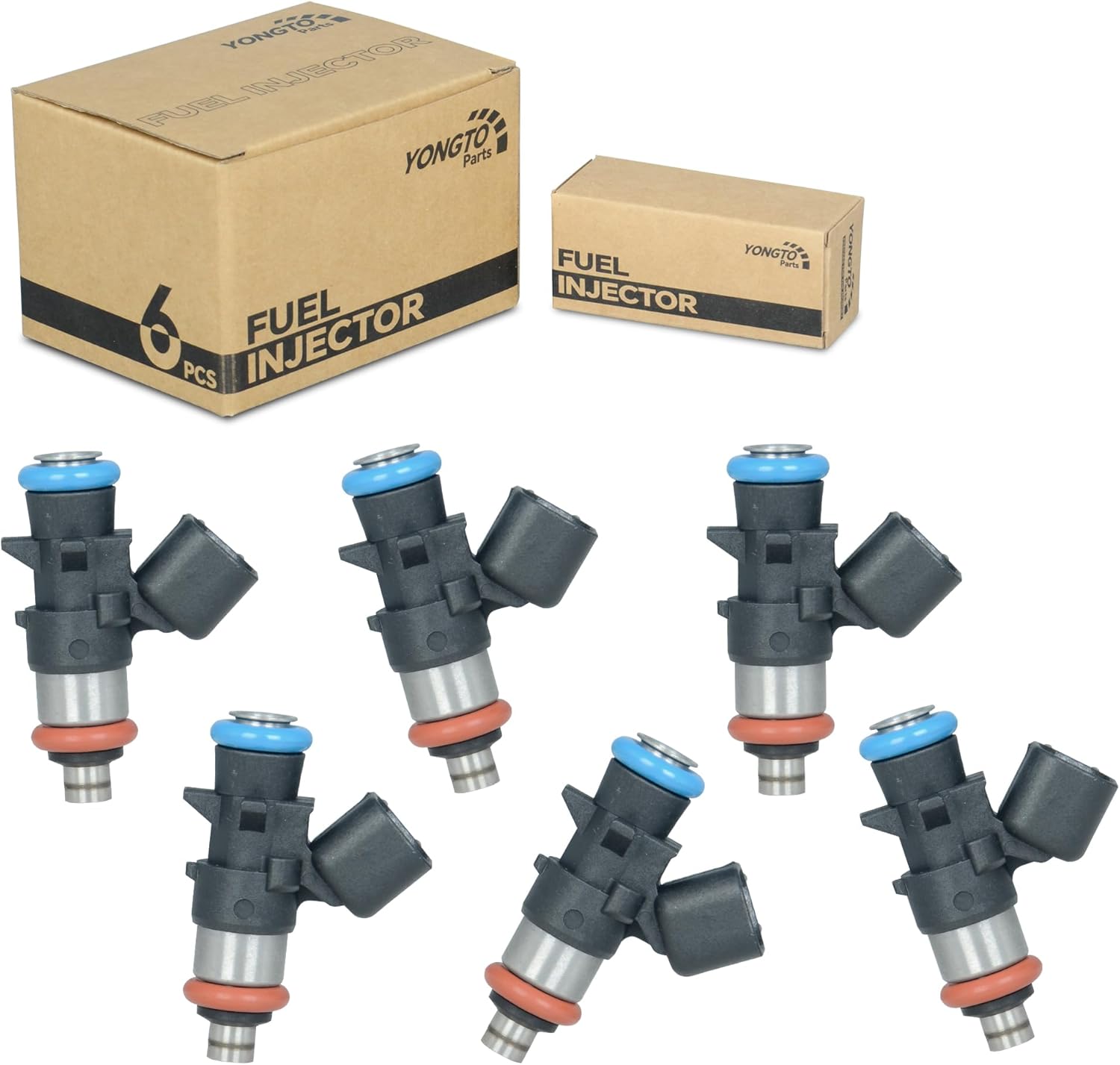
| Compatible engine | 3.6L V6 |
|---|---|
| Fitment years | 2011-2014 Dodge Challenger |
| Quantity | 6 pieces |
| Replaces part numbers | 0280158233, 05184085AC, 5184085AD |
These Yongtoparts fuel injectors are sold as a six-pack replacement set that matches the 0280158233 and related factory part numbers used on 3.6L V6 Dodge Challengers from 2011 to 2014. Installation is straightforward for a technician or competent DIYer because the connectors and seals are designed to snap into the factory harness and intake without modification. The listing emphasizes corrosion-resistant components and protected internal seal rings to improve longevity under normal fuel exposure. In practice this product is useful for restoring smooth idle, consistent throttle response, and eliminating issues caused by leaking or clogged injectors without the cost of dealer parts. Limitations to consider are standard for budget aftermarket injectors: they are not branded OEM units and long-term durability beyond typical driving patterns is less certain than factory-quality replacements. Also, fitment is specific to the 3.6L Challenger application so verify engine and year before purchasing.
Best for: Budget-conscious Challenger owners who need a full-set repair that restores drivability without paying dealer prices.
Less Ideal for: Owners seeking factory-quality or long-term guaranteed replacements or those who want a performance-tuned injector should consider higher-end or OEM options.
- Direct-fit design for 3.6L V6 Dodge Challenger 2011–2014 for easy installation
- Sold as a complete set of six so all cylinders are serviced at once
- Corrosion-resistant construction and protected seal rings to reduce early failure risk
- Aftermarket part rather than factory-quality OEM so long-term reliability can vary
- Limited to the specified 3.6L Challenger years and not a universal fit
Verdict A cost-effective full-set replacement for 3.6L Dodge Challenger injectors that restores drivability but sacrifices OEM-backed longevity.
5. Bosch 62410 Fuel Injector (single)

| Inlet Connection Type | Barb |
|---|---|
| Outlet Connection Type | Barb |
| Number of Ports | 2 |
| Specification Met | OEM |
| Included Components | Fuel Injector, seals/O-rings |
This Bosch 62410 is a direct-fit fuel injector sold individually and designed to reproduce factory flow rates and spray patterns for compatible Dodge Challenger engines. It installs like a factory replacement and arrives with the necessary seals and O-rings so a technician or competent DIYer can swap it in without extra parts. Bosch emphasizes corrosion-resistant steels and plastic coverings and says the injector supports ethanol fuels and improved warm-start and emissions behavior, which translates to smoother idling and more consistent throttle response after replacement. User reports show many successful installs on Pentastar 3.6L and related Chrysler engines, though a minority describe early failures, so purchase from a trusted source and verify authenticity if that matters. Expect OEM-level fit, quieter operation compared with worn injectors, and potential fuel trim improvement, but understand that outcomes depend on overall fuel system condition and correct engine calibration. If multiple injectors are aged, replacing only one may not resolve drivability codes on its own.
Best for: Risk-averse mainstream buyers seeking a factory-quality replacement for a Dodge Challenger who prioritize reliable fitment and avoiding aftermarket unknowns.
Less Ideal for: Drivers looking for performance-tuned injectors for increased flow or race use should consider high-performance options instead.
- Factory-style flow and spray pattern for compatible engines
- Includes seals and O-rings for immediate installation
- Engineered for corrosion resistance and ethanol fuel compatibility
- Designed to improve warm-start performance and reduce emissions
- Sold as a single injector so replacing an entire bank requires multiple purchases
- Some user reports cite early failures, so quality can vary by batch
Verdict A factory-style single replacement injector good for restoring stock drivability on Dodge Challenger engines, but buy with care and consider replacing all aging injectors for consistent results.
6. TAUTOY FJ732 Fuel Injectors (8-Pack) for 5.7L Dodge Challenger

| Material | Stainless Steel |
|---|---|
| Inlet Connection Type | Barb |
| Outlet Connection Type | Barb |
| Number of Ports | 8 |
These TAUTOY FJ732 injectors are a direct-replacement aftermarket set sold as an eight-pack for 5.7L Dodge Challenger engines. They are intended to restore proper fuel atomization and engine response when factory injectors are worn or leaking. Installation is the same as a standard injector swap and they are commonly used when repairing misfires, rough idle, or poor fuel economy. Notable features from the listing include stainless steel construction, barb-style inlet and outlet fittings, and factory part number compatibility so they match the Challenger 5.7L injector fitment. Buyers can expect cleaner combustion and improved throttle response if the original injectors were degraded. Quality control claims include TS16949 manufacturing and 100 percent function and leak testing, but some owners report mixed results so bench-testing after purchase is wise. These are a value-oriented alternative to dealer replacements, offering cost savings but with occasional reliability variability compared with higher-end aftermarket or factory-quality units.
Best for: Practical optimizers who prioritize getting reliable, affordable repairs without overspending and want a complete injector set to bring a 5.7L Challenger back to serviceable performance.
Less Ideal for: Owners seeking the highest-end performance tuning or absolute factory-equivalent durability should consider premium branded injectors or dealer replacements instead.
- Sold as a complete 8-piece set to replace all injectors at once
- Made from stainless steel and listed as fully function and leak tested
- Matches OEM part numbers for direct fitment on 5.7L Challenger engines
- Some customer reports of misfires and injector-related check engine codes
- Aftermarket build quality can vary compared with premium or factory-quality injectors
Verdict A budget-focused, full set replacement for 5.7L Dodge Challenger injectors that can restore performance affordably but may show variable long-term reliability.
7. A-Premium Fuel Injectors (0280158233) Compatible with Dodge Challenger 3.6L

| Compatible Engine | 3.6L V6 |
|---|---|
| Hole Quantity | 4 holes |
| Terminal Type | Blade |
| O-Rings | Preinstalled |
These A-Premium injectors are an aftermarket direct-replacement for the 3.6L V6 used in Dodge Challenger models and are sold singly with factory-style terminals and preinstalled O-rings. They install like stock injectors and are typically used to replace leaking, clogged, or failed injectors to restore smooth idle and consistent throttle response. The design combines metal and composite plastic and uses a 4-hole spray pattern and blade-style electrical terminals, which helps maintain even fuel atomization for everyday driving and light towing. Practical benefits include easy fitment on compatible Challengers, included O-rings to reduce leak risk at installation, and a one-year unlimited-mileage guarantee for peace of mind. Limitations to consider are variable long-term durability compared with higher-end branded injectors and mixed user reports on longevity under heavy use, so they may be best as a value-focused replacement rather than a performance upgrade. Expect reliable everyday performance but plan to monitor for misfire codes over extended service life.
Best for: Balanced owners who want a practical, budget-conscious replacement that restores smooth running and drivability without chasing a high-performance upgrade.
Less Ideal for: Drivers seeking a high-end performance injector for modified engines or heavy-duty daily high-mileage use should consider premium branded alternatives or performance-specific injectors.
- Direct-fit design for 3.6L Dodge Challenger V6 for straightforward installation
- Preinstalled O-rings reduce risk of fuel leaks during replacement
- 4-hole spray pattern and factory-style terminals for consistent fuel delivery in normal driving
- Includes a one-year unlimited-mileage guarantee from the brand
- Aftermarket construction may not match longevity of premium OEM-brand injectors
- Some users report intermittent failures on long-term high-mileage use
Verdict A cost-effective, direct-fit replacement that restores normal fuel delivery on 3.6L Dodge Challenger V6 engines but is best suited as a value-focused service part rather than a long-term high-performance upgrade.
Choosing the Right Dodge Challenger Fuel Injector: Key Factors to Consider
Flow Rate And Consistency
Flow rate determines how much fuel the injector delivers at a given duty cycle and pressure. Choosing an injector with a flow rate matched to the engine's fueling needs ensures the air/fuel ratio remains within safe and efficient limits across operating conditions.
Consistency between injectors matters more than absolute flow numbers. Mismatched flow among cylinders can cause rough idle, uneven power delivery, and drivability issues. Look for documented flow testing and tight tolerances so the injectors behave uniformly when installed together.
Spray Pattern And Atomization
Spray pattern affects how fuel mixes with incoming air. A well-atomized, evenly distributed spray promotes complete combustion, reducing hesitation and improving throttle response. Different engine intake designs benefit from specific spray angles and cone shapes, so matching the injector's spray characteristics to the intake and combustion chamber design helps optimize performance.
Poor atomization can leave larger droplets that do not vaporize quickly, increasing emissions and leaving deposits. Prioritize injectors with documented spray pattern quality to reduce those risks.
Fitment And Electrical Compatibility
Proper mechanical fit and electrical compatibility are essential for a straightforward installation and reliable operation. An injector must seat correctly in the rail and manifold, use the correct O-ring sizes, and match the vehicle's connector and electrical resistance to avoid wiring or ECU issues.
Incorrect fitment can cause fuel leaks, vacuum leaks, or intermittent electrical faults. Verify that the injector aligns with the Challenger's mounting and connector standards to minimize installation complications.
Seal Durability And Leak Resistance
Seals and O-rings keep fuel contained under pressure and prevent vacuum leaks at the intake. Materials that resist heat, fuel additives, and ozone will last longer in the engine bay environment. A leaking injector causes rough idle, fuel odor, and potential engine bay hazards.
Select injectors with high-quality sealing materials and robust seat geometry to reduce the chance of leaks and the need for frequent resealing or replacement.
Electrical Resistance And Response Time
Injector electrical resistance affects how the injector responds to pulses from the engine control unit. Proper resistance ensures predictable opening and closing behavior and prevents excessive current draw that could stress wiring or the ECU.
Faster response times improve metering precision at low pulse widths, which helps idle stability and transient throttle response. Confirm the electrical specs match the vehicle's expectations to ensure consistent control and longevity.
Serviceability And Maintenance Considerations
Ease of cleaning, availability of replacement seals, and whether the injector can be flow-tested or serviced influence the long-term ownership experience. Some injectors allow straightforward bench cleaning or ultrasonic service, while others may require full replacement when clogged or worn.
Consider how accessible the injector is in the engine and whether common maintenance procedures such as fuel system cleaning or injector testing can be performed without extensive disassembly.
FAQ
What are common symptoms of a failing fuel injector?
Common signs include rough idle, hesitation on acceleration, reduced fuel efficiency, and occasional misfires. You may also notice a persistent fuel odor or an illuminated engine warning light. Symptoms often vary with the extent and type of injector issue.
Can I replace a fuel injector myself?
Many mechanically inclined owners can swap injectors with basic tools, but proper procedure and attention to sealing and electrical connections are vital. If you are unsure about fuel system depressurization, correct torque specs, or connector fit, seek professional help to avoid leaks or damage.
How often should injectors be cleaned or tested?
Frequency depends on fuel quality and driving conditions, but routine inspection or testing every 30,000 to 60,000 miles is common for preventive maintenance. Cleaning may be needed sooner if you experience deposit-related symptoms such as rough idle or reduced performance.
What does a fuel injector leak look like?
A leaking injector can cause fuel smell near the intake, visible wetness around the injector base, or fuel pooling on engine components. It may also contribute to vacuum leaks that lead to erratic idle. Address leaks promptly to reduce fire risk and drivability problems.
How is injector flow tested?
Flow testing typically uses a controlled bench setup that measures volume delivered under a set pressure and pulse pattern. Technicians look for uniformity across injectors and compare results to expected flow rates. Testing helps distinguish clogged or worn units from other engine issues.
Will higher-performance injectors improve throttle response?
Higher-flow or better-atomizing injectors can support increased power or tuning, but they must be matched to engine needs and calibration. Without correct tuning and supporting modifications, larger injectors can cause poor idle or fuel metering issues. Consider injector upgrades as part of a holistic engine plan.
How We Chose the Best Dodge Challenger Fuel Injector
We focused on descriptors that matter to Dodge Challenger owners and excluded items that do not directly influence in-vehicle performance. Key evaluation criteria included flow rate consistency under operating pressure, OEM or exact-fit mechanical compatibility with the vehicle, spray pattern uniformity and atomization quality, durability of seals and electrical connectors, and manufacturing tolerances that affect idle and part-throttle behavior. We also considered resistance to common failure modes such as clogging, leakage, and electrical deterioration. Units that required vehicle-specific modification, nonstandard wiring, or unverified fitment were excluded. Our process prioritized injectors that match Challenger electrical and mounting standards, present transparent flow data, and show robust sealing and construction for reliable long-term operation.
Our full evaluation process is outlined in our review methodology.
Conclusion
Choosing the right fuel injector for a Dodge Challenger means balancing flow, spray quality, fitment, and durability. Prioritize injectors that match the vehicle's mechanical and electrical requirements and show consistent flow and good sealing to avoid drivability issues.Keep in mind the tradeoffs between higher flow capacity and control precision. Plan maintenance and testing to catch early symptoms of failure, and choose units that allow straightforward service to prolong reliable operation.
Explore More:
- Check out all Dodge Challenger parts & accessories
- Explore Fuel Injectors Maintenance & Repair Guides
- Explore Fuel System
- Browse all Auto Parts
