

Note: This article contains affiliate links. If you click on these links and make a purchase, I may earn a small commission at no extra cost to you. This helps support my research and content. Read my full affiliate disclosure here.
If you plan to tow a small trailer or add a bike rack, choosing the right Dodge Challenger tow hitch receiver matters for safe handling and durability. The Challenger is not a traditional tow vehicle, so selecting a receiver that matches the car's frame, attachment points, and intended load is essential.This guide shortlists seven top-rated options that fit the Challenger and explains the key criteria we used to evaluate them, including fitment, mounting method, and towing capacity. Read on to understand what to prioritize before you install a hitch on your Challenger.
Looking for other parts? See all Dodge Challenger parts & accessories.
Top Picks at a Glance
| Best Overall The best all-around choice for most situations | Armordillo Class 3 Trailer Hitch 2" Receiver for Dodge Challenger/Charger/Chrysler 300 |  |
| Best Quality Built to a higher standard if you want something more solid | Mopar Hitch Receiver 82215648 — Factory-Style Upgrade |  |
| Best Value The sweet spot between price and what you get | Gelacie Class 3 2" Rear Trailer Hitch Receiver for Dodge Challenger/Charger/Chrysler 300 |  |
| Best Budget The cheapest option that still gets the job done reliably | ALMULOO 2-inch Class 3 Trailer Tow Hitch Receiver for Dodge Challenger/Charger/Chrysler 300 |  |
| Highest Rated A top-rated pick with lots of positive feedback | Draw-Tite 36548 Class II Trailer Hitch, 1-1/4-Inch Receiver |  |
| Best Seller A high-volume bestseller chosen again and again | CURT 13236 Class 3 2" Receiver Trailer Hitch |  |
1. Armordillo Class 3 Trailer Hitch 2" Receiver for Dodge Challenger/Charger/Chrysler 300

| Compatible with Vehicle Type | Car |
|---|---|
| Automotive Fit Type | Vehicle Specific Fit |
| Maximum Towing Capacity | 3500 Pounds |
| Material Type | Alloy Steel |
| Finish Type | Painted |
This Armordillo Class 3 trailer hitch installs as a vehicle-specific replacement to add a 2-inch receiver to compatible Chrysler 300, Dodge Challenger, and Dodge Charger models. It is built from alloy steel with a painted finish and includes the installation hardware required to mount the hitch to the car; pin, clip, ballmount, and wiring are not included. With a 3,500 pound maximum towing capacity and 350 pound tongue weight it covers common light-trailer and accessory tasks like small boat, cargo trailer, and bike rack use while preserving a low-profile look. The painted finish helps resist corrosion but expect some prep and torqueing during installation since it requires basic mechanic tools. Buyers should plan to add a wiring harness and hitch ball or receiver accessories separately. This hitch is a straightforward option when you want a factory-style tow point without major modification, though it does not include electrical or towing accessories out of the box.
Best for: Balanced buyers who want a factory-style, vehicle-specific tow solution for occasional towing and accessory use without major vehicle modification.
Less Ideal for: Drivers who need a full towing kit including wiring and ballmounts or who plan to tow heavy loads beyond the listed capacity should look for a more complete or higher-capacity system.
- Vehicle-specific fit for Chrysler 300, Dodge Challenger, and Dodge Charger models in the listed years
- Class 3 2-inch receiver with 3,500 lb towing and 350 lb tongue weight suitable for common light trailers and racks
- Constructed from alloy steel with a painted finish for durability
- Includes required installation hardware and an installation guide for DIY-capable owners
- Does not include electrical wiring, ballmount, pin/clip accessories beyond basic hardware
- Painted finish may show chips over time on frequently used hitches
Verdict: Adds a factory-style 2-inch Class 3 receiver to compatible Dodge Challenger and Chrysler 300 models for reliable light towing and accessory use.
2. Mopar Hitch Receiver 82215648 — Factory-Style Upgrade

| Maximum Towing Capacity | 7650 Pounds |
|---|---|
| Pull Force | 7650 Pounds |
| Material Type | Metal |
| Finish Type | Powder Coated |
This Mopar hitch receiver replaces a bumper-mounted Class II hitch with a factory-style Class IV receiver rated to 7,650 pounds, intended as a direct-fit, vehicle-specific component. For a Challenger that requires a heavier-duty tow point for towing trailers or mounting larger accessories, the unit bolts in to factory attachment points and uses a powder-coated metal construction for corrosion resistance. Installation typically requires two people to support and align the hitch and may involve removing the rear bumper cover depending on Challenger trim and rear valance design. Buyers will appreciate the factory fit, strong pull and the confidence of a Mopar-manufactured part that matches factory mounting geometry. Limitations include potential need for additional mounting hardware or wiring harness adapters depending on the Challenger model and that professional installation can simplify alignment and torque requirements for safe towing. This part is focused on restoring or upgrading factory-quality towing capacity rather than offering universal fit or lightweight aftermarket aesthetics.
Best for: Performance-oriented owners who prioritize factory-quality upgrades and need a stronger, factory-style hitch for towing heavier trailers or mounting robust accessories on their Dodge Challenger.
Less Ideal for: Owners who want a universal, lightweight aftermarket receiver or a plug-and-play bolt-on without any potential bumper removal or wiring adaptation should consider other options.
- Factory-manufactured Mopar part designed for vehicle-specific fit and mounting geometry
- Class IV towing capacity rated at 7,650 pounds for heavier trailer loads
- Powder-coated metal finish improves corrosion resistance for long-term durability
- Direct replacement intended to match factory fit, form, and function
- May require two people or professional help to install due to weight and alignment
- Some buyers report mounting hardware was not included and may need to be sourced separately
Verdict: A factory Mopar Class IV hitch receiver that brings a substantial 7,650-pound towing capacity and factory-fit confidence to vehicles requiring a heavy-duty upgrade.
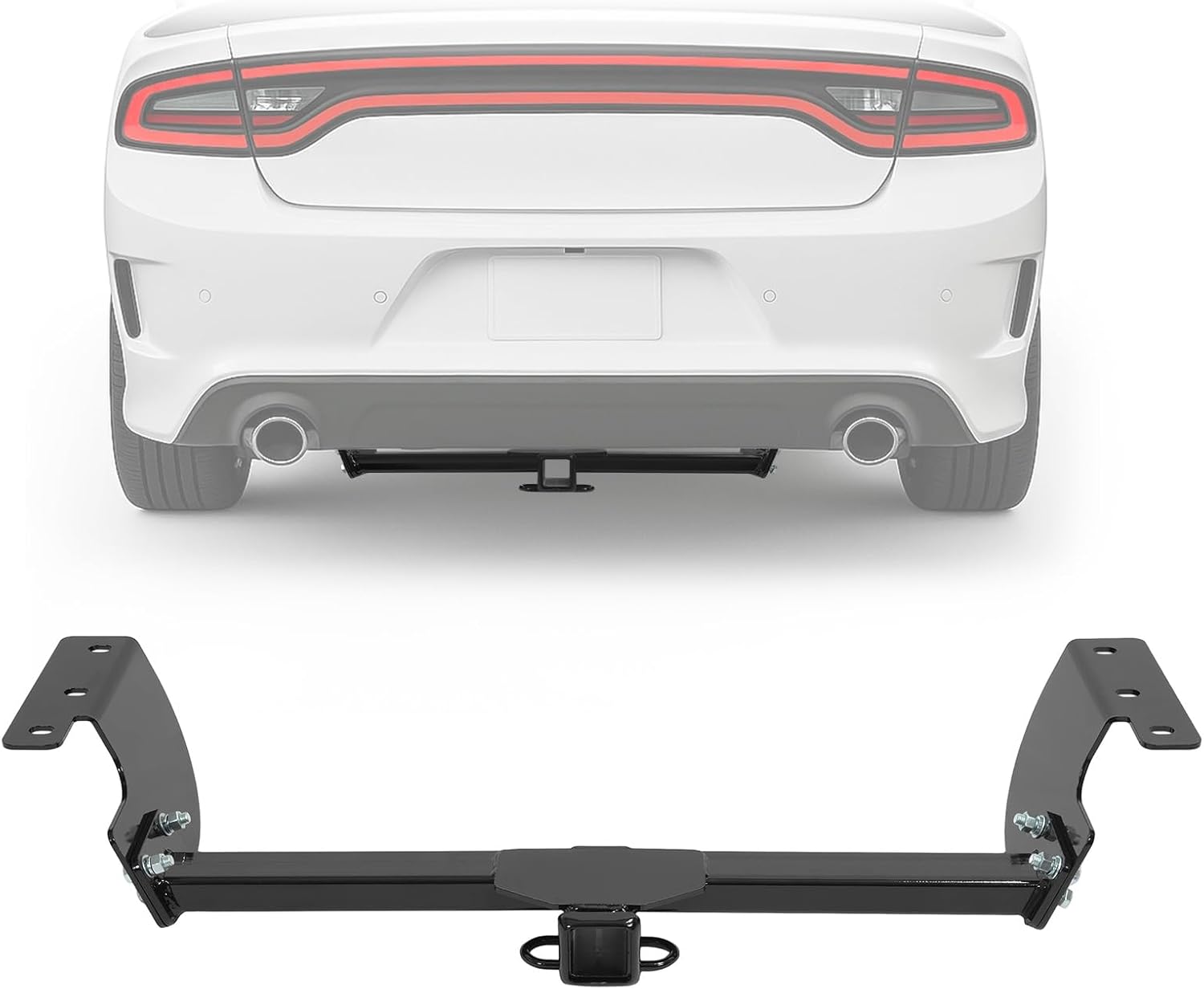
3. Gelacie Class 3 2" Rear Trailer Hitch Receiver for Dodge Challenger/Charger/Chrysler 300
| Compatible with Vehicle Type | Car |
|---|---|
| Maximum Towing Capacity | 3500 Pounds |
| Material Type | Stainless Steel |
| Finish Type | Powder Coated |
This Gelacie Class 3 rear trailer hitch is a bolt-on 2-inch receiver designed to add towing and cargo capability to compatible Dodge Challengers, Chargers, and Chrysler 300s. It installs using included hardware and follows a vehicle-specific fit approach so the hitch sits close to the bumper for a factory-like appearance. Constructed from steel with a powder-coated finish, the hitch resists corrosion and handles everyday towing needs up to the listed 3500 pound rating, making it suitable for light trailers, cargo carriers, and bike racks. The package includes basic installation instructions but professional fitment may be recommended for clean alignment and torqueing. Users should note mixed feedback on fitment, so double-check year and submodel compatibility before buying and be prepared to address minor adjustments during install. For buyers prioritizing cost-effectiveness, this hitch delivers a straightforward way to add towing function without expensive OEM options, while offering solid materials and a common 2-inch receiver size.
Best for: Practical optimizers who want a budget-conscious, vehicle-specific hitch to add everyday towing and cargo utility without paying for dealer parts.
Less Ideal for: Drivers who need higher towing capacity, heavy commercial towing, or guaranteed dealer-fit precision should consider heavier-duty or factory replacements.
- Vehicle-specific design for Dodge Challenger, Charger, and Chrysler 300 improves fit and appearance
- 2-inch Class 3 receiver supports common hitch accessories like bike racks and cargo carriers
- Powder-coated steel construction for corrosion resistance and durable daily use
- Includes installation hardware and assembly manual for bolt-on mounting
- Some customers reported fitment issues on certain Chrysler 300 examples requiring adjustments
- Towing capacity listed at 3500 pounds may be lower than some heavier-duty hitches
Verdict: A cost-effective, vehicle-specific Class 3 hitch that adds common towing and cargo capability to Dodge Challengers and Chargers with durable powder-coated steel construction.
4. ALMULOO 2-inch Class 3 Trailer Tow Hitch Receiver for Dodge Challenger/Charger/Chrysler 300

| Compatible vehicles | 2011–2023 Dodge Charger/Challenger; 2015–2023 Chrysler 300 |
|---|---|
| Receiver size | 2 inches |
| Class | Class 3 |
| Maximum towing capacity | 3500 Pounds |
| Pull force | 3500 Pounds |
This ALMULOO 2-inch Class 3 hitch is a vehicle-specific trailer receiver built to give Dodge Challenger owners basic, light-duty towing capability. It installs at the rear of the car to accept common 2" accessories such as bike racks, small camping trailers, and utility trailers. The hitch is steel construction with a powder-coated finish for corrosion resistance and comes with mounting hardware and an installation manual, though professional fitting is recommended. With a 3,500 lb maximum tow rating and 350 lb tongue capacity it covers most weekend hauling and gear-carrying tasks while keeping the vehicle low-profile. Practical buyers will appreciate the direct-fit design that avoids major body modification, but expect a no-frills unit: there is limited documentation on corrosion warranty and the part may require professional alignment or trimming during install on some models. This is a sensible budget option for Challenger owners who need occasional, light towing without upgrading to a heavy-duty hitch or truck-based setup.
Best for: Budget-conscious Challenger owners who want a straightforward, vehicle-specific hitch to enable occasional light towing or accessory use without upgrading to a heavy-duty system.
Less Ideal for: Do not choose this if you need frequent heavy towing, commercial hauling, or higher tongue capacities where a heavier-duty or truck-based hitch is required.
- Vehicle-specific fit for 2011–2023 Dodge Charger and Challenger and 2015–2023 Chrysler 300 simplifies installation.
- Class 3 2-inch receiver supports common accessories like bike racks and small trailers.
- 3,500 lb tow and 350 lb tongue ratings cover most light-duty towing needs.
- Powder-coated steel construction improves durability and resistance to rust.
- Installation may require professional help or minor trimming for exact fit on some models.
- Limited manufacturer information on warranty and long-term corrosion protection.
Verdict: A low-cost, vehicle-specific 2" Class 3 hitch that gives Dodge Challenger owners reliable light-duty towing and accessory carrying capability.
5. Draw-Tite 36548 Class II Trailer Hitch, 1-1/4-Inch Receiver

| Receiver opening | 1-1/4 in. square |
|---|---|
| Maximum towing capacity | 3500 Pounds |
| Maximum tongue weight | 300 Pounds |
| Material type | Alloy Steel |
| Finish type | Powder Coated |
This Draw-Tite 36548 is a custom-fit Class II trailer hitch designed to bolt to the frame of compatible Dodge Challenger models and other passenger cars. It provides a 1-1/4-inch receiver for light towing tasks such as bike racks, small trailers, and compact campers with a maximum gross trailer weight of 3,500 pounds and 300 pounds tongue weight. The hitch is made from alloy steel with an all-welded construction and a powder-coated finish to resist corrosion, and it installs with the included mounting hardware without drilling on most applications. In practice it gives a clean, factory-like appearance and solid towing performance, though the unit is heavy and some installs require lowering or removing the exhaust and at least two people to position it safely. A few reports note missing hardware or occasional weld alignment defects, so inspect the receiver before installation. For convenience-focused buyers this hitch delivers a straightforward, durable tow solution when matched to the vehicle fit list.
Best for: Convenience-driven owners who want a ready-made, vehicle-specific hitch that delivers easy bolt-on installation and reliable light-duty towing without custom fabrication.
Less Ideal for: Buyers needing heavy-duty towing above 3,500 lb or a 2-inch receiver should choose a higher-class hitch designed for greater capacity.
- Vehicle-specific fit for a clean, factory-like installation on supported models
- Rated for up to 3,500 lb gross trailer weight and 300 lb tongue weight for common light-duty towing
- All-welded alloy steel construction with powder-coat finish for durability and corrosion resistance
- Bolt-on installation using included mounting hardware with no drilling required in most cases
- Heavy unit often requires two people or a lift to position during installation
- Some customers reported missing hardware or occasional weld/alignment defects on arrival
Verdict: A vehicle-specific, factory-style Class II hitch that makes light towing and accessory mounting easy and reliable for supported Dodge Challengers.
6. CURT 13236 Class 3 2" Receiver Trailer Hitch

| Receiver Tube Size | 2" |
|---|---|
| Weight Carrying Capacity (GTW) | 3,500 lbs |
| Tongue Weight | 350 lbs |
| Material Type | Carbon Steel |
| Finish Type | Gloss, Powder-Coated |
The CURT 13236 is a vehicle-specific Class 3 trailer hitch built for certain Dodge Challenger, Charger and Chrysler 300 models that gives a factory-quality fit and the ability to tow modest loads. It installs under the rear bumper and provides a 2" receiver tube for ball mounts, bike racks and cargo carriers. Constructed from carbon steel with a powder-coated, co-cured finish, the hitch resists rust and chipping and is welded for strength. Rated for 3,500 lbs gross trailer weight and 350 lbs tongue weight, it covers typical light towing and most hitch-mounted accessories used by car owners. Expect a heavy assembly that can be awkward to position during installation and may require two people or a lift to lower exhaust or hold the hitch in place. Some users report tight clearances and occasional fitment fussiness on particular chassis, so verifying vehicle application before purchase is important. For risk-averse buyers who want a tested, vehicle-specific receiver, this hitch balances durable construction with straightforward functionality.
Best for: Risk-averse mainstream buyers who prioritize a vehicle-specific, tested receiver for occasional towing and hitch-mounted accessories and prefer a factory-quality replacement over generic options.
Less Ideal for: Buyers who need high-capacity towing above 3,500 lbs or those seeking a universal hitch solution for multiple vehicle types should consider other options.
- Vehicle-specific design for a close fit to listed Dodge Challenger and Chrysler models
- Durable carbon steel construction with co-cured liquid undercoat and powder coat finish for corrosion resistance
- 2" receiver tube compatible with common ball mounts, bike racks and cargo carriers
- Factory-style welding and testing to SAE J684 standards for predictable strength
- Heavy and bulky, often requiring two people or a lift to align and install
- Some users report tight clearances and fitment issues with exhaust or frame on certain model years
Verdict: A rugged, vehicle-specific 2" Class 3 receiver that gives Dodge Challenger owners a tested, factory-quality solution for light towing and hitch-mounted accessories.
Choosing the Right Dodge Challenger Tow Hitch Receiver: Key Factors to Consider
Vehicle-Specific Fitment
Fitment is the most important factor because the Challenger's rear structure and bumper geometry differ from trucks and SUVs. A receiver designed or tested for the Challenger will align with factory attachment points and reduce the need for cutting or modification.
Incorrect fitment can lead to poor load transfer, interference with exhaust components, or compromised trunk access. Verify that mounting holes, bracket shapes, and clearance match the car's model year and trim to ensure a safe, secure installation.
Towing Capacity and Tongue Weight
A receiver's rated towing capacity and tongue weight determine what the Challenger can safely tow and carry on the hitch. These values should be clearly stated by the manufacturer and should not exceed the vehicle's own limits as specified by the automaker.
Consider both the total trailer weight and the downward force on the hitch when calculating loads. Picking a receiver with adequate tongue weight rating helps prevent sagging, poor handling, and excessive stress on mounting points.
Mounting Style and Installation Complexity
Receivers attach to the vehicle in different ways, including bolt-on brackets that use existing holes, models that require drilling, or kits that use frame clamps. The mounting style affects installation time, the need for specialized tools, and whether professional installation is advisable.
Bolt-on designs that reuse factory holes typically reduce labor and risk, while welded or drill-in options may offer stronger attachment but require more skill. Evaluate how much disassembly is needed and whether wiring integration for lights is included.
Material Quality and Corrosion Protection
Materials and finish affect long-term durability, especially in climates with moisture or road salt. Heavy-gauge steel is standard for strength, and protective coatings such as powder coat or e-coat help resist rust and abrasion.
Check for plated fasteners and sealed welds where possible. Better corrosion protection reduces the likelihood of structural degradation and simplifies maintenance over the life of the receiver.
Hitch Receiver Size and Accessory Compatibility
Receiver opening size determines which ball mounts, cargo carriers, and bike racks will fit. Common sizes have different load ratings and accessory availability, so matching the receiver size to your intended accessories prevents surprises.
Also consider pinhole placement and clearance for locking pins or anti-rattle devices. A receiver that accepts standard accessories makes it easier to outfit the Challenger for different tasks without additional adapters.
Ground Clearance and Rear Access
A receiver's design can change rear ground clearance and affect access to the trunk or bumper components. Low-hanging crossmembers or deep inserts increase the chance of scraping on ramps or driveways.
Choose a design that balances strength with minimal intrusion below the bumper and that preserves trunk access if you need to open the hatch while a hitch-mounted accessory is installed.
How We Chose the Best Dodge Challenger Tow Hitch Receiver
We focused on options designed to fit the Dodge Challenger's unibody and rear structure, prioritizing secure attachment, correct geometry, and corrosion resistance. Our evaluation criteria included: accurate vehicle-specific fitment, rated towing capacity and tongue weight limits, mounting style and ease of installation, materials and protective finishes, and compatibility with common towing accessories such as ball mounts and wiring adapters. We also considered whether the design preserved rear ground clearance and trunk access when possible. Exclusions included universal adapters that require extensive fabrication or models that lack clear vehicle-specific fitment data. The shortlist reflects products that meet structural requirements for the Challenger and offer clear load ratings, robust construction, and sensible mounting methods for a passenger coupe.
Our full evaluation process is outlined in our review methodology.
FAQ
Can I install a tow hitch receiver on a Dodge Challenger myself?
It depends on your mechanical skills and the receiver's mounting style. Bolt-on kits that use factory holes are often within reach for a well-equipped DIYer. More involved installs that require drilling, welding, or bumper removal are best handled by a professional to ensure safe attachment and correct alignment.
How do I know what towing capacity I can use with a receiver on my Challenger?
Start with the receiver's rated towing and tongue weight limits, then cross-check the vehicle manufacturer's specifications for the Challenger. The usable capacity is the lower of the two. Also factor in the trailer's tongue weight and distribution to avoid overloading the hitch or rear axle.
Will a hitch receiver affect my Challenger's ground clearance or rear appearance?
Some receivers sit lower and may reduce ground clearance or be visible below the bumper. Low-profile designs minimize visual impact and scraping risk, while larger crossmembers can be more noticeable. Review installation photos and measurements to understand how a specific design sits relative to the bumper.
Do I need to modify the bumper or trunk to install a receiver?
Many vehicle-specific kits are designed to install without permanent bumper modification, using existing mounting points. However, some installations require minor trimming of plastic valances or temporary removal of the bumper cover for access. Permanent cutting is uncommon for well-designed, vehicle-specific receivers.
How should I maintain a hitch receiver to prevent corrosion?
Keep the exposed metal clean and inspect welded seams and fasteners periodically. Touch up scratches with rust-inhibiting paint and apply grease or a protective sleeve to the receiver tube if storing accessories. Cleaning salt and road grime off the hitch after winter helps prolong its life.
Conclusion
When choosing a Dodge Challenger tow hitch receiver, prioritize vehicle-specific fitment, rated towing and tongue weight, and a mounting style that matches your installation ability. Balance material quality and corrosion protection with a design that preserves ground clearance and trunk access.Focus on the receiver opening size and accessory compatibility you will actually use, and verify that the receiver's ratings do not exceed the vehicle's limits. With those tradeoffs in mind, you can select an option that safely adds towing or cargo-carrying capability to your Challenger.
Explore More:
- Check out all Dodge Challenger parts & accessories
- Explore Exterior Accessories
- Browse all Accessories
