

Note: This article contains affiliate links. If you click on these links and make a purchase, I may earn a small commission at no extra cost to you. This helps support my research and content. Read my full affiliate disclosure here.
If your Infiniti G35 is showing drivability issues or a check engine light related to emissions, swapping the oxygen sensor can often restore proper fuel control and emissions performance. Choosing the right Infiniti G35 oxygen sensor matters because an incorrect fit or slow response can keep the engine running rich or lean, reduce fuel economy, and trigger persistent faults.This guide covers seven shortlisted options that meet common fitment and durability needs. We evaluated each candidate for proper fitment, sensor response speed, and expected durability to help you find a replacement that gets the system back into specification. Read on to see which features matter most and to move on to installation or testing steps confidently.
Looking for other parts? See all Infiniti G35 parts & accessories.
Top Picks at a Glance
| Best Reviewed A top-rated pick with lots of positive feedback | LuxOxyPro Upstream Oxygen (O2) Sensor, Replace 234-5060 |  |
| Most Popular A crowd favorite that many people choose with confidence | NECATUO 234-4380 Heated Downstream Oxygen Sensor (Compatible with Infiniti G35) |  |
| Best Quality Built to a higher standard if you want something more solid | A-Premium 4-Pack Heated Oxygen Sensors Compatible with Infiniti G35/FX35 and Nissan 350Z |  |
| Best Budget The cheapest option that still gets the job done reliably | JOYOMSTW Downstream O2 Oxygen Sensor (Replace 234-4380) for Infiniti G35 |  |
| Most Sold A high-volume bestseller chosen again and again | higherbro 4-Pack Oxygen O2 Sensors (Upstream & Downstream) for 2008–2010 Infiniti and Nissan 3.5L–3.7L |  |
| Best Value for Money The sweet spot between price and what you get | BOXI Upstream Oxygen Sensor (234-5060) |  |
| Best Overall The best all-around choice for most situations | Sangyue Oxygen O2 Sensor Kit (4-Pack) for 2008 Infiniti G35 3.5L (Upstream + Downstream) |  |
1. LuxOxyPro Upstream Oxygen (O2) Sensor, Replace 234-5060

| Manufacturer | LuxOxyPro |
|---|---|
| Manufacturer Part Number | FLP001-0066 |
| Replacement Part Number | 234-5060 |
| Compatible Vehicles (example) | Infiniti G35 (check fitment) |
This LuxOxyPro upstream oxygen sensor is a direct-replacement style part intended to read exhaust oxygen and feed that information to the engine control system to help the ECU manage fuel trim and emissions. It is typically installed in the upstream position before the catalytic converter and is used to address rough idle, poor acceleration, or a persistent check engine light tied to the O2 circuit. The listing highlights construction rated for high temperatures and a claimed faster response time, which in practice helps the sensor settle quickly after installation so the engine can return to stable running sooner. Installation is straightforward for a mechanically inclined owner or a shop that specializes in routine sensor swaps, but buyers should verify plug and thread compatibility with their vehicle. The product's strengths are its focused function and described durability, while limitations include the need to confirm exact fitment for your Infiniti G35 and that calibration or ECU resets may still be required after replacement.
Best for: A reliability-focused buyer who prioritizes restoring factory-level driveability and steady engine performance on an Infiniti G35 and prefers a direct replacement part over modifications.
Less Ideal for: Drivers looking for a performance-tuning sensor or integrated diagnostic features should consider alternatives designed for tuning rather than straightforward replacement.
- Designed for upstream installation to restore correct air-fuel feedback
- Built to tolerate high exhaust temperatures for longer service life
- Faster response time claim aids quicker ECU recovery after installation
- Fitment must be verified against the vehicle connector and thread before purchase
- Does not include installation hardware or advanced diagnostic support
Verdict A practical upstream replacement aimed at reliability-minded Infiniti G35 owners who need a durable, quicker-responding oxygen sensor, provided you verify fitment first.
2. NECATUO 234-4380 Heated Downstream Oxygen Sensor (Compatible with Infiniti G35)

| Material | Metals and Ceramics |
|---|---|
| Measurement Accuracy | ±1.5% |
| Measuring Range | 0% – 25% O2 |
| Mounting Type | Flange Mount |
| Output Type | electrical signal |
The NECATUO 234-4380 is a heated downstream O2 sensor designed to replace the factory unit and restore correct exhaust oxygen readings after the catalytic converter. It installs in the exhaust after the cat and plugs into the factory harness for a plug-and-play replacement on compatible vehicles. Notable features include a heated element for quicker warm-up and an electrical signal output built to match the original sensor behavior. In practice this means faster closed-loop operation, which helps clear check engine codes tied to downstream oxygen sensing and can prevent unnecessary rich/lean drivability symptoms. Build quality appears consistent with aftermarket factory-replacement parts and many users report easy installation and immediate CEL resolution. Limitations to note are that aftermarket sensors can vary in long-term stability and one-off reports show incompatibility on some vehicles, so confirm fitment for the G35 before installation and be prepared to clear codes after replacement. For a convenience-focused buyer this sensor offers an affordable, straightforward fix when the downstream O2 fails.
Best for: A convenience-driven buyer who wants a quick, direct-fit repair to clear downstream O2 codes and return a G35 to normal operation without a shop visit.
Less Ideal for: Drivers seeking guaranteed factory-equivalent long-term durability or who need a part backed by OEM testing should consider name-brand factory-quality replacements or dealer parts instead.
- Heated element for faster warm-up and quicker closed-loop operation
- Designed to match factory fit and plug into the stock harness for simple installation
- Measurement accuracy listed at ±1.5% which supports reliable voltage readings
- Multiple customer reports of resolving downstream O2 codes right after install
- Aftermarket build variability means long-term durability may differ from OEM
- Some users reported incompatibility on certain vehicles despite matching part numbers
Verdict A budget-friendly, plug-and-play downstream O2 sensor that gets a G35 back to normal quickly, with the usual long-term uncertainty of aftermarket sensors.
3. A-Premium 4-Pack Heated Oxygen Sensors Compatible with Infiniti G35/FX35 and Nissan 350Z

| Vehicle fitment | Infiniti FX35 2003, G35 2003; Nissan 350Z 2003-2004 (3.5L V6) |
|---|---|
| Wire quantity | 4 |
| Sensor type | Heated |
| Mounting type | Threaded Mount |
| Upper temperature rating | 1472 Degrees Fahrenheit |
This 4-piece A-Premium oxygen sensor kit replaces both upstream and downstream sensors for Infiniti FX35 2003, G35 2003 and Nissan 350Z 2003–2004 with the 3.5L V6. Each sensor is a heated, threaded, four-wire design with a factory-style male connector intended for direct replacement and real-time oxygen monitoring so the ECU can maintain closed-loop air-fuel control. Expect straightforward installation without special tools and material construction aimed at durability and high temperature tolerance. The heated element and four-wire connection help the engine reach proper closed-loop operation faster, which benefits drivability and emissions after replacement. Limits include reliance on correct fitment for the specified model years and the usual variability in long-term lifespan versus higher-end branded factory-replacement sensors; buyers wanting OE-level validation may prefer an OEM-branded option. The kit is best when you need to replace all sensors at once for consistent performance across banks and upstream/downstream locations.
Best for: Performance-oriented owners who want to restore or maintain precise air-fuel control on a G35/FX35/350Z and prefer replacing the full sensor suite for consistent engine response.
Less Ideal for: Drivers seeking an OEM-branded sensor with manufacturer validation or those who only need a single sensor replaced to diagnose intermittent faults.
- Four-piece kit covers both upstream and downstream locations for complete system replacement
- Heated four-wire sensors speed warm-up to closed-loop operation for more consistent air-fuel control
- Threaded, direct-fit design with factory-style connector simplifies installation without special tools
- High temperature rating and stainless steel construction intended for durability in exhaust environments
- Not an OEM-branded part so long-term durability may vary compared with factory sensors
- Fitment is limited to the listed 2003 Infiniti/Nissan 3.5L applications and not a universal fit
Verdict A complete four-sensor heated replacement kit that makes restoring consistent air-fuel control on the specified 3.5L Infiniti/Nissan models quick and straightforward.
4. JOYOMSTW Downstream O2 Oxygen Sensor (Replace 234-4380) for Infiniti G35

| Manufacturer | JOYOMSTW |
|---|---|
| Manufacturer Part Number | JY001-0008-1 |
| Compatible Part | Replace 234-4380 |
| Power Consumption | 7 watts |
This JOYOMSTW downstream oxygen sensor is a low-cost replacement intended to restore closed-loop fuel control on Infiniti G35 models that use part 234-4380. It installs in the downstream bank and includes a built-in heater and OEM-style sensing element so the engine control module receives accurate oxygen readings more quickly after startup. Typical use is a direct swap for a failed downstream sensor to clear rich or lean fuel trims, reduce rough idle, and help the catalytic converter monitor. The unit is promoted as stainless steel construction with a ceramic sensing element and plug-and-play connector, which makes installation straightforward for a competent DIYer or a technician. Practical benefits are lower cost and rapid replacement when a check engine light points to the downstream sensor. Limitations are typical of budget replacements: long-term durability and exact match tolerance can vary from factory-quality parts, so frequent retesting after installation is wise and occasional early failure is possible.
Best for: Budget-conscious Infiniti G35 owners who prioritize a low-cost, functional repair to restore normal fuel control and clear a downstream O2 fault.
Less Ideal for: Drivers seeking a guaranteed factory-quality lifetime or motorsport-level durability should consider OEM or higher-end branded sensors instead.
- Direct replacement designed to fit downstream port for Infiniti G35 models that use part 234-4380
- Built-in heater and OEM-style sensing element for faster warm-up and reliable voltage response
- Stainless steel construction and plug-and-play connector simplify installation
- Low power consumption specification and compact design suitable for standard O2 sensor circuits
- Aftermarket longevity and exact tolerance may not match factory-quality sensors
- Limited manufacturer information on long-term reliability and testing standards
Verdict A cost-effective downstream O2 sensor that restores proper O2 readings on Infiniti G35s but may not match OEM longevity.
5. higherbro 4-Pack Oxygen O2 Sensors (Upstream & Downstream) for 2008–2010 Infiniti and Nissan 3.5L–3.7L

| Fitment | Select 2008–2010 Infiniti and Nissan 3.5L–3.7L models |
|---|---|
| Quantity | 4 pieces (upstream + downstream) |
This four-pack of higherbro oxygen sensors includes both upstream and downstream units intended to replace factory-style sensors on compatible 2008–2010 Infiniti and Nissan 3.5L–3.7L engines. In use they restore the vehicle’s ability to measure exhaust oxygen content so the engine computer can regulate fuel trim and keep emissions systems functioning. The set covers both banks, which is convenient for owners addressing check-engine codes tied to multiple sensor locations. Installation is standard sensor replacement using the factory ports and wiring harness; the product listing notes vehicle fitment checks before purchase. The practical benefits are straightforward: replacing failing sensors typically clears emissions codes, improves fuel economy and helps catalytic converter performance. Limitations are that this is an aftermarket kit rather than a factory part so long-term durability can vary and buyers should verify exact engine and year fitment before ordering. There is no detailed specification for sensor element type or connector pin-out on the listing, so installers should compare against the original sensors to confirm compatibility.
Best for: Risk-averse mainstream buyers who prioritize resolving emissions or check-engine sensor faults quickly and prefer buying a complete matched set to replace all related sensors at once.
Less Ideal for: Owners seeking a factory-branded sensor with manufacturer-backed long-term specifications or those who need documented OEM-equivalent durability testing should consider factory-quality alternatives.
- Includes four sensors (upstream and downstream) to service both banks without buying extras
- Sold as a matched set which simplifies diagnosis and replacement for multiple fault codes
- Listed fitment explicitly covers 2008–2010 Infiniti G35 and related Nissan/Infiniti 3.5L–3.7L models
- Aftermarket part with no listed detailed specs on sensor element or connector pin configuration
- Listing does not include long-term durability or mileage rating information
Verdict A convenient four-piece aftermarket sensor kit to clear emissions-related faults on compatible 2008–2010 Infiniti/Nissan 3.5L–3.7L cars, but verify connector and long-term durability before installation.
6. BOXI Upstream Oxygen Sensor (234-5060)

| Maximum Supply Voltage | 12 Volts (DC) |
|---|---|
| Mounting Type | Flange Mount |
| Specific Uses For Product | Oxygen Sensor |
This BOXI upstream oxygen sensor is sold as a direct-replacement sensor intended to restore accurate air-fuel feedback to the engine control unit. Installers typically mount it in the exhaust manifold or front downpipe to measure pre-catalyst oxygen levels and help the engine maintain correct fuel trim. The sensor uses a flange mount and a 12 V supply, and BOXI lists multiple OEM cross-reference numbers including 234-5060 for fitment. For a G35, a working upstream sensor can clear a check engine light, improve idle stability, and help return fuel economy if the original sensor was aging. Practical benefits here are straightforward: affordable price, listed compatibility with the required part references, and a factory-style mounting method that makes swap-in replacement relatively simple for a home mechanic or shop. Limitations include fewer performance guarantees than premium branded sensors and a one-year limited warranty, so long-term durability and exact sensor response time may vary compared with higher-end replacements.
Best for: A practical optimizer who wants a budget-friendly, functional replacement to get an Infiniti G35 back to stable running without paying for premium specialist sensors.
Less Ideal for: Drivers seeking highest-end OEM-equivalent longevity or track-tuned engine control should consider branded or upgraded sensors with documented response specs.
- Direct-replacement design with flange mount for straightforward installation
- Lists OEM cross-reference numbers for easy compatibility checking
- Affordable option that can restore ECU oxygen readings and resolve related drivability issues
- Limited one-year warranty and fewer manufacturer performance claims than premium branded sensors
- Lower long-term durability certainty compared with higher-end sensor manufacturers
Verdict A cost-conscious direct-replacement upstream oxygen sensor that can restore proper fuel trim on an Infiniti G35 but may not match premium sensor longevity.
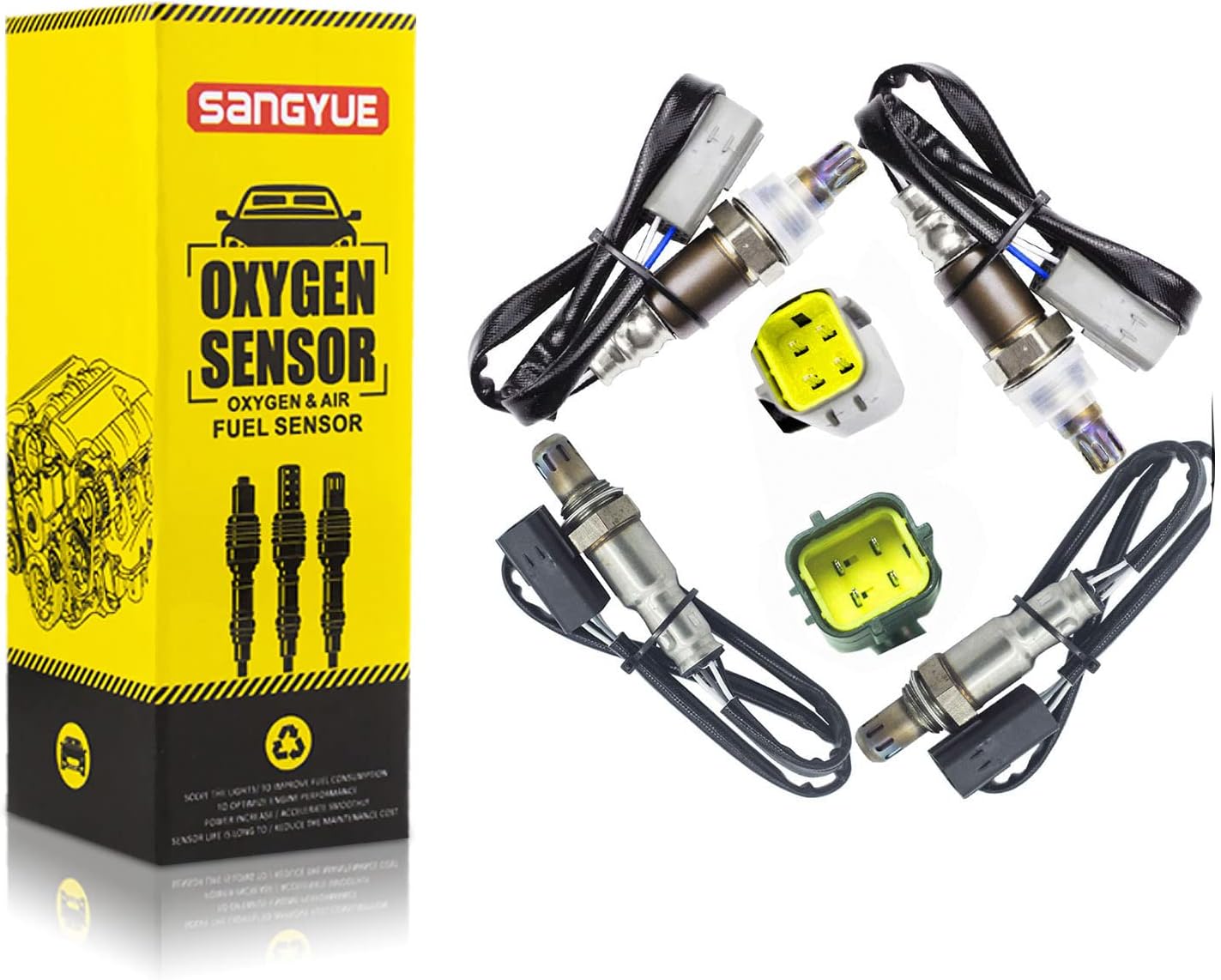
7. Sangyue Oxygen O2 Sensor Kit (4-Pack) for 2008 Infiniti G35 3.5L (Upstream + Downstream)
| Brand | Sangyue |
|---|---|
| Material | Aluminum Oxide, Stainless Steel |
| Output Type | Electrical signal |
| Upper Temperature Rating | 800 Degrees Fahrenheit |
This Sangyue four-piece oxygen sensor kit supplies two upstream (air-fuel ratio) and two downstream sensors intended for the 2008 Infiniti G35 3.5L. It installs in the factory sensor locations and outputs the electrical signals the engine control module expects to manage fuel trim and emissions. The listing emphasizes a factory-style production line and includes temperature-rated sensing elements suitable for exhaust conditions. In practice the kit provides a complete replacement set so you can clear multiple fault codes or service both banks without buying sensors individually. Installation is straightforward for a mechanically inclined DIYer who can access the exhaust and unplug the factory harnesses. Limitations to note are that this is an aftermarket part rather than a factory-sourced unit and a minority of buyers reported individual sensor failures, so thorough diagnostic checks before replacement and inspection of connectors are advisable.
Best for: Balanced, practical buyers who want a complete, DIY-friendly replacement kit to service or restore the oxygen-sensing system on a 2008 Infiniti G35 without splitting purchases across multiple parts.
Less Ideal for: Users seeking original factory-brand components or those who prefer professional installation with dealer-sourced parts should consider factory-quality alternatives.
- Complete four-sensor kit covers both upstream and downstream positions for a full system service
- Engineered to mirror factory production processes for compatible signal output and fitment
- Temperature-rated sensing element suitable for typical exhaust operating conditions
- Includes hardware that lets one repair all oxygen-sensor-related fault codes in a single job
- Aftermarket unit rather than factory-sourced which may affect long-term durability for some vehicles
- Some buyers reported individual sensors failing, so quality can vary between units
Verdict A budget-friendly, complete four-sensor replacement kit that suits DIY Infiniti G35 owners who want to service the whole oxygen-sensor system at once, with the usual variability of aftermarket parts.
Choosing the Right Infiniti G35 Oxygen Sensor: Key Factors to Consider
Fitment and Connector Type
Correct fitment is the first priority because the sensor must thread into the exhaust bung and mate with the vehicle’s wiring harness without splicing. If the thread size, pitch, or hex dimensions do not match the factory port, installation may require adapters that can introduce sealing and grounding problems.
Connector type and pinout also matter. Using a sensor with an incompatible connector forces wiring changes that increase installation time and error risk. Choosing a unit listed for the Infiniti G35 minimizes electrical compatibility issues and helps preserve original ground paths and heater circuit connections.
Upstream Versus Downstream Placement
Sensors before the catalytic converter (upstream) are used by the engine control unit to trim fuel mixture and must respond quickly to changes in exhaust oxygen content. Downstream sensors, located after the converter, primarily monitor catalytic efficiency and do not need as fast a response. Picking the correct location-specific sensor ensures the control strategy functions as intended.
Installing the wrong type for the position can lead to improper feedback and adaptive learning behavior, which may keep the engine running outside optimal parameters or leave catalytic converter faults unresolved.
Heater Circuit and Warm-Up Time
Most modern oxygen sensors include an internal heater to bring the sensing element up to operating temperature quickly. A reliable heater circuit reduces the time the engine runs in open-loop mode after a cold start, improving emissions and fuel economy. Heater resistance, connector wiring, and power draw should match the vehicle’s specifications to ensure proper operation.
A sensor with a slow or failed heater will delay accurate readings and can trigger diagnostic trouble codes related to the heater circuit. Confirming heater compatibility prevents unexpected faults and helps the ECU reach closed-loop control sooner.
Response Time and Accuracy
Response time describes how quickly the sensor reacts to changes in exhaust oxygen level. Faster response helps the engine control unit make timely fuel trim corrections, which improves throttle response, fuel economy, and emissions performance. Accuracy across a range of air-fuel ratios is important so the ECU receives reliable data for both light-load and heavy-load conditions.
Sensors with sluggish or drift-prone outputs can cause long-term adaptive issues and repeated diagnostics. Choosing a sensor specified for rapid, stable output reduces the risk of persistent lean or rich running conditions and unexpected drivability problems.
Durability and Contamination Resistance
Oxygen sensors are exposed to extreme temperatures, soot, and chemical contaminants from fuel and oil combustion. Construction quality, protective shielding, and the use of contamination-resistant coatings affect how long the sensor maintains accuracy. A more robust sensor will tolerate brief exposure to harsh conditions without permanent drift.
Consider sensors with proven element materials and protective features that are rated for extended service life. Durability reduces the likelihood of premature failure and the need for repeated replacements, which is especially important if you drive in stop-and-go traffic or use tiered fuels that can elevate contamination risk.
Diagnostic Compatibility And Testing
Ensure the replacement sensor provides diagnostic signals compatible with common OBD-II testing procedures. This includes producing a predictable voltage swing for narrowband units or a usable millivolt/voltage output for wideband types if applicable. Compatibility makes it easier to interpret live data, run heater checks, and verify post-installation operation with a scan tool.
Also consider how easy the sensor is to test with standard tools like a multimeter or scan tool. Clear wiring color codes and documentation reduce diagnostic time and help you confirm whether a sensor is functioning or if other components are causing the fault.
FAQ
What are common symptoms of a failing oxygen sensor in an Infiniti G35?
Common signs often include a persistent check engine light with emissions-related codes, poor fuel economy, rough idle, and hesitation under acceleration. You might also notice increased exhaust odor or failed emissions tests. Symptoms can vary, so diagnostic scanning and live-data checks help confirm the oxygen sensor as the source.
Can I test an oxygen sensor myself before replacing it?
Yes, you can perform basic checks using a scan tool to monitor live oxygen voltage or current and watch for expected switching behavior or stable wideband readings. A multimeter can verify heater circuit resistance and power. However, complete diagnosis sometimes requires comparing live data under different loads and temperatures to rule out related issues like vacuum leaks or fueling faults.
Should I replace upstream and downstream sensors at the same time?
It depends on condition and diagnostic codes. Upstream sensors wear faster because they regulate fueling, while downstream sensors mainly monitor catalytic converter performance and can last longer. If one failed due to contamination or age, it can make sense to inspect the other, but replacing both is not always necessary unless diagnostics or wear indicate it.
What does code P0135 indicate on an Infiniti G35?
Code P0135 usually points to a heater circuit malfunction for an oxygen sensor. It often signals that the sensor’s heater is not reaching expected resistance or that there is an open circuit, blown fuse, or connector issue. Verifying wiring, fuses, and heater resistance is a common first step in diagnosing this code.
How do upstream and downstream oxygen sensors differ in function?
Upstream sensors are located before the catalytic converter and are used by the engine control unit to adjust air-fuel ratio in real time. Downstream sensors sit after the converter and monitor its efficiency by comparing post-converter oxygen levels to expected values. Each location supports different diagnostic and control roles.
Are wideband sensors necessary for the Infiniti G35?
Most factory systems use narrowband sensors for closed-loop fueling control, while wideband units are used in some tuning and diagnostic applications for more precise air-fuel ratio measurement. Unless your vehicle’s control system is designed for wideband input, replacing like-for-like is typically the correct approach to maintain proper ECU behavior.
How We Chose the Best Infiniti G35 Oxygen Sensor
We focused on items that specifically fit the Infiniti G35 and meet the vehicle’s electrical and mounting requirements. Primary filters included exact thread and connector compatibility, wiring harness length, and sensor placement to ensure straightforward fitment without modification. Performance filters emphasized sensor response time and accuracy because quick, reliable oxygen readings are essential for stable air-fuel control and avoiding repeat fault codes.Durability factors included sensor element construction and protective features against exhaust heat and contamination, plus expected service life under normal driving. We also prioritized parts with clear technical documentation and wiring diagrams to aid diagnosis and installation. Exclusions: we excluded universal sensors that require splicing or major adaptations and parts lacking explicit Infiniti G35 fitment data or technical specs. Final selections balanced mechanical fit, electrical compatibility, sensing performance, and long-term reliability.
Our full evaluation process is outlined in our review methodology.
Conclusion
When replacing an Infiniti G35 oxygen sensor, prioritize correct mechanical and electrical fitment, heater compatibility, and sensor response characteristics. Those factors directly affect fuel trims, emissions performance, and diagnostic clarity.Balance durability and diagnostic friendliness against how you drive and how long you expect the replacement to last. Confirming connector type, placement (upstream or downstream), and heater specifications will help you avoid installation surprises and restore reliable engine control.
Explore More:
- Check out all Infiniti G35 parts & accessories
- Explore Oxygen Sensors Maintenance & Repair Guides
- Explore Engine
- Browse all Auto Parts
