

Note: This article contains affiliate links. If you click on these links and make a purchase, I may earn a small commission at no extra cost to you. This helps support my research and content. Read my full affiliate disclosure here.
Towing heavier trailers with your Chevrolet Silverado 2500 HD places more demand on the truck and trailer connection. The right weight distribution hitch helps level the rig, move tongue weight toward the truck axles, and reduce trailer sway so braking, steering, and cornering feel more controlled. For many owners, fitment, tongue weight rating, and integrated sway-control features are the difference between a secure tow and persistent handling problems.This guide shortlists the top options for Chevrolet Silverado 2500 HD owners, focusing on capacity, sway-control capability, ease of setup, and long-term durability. Read on for the key evaluation points and practical advice to pick the best weight distribution hitch for your towing needs.
Top Picks at a Glance
| Best Overall Weight Distribution Hitch A well-rounded kit that balances capacity, sway control, and durability | CURT Round Bar Weight Distribution Hitch with Sway Control, 14,000 lb Capacity |  |
| Best Budget Weight Distribution Hitch A lower-cost kit that covers essential load leveling and basic sway control | Fastway CONNECT Weight Distribution Hitch |  |
| Best Heavy‑Duty Weight Distribution Hitch High-capacity systems rated for larger GTW and elevated tongue weights | Weigh Safe TrueTow Heavyweight Distribution Hitch with Built-In Scale |  |
| Best with Integrated Sway Control Hitches with built-in sway-resistance features for smoother, safer towing | CURT TruTrack 17500 Weight Distribution Hitch with Integrated Sway Control |  |
| Best Trunnion‑Bar Weight Distribution Hitch Trunnion-style forged bars and fixed-support brackets for stronger leverage | CURT 17422 Trunnion Bar Weight Distribution Hitch with Sway Control |  |
| Best Grease‑Free / Quick‑Adjust Hitch Low‑maintenance or fast‑adjust designs that minimize greasing and setup time | Andersen Hitches 3324 Weight Distribution Hitch, 4" Drop/Rise, 2" Ball |  |
| Best Trailer‑Mounted / Quick‑Connect Hitch Convenient trailer‑mounted heads or quick‑connect coupling for fast hitching | CURT TruTrack Trailer-Mounted Weight Distribution Hitch with Integrated Sway Control (8–10K) |  |
1. CURT Round Bar Weight Distribution Hitch with Sway Control, 14,000 lb Capacity
Best Overall Weight Distribution Hitch

| Towing capacity | Up to 14,000 lbs. GTW |
|---|---|
| Tongue weight | 1,000 to 1,400 lbs. TW |
| Shank fit | 2" x 2" receiver |
| Ball size | 2-5/16" pre-torqued |
| Material | Carbon Steel |
This CURT round bar weight distribution hitch is a solid, do-it-yourself choice for towing heavier trailers with a Silverado 2500 HD. It redistributes tongue weight to level the tow vehicle and trailer, and the included sway control unit helps reduce trailer yaw on highways and crosswinds. Notable features include forged steel round spring bars, a formed steel head with built-in grease zerk fittings for easy lubrication, and a powder-coated finish for corrosion resistance. The hitch ships with a pre-torqued 2-5/16" ball and installation hardware, and the adjustable shank and chain hookup brackets let you tune tension to get a level setup. Practical benefits for routine towing are predictable handling, improved weight distribution, and simpler maintenance thanks to the integrated lubrication points. On the downside, the assembly is heavy and bulky to handle during installation and it requires periodic greasing to maintain the smooth operation of the spring bar pivot. Expect professional-grade capability but plan for a two-person install.
Best for: A Silverado 2500 HD owner who wants a proven, durable weight-distributing hitch they can install and maintain themselves for regular towing of travel trailers or campers.
Less Ideal for: Drivers who only tow very lightweight trailers infrequently or who need a lightweight, quick-connect system for occasional use should consider simpler hitching options.
- High towing capacity up to 14,000 lb GTW with 1,000–1,400 lb tongue weight range
- Integrated grease zerk fittings simplify lubrication and reduce wear at pivot points
- Includes sway control unit and pre-torqued 2-5/16" ball for a more complete out-of-the-box setup
- Forged steel spring bars and formed steel head provide durable, long-term strength
- Heavy, bulky assembly that typically requires two people to install safely
- Requires regular greasing at the zerk fittings to maintain optimal performance
Verdict: The all-around choice for DIY mechanics who want a proven weight-distributing hitch that balances load leveling, sway reduction, and long-term durability for routine towing.
2. Fastway CONNECT Weight Distribution Hitch
Best Budget Weight Distribution Hitch

| Maximum Towing Capacity | 10000 Pounds |
|---|---|
| Maximum Tongue Weight | 1000 lb max tongue wt. |
| Pull Force | 10000 Pounds |
| Material Type | Alloy Steel |
| Finish Type | Powder Coated |
The Fastway CONNECT is a straightforward, budget-friendly weight-distribution hitch designed to restore balance when towing heavier trailers. It uses hardened steel chains and round-bar spring arms to transfer tongue load from the rear axle back toward the front axle, which improves steering, braking, and reduces rear sag. Typical setup is simple: the hitch arrives with a pre-installed 2-5/16" ball and a standard shank and adjusts by moving the chain to different links for more or less lift. The powder-coated alloy-steel construction resists corrosion and the universal fit is intended for RV, cargo, horse, and utility trailers without drilling the trailer frame. Limitations are its basic chain-style system and lack of finer micro-adjustment found on higher-end models, and the 1,000 lb tongue weight / 10,000 lb trailer rating should be matched carefully to your Silverado 2500 HD's towing capacities and hitch requirements.
Best for: Buyers who want an economical, no-frills solution to improve towing stability on a Silverado 2500 HD and who prioritize straightforward setup and proven chain-style weight distribution.
Less Ideal for: Drivers seeking the quietest ride, the smoothest incremental adjustments, or the highest-end materials and features should consider more advanced weight-distribution systems.
- Provides effective tongue-weight redistribution using hardened steel chains and round-bar arms
- Includes 2-5/16" pre-installed ball and standard shank for quick installation
- Powder-coated alloy-steel construction offers corrosion resistance
- Simple, tool-light adjustments by changing chain link provide quick setup on the road
- Chain-style system lacks the finer incremental adjustment and noise reduction of spring-bar or trunnion designs
Verdict: Pick this economical weight-distribution hitch when you need reliable tongue-weight redistribution and basic stability features without paying for high-end materials or extra tech.
3. Weigh Safe TrueTow Heavyweight Distribution Hitch with Built-In Scale
Best Heavy‑Duty Weight Distribution Hitch
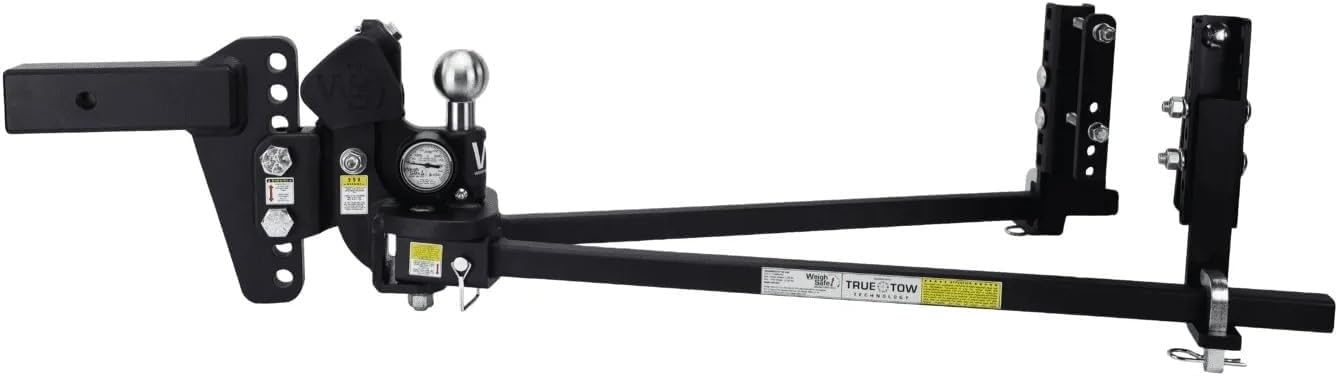
| Pull Force | 22000 Pounds |
|---|---|
| Compatible with Vehicle Type | RV, Truck |
| Automotive Fit Type | Universal Fit |
| Material Type | Alloy Steel |
| Finish Type | Powder Coated |
The Weigh Safe TrueTow Heavyweight is a beefy weight distribution hitch designed to handle high-capacity towing needs while giving you precise control over tongue weight and sway. It installs between the truck receiver and trailer, uses spring bars and a shank to redistribute tongue load across the tow vehicle and trailer axles, and includes a hydraulic built-in scale plus a smartphone DTW tool to verify distributed tongue weight. Notable features are a live adjustment screw for quick tensioning, four-area anti-sway connection points for stronger sway control, and a powder-coated alloy steel build with a 2.5-inch shank option and a 6-inch drop in this configuration. For use on a Silverado 2500 HD, the 22,000 lb GTW rating and heavy-duty components suit frequent towing of large fifth-wheel style or travel trailers and RVs. The hitch is substantial and adds weight to the truck when not in use, and its size means installation and handling are more involved than lighter systems, but those are expected for a high-capacity unit.
Best for: Drivers who regularly tow heavy trailers with a Silverado 2500 HD and need a high-capacity, durable distribution hitch that provides precise tongue-weight measurement and strong sway control.
Less Ideal for: Casual or infrequent haulers who tow light trailers or prioritize an easy-to-store, lower-weight hitch should consider simpler, lighter systems instead.
- 22,000 lb gross trailer weight rating for heavy-duty towing
- Built-in hydraulic scale and smartphone DTW tool for accurate tongue-weight measurement
- Live adjustment screw allows on-the-fly tensioning without removing the hitch
- Four-area anti-sway connection provides stronger sway control than basic systems
- Durable alloy steel construction with powder-coat finish for corrosion resistance
- Substantial unit weight and size make it cumbersome to handle and store when not in use
- Installation and setup are more involved compared with lighter passenger-grade hitches
Verdict: Choose a heavy-duty hitch when you regularly tow heavier trailers and need extra gross-trailer-weight and tongue-weight capacity with beefier bars and shanks for demanding loads.
4. CURT TruTrack 17500 Weight Distribution Hitch with Integrated Sway Control
Best with Integrated Sway Control

| Capacity | Up to 10,000 lbs. |
|---|---|
| Shank | 2-inch |
| Ball Size | 2-5/16-inch |
| Material | Carbon Steel |
| Finish | Powder Coated |
The CURT TruTrack 17500 is a weight distribution hitch that blends active, built-in sway control with conventional spring-bar load levelling to improve stability when towing heavy trailers behind a Chevrolet Silverado 2500 HD. It attaches with a 2-inch shank and a 2-5/16-inch ball and uses forged trunnion-style spring bars plus a spring-and-cam mechanism to resist trailer oscillation rather than relying on separate friction devices. Adjustable support brackets secure the bars laterally and vertically, and the TruTrack head features interlocking nuts and six preset tilt positions so you can set tongue angle without disassembling the head. In practice that means quicker setup, stronger resistance to sway during highway driving, and more even weight distribution across tow vehicle and trailer axles—benefits that matter when towing campers, car haulers, or livestock trailers. The hitch is built from carbon steel with a powder coat finish for durability, but it is a substantial, dedicated towing component so installation and alignment require basic tools and a two-person lift for safe mounting.
Best for: Towing-focused Silverado 2500 HD owners who prioritize highway stability and confident handling with heavy trailers and want an integrated sway-control solution that reduces the need for aftermarket add-ons.
Less Ideal for: Drivers who only tow light loads occasionally or want a minimal, easy-to-store hitch should consider simpler ball mounts or lower-capacity systems.
- Integrated multi-point sway control resists trailer oscillation without add-on brackets
- Spring-and-cam system with hardened components provides active sway intervention and smoother turns
- Interlocking nuts and six preset tilt holes simplify setup and on-vehicle adjustment
- Forged trunnion-style spring bars and adjustable support brackets spread tongue weight across axles
- Requires substantial installation effort and likely a second person to mount and align
- Heavy, dedicated unit that may be overkill for light towing needs
Verdict: This slot is for hitches that include integrated or multi-point sway-control systems to reduce trailer oscillation and improve highway stability without add-on brackets.
5. CURT 17422 Trunnion Bar Weight Distribution Hitch with Sway Control
Best Trunnion‑Bar Weight Distribution Hitch

| Gross trailer weight capacity | Up to 15,000 lbs. |
|---|---|
| Tongue weight capacity | 1,500 lbs. |
| Shank size | 2-inch |
| Material | Carbon Steel |
| Finish | Powder Coated |
The CURT 17422 is a trunnion-bar weight distribution hitch built for heavier towing applications where precise leveling and firm control matter. It uses forged steel trunnion-style spring bars and a formed head to redistribute tongue weight across the tow vehicle and trailer axles, helping the truck maintain level stance and improve steering and braking stability. The kit includes a trailer ball, hook-up brackets, spring bar safety chains, a pin and clip, and an integrated sway control unit that mounts to built-in attachment tabs for added resistance to trailer oscillation. With a gross trailer weight capacity up to 15,000 lbs and a tongue weight rating of 1,500 lbs, this CURT hitch suits large travel trailers and heavy loads commonly paired with three-quarter-ton trucks. The powder coat finish protects components from corrosion, but the system is substantial and requires proper installation, possible shank changes for some heavy-duty hitch receivers, and attention to vehicle payload limits before increasing trailer weight. Installation and setup take more time than a simple ball mount but deliver firmer control and better load distribution when matched correctly to the tow vehicle.
Best for: Owners who prioritize rugged, heavy-duty towing performance and want the rigid support and precise leveling that forged trunnion bars deliver when towing large trailers behind a Silverado 2500 HD.
Less Ideal for: Drivers who tow light loads occasionally or who prefer a lighter, quicker-to-install weight distribution solution should consider simpler systems instead.
- Forged trunnion-style spring bars and formed head provide rigid support for precise leveling
- Includes sway control unit and attachment tabs to reduce trailer oscillation
- High capacity ratings: up to 15,000 lb gross trailer weight and 1,500 lb tongue weight
- Comprehensive kit includes ball, brackets, safety chains and hardware for hookup
- Durable powder coat finish resists rust and UV damage
- Heavy, bulky assembly that requires time and space to install and adjust
- May require a different shank for some commercial 2.5-inch receivers
Verdict: Select a trunnion-bar hitch when you prefer forged trunnion spring bars and rigid support brackets for precise leveling and heavier-duty performance.
6. Andersen Hitches 3324 Weight Distribution Hitch, 4" Drop/Rise, 2" Ball
Best Grease‑Free / Quick‑Adjust Hitch

| Maximum Towing Capacity | 10000 Pounds |
|---|---|
| Pull Force | 10000 Pounds |
| Automotive Fit Type | Universal Fit |
| Material Type | Alloy Steel |
The Andersen 3324 is a grease-free weight distribution hitch built around a friction cone and tension-chain system to control sway and road bounce while cutting routine maintenance. It is used between a truck and bumper-pull trailer with a 2" ball; the 4" drop/rise shank lets the trailer sit level with many heavy-duty truck hitches. The tension chains attach faster and adjust more quickly than traditional spring bars, so hitching and unhitching is a simpler process for one person. Its powder-coated alloy steel construction and 10,000 lb GTWR rating make it suitable for heavy recreational or work trailers. Because the sway control is integrated into the ball housing, you do not need separate sway bars or frequent greasing, which keeps hands and components cleaner. Limitations are that it is a fixed styling of friction-based sway control, so fine-tuning feel requires chain adjustment rather than swapping bar types, and correct setup still requires proper tongue weight distribution and occasional inspection.
Best for: Buyers who prioritize quick, low-maintenance hookups and integrated sway control for regular heavy towing with a Silverado 2500 HD and similar heavy-duty trucks.
Less Ideal for: Drivers seeking highly tunable spring-bar setups or those who prefer separate adjustable sway-control bars for fine-grain handling adjustments.
- Grease-free friction cone and tension-chain design reduces maintenance and keeps hands cleaner.
- Faster hookup and adjustment compared with traditional spring-bar systems due to tension chains.
- Rated for up to 10,000 lb GTWR and 1,400 lb tongue weight for common heavy-duty towing needs.
- Powder-coated alloy steel construction resists corrosion and withstands regular towing use.
- Friction-cone sway control offers less modular tuning than interchangeable spring bars for very specific handling preferences.
Verdict: This pick fits towers who want easy hook‑up and minimal maintenance—systems that use tension chains, top‑loading bars, or friction/cone designs to reduce grease and speed adjustments.
7. CURT TruTrack Trailer-Mounted Weight Distribution Hitch with Integrated Sway Control (8–10K)
Best Trailer‑Mounted / Quick‑Connect Hitch

| Maximum Towing Capacity | 4535 kg |
|---|---|
| Pull Force | 10000 pounds |
| Automotive Fit Type | Universal Fit |
| Material Type | Carbon Steel |
The CURT TruTrack is a trailer-mounted weight distribution system designed to remain on the trailer and snap onto the vehicle-mounted head for fast, repeatable hookups. You install the spring bar and horn assembly on the trailer and leave it in place while the shank and head stay in the tow vehicle receiver, so daily coupling only requires lowering the horn, inserting a single pin, and engaging the snap-up brackets. Its forged steel spring bars, heavy-duty fabricated head, and carbide powder coat finish make it robust for heavy towing and the fixed support brackets provide consistent leveling and more control than chain-style setups. The TruTrack includes integrated sway control via friction brackets to reduce trailer oscillation and improve ride stability. Practical benefits include quicker hitching, less bending to handle spring bars, and a more consistent hitch geometry between tows. Limitations are that this is a trailer-mounted design so installation on the trailer is required and its fixed system may be less convenient for users who swap trailers frequently or need a different style of sway control system.
Best for: Tow owners who prioritize fast, repeatable hookups and consistent hitch geometry for heavy-duty towing with a Silverado 2500 HD and want a trailer-mounted system that stays in place between uses.
Less Ideal for: Drivers who regularly swap between multiple trailers with different hitch setups or who need highly adjustable or aftermarket active sway control solutions should consider other options.
- Quick-connect coupling with single-pin locking for fast, repeatable hookups
- Trailer-mounted spring bar assembly stays installed to avoid reassembly each use
- Forged steel spring bars and heavy-duty head provide strong load handling
- Integrated friction-based sway control and fixed support brackets improve stability
- Durable carbide powder coat finish resists corrosion
- Requires installation on the trailer, adding upfront setup time
- Fixed bracket configuration may not suit users who frequently change trailers or need adjustable sway tuning
Verdict: Choose a trailer‑mounted or quick‑connect weight distribution hitch when you want a setup that stays on the trailer and locks into place for faster, repeatable hookups.
Choosing the Right Chevrolet Silverado 2500 HD Weight Distribution Hitch: Key Factors to Consider
Tongue Weight Rating
Tongue weight rating is the most critical spec because it determines whether a weight distribution hitch can safely carry the vertical load from your trailer. For the Chevrolet Silverado 2500 HD, many trailers produce substantial tongue weight, especially when loaded, so choose a hitch whose tongue weight rating exceeds your measured tongue weight by a safe margin. Operating close to the maximum rating reduces adjustment range and can compromise sway-control performance.
Measure tongue weight with the trailer loaded to typical towing condition and include any cargo or equipment. If you plan to change trailers frequently, select a hitch with a rating that accommodates your heaviest trailer. Allowing headroom in the rating preserves adjustment flexibility and reduces wear on components.
Gross Trailer Weight Capacity
Gross trailer weight capacity indicates the heaviest trailer load the hitch system is engineered to influence. While tongue weight rating is about vertical load, gross trailer weight affects dynamic forces during acceleration, braking, and cornering. For heavier trailers commonly towed by a Silverado 2500 HD, a hitch with a higher gross trailer weight rating provides a safety buffer and more consistent handling.
Confirm the trailer's loaded GVWR and match that to the hitch's published capacity rather than relying only on the vehicle tow rating. Choosing a hitch with insufficient gross trailer weight capacity can leave the truck-trailer setup undercontrolled under dynamic loads.
Sway Control Integration
Sway control integration determines how effectively the hitch prevents side-to-side oscillation. Mechanical sway-control features that work through spring-bar geometry or friction damping are typically more predictable under heavy loads. Some systems allow add-on sway-control devices; others have built-in resistance. For Silverado 2500 HD owners, look for systems that maintain consistent damping across different trailer loads.
Consider whether sway control disengages for backing or low-speed maneuvers and how easy it is to reengage. A system that is adjustable and reliable will reduce the likelihood of trailer snaking at highway speeds while allowing manageable maneuvering at low speeds.
Adjustability and Setup Range
Adjustability covers the hitch's capacity to fine-tune head height, spring bar angle, and weight distribution tension. A broad setup range makes it easier to level the truck and trailer across different trailer designs and varying loads. For heavy-duty towing with a Silverado 2500 HD, you want a hitch that provides incremental adjustments so you can dial in balance without repeated disassembly.
Look for features like multiple shank drop settings, indexed spring-bar positions, and clear marking for tension levels. The more accessible and repeatable the adjustments, the less downtime and frustration when swapping trailers or changing cargo weight.
Build Quality and Corrosion Resistance
Hitches on heavy pickups face significant mechanical stress as well as exposure to road salts, moisture, and debris. High-strength steel components, robust welds, and durable finishes extend service life and maintain safety margins. Corrosion-resistant coatings and sealed pivot points keep adjustment mechanisms functional over time.
Inspect how manufacturers protect critical parts like spring bars, hitch heads, and mounting pins. For Silverado 2500 HD owners who tow regularly or in harsher climates, prioritizing corrosion resistance reduces maintenance and replacement frequency.
Compatibility With Truck Hitch Receiver And Ball Sizes
Compatibility means ensuring the weight distribution hitch fits your truck's receiver size and works with the hitch ball and shank combination you use. Silverado 2500 HD setups often employ heavy-duty shanks and larger ball sizes. Confirm the hitch accepts standard balls and that the shank fits your receiver drop and rise needs. Some hitches require specific shank lengths or offer multiple shank options to align the trailer coupler properly.
Also consider clearance for aftermarket bumpers, spare tire locations, or bumper-mounted accessories. Ensuring straightforward physical compatibility avoids on-truck modifications and keeps installation simple.
How Weight Distribution Hitches Affect Silverado 2500 HD Handling
Weight distribution hitches transfer a portion of the trailer's tongue load to the truck's front axle, which helps maintain steering traction and even the load across axles. For the Silverado 2500 HD, this can reduce nose lift under heavy loads and improve braking balance.
A properly set system minimizes the tendency for the trailer to push the rear of the truck down, making lane changes and emergency maneuvers more predictable. The net result is a more stable towing platform and reduced driver fatigue on long hauls.
- Improves front-axle weight to preserve steering feel
- Helps level the truck and trailer for better braking
- Reduces trailer-induced rear sag and headlight misalignment
Installation Basics and Practical Tips
Installing a weight distribution hitch requires measuring the unloaded and loaded ride heights of the truck and trailer, setting the correct shank drop, and adjusting spring-bar tension to achieve level. For heavy-duty trucks like the Silverado 2500 HD, having an assistant or a floor jack can simplify alignment of the trailer coupler and ball during setup.
Use a reliable tongue weight scale or a properly rated bathroom scale with a leverage rig to check tongue weight. Recheck settings after a short test drive and again after the first few hundred miles towing to allow components to settle.
- Measure tongue weight with typical cargo onboard
- Start with manufacturer-recommended tension and fine-tune
- Reinspect hardware torque and pin retention after initial use
Common Setup Mistakes to Avoid
A frequent mistake is undersizing the hitch relative to tongue weight or gross trailer weight. This can leave the truck-trailer combination underdamped and prone to sway. Another is over-tightening the spring bars which can cause binding and make low-speed maneuvering difficult.
Failing to check the hitch and trailer coupling clearance can lead to rubbing or interference during articulation. Also, forgetting to secure all safety chains and attachment pins properly increases risk during a tow.
- Do not assume the same settings work for different trailers
- Avoid excessive spring-bar preload that limits articulation
- Always verify clearance and pin retention before departure
Maintaining Your Weight Distribution System
Routine checks keep the hitch functioning safely. Inspect pivot points and fasteners for wear, ensure coatings are intact, and lubricate manufacturer-recommended areas. Replace any bent or fatigued components promptly.
Periodically re-torque mounting hardware according to the hitch instructions and check for corrosion around the ball and shank interfaces. Proper maintenance preserves sway-control effectiveness and load distribution performance.
- Inspect spring bars and pins for bends or cracks
- Clean and protect finish from road salt and grit
- Lubricate moving parts per instructions
When To Add Or Upgrade Sway-Control Components
If you notice persistent trailer oscillation, loosen or inconsistent damping across load conditions, consider adding or upgrading sway-control components. Heavy trailers or shifts in load distribution can overwhelm a basic friction-based system and require a more robust sway-control device.
Upgrades can include stronger friction assemblies, dual-arm systems, or sway-control that interfaces directly with the hitch head for improved leverage. Any upgrade should be matched to the tongue weight and the towing dynamics you experience with the Silverado 2500 HD.
- Consider upgrades when towing heavier loads frequently
- Match sway-control capacity to tongue weight, not just GVWR
- Test changes gradually to find the optimal damping level
How We Chose the Best Chevrolet Silverado 2500 HD Weight Distribution Hitch
We started by narrowing candidates to weight distribution hitches designed to handle the higher tongue weights typical of heavy-duty pickups and commercial-style trailers. Primary evaluation criteria included rated tongue weight and gross trailer weight capacity, because underspecifying a hitch creates handling and safety risks. Next, we assessed sway-control integration and effectiveness, prioritizing hitches with proven mechanical sway-control features or compatible add-on systems.Ease of installation and adjustability were important because Silverado 2500 HD owners often change trailers or towing configurations; systems that allowed clear adjustments without repeated disassembly were favored. Construction quality and corrosion resistance were reviewed to ensure long service life under heavy loads and exposure to road conditions. Finally, we considered compatibility with common hitch ball sizes and shank designs used on heavy-duty tow setups.We excluded light-duty and consumer-grade hitches with low tongue-weight ratings or those lacking any sway-control provisions. Products that required significant truck modification or special adaptors beyond normal towing equipment were also removed. The remaining selections balance capacity, control, and practical usability for Silverado 2500 HD owners.
Our full evaluation process is outlined in our review methodology.
FAQ
How do I know if my Silverado 2500 HD needs a weight distribution hitch?
If your truck's rear sags under load, the front axle lightens noticeably, or steering and braking feel compromised while towing, a weight distribution hitch can help. Also consider one if your trailer tongue weight approaches a significant portion of the truck's payload rating.
Can I install a weight distribution hitch myself on a Silverado 2500 HD?
Many owners can install these hitches using basic tools and a helper, following the manufacturer instructions. For complex setups or if you are unsure about torque specs and alignment, professional installation ensures correct setup and safety.
How often should I check or adjust the hitch setup?
Check the hitch and adjustments after the first few miles of a new setup, then periodically during the first few trips. Regular inspections every few months or after heavy use will catch wear or loosening before it becomes a safety issue.
Will a weight distribution hitch completely eliminate trailer sway?
A properly rated and adjusted weight distribution hitch with effective sway control greatly reduces sway risk, but it may not eliminate it in every condition. Road winds, uneven loads, and sudden maneuvers can still induce sway, so drive cautiously and address load distribution first.
Do I need different spring bars for different trailers?
Spring-bar selection or shank position can change effective leverage and tension. Some systems provide interchangeable bars or multiple index positions to accommodate different tongue weights, while others require selecting the correct bar rating for each trailer.
How does tongue weight change when I add cargo to the trailer?
Adding cargo typically increases tongue weight proportionally, and shifting cargo fore or aft changes how that weight is distributed. Always re-measure tongue weight when you change cargo configuration to ensure the hitch rating and settings remain appropriate.
Final Verdict
Prioritize a weight distribution hitch that matches your Silverado 2500 HD's measured tongue weight and the loaded trailer gross weight. Balance capacity and sway-control capability with ease of adjustment so you can fine-tune handling across different trailers and loads. Remember that proper setup and routine maintenance matter more than marginal differences in hardware; selecting a system with clear adjustment range and reliable sway control gives the most consistent benefit. Choose a hitch that leaves room above your typical towing load and that provides dependable damping so you can tow heavier trailers with greater confidence.
