

Note: This article contains affiliate links. If you click on these links and make a purchase, I may earn a small commission at no extra cost to you. This helps support my research and content. Read my full affiliate disclosure here.
If you tow with a 2018-present Jeep Wrangler, a reliable trailer brake controller can make towing safer and more predictable. Whether your Wrangler is a two-door JL or a four-door JLU, the right controller reduces trailer sway, shortens stopping distance, and gives you in-cab control over trailer braking behavior. This guide covers the top shortlisted trailer brake controllers chosen for modern Jeep Wranglers. We evaluated units that suit common towing setups for the 2018-present Wrangler and explain the practical differences between proportional, time-delayed, and electric controllers. Read on for a concise evaluation of features, installation considerations, and which controller traits matter most for your Wrangler and towing needs.
Looking for other parts? See all Jeep Wrangler parts & accessories.
Top Picks at a Glance
| Best Overall Trailer Brake Controller A balanced, reliable controller with broad compatibility and solid performance | REDARC Tow-Pro Trail Electric Trailer Brake Controller Kit |  |
| Best Budget Trailer Brake Controller An inexpensive, straightforward controller for light-duty or occasional towing needs | Gihdfer Brakeman IV Time-Delayed Digital Trailer Brake Controller |  |
| Best Premium Trailer Brake Controller Feature-rich, heavy-duty controllers with advanced sensors and multiple braking modes | Tekonsha Prodigy P2 Proportional Trailer Brake Controller |  |
| Best Compact Trailer Brake Controller Low-profile or slim controllers designed to sit unobtrusively under the dash | CURT Venturer NEXT Time-Delay Trailer Brake Controller (Low-Profile) |  |
| Best Wireless / Bluetooth Trailer Brake Controller Portable, app-enabled controllers that plug into the 7-way and pair with phones | CURT Echo 51180 Mobile Bluetooth Trailer Brake Controller |  |
| Best Proportional / Multi‑Axle Trailer Brake Controller Proportional controllers with accelerometers and support for 1–3+ axles | CURT TriFlex NEXT Proportional Inertia Trailer Brake Controller |  |
| Best Plug‑and‑Play Kit Trailer Brake Controller Complete kits that include vehicle‑specific wiring harnesses and mounting parts | REDARC Tow-Pro Elite Electric Trailer Brake Controller |  |
1. REDARC Tow-Pro Trail Electric Trailer Brake Controller Kit
Best Overall Trailer Brake Controller

| Model | Tow-Pro Trail |
|---|---|
| Fits vehicles | Jeep Wrangler (2018-2024), Rubicon, Gladiator (2019-2024) |
| Axle support | 1–3 axles |
| Voltage compatibility | 12V/24V compatible |
| Manufacturer | REDARC |
The REDARC Tow-Pro Trail kit is a compact, vehicle-specific trailer brake controller package built for on-road towing and off-road use in Jeep Wranglers and Gladiators. It installs using the included vehicle harness and universal pigtail so most DIY mechanics can achieve a near-factory fit and finish without complex wiring. The controller offers two operating modes: Everyday Mode for smooth, proportional braking on pavement and Manual Off-Road Mode that applies full trailer braking instantly for steep descents or loose surfaces. Built-in active calibration and sway control help keep trailer braking balanced whether you are loaded or not. The dash-mounted dial is small and unobtrusive and fits factory switch blanks with the supplied hardware. Practical benefits include support for 1–3 axles and a kit assembled to simplify install in the specified Jeep models. The main limitations are that fitment and the supplied harness target Jeep Wrangler and Gladiator model years listed, so this exact kit is not a universal solution for other vehicles, and advanced users wanting wireless or Bluetooth tuning will need a different controller.
Best for: DIY mechanics who tow with 2018–present Jeep Wranglers or Gladiators and want a dependable controller that installs cleanly, gives predictable stopping power, and includes an off-road mode for steep or loose terrain.
Less Ideal for: Drivers seeking a universal controller for multiple vehicle makes or those who want wireless/Bluetooth tuning and advanced mobile configuration features.
- Plug-and-play wiring harnesses tailored for Jeep Wrangler and Gladiator for quick installation
- Two operating modes (Everyday and Manual Off-Road) cover pavement and trail braking needs
- Active calibration and sway control provide consistent, balanced trailer braking
- Compact dash dial mounts into factory switch blanks for a clean, factory-style appearance
- Supports 1–3 trailer axles, making it suitable for a wide range of small to medium trailers
- Not a universal kit — the included harness and inserts are specific to the listed Jeep models
Verdict: For DIY mechanics who want a dependable, well-rounded trailer brake controller that combines easy installation, consistent stopping power, and features that work for most towing situations.
2. Gihdfer Brakeman IV Time-Delayed Digital Trailer Brake Controller
Best Budget Trailer Brake Controller

| Fitment | 1 to 4 axles |
|---|---|
| Operation | Time-delayed brake activation |
| Display | LED braking force indicator |
| Package | Controller, mounting bracket, screws, instruction |
The Brakeman IV is a no-frills, time-delayed brake controller aimed at budget-minded towers. It mounts compactly and uses a simple LED display to show braking force while letting you set gain and delay so trailer braking comes on smoothly instead of abruptly. It supports 1 to 4 axles, so it can handle small utility trailers up to larger multi-axle rigs, and the package includes a mounting bracket and screws for quick installation. In practice this unit is best for occasional towing where you want reliable, predictable timed braking without advanced proportional sensing or multiple tow modes. Installers note the plastic screw bosses can strip if overtightened and the wiring looks lighter gauge than premium units, so take care during installation. If you need a basic, inexpensive controller that improves towing safety on short trips and light-to-moderate loads, this delivers solid value; but frequent heavy towing or drivers who want highway and town modes or vehicle-integrated proportional control should consider higher-end alternatives.
Best for: Jeep Wrangler owners who tow occasionally and prioritize an affordable, straightforward brake controller that provides predictable timed braking and easy installation.
Less Ideal for: Drivers who tow frequently, haul heavy loads, or want proportional sensing and multiple tow modes integrated with the vehicle should look at higher-end controllers.
- Simple time-delayed operation with adjustable gain for smoother trailer braking
- LED display clearly shows braking force for easy monitoring
- Compact design and included mounting hardware make installation straightforward
- Supports 1 to 4 axle trailers, covering a wide range of trailer types
- Plastic mounting screw bosses can strip if overtightened
- Wiring appears lighter gauge than premium controllers, which may limit long-term durability
Verdict: Choose this slot if you need a low-cost, serviceable brake controller that delivers basic timed or proportional braking for occasional towing without extra bells and whistles.
3. Tekonsha Prodigy P2 Proportional Trailer Brake Controller
Best Premium Trailer Brake Controller

| Model | 90885 |
|---|---|
| Voltage | 12 Volts |
| Axles supported | 1-4 axles (electric or electric over hydraulic) |
| Mounting | Top or under dash; auto-level within 90° |
| Display | LED digital display |
The Tekonsha Prodigy P2 is a proportional electric brake controller that senses your vehicle’s deceleration and modulates trailer brakes for smoother, more predictable stops. It is typically mounted on or under the dash and connects to the vehicle wiring; plug and play harnesses are available for many rigs including Wrangler installations when a compatible harness is used. Notable features include an easy-to-read LED display, a large control knob for on-the-fly power adjustments, a three-level boost for heavier loads, manual override to apply trailer brakes independently, and auto-leveling when mounted within a 90-degree vertical range. In practice the P2 delivers consistent, fade-free braking across highway and mountain driving and is simple to reconfigure while towing. Limits for this pick: it does not include advanced multi-axis sway-control or dedicated off-road modes found on higher-end smart controllers, and buyers who need those extras will need a different model. Power-save and removable connector make it convenient to store when not towing.
Best for: A buyer who prioritizes reliable, consistently proportional trailer braking and simple in-cab controls for demanding towing on-road and trail approaches, and who values proven hardware over advanced electronic sway or off-road features.
Less Ideal for: Drivers who need integrated multi-axis sway control or dedicated off-road/dual-mode tuning should consider premium smart controllers with those specialized features instead.
- Proportional braking via internal inertia sensor for smooth, intuitive trailer control
- Large, easy-to-use knob and LED display let you change settings quickly while driving
- Boost feature adds up to three levels of extra braking for heavier loads
- Auto-level mounting and compact design fit easily under or on top of dash and stows with a snap-in clip
- Power-save mode and removable connector simplify storage and reduce parasitic drain
- Does not offer multi-axis sensors, built-in sway control, or specialized off-road modes
Verdict: This label fits buyers who want top-tier performance and extras like multi-axis sensors, sway control, or dual on-/off-road modes for demanding towing and off-road use.
4. CURT Venturer NEXT Time-Delay Trailer Brake Controller (Low-Profile)
Best Compact Trailer Brake Controller

| Model | Venturer NEXT (51116) |
|---|---|
| Vehicle system | 12-volt |
| Brake capacity | Controls up to 6 brakes / 1–3 axles |
| Display | LED ramp indicator with adjustable brightness |
The CURT Venturer NEXT is a small, cab-mounted time-delay brake controller designed to give precise control over electric trailer brakes without taking up much dash space. It controls up to six brakes (three axles) and offers fully adjustable power and ramp settings so you can tune braking force and response to match different trailer weights. The slim housing and included low-profile bracket make mounting under the dash straightforward and help keep the unit unobtrusive while still showing ramp progress on an LED bar whose brightness is adjustable for day or night. Because it is time-based, setup is simple and there are no internal moving parts or leveling requirements, and many owners find it easy to install with a CURT plug-and-play wiring harness. Limitations to consider are that time-delay controllers do not react to vehicle deceleration like proportional models do, and the supplied double-sided tape may be less secure than a screw mount for long-term use. Overall it is a solid compact choice when dash clearance and a tidy installation matter most.
Best for: Buyers who prioritize a small, unobtrusive brake controller that still lets them fine-tune braking for different trailers and wants an easy-to-install unit that stays out of the way on the dash.
Less Ideal for: Drivers who need instant proportional braking response tied to vehicle deceleration or who tow very heavy or highly variable loads requiring real-time brake modulation.
- Low-profile, compact design that preserves dashboard space
- Fully adjustable power and ramp time for tuning braking to trailer load
- Controls up to 6 brakes (1–3 axles) for common small-to-medium trailers
- LED ramp indicator with adjustable brightness for day or night use
- Time-delay operation does not sense vehicle deceleration like proportional controllers
Verdict: Pick this slot if you prefer a small, low-profile unit that frees up dash space while still providing adjustable braking and reliable performance.
5. CURT Echo 51180 Mobile Bluetooth Trailer Brake Controller
Best Wireless / Bluetooth Trailer Brake Controller
| Model | 51180 |
|---|---|
| Connection | Bluetooth to smartphone |
| Installation | Plug into 7-way RV blade socket |
| Brakes supported | 1 to 2 axles (2–4 brakes) |
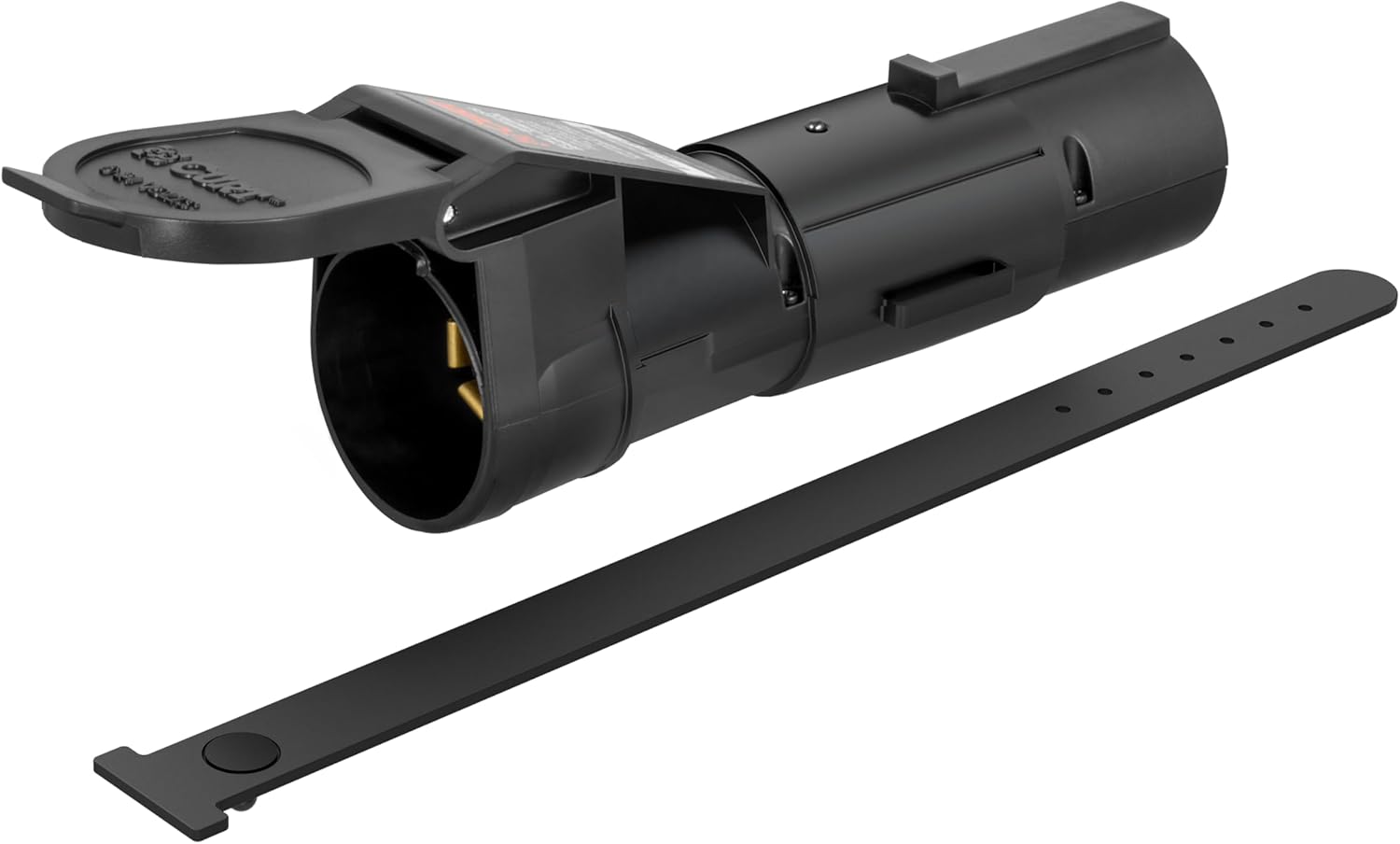
The CURT Echo mobile brake controller replaces a dash-mounted unit with a plug-and-play device that connects to your phone over Bluetooth and lets you monitor and adjust trailer braking from the OneControl app. It installs by inserting between the vehicle and trailer 7-way connector so you can move it between vehicles without cutting wires or fitting an under-dash harness. The Echo uses a tri-axis accelerometer and automatic calibration to provide proportional braking and supports one to two axles depending on trailer brakes. The unit is sealed with a potted enclosure and includes a retention strap and locking tab to improve the connection at the 7-way plug. Practical benefits include easy setup, saved towing profiles for different trailers, and compatibility with cruise control and ABS systems. Limitations to consider are its exposed, protruding position at the trailer plug which can reduce ground clearance and risk loosening on rough roads, and dependence on a stable Bluetooth connection and smartphone app for live control and monitoring.
Best for: Someone who values a non-invasive, transferable brake controller and prefers configuring brake output from a smartphone instead of installing a wired in-cab unit.
Less Ideal for: Drivers who need a permanently mounted, out-of-sight controller or who tow in very rough conditions where a plug-in unit could be repeatedly jarred or damaged.
- True plug-and-play design for quick transfer between vehicles using the vehicle 7-way connector
- Bluetooth control and app-based settings let you adjust max output, sensitivity, and save towing profiles
- Tri-axis accelerometer and automatic calibration deliver proportional braking without complex setup
- Sealed, potted enclosure and locking tab improve durability and connection security
- Works with ABS, cruise control, low-voltage and PWM systems so it fits modern towing setups
- External, protruding placement at the 7-way plug can reduce ground clearance and is vulnerable to impact or loosening
- Relies on a smartphone and Bluetooth for live control which may have occasional pairing or connectivity issues
Verdict: Targeted at users who want a non-invasive, transferable controller with smartphone setup and wireless control instead of hardwiring a dash-mounted unit.
6. CURT TriFlex NEXT Proportional Inertia Trailer Brake Controller
Best Proportional / Multi‑Axle Trailer Brake Controller

| Brand | CURT |
|---|---|
| Model | TriFlex NEXT |
| Axle control | 2–8 brakes (1–4 axles) |
| Mounting | Universal bracket, any angle |
| Protection | Reverse polarity and short-circuit protection |
The CURT TriFlex NEXT is a slim proportional brake controller that uses a triple-axis accelerometer to apply trailer brakes in response to vehicle deceleration. It mounts with a small bracket and can be installed at any angle, which helps when fitting into tight dash spaces on late-model vehicles like a 2018‑present Jeep Wrangler. The full-text display shows diagnostics, ramp progress, and vehicle voltage while large buttons and day/night brightness make in-cab adjustments straightforward. It supports 2 to 8 trailer brakes (1–4 axles) and offers adjustable gain and ramp time so you can tune braking for light or heavy trailers and match multi-axle behavior to tow-vehicle deceleration. Built-in reverse polarity and short-circuit protection add electrical safety. Reported issues in some units include intermittent power or control failures that required reseating or replacement, so expect to verify operation after installation. For Jeep owners without a factory brake controller plug, a vehicle-specific harness is recommended to avoid splicing and simplify setup.
Best for: Buyers who prioritize smooth, inertia-based braking for multi-axle trailers and want a compact controller that can be tuned to match vehicle deceleration for confident towing with a Jeep Wrangler.
Less Ideal for: Drivers who prefer a completely plug-and-play factory-matched system without any potential wiring or compatibility checks should consider a factory-integrated or widely reviewed alternative.
- Triple-axis accelerometer provides smooth, inertia-based proportional braking across multiple axles
- Slim, low-profile housing and flexible bracket let you mount it in tight dash locations
- Full-text display with diagnostics, adjustable brightness, and visible ramp progress
- Supports 2–8 trailer brakes (1–4 axles) with adjustable gain and ramp time to tune multi-axle behavior
- Built-in reverse polarity and short-circuit protection for safer electrical operation
- Some users report intermittent failures or need to reseat the unit before it will operate reliably
Verdict: This slot is for buyers who need smooth, inertia-based braking across multiple axles—ideal when matching trailer brake output precisely to vehicle deceleration.
7. REDARC Tow-Pro Elite Electric Trailer Brake Controller
Best Plug‑and‑Play Kit Trailer Brake Controller
| Supports | 1–3 axles |
|---|---|
| Power | 12V/24V compatible |
| Includes | Remote head, knob, universal harness |
| Mounting | Remote-box with dash knob |
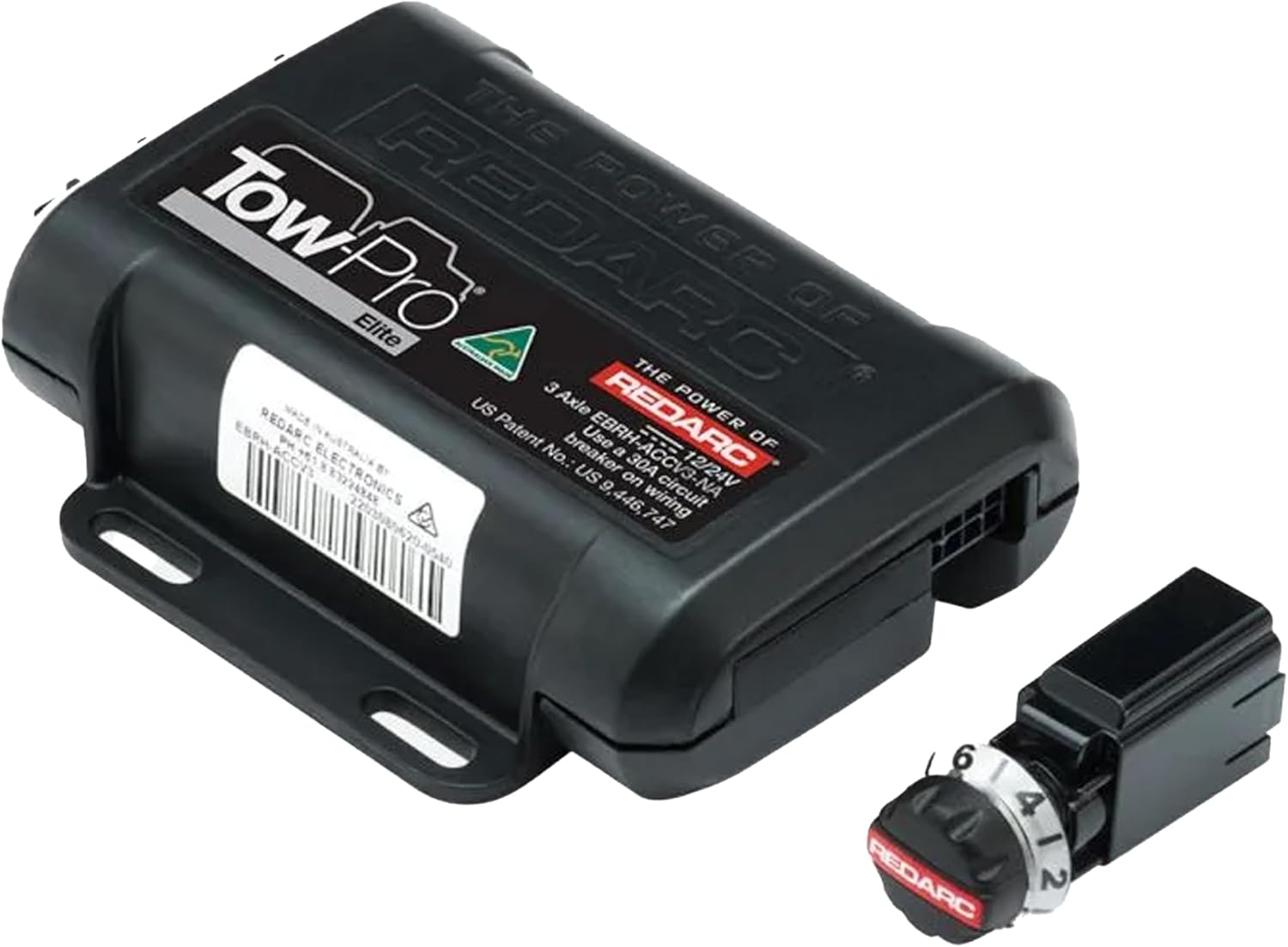
The REDARC Tow-Pro Elite is a compact brake controller designed for smooth, predictable trailer braking on road and the ability to apply brakes manually for low-speed or off-road situations. It installs as a remote-box system with a small dash-mounted knob and includes wiring and a universal harness that make it straightforward to integrate into vehicles that provide a factory-style plug. In use the proportional mode mirrors vehicle braking for seamless stops and the manual mode gives precise control when crawling or maneuvering. The remote knob keeps the dash tidy and the controller’s active calibration and built-in sway control help maintain stability with or without a trailer. Practical limits include the need for a vehicle-specific plug or minor wiring on models without the factory connector and the compact knob can be fiddly to adjust compared with larger control heads. For Jeep Wrangler owners who can fit the correct harness, this unit delivers a near-factory look and consistently smooth braking.
Best for: Jeep Wrangler owners who prioritize a tidy, factory-like installation and want dependable proportional braking plus a manual option for off-road control.
Less Ideal for: Buyers who need a plug‑and‑play solution without any wiring changes for vehicles that lack the factory trailer connector or who prefer a larger, easier-to-manipulate control head.
- Proportional and user-controlled modes for both highway and off-road towing
- Remote dash knob provides a clean, factory-style appearance
- Includes universal harness and mounting hardware to simplify installation
- Active calibration and sway control for smoother stops and improved stability
- May require a vehicle-specific plug or splicing on Wranglers without the factory connector
- Small control knob can be harder to adjust precisely compared with larger control heads
Verdict: Choose this pick if you want a controller sold with the correct plug‑and‑play harness and hardware for a clean, factory‑style installation without splicing.
Choosing the Right 2018-Present Jeep Wrangler Trailer Brake Controller: Key Factors to Consider
Control Type and Braking Behavior
The control type dictates how trailer brakes are applied and how they feel during towing. Proportional controllers sense vehicle deceleration and match brake force to the trailer, which produces smoother, more natural stops on the 2018-present Wrangler. Time-delayed or user-variable electric controllers apply a preset ramp of brake power when you tap the vehicle brakes. That can be simpler to set up but may require ongoing adjustment as trailer load changes. For Wrangler owners who tow varied loads, a proportional controller often reduces surge and reduces the need to constantly retune settings. For those towing a consistently weighted trailer and wanting a lower-cost option, a time-delayed unit can work acceptably. Consider how often you change trailer loads and whether you prefer automatic modulation or manual control when choosing the control type.
Installation and Wiring Compatibility
How a controller installs affects total project time and whether you can return the vehicle to stock easily. Many in-cab controllers mount under the dash or on the center console and require a single power, ground, brake signal, and trailer output wire. On 2018-present Wranglers, wiring access points and factory connectors vary slightly between JL and JLU generations, so verify connector locations and harness availability before you start. If you prefer a plug-in install without splicing, look for controllers with Jeep-compatible harnesses or confirm that a compatible adapter is available. Also evaluate whether the controller requires a separate brake light relay or fuse tap and whether routing the trailer output wire will interfere with factory electronics. Clear wiring documentation and a wiring diagram specific to the Wrangler generation will speed installation and reduce the risk of electrical issues.
Mounting Location and In-Cab Usability
Where you mount the controller affects accessibility and how comfortable it is to operate while towing. In-cab controllers should be within reach and have controls that are easy to adjust while driving. For Wranglers, space under the dash and around the center console can be limited, especially with aftermarket interiors or roll cages, so compact controllers or those with remote pods can be a better fit. Consider whether the controller display is readable in direct sunlight and whether control knobs or buttons can be operated with gloves. Some systems offer detachable faceplates or remote remotes so you can position the user interface for optimal ergonomics. Confirm the mounting hardware meets vehicle-specific constraints so you do not block vents, airbags, or factory controls.
Adjustability and Tuning Range
An adjustable controller lets you match braking to different trailer weights and towing conditions. Look for makers that provide a wide and repeatable range of gain or output settings and clear markings so you can return to known settings after testing. Some controllers include boost modes, manual override levels, or automatic gain learning; these features can be helpful when switching between a light utility trailer and a heavy camper. Wrangler drivers who frequently change trailer load, tow on mixed terrain, or drive with variable passenger/cargo weight will value a controller with fine adjustment and consistent feedback. Verify how adjustments affect braking feel during initial setup and whether changes require stopping the vehicle or can be made while moving safely.
Diagnostics and Feedback
A controller that communicates diagnostics helps you detect wiring faults, shorted outputs, or low battery conditions before they become safety issues. Simple LED indication of power and output activity is useful, but more advanced units provide detailed fault codes, output current readouts, or pairing with smartphone apps for monitoring. For Wrangler owners who tow regularly, these diagnostics can reduce time troubleshooting and improve confidence in the system. When evaluating controllers, check for features that show real-time output or vehicle-to-trailer communication status. Clear fault reporting reduces the chance of driving with underperforming trailer brakes and makes it easier to perform periodic checks during long trips.
Durability and Weather Resistance
Wranglers are often exposed to dust, water spray, and vibration, so controller construction matters. Durable enclosures, corrosion-resistant connectors, and vibration-tolerant mounting hardware help the controller last longer and maintain reliable connections. Waterproof or splash-resistant ratings are valuable when the vehicle is used off-road or in wet climates. Consider whether key components such as the control knob, display, and harness connections are rated for harsh environments. A controller that stands up to road salt, mud, and temperature swings will reduce the frequency of repairs and keep trailer braking consistent across seasons.
Why Wrangler Owners Should Prioritize Proportional Control
Proportional controllers sense how quickly your Jeep slows and apply trailer braking force in proportion to that deceleration. For 2018-present Jeep Wranglers, this reduces the chance of trailer push or surge during abrupt stops and produces a more predictable towing feel.
If you frequently tow heavier trailers or drive in mixed traffic where sudden braking can occur, proportional control helps maintain stability. JL and JLU models benefit from this modulation when towing heavier loads because it reduces stress on the tow vehicle during dynamic driving situations.
- Smoother stops with less trailer surge
- Automatic modulation reduces manual tuning
- Better confidence in emergency braking situations
Matching Controller Size and Mounting to Wrangler Interiors
Wrangler interiors vary by trim and aftermarket customization. Choose a compact unit or a remote-mounted pod if space under the dash is tight or a roll cage limits mount options. Consider controls that can be mounted on the center console or side panels while keeping the driver's sightlines and airbag areas clear.
- Measure available under-dash and console space before buying
- Prefer low-profile mounts for cramped interiors
- Check that wiring routes do not interfere with moving parts
Electrical Considerations Specific to 2018-Present Wranglers
Modern Wrangler electrical systems include multiplexed wiring and generator options that affect where you tap brake signals and power. Confirm whether your Wrangler uses a dedicated brake switch output that is easy to access and whether the controller requires a separate fused power feed.
Some Wrangler owners switch to aftermarket trailers with electric brakes that draw significant current, so verify that the trailer output circuit and ground routing are robust. Proper grounding and a quality connector at the hitch are critical for reliable trailer brake performance.
- Locate the brake switch and test for a clean signal before wiring
- Use appropriately rated fuses and wiring for the trailer output
- Secure grounds to bare metal on the frame for best results
Practical Setup Workflow for a Wrangler
Plan your installation by locating the brake signal, battery power, and a good ground point. Lay out wiring from the controller to the hitch and trailer connector, keeping wires away from heat sources and moving suspension parts. Mount the controller in a location that allows quick adjustments while maintaining safe driving posture.
After wiring, perform a step-by-step setup: confirm power and ground, verify brake signal activation, test trailer output with the trailer connected, and then perform a road test at low speed to tune gain or output. Keep notes of settings that produce consistent braking so you can return to them when towing similar loads.
- Pre-route wires before final mounting
- Test each circuit as you go to isolate issues quickly
- Use short test drives to iterate and record ideal settings
Legal and Safety Checklist Before You Tow
Confirm that trailer brakes operate as intended before each trip. Check lighting, breakaway systems if fitted, and that the controller responds to vehicle braking. A functioning controller is one part of the overall towing safety system, which also includes trailer lighting, hitch security, and load distribution.
Document basic pre-tow checks such as brake lamp function, secure wiring connections, and controller status indicators. Regular inspections reduce the likelihood of roadside failures and help maintain safe handling characteristics for your Wrangler while towing.
- Verify controller power and output LEDs prior to departure
- Inspect trailer connector and pins for corrosion
- Confirm emergency breakaway switch is charged if equipped
When to Choose a Remote or Dash-Mounted Pod
Remote pods offer flexible placement and can be ideal for Wranglers with limited dash space or aftermarket accessories. Dash-mounted pods can be more integrated and may feel more like factory equipment. Decide based on visibility, accessibility, and how often you expect to adjust settings on the move.
If you tow frequently and adjust settings for different trailers, a readily accessible dash pod is practical. For occasional towing where settings remain static, a hidden or remote mount keeps the cabin tidy without sacrificing function.
- Pod units offer flexible placement for tight interiors
- Dash mounts give faster access for on-the-fly adjustments
- Consider how often you will change settings when choosing mount style
Still looking for the perfect fit?
Select your Jeep Wrangler configuration to see the most relevant Trailer Brake Controllers recommendations
How We Chose the Best 2018-Present Jeep Wrangler Trailer Brake Controller
We focused on attributes that directly affect real-world towing on the 2018-present Jeep Wrangler. Primary evaluation criteria included braking control type and responsiveness, installation complexity and wiring compatibility with Wrangler electrical systems, size and mounting options for in-cab placement, compatibility with common trailer brake sizes and axle types, and adjustability for different trailer weights and load distributions. We also prioritized controllers with clear user controls and diagnostics so owners can tune braking feel without repeated trial and error. Durability and environmental resistance were considered because Wranglers are often used off-road and in varied weather. Excluded from consideration were any controllers lacking adequate documentation for Jeep Wrangler wiring or those that required extensive vehicle modification. We did not consider specialty controllers intended only for heavy commercial vehicles or controllers that depend on vehicle-specific network adapters unavailable for the Wrangler. The shortlist represents units that balance predictable braking performance, straightforward wiring and installation, and in-cab usability for daily towing and occasional off-road rigs.
Our full evaluation process is outlined in our review methodology.
FAQ
Do I need a trailer brake controller for every trailer I tow with my Wrangler?
It depends on trailer weight and local regulations. Heavier trailers typically require a brake controller because trailer brakes improve stopping power. Check local towing laws and whether your trailer has electric brakes; if it does, a controller is usually required.
Can I install a brake controller myself on a 2018-present Wrangler?
Many owners can install a controller with basic wiring skills, especially if a Jeep-compatible harness is available. Installation involves tapping power, ground, brake signal, and the trailer output. If you are not comfortable with vehicle wiring or the Wrangler has complex factory modules, professional installation is reasonable.
Will a proportional controller work with all trailer brake setups?
Proportional controllers generally work with most electric trailer brakes but performance depends on proper wiring, good grounding, and correct trailer maintenance. Very small or overloaded trailers can still present tuning challenges, so test and adjust the controller after installation.
How often should I check or adjust the controller settings?
You should check settings whenever trailer load or distribution changes and perform a quick verification before long trips. Adjustments are also sensible after servicing brakes or changing tires because those variables affect braking balance.
Does the Wrangler generation (JL and JLU) affect the controller choice?
Generation differences influence where to access brake signals and how you route wiring. While the controller type and features remain the main selection factors, confirm mounting and harness compatibility for your Wrangler generation to simplify installation.
What should I do if the controller shows a fault light?
A fault light usually indicates wiring issues, a shorted trailer brake circuit, or low power. Safely pull over, inspect connector pins and grounds, and if you cannot locate the issue, avoid towing until the circuit is repaired to prevent unsafe braking.
Final Verdict
Prioritize a controller that matches your towing habits and installation preferences for the 2018-present Jeep Wrangler. For frequent towing and variable loads, proportional control and fine adjustability deliver the most predictable braking. If you tow a consistently light load and want a simpler install, a time-delayed electric unit can be acceptable. Balance ease of installation, durable construction, and in-cab usability when choosing. Confirm wiring and mounting compatibility with your Wrangler generation before purchase so you can install cleanly and tune the controller to achieve consistent, confident braking on the road.
Explore More:
- Check out all Jeep Wrangler parts & accessories
- Explore Electronics
- Browse all Accessories
