

Note: This article contains affiliate links. If you click on these links and make a purchase, I may earn a small commission at no extra cost to you. This helps support my research and content. Read my full affiliate disclosure here.
Towing with a 2007-2018 Jeep Wrangler brings extra demands on vehicle control and safety, whether you drive a two-door JK or a four-door JKU. The right trailer brake controller reduces sway, shortens stopping distances, and makes trailer braking feel predictable under load. This guide covers six top-rated trailer brake controllers shortlisted for Jeep Wranglers from 2007 through 2018. We focus on controllers that balance proportional braking performance, in-cab usability, and installation practicality for common Wrangler wiring and mounting locations. Read on to compare how these options score on control feel, installation needs, and feature tradeoffs before you pick one for your towing setup.
Looking for other parts? See all Jeep Wrangler parts & accessories.
Top Picks at a Glance
| Best Overall Trailer Brake Controller The best all-around controller balancing performance, ease, and reliability | CURT Spectrum Integrated Electric Trailer Brake Controller (Proportional) |  |
| Best Budget Trailer Brake Controller A low-cost controller that covers basic braking needs reliably | Gihdfer Brakeman IV Time-Delayed Digital Trailer Brake Controller |  |
| Best Premium Trailer Brake Controller Higher-end unit with advanced features, refined controls, and build quality | REDARC Tow-Pro Elite Electric Trailer Brake Controller |  |
| Best Proportional Trailer Brake Controller Unit that applies trailer brakes proportionally based on vehicle deceleration | Tekonsha Primus IQ Proportional Trailer Brake Controller (90160) |  |
| Best Time-Delayed Trailer Brake Controller Simple time-based controller with adjustable ramp and fixed output | REESE Towpower Brakeman IV Time‑Delay Trailer Brake Controller |  |
| Best Wireless Trailer Brake Controller Cordless or Bluetooth-enabled controller for easy installation and monitoring | CURT Echo Mobile Bluetooth Trailer Brake Controller (Proportional) |  |
1. CURT Spectrum Integrated Electric Trailer Brake Controller (Proportional)
Best Overall Trailer Brake Controller

| Brand | CURT |
|---|---|
| Model | Spectrum (51170) |
| Control Type | Proportional (accelerometer) |
| Interface | Rotary knob with push-button and tri-color LEDs |
The CURT Spectrum is a proportional electric brake controller that separates the main module from a compact rotary knob so the unit blends into the dash while the computer stays hidden behind it. It uses a triple-axis accelerometer to sense vehicle motion and apply braking force smoothly whether you are stopping on level ground or on a grade. Setup is straightforward for a 2007–2018 Jeep Wrangler when you use the vehicle-specific quick plug harness; automated leveling and calibration reduce manual tuning and the push-button knob provides an easy manual override. The ten tri-color LEDs give clear feedback on brake activity and power. Practical benefits include near-factory appearance on the dash, responsive braking without frequent adjustment, and the option to mount the main module out of sight. Limitations reported by some users include occasional LED behavior where lights stay lit when the vehicle is off, which can be distracting and could drain the battery if not addressed, and it is pricier than basic controllers.
Best for: Jeep Wrangler owners who want a near-factory look and dependable, hands-off braking performance for routine towing and prefer a neat dash-mounted control instead of a bulkier head unit.
Less Ideal for: Buyers seeking the cheapest possible controller or those who need a simple non-proportional surge-style unit should consider other options.
- Proportional braking via triple-axis accelerometer for smooth, adaptive stops
- Separate hidden module with remote knob keeps dash uncluttered and factory-like
- Automated leveling and calibration simplify setup and reduce tuning time
- Push-button rotary control gives easy manual override and clear LED status feedback
- Some units have reported LED lights remaining on after shutdown which can be distracting or risk battery drain
Verdict: The best all-around trailer brake controller that balances consistent braking performance, straightforward setup, and dependable durability for most towing needs.
2. Gihdfer Brakeman IV Time-Delayed Digital Trailer Brake Controller
Best Budget Trailer Brake Controller

| Fitment | 1 to 4 axles (2-,4-,6-,8-brake systems) |
|---|---|
| Display | LED display for braking force |
| Activation Type | Time-delayed brake activation |
| Package | Includes controller, mounting bracket, screws, instruction |
The Brakeman IV is a simple, time-delayed digital brake controller aimed at DIY installers who want reliable trailer braking without advanced features. It mounts compactly and includes a bracket, screws, and basic instructions, so installation in vehicles like the 2007–2018 Jeep Wrangler is straightforward when using proper wiring adapters. The unit uses a time-delay activation method with an adjustable gain shown on an LED display so you can tune braking force for different trailer loads. In practice it smooths out stops compared with no controller and is easy to operate from the cab. Limitations include simpler time-delayed control rather than proportional braking and plastic mounting points that some users report can strip if over-tightened; wiring harnesses are also modest gauge. For owners who need predictable, budget-friendly trailer braking for occasional towing, this controller delivers the core functionality without complexity.
Best for: DIY owners who want a budget-friendly, install-it-yourself brake controller that provides predictable, tunable braking for occasional towing with a Wrangler.
Less Ideal for: Drivers who tow frequently with varying loads and need proportional, vehicle-sensing braking or higher-end durability and wiring components should consider more advanced controllers.
- Compact, easy-to-mount design with included bracket and hardware.
- Adjustable gain and clear LED display make tuning braking force straightforward.
- Compatible with 1 to 4-axle trailers, covering common small to medium trailer setups.
- Good real-world value for basic, dependable trailer braking control.
- Time-delayed activation rather than proportional braking limits responsiveness and smoothness at varying speeds.
- Plastic screw bosses reported to be weak and may strip if over-tightened.
Verdict: The best budget trailer brake controller for DIYers who need a dependable, no-frills unit that provides adequate braking control without a high price.
3. REDARC Tow-Pro Elite Electric Trailer Brake Controller
Best Premium Trailer Brake Controller
| Fit | Universal for 1–3 axles |
|---|---|
| Power | 12V/24V compatible |
| Modes | Proportional and user-controlled |
| Remote head cable | 3.3 ft (1 m) |
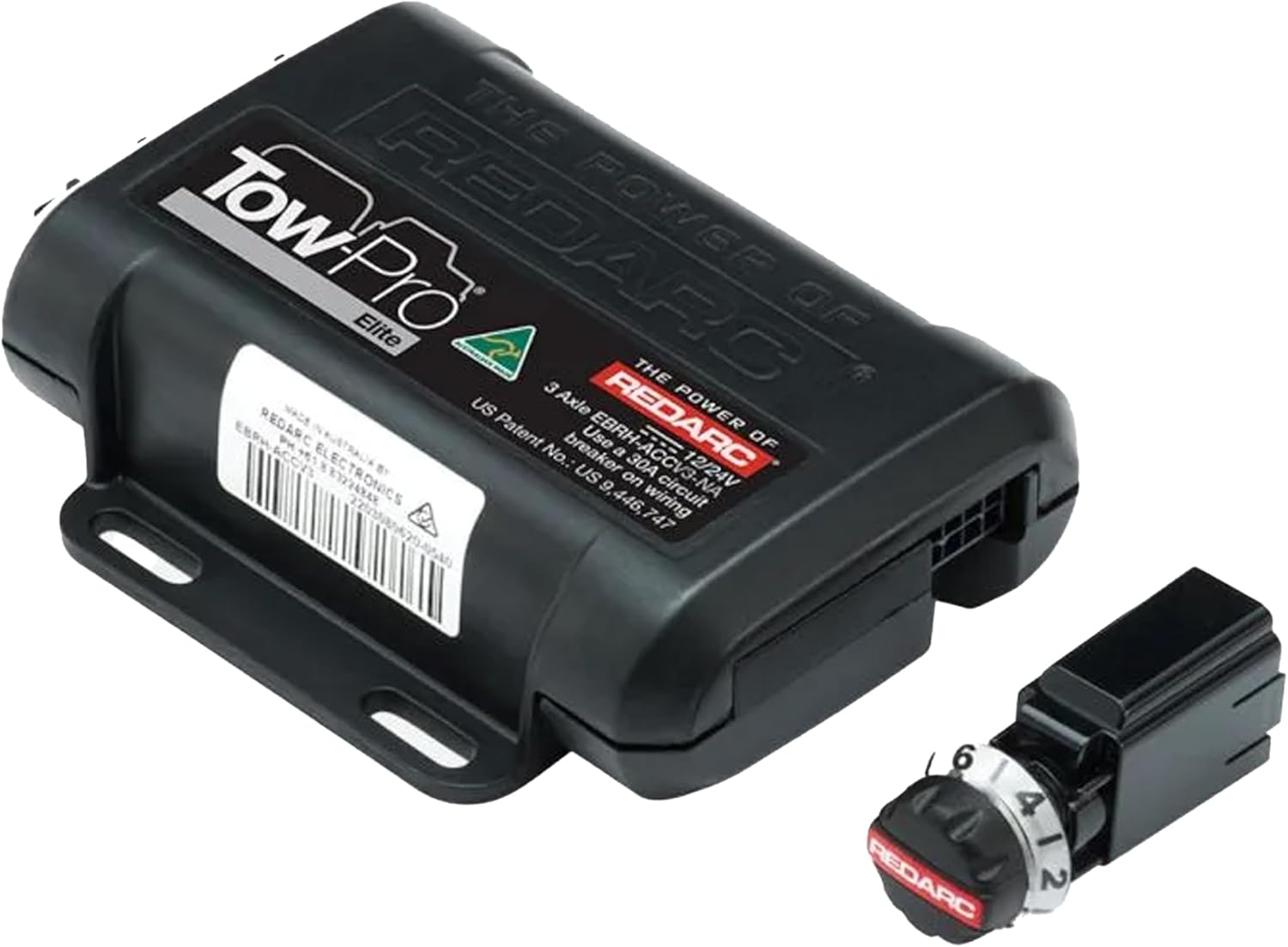
The REDARC Tow-Pro Elite is designed for drivers who tow frequently and need precise, reliable brake control. It provides proportional mode for smooth on-road braking and a manual user-controlled mode for off-road or specialty situations, selectable via a small dash dial. The unit installs as a remote-mounted module with a low-profile knob and includes a universal harness and mount for near-factory fit and appearance. Active calibration and sway control help stabilize towing whether you are cruising highways or navigating steep terrain. Real-world benefits include consistent stopping response, minimal dash clutter, and flexible placement of the control knob to suit different Wrangler interiors. Limitations to consider are the need for a vehicle-specific wiring harness or splicing if your Wrangler lacks a factory plug and the compact knob can be slightly awkward to operate under heavy-handed adjustment compared with larger controllers. Overall, build quality and feature set make it well suited to heavy or frequent towing when premium control and a tidy installation matter.
Best for: Drivers who tow regularly and prioritize precise, dependable braking and a factory-style, low-profile install for their Jeep Wrangler, especially when towing heavy or variable loads.
Less Ideal for: Casual tow users who rarely trailer and prefer a very simple, large-button controller or who want an out-of-the-box plug-and-play setup without any wiring work.
- Proportional and manual modes let you tune braking for on-road smoothness or precise off-road control.
- Remote-mounted module with a compact dash knob gives a near-factory, low-profile installation.
- Active calibration and sway control deliver stable, consistent braking with or without a trailer.
- Includes universal harness and switch insert for easier integration into common dash openings.
- Requires vehicle-specific plug or wiring splicing on some vehicles to achieve plug-and-play installation.
Verdict: The best premium trailer brake controller for buyers willing to pay more for superior build quality, finer adjustment, and feature-rich operation for frequent or heavy towing.
4. Tekonsha Primus IQ Proportional Trailer Brake Controller (90160)
Best Proportional Trailer Brake Controller

| Model | 90160 |
|---|---|
| Voltage | 12 Volts |
| Trailer axles supported | 1-3 axles |
| Display | LED diagnostics |
The Tekonsha Primus IQ is a compact proportional brake controller designed to provide smooth, automatically scaled trailer braking. It senses vehicle deceleration and applies trailer brakes proportionally, which helps maintain stable, natural stopping when towing. Typical use is under-dash installation where the unit is set and left for regular towing; the LED display gives real-time diagnostics and connection status while a manual override and three-level boost let you add braking power for heavier loads or steep descents. The unit is self-leveling within a 90-degree vertical range so you rarely need to reconfigure after mounting, and its snap-in dash clip and removable connector make it easy to unplug and stow when not towing. Practical benefits include straightforward setup, predictable proportional braking for safer stops, and audible/visual diagnostics if trailer wiring develops faults. Limitations are that it supports only trailers with 1 to 3 axles and requires a compatible vehicle wiring harness or aftermarket adapter for plug-and-play integration; visibility of the LED can be limited if mounted low on the dash.
Best for: Drivers who prioritize smooth, automatically scaled trailer braking and want a compact controller that installs under the dash and stays out of the way once set up.
Less Ideal for: Towing professionals who need control for trailers with more than three axles or users who require advanced multi-trailer management features.
- Proportional braking that mirrors vehicle deceleration for smooth, natural stops
- Self-leveling sensor and compact design simplify mounting and reduce setup adjustments
- LED display with diagnostics helps detect wiring or connection issues quickly
- Boost feature offers three levels of extra braking power for heavier loads
- Snap-in dash mount and removable connector allow easy removal and storage
- Rated for trailers with a maximum of three axles, so not suitable for larger multi-axle trailers
Verdict: The best proportional trailer brake controller for drivers who want smooth, automatically scaled braking that mirrors vehicle deceleration for more natural trailer control.
5. REESE Towpower Brakeman IV Time‑Delay Trailer Brake Controller
Best Time-Delayed Trailer Brake Controller

| Compatible brakes | 2, 4, 6, 8 brakes (1–4 axles) |
|---|---|
| Power system | 12‑volt negative ground |
| Display | Digital LED output and status indicator |
| Controls | Output and sync push‑button adjustments |
| Mounting | Mounts in any direction |
The REESE Brakeman IV is a simple time‑delay brake controller designed to deliver consistent, ramped braking to trailers with 2, 4, 6, or 8 brakes (1–4 axles). It mounts in any orientation and installs quickly using a vehicle‑specific plug‑in harness (sold separately) for a clean, near‑factory connection. Two push‑button controls let you set overall output and the sync rate so you can tune how quickly the trailer brakes come on for city stops or highway decels. A bright digital LED display shows output setting and connectivity status and warns of short or overload conditions. Because it is a time‑based unit rather than a proportional controller, it gives predictable, repeatable brake pulses that work well with many drum‑brake trailers and simple towing setups. Expect straightforward operation and easy manual activation via the lever, but note it will not adjust braking intensity dynamically based on vehicle deceleration like proportional controllers do, so heavier or mixed‑load trailers may need more careful tuning.
Best for: Buyers who want a straightforward, easy‑to‑install time‑based controller that is simple to tune and provides predictable braking for routine towing with the 2007–2018 Jeep Wrangler.
Less Ideal for: Towing situations that demand adaptive, proportional modulation for mixed loads, very heavy trailers, or frequent stop‑and‑go city driving where automatic intensity adjustment is preferred.
- Time‑delay algorithm provides consistent, repeatable ramped braking for trailers with up to four axles
- Mounts in any direction and has a compact profile for flexible dash placement
- Simple two‑button controls and bright LED readout make setup and in‑drive adjustments easy
- Plug‑and‑play installation with vehicle harnesses keeps wiring tidy and reduces install time
- Manual lever lets the driver apply trailer brakes instantly when needed
- Time‑delayed design cannot match the smooth, adaptive modulation of proportional controllers
Verdict: The best time-delayed trailer brake controller for buyers who prefer straightforward, user-adjustable timed braking pulses rather than dynamic proportional control.
6. CURT Echo Mobile Bluetooth Trailer Brake Controller (Proportional)
Best Wireless Trailer Brake Controller
| Compatibility | Standard 7-way RV blade plug |
|---|---|
| Control | Bluetooth smartphone app (iOS/Android) |
| Brake type | Proportional, tri-axis accelerometer |
| Trailer brakes supported | 2–4 brakes (one to two axles) |
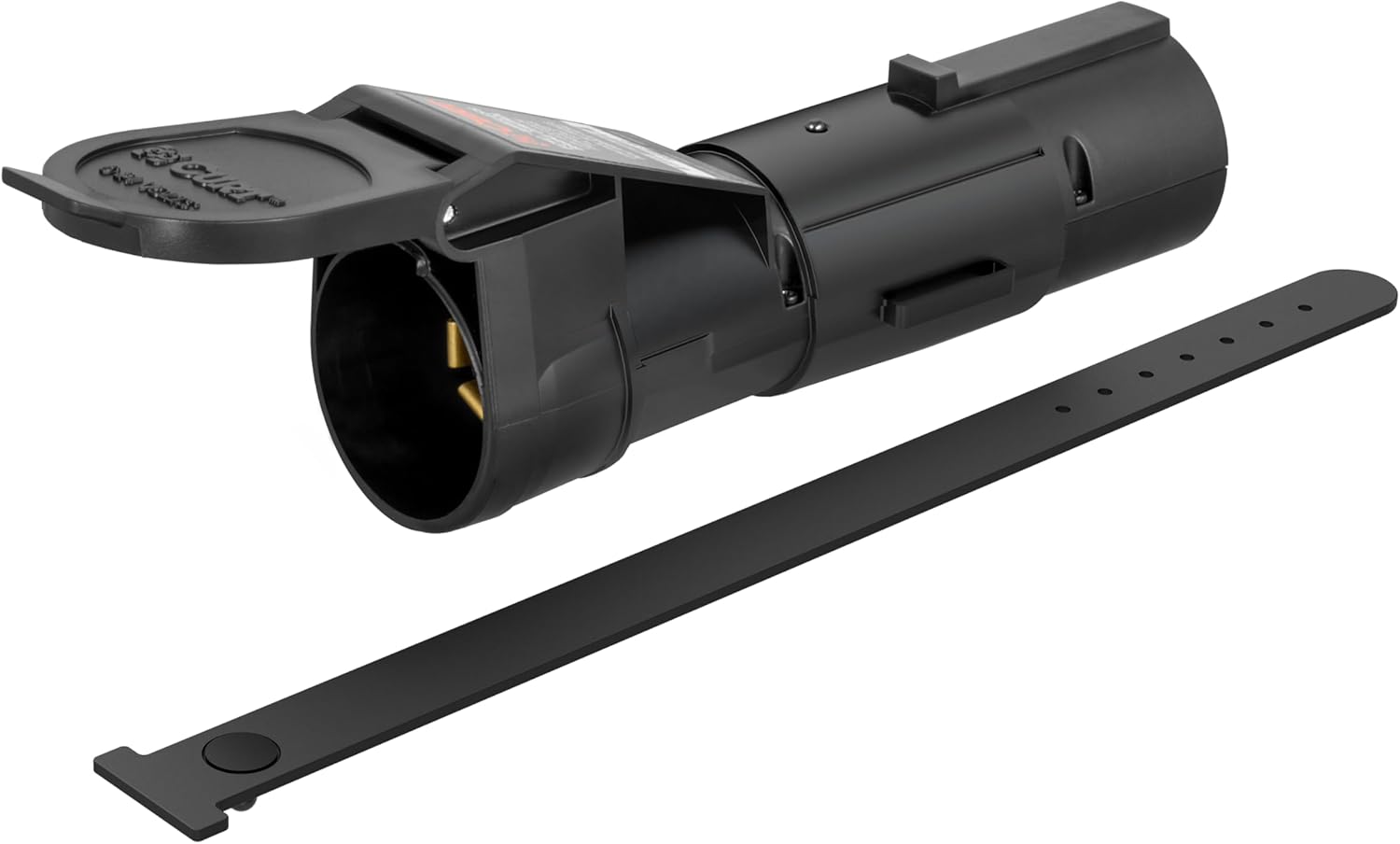
The CURT Echo Mobile moves trailer brake control out of the dash and into a compact, plug-and-play unit that connects to your phone over Bluetooth. For DIYers towing a Jeep Wrangler (2007–2018) with a 7-way connector, the Echo installs between the vehicle and trailer plug with no under-dash wiring required and can be moved between vehicles easily. The OneControl app lets you set maximum output, adjust sensitivity, save towing profiles, and manually pulse the brakes from the phone while driving. Hardware features include a triple-axis accelerometer for proportional braking, potted electronics for weather resistance, and a retention strap with a locking tab to improve the 7-way connection. Practical benefits are quick installation, no permanent wiring, and real-time monitoring from the cab. Limitations to consider are occasional Bluetooth pairing quirks on some phones, the unit’s external protrusion that can hang low on certain vehicle sockets, and reliance on the phone for on-the-fly adjustments rather than a hardwired in-cab control.
Best for: DIY owners who prefer to avoid permanent wiring and want a mobile, app-driven controller they can install and move themselves for occasional towing with a 2007–2018 Jeep Wrangler.
Less Ideal for: Drivers who need a permanently mounted in-cab controller or who frequently tow in extremely rough conditions where a protruding plug-in unit could be damaged should consider a hardwired under-dash or in-line solution.
- Truly plug-and-play design that requires no permanent wiring for fast DIY installation
- Bluetooth app provides live monitoring, profile saving, and manual activation from your phone
- Triple-axis accelerometer provides proportional, hill-aware brake modulation
- Potted enclosure and locking tab help protect electronics from moisture and improve connection security
- Portable form factor lets you transfer the controller between vehicles without tools
- External plug-in design protrudes from the 7-way socket and can reduce ground clearance or be vulnerable to impact
- Some phones experience pairing or connectivity issues that can require troubleshooting
Verdict: The best wireless trailer brake controller for DIYers who want minimal wiring, convenient mobile monitoring or app control, and flexible temporary installations.
Choosing the Right 2007-2018 Jeep Wrangler Trailer Brake Controller: Key Factors to Consider
Control Mode and Modulation
How the controller modulates trailer brakes directly affects stopping feel and stability. Proportional controllers sense vehicle deceleration and apply braking to the trailer in proportion to vehicle decel, producing smoother, more intuitive stops. Time-delayed or user-rated controllers can work, but they require more frequent manual adjustments and may feel abrupt in heavy traffic or on grades. For Wrangler owners who tow varied loads, proportional control reduces the need to tune gain for every trip and helps prevent trailer push during sudden stops. Consider whether the controller offers adjustable profiles to fine-tune behavior for different trailer weights.
Compatibility With Wrangler Wiring and Tow Packages
A controller must integrate with the Wrangler's existing tow wiring or a common aftermarket harness without requiring invasive modifications. Check whether the controller supports a dedicated brake controller connector or whether it needs a hardwired tap into the vehicle's brake light switch and battery power. Some Wranglers with factory tow packages provide convenient access points; others require routing wires through dash panels. Compatibility also includes whether the controller draws excessive current through in-cab harnesses, which can stress smaller gauge wires. Confirm that the wiring method matches the Wrangler's factory connectors or planned harness to avoid unexpected rework.
Mounting Location and In-Cab Ergonomics
Where the controller mounts influences driver access and safety. Wranglers have compact, sometimes cluttered dash and center console areas, and certain model years and trim levels place the steering column, dash panels, or storage bins in the way. Look for controllers with compact housings and flexible mounting brackets that fit under dash trim or to the side of the steering column. Controls should be reachable without distracting the driver. Larger knobs or simple digital interfaces can be easier to use while driving than tiny buttons. Consider whether the unit provides an in-cab display for gain and status so you can check setup at a glance.
Electrical Load and Thermal Management
Trailer brakes can generate sustained current draw during heavy or descending towing. Controllers should manage thermal load to avoid shutdowns or inconsistent braking during prolonged use. Units with thermal protection and conservative fade behavior will preserve braking function on long declines. Verify the controller's current rating against the trailer brake coil draw you expect. Proper wire gauges and fusing are essential to prevent overheating. For Wranglers that do off-road towing, components that cope with heat and vibration will last longer and maintain consistent performance.
Setup Features and Diagnostics
Setup tools like automatic self-calibration, boost modes, and real-time diagnostics reduce guesswork. Automatic or inertial setup simplifies initial installation, and diagnostic feedback on wiring faults, short circuits, or low-power conditions can help you troubleshoot without disassembling connectors. Wrangler owners benefit from controllers that indicate trailer connection status and provide simple procedures for adjusting gain and braking aggressiveness. Consider whether the unit supports step-by-step setup prompts or requires external tools for calibration.
Serviceability and Weather Resistance
Wranglers are often used in wet or dusty environments, so weather resistance matters. Controllers installed under dash panels still face moisture from open tops or leaks. Choose controllers with sealed electronics or durable enclosures that resist corrosion and debris. Also consider how easy it is to access fuses, wiring, and connectors for inspection or replacement. Units that allow harness replacements without altering the controller simplify service and reduce downtime when troubleshooting or upgrading.
Why Proportional Controllers Suit the Wrangler Chassis
Proportional controllers match trailer braking to actual vehicle deceleration, producing a natural stopping sequence that works well with the Wrangler's relatively short wheelbase and light rear axle when under tow. On JK and JKU Wranglers, which can feel the trailer's influence quickly during sudden stops, proportional modulation reduces the tendency for the trailer to push the tow vehicle or induce snatchy braking.
- Smoother deceleration transitions
- Less driver intervention during mixed-traffic stops
- Improved trailer stability on grades and turns
Mounting Tips for JK and JKU Interiors
Plan your mounting location before installation. JK and JKU dash layouts offer different clearance and panel attachment points than older TJs, so identify a bracket position that avoids interfering with steering column movement or airbag covers. A common location is the lower dash panel left of the steering column where wire runs to the brake switch are shorter.
- Test fit the bracket and cable routing with seat positions adjusted
- Avoid blocking access to fuse panels and OBD connectors
- Use rubber-isolating mounts if you tow off-road to reduce vibration transfer
Wiring Basics and Common Harness Approaches
Most installations use four core connections: battery power, ground, brake output to trailer connector, and a signal from the vehicle brake light switch. On Wranglers with factory tow wiring, there may be an accessible harness or module that simplifies tapping the brake signal. If not, a relay-based harness or a dedicated brake controller connector can reduce the need to splice into factory wiring. Secure routing and correct wire gauge are essential to prevent voltage drop that reduces controller performance. Label wires during installation and protect them with conduit or loom where they pass through body panels.
- Confirm ground location is clean, bare metal
- Use fused battery feeds close to the battery terminal
- Avoid routing near high-heat sources like exhaust components
Adjusting Gain and Smoothing Braking Behavior
Start with conservative gain settings and perform low-speed test stops with a typical trailer load to observe response. Increase gain gradually until trailer braking feels proportionate to vehicle deceleration without locking or skittering. Many proportional controllers include a manual boost or level setting for heavy loads or steep descents. Keep a simple checklist for in-field adjustments: verify trailer connection, check controller's diagnostic lights, and re-test after any change. Small tweaks after a couple of towed trips will help dial in the ideal setting for the trailer's weight and brake condition.
- Perform tests on level pavement with a safe stopping area
- Re-check after wiring changes or connector cleaning
- Document ideal settings for different trailers or loads
Safety Practices During Towing with a Brake Controller
Before any trip, confirm the controller shows an active trailer connection and that the trailer basic lights and emergency breakaway switch are functional. Monitor for signs of overheating or fading on long descents. If the controller indicates a short or fault, pull over and inspect the harness and trailer brakes before continuing. Practice emergency stops in a controlled environment to understand how the controller and trailer respond. Regular inspection of wheel bearings, brake drums or rotors, and electrical connectors will reduce the chance of failures on the road.
- Check breakaway battery condition and switch function
- Inspect connectors for corrosion before long trips
- Carry basic spare wiring supplies and connector pins
Still looking for the perfect fit?
Select your Jeep Wrangler configuration to see the most relevant Trailer Brake Controllers recommendations
How We Chose the Best 2007-2018 Jeep Wrangler Trailer Brake Controller
We prioritized controllers that address the real-world towing conditions Wrangler owners face across the 2007-2018 model years and the JK and JKU chassis codes. Evaluation criteria included braking modulation type, interface suitability for Wrangler cockpits, wiring and harness compatibility with factory tow packages, and mechanical mounting options for typical in-cab locations. We also weighed electrical demands and thermal protection because Wranglers often tow in variable terrain where repeated brake activation can heat components. Durability and weather resilience were considered given off-road use. Ease of installation and the clarity of setup features were measured against common Wrangler wiring layouts. Exclusions: we excluded controllers that require custom vehicle modifications beyond standard tow harnesses, units without proportional or adaptive control modes, and products that lack clear wiring support for Jeep Wrangler tow connectors. The final list favors devices that deliver repeatable braking performance, straightforward installation, and controls that work ergonomically within Wrangler cabins.
Our full evaluation process is outlined in our review methodology.
FAQ
Will a proportional controller work with my Wrangler's factory tow package?
Often it will, but compatibility depends on the connector types and available wiring access. Many factory tow packages provide an accessible brake signal and fused power that a proportional controller can use. Confirm the connector or harness routing on your specific Wrangler year and install method.
Can I install a controller myself or should a professional do it?
Many owners with basic electrical skills can install a controller using a vehicle-specific harness and common tools. However, if you are uncomfortable splicing into brake signal wires or routing power to the battery, professional installation reduces risk and ensures correct wire gauges and fusing.
How do I test if the controller is working correctly after installation?
Perform a static bench test by simulating the brake signal and observing the controller's output to the trailer connector. Then do low-speed dynamic tests on level ground with the trailer attached, checking for gradual modulation and no dragging during normal stops. Use diagnostic indicators on the controller to confirm proper wiring.
Does the Wrangler require a specific mounting location for safety systems?
No single mandated location exists, but avoid obstructing airbag covers, steering column movement, or driver controls. Choose a mounting spot that keeps the controller reachable but out of the way of regular ingress and egress to prevent accidental damage.
What wiring gauge should I use for the brake output and power feed?
Wire gauge depends on the controller's rated current and the combined draw of the trailer brakes. Typically, use heavier gauge for the brake output to the trailer connector and a properly fused battery feed sized to the controller's specification. Consult the controller manual and match wire gauge to the expected amperage.
Will a controller prevent trailer sway on its own?
A brake controller helps stabilize the trailer by applying proportional braking, which can reduce sway caused by uneven braking forces. It is not a complete solution for all sway scenarios; proper weight distribution, correct hitch setup, and sway control devices may also be necessary.
Final Verdict
Choose a trailer brake controller that matches how and where you tow with your 2007-2018 Jeep Wrangler. Prioritize proportional modulation if you want smoother stops and less driver adjustment, and match the electrical and mounting requirements to the Wrangler chassis code in your range to avoid installation headaches. Balance thermal capability and diagnostic features against the simplicity of the interface. By focusing on compatibility, mounting, and reliable braking behavior, you can pick a controller that gives predictable performance and greater confidence every time you tow.
Explore More:
- Check out all Jeep Wrangler parts & accessories
- Explore Electronics
- Browse all Accessories
