

Note: This article contains affiliate links. If you click on these links and make a purchase, I may earn a small commission at no extra cost to you. This helps support my research and content. Read my full affiliate disclosure here.
If you want to make the most of weekend trips and overland adventures with your Mitsubishi Outlander, choosing the right roof tent can transform how and where you camp. The right option gives you a dry, elevated sleeping area, faster setup than ground tents, and better access to scenic spots that are hard to reach with a traditional campsite.This guide covers five shortlisted roof tents that suit the Mitsubishi Outlander roof tent mounting constraints and typical use cases. We evaluated each pick for mounting compatibility, ease of setup, shelter performance, and day-to-day practicality. Read on to find the style and features that match how you plan to use your Outlander.
Looking for other parts? See all Mitsubishi Outlander parts & accessories.
Top Picks at a Glance
| Best Overall The best all-around choice for most situations | Jiadrooe Hard-Shell Roof Top Tent with Adjustable Crossbars (Standard) |  |
| Best Quality Built to a higher standard if you want something more solid | ARCTWONDER Hard-Shell Rooftop Tent with Winter Thermal Layer and Solar Panel |  |
| Best Budget The cheapest option that still gets the job done reliably | HEYFUN Explorer Pro Hard-Shell Rooftop Tent with USB Outlet and Side Awning |  |
| Highest Rated A top-rated pick with lots of positive feedback | HEYFUN Adventurer Pro Aluminum Hard-Shell Rooftop Tent with USB Outlet and Side Awning |  |
| Best Seller A high-volume bestseller chosen again and again | Naturnest Sirius 1 Hardshell Rooftop Tent |  |
Jiadrooe Hard-Shell Roof Top Tent with Adjustable Crossbars (Standard)

| Occupancy | 4 Person |
|---|---|
| Seasons | 4 Season |
| Water Resistance Technology | 2000 mm |
| Form Factor | Hard-shell, vehicle-mounted with adjustable crossbars |
| Included Components | Repair Kit |
This Jiadrooe hard-shell rooftop tent mounts to a vehicle roof rack and converts your Mitsubishi Outlander into a comfortable, all-season sleeping platform. The shell opens with gas struts for a one-person, roughly 60-second setup and includes a 7 cm high-density mattress, interior storage pockets and integrated LED light strips for convenient in-camp use. Two adjustable aluminum crossbars let you carry bikes or extra cargo on top of the closed shell, and the tent uses waterproof 280G ripstop canvas plus an anti-condensation mat to help control moisture. Large mesh windows provide ventilation and views while keeping bugs out, and the package includes a telescoping ladder and universal mounting hardware for roof racks found on the Outlander. Be aware this is a large, heavy unit that requires a compatible roof rack and correct mounting; some buyers reported incomplete instructions or missing contact info from the seller which can complicate installation. When fitted and secured properly it offers fast setup, solid weather protection and comfortable sleeping for two to four people depending on configuration.
Best for: Balanced buyers who want a quick-to-deploy, weather-ready roof-top sleeping solution for regular weekend trips and longer overland outings in a Mitsubishi Outlander.
Less Ideal for: Buyers who lack a rated roof rack, prefer lightweight minimalist setups, or want a product with extensive manufacturer support included out of the box should consider other options.
- Rapid hydraulic gas-strut deployment for one-person, ~60-second setup.
- Integrated 7 cm high-density mattress and interior LED lighting for immediate comfort.
- Adjustable aluminum crossbars expand cargo options when the shell is closed.
- Waterproof 280G ripstop canvas with anti-condensation mat for improved moisture control.
- Large mesh windows for ventilation and insect protection.
- Heavy and bulky unit that requires a strong, compatible roof rack and careful mounting.
- Some customers report missing or unclear installation instructions and limited manufacturer contact information.
Verdict: A fast-deploying, well-equipped hard-shell rooftop tent that suits Outlander owners seeking comfort and versatility, provided they have a strong roof rack and patience for mounting.
ARCTWONDER Hard-Shell Rooftop Tent with Winter Thermal Layer and Solar Panel

| Occupancy | 2 Person |
|---|---|
| Seasons | 4 Season |
| Materials | Aluminum, Polyester |
| Water Resistance Technology | 0-5000mm |
| Assembly Time | 30 Minutes |
This ARCTWONDER hard-shell rooftop tent is built for durable, frequent use and targets campers who want a fast, weatherproof sleeping platform mounted to their Mitsubishi Outlander. The shell uses aluminum panels and aluminum struts for strong load-bearing and improved wind resistance, while the included winter thermal layer and 6 cm mattress add measurable insulation for cold-weather trips. Setup is a one-person pop-up using air-pressure rods that open in seconds and close to a low-profile 7-inch height for better clearance. The tent ships with roof rails, a solar panel and a 12V outlet to keep small devices charged on multi-day outings, plus storage pockets, a telescoping ladder and waterproof construction rated up to 5000 W/R. Expect straightforward assembly of the mounting hardware and some fiddly steps around solar wiring and ladder routing. The tent is relatively heavy and requires proper roof racks and two people to lift into place, and its interior fits two but not three adults comfortably. For Mitsubishi Outlander owners who want a stout, all-season rooftop option that keeps gear powered, this is a compelling factory-quality replacement style choice.
Best for: Performance-oriented Outlander owners who prioritize a sturdy, weather-ready roof tent for frequent or cold-season overland trips and value fast setup and integrated power.
Less Ideal for: Buyers who need an ultra-light or ultra-compact solution for casual weekend use or who plan to carry three adults sleeping in the tent should look at lighter soft-shell or larger-capacity alternatives.
- Hard-shell aluminum construction improves durability and wind resistance for regular highway driving.
- Included winter thermal layer and thick mattress provide meaningful insulation for cold-weather camping.
- Integrated solar panel and 12V outlet let you charge small devices off-grid without additional mods.
- Pop-up air-pressure struts enable fast one-person setup and low closed profile for better clearance.
- Comes with ladder, roof rails and multiple storage bags for organized overland use.
- Heavy assembly and installation require two people to safely lift and properly mount on the vehicle roof.
- Solar wiring instructions may be unclear and could need additional electrical know-how to finalize setup.
- Interior space is sized for two adults and will feel tight for larger occupants or three-person use.
Verdict: A rugged, performance-focused hard-shell rooftop tent for Mitsubishi Outlander owners who want fast setup, winter insulation and on-board solar power, but plan for heavy lifting during installation.
HEYFUN Explorer Pro Hard-Shell Rooftop Tent with USB Outlet and Side Awning

| Occupancy | 3 Person |
|---|---|
| Seasons | All Seasons |
| Included Components | Awning, Rain Curtains, Luggage Racks, Mattress, Ladder, USB Outlet, LED Light |
| Water Resistance Technology | 0-5,000 mm |
| Assembly Time | 10 Minutes |
The HEYFUN Explorer Pro is a budget-focused hard-shell rooftop tent that mounts to crossbars and opens hydraulically in seconds, giving a quick elevated sleeping platform for two adults and a child. It is used as a vehicle-mounted campsite on a daily driver like a Mitsubishi Outlander for weekend trips and extended overland runs, and includes a three-layer mattress, built-in LED strip, USB outlet, side awning, luggage racks and multiple storage pockets for gear. Notable features are its aircraft-grade aluminum shell and stainless gas struts for easy opening, YKK mesh windows and waterproof seals for wet-weather protection, and an included ladder and installation hardware. Practical benefits include fast setup, roomy internal visibility, and accessories that reduce the need for aftermarket add-ons. Important limitations are the unit weight and bulk that require two people to lift and sturdy roof crossbars rated to at least 165 lbs, and the factory mattress is fairly thin so many buyers add an inflatable topper for comfort.
Best for: Budget-conscious Outlander owners who want an affordable hard-shell rooftop tent that balances quick setup and weather protection for regular weekend camping and occasional overlanding.
Less Ideal for: Drivers who need the lightest possible roof setup for fuel economy or who prefer a plush mattress out of the box should consider alternatives instead.
- Hydraulic hard-shell design pops open and closes quickly for fast setup
- Built-in LED light strip and USB outlet for onboard power and convenience
- All-season construction with waterproof seals, YKK mesh windows and UV protection
- Includes ladder, side awning, luggage racks and multiple internal storage pockets
- Very heavy to lift onto roof rails and requires at least one helper
- Onboard foam mattress is thin and many buyers prefer to add extra padding
Verdict: A cost-conscious hard-shell rooftop tent that gives quick, weatherproof sleeping for up to three people but is heavy to mount and benefits from a mattress upgrade.
HEYFUN Adventurer Pro Aluminum Hard-Shell Rooftop Tent with USB Outlet and Side Awning
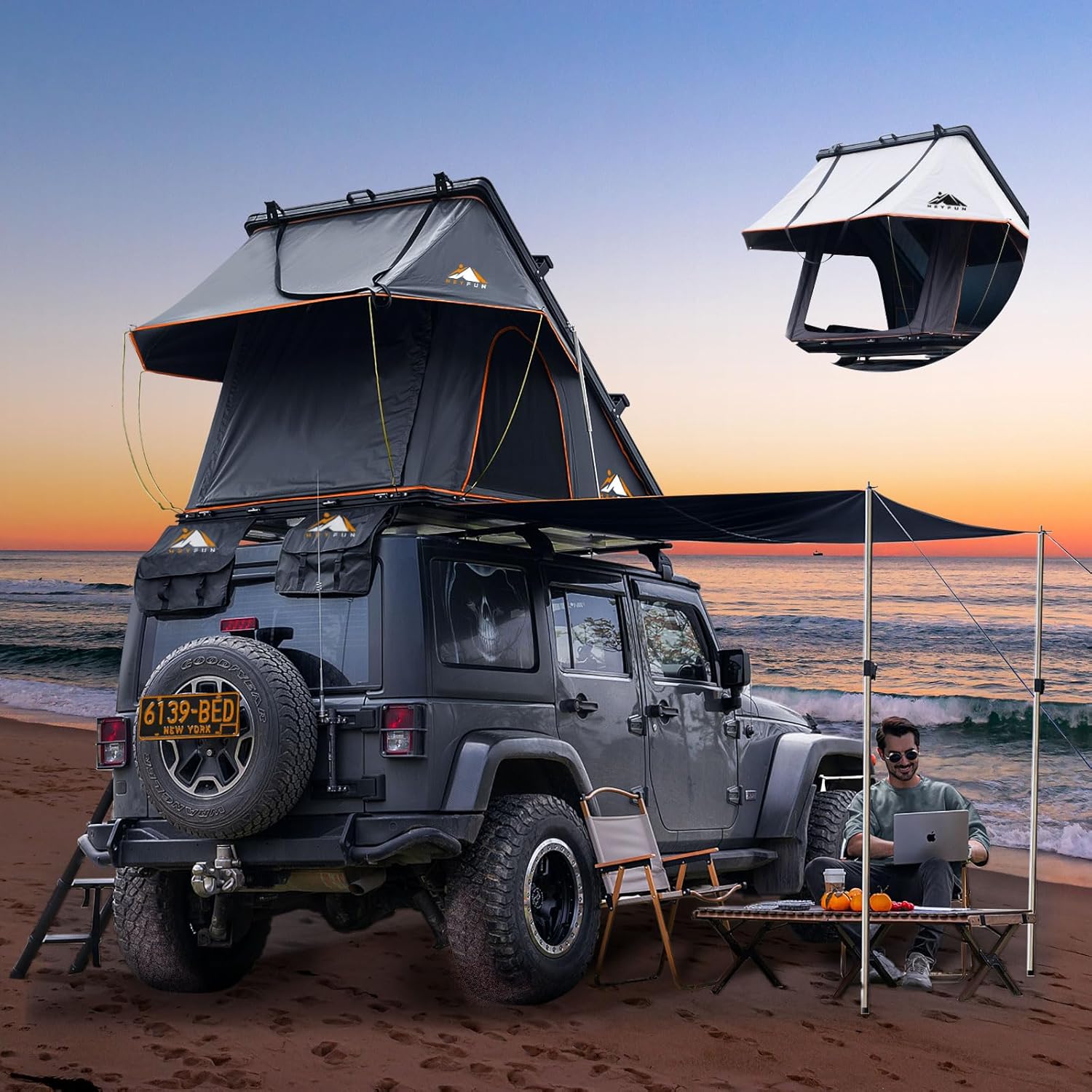
| Occupant Capacity | 3 Person |
|---|---|
| Water Resistance Technology | 0-5,000 mm |
| Assembly Time | 10 Minutes |
| Included Components | Side awning, 2 rain flies, ladder, luggage racks, built-in USB, LED light |
The HEYFUN Adventurer Pro is a hard-shell rooftop tent built to mount on a vehicle roof and provide a comfortable elevated sleeping area for two adults and a child. It uses aircraft-grade aluminum components, stainless gas struts and a waterproof polyester shell so the tent opens and closes quickly via hydraulic assist and stays rigid in wind. Inside you get a three-layer mattress, LED strip and a built-in USB outlet for charging devices, plus 13 storage pockets and multiple windows for ventilation. The package includes a side awning, replaceable rain fly, ladder and adjustable luggage racks that let you carry extra gear or mount accessories on top. Practical benefits include fast one-person setup, better weather protection than soft-shell options and added storage/lighting convenience. Important limitations are the tent mass and roof load requirement that need sturdy crossbars and the included mounting hardware and bolts may be weaker than aftermarket fasteners, so plan to use higher-grade mounting bolts and confirm your Outlander’s roof rack capacity before fitting.
Best for: Reliability-focused buyers who prioritize a durable, factory-quality roof-top sleeping solution and want a fast, weatherproof tent that reduces setup time and holds up on year-round trips in a Mitsubishi Outlander.
Less Ideal for: Drivers who plan frequent roof access, need a lightweight minimal setup, or lack a roof rack system rated for significant payload should consider lighter soft-shell tents or a truck-bed solution instead.
- Hard-shell aluminum construction and stainless gas struts for quick, stable hydraulic pop-up and strong weather resistance
- Integrated LED light strip and USB outlet for in-tent power and device charging
- Includes side awning, replaceable rain fly and adjustable roof luggage racks for extra shelter and cargo options
- Three-layer built-in mattress and multiple storage pockets for immediate comfort and organized gear
- Designed for year-round use with waterproofing, UV protection and breathable materials
- Heavy unit that requires roof crossbars rated for the tent’s load and reduces vehicle roof payload
- Some users reported included mounting bolts and nuts are soft and may strip or fail under repeated install/removal
Verdict: A robust, quick-deploy hard-shell rooftop tent built for dependable, year-round camping on a Mitsubishi Outlander as long as your roof rack supports the load.
Naturnest Sirius 1 Hardshell Rooftop Tent

| Occupancy | 3 Person |
|---|---|
| Seasons | 4 Season |
| Floor Width | 63 Inches |
| Floor Length | 82.7 Inches |
| Is Waterproof | True |
The Naturnest Sirius 1 is a factory-style hard-shell rooftop tent that mounts to roof racks and gives the Outlander a comfortable off-ground sleeping platform for two adults and a child. It uses an ABS hardshell and aluminum alloy frame with hydraulic gas struts to pop open in seconds and includes a built-in ladder and a 1.2-inch foam mattress for immediate use. The shell and 420D ripstop nylon fabric offer a high waterproof rating and UV 50+ protection, and large stargazer windows and mesh panels improve ventilation and views while keeping insects out. In real-world use it speeds setup and breakdown compared with a ground tent, feels more secure in windy conditions, and provides better sleeping comfort on road trips. Important limitations are the unit weight and roof load considerations for an Outlander roof rack and the need for two people to manage folding and reinstalling in some situations. Expect some effort to confirm compatible mounting points and to factor the additional wind noise and MPG impact while driving.
Best for: Risk-averse mainstream buyers who prioritize reliable, easy-to-use gear and want a ready-to-go rooftop sleeping solution for weekend trips and longer road travel with their Mitsubishi Outlander.
Less Ideal for: Adventurers who need the lightest possible setup or who plan to frequently remove the tent between drives should consider lighter, more compact alternatives.
- Quick hydraulic gas-strut opening for near-instant setup
- Hard-shell ABS top and aluminum frame for increased durability
- High waterproof rating with UV 50+ protection and full rain canopy
- Built-in ladder and preassembled mattress make it campsite-ready
- Large mesh windows and stargazer window for ventilation and views
- Heavy unit that requires checking Outlander roof load and compatible rack capacity
- May be awkward to close or stow alone; some users recommend two people
Verdict: A quick-opening, weatherproof hard-shell roof tent that gives Outlander owners a comfortable, ready-to-use sleeping setup but requires careful attention to roof load and handling due to its weight.
Choosing the Right Mitsubishi Outlander Roof Tent: Key Factors to Consider
Roof Load Capacity and Mounting Compatibility
Knowing your Mitsubishi Outlander roof load limits and the crossbar specifications matters because the tent and occupants create both static and dynamic loads. Roof tents add weight on the rack and impose shifting loads while driving over uneven terrain. Make sure the tent's stated weight and expected occupant load fit within your vehicle's published roof and rack limits.
Mounting compatibility affects whether the tent attaches to common crossbar shapes and spacing. Look for tents that offer flexible bracket options and clear guidance for channel widths and bolt patterns. If a tent requires specialized hardware or permanent modifications, that increases installation complexity and may limit how easily you can remove the tent between trips.
Setup Mechanism and Deployment Time
How the tent opens and closes changes the convenience of weekend trips and frequent overnight stops. Pop-up and soft-shell designs often deploy faster and with fewer moving parts, while hard-shell models can provide quicker one-person operation but may be heavier. Consider how often you expect to set up camp and whether you will usually do so alone.
Also factor in the ladder arrangement and whether it stores compactly. A tent with a straightforward, tool-free setup reduces time in bad weather and lowers the chance of user error when securing the fly and internal supports.
Weather Protection and Ventilation
Roof tents are exposed to wind, rain, and sun more directly than ground tents, so fabric quality, seam sealing, and the design of rain flies matter for staying dry. High-quality, tightly woven fabrics and well-sealed seams resist driving rain and prolonged exposure. Look for storm flaps, tub-style floors, and fly designs that deflect wind-driven rain.
At the same time, ventilation reduces condensation inside the tent. Mesh panels and adjustable vents let you control airflow without sacrificing protection. Good ventilation paired with weather-proofing gives a more comfortable sleep environment across seasons.
Internal Space and Mattress Comfort
The size and layout of the sleeping platform affects comfort, gear storage, and how many people can sleep comfortably. Pay attention to internal headroom, usable floor area, and whether the mattress is thick and supportive enough for multi-night trips. Some tents include high-density foam mattresses that perform better than thin pads.
Consider whether the tent's interior has pockets, hanging points, or a divider to keep gear organized and to improve sleep comfort. If you plan to use the tent year-round, insulating mattress properties and the ability to add liners or pads are also relevant.
Durability and Long-Term Maintenance
Materials, zippers, and hardware determine how a roof tent holds up after repeated use and exposure to sun and moisture. UV-resistant fabrics, corrosion-resistant hardware, and heavy-duty stitching reduce long-term wear. Check whether the tent uses replaceable parts or offers standard component sizes for easier repairs.
Maintenance considerations include how the tent dries after wet trips, how easily the cover and bedding can be cleaned, and whether moving parts are serviceable without specialized tools. A design that is simple to maintain will reduce ownership hassle and extend the useful life of the tent.
Access, Storage, and Daytime Use
Practical details like ladder reach, entry height, and how the tent integrates with rooftop storage affect daily usability. A ladder that adjusts to uneven ground and folds compactly when stowed is more versatile. Also consider whether the tent allows you to store gear underneath the platform or attach external pouches for quick access.
Some roof tents double as sheltered living space during the day. Look at vestibule options, awning compatibility, and how windows and awnings attach. These features expand utility beyond sleeping and make the tent more valuable for extended trips.
Why a Mitsubishi Outlander Roof Tent Is a Smart Choice for Weekend Adventures
The Mitsubishi Outlander is a compact SUV with enough cargo flexibility and roofline practicality to make a roof tent a compelling upgrade for owners who want quick, comfortable camping without towing a trailer. A roof-mounted shelter transforms the Outlander into a self-contained micro-camper: you gain sleeping space off the ground, faster campsite setup than pitching a ground tent, and the ability to leave gear stored underneath during multi-day stops. For solo travelers and couples, it is particularly efficient because it uses the vehicle as both transport and basecamp, minimizing setup and teardown time on short trips.
Choosing a roof tent designed to work with the Outlander lets you take advantage of the SUV's compact dimensions for narrow forest roads and parking-lot camping while still enjoying a comfortable sleep system. The elevated sleeping position reduces exposure to uneven or damp ground, and the built-in mattress and body typically offer better support than many backpacking shelters. For owners who value mobility and convenience over full camper conversions, a roof tent keeps the Outlander nimble on and off-road while adding meaningful capability for weekend escapes.
- Keeps you off wet or uneven ground
- Faster setup and teardown compared with large ground tents
- Maintains cargo space inside the vehicle
- Ideal for weekend and short overland-style trips
Preparing Your Outlander for a Roof Tent: Tools, Mounting Checklist, and Safety Checks
Installing a roof tent on an Outlander requires preparation beyond simply bolting the unit on the crossbars. Before you attempt to mount a roof tent, gather the right tools and plan a mounting sequence to protect both the tent and the vehicle. Essential items include a torque wrench for properly tightening mounting hardware, long-handled wrenches or sockets to reach difficult bolt locations, corrosion-resistant washers and lock nuts, and a helper to lift and position the tent safely. A mounting checklist ensures you do not skip critical safety steps and that the tent sits squarely on the roof rails or rack.
Start by inspecting your existing roof rack or crossbars for wear and proper attachment to the Outlander's fixed points. Confirm the rack's load rating and that any crossbar feet are tightened to factory specs. Lay out the tent on moving blankets or cardboard to protect the tent base and the vehicle paint during placement. When fastening, follow torque specifications from the tent manufacturer and recheck all fasteners after the first drive and again after 100 miles. Also check for any interference with the rear hatch and roof antenna so normal vehicle operation is not impaired.
- Tools: torque wrench, socket set, pry protection pads, helper for lifting
- Checklist: inspect rack, protect paint, align tent, tighten to torque specs
- Safety: re-torque after first drive and at regular intervals
Driving, Clearance, and Everyday Use Considerations with a Roof Top Tent on the Outlander
A roof tent changes how you drive and store the Outlander. Know your vehicle's new height and the added wind profile from the tent when folded or deployed. Many garages, drive-throughs, and low branches that posed no problem before can become hazards with a tent installed. Measure the overall vehicle height with the tent mounted (both folded and when the ladder is attached) and make a note to avoid routes and parking structures with low clearance. A rooftop tent will also affect handling slightly due to increased center of gravity; take corners more gently until you are comfortable with the feel.
For everyday use, some owners leave tents on the vehicle full time, while others remove them between trips. Leaving a tent mounted adds convenience but increases fuel consumption and exposes the tent to weather wear. If you plan to keep the tent on the Outlander, secure any loose accessories and periodically check mounting hardware. When carrying passengers and cargo, be mindful of roof load distribution; stow heavier items lower in the vehicle and toward the centerline when possible to maintain stable handling.
- Measure total vehicle height with tent and ladder attached
- Drive more cautiously until you adapt to the changed center of gravity
- Decide whether to keep the tent mounted long term based on convenience versus fuel and wear
Packing and Organizing Gear for a Vehicle Mounted Tent Setup
An efficient gear layout makes overnight trips from the Outlander easier. With sleeping quarters on the roof, the vehicle's cargo area becomes primary storage for clothing, cooking gear, and personal items. Use soft-sided duffels and packing cubes to compress items and fill voids so gear does not shift while driving. Reserve one easy-access bag for items you will need immediately at camp, such as headlamps, a first-aid kit, a compact camp stove, and a tarp. If your tent includes an annex, plan for which items can stay under the tent for quick access.
Think vertically and modular when storing gear. Stackable plastic bins or soft storage boxes work well behind the rear seats and allow you to access items without digging through multiple bags. Mount small organizers or nets on the inside of the hatch to store maps, gloves, and small tools. If you carry water or extra fuel, secure those containers low and close to the vehicle centerline to maintain balance and reduce sway while driving. Finally, label containers so teammates can find items quickly at camp without rummaging.
- Use soft duffels and packing cubes for compression
- Keep one grab-and-go bag for immediate camp needs
- Secure heavy liquids low and centered to maintain balance
Maximizing Comfort and Interior Layout Inside Your Roof Tent
Comfort in a roof tent depends on making the most of the mattress footprint and internal storage. Add a thin foam topper designed for roof tents if you want more cushion without significantly reducing headroom. Use low-profile organizers that attach to the tent walls to keep phones, flashlights, and eyeglasses within reach and off the mattress. Consider bedding that compresses well and retains warmth, such as down or synthetic sleeping bags rated for expected temperatures and a separate insulating layer between the mattress and sleeping bag for cooler nights.
Ventilation and condensation control are also important for restful sleep. Keep vents and windows partially open during mild weather to promote airflow while using rain flaps to block wind-driven moisture. For cooler climates, a small rechargeable or 12V heated blanket can add warmth without bulky sleeping systems. If you travel with a partner, agree on a head-to-head mattress arrangement and use individual organizers to avoid clutter. Thoughtful interior layout improves sleep quality and extends how comfortable you can be on extended trips.
- Consider a thin mattress topper for added cushion
- Use wall organizers to keep essentials off the sleeping surface
- Manage ventilation to reduce condensation and improve airflow
Seasonal Use, Maintenance, and Longevity Tips for Your Outlander Roof Tent
Maintaining a roof tent extends its life and keeps it reliable on future outings. After each trip, shake out debris, zip all windows and vents closed, and store the tent dry to prevent mildew. Inspect fabric seams, zippers, and mounting hardware regularly for signs of wear or corrosion. Treat canvas or fabric per the manufacturer's recommendations with appropriate cleaners and waterproofing agents rather than household detergents that can degrade coatings. Replace worn straps or buckles promptly to avoid failure while driving.
Seasonal considerations differ depending on how you use the tent. In summer, protect the tent from prolonged exposure to intense sun by parking in shade when possible and using breathable covers rather than opaque wraps that trap heat and moisture. In colder months, minimize condensation by airing the tent during daylight hours when temperatures rise. If you intend to use the tent in snow, clear accumulated snow from the folded cover before driving and periodically remove load from the top to prevent packing strain. Regular inspections and proactive care keep your roof tent serviceable and safe over many seasons.
- Dry and air the tent before long-term storage to prevent mildew
- Use manufacturer-recommended cleaners and waterproofing products
- Inspect and replace worn hardware and straps proactively
How We Chose the Best Mitsubishi Outlander Roof Tent
We focused on roof tents that work specifically with the Mitsubishi Outlander roof tent mounting footprint and typical roof-rack load limits. Key evaluation criteria included compatibility with crossbars and load ratings, setup speed and mechanism type, construction and weather sealing, mattress comfort and internal space, and long-term durability of fabrics and hardware. We also considered real-world usability factors such as access ladder design, ventilation, and storage without relying on brand claims.Excluded items included ground-only tents, vehicle-specific hard-shell conversions that require permanent roof modifications, and models that demand professional structural changes to the roof. Our shortlisting prioritized solutions that can be installed and removed by a typical vehicle owner and that fit within the Outlander roof load constraints. The final selections balance practical field performance with installation and daily usability concerns.
Our full evaluation process is outlined in our review methodology.
FAQ
Will a roof tent damage my Mitsubishi Outlander roof?
A properly installed roof tent typically does not damage the vehicle if you stay within the Outlander's roof and crossbar load limits. Use compatible mounting hardware, tighten fasteners to the recommended torque, and check the rack and roof rails periodically. Regularly inspect seals and contact points and avoid overloading the roof with additional gear.
How difficult is it to install a roof tent on an Outlander?
Installation difficulty often depends on the tent weight and the rack hardware. Many tents can be fitted by two people using basic tools and the included mounting brackets. Some models offer single-person setup options, but heavier tents typically need two people to lift and position safely. Follow the manufacturer's instructions and torque specs for secure attachment.
Can I leave a roof tent on my Outlander year-round?
You can leave a tent mounted for extended periods, but prolonged exposure to sun, wind, and moisture increases wear on fabrics and seals. If you park frequently under trees or in areas with heavy weather, consider removing the tent when not in use to extend its lifespan. Regular cleaning and waterproofing maintenance help preserve materials.
How do roof tents affect fuel economy and driving?
Any rooftop load alters aerodynamics and increases wind resistance, which can reduce fuel efficiency and change handling slightly. The extent depends on the tent's profile and how often you drive with it mounted. Reduce speed in strong crosswinds, and secure all hardware to minimize noise and movement while driving.
What tools or accessories should I plan to carry for upkeep?
Keep basic maintenance items like a soft brush, quick-dry towel, seam sealer, and spare fasteners or mounting bolts. A small multi-tool and lubrication for hinges or zippers can be useful. These items help you address minor repairs and keep the tent functional during a trip without needing specialized service.
Final Verdict
Choosing a Mitsubishi Outlander roof tent comes down to balancing load capacity, ease of setup, and the level of weather protection you need. Prioritize tents that fit your roof rack limits, deploy reliably with the number of people who will use them, and offer durable fabrics and hardware for your typical climate.Think about how you will use the tent most often—weekend escapes, longer overland routes, or family trips—and let the factors above guide your choice. Proper installation and routine maintenance will maximize comfort and lifespan, so focus on compatibility and practical features when making a final selection.
Explore More:
- Check out all Mitsubishi Outlander parts & accessories
- Explore Exterior Accessories
- Browse all Accessories
