

Note: This article contains affiliate links. If you click on these links and make a purchase, I may earn a small commission at no extra cost to you. This helps support my research and content. Read my full affiliate disclosure here.
If you own a 1996-2000 Honda Civic and want noticeably better audio from factory locations, swapping the door speakers is one of the highest-impact changes you can make. Door speakers control most of the music you hear from the dash out, so choosing units that match the Civic's door mounting, power limits, and speaker depth will keep installation straightforward and sound balanced.This guide covers the top shortlisted door speaker upgrades that fit the 1996-2000 Civic (EJ, EK, and EM), explains the key specs to check, and outlines installation and tuning considerations. Use the evaluation notes to pick options that match your listening style and amplifier setup before you start a door speaker replacement project.
Looking for other parts? See all Honda Civic parts & accessories.
Top Picks at a Glance
| Best Overall Door Speakers Balanced sound, fit, and build — a reliable all-around upgrade | Harmony Audio HA-R65/HA-R69 Civic 1996–2000 Speaker and Harness Bundle |  |
| Best Budget Door Speakers Low-cost replacements that improve sound without breaking the bank | BOSS Audio Systems CH6530 6.5" 3-Way Car Door Speakers (Pair) |  |
| Best Direct-Fit Door Speakers Speakers sold with vehicle-matched harnesses or plug-and-play fitment | Harmony Audio HA-C65 6.5" Premium Front Door Speaker for Honda Civic 1996-2000 |  |
| Best 6.5" Coaxial Door Speakers Standard 6.5-inch coaxial speakers for most door locations and installs | JVC CS-J620 6.5" 2-Way Coaxial Car Speakers (pair) |  |
| Best 6×9 Door Speaker Kit Larger 6×9-inch drivers and kits for punchier bass and output | BOSS Audio Systems CH6930B 6×9 3-Way Car Door Speakers (Pair) |  |
| Best Shallow-Mount Door Speakers Low-profile speakers designed for tight door cavities or window clearance | BOSS Audio Systems BRS65 6.5" Replacement Car Door Speaker (sold individually) |  |
| Best Full‑Kit Door Speaker Bundles Complete packages with speakers, adapters, harnesses, and mounting parts | Harmony Audio 6.5" 2-Way Speaker and Amp Bundle for Honda Civic 1996–2000 |  |
1. Harmony Audio HA-R65/HA-R69 Civic 1996–2000 Speaker and Harness Bundle
Best Overall Door Speakers

| Speaker Size | 6.5 Inches and 6×9 Inches |
|---|---|
| Impedance | 4 Ohms |
| Sensitivity | 90dB |
| Frequency Response | 40Hz-20kHz |
| Tweeter Size | 0.5 Inches |
This Harmony Audio bundle pairs 6.5" 300W rhythm-series coaxials with 6×9" 450W coaxials and includes a factory speaker-to-aftermarket harness for a direct-fit door and rear replacement on 1996–2000 Honda Civic models. In everyday use these speakers deliver louder, fuller sound than typical factory units thanks to higher peak and RMS power handling and a sensitivity around 90dB that helps them sing with modest head-unit power. The 4 ohm impedance keeps them compatible with most stock and aftermarket stereos while the 1/2" tweeters improve highs for vocals and percussion. Mounting depths and cutouts match common Civic openings so installation is straightforward when using the included harness, avoiding splicing and wiring confusion. Trade-offs are typical for value coaxials: the enclosure is plastic rather than a higher-end composite and they are not water resistant, so long-term durability and extreme weather performance will lag premium options. For a practical, bolt-in upgrade that meaningfully improves clarity and output over factory speakers, this bundle is a solid choice.
Best for: Buyers who prioritize a straightforward, bolt-in improvement to factory sound on a 1996–2000 Civic and want clearer, louder performance without extensive wiring modifications.
Less Ideal for: Audiophiles seeking premium materials, extreme weather durability, or the highest-end component separates should consider higher-tier options or dedicated component speaker systems.
- Includes both 6.5" and 6×9" coaxial speakers for door and rear upgrades
- Factory speaker-to-aftermarket harness for plug-and-play installation
- Higher power handling and 90dB sensitivity for louder, clearer sound from stock head units
- 0.5" tweeters improve high-frequency detail compared with typical factory speakers
- Enclosure is plastic and the speakers are not water resistant, limiting durability in wet environments
Verdict: The top pick for readers who want the best combination of clarity, power handling, and fitment for a straightforward door-speaker replacement.
2. BOSS Audio Systems CH6530 6.5" 3-Way Car Door Speakers (Pair)
Best Budget Door Speakers

| Speaker Size | 6.5 Inches |
|---|---|
| Impedance | 4 Ohms |
| Surround Sound Channel Configuration | 3.0 |
| Sensitivity | 90 dB |
| Frequency Response | 100 Hz to 18 KHz |
The BOSS CH6530 is a low-cost 6.5-inch 3-way coaxial speaker pair built to replace worn factory door speakers. It combines a poly injection woofer, rubber surround and a 0.5-inch piezo tweeter with a 1-inch polyimide midrange to cover a wide frequency range for everyday listening. In use these speakers deliver clearer highs and tighter midrange compared with aged stock units, and their 90 dB sensitivity helps them play noticeably louder from a factory head unit or low-power amp. Installation is straightforward in most 6.5-inch door openings though some buyers report missing mounting adapters or thin wiring, so plan to use adapter rings or better speaker leads if your Civic needs them. Expect bass to be limited compared with larger or powered systems and the piezo tweeter will not offer the same refinement as a dedicated soft-dome tweeter, but for an inexpensive, reliable door swap the CH6530 gives a solid improvement without requiring additional amplification.
Best for: Buyers who want a low-cost, straightforward door speaker swap that noticeably improves clarity and loudness over old factory speakers without adding amplifiers or complex installation.
Less Ideal for: Audiophiles seeking deep bass or highly detailed high-end sound and installers who want fully matched component systems should consider higher-end options instead.
- Affordable pair that upgrades sound over worn factory speakers
- 3-way coaxial design improves clarity across highs and mids
- 90 dB sensitivity helps produce good volume from stock head units
- Rubber surround and stamped basket provide decent durability for daily use
- Piezo tweeter is less refined than higher-end tweeters and can sound harsh at high volumes
- May require adapter rings or different mounting hardware for some door panels
Verdict: Choose this slot if you need inexpensive, reliable door speakers that noticeably out-perform worn stock units while keeping costs low.
3. Harmony Audio HA-C65 6.5" Premium Front Door Speaker for Honda Civic 1996-2000
Best Direct-Fit Door Speakers

| Speaker Size | 6.5 Inches |
|---|---|
| Peak Power | 350 watts |
| RMS | 150 watts |
| Sensitivity | 91 dB |
| Frequency Response | 45Hz to 21kHz |
The Harmony Audio HA-C65 is a direct-fit 6.5-inch coaxial front door speaker intended as a straightforward replacement for 1996–2000 Honda Civic doors. It pairs a 6.5-inch woofer with a 1-inch tweeter to cover from 45 Hz up to 21 kHz, and it is rated for 150 watts RMS (350 watts peak), so it can play loudly without distortion when paired with a modest factory or aftermarket head unit. Typical installation is simple: the speaker is sized and mounted for the Civic door cutout and supports speaker-level and RCA connectivity, which makes wiring to a factory harness or speaker-level outputs easy. The 91 dB sensitivity means it responds well to lower-power radios, and the shallow mounting depth helps avoid clearance issues in the door. Limitations include a basic non-waterproof construction and no mention of included mounting hardware or a specific harness adapter, so double-check what comes in the box and whether clips or a spacer are needed for a perfect fit.
Best for: Buyers who want a hassle-light replacement that fits Civic front doors and improves sound over aging factory speakers without needing door modifications or custom wiring.
Less Ideal for: Audiophiles seeking high-end components or users who need moisture-resistant speakers for frequent wet conditions should look for upgraded or weather-rated options instead.
- Direct-fit 6.5-inch size matched to 1996–2000 Honda Civic front doors for easier installation
- 91 dB sensitivity helps achieve good volume with factory radios
- 150 watts RMS power handling accommodates louder listening without immediate clipping
- Wide frequency range (45 Hz–21 kHz) provides solid bass-to-treble coverage
- Not listed as waterproof so may be vulnerable to moisture inside door panels
- Product listing does not clearly state included mounting hardware or harness adapter
Verdict: Pick a direct-fit speaker when you want an easy, no-modification swap using an included or matched harness for hassle-free installation.
4. JVC CS-J620 6.5" 2-Way Coaxial Car Speakers (pair)
Best 6.5" Coaxial Door Speakers
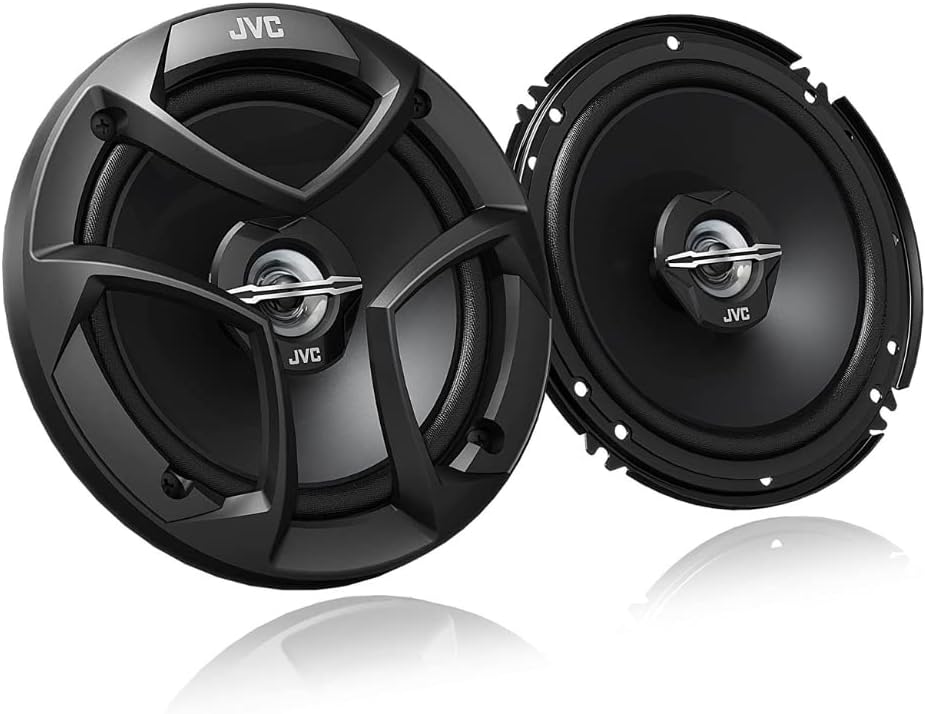
| Speaker Size | 6.5 Inches |
|---|---|
| Tweeter Diameter | 1 Inches |
| Impedance | 4 Ohms |
| Sensitivity | 92 dB |
| Speaker Maximum Output Power | 300 Watts |
The JVC CS-J620 is a budget-friendly 6.5-inch coaxial set aimed at replacing factory door speakers. Each speaker pairs a mica-injected polypropylene woofer with a 1-inch PEI tweeter in a two-way coaxial layout to improve midrange clarity and high-frequency detail compared with many stock units. Typical use is as a direct door replacement in vehicles with standard 6.5" cutouts; the shallow top-mount depth and included mounting hardware simplify installation where door clearance is limited. Measured specs such as 300W peak power, 92 dB sensitivity, and a 35 Hz–22 kHz frequency range mean these speakers are efficient and produce clear vocals and cymbals without needing a high-power amplifier. Limitations are obvious at the low end: they will not deliver deep bass on their own and some distortion can appear at high volumes, so drivers seeking punchy lows should plan to add an amp and subwoofer. Wire lengths and adapters in the package may be short for some door installations, so expect minor wiring or bracket modification on certain Civic door panels.
Best for: Buyers who want a straightforward, easy-to-install upgrade of factory door speakers that improves midrange detail and high-end clarity without adding an external amp.
Less Ideal for: If you prioritize deep bass or plan to drive speakers very loudly without distortion, this set alone will not satisfy and you should consider adding an amp and sub or choosing a different component setup.
- Common 6.5-inch size fits standard door cutouts with minimal modification
- High sensitivity (92 dB) for good volume from low-power factory head units
- Wide stated frequency range for clear mids and highs
- Shallow top-mount depth and included mounting hardware ease installation in tight door spaces
- Limited low-frequency output without a dedicated subwoofer or amplifier
- Included speaker wires and adapters may be short or require aftermarket connectors
Verdict: Select a 6.5" coaxial when you need a common-size, full-range speaker that fits typical door cutouts and delivers balanced mids and highs.
5. BOSS Audio Systems CH6930B 6×9 3-Way Car Door Speakers (Pair)
Best 6X9 Door Speaker Kit

| Speaker Type | Coaxial 3-way |
|---|---|
| Impedance | 4 Ohms |
| Frequency Response | 50 Hz to 20 kHz |
| Sensitivity | 92 dB @ 1W/1m |
| Woofer Diameter | 9 Inches |
The CH6930B is a budget 6×9 three-way coaxial speaker pair intended for straightforward door or deck-mounted upgrades. It combines a 9 inch woofer with a 2 inch midcone and a 0.75 inch piezo tweeter to extend response from about 50 Hz up to 20 kHz and deliver louder, fuller sound than most factory 6x9s. Typical use is direct replacement in a vehicle door where you want stronger low-frequency presence without adding a subwoofer. Notable features include a poly injection woofer cone, rubber surround and stamped basket for durability, 4 ohm impedance that pairs easily with common head units and amps, and a sensitivity near 92 dB for good loudness from modest power. Practical benefits are punchier bass and clear mids at normal listening levels and simple installation for DIY fits. Limitations to expect are increased distortion and possible durability concerns at sustained very high volumes, and some users report fitment or mounting-hole alignment differences that may require trimming or retaining factory mounting hardware.
Best for: Buy this if you want a simple door-mounted upgrade that increases bass presence and overall loudness without adding a subwoofer and you prefer a plug-and-play replacement you can install yourself or have a shop fit.
Less Ideal for: Not the best choice for users seeking competition-grade clarity at extreme volumes or for installations that require factory-level moisture resistance or exact factory hole alignment.
- Large 9 inch woofer and separate midrange provide stronger low-end and fuller midrange compared with typical factory 6x9s
- 92 dB sensitivity yields good volume with stock head units or moderate amps
- 3-way coaxial design covers lows, mids, and highs without separate components
- Rubber surround and stamped basket aimed at durability for door-mounted use
- May distort or produce crackling at very high volumes without a proper amplifier
- Mounting hole dimensions can differ from factory templates and may need modification or use of original mounting brackets
- Not water resistant so exposure to moisture in door cavities could be a concern
Verdict: Choose a 6×9 kit if you want bigger cone area and stronger low-frequency output from a door or deck-mounted speaker upgrade.
6. BOSS Audio Systems BRS65 6.5" Replacement Car Door Speaker (sold individually)
Best Shallow-Mount Door Speakers

| Speaker Size | 6.5 Inches |
|---|---|
| Impedance | 4 Ohms |
| Frequency Response | 100 Hz to 18 kHz |
| Sensitivity | 85 dB @ 1W/1m |
| Mounting Depth | 1.79 inches |
The BOSS BRS65 is a budget-friendly 6.5-inch coaxial replacement speaker aimed at restoring functional sound in a cramped door cavity. It uses a polypropylene cone with foam surround and a 1-inch tweeter to deliver a full-range response from roughly 100 Hz to 18 kHz, and its shallow 1.79-inch mounting depth makes it suitable where window tracks or inner door panels limit clearance. Expect clear mids, usable highs, and modest bass for day-to-day listening at moderate volumes; it is not built for high-power SPL or deep bass without an amplifier and subwoofer. Installation is straightforward for someone comfortable with basic wiring and trimming mounting holes; the speaker is sold individually so you will need to buy a pair for stereo. Durability is typical for an economy speaker and it is not water resistant, so protect it from moisture inside door cavities. For a replacement that fits shallow doors and restores decent sound without breaking the bank, the BRS65 is a practical choice.
Best for: Buyers who need a compact, shallow-mount replacement to fit cramped 1996–2000 Honda Civic door cavities and prefer a simple, factory-like sound restoration over high-power upgrades.
Less Ideal for: Audiophiles seeking deep bass or high-volume output and anyone who wants weatherproof speakers for exposed locations should consider higher-end or moisture-rated options.
- Shallow 1.79 inch mounting depth fits tight door cavities and clears window tracks
- Polypropylene cone and 1 inch tweeter provide balanced full-range sound for factory-style systems
- Sold individually so you can replace only the failed speaker instead of buying a pair
- Wired coaxial design is simple to install with standard car speaker wiring
- Not water resistant so it needs protection from door moisture
- Rated for modest power and sensitivity so it will not deliver strong bass or high-volume performance without an external amp
- Sold individually which requires purchasing two for a full stereo replacement
Verdict: Go with a shallow-mount speaker when your door has limited depth and you need a compact driver that clears window tracks and panels.
7. Harmony Audio 6.5" 2-Way Speaker and Amp Bundle for Honda Civic 1996–2000
Best Full‑Kit Door Speaker Bundles

| Speaker Size | 6.5 Inches |
|---|---|
| RMS | 100 watts |
| Peak | 300 watts |
| Frequency Response | 10Hz-30kHz |
| Connectivity Technology | RCA |
This Harmony Audio bundle is a full-door speaker package designed to replace factory front or rear speakers on a 1996–2000 Honda Civic. The kit pairs 6.5" 2-way speakers (100 watts RMS per pair) with a compact HA-A400.4 four-channel amplifier and includes install adapters and wiring harness pieces to simplify a clean swap into factory openings. The speakers offer a wide stated frequency response down to 10Hz and a 1/2" tweeter for clearer highs, while the amp provides extra headroom for fuller sound and better dynamics than the stock system. RCA connectivity and the included harness make it straightforward for a single-shop or DIY install where you want to avoid custom mounting or major dash work. Expect noticeably louder, clearer audio and tighter bass compared with factory speakers, but note the bundle is battery powered and the amp footprint is compact, so amplifier placement and power wiring should be planned carefully during installation. This is a practical, all-in-one option for Civic owners who want a clean, factory-style upgrade with fewer compatibility headaches.
Best for: Buyers who want a straightforward, all-in-one door speaker upgrade for a 1996–2000 Honda Civic and prefer a kit that reduces wiring and mounting headaches during installation.
Less Ideal for: Audiophiles who plan heavy power tuning or staged component systems that require larger, hardwired amplifiers should look at separate high-power amp and component options.
- Complete kit includes speakers, amp, and install adapters for a one-stop upgrade
- 6.5" 2-way speakers with 1/2" tweeters for improved clarity and wider frequency response
- Compact four-channel amp adds headroom and supports a fuller system without replacing the head unit
- RCA connectivity and harness pieces simplify wiring and reduce need for custom parts
- Amp is compact and battery powered which may limit power handling compared with larger hardwired amps
Verdict: Opt for a full-kit bundle if you want everything needed for a clean upgrade—speakers plus adapters and wiring—to simplify the install process.
Choosing the Right 1996-2000 Honda Civic Door Speakers: Key Factors to Consider
Fitment and Mounting Depth
Correct fitment is critical for a smooth installation in the Civic's door panel. Mounting bolt patterns, cutout diameter, and overall speaker depth determine whether a speaker will drop into the existing door pocket or require an adapter or trimming.
The 1996-2000 Civic doors have limited clearance behind the panel and around the regulator, so checking depth prevents contact with the glass or inner door hardware. You should measure the factory speaker location before buying and compare that to the new speaker's magnet depth and mounting flange thickness. For near-direct-fit speakers, plan for a thin adapter ring rather than cutting the door metal. Proper fitment preserves factory trim and reduces rattle by allowing the speaker to sit flush against the baffle.
Power Handling and Sensitivity
Match speaker power handling to the amplifier or head unit you plan to use. RMS power ratings give a realistic idea of continuous capability, while sensitivity (decibels per watt at one meter) indicates how loud a speaker will be with a given power input.
A speaker with low sensitivity needs more amplifier power to reach the same volume as a high-sensitivity unit. In the Civic, many owners keep the factory head unit or add a modest external amp, so choosing a speaker with sensitivity in the mid- to high-80s dB range or higher helps achieve strong output without driving the amp to distortion. Also consider peak power specs for short-term headroom, but prioritize RMS for long-term reliability in door installations.
Speaker Type: Component Vs Coaxial
Decide whether a component set or a coaxial speaker better fits your goals and door constraints. Coaxial door speakers combine woofer and tweeter into one unit for simpler installation and fewer mounting locations. Component systems separate tweeters and woofers, offering better imaging if you can place tweeters up high in the dash or A-pillars.
For the Civic doors, coaxial speakers are often the easiest and most practical upgrade because they fit existing mounts and avoid additional tweeter wiring and placement work. However, if you plan a phased upgrade with an external amplifier and can route tweeter wires, a component set can improve clarity and stereo imaging. Consider whether you want a clean single-door swap or a more involved staged upgrade when choosing between these types.
Frequency Response and Tonal Balance
Look for a speaker with a frequency range and cone design that matches your listening preferences. A wider frequency response helps reproduce more detail from lows to highs, but real-world door speakers are influenced by the vehicle interior and door cavity acoustics.
Cones made from stiffer materials usually deliver tighter bass and clearer mids, while softer materials can sound warmer. Pay attention to midrange clarity because vocals and guitars sit in that band and are critical for everyday listening. Aim for a balanced tonal profile if you listen to varied music styles, or pick a speaker that emphasizes bass or highs if that matches your taste.
Durability and Moisture Resistance
Door speakers sit in an environment exposed to temperature swings, condensation, and road moisture. Materials such as treated surrounds, rust-resistant metal parts, and sealed tweeters improve longevity in the Civic's door cavity.
Choose speakers with coatings or materials rated for automotive use rather than indoor-only components. Durable spiders, weather-resistant diaphragms, and protective grills reduce the chance of premature failure. Considering long-term durability is especially important if you live in humid or coastal areas where corrosion risk is higher.
Installation Hardware and Wiring
Check whether the speaker comes with vehicle-specific mounting brackets, screws, or adapter plates that match the Civic's factory locations. Complete hardware reduces installation time and the need to source third-party parts.
Also verify connector compatibility with the Civic wiring harness. Many aftermarket door speakers use universal pigtails or bare leads; having harness adapters prevents splicing and preserves factory connectors. Finally, consider whether sound-damping material or foam baffles are needed to reduce road noise and vibration around the new speaker, as these small additions can greatly improve perceived sound quality.
Door Speaker Sizes and What Fits the Civic
The 1996-2000 Civic door speaker locations accept a few common sizes but always confirm the factory opening before ordering. Typical direct-fit upgrades for these model years prioritize the factory 6.5-inch footprint in the front doors and smaller rear door or sail panel locations where applicable.
Measure the mounting bolt spacing and depth from the speaker flange to the inner door skin. Some options are near-direct-fit and require only an adapter ring, while deeper aftermarket designs may need spacer plates or slight trimming of the door panel foam. Keeping the speaker tucked away from window channels and regulator mechanisms is essential to avoid damage during operation.
- Front door: usually 6.5-inch or equivalent aftermarket footprint
- Check magnet depth to avoid contact with window hardware
- Rear or sail panel locations may take 4×6 or 6×9 formats depending on configuration
Wiring and Crossover Basics for Door Upgrades
Understanding basic wiring and crossover behavior helps preserve clarity and prevents component damage. Coaxial speakers include integrated tweeters and internal crossovers sized for the combined drivers, while component systems use external or inline crossovers to split frequencies cleanly between tweeter and woofer.
If you plan to add an aftermarket amplifier, match the speaker's crossover points and impedance so the amp operates within safe limits. In many Civic upgrades, a simple inline high-pass for the tweeter or a full-range amplifier with adjustable crossover presents an easy tuning path without complex wiring.
- Verify speaker impedance (usually 4 ohms) matches amp channels
- Use inline crossovers for simple component integration
- Keep wiring runs short in the door to reduce signal loss
Sound Deadening and Door Baffle Tips
Adding sound deadening to the inner door skin and a foam baffle behind the speaker can dramatically improve bass response and reduce panel vibration. The factory paper or thin plastic baffle is not acoustically ideal, so upgrading to a closed-cell foam ring or molded baffle helps the speaker load correctly and lowers resonance.
Apply deadening material strategically around the speaker opening and on the large flat areas of the inner door. This reduces rattles at higher volumes and creates a firmer mounting surface for the speaker, which results in tighter, more controlled bass and clearer mids.
- Use a foam or plastic baffle to seal the speaker to the door
- Apply deadener to the sheet metal behind the speaker for reduced resonance
- Secure wiring and terminals to avoid noise from vibration
Tweeter Placement Options in the Civic
If you choose component door speakers, decide where to place tweeters for better imaging. Common choices are the dash corner, A-pillar, or high in the door near the mirror. Routing wires through the door jamb and up to the dash requires patience but pays off in improved stereo staging and vocal clarity.
When using coaxials, the integrated tweeter simplifies placement and avoids extra holes. However, coaxial tweeters sit lower in the door and may be slightly less detailed than a properly placed component tweeter. Consider your installation skill and whether you want a clean single-location swap or a multi-point upgrade for the tweeters.
- High tweeter placement improves imaging and clarity
- Plan wiring routes through the existing door harness grommet
- Use removable panels or flush mounts to keep the install reversible
Matching Speakers to Your Head Unit or Amplifier
The speakers you pick should complement the power output and tonal characteristics of your head unit or amplifier. If you keep the factory head unit, prioritize higher-sensitivity speakers that deliver adequate volume. If you plan to add an amp, focus on speakers with solid RMS ratings and robust cone materials that handle more power without distortion.
Consider using a basic two-channel amp to drive the front doors if you want cleaner dynamics and lower distortion. Crossovers or amp filters allow you to protect tweeters and tighten the low end by reducing uncontrolled bass from the door locations.
- Higher sensitivity for head-unit-only setups
- Sturdy cones and higher RMS for amp-driven installs
- Use a proper gain-matching process when adding amplification
Still looking for the perfect fit?
Select your Honda Civic configuration to see the most relevant Door Speakers recommendations
How We Chose the Best 1996-2000 Honda Civic Door Speakers
We selected products using a hands-on fitment and specification framework tailored to the 1996-2000 Honda Civic door environment. Primary evaluation criteria included physical fitment to the Civic door mounting pattern and depth, power handling relative to common factory and aftermarket amplifiers, frequency range and sensitivity for balanced output, and build quality features that matter in door locations such as moisture resistance and rigid cones.Additional filters targeted practical installation details: grille and mounting hardware compatibility, typical adapter needs, and whether the speaker required cutting or major door modifications. We also considered voice-coil cooling and magnet size trends that affect reliability in confined door cavities. Exclusions included speakers that explicitly need custom enclosures, units with unverified fitment for 1996-2000 Civic doors, and products lacking minimum water resistance for door-trim environments.The result is a focused list of direct-fit and near-direct-fit door speaker upgrades that prioritize correct fit, appropriate power handling, reliable materials for door use, and neutral tonal balance suitable for common head unit and amp pairings. Technical specs and common installation notes were used to rank and shortlist options for this vehicle scope.
Our full evaluation process is outlined in our review methodology.
FAQ
Will any 6.5-inch speaker fit the 1996-2000 Civic doors?
Not necessarily. While many 6.5-inch aftermarket speakers share a common cone size, mounting flange dimensions, bolt pattern, and magnet depth vary. Measure the factory opening and clearance before purchasing and prefer speakers labeled as direct-fit or that specify compatibility with 1996-2000 Civic mounting patterns.
Do I need an amplifier for upgraded door speakers?
It depends. Upgraded speakers with higher sensitivity may perform well on a factory head unit, but more powerful or lower-sensitivity speakers benefit from an external amplifier. An amp reduces distortion at listening levels and gives better control, especially for bass and dynamic music passages.
Are component door speakers worth the extra work in a Civic?
Component systems can deliver improved imaging and clearer highs if you can mount tweeters in an optimal location and install crossovers correctly. For many Civic owners, quality coaxials provide a simpler path to better sound, while components make sense if you want a phased or high-end upgrade and are willing to do more installation work.
How can I prevent rattles after installing new door speakers?
Use sound-deadening material on the inner door skin and fit a foam or plastic baffle behind the speaker to create a solid mounting surface. Tighten mounting screws evenly, secure loose wires, and check door trim clips to eliminate vibration paths that cause rattles.
Will replacing door speakers affect the factory alarm or wiring?
Most speaker swaps do not affect factory alarms if you avoid cutting factory wiring and use compatible harness adapters. Preserve factory connectors or use clean splices and insulation. If the Civic has factory features tied to door wiring, take care to route and secure new wires without interfering with door switches or sensors.
What impedance should I look for in replacement door speakers?
Most automotive speakers use 4-ohm impedance, which matches common head units and amplifiers. Check the speaker specification and ensure the amp or head unit can drive that load. If a speaker is 2 ohms or 8 ohms, confirm compatibility before installation.
Final Verdict
When upgrading door speakers in a 1996-2000 Honda Civic, prioritize fitment, power handling, and durability to avoid installation headaches and ensure long-term performance. Decide between coaxial units for a straightforward swap or component speakers if you want improved imaging and are prepared for added installation steps.Balance sensitivity and RMS ratings with your head unit or amplifier choice, and invest in basic sound-deadening and proper baffles to maximize sound quality. With the right combination of fit, materials, and installation care, you can achieve a meaningful car speaker upgrade that noticeably improves clarity and bass in your Civic.
Explore More:
- Check out all Honda Civic parts & accessories
- Explore Electronics
- Browse all Accessories
