

Note: This article contains affiliate links. If you click on these links and make a purchase, I may earn a small commission at no extra cost to you. This helps support my research and content. Read my full affiliate disclosure here.
If you spend time commuting, road-tripping, or running errands with perishable items, selecting the right portable fridge for your Honda Civic makes a noticeable difference. The Civic has limited cargo and cabin power capacity compared with larger vehicles, so you need a compact, energy-efficient fridge that fits the available space and electrical supply.This guide covers seven carefully shortlisted portable fridges that suit the Civic's footprint and typical driving patterns. We evaluated capacity, power draw, mounting and placement options, and thermal performance to help you pick a unit that keeps food and drinks cold without compromising passenger space. Read on to see which features matter most and which setups work best in a Civic.
Looking for other parts? See all Honda Civic parts & accessories.
Top Picks at a Glance
| Best Overall Portable Fridge The best all-around portable fridge for most shoppers | EUHOMY CFC-18 12V Portable Compressor Car Refrigerator with App Control (19 QT) |  |
| Best Budget Portable Fridge A low-cost model that keeps items cold without frills | Stopsad 11QT Portable 12V Compressor Car Refrigerator (Model 805) |  |
| Best Compact Portable Fridge A small, space-saving fridge that fits tight car spaces | Alpicool NL9 10-Quart Portable 12V Refrigerator/Freezer |  |
| Best Large-Capacity Portable Fridge A roomy fridge for longer trips or larger food loads | EUHOMY CF-55 55L (59QT) 12V Portable Compressor Refrigerator with App Control |  |
| Best Dual-Zone Portable Fridge Separate compartments for simultaneous cooling and freezing needs | Feelfunn 50QT Dual-Zone 12V Portable Car Refrigerator |  |
| Best Energy-Efficient Portable Fridge A model engineered for low power draw and long runtimes | Setpower RF20 12V Portable Refrigerator 21 Quart with 50H Backup Cooling |  |
| Best Premium Portable Fridge A higher-end model with top build quality and features | BougeRV CRX3 23 Quart Portable Refrigerator with 240Wh Detachable Battery |  |
1. EUHOMY CFC-18 12V Portable Compressor Car Refrigerator with App Control (19 QT)
Best Overall Portable Fridge

| Capacity | 18 Liters |
|---|---|
| Voltage | 12 Volts (also 24V DC, 100–240V AC) |
| Temperature range | -4°F to 68°F (-20°C to 20°C) |
| Cooling method | Compressor |
The EUHOMY CFC-18 is a small, compressor-driven portable fridge designed for car and travel use. It runs on 12/24V DC or 100–240V AC and cools to freezing temperatures while offering three-level battery protection so you can run it from a vehicle without overwhelming the battery. The 19 QT (18 L) chest layout uses a magnetic lid and rubber gasket for tighter insulation and a reversible door for flexible placement. An inverter-style rotary scroll compressor promises quick cooling and relatively low noise, and the unit includes touch controls plus optional Bluetooth app control for remote temperature changes. Practical benefits include fast cool-down, a light weight and compact footprint that fits behind a seat or in a trunk, and low power draw on ECO mode that makes overnight runs from a car battery or portable power station feasible. Expect some temperature variance of a few degrees during heavy use and limited interior space compared with larger dual-zone fridges, and note the small display cannot be dimmed. For everyday refrigeration on road trips in a compact car the CFC-18 delivers a strong balance of performance, efficiency, and usability.
Best for: Buyers who need a compact, energy-efficient fridge for daily use and road trips in a small car and who prioritize reliable cooling, low power draw, and simple controls.
Less Ideal for: Not a good choice if you need large capacity, precise multi-zone temperature control, or a fully silent unit for long-term stationary indoor use.
- Compressor cooling down to freezing temperatures for fridge or freezer use.
- Runs from both 12/24V DC and 100–240V AC for versatile power options.
- Three-level battery protection and low ECO-mode power draw to reduce vehicle battery drain.
- Compact 19 QT capacity and chest form factor that fits in tight car interiors or trunks.
- Magnetic sealed lid and rubber gasket improve insulation and cooling efficiency.
- Limited interior capacity compared with larger portable fridges and no dual-zone option.
- Display cannot be dimmed which may be distracting in low-light vehicle cabins.
Verdict: The best all-around portable fridge that balances size, cooling performance, efficiency, and ease of use for everyday car and road-trip needs.
2. Stopsad 11QT Portable 12V Compressor Car Refrigerator (Model 805)
Best Budget Portable Fridge
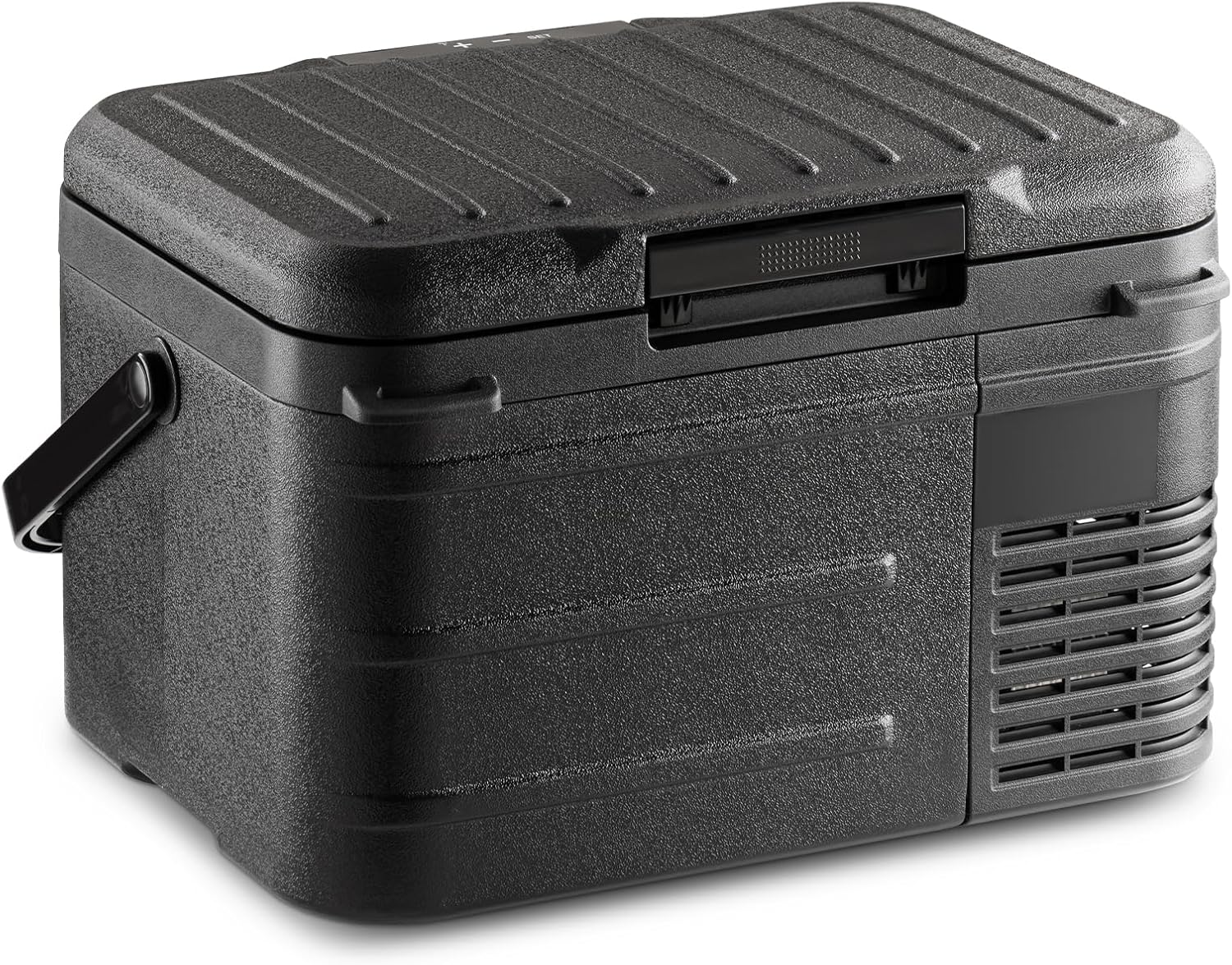
| Capacity | 10 Liters |
|---|---|
| Cooling method | Compressor |
| Temperature range | -4°F to 68°F |
| Power source | 12/24V DC and 110/240V AC |
| Defrost system type | Frost Free |
The Stopsad 11QT portable refrigerator is a compact compressor cooler built for short trips, daily driving, and small-scale food and drink storage in a car. It runs from 12/24V DC or 110/240V AC and uses a variable frequency compressor to reach temperatures from about -4°F up to 68°F, with ECO and MAX cooling modes for energy or fast chill. Controls are on a simple LCD panel and the unit includes three-level battery protection to avoid draining a vehicle battery. At roughly 10 liters capacity it fits several cans or a few bottles and stows easily in a trunk or back seat; the reversible stainless steel door and frost-free operation add convenience. Trade-offs for the low price are limited capacity and modest weight compared with ultra-compact soft coolers, and it lacks smart features or a convertible freezer compartment. For ordinary Civic trips, camping weekends, or commuting with chilled drinks, it offers reliable cold performance in a small, portable package.
Best for: Buyers who need dependable, fridge‑style cooling on a tight budget for short road trips, commuting, or weekend camping and prioritize reliable cold performance over extra features.
Less Ideal for: Someone who needs large capacity for long trips, a convertible freezer compartment, or smart connectivity should consider larger or higher‑end models instead.
- Compressor cooling with wide temperature range for true refrigeration and fast cooling.
- Works on both 12/24V DC and 110/240V AC so it can run from a car or household outlet.
- Three-level battery protection helps prevent vehicle battery drain during use.
- Frost-free operation and reversible stainless steel door improve usability and durability.
- Compact 11‑quart capacity fits easily in a Civic’s trunk or rear seat area for weekend trips.
- Small 10 liter capacity limits how much food or drinks you can carry for longer trips.
Verdict: The best affordable portable fridge for buyers seeking reliable cooling on a tight budget, trading premium features for a lower price.
3. Alpicool NL9 10-Quart Portable 12V Refrigerator/Freezer
Best Compact Portable Fridge

| Capacity | 9.46 Liters (10 Quart) |
|---|---|
| Voltage | 12V / 24V DC and 100–240V AC |
| Cooling method | Compressor (rotary scroll) |
| Defrost system | Frost Free |
| Noise level | Approximately 45 dB |
The Alpicool NL9 is a true compact compressor fridge designed for tight spaces where you need reliable cooling without a bulky unit. In everyday use it sits easily on a car floor or in a Civic trunk, runs from the cigarette lighter or household power, and reaches refrigerator temperatures quickly and can drop toward freezing within an hour. Notable features include a rotary scroll compressor for faster cooling than thermoelectric units, adjustable digital temperature control, low noise operation around 45 dB, and built‑in over‑discharge protection to avoid draining your vehicle battery. The included AC and 12/24V DC cords and strap anchor points make it simple to secure and power on short road trips, commuter days, or trunk storage for groceries. Limitations are its small 10‑quart capacity, which means it holds only a few drinks or small food items, and it can be relatively energy hungry at maximum cooling so continuous off‑grid operation requires careful power planning. The NL9 is best when you need a small, fast‑cooling fridge that fits a compact car interior and offers freezer capability in a tiny package.
Best for: Drivers who need a genuinely small, easy‑stored fridge that fits a Honda Civic interior and cools quickly for short trips, daily commutes, or occasional groceries.
Less Ideal for: People who need larger storage for family camping or want a fridge to run long periods from small battery systems without managing power usage.
- Very compact 10‑quart capacity fits small car trunks and rear footwells
- Compressor cooling reaches refrigerator and near‑freezer temperatures quickly
- Works on 12V/24V DC and 100–240V AC with included power cords
- Low noise operation suitable for sleeping or long drives
- Strap anchor points and freestanding design make it easy to secure in a vehicle
- Limited internal capacity restricts it to short trips or minimal provisioning
- Higher energy draw at max cooling settings compared with some eco‑mode fridges
Verdict: The best compact portable fridge for users prioritizing minimal footprint and easy storage while still providing adequate cooling for short trips.
4. EUHOMY CF-55 55L (59QT) 12V Portable Compressor Refrigerator with App Control
Best Large-Capacity Portable Fridge

| Capacity | 55 liters |
|---|---|
| Temperature range | -4°F to 68°F (-20°C to 20°C) |
| Power source | 12/24V DC and 100–240V AC |
| Defrost system type | Frost Free |
| Compressor type | Rotary Scroll |
The EUHOMY CF-55 is a large-capacity portable compressor fridge designed for long road trips, family outings, and camping where you need near-freezer temperatures on the go. It delivers a dual-zone interior with a removable basket for organized storage and an LCD panel plus Bluetooth app control for remote temperature adjustments. The rotary scroll compressor and selectable ECO/MAX modes let you balance energy use and cooling speed; the brand claims it can drop from 68°F to 32°F quickly and maintain temperatures down to -4°F. Built-in three-level battery protection and DC/AC power options make it safe to run from a Civic’s 12V outlet during travel while reducing the risk of draining the car battery. At roughly 55 liters capacity it fits multiple coolers’ worth of food and beverages, but its size and weight mean you will need to plan cargo space inside a Honda Civic and use the trunk or rear seat area for placement. Noise and power draw are typical for compressor units, so expect some running sound and a steady electrical load during MAX cooling.
Best for: Buyers who prioritize maximum portable fridge capacity for extended outings or family trips and are willing to allocate trunk or rear-seat space in a Honda Civic to carry a full-size unit.
Less Ideal for: Those needing a compact, lightweight cooler for tight-city driving, frequent one-person use, or who cannot accommodate a heavy unit in the Civic should consider smaller portable fridges or soft coolers.
- Large 55 L (59 QT) capacity suitable for multi-day trips or family provisioning
- Dual-zone layout with removable basket for organized storage and odor separation
- Runs on both 12/24V DC and 100–240V AC for car and home use
- Three-level battery protection to prevent vehicle battery drain during long stops
- App control and LCD panel for convenient remote temperature adjustment
- Bulk and weight require dedicated cargo space; not convenient for tight cabin placement
- Compressor operation produces audible noise and continuous power draw during rapid cooling
Verdict: The best large-capacity portable fridge for those who need maximum storage space for extended outings, family trips, or bulk provisioning.
5. Feelfunn 50QT Dual-Zone 12V Portable Car Refrigerator
Best Dual-Zone Portable Fridge

| Capacity | 48 liters |
|---|---|
| Temperature range | -4°F to 68°F (-20°C to 20°C) |
| Power source | 12/24V DC and 100–240V AC |
| Cooling method | Compressor |
| Noise level | ~45 dB |
The Feelfunn 50QT dual‑zone portable fridge is built to keep two types of items at different temperatures at the same time, letting you chill drinks on one side while freezing food on the other. It uses a compressor cooling system with a temperature range from -4°F to 68°F and an easy touch control panel for independent zone settings. Practical features include a removable storage basket, bottom drain for cleaning, built‑in LED lights, reversible doors and handles for carrying, and both 12/24V DC and 100–240V AC power options for car or home use. The unit claims fast cooling—down to 32°F in about 15 minutes—and has three battery‑protection levels and ETL/UL certification for safer vehicle operation. Expect about 45 dB noise during operation and a moderate annual energy draw. The fridge is fairly large at 50 quarts, so it offers good capacity but will need a stable, secured spot in a Civic to prevent movement on bumpy roads. Setup is straightforward, but the size and weight make it better suited to trunk or rear‑seat placement rather than tight cabin spaces.
Best for: Buyers who need reliable independent control to chill drinks and freeze food at the same time on road trips or daily commutes and prioritize fast, compressor‑style cooling over compactness. This fits drivers who plan to mount or stash the fridge in their Civic trunk or rear area and use it regularly for multi‑temperature storage.
Less Ideal for: Drivers who need a very compact, lightweight cooler for tight cabin spaces or frequent one‑hand carrying should consider smaller single‑zone units instead.
- True dual‑zone with independent temperature controls for simultaneous cooling and freezing
- Compressor cooling with fast pull‑down times for quick chilling or freezing
- Works on 12/24V DC and 100–240V AC so it runs from a Civic’s accessory outlet or at home
- User conveniences like removable basket, bottom drain, LED interior lights, and reversible doors
- 3‑level battery protection and ETL safety certification for vehicle use
- Large footprint and weight make interior placement and carrying in a compact car more cumbersome
Verdict: The best dual-zone portable fridge for buyers who want independent temperature control to chill drinks in one compartment and freeze items in the other.
6. Setpower RF20 12V Portable Refrigerator 21 Quart with 50H Backup Cooling
Best Energy-Efficient Portable Fridge

| Capacity | 31 Liters |
|---|---|
| Freezer Capacity | 20 Liters |
| Voltage | 12 Volts (DC) |
| Cooling Method | Compressor |
| Additional Features | 50H Backup Cooling, App Control, Energy Efficient, Low Noise |
The Setpower RF20 is a small compressor-driven portable refrigerator intended for car and van use; it works as either a refrigerator or a freezer and offers app and panel controls for temperature. In practice it is sized for short road trips and daily vehicle use, holding about 21 quarts and fitting in tighter trunks or back seats of compact cars like a Honda Civic. Notable features include a low-power ECO mode (reported consumption as low as 28W in ECO and cycling lower during steady-state), a reversible removable lid, a built-in ice pack that doubles as a divider, and a frost-free compressor that can reach freezer temperatures. Those features translate to practical benefits for limited- power setups: it cools quickly, maintains set temperatures with modest duty cycles, and can ride out short power interruptions thanks to the ice pack. The trade-offs are its limited interior volume for longer trips and moderate weight compared with passive coolers, so planning for placement and vehicle power draw is important. For Civic owners who need reliable, energy-conscious refrigeration on short excursions, this unit covers the essentials without wasting current.
Best for: Drivers who need a reliable, low-draw refrigerator for short road trips, daily commuting, or weekend camping from a Honda Civic and prioritize conserving vehicle or battery power over large capacity.
Less Ideal for: People who need high-capacity refrigeration for long multi-day trips, family outings, or frequent off-grid use without access to vehicle power should consider larger dual-zone or higher-capacity units.
- Compressor cooling achieves fast temperature drops and can reach freezer temps.
- Low power ECO mode and reported steady-state draw make it suitable for limited vehicle batteries.
- 50-hour passive cooling support from included ice pack helps through short outages.
- Reversible removable lid and compact footprint fit smaller car interiors.
- App and panel controls allow temperature adjustments and remote monitoring.
- 21-quart capacity is small for longer trips or for multiple passengers' supplies.
- Heavier than passive coolers, requiring secure placement in smaller cars.
Verdict: The best energy-efficient portable fridge for users who run off limited vehicle power or battery systems and need minimal current draw over long periods.
7. BougeRV CRX3 23 Quart Portable Refrigerator with 240Wh Detachable Battery
Best Premium Portable Fridge

| Capacity | 23 Quarts |
|---|---|
| Power Source | 240Wh LiFePO4 battery / 12V/24V DC / 100‑240V AC |
| Temperature Range | -4°F to 68°F |
| Cooling Method | Compressor |
| Noise Level | ~35 dB |
The BougeRV CRX3 is a compact compressor refrigerator designed for portable, vehicle‑based use and includes a detachable 240Wh battery so it can run away from shore power. It cools quickly — the compressor can pull interior temps down from room temperature to near refrigeration within minutes — and runs quietly at about 35dB so it is unobtrusive inside a car. Typical uses include weekend road trips, tailgating, and keeping groceries or drinks cold in the cabin or trunk; the pogo‑pin battery connection makes set up and removal fast without extra cables. The unit offers adjustable temperature control, a built‑in LED for night access, and app control for remote monitoring and mode changes from up to roughly 32 feet. Practical benefits are true portability thanks to the included battery, fast reliable cooling, and energy‑efficient ECO mode that cuts draw to under 35W. Limits to consider are the 23‑quart capacity — good for a couple of people but small for larger families — and the battery uses specific connection cables for external charging that are not included, so adding solar or other input may need extra adapters.
Best for: Buyers who prioritize a high‑quality, smart portable fridge that can run off its own battery for short off‑grid trips and who value fast cooling, quiet operation, and remote control.
Less Ideal for: Not the best choice for users needing large capacity cold storage for family trips or for setups that require included solar charging cables and high storage capacity.
- Included 240Wh detachable LiFePO4 battery enables untethered operation
- Compressor cooling cools quickly and can reach near‑freezing temperatures
- Quiet operation around 35dB suitable for sleeping in a parked car
- App control for remote temperature and mode adjustments
- Energy‑efficient ECO mode that keeps power draw under 35W
- 23‑quart capacity is limited for larger groups or extended trips
- Some accessory cables for external charging are not supplied
Verdict: The best premium portable fridge for buyers willing to pay more for superior materials, advanced cooling, smarter controls, and enhanced durability.
Choosing the Right Honda Civic Portable Fridge: Key Factors to Consider
Capacity and Interior Layout
Capacity determines how much cold storage you can carry without impeding passenger or cargo space. In a Civic you will often choose between a slim, taller unit that fits beside luggage and a low, wider box that stacks under a folded seat. Consider the usable internal volume after accounting for shelving or removable baskets since awkward shapes can reduce practical storage.
Think about the typical items you carry: beverage cans, meal prep containers, or grocery bags. A compartment with adjustable shelving or a split freezer section increases flexibility. Also plan for airflow around the unit; a fridge that fills the trunk edge-to-edge may restrict ventilation and reduce performance.
Power Draw and Vehicle Electrical Compatibility
Most portable fridges run off the Civic's 12V accessory power or a dedicated battery. Power draw affects how long you can run the unit while the engine is off and whether the fridge will overload the outlet during startup. Choose models with low continuous draw and a modest compressor startup current to avoid tripping the Civic's fuses or draining the battery quickly.
Look for fridges with built-in battery protection or low-voltage cutoffs, adjustable power modes, and the option to run at lower temperatures with reduced draw. If you frequently camp with the engine off, calculate expected runtime given your battery capacity and other accessories you use.
Size, Fit, and Mounting Options
Fit is crucial in a compact car. Measure trunk depth, width, and the space between wheel wells to confirm a good fit. Some fridges offer recessed handles and flat sides that make them easier to wedge into the Civic's trunk or under a folded rear seat. Others include tie-down points or brackets for securing the unit during travel.
Also consider door swing and access angle. A top-opening fridge may be more convenient for tight trunks, while a front-opening unit could work better if you plan to access it from the rear seats. Secure mounting reduces movement and potential damage during sharp turns or sudden stops.
Cooling Method and Temperature Control
Portable fridges typically use compressor, thermoelectric, or absorption cooling. Compressor units generally provide reliable cooling to lower temperatures and better temperature stability across ambient conditions, which is valuable for grocery trips and chilled beverages in hot weather. Thermoelectric models are lighter and quieter but struggle in high ambient temperatures and do not reach very low temps.
Evaluate the temperature range and how precisely you can set it. Digital controls with clear displays are easier to adjust while on the road. Consider whether the unit can maintain safe refrigeration for perishables during long warm trips and whether it has a freezer mode if you need frozen storage.
Noise and Vibration
Noise level matters in a compact cabin where compressor noise can be more noticeable. Look for units with vibration-dampening feet and well-balanced compressors to reduce hum and rattle. Excessive vibration can also cause items inside to shift and can be transmitted into the car structure, making long drives less pleasant.
Manufacturers sometimes list decibel levels; use those as a reference but note that perceived noise depends on placement. Mounting the fridge securely and adding simple rubber isolators can greatly reduce in-cabin noise.
Durability and Maintenance
A robust exterior and tough interior liners help the fridge withstand frequent loading and the occasional spill. Removable baskets and washable liners simplify cleanup after road snacks or grocery runs. Check sealing quality and gasket design since a tight seal improves efficiency and reduces moisture build-up.
Consider how easy it is to service filters or access the compressor for routine checks. Units designed for automotive use often include reinforced corners and protected control panels that handle the bumps and temperature cycles of daily driving.
Best Placement Strategies in a Civic
Maximizing space and maintaining safety starts with choosing the right placement. The trunk usually provides the most stable platform and keeps cold air out of the cabin, but access is less convenient. Placing the fridge on the rear seat or the floor behind the front passenger can make access easier on road trips, especially for a top-opening model.
- Measure trunk and seat dimensions before buying.
- Use anti-slip mats or tie-downs to secure the unit in the trunk.
- For frequent access, choose top-opening designs when planning to place the fridge on the rear seat.
Powering the Fridge Without Draining the Battery
To avoid a dead battery, prioritize fridges with low-voltage cutoffs and consider using the engine periodically on long stops. If you plan to run a fridge while camping with the engine off, calculate total amp-hours consumed versus your Civic's battery reserve and any other accessories in use. A portable DC power pack can extend runtime without altering the vehicle's wiring.
- Check the fridge's continuous amp draw and startup surge.
- Enable eco or low-power modes for overnight use.
- Avoid running high-draw accessories simultaneously on a single outlet.
Packing Tips to Improve Cooling Efficiency
How you load the fridge affects performance. Pre-chill items when possible and pack denser items at the bottom where temperatures are more stable. Use dedicated compartments for frequently accessed items to reduce cold-air loss when opened. Filling empty space with frozen gel packs or insulated containers helps maintain temperature during long drives.
- Keep a small selection of frozen packs to top up cooling.
- Organize by frequency of use to minimize open time.
- Avoid packing warm items directly into the fridge; cool them first.
Seasonal Considerations for Use
Ambient temperature affects cooling performance, so summer usage in hot climates demands better insulation and a stronger compressor. In colder months the fridge will work less to maintain set temperatures, but condensation risks may increase when temperatures fluctuate. If you leave the unit in an unheated garage, take steps to protect electronics and seals from freezing temperatures.
- Use compressor units for hot-weather reliability.
- Store with the lid slightly open when unused to prevent odors and mold.
- Monitor seals and defrost if frost buildup reduces capacity.
Installation and Secure Mounting Options
Permanent hardwiring is an option for frequent users, but in a Civic this can be invasive and may require professional installation. Safer alternatives include using dedicated 12V plugs with proper fusing or adding accessory wiring routed through the cabin. Whatever method you choose, ensure the unit has secure tie-downs or brackets and that wiring does not interfere with seat operation or safety systems.
- Route cables away from door hinges and moving parts.
- Use inline fuses sized to the fridge's maximum draw.
- Test the setup on short drives before committing to long trips.
How We Chose the Best Honda Civic Portable Fridge
Our selection process focused on real-world usability in the Honda Civic rather than raw specifications alone. We prioritized compact units with clear interior layouts that fit common Civic cargo and rear-seat dimensions, and we favored models with documented low power consumption compatible with typical 12V accessory outlets. Thermal performance was judged by rated temperature range and insulation design to ensure reliable cooling across varied driving conditions.Additional criteria included mounting and securing options to prevent movement during cornering, user-friendly controls for in-car adjustments, and maintenance features such as removable baskets and easy defrosting. Portability and handle placement were considered to ensure getting the unit in and out of the trunk or back seat is practical. We excluded units that required complex vehicle wiring modifications or that exceeded typical Civic power limits. The final list balances capacity, efficiency, and installation convenience for everyday Civic owners.
Our full evaluation process is outlined in our review methodology.
FAQ
Will a portable fridge run from the Civic's cigarette lighter outlet?
Many compact portable fridges can run from the Civic's 12V accessory outlet, but you must check the continuous and startup amp draw. Some higher-capacity compressor units require a dedicated outlet or hardwiring to avoid overloading a single socket.
How long can I run a portable fridge with the engine off?
Runtime depends on the fridge's amp draw and your Civic's battery capacity. Low-draw models can run many hours, while higher-power units drain the battery faster. Use low-power modes or a secondary battery pack for extended off-engine use.
Is a compressor fridge necessary for hot summer trips?
Compressor fridges generally perform better in high ambient temperatures and when you need lower interior temps. For mild climates or short outings, thermoelectric models may suffice, but they are less reliable in very hot conditions.
Can I secure a portable fridge in the Civic without permanent modifications?
Yes. Many owners use tie-down straps, anti-slip mats, or cargo nets to secure fridges in the trunk or on rear seats. Ensure straps attach to solid anchor points and do not interfere with seat belts or seat operation.
How should I store the fridge when not in use?
Clean and dry the interior, leave the lid slightly ajar to avoid mold, and store in a dry area protected from freezing temperatures. Remove batteries or power packs according to manufacturer guidance.
Will vibration from road driving damage the fridge?
Normal road vibration rarely damages a well-built portable fridge, but repeated strong impacts can loosen fittings. Secure mounting and rubber isolators reduce transmitted vibration and prolong component life.
Final Verdict
For Civic owners the ideal choice balances compact size, low power draw, and adequate cooling for the kinds of trips you take most often. Prioritize a unit that fits your trunk or rear-seat footprint, offers battery protection, and delivers reliable cooling in expected ambient conditions. Tradeoffs are inevitable: larger capacity often means higher power draw and less flexible placement. Focus on the features that matter most for your driving patterns and cargo requirements so you can choose a portable fridge that integrates smoothly into Civic life.
Explore More:
- Check out all Honda Civic parts & accessories
- Explore Electronics
- Browse all Accessories
