

Note: This article contains affiliate links. If you click on these links and make a purchase, I may earn a small commission at no extra cost to you. This helps support my research and content. Read my full affiliate disclosure here.
Your Chevrolet Silverado 2500 HD works hard towing, hauling, and operating under high loads. Choosing the right coolant matters because it safeguards the engine, radiator, and cooling system components from corrosion, overheating, and freeze damage that can lead to costly repairs. This guide gathers the top seven coolant options suited to the Silverado 2500 HD and explains the performance attributes that matter for this truck.The shortlist covers long-life formulas and heavy-duty blends that focus on corrosion inhibitors, freeze and boil protection, and compatibility with aluminum radiators and engine alloys. Below you will find the evaluation criteria we used and practical guidance to help you pick the best coolant for your driving pattern and maintenance plan.
Top Picks at a Glance
| Best Overall Coolant Well-rounded, long‑life coolant that balances protection and compatibility | Zerex Dex‑Cool 50/50 Ready‑to‑Use Antifreeze/Coolant 1 Gallon |  |
| Best Budget Coolant Low‑cost, ready-to-use coolant that covers basic freeze/boil and corrosion needs | PEAK 50/50 Prediluted Antifreeze and Coolant, 1 Gal |  |
| Best OEM‑Spec Dex‑Cool Orange OAT/Dex‑Cool formulation matched to GM‑style extended life specifications | ACDelco DEX-COOL Extended Life Coolant, 1 Gallon |  |
| Best Prediluted Ready‑to‑Use 50/50 premixed coolants that are ready straight from the bottle for easy top‑offs | Valvoline Multi-Vehicle 50/50 Ready-to-Use Antifreeze/Coolant, 1 Gallon |  |
| Best Concentrate Coolant Concentrated antifreeze for owners who mix their own 50/50 solutions to spec | PEAK OET Extended Life Orange Concentrate Antifreeze/Coolant, 1 Gal |  |
| Best Heavy‑Duty / Nitrite‑Free Formulated for heavy‑duty engines or systems requiring nitrite‑free extended life protection | Zerex Heavy Duty Nitrite Free Extended Life Concentrate Antifreeze/Coolant 1 gal |  |
| Best Multi‑Vehicle Universal Coolant Universal chemistry designed to work across many makes and cooling systems safely | PEAK Global Lifetime Concentrate Antifreeze and Coolant (1 gal) |  |
1. Zerex Dex‑Cool 50/50 Ready‑to‑Use Antifreeze/Coolant 1 Gallon
Best Overall Coolant

| Brand | Valvoline |
|---|---|
| Model | Dex-Cool |
| Formulation | 50/50 ready-to-use |
| Technology | Organic Acid Technology (OAT) |
Zerex Dex‑Cool is a ready-to-use, orange OAT antifreeze designed to provide long-life protection for trucks and passenger vehicles that specify Dex‑Cool chemistry. For a DIY mechanic working on a Chevrolet Silverado 2500 HD, this gallon provides a simple top-off or can be used when performing a complete drain and refill during routine maintenance. The formula is silicate- and phosphate-free and uses a carboxylate solution to guard against corrosion, scale, and deposits in aluminum and other cooling system metals, which helps water pumps and radiators stay clean. It arrives pre-diluted 50/50 to protect against freezing and boiling without mixing, and includes denatonium benzoate as a bittering agent to discourage ingestion. Limitations: this product follows Dex‑Cool/OAT chemistry and is intended only for systems that require that specific coolant type, so it should not be mixed with incompatible antifreeze formulations or used where a different chemistry is specified by the vehicle maker. Follow the Silverado 2500 HD service recommendations when flushing and refilling the system.
Best for: DIY mechanics servicing a Chevrolet Silverado 2500 HD who prioritize a long‑life, factory‑type coolant that simplifies top-offs and full system refills.
Less Ideal for: Do not use this if your Silverado 2500 HD requires a different coolant chemistry or if you need a concentrate rather than a pre-mixed solution.
- Pre-mixed 50/50 ready to use with deionized water for easy top-offs and refills
- Organic acid technology designed to protect aluminum and other cooling system metals from corrosion
- Formulated to resist scale and deposits, helping maintain radiator and water pump performance
- Approved for vehicles that require orange OAT/Dex‑Cool chemistry, matching factory specifications
- Not compatible with other coolant chemistries; do not mix with different formulations
Verdict: The pick for most DIY mechanics who want a reliable, long‑life coolant that offers broad corrosion protection and fits common engine chemistries.
2. PEAK 50/50 Prediluted Antifreeze and Coolant, 1 Gal
Best Budget Coolant

| Compatible with Vehicle Type | Car, Truck, Motorcycle, SUV |
|---|---|
| Automotive Fit Type | Universal Fit |
| Liquid Volume | 1 Gallons |
| Size | 50/50 |
This prediluted PEAK 50/50 antifreeze is a simple, no‑mix coolant option for routine top‑offs and coolant changes on a Silverado 2500 HD. Designed for extended‑life service, it claims long‑term protection and immediate corrosion defense for aluminum and other cooling‑system metals. The ready‑to‑use jug removes any guesswork about mixing ratios and color compatibility, so you can quickly restore proper coolant level and corrosion inhibitors without tools or extra fluid. Practical benefits include universal fitment for passenger vehicles and light trucks, a one‑gallon container sized for many maintenance jobs, and a formula that combines ethylene glycol with corrosion inhibitors. Limitations are that the product is a generic universal coolant rather than a vehicle‑specific factory replacement, so always confirm the Silverado 2500 HD factory service recommendations before switching coolant types or colors; also prediluted formula adds transport of extra water compared with concentrated options for long‑term storage. For routine roadside top‑offs or scheduled coolant service, this is a straightforward, budget‑minded choice.
Best for: Drivers who want a low‑cost, no‑fuss coolant to quickly restore protection during routine maintenance or roadside top‑offs on a Silverado 2500 HD.
Less Ideal for: Owners seeking a model‑specific factory‑formulated concentrate or those planning long‑term storage of concentrated coolant for multiple future services.
- Ready to use 50/50 mix eliminates the need to measure or dilute coolant.
- Formulated with inhibitors to protect aluminum and other cooling‑system metals from corrosion.
- One‑gallon jug is convenient for common top‑offs and most coolant drain‑and‑fill jobs.
- Prediluted formula is compatible with a range of coolant colors and technologies for easy mixing.
- Generic universal formula may not match some manufacturer‑specific coolant chemistries exactly.
Verdict: Choose this if you need an affordable, pre‑mixed coolant to restore protection quickly without fuss or extra mixing.
3. ACDelco DEX-COOL Extended Life Coolant, 1 Gallon
Best OEM‑Spec Dex‑Cool

| Volume | 1 gallon |
|---|---|
| Brand | ACDelco |
| Model | Extended Life Coolant |
| Item model number | 10-101 |
This ACDelco DEX‑COOL extended life coolant is a direct replacement fluid designed for vehicles that require a GM OAT formulation. It is typically used when topping off or performing a full coolant flush on trucks that specify DEX‑COOL to preserve corrosion protection and extended service intervals. The product comes in a one‑gallon container and is labeled as the OEM‑matched extended life formula, helping maintain the aluminum and mixed‑metal protection that GM systems expect. Practical benefits include long life between changes and compatibility with service schedules intended for OAT chemistry, reducing maintenance frequency when used as directed. Limitations are that it is a specific DEX‑COOL/OAT type coolant, so it must not be mixed with traditional green IAT or some hybrid formulations, and it may require a full system flush before switching from other chemistries to avoid reactions.
Best for: Buyers who maintain Chevrolet Silverado 2500 HD trucks to factory service intervals and want a direct, manufacturer‑matched DEX‑COOL replacement to preserve cooling system materials and extended‑service schedules.
Less Ideal for: Drivers who are running non‑OAT or unknown coolant types and do not want to perform a full flush before switching should consider a different product or professional service.
- Factory‑matched DEX‑COOL OAT formulation for GM systems
- Extended life chemistry supports longer service intervals
- Sold in a convenient one‑gallon size suitable for topping off or refill
- Widely available brand with a long track record in automotive fluids
- Not compatible with older green IAT coolants and should not be mixed with different chemistries
Verdict: For owners who prefer an OAT/Dex‑Cool formulation that follows GM extended‑life chemistry and helps maintain OEM service intervals.
4. Valvoline Multi-Vehicle 50/50 Ready-to-Use Antifreeze/Coolant, 1 Gallon
Best Prediluted Ready‑to‑Use

| Size | 1 Gallon |
|---|---|
| Flash Point | 250 Degrees Fahrenheit |
| Automotive Fit Type | Universal Fit |
| Model | Multi-Vehicle |
Valvoline Multi-Vehicle 50/50 Ready-to-Use is a premixed antifreeze/coolant intended for quick, mess-free topping off or full fills in cooling systems that call for ethylene glycol-based fluid. It arrives at a 50/50 concentration so you can pour directly into the radiator or overflow bottle without measuring or diluting. The formula includes Valvoline’s Alugard Plus additive to resist corrosion, scaling, and aluminum pitting while remaining compatible with other ethylene glycol coolants. In practice that means simple maintenance stops—top-ups during seasonal checks or a flush-and-fill after a coolant service—without worrying about mixing errors. It is labeled for universal fit in automobiles and light duty trucks, so for a Silverado 2500 HD it is a convenient option when the vehicle’s coolant specification allows ethylene glycol premix. The main limitation is that it is a generic premix; for Silverado 2500 HDs that require a specific factory coolant formulation, always confirm your truck’s owner manual before switching to a universal product.
Best for: Chevrolet Silverado 2500 HD owners who prioritize quick, hassle-free top-ups or routine coolant fills and want a premixed ethylene glycol solution they can pour straight in.
Less Ideal for: Owners who must follow a manufacturer-specified coolant formula for warranty or service reasons should consult the Silverado manual or dealer and consider a factory-specified fluid instead.
- Ready-to-use 50/50 premix eliminates measuring and dilution for fast, low-mess top-offs
- Alugard Plus additive provides corrosion and aluminum protection for mixed-metal cooling systems
- Compatible with other ethylene glycol-based coolants for safe mixing if needed
- Generic universal formula may not match specific factory coolant chemistry required by some trucks
Verdict: Pick this when you want a no‑mix, 50/50 premixed coolant for fast, mess‑free topping up or radiator fills.
5. PEAK OET Extended Life Orange Concentrate Antifreeze/Coolant, 1 Gal
Best Concentrate Coolant

| Formulation | Concentrate |
|---|---|
| Volume | 1 gallon |
| Chemistry | Orange OAT (organic acid technology) |
This PEAK OET concentrate is an orange, extended-life antifreeze designed for North American passenger and light-duty truck cooling systems that specify organic acid technology. Sold as a one-gallon concentrate it is meant to be mixed to the desired dilution for flushing, filling, or topping off the system, which makes it convenient for DIY maintenance and periodic service work. The formula includes corrosion inhibitors to protect aluminum and mixed-metal cooling components and the product is labeled for Ford, Chrysler, and GM vehicles that require an orange OAT coolant. A practical benefit is the service-life coverage when used with a complete flush and fill, and the concentrate format reduces packaging waste and lets you set the exact freeze/boil protection needed. Limitations are that you must mix to the correct 50/50 or other ratio and it is specific to vehicles calling for an orange OAT coolant, so it is not a universal replacement for every coolant type.
Best for: Someone who prefers to carry concentrated coolant for accurate dilution during flushes or for topping off and who needs a factory-quality orange OAT formula for GM truck cooling systems.
Less Ideal for: Drivers who want a pre-mixed 50/50 coolant or who have vehicles that require a different coolant chemistry should choose a different product.
- Concentrated formula lets you dilute to the exact mixture needed for service or seasonal protection
- Formulated with organic acid technology for extended-life corrosion protection
- Compatible with North American vehicles specifying orange OAT coolant, including GM diesel applications that call for this chemistry
- One-gallon size provides enough concentrate for multiple flushes or topping off during maintenance
- Not compatible with cooling systems that require other coolant chemistries such as IAT or HOAT without a full flush and compatibility check
Verdict: Use a concentrate if you prefer to dilute to your exact ratio or carry extra concentrate for service jobs.
6. Zerex Heavy Duty Nitrite Free Extended Life Concentrate Antifreeze/Coolant 1 gal
Best Heavy‑Duty / Nitrite‑Free
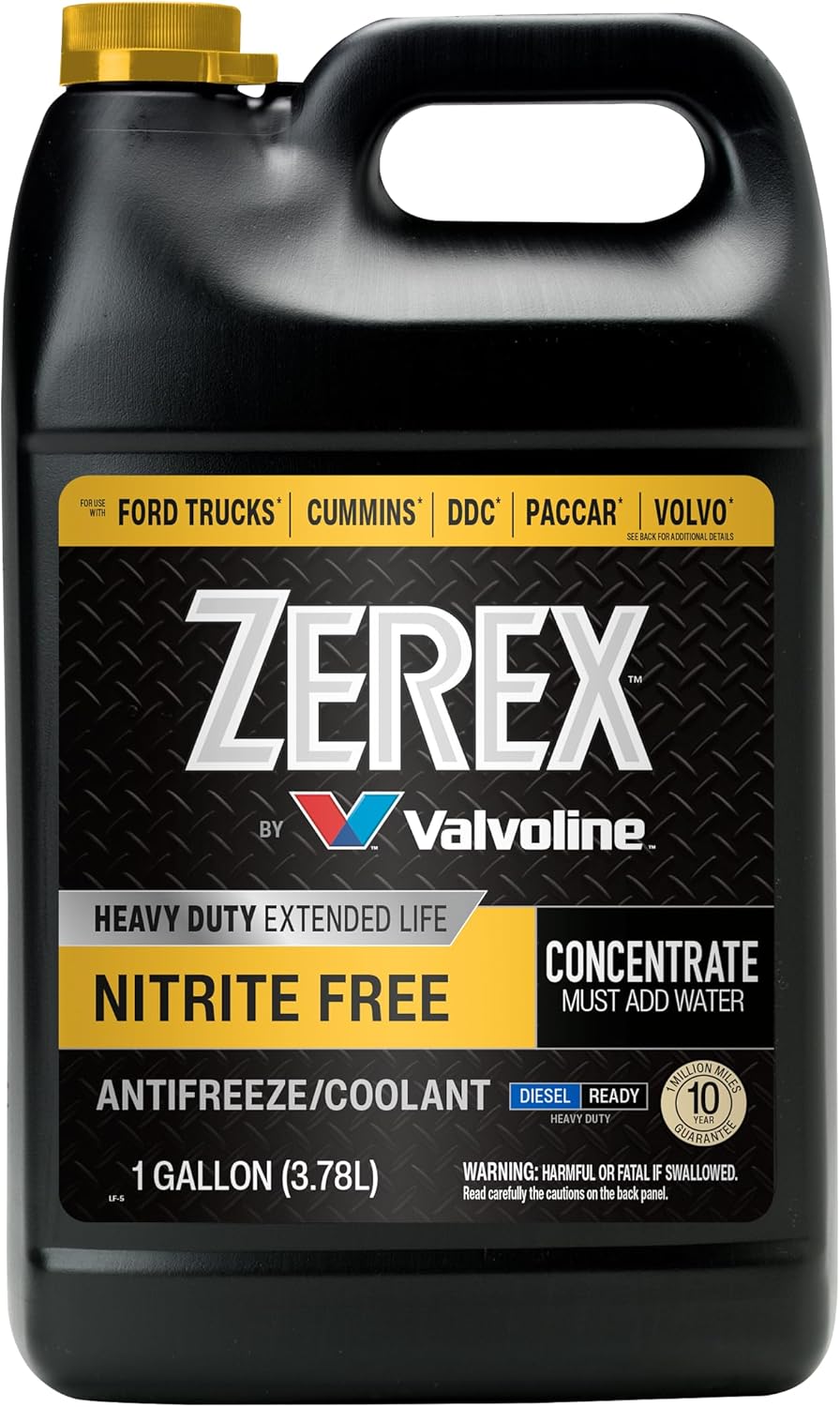
| Formulation | Nitrite-free OAT concentrate |
|---|---|
| Mix ratio | 50/50 with water |
| Service life claim | Up to 10 years or 1,000,000 miles |
| Free of | Silicate, amine, and borate |
Zerex Heavy Duty Nitrite Free Extended Life is a concentrated OAT coolant designed for heavy-duty engines and systems that call for a nitrite-free formulation. It is typically mixed 50/50 with clean tap or demineralized water and used as a long-life service fill for radiators in trucks. Notable features include organic acid technology to resist rust and hard-water scale, and a silicate, amine, and borate-free chemistry aimed at protecting cylinder liners, water pumps, and other cooling system metals from pitting and corrosion. The product is advertised to last up to 10 years or 1,000,000 miles when used per label instructions, which reduces the need for frequent coolant changes on long-haul or fleet Silverado 2500 HD duty cycles. Limitations to keep in mind are that this is a concentrate requiring proper dilution and that it is specifically nitrite-free, so it must match the Silverado 2500 HD engine cooling spec or OEM requirement before use. Follow vehicle manufacturer guidance when switching coolant chemistries.
Best for: Drivers and fleet technicians who maintain Chevrolet Silverado 2500 HD trucks and prioritize a long‑life, nitrite‑free coolant that protects heavy‑duty cooling system internals under demanding duty cycles.
Less Ideal for: Owners who cannot confirm their Silverado 2500 HD specifies a nitrite‑free OAT coolant or who prefer ready‑to‑use prediluted products should consider other options.
- Formulated for heavy-duty diesel engines and compatible with many truck cooling systems
- Organic acid technology helps prevent rust, cavitation, and hard-water scale deposits
- Silicate, amine, and borate-free chemistry reduces risk of pitting on cylinder liners and water pumps
- Long service life claim reduces frequency of coolant changes for heavy-duty use
- Requires correct 50/50 dilution and adherence to vehicle coolant specifications before use
Verdict: Recommended for heavy‑duty cooling systems or when a nitrite‑free, longer‑lasting formulation is required to reduce corrosion in demanding use.
7. PEAK Global Lifetime Concentrate Antifreeze and Coolant (1 gal)
Best Multi‑Vehicle Universal Coolant

| Form | Concentrate |
|---|---|
| Technology | POAT (phosphate-enhanced organic acid) |
| Compatibility claim | All American, Asian, and European automobiles |
| Volume | 1 gal |
The PEAK Global Lifetime Concentrate is a universal coolant concentrate intended as a do-it-yourself solution for topping off or refilling a Silverado 2500 HD cooling system after a proper flush. Its POAT corrosion inhibitor package is designed to protect aluminum and other cooling-system metals and is free of silicate, borate, nitrite and amines, which helps reduce risk of incompatible chemistry when mixing with many factory coolants. Because it is a concentrate you control the dilution, and the amber color is formulated not to drastically change the existing coolant color when added. The manufacturer claims lifetime protection when used with a complete flush and maintained correctly, which appeals to owners looking for a long-term corrosion inhibitor. Limitations: as a broad-spectrum formula it is not a vehicle-specific OEM replacement and you should confirm your Silverado 2500 HD’s factory coolant requirements before switching, and concentrated product requires proper mixing before use.
Best for: Buyers who want a single, broadly compatible coolant to refill or top off a Silverado 2500 HD after a proper flush and who prioritize long-term corrosion protection over strict factory-matched chemistry.
Less Ideal for: Owners who need a coolant that exactly matches a specific factory-prescribed formulation, or technicians who prefer OEM-labeled fluids for warranty or fleet-standard use.
- Formulated to protect aluminum and common cooling-system metals with POAT corrosion inhibitors.
- Free of silicate, borate, nitrite and amines to reduce incompatibility risks with many factory coolants.
- Amber concentrate safe for top-offs without dramatically changing system color.
- Available as a concentrate so you can mix to the exact 50/50 ratio required by the system.
- Marketed for broad compatibility across American, Asian, and European vehicles.
- Not a vehicle-specific factory-equivalent formula so you must verify compatibility with Chevrolet Silverado 2500 HD service specs before use.
Verdict: Choose a universal, multi‑vehicle coolant when you need one product that’s marketed for broad compatibility across different engines and cooling systems.
Choosing the Right Chevrolet Silverado 2500 HD Coolant: Key Factors to Consider
Corrosion Inhibitor Chemistry
Different coolants use different inhibitor packages to protect metal components from rust and electrochemical corrosion. For a Silverado 2500 HD with aluminum radiators and mixed-metal components, the chemistry must protect aluminum, copper, iron, and soldered joints. Choosing the correct inhibitor type helps prevent localized pitting and galvanic corrosion that can cause radiator leaks or heater core failures.
Longer-life inhibitors may reduce the frequency of full coolant changes, but they must still be compatible with seals and hoses. When assessing options, look for explicit statements about mixed-metal protection and any laboratory or industry test references that show how the formula performs over time.
Freeze and Boil-Over Protection
Effective freeze protection prevents ice expansion damage in cold climates, while high boil-over resistance supports heavy-duty cooling during towing or extended idling. Coolant concentration, typically a 50/50 mix with water, determines freeze and boiling points. For Silverado 2500 HD owners who tow or operate under load, sustained high coolant temperatures can stress the system, so thermal stability is crucial.
Consider the climate you drive in and the vehicle's duty cycle. Some formulas offer better high-temperature stability or higher dry-boiling points, while others focus on low-temperature protection. Verify the recommended dilution ratios and lab test data when available.
Compatibility With Seals and Hoses
Some coolant chemistries can accelerate the degradation of rubber seals, gaskets, and plastic components if they are not formulated with compatible inhibitors. The Silverado 2500 HD uses various elastomers in hoses and heater-core connections that are sensitive to pH and additive concentration. Selecting a coolant that states compatibility with common automotive elastomers reduces the chance of leaks developing between service intervals.
If you are switching coolant types, a thorough flush is often advised to avoid mixing incompatible inhibitor packages. Review manufacturer guidance on seal compatibility and any recommended flushing procedures before changing coolant type.
Service Interval and Maintenance Impact
Long-life coolants can lower maintenance frequency by extending drain intervals, but they may also require specific testing or additive top-ups over time. Understanding the expected service life helps you plan coolant flushes alongside other maintenance tasks on a Silverado 2500 HD that sees heavy use. Some formulas recommend periodic condition checks rather than calendar-based changes.
Factor in whether you prefer scheduled full replacements or condition-based maintenance. Also consider how easy the coolant is to test with standard test strips or electronic testers and whether the manufacturer provides clear guidance for service intervals.
Heat Transfer and Thermal Stability
Coolant contributes to overall heat transfer from the engine to the radiator. Additives and glycol content affect thermal conductivity and boiling behavior under load. For a heavy-duty truck like the Silverado 2500 HD, the coolant must maintain consistent thermal performance during steep climbs, towing, or prolonged high-rpm operation.
While most modern formulations are adequate for normal driving, severe-duty use benefits from coolants that maintain low viscosity and resist vapor formation at elevated temperatures. Evaluate technical specifications related to thermal stability and any field data relevant to heavy-load operation.
Compatibility With Factory Specifications
Many vehicle manufacturers publish recommended coolant types or specifications that preserve warranty coverage and system longevity. For the Silverado 2500 HD, matching or meeting the factory-recommended specification helps ensure the coolant interacts correctly with OEM materials and recommended service procedures.
If you choose an aftermarket formula, check that it meets or exceeds the stated specifications for this truck. Avoid products that lack clear claims of compatibility with the vehicle's recommended coolant types.
When to Flush and Replace Your Coolant
The timing for a coolant flush depends on the formula used and the truck's duty cycle. Heavy towing, frequent short trips, or exposure to extreme temperatures can shorten coolant life. Many long-life coolants specify multi-year or multi-mile intervals, but those guidelines assume a clean system and correct concentration.
Signs that indicate a flush is needed include rusty or discolored fluid, a sweet smell in the engine bay, overheating under load, or evidence of localized corrosion in accessible components. Periodic testing with a refractometer or test strips can help determine concentration and inhibitor condition before committing to a full replacement.
- Check coolant color and clarity during routine inspections
- Use a 50/50 mix unless the manufacturer specifies otherwise
- Perform a pressure test if you suspect leaks or head gasket issues
- Flush the system thoroughly when changing inhibitor chemistries
Mix Ratios and Water Quality
The recommended mix ratio balances freeze protection with heat transfer efficiency. A 50/50 mix is a common baseline that provides freeze and boil-over protection suitable for most climates and workloads. Increasing glycol concentration improves freeze protection but can slightly reduce heat transfer efficiency.
Water quality matters. Hard water can introduce minerals that encourage scaling inside the radiator and engine passages. When possible, use distilled or deionized water for mixing concentrated coolants to limit mineral deposits and extend radiator life.
- 50/50 mix for balanced protection
- Use distilled water to avoid scaling
- Adjust mix for extreme climates according to specs
- Never top up with plain water long-term
How Coolant Chemistry Affects Warranty and Component Life
Using a coolant that does not meet the vehicle manufacturer's specification can sometimes affect component warranties. While this is less common for routine maintenance items, it is important to select a coolant that is clearly compatible with the Silverado 2500 HD's materials and published recommendations.
Beyond warranty considerations, the right chemistry preserves the heater core, water pump, thermostat, and radiator. Poorly matched coolants can accelerate seal swelling or gasket degradation, leading to leaks and premature component replacement.
- Verify compatibility with factory specifications
- Consider manufacturer service interval recommendations
- Be cautious when switching inhibitor types without flushing
Winter and Summer Driving Considerations
If you operate the Silverado 2500 HD in very cold climates, ensure your chosen coolant mix protects against freeze damage at the lowest expected temperatures. In hot or mountainous regions where towing is frequent, prioritize formulas with strong boil-over resistance and vapor suppression.
Some owners adopt a seasonal check routine to confirm concentration and system integrity before heavy-use seasons. This simple approach reduces the chance of weather-related coolant failures.
- Test concentration before winter and summer seasons
- Replace or top up to maintain proper freeze protection
- Inspect hoses and clamps for age-related deterioration
Top-Up Practices and Interim Maintenance
Topping up between full service intervals is common but should be done with care. Always match the coolant chemistry and concentration when adding fluid. Mixing incompatible inhibitor packages can reduce corrosion protection or cause precipitates to form.
Keep a small supply of the recommended concentrate or pre-mixed solution on hand if you frequently drive in conditions that cause periodic coolant loss. Use proper safety procedures to avoid burns and dispose of old coolant responsibly.
- Match chemistry and concentration when topping up
- Avoid mixing different inhibitor types without flushing
- Follow proper disposal rules for drained coolant
How We Chose the Best Chevrolet Silverado 2500 HD Coolant
We selected candidates based on attributes that directly affect longevity and reliability in heavy-duty use for the Chevrolet Silverado 2500 HD. Primary evaluation criteria included corrosion inhibition performance for mixed-metal cooling systems, extended service life and recommended drain intervals, freeze and boil-over protection across common operating temperatures, and compatibility with gaskets, hoses, and radiator materials found in this truck.We also considered manufacturer-recommended specifications and industry-standard approvals relevant to heavy-duty gasoline and diesel engines, plus ease of use for common maintenance tasks like coolant flushes and top-ups. Products that relied on unproven inhibitor chemistries or lacked clear compatibility statements for aluminum radiators were excluded. We did not include products intended only for passenger cars or short-life formulas unsuited to towing and high-load operation. The final picks balance corrosion protection, thermal stability, and maintenance convenience for Silverado 2500 HD owners.
Our full evaluation process is outlined in our review methodology.
FAQ
How often should I change the coolant in my Silverado 2500 HD?
It depends on the coolant type and your usage. Long-life formulas often recommend multiple years or tens of thousands of miles between changes, while older short-life types need more frequent service. Heavy towing or severe duty may require earlier replacement.
Can I mix different coolant brands in my truck?
Mixing is sometimes acceptable if the chemistries are the same, but mixing different inhibitor types can reduce protection or cause deposits. When in doubt, perform a full system flush and refill with a single, compatible formula.
What is the best mix ratio for towing with a Silverado 2500 HD?
A 50/50 mix of coolant and water is a common recommendation for balanced freeze protection and heat transfer. For extreme climates, adjust the ratio according to the coolant maker's guidance, but do not exceed recommended glycol concentrations.
How can I test if my coolant is still good?
Use test strips or a refractometer to check freeze point and glycol concentration. Visual checks for discoloration, rust particles, or oil contamination are also useful indicators. If tests show low inhibitor levels or contamination, plan a flush and refill.
Will switching to a long-life coolant improve system longevity?
Long-life coolants can reduce the frequency of changes and often provide robust corrosion protection, which may help system longevity. However, compatibility with seals and existing inhibitors is essential, and a flush may be necessary when switching types.
Is distilled water necessary when mixing coolant concentrate?
Using distilled or deionized water is recommended because it limits mineral deposits and scaling. Hard tap water can introduce minerals that reduce cooling efficiency and promote corrosion inside the radiator and engine passages.
Final Verdict
For a Chevrolet Silverado 2500 HD, prioritize coolants that explicitly protect mixed metals, offer strong thermal stability under load, and align with factory specifications. Balancing corrosion inhibition, freeze and boil-over protection, and convenient service intervals will reduce the risk of cooling-system failures during towing and heavy use. When in doubt, match the chemistry to the vehicle's requirements and follow proper flushing and top-up practices to maintain reliable cooling performance.
