

Note: This article contains affiliate links. If you click on these links and make a purchase, I may earn a small commission at no extra cost to you. This helps support my research and content. Read my full affiliate disclosure here.
If you own a 2001-2005 Honda Civic (ES, EM, and EP), choosing the right coolant matters for engine longevity, corrosion control, and reliable cooling under everyday driving. The Civic s cooling system uses specific corrosion inhibitors and recommended fluid properties to prevent aluminum corrosion, protect the water pump, and stabilize temperatures during highway and stop-and-go use.This guide shortlists seven top coolant options suitable for the 2001-2005 Honda Civic and explains the evaluation criteria used, including thermal performance and compatibility with Honda materials. Read on to understand maintenance intervals, mixing guidance, and signs that your Civic needs a coolant service before selecting the right product for your car.
Looking for other parts? See all Honda Civic parts & accessories.
Top Picks at a Glance
| Best Overall Coolant A well-rounded, reliable coolant that balances protection and compatibility | Honda Genuine Extended Life Antifreeze/Coolant Type 2, 50/50 Pre-Diluted, 1 Gallon |  |
| Best Budget Coolant An affordable, ready-to-use formula that protects on a tight budget | Prestone MAX Asian Green 50/50 Antifreeze Coolant (Premixed) |  |
| Best OEM Honda Coolant Factory-formulated, Type 2 coolant matched to manufacturer specifications | Honda Long Life Antifreeze/Coolant Type PZ (Pre-Diluted 50/50) | 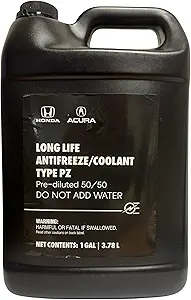 |
| Best Ready-to-Use Coolant Pre-mixed 50/50 antifreeze that’s ready to pour with no mixing | Zerex Asian Vehicle Green 50/50 Ready-to-Use Antifreeze/Coolant (1 Gallon) |  |
| Best Concentrate Coolant Undiluted coolant concentrate for installers who prefer to mix to spec | PEAK OET Extended Life Green Concentrate Antifreeze/Coolant (1 gal) |  |
| Best Long-Life Coolant Extended-life formulas designed to last multiple years or miles | PEAK OET Extended Life Blue 50/50 Prediluted Antifreeze/Coolant for Asian Vehicles, 1 Gal. |  |
| Best Universal/All-Vehicle Coolant A broadly compatible formula intended to work in many makes and models | Valvoline Multi-Vehicle 50/50 Ready-to-Use Antifreeze/Coolant, 1 Gallon |  |
1. Honda Genuine Extended Life Antifreeze/Coolant Type 2, 50/50 Pre-Diluted, 1 Gallon
Best Overall Coolant

| Brand | Honda |
|---|---|
| Model | Type 2 Antifreeze/Coolant |
| Pre-diluted | 50/50 ready to use |
| Volume | 1 gallon |
| Service interval | Up to 5 years or 60,000 miles |
This Honda genuine Type 2 coolant is a ready-to-use 50/50 ethylene glycol formula that matches the factory fill for Hondas requiring Type 2 coolant. It is intended for routine cooling system service and offers corrosion and rust protection for both metal and non-metal components, plus freeze protection and boil-over resistance for year-round use. The product ships in a one-gallon container and is formulated to provide an extended service interval of up to five years or roughly 60,000 miles under normal conditions, which reduces the frequency of fluid changes. Because it is the factory-recommended fluid, it simplifies maintenance decisions and helps avoid compatibility worries that can arise when mixing different coolant chemistries. The coolant contains a bittering agent to deter ingestion and uses established ethylene glycol technology, so care is needed to avoid spills and keep it away from pets and children. This single-gallon size is suitable for topping off or a single-system refill for many compact Hondas but may be insufficient for full flushes on larger cooling systems without purchasing additional containers.
Best for: DIYers who want a worry-free, factory-matching coolant for routine maintenance on Honda vehicles and value long drain intervals and straightforward compatibility with Honda systems.
Less Ideal for: Buyers who need large-volume fleet servicing or who prefer propylene glycol or universal OAT blends for cross-brand use should consider higher-capacity packaging or an alternative fluid type.
- Factory-approved formula matched to Honda Type 2 specification
- Pre-mixed 50/50 ready to use with no dilution required
- Long service life rated up to 5 years or about 60,000 miles
- Protects both metal and non-metal cooling system components
- Contains ethylene glycol and a bittering agent so it is toxic and must be handled and disposed of carefully
Verdict: The top pick for most DIY mechanics who want dependable corrosion, freeze and boil protection with broad vehicle compatibility and long service life.
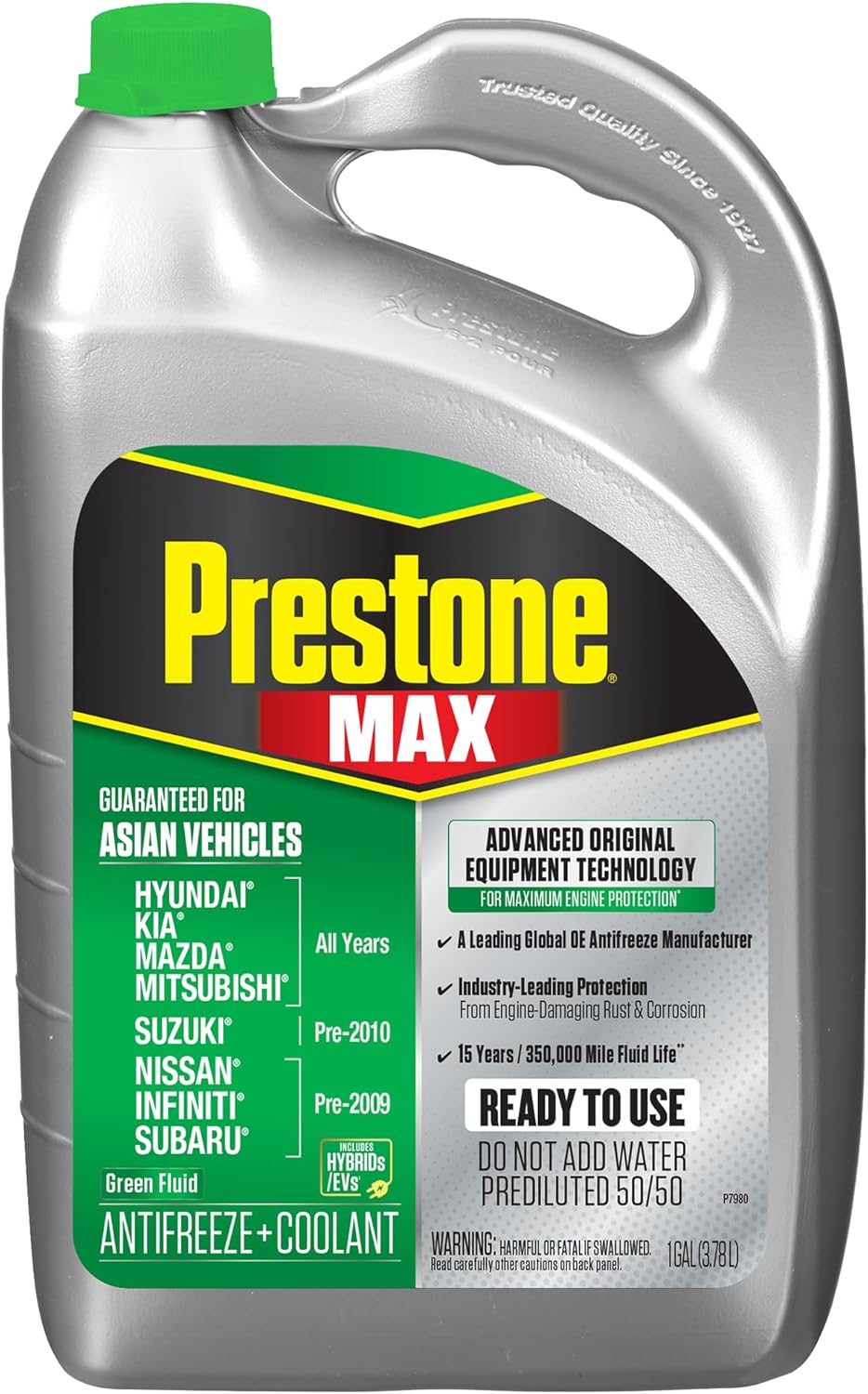
2. Prestone MAX Asian Green 50/50 Antifreeze Coolant (Premixed)
Best Budget Coolant
| Mixture | 50/50 premixed |
|---|---|
| Technology | Prestone CorGuard |
| Formulation type | Asian green antifreeze |
| Contains | Bitterant |
Prestone MAX Asian Green 50/50 is a ready-to-use premixed coolant aimed at delivering reliable freeze and boil protection without mixing. It is formulated with Prestone CorGuard technology and bitterant, so you pour straight into the coolant reservoir when cold and get both corrosion inhibition and year-round temperature control. Typical use is topping off or replacing the cooling system fluid during service or after a drain and fill; the premix simplifies DIY jobs and reduces the chance of incorrect dilution. Practical benefits include broad temperature protection for everyday driving and compatibility with vehicles that call for green Asian-style coolant chemistry. The main limitation is that it is a budget-oriented, conventional coolant rather than a long-life specialty formula, so it may require more frequent changes than extended-life options and may not match every factory-specified coolant for some models. It performs well as an affordable, no-fuss replacement for routine maintenance.
Best for: Buyers who want a low-cost, premixed coolant that is easy to use for regular maintenance on compatible cars and prefer a straightforward replacement over specialty long-life fluids.
Less Ideal for: Those seeking ultra-long service intervals or a manufacturer-specified specialty coolant for warranty-sensitive repairs should consider OEM or extended-life formulas instead.
- Premixed 50/50 ready to use so no measuring or distilled water needed.
- Includes corrosion inhibitors to protect cooling system metal components.
- Designed for broad temperature protection across hot and cold climates.
- Contains bitterant to discourage accidental ingestion.
- Conventional formula rather than extended-life, so service intervals may be shorter than specialty long-life coolants.
- Green Asian-type chemistry may not match every factory-specified coolant for some vehicles.
Verdict: Choose this slot if you need a low-cost, pre-diluted antifreeze that delivers basic freeze/boil protection and corrosion inhibitors without a premium price.
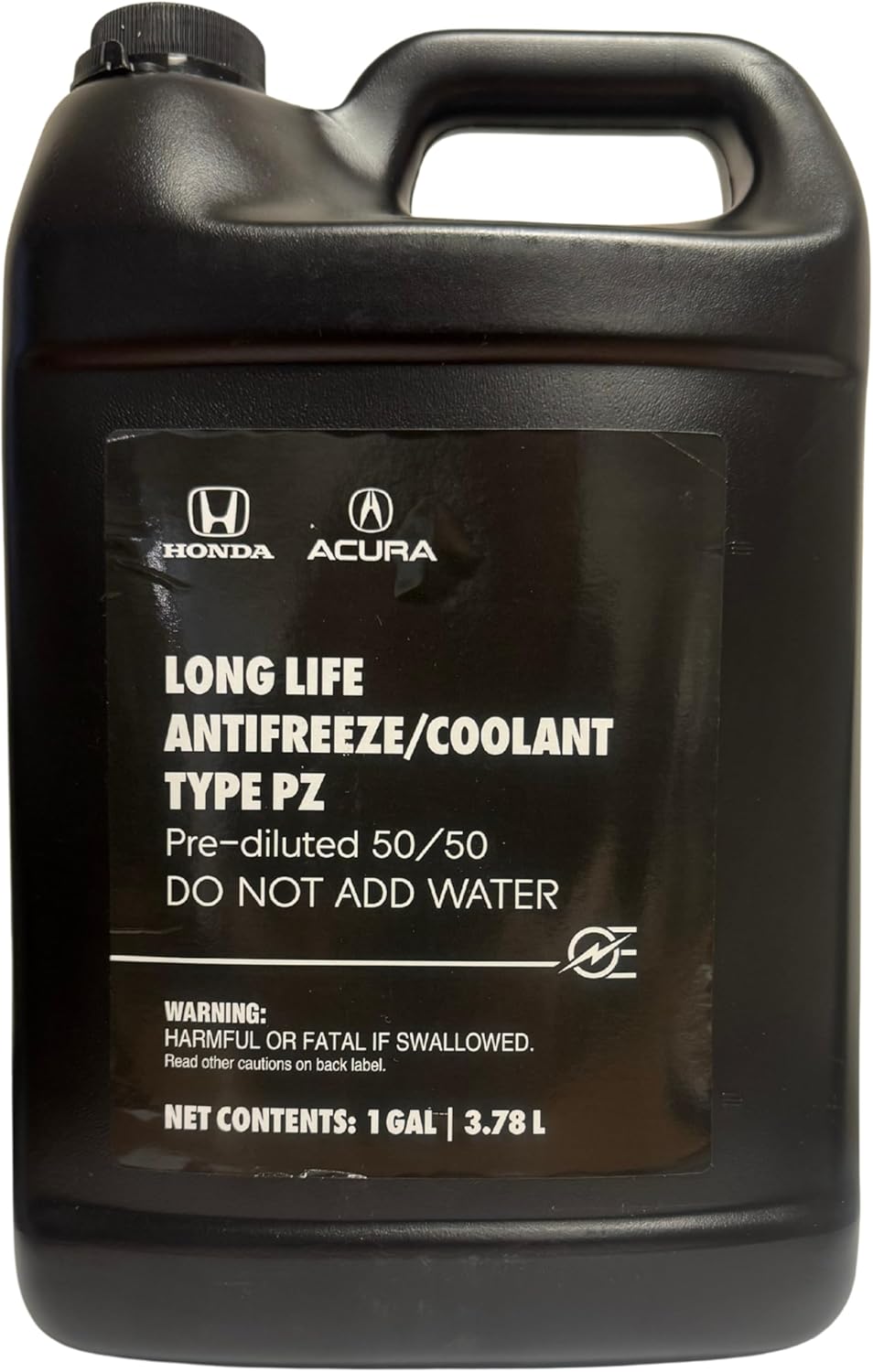
3. Honda Long Life Antifreeze/Coolant Type PZ (Pre-Diluted 50/50)
Best OEM Honda Coolant
| Pre-diluted | 50/50 ready-to-use |
|---|---|
| Freeze protection | -34°F |
| Boil-over protection | 265°F at 15 PSI |
| Standards | Meets ASTM D3306 and ASTM D4985 |
This Honda Long Life Antifreeze/Coolant Type PZ is a ready-to-use 50/50 coolant engineered to match Honda factory chemistry and protect cooling system components over extended service intervals. It is typically poured straight into the radiator or expansion tank with no additional water required, which reduces mixing errors during maintenance. The formula emphasizes corrosion inhibitors and heat transfer so it offers freeze protection to -34°F and boil-over protection to 265°F at 15 PSI, and it meets ASTM standards for automotive and heavy-duty diesel service. Practical benefits include direct compatibility with Honda systems, simplified installation, and long-term protection that helps prevent rust, pitting, and component degradation. The main limitation is that it is a vehicle-specific factory formula, so it should be used to maintain factory chemistry rather than mixed with unrelated aftermarket coolants or noncompatible chemistries. Always consult the service manual for recommended change intervals and capacity when servicing older Civic models from 2001 to 2005.
Best for: Buyers who prioritize maintaining factory chemistry and long-term compatibility with Honda cooling systems, and who want a plug-and-play coolant with minimal preparation.
Less Ideal for: Those looking for a universal or aftermarket performance coolant for modified engines or mixed-brand coolant systems should consider alternatives designed for those applications.
- Factory-formulated to match Honda chemistry for optimal compatibility
- Ready-to-use 50/50 mix eliminates need for on-site dilution
- Long-life corrosion inhibitors protect cooling system components
- Provides wide temperature protection: freeze to -34°F and boil-over to 265°F
- Meets or exceeds ASTM performance requirements
- Designed for factory chemistry so not suitable to blend with unrelated aftermarket coolants
Verdict: Pick this when you want the exact factory-recommended formula to match OEM chemistry and service intervals for optimal compatibility with original components.
4. Zerex Asian Vehicle Green 50/50 Ready-to-Use Antifreeze/Coolant (1 Gallon)
Best Ready-to-Use Coolant

| Brand | Zerex by Valvoline |
|---|---|
| Formulation | 50/50 ready-to-use, HOAT with phosphate |
| Volume | 1 gallon |
| Free of | Silicates and borates |
Zerex Asian Vehicle Green is a 50/50 ready-to-use antifreeze formulated with Hybrid Organic Acid Technology and a phosphate additive to protect aluminum and other cooling system metals. It is intended for topping off or full system fills in vehicles that specify a green, silicate- and borate-free formula. Because it arrives pre-diluted you can pour it straight into the radiator or expansion tank without measuring or adding distilled water, which simplifies DIY coolant service and reduces mixing mistakes. The formulation advertises protection against corrosion, scale, leaks, freezing and boiling and is compatible with the factory cooling-system materials listed by many Asian automakers. The main limitation is that a pre-mixed product makes achieving an exact post-flush concentration harder when residual water remains after a flush, so technicians who prefer to fine-tune coolant strength may prefer concentrated products. Also the color and formulation mean it is intended for vehicles specifying this green HOAT chemistry rather than every coolant spec.
Best for: DIYers who want a simple, no-mix coolant solution they can pour straight into the cooling system and get manufacturer-style protection without fuss.
Less Ideal for: Those who need to precisely control coolant concentration after a flush or vehicles that require a different coolant chemistry should look elsewhere.
- Comes pre-mixed 50/50 so it can be added directly without measuring or buying distilled water.
- HOAT formula with phosphate additive protects aluminum and other metals from corrosion and scale.
- Silicate- and borate-free formulation matches many Asian manufacturers’ coolant requirements.
- Ready-to-use gallon size is practical for topping off or performing a single full-system fill.
- Pre-mixed solution can leave final concentration slightly low after a system flush because residual water is hard to remove.
- Only suitable for vehicles that call for the green HOAT-type chemistry, not universal for all coolant specifications.
Verdict: Ideal for DIYers who want the convenience of a pre-diluted coolant that’s safe to add straight to the system without measuring or distilled water.
5. PEAK OET Extended Life Green Concentrate Antifreeze/Coolant (1 gal)
Best Concentrate Coolant

| Volume | 1 gallon |
|---|---|
| Formula type | Concentrate POAT |
| Vehicle focus | Asian vehicles (listed manufacturers) |
| Service life claim | Up to 400,000 miles or 15 years (when used with flush and fill) |
PEAK OET Extended Life Green Concentrate is a phosphate-enhanced organic acid technology coolant packaged as a 1 gallon concentrate for mixing prior to use. It is intended for Asian vehicles and is designed to protect cooling-system metals from rust and corrosion while providing long service life when installed as part of a full flush and fill. As a concentrate you can blend it to a 50/50 mix for typical freeze and boil protection or adjust concentration for top-offs and season-specific needs. The formula is marketed for extended-life service and PEAK cites long-term protection when used correctly. Practical benefits include flexibility in dilution, compatibility with other extended-life coolants, and a concentrate format that reduces plastic waste compared with multiple premixed bottles. Limitations are that this is the green POAT formula tailored toward Asian specs, so confirm your Civic's coolant type before using and follow a proper flush and fill; handling concentrate requires careful measuring and mixing unlike a ready-to-use 50/50 bottle.
Best for: Buyers who want a concentrate they can blend and store for top-offs or complete flushes, and who prioritize matching an Asian-spec POAT coolant for long-term corrosion protection.
Less Ideal for: Drivers seeking a ready-to-use 50/50 premix or those whose 2001–2005 Honda Civic explicitly calls for a different coolant chemistry should consider a premixed or model-specific alternative.
- Concentrated formula lets you mix exact dilution for freeze and boil protection.
- Designed to prevent rust and corrosion in cooling systems for long-term protection.
- Marketed for Asian vehicle specifications, improving fit for compatible engines.
- Compatible with other extended-life antifreeze/coolants for easier top-offs.
- Color and POAT chemistry mean it may not be appropriate if your Civic requires a different coolant specification.
Verdict: Use this pick if you prefer a concentrated formula you can blend to the exact freeze/boil protection ratio or keep on hand for multiple top-ups.
6. PEAK OET Extended Life Blue 50/50 Prediluted Antifreeze/Coolant for Asian Vehicles, 1 Gal.
Best Long-Life Coolant

| Volume | 1 gallon |
|---|---|
| Dilution | 50/50 prediluted |
| Compatibility note | Formulated for Asian vehicles (POAT, blue) |
This PEAK OET extended-life coolant is a ready-to-use, 50/50 prediluted blue formula designed for Asian vehicles and intended to lengthen service intervals. You pour it straight into the cooling system for quick top-offs or fill-and-flush jobs without measuring concentrate. The formula is phosphate-enhanced organic acid technology aimed at preventing rust and corrosion across cooling system components and PEAK guarantees up to 150,000 miles or five years of service life when used with a full flush and fill. In practice it keeps engine temperatures steady and is convenient for routine maintenance because it removes the need to mix water. Limitations: it is targeted at Asian OEM coolant specs so you should verify compatibility with your Civic's service manual before use, and because it is pre-diluted it is not suitable if your system requires a concentrate for specific mixing ratios or specialty formulations.
Best for: Buyers who prioritize longer drain intervals and low-maintenance cooling system care for compatible Asian-engine vehicles and want a ready-to-use coolant that avoids mixing on the driveway.
Less Ideal for: Anyone whose vehicle requires a different coolant chemistry or a custom concentrate mix should avoid this and choose the exact factory-specified formula or a concentrate option instead.
- Prediluted 50/50 mix for easy topping off and faster installations
- Extended-life formulation with claimed protection up to 150,000 miles or 5 years when used after a full flush
- Formulated for many Asian vehicles with phosphate-enhanced OAT chemistry to protect cooling system components
- Targeted to Asian vehicle coolant specifications so you must confirm compatibility with the vehicle manufacturer’s requirement
Verdict: Choose an extended-life coolant when you want longer drain intervals and durable corrosion protection for reduced maintenance frequency.
7. Valvoline Multi-Vehicle 50/50 Ready-to-Use Antifreeze/Coolant, 1 Gallon
Best Universal/All-Vehicle Coolant

| Size | 1 Gallon |
|---|---|
| Flash Point | 250 Degrees Fahrenheit |
| Automotive Fit Type | Universal Fit |
| Model | Multi-Vehicle |
Valvoline Multi-Vehicle 50/50 is a ready-to-use antifreeze/coolant designed as a universal solution for topping off or refilling a Civic coolant system after a flush or repair. It arrives pre-diluted to a 50/50 ratio so you can pour it directly into the radiator or overflow reservoir, which is convenient for quick service and avoids mixing errors. The formula includes Valvoline's Alugard Plus additive to help protect aluminum and other cooling-system metals from corrosion, scaling, and deposits while resisting leaks and harm to hoses and plastics. It also provides freeze protection down to around -34F and boil-over protection to about 265F when mixed 50/50. The practical upside is reliable, factory-replacement-style protection without worrying about matching coolant colors or types. The trade-off is you cannot adjust concentration for extreme climates and some vehicles specify a particular coolant chemistry, so check the 2001–2005 Honda Civic service recommendations before using a universal product.
Best for: Drivers who want a simple, no-mix coolant that protects the cooling system after service or a flush and avoids the hassle of matching coolant colors or chemistries.
Less Ideal for: Owners who need a manufacturer-specific coolant chemistry or who want to change freeze/boil protection by custom-mixing concentrate for extreme climate conditions.
- Pre-mixed 50/50 ready to pour for faster top-offs and refills
- Alugard Plus additive formulated for compatibility with various ethylene glycol coolants and metals including aluminum
- Protects against corrosion, scaling, freezing and boiling comparable to industry standards
- Suitable for routine maintenance after a coolant flush or to top off a cooling system without color-matching
- Pre-diluted formula prevents customizing concentration for very cold or hot climates
Verdict: Select a universal coolant if you need a single product that’s marketed to protect different metals and work across varied cooling-system chemistries.
Choosing the Right 2001-2005 Honda Civic Coolant: Key Factors to Consider
Chemical Compatibility With Honda Materials
The Civic s engine, radiator, heater core, and water pump include aluminum, brass, and various rubbers. Coolant chemistry determines whether those metals will be protected or exposed to accelerated corrosion. Choosing a coolant whose inhibitor package is compatible with aluminum is crucial to prevent pitting in the cylinder head and radiator cores.
Look for formulations designed for mixed-metal systems and avoid fluids that rely solely on high silicate content without appropriate organic inhibitors. Over time, incompatible chemistry can cause gasket leaks, localized corrosion, and reduced heat transfer in the radiator.
Inhibitor Longevity and Service Interval
Not all coolants provide the same lifespan for their corrosion inhibitors. Long life coolants are formulated to maintain protective films on metal surfaces for longer intervals, meaning fewer coolant flushes and lower maintenance frequency. For a 2001-2005 Civic, which may already have some age-related wear, selecting a coolant with proven inhibitor longevity reduces the risk of internal corrosion between services.
Consider how often you want to flush the system and whether you prefer a conventional 2-year service interval or an extended 5-year/100,000-mile style product. Be aware that longer intervals work best when the cooling system is clean and free of scale or existing corrosion.
Freeze and Boilover Protection at Recommended Concentrations
Coolant effectiveness depends on concentration. Manufacturers specify freeze and boilover protection levels at typical mixes such as 50/50 with water. For owners in colder climates this affects winter starting reliability, and for hot climates or towing it affects boilover resistance.
Choose a coolant that achieves safe freeze points and a raised boiling point at the mix you will use, and follow the vehicle s owner guidance for concentration. Some long-life formulas require specific distilled water mixes to reach their rated performance.
Compatibility With Existing Coolant During Top-Ups
Many owners add coolant between full flushes rather than replacing the entire system. Mixing incompatible coolant chemistries can neutralize inhibitors and reduce protection. That is especially important for older Civics where the current fluid type may be unknown.
If you cannot confirm the existing coolant chemistry, choose a product that is backward-compatible or be prepared to perform a full flush to switch chemistries safely. Topping up with a different inhibitor type can accelerate corrosion rather than prevent it.
Impact on Rubber Hoses and Seals
Coolants interact with rubber hoses, O-rings, and the water pump seal. Some formulations preserve elastomer flexibility better than others, which matters on a Civic with original hoses or seals approaching service life. If a coolant causes rubber hardening or swelling it can lead to leaks at hose ends or thermostat housings.
Select coolants that state compatibility with common elastomers used in automotive cooling systems or choose those recommended for Honda vehicles to reduce the risk of premature hose or seal failure.
Residue, Sludge Risk, and System Cleanliness
Older cooling systems can have deposits, scale, or sludge. A coolant that leaves heavy deposits or accelerates sludge formation will reduce heat transfer and block small radiator passages or heater cores. Conversely, some formulations include detergents or cleaners that help remove light residue during a change.
When servicing a 2001-2005 Civic, assess the system condition. If residue is present, plan a proper flush and choose a coolant designed to either tolerate residual contamination without gelling or to aid in gentle cleaning without compromising inhibitors.
Why Honda-Specific Recommendations Matter
Honda published coolant specifications are tailored to the alloy mix and gasket materials used in Civic engines of this era. Following a coolant that matches those specifications reduces the risk of electrochemical corrosion in the aluminum head and radiator, and helps preserve water pump and thermostat function over time.
- Match inhibitor type to the vehicle s materials to prevent electrolytic corrosion
- Use recommended concentrations to meet Honda s freeze and boilover targets
When to Perform a Coolant Flush on a 2001-2005 Civic
Inspect coolant color, smell, and level every service interval. Typical signs that a flush is due include dark or muddy coolant color, visible particles, recurring overheating, or a radiator cap that does not hold pressure. For Civics in regular use, plan a full flush and refill if the coolant condition is uncertain or older than the recommended interval.
- Look for flaking, rust-like particles in the overflow bottle
- Check the radiator cap and expansion tank for pressure-related leaks
Mixing Ratios and Practical Advice
Most modern coolants are rated at a 50/50 mix with distilled water for balanced freeze and boil protection. Follow the label guidance and the Civic owner manual where specified. Using tap water can introduce minerals that promote scale; distilled water is recommended for best longevity.
If you are switching chemistries, perform a thorough drain and flush to remove as much of the old fluid as possible before filling with the new coolant. Top-up practices between flushes should use the same coolant family to avoid neutralizing inhibitors.
- Use distilled water for final mixing to minimize mineral deposits
- Bleed air from the cooling system after filling to prevent hotspots
Signs a Coolant Is Failing
Watch for overheating, new leaks, white smoke from the exhaust, or coolant loss without visible external leaks. Contaminated coolant can fail to lubricate the water pump and may form abrasive particles that reduce impeller life. If the coolant has a sour or unusual odor or sediment, replace it and inspect cooling system components.
Periodic pressure testing and a visual inspection of hoses and heater core connections will reveal early-seal deterioration often related to coolant breakdown.
- Monitor temperature gauge behavior under load
- Observe coolant reservoir for oil contamination which can indicate head gasket issues
Preparing Your Civic for a Coolant Change
Gather the correct tools, protective gloves, and a proper drain pan. If you plan to use a different coolant chemistry than currently in the system, drain thoroughly and consider a light system flush with plain water or a manufacturer-recommended flushing agent.
Dispose of old coolant according to local regulations. After filling, run the engine to operating temperature and recheck level after a cooling cycle to confirm no air remains and the concentration is correct.
- Record the date and mileage of the coolant change for future maintenance
- Inspect the thermostat and hoses during the service for signs of age
Still looking for the perfect fit?
Select your Honda Civic configuration to see the most relevant Coolants recommendations
How We Chose the Best 2001-2005 Honda Civic Coolant
We focused on technical fit and long-term protection relevant to the 2001-2005 Honda Civic cooling system. Selection prioritized fluids formulated for mixed-metal systems with aluminum engine components and compatible inhibitor packages for Honda-spec head gaskets and water pumps. We evaluated thermal stability under repeated heat cycles and resistance to boil-over and cavitation caused by pump wear.Additional criteria included corrosion protection test results, recommended service intervals or long-life labels, and clarity of mixing instructions. We favored products with clear guidance for concentration, freeze and boilover protection at common coolant mixes, and fluids that minimize residue or sludge risk in older systems.Exclusions: we excluded fluids not compatible with Honda materials, generic automotive mixes lacking published inhibitor specs, and products intended solely for heavy-duty diesel engines. The final list balances compatibility, longevity, and practical maintenance needs for owners of 2001-2005 Civics.
Our full evaluation process is outlined in our review methodology.
FAQ
Can I mix different coolant types in my 2001-2005 Civic?
Mixing different coolant chemistries is risky. Some inhibitor packages react and reduce protection, so matching the coolant family is safer. If the current type is unknown, perform a full drain and flush before switching.
How often should I change the coolant in a 2001-2005 Civic?
Service intervals depend on the coolant type. Conventional formulas may need more frequent changes, while long-life options can go several years. Inspect the fluid condition and follow interval guidance for the chosen product.
Will using a long life coolant cause problems in an older Civic?
Long life coolants can be beneficial, but only if the system is clean and free of heavy deposits. If residue exists, a flush is recommended prior to filling with a long-life formula to avoid trapping particles that reduce heat transfer.
What concentration should I use for winter and summer?
A 50/50 mix of coolant and distilled water provides balanced freeze and boil protection for most climates. In colder climates you might increase concentration for lower freeze points, but follow the coolant label and Civic guidelines to avoid overconcentration.
How do I know if the coolant has damaged my water pump or radiator?
Look for coolant leaks at seals, unusual noises from the water pump bearing, and reduced cooling performance. Visual inspection for pitting or heavy deposits in the radiator and a pressure test can reveal component damage.
Is OEM coolant replacement required for proper protection?
OEM-formulated coolants match the manufacturer s inhibitor specifications, but compatible aftermarket products that meet the same chemical profile can also provide proper protection. The key is matching inhibitor type and concentration.
Final Verdict
Prioritize coolant chemistry and inhibitor longevity when choosing for a 2001-2005 Honda Civic. Start by assessing system cleanliness and whether a full flush is needed before switching fluids. Choose a coolant compatible with aluminum components, maintain the proper mix ratio, and plan service intervals that match the chosen product s inhibitor life.Balancing corrosion protection against the convenience of longer service intervals will help you pick a coolant that protects the engine and cooling components. When in doubt, flush and use a product whose specs match Honda s requirements to reduce corrosion risk and extend component life.
Explore More:
- Check out all Honda Civic parts & accessories
- Explore Fluids & Chemicals
- Browse all Accessories
