

Note: This article contains affiliate links. If you click on these links and make a purchase, I may earn a small commission at no extra cost to you. This helps support my research and content. Read my full affiliate disclosure here.
If you spend weekends camping, touring, or simply hauling groceries, a Subaru Outback portable fridge can make a big difference in convenience and food safety. The right unit fits the Outback cargo area, runs efficiently from the vehicle electrical system, and gives you usable capacity without blocking access to gear.This guide shortlists seven top portable fridges for the Subaru Outback, chosen for real-world fit, power efficiency, temperature range, and durability. Below we explain what matters, how we evaluated options, and practical tips for using a portable fridge in your Outback before the product list.
Looking for other parts? See all Subaru Outback parts & accessories.
Top Picks at a Glance
| Best Overall Portable Fridge The best all-around compressor fridge balancing features, reliability, and price | BougeRV CR22 23‑Quart 12V Portable Compressor Refrigerator |  |
| Best Budget Portable Fridge A low-cost fridge that still keeps food and drinks cold reliably | Wagan EL6214 14L Personal Thermoelectric Cooler/Warmer |  |
| Best Compact Portable Fridge A small, space-saving fridge for limited cargo and quick trips | VEVOR 12V Portable Car Refrigerator 10 QT with App Control |  |
| Best Dual-Zone Portable Fridge Separate compartments for simultaneous fridge and freezer use with independent controls | BODEGA 42-Quart Dual-Zone Portable Car Refrigerator with App Control |  |
| Best High-Capacity Portable Fridge Large internal volume for extended trips and bigger food loads | EUHOMY 53QT Portable 12V Refrigerator with Wheels and Dual Zones |  |
| Best Energy-Efficient Portable Fridge Low-power draw fridge optimized for limited vehicle or battery power | Setpower RF20 12V Portable Refrigerator 21QT with 50H Backup Cooling |  |
| Best Premium Portable Fridge Top-tier build, advanced features, and superior cooling performance | BougeRV CRH20 21QT Portable 12V Refrigerator with 240Wh LiFePO4 Battery | 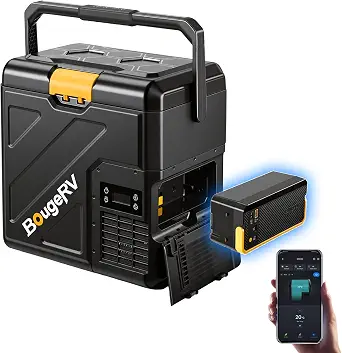 |
1. BougeRV CR22 23‑Quart 12V Portable Compressor Refrigerator
Best Overall Portable Fridge

| Capacity | 23 Quarts |
|---|---|
| Cooling method | Compressor |
| Voltage | 12/24V DC, 110–240V AC |
| Temperature range | -8℉ to 50℉ |
| Noise level | ~45 dB |
The BougeRV CR22 is a compact compressor fridge built to stay cold on the road and in camp. It runs from a vehicle 12/24V outlet or household 110–240V and cools quickly enough to drop from room temperature to near‑freezer levels in under an hour. The chest layout and manual defrost keep the interior simple and efficient, while an electronic lock and adjustable temperature control let you tailor storage for drinks, perishables, or frozen items. Low noise, shock‑proof design, and the ability to operate tilted up to 30 degrees make it practical for travel on rough roads. Integrated battery protection modes prevent deep discharge of a vehicle battery. Downsides are the small 23‑quart capacity, which limits long trips with many passengers, and the lack of app control or a true dual‑zone layout for separating frozen and fresh goods. For everyday use in an Outback this fridge fits under or behind seats and keeps groceries and camping food reliably chilled without complex setup.
Best for: Drivers who want a reliable, no‑fuss portable compressor fridge that fits compact vehicle spaces and keeps food cold on weekend trips and daily grocery runs.
Less Ideal for: Those needing large capacity for extended car camping with several people or users who want app control and a true dual‑zone fridge for separate freezing and chilling.
- Compact 23‑quart size that fits small vehicle storage areas
- Compressor cooling with fast drop in temperature for reliable food safety
- Multiple power options: 12/24V DC and 110–240V AC included
- Low noise and shock‑tolerant design suitable for driving and overnight use
- Three‑level battery protection to avoid draining the vehicle battery
- Limited interior volume compared with larger portable fridges
- Manual defrost and single chamber mean no simultaneous true freezer and fridge zones
Verdict: The best all-around portable fridge that balances cooling performance, build quality, power flexibility, and usable capacity for most on‑the‑road and garage needs.
2. Wagan EL6214 14L Personal Thermoelectric Cooler/Warmer
Best Budget Portable Fridge

| Capacity | 14 liters |
|---|---|
| Cooling method | Thermoelectric |
| Power source | 12V DC (vehicle outlet) |
| Cooling capacity | Up to 36°F below ambient |
| Max heating temp | Up to 140°F |
The Wagan EL6214 is a small, portable 12V cooler/warmer designed for in‑car use on trips or errands. It cools roughly 36°F below ambient and can heat up to about 140°F, so you can keep drinks chilled or warm meals during drives. The unit plugs into a vehicle 12V outlet with a six foot detachable cord and includes a shoulder strap and two external cupholders for easy placement and transport. Inside there is one shelf and enough room for 12 standard cans or a 2L bottle laid flat. Thermoelectric cooling means no refrigerant and quieter operation, but it is less efficient than compressor fridges in very hot conditions and takes time to pre‑chill for best performance. The cooler is compact and stable for use inside an SUV like the Subaru Outback, but it does not include an AC adapter as standard and will not reach freezer temperatures. For buyers seeking straightforward, dependable cooling and a warming option at a low cost, this model covers the basics without premium features.
Best for: Buyers who want an affordable, no‑frills portable fridge to keep drinks and food at reasonable temperatures during drives in a Subaru Outback and on short road trips.
Less Ideal for: Not a good choice for users who need freezer‑level cooling, rapid chill performance, or full home/AC operation without buying extra accessories.
- Dual cooling and warming modes for versatile on‑road use.
- Runs from a 12V vehicle outlet with a long detachable cord for flexible placement.
- Compact 14L capacity fits about 12 cans or a 2L bottle while occupying minimal cabin space.
- Included shoulder strap and external cupholders make carrying and in‑car placement convenient.
- Thermoelectric system uses no refrigerant and operates quietly.
- Thermoelectric cooling is less effective in very hot ambient conditions and cannot freeze items.
- No AC adapter included by default so home use requires buying an extra accessory.
- Cooling performance depends on pre‑chilling items and ambient temperature, so it is not as fast as compressor units.
Verdict: The best low-cost portable fridge for buyers who need dependable cooling and basic features without paying for premium extras.
3. VEVOR 12V Portable Car Refrigerator 10 QT with App Control
Best Compact Portable Fridge

| Capacity | 9 Liters |
|---|---|
| Temperature range | -4°F to 68°F |
| Power | 12/24V DC and 110–240V AC |
| Cooling method | Compressor |
| Defrost system | Automatic |
This VEVOR 10 QT portable compressor refrigerator is a small, travel-ready fridge designed for short trips and tight cargo spaces. It uses a compressor to reach freezing temperatures quickly and offers a broad -4°F to 68°F range, so you can freeze or chill food and drinks depending on the trip. Controls are available via a touch panel and a mobile app for remote monitoring, and a built-in USB port adds device charging convenience. The unit accepts both 12/24V DC and 110–240V AC power and includes adapters, so you can run it from a car outlet or household plug. Practical features include automatic defrost, a reversible door with a secure latch, three-level battery protection to protect your vehicle, and low-noise operation that holds up on uneven roads. The main compromises are its limited 9 liter capacity and roughly 15 lb weight, which restrict how much you can store, and it is a single‑compartment design without separate zones. For carrying chilled items on weekend trips this fridge balances performance with a compact footprint.
Best for: Drivers who need a genuinely compact, vehicle-friendly compressor fridge that fits tight cargo areas and is easy to move for short outings and weekend trips in a Subaru Outback.
Less Ideal for: Families or groups who need high capacity or multi‑zone cooling for extended trips should look at larger portable fridges with greater volume and separate compartments.
- True compressor cooling down to -4°F for freezing as well as refrigeration
- Compact 10 quart (9 L) footprint suitable for tight cargo spaces
- Works from 12/24V DC and 110–240V AC with included power cords and adapters
- Touch panel plus mobile app control for remote temperature monitoring
- Three-level battery protection and low-noise operation for vehicle use
- Small internal capacity limits storage for longer trips or multiple passengers
- Single compartment without separate freezer/refrigerator zones
Verdict: The best compact portable fridge for users who prioritize footprint and weight for easy storage in tight vehicle cargo areas or quick outings.
4. BODEGA 42-Quart Dual-Zone Portable Car Refrigerator with App Control
Best Dual-Zone Portable Fridge

| Capacity | 42 Quarts (40 L) |
|---|---|
| Temperature range | -4°F to 68°F |
| Power | 12/24V DC and 100–240V AC |
| Cooling method | Compressor |
| Noise level | <45 dB |
The BODEGA 42‑quart dual‑zone portable refrigerator is a compressor chest fridge designed for road trips and in‑vehicle use in places like an Outback. It provides two independently controlled compartments so you can run one side as a refrigerator and the other as a freezer between 68°F and -4°F, and it supports both manual controls and mobile app monitoring. Typical use is storing drinks, snacks, or frozen items while driving or parked; it runs from 12/24V DC in the car and also accepts 100–240V AC for home use. Notable features include a fast‑cooling compressor promising a rapid drop in temperature, battery protection modes to avoid draining your vehicle battery, removable baskets and a reversible lid for easier access, and a bottom drain for cleaning. Practical benefits are flexible storage for mixed loads and quieter operation under 45 dB. Important limitations are its chest form factor and weight that require secure placement in the Outback and reduce cabin pass‑through convenience, and a 1‑star BEE energy rating which indicates modest efficiency compared with domestic refrigerators.
Best for: Buyers who want to carry both refrigerated and frozen items on trips and prioritize in‑vehicle flexibility and temperature control in their Subaru Outback.
Less Ideal for: People seeking a lightweight, pass‑through friendly fridge or those who need a built‑in drawer style for tight interior packaging should consider other formats.
- True dual‑zone control with independent temperature ranges for simultaneous refrigeration and freezing
- App and manual controls provide convenient remote monitoring and adjustments
- 12/24V DC and 100–240V AC power options let you use it in a Subaru Outback or at home
- Battery protection modes and ECO setting reduce the risk of draining vehicle power
- Detachable baskets, reversible lid and bottom drain make loading and cleaning easier
- Chest design is bulky and relatively heavy, requiring a stable, secured location in a vehicle
- Type F plug listed for AC adapter may require an adapter depending on local sockets
Verdict: The best dual-zone portable fridge for buyers who need the flexibility to refrigerate and freeze different items at once without compromise.
5. EUHOMY 53QT Portable 12V Refrigerator with Wheels and Dual Zones
Best High-Capacity Portable Fridge

| Capacity | 53 Quarts |
|---|---|
| Voltage | 12 Volts (supports 12/24V DC and 100–240V AC) |
| Cooling Method | Compressor |
| Temperature Range | -4°F to 68°F |
| Included Components | AC adaptor and DC power cord |
This EUHOMY 53QT portable refrigerator is built to carry a lot of food and drinks for multi‑day trips and group outings. It uses a variable‑frequency compressor with a wide temperature range from -4°F to 68°F and offers ECO and MAX modes so you can favor energy savings or fast cooling. The interior is organized with two baskets and a removable divider to separate items and reduce odor transfer. Mobility is practical for outdoor use: dual handles and off‑road wheels make it easier to load in and out of an Outback and the unit runs from 12/24V DC or 100–240V AC. Practical safety features include a three‑level battery protection setting to avoid draining a vehicle battery and a low‑noise design rated around 40 dB. Tradeoffs are its bulk and weight for a Subaru Outback cargo area and the need to manage power mode and space when carrying full loads, but for groups or long trips it provides reliable refrigerated storage where a regular cooler would not.
Best for: Buyers who plan extended road trips or often transport food and drinks for groups and need a dependable, large‑capacity refrigerator that can run from a Subaru Outback's 12V outlet.
Less Ideal for: Those who only need occasional cooling for one or two people or who prioritize minimal cargo footprint over refrigerated volume.
- Large 53 quart capacity suitable for provisioning for several people
- Compressor cooling with -4°F to 68°F range for freezer‑level and fridge‑level storage
- Dual baskets and removable divider keep contents organized and reduce odor mixing
- Three‑level battery protection and AC/DC power options for safe vehicle use
- Wheels and handles make loading and moving in and out of an Outback easier than a rigid chest
- At about 35 pounds and substantial external size it occupies significant cargo space in the Outback
Verdict: The best high-capacity portable fridge for those who frequently carry large loads, provision for groups, or need extended refrigeration on long trips.
6. Setpower RF20 12V Portable Refrigerator 21QT with 50H Backup Cooling
Best Energy-Efficient Portable Fridge

| Capacity | 31 Liters |
|---|---|
| Freezer Capacity | 20 Liters |
| Voltage | 12 Volts (DC) |
| Cooling Method | Compressor |
| Additional Features | 50H Backup Cooling, App Control, Low Noise |
The Setpower RF20 is a compact 12V compressor fridge meant for days-long trips where vehicle power or battery packs are the primary energy source. It runs in an ECO mode that draws about 28W and a MAX mode around 40W, so it can maintain cold temperatures while keeping electrical load low. The unit cools rapidly—advertised as reaching 32°F from room temperature in about 15 minutes—and offers a convertible freezer section, reversible lid, and a built-in ice pack that doubles as a divider and provides up to 50 hours of passive cooling during power interruptions. App control and adjustable temperature settings make it easy to monitor and tweak while on the road. Practical benefits include efficient power draw suited to DC power in SUVs or Outbacks, quiet operation, and a size suitable for 2 to 3 day trips. Limitations are its modest 21QT/20L capacity, which restricts it to small groups or short outings, and reliance on keeping the unit out of direct sunlight for best performance.
Best for: Drivers and campers who prioritize minimal power draw and need a compact fridge that can run off a vehicle 12V system or portable battery for multi-day outings.
Less Ideal for: People planning long trips for larger groups or who need freezer-scale capacity should consider larger dual-zone or higher-capacity units.
- Low power consumption in ECO mode (about 28W) suitable for vehicle electrical systems or battery packs
- 50-hour backup cooling with included ice pack for short power interruptions
- Fast cooling capability to reach near-fridge temperatures quickly
- App control and adjustable temperature for remote monitoring and convenience
- Compressor cooling with reversible lid and convertible freezer function for flexible use
- Limited internal capacity (about 21QT/20L) not ideal for extended multi-person trips
Verdict: The best energy-efficient portable fridge for people who rely on vehicle electrical systems or battery packs and need minimal power consumption with sustained cooling.
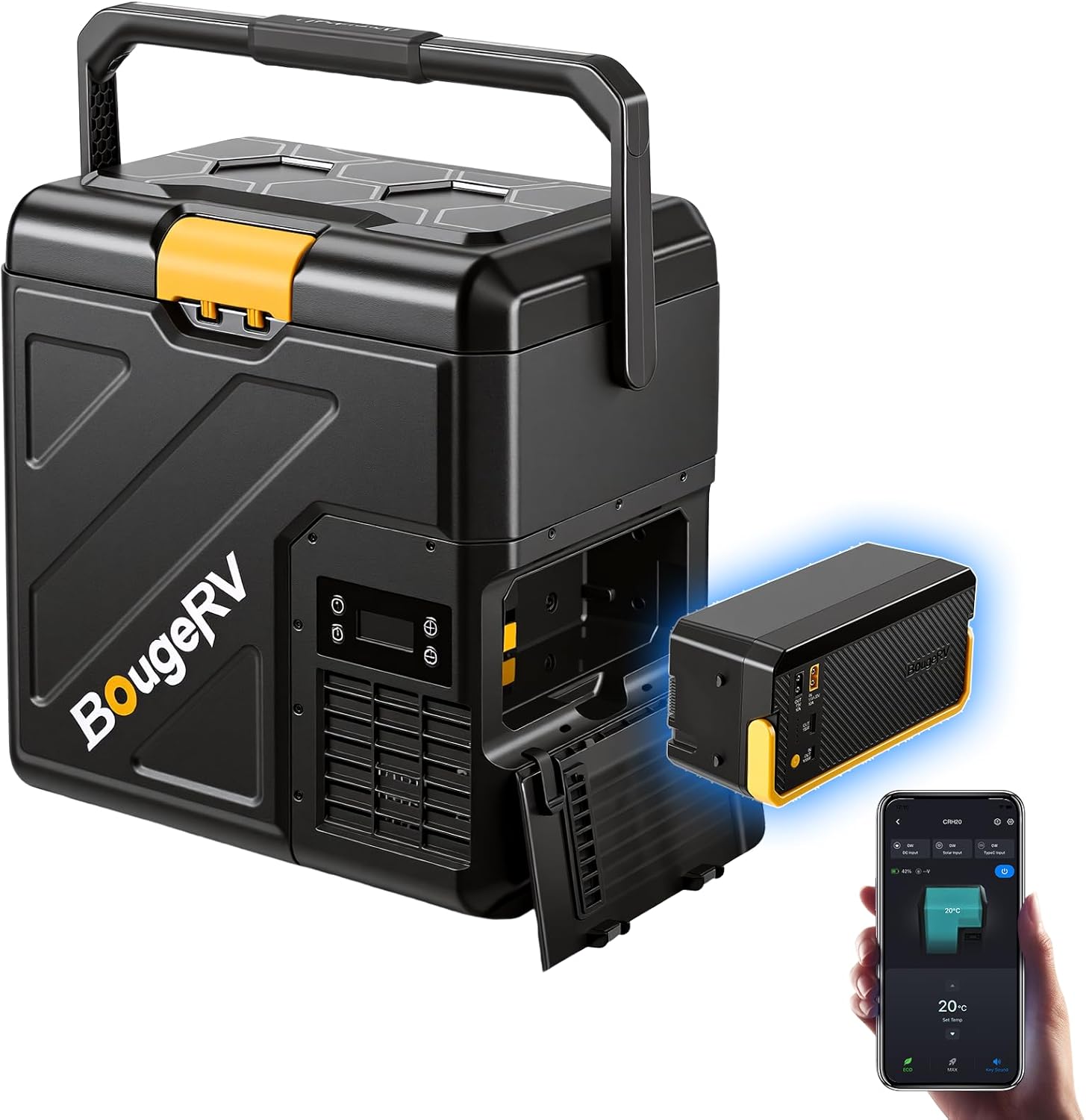
7. BougeRV CRH20 21QT Portable 12V Refrigerator with 240Wh LiFePO4 Battery
Best Premium Portable Fridge
| Capacity | 21 quarts |
|---|---|
| Battery | 240Wh LiFePO4 detachable |
| Temperature range | -4°F to 68°F (-20°C to 20°C) |
| Cooling method | Thermoelectric |
| Power source | 12/24V DC, 110V AC, battery |
The BougeRV CRH20 is a compact, battery‑equipped portable fridge designed for car camping and day trips. It combines a 21‑quart interior that fits roughly 25 cans with a detachable 240Wh LiFePO4 battery that mounts via pogo pins for tool‑free connection. Power options include the internal battery plus 12/24V DC or 110V AC cords, so you can run it in a parked Subaru Outback or at camp. The unit uses thermoelectric cooling with adjustable temperature control and can reach freezer temperatures down to -4°F when conditions allow. Notable features are the sturdy carry handle for easy loading into an Outback cargo area, manual defrost, a convertible freezer compartment, and the compact freestanding form factor. Practical benefits include multi‑day cooling on battery power for short trips and flexibility to plug into vehicle power for longer drives. Limitations to consider are the thermoelectric cooling method, which is generally slower and less efficient than compressor fridges in hot ambient conditions, and the manual defrost requirement that adds maintenance. For buyers prioritizing ruggedness and a built‑in battery, this hits the mark, but it is not the fastest cooling option for very hot weather or heavy loads.
Best for: Buyers who prioritize a rugged, ready‑to‑go portable fridge with an integrated battery for short to medium Subaru Outback trips and want flexible power options for campsite and vehicle use.
Less Ideal for: People who need rapid cooling, heavy multi‑day provisioning, or best-in-class efficiency in very hot environments should consider compressor‑based portable fridges instead.
- Built‑in detachable 240Wh LiFePO4 battery for hours of off‑vehicle use
- Multiple power options: 12/24V DC and 110V AC plus battery pogo‑pin connection
- Adjustable temperature range that can operate as freezer or fridge (-4°F to 68°F)
- Compact 21‑quart capacity that still fits a useful load for 1–2 people
- Comfortable carry handle and freestanding design for easy placement in an Outback cargo area
- Thermoelectric cooling is slower and less efficient than compressor fridges in high ambient temperatures
- Manual defrost adds periodic maintenance
Verdict: The best premium portable fridge for buyers willing to pay more for rugged construction, faster cooling, extra features, and longer-term reliability.
Choosing the Right Subaru Outback Portable Fridge: Key Factors to Consider
Power Consumption and 12V Compatibility
A portable fridge must run efficiently from the Outback 12V system to avoid depleting the battery on long stops. Look for units with low amp draw at typical operating temperatures and clear DC input ratings. Consider whether the fridge supports both the vehicle 12V socket and a direct-battery connection; direct wiring can be more reliable for extended off-grid use but may require a fused cable.
Also check the fridge's idle current when the compressor cycles down and its startup surge. Some compressor-based fridges have a short high-current startup that can trip weak accessory sockets or inline fuses. If you plan long drives or overnight stops without shore power, prioritize models with proven low average power consumption and built-in battery protection features.
Capacity and Internal Layout
Capacity should match how you use the Outback. For solo travelers, compact 20 to 30 liter units might suffice; for families or longer trips, 40 liters or more gives meaningful storage without requiring rooftop cargo. Pay attention to usable interior space rather than the nominal liter rating, since thick insulation and compartment shapes can reduce practical storage.
Internal layout matters for organization. Look for removable baskets, flat bottoms for containers, and a lid or door that opens in a way that fits the Outback cargo height. If you often carry tall bottles, choose a unit with configurable shelving or deep cavities. Consider whether the fridge has a small freezer section for ice packs or frozen meals.
Cooling Performance and Temperature Control
Cooling range determines what you can store. Compressor-based portable fridges reach and hold lower temperatures and respond faster in hot ambient conditions compared with thermoelectric coolers. Verify manufacturer temperature ranges and the ability to maintain set points when the vehicle is parked in direct sun or during high ambient temperatures.
Precise electronic controls and a clear display help you monitor set temperature and adjust for different loads. Look for units with low temperature variance across the interior and the ability to switch between fridge and freezer modes if you need both functions for trips.
Size, Fitment, and Mounting in the Outback
Measure your Outback cargo area before shopping. The fridge should fit lengthwise or widthwise without blocking access to underfloor storage or cargo attachments. Consider whether you will use the fridge on the cargo floor, folded rear seats, or in a roof box; each position affects dimensions and lid clearance.
Think about secure mounting to prevent shifting during driving. Some units include tie-down points or can be fastened with cargo straps. A lighter, smaller fridge may be easier to stow when not in use, while a larger unit may require leaving it in place full time.
Durability, Vibration Resistance, and Weather Tolerance
The Subaru Outback is often used for active, off-pavement adventures, so a portable fridge should stand up to vibration, bumps, and temperature swings. Robust construction, reinforced corners, and corrosion-resistant materials extend the unit's life when exposed to outdoor conditions. Check for compressors and components rated for automotive use rather than household-only designs.
Also consider water and dust resistance for use during wet-weather trips. While not all fridges are waterproof, a splash-resistant lid seal and sealed control panel reduce the risk of damage. Removable panels and accessible service points make field maintenance and troubleshooting easier.
Noise, Convenience Features, and Portability
Compressor fridges make some noise when running; consider units with lower decibel ratings if you sleep near your vehicle. Quiet operation is helpful at campsites and during overnight drives. Convenience features such as a digital thermostat, interior light, quick-freeze mode, and USB power outlets add usability.
Portability features include sturdy handles, wheels for heavier units, and a low weight for lifting into the Outback cargo area. Also check power cord length and whether the unit includes both AC and DC cords so you can use it at home or when plugged into the Outback's 12V outlet.
Choosing Between Compressor and Thermoelectric Cooling
Compressor systems offer stronger cooling performance and are better suited to hot climates or when you need a freezer-level temperature. They are more efficient per degree of cooling and maintain set temperatures even under heavy load, which is important for preserving frozen goods during long trips in the Outback.
Thermoelectric units are lighter and quieter but struggle to achieve low temperatures in high ambient heat. They can be acceptable for short day trips or for keeping drinks cool, but for multi-day camping or transporting perishable food, a compressor-based unit is often a more reliable choice.
- Compressor: better for freezing and hot conditions
- Thermoelectric: lighter, quieter, limited cooling depth
- Consider cooling method based on trip length and ambient temperatures
Power Options and Protecting Your Outback Battery
Most portable fridges support vehicle 12V input and some also accept 120V AC. For Outback owners, the DC input is the primary consideration. Use fused direct-wiring or a high-quality cigarette-lighter lead rated for the fridge's current to avoid overloads.
Consider a fridge with built-in battery protection that can shut the unit down at a preset battery voltage. If you often camp away from shore power, plan for a dual-battery setup or a portable power pack to avoid draining the starter battery.
- Use proper fusing and connection methods
- Look for low-voltage shutdown features
- Consider accessories like booster batteries for long stationary runs
Packing Strategies for Efficient Use
Pre-chill the fridge or use frozen bottles to reduce initial power draw and help maintain temperature when it's opened frequently. Organize items by frequency of access so you open the lid minimally on the road. Use stackable containers and rigid bottles to reduce wasted interior space.
If you need both chilled and frozen storage, dedicate a small section or use ice packs in insulated bags rather than cycling the whole interior between modes. This reduces compressor runtime and saves energy during long trips.
- Pre-chill and use frozen bottles to stabilize interior temperature
- Organize by access frequency to minimize lid openings
- Use rigid containers to maximize usable volume
Installation Tips and Secure Fastening
Place the fridge on a flat cargo floor and use the Outback's tie-down points or cargo straps to secure it. Prevent lateral movement by backing the unit into a corner or using anti-slip mats. For heavier fridges, consider a shallow wooden platform that locks into place with straps to distribute weight and keep the unit stable.
If you plan a semi-permanent install with direct battery wiring, use proper gauge wire, an inline fuse near the battery, and routed cable clips to prevent chafing. Keep the control panel accessible and avoid running cords where they can be pinched by seats or cargo.
- Use tie-downs or anti-slip mats for secure placement
- Distribute weight and avoid tipping during cornering
- Follow safe wiring practices for direct battery connections
Maintaining and Troubleshooting on the Road
Regularly check seals and drain plugs to prevent spills and odors. Clean interior surfaces with mild detergent and dry thoroughly before storage to avoid mildew. Inspect power cables and terminal connections for wear and secure attachments before long trips.
On the road, common issues include blown fuses, tripped low-voltage cutouts, and noisy compressors due to loose mounting. Keep spare fuses and a basic tool kit handy. If the unit fails to cool, verify the DC input voltage, check for ventilation clearance, and confirm that vents are not blocked by cargo or snow.
- Inspect seals, drains, and power connections periodically
- Keep spare inline fuses and basic tools
- Ensure adequate ventilation around compressor vents
How We Chose the Best Subaru Outback Portable Fridge
We focused on attributes that matter to Subaru Outback owners who use a portable fridge while driving, camping, and hauling gear. Primary evaluation criteria included power consumption and voltage compatibility, because the Outback relies on its 12V accessory circuits and battery for extended use. We also assessed usable interior capacity and shape to ensure units fit in the Outback cargo area without interfering with cargo tie-downs or rear-seat access. Temperature range and cooling method were judged for both refrigeration and light freezing performance, with an eye toward preserving perishables during warm-weather trips.Durability and build quality were considered, including how well the unit resists vibration and handles roadside use. Usability factors included control layout, reversible lids or doors, and whether the unit supports both AC and DC power for versatile use at home or at campsites. We excluded units designed only for household use or that require nonstandard vehicle wiring. Units that demanded major vehicle modifications or had unverified automotive compatibility were not considered. Final selections balanced efficiency, capacity, durability, and convenience for Outback owners.
Our full evaluation process is outlined in our review methodology.
FAQ
Will a portable fridge run off the Subaru Outback 12V outlet for hours?
It depends on the fridge's power draw and your Outback's battery condition. Many compressor fridges can run for hours while the engine is on. For extended stops, choose a unit with low amp draw and battery protection, or use a secondary battery or portable power pack to avoid draining the starter battery.
How do I know what size fridge will fit in my Outback cargo area?
Measure the cargo floor area, including height with the rear hatch closed and any underfloor storage you need to keep accessible. Compare those dimensions to the fridge's external size and account for clearance to open the lid. Aim for a unit that leaves room for straps or tie-downs.
Can a portable fridge freeze items or only chill?
Many compressor-based portable fridges can reach freezer temperatures and have modes for chilling or freezing. Thermoelectric models usually cannot freeze reliably in hot conditions. Check the unit's specified lowest temperature and real-world reports of freezer performance for assurance.
Are portable fridges noisy when used in the Outback?
Compressor fridges produce periodic noise when the compressor cycles. Noise levels vary by model; some are relatively quiet and unobtrusive for campsite sleeping, while others are louder. If noise matters, look for units with vibration-damping mounts and lower decibel ratings.
Do I need any special wiring to run a fridge from the Outback battery?
For short use, the 12V accessory outlet may suffice if the fridge draw is within the outlet rating. For extended or high-current use, direct-wiring with an inline fuse and proper gauge wire is recommended. Always protect the circuit with a fuse close to the battery and route cables safely.
How should I store the fridge when not in use?
Clean and dry the interior, leave the lid slightly ajar to prevent mildew, and store cords and accessories together. If storing in the vehicle, secure it to avoid movement. For winter storage, protect the unit from freezing temperatures if it is not designed for cold storage.
Final Verdict
When choosing a portable fridge for a Subaru Outback, prioritize power efficiency, a capacity and shape that fit your cargo area, and reliable cooling performance for your typical trips. Expect tradeoffs between weight, cooling depth, and usable volume: compressor units give better cold performance but weigh more, while lighter units are easier to stow.Decide whether you need freezer capability, how long you will run the unit from the vehicle, and whether you require additional accessories such as a second battery or mounting hardware. Focusing on those priorities will help you pick the fridge that balances convenience and reliability for your Outback adventures.
Explore More:
- Check out all Subaru Outback parts & accessories
- Explore Electronics
- Browse all Accessories
