

Note: This article contains affiliate links. If you click on these links and make a purchase, I may earn a small commission at no extra cost to you. This helps support my research and content. Read my full affiliate disclosure here.
Towing with a 2026 Subaru Outback requires reliable trailer braking that works smoothly with the vehicle's systems and your trailer's load. A proper trailer brake controller improves stopping consistency, reduces tow vehicle strain, and makes towing safer and less stressful on busy roads.This guide covers our shortlist of the top trailer brake controllers suited to the 2020-present Subaru Outback. We evaluate options for braking responsiveness, compatibility with the Outback's wiring and electrical limits, installation complexity, and ease of in-cab adjustment. Read on to find controllers that match common towing setups and driving styles.
Looking for other parts? See all Subaru Outback parts & accessories.
Top Picks at a Glance
| Best Overall Trailer Brake Controller The top all-around controller balancing features, reliability, and ease of install | Tekonsha Brake-EVN Proportional Trailer Brake Controller (8508220) |  |
| Best Budget Trailer Brake Controller A no-frills, low-cost controller that covers basic towing braking needs | Timilge Time-Delay Trailer Brake Controller (BC05) |  |
| Best Proportional Trailer Brake Controller Units with inertia/proportional sensors that match trailer braking to vehicle deceleration | REDARC Tow-Pro Liberty Proportional Trailer Brake Controller |  |
| Best Time‑Delay Trailer Brake Controller Simpler time-based controllers that ramp brake power over a set interval | REESE Towpower Brakeman IV Time-Delay Trailer Brake Controller |  |
| Best Bluetooth / Mobile Trailer Brake Controller Wireless controllers that pair with a smartphone app or offer portable Bluetooth control | CURT Echo Mobile Bluetooth Trailer Brake Controller (Proportional) |  |
| Best Plug‑and‑Play / Harness‑Ready Controller Controllers designed to work with vehicle-specific plug‑in wiring harnesses for fast install | Tekonsha Primus IQ Proportional Trailer Brake Controller |  |
| Best Low‑Profile / Compact Trailer Brake Controller Slim, dash-friendly controllers that tuck away for a neater cabin installation | CURT Venturer NEXT Electric Trailer Brake Controller (Low-Profile, Time-Delay) |  |
1. Tekonsha Brake-EVN Proportional Trailer Brake Controller (8508220)
Best Overall Trailer Brake Controller

| Model | 8508220 |
|---|---|
| Axle compatibility | 1-4 axles |
| Display | Digital LED |
| Warranty | Five-year limited warranty |
The Tekonsha Brake-EVN is a proportional trailer brake controller designed to give smooth, consistent braking for 1–4 axle trailers by sensing how hard and how quickly you apply the vehicle brakes. It mounts within easy reach of the driver and shows settings and diagnostics on a clear digital LED display. Setup is straightforward for DIY installers when a vehicle-specific Tekonsha plug-and-play wiring harness is used, and the unit includes mounting hardware and a removable connector for quick unplugging. Notable controls include arrow buttons for adjusting power output, a three-level boost feature for heavier loads, and a manual override lever for immediate trailer braking. Power-save mode helps reduce battery drain when idle. The main compromises are that a dedicated plug-in harness is sold separately for many vehicles and that advanced features like smartphone integration are not available, so installation and tuning still require some wiring familiarity and occasional manual adjustment for fine-tuning trailer feel.
Best for: DIY-minded drivers who prioritize reliable, consistent trailer braking and want a feature-rich controller they can install and adjust without needing professional tuning.
Less Ideal for: Buyers seeking wireless or app-based setup, fully integrated vehicle controls, or a completely harness-free out-of-the-box installation should consider other options.
- Proportional braking using an internal inertia sensor for smooth, natural trailer stopping
- Clear digital LED readout for settings and real-time diagnostics
- Boost feature with up to three levels for extra braking power when hauling heavier loads
- Compact design with included mounting hardware and removable connector for easy access and service
- Power-save mode helps minimize vehicle battery drain when not in use
- Vehicle-specific plug-and-play wiring harness is typically sold separately so additional purchase may be required
- No smartphone app or wireless configuration options for remote tuning
Verdict: For DIYers who want a dependable, feature-rich controller that provides smooth, consistent braking and straightforward installation without major compromises.
2. Timilge Time-Delay Trailer Brake Controller (BC05)
Best Budget Trailer Brake Controller

| Fits trailers | 1 to 4 axles |
|---|---|
| Display | LED digital voltage readout |
| Wiring | BLACK/RED/WHITE/BLUE ports |
| Model | BC05 |
The Timilge BC05 is a basic time-delay trailer brake controller designed for light-duty, occasional towing. It sends a preset braking signal to 1–4 axle trailers and lets you adjust the initial power and ramp time from the unit. Installation is straightforward thanks to labeled wiring ports for vehicle power, stop light, ground, and trailer output, and the LED display shows the voltage being delivered so you can make real-time adjustments while towing. For Subaru Outback drivers who tow intermittently with small boats or lightweight trailers, this controller gives dependable, predictable stopping without the complexity or cost of proportional units. The limitation is that time-delay operation applies braking based on a timer rather than vehicle deceleration, so it will not match braking as precisely as a proportional controller and may increase brake wear in heavier or frequent towing scenarios. For its price and ease of use, it covers the needs of occasional haulers who want a simple, functional brake controller.
Best for: Drivers who tow infrequently and prioritize a low-cost, easy-to-install controller that delivers straightforward, adjustable brake application for light trailers.
Less Ideal for: Frequent haulers, owners of heavy trailers, or drivers seeking the smoothest, most responsive braking should consider a proportional controller instead.
- Fits 1–4 axle trailers so it works with most small utility and boat trailers
- Adjustable initial braking power and ramp time for tuning to trailer feel
- LED digital display shows output voltage for easy monitoring
- Simple wiring ports labeled for quick installation or removal
- Time-delay operation is less responsive than proportional controllers and may not be ideal for frequent or heavy towing
Verdict: Choose this if you tow occasionally and need an inexpensive, functional controller that reliably applies trailer brakes without advanced features.
3. REDARC Tow-Pro Liberty Proportional Trailer Brake Controller
Best Proportional Trailer Brake Controller

| Voltage | 12 Volts |
|---|---|
| Supports | 1–2 axles |
| Item model number | EBRH-ACCNA |
The REDARC Tow-Pro Liberty is a compact proportional brake controller made to deliver smooth, natural trailer stops by sensing vehicle deceleration and applying trailer brakes accordingly. It installs as a remote-head system with a small dash dial and a 3.3 foot remote cable, which helps it integrate cleanly into a Subaru Outback interior when used with the appropriate wiring harness. The unit supports 1 to 2 axle trailers and includes active calibration and sway control to reduce trailer pull and improve on-road stability. Practical benefits include intuitive dial control for quick adjustments, a low-profile appearance that avoids knee interference, and proven durability from REDARC testing. The controller requires either REDARC’s universal pigtail or a vehicle-specific harness for factory-style integration, which are sold separately, so plan for that additional part and installation time. If you tow light to medium trailers and prioritize smooth, proportional braking for everyday highway and canyon driving, this controller delivers predictable, confidence-building performance.
Best for: Drivers who tow light to midsize trailers and want a proportional controller that blends into the dash and prioritizes predictable, smooth braking for everyday highway and twisty-road use.
Less Ideal for: Drivers who need a multi-vehicle universal solution without additional harnesses or who tow heavy multi-axle commercial trailers needing higher-capacity controllers.
- Proportional braking for smoother, more natural stops based on vehicle deceleration
- Compact remote-head design that mounts neatly on the dash and reduces knee interference
- Active calibration and sway control improve stability with or without a trailer
- Supports common 1–2 axle trailer setups used with Outback towing
- Durable design from a brand with long towing product experience
- Requires a separate wiring harness or pigtail for factory-style integration which adds cost and installation steps
Verdict: Pick a proportional controller when you want smoother, more natural trailer stops because the unit applies braking based on vehicle deceleration and motion sensing.
4. REESE Towpower Brakeman IV Time-Delay Trailer Brake Controller
Best Time‑Delay Trailer Brake Controller

| Compatibility | Trailers with 2, 4, 6 or 8 brakes (1–4 axles) |
|---|---|
| Controller type | Time-delay digital |
| Power system | 12-volt negative ground |
| Display | Digital LED output and sync indicator |
The REESE Towpower Brakeman IV is a simple time-delay brake controller designed to add predictable, ramped braking to a trailer tow setup. It mounts above or below the dash and installs quickly using a plug-and-play wiring harness (sold separately), making it an easy upgrade for occasional towing. Two push-button controls let you set overall output and the sync timing so you can match brake force and activation speed to different trailer weights and driving conditions. A bright digital LED display shows output level, sync, and fault conditions while a manual lever gives on-demand trailer braking. Because it is a time-based unit rather than proportional, braking follows a preset ramp rather than reacting to vehicle deceleration, so it is straightforward to tune but less responsive to sudden stops. Built-in circuit protection and 12V negative-ground compatibility help with reliability. For light to moderate towing where simple, repeatable braking is preferred, this controller performs well; heavy towing or drivers who want automatic proportional response may prefer a different design.
Best for: Subaru Outback owners who tow occasionally and want a straightforward, easy-to-adjust controller that produces consistent, ramped brake force without complex setup.
Less Ideal for: Drivers who frequently tow heavy loads or want the most responsive, inertia-based braking behavior should choose a proportional controller instead.
- Simple, easy-to-use time-delay braking that is predictable to set up
- Compact design mounts in any orientation for flexible dash placement
- Plug-and-play compatibility with vehicle-specific wiring harnesses simplifies installation
- Bright digital LED shows output, sync, and fault info for easy monitoring
- Manual lever allows instant application of trailer brakes when needed
- Time-delay operation is less responsive than proportional controllers for emergency stops
Verdict: Opt for a time‑delay controller if you prefer a straightforward, easy-to-set system that delivers predictable, ramped brake force for light or occasional towing.
5. CURT Echo Mobile Bluetooth Trailer Brake Controller (Proportional)
Best Bluetooth / Mobile Trailer Brake Controller
| Connection | Bluetooth to smartphone |
|---|---|
| Mount type | Portable plug-in 7-way RV blade |
| Brake control | Proportional (tri-axis accelerometer |
| Compatibility | Works with 1–2 axles (2–4 brakes) |
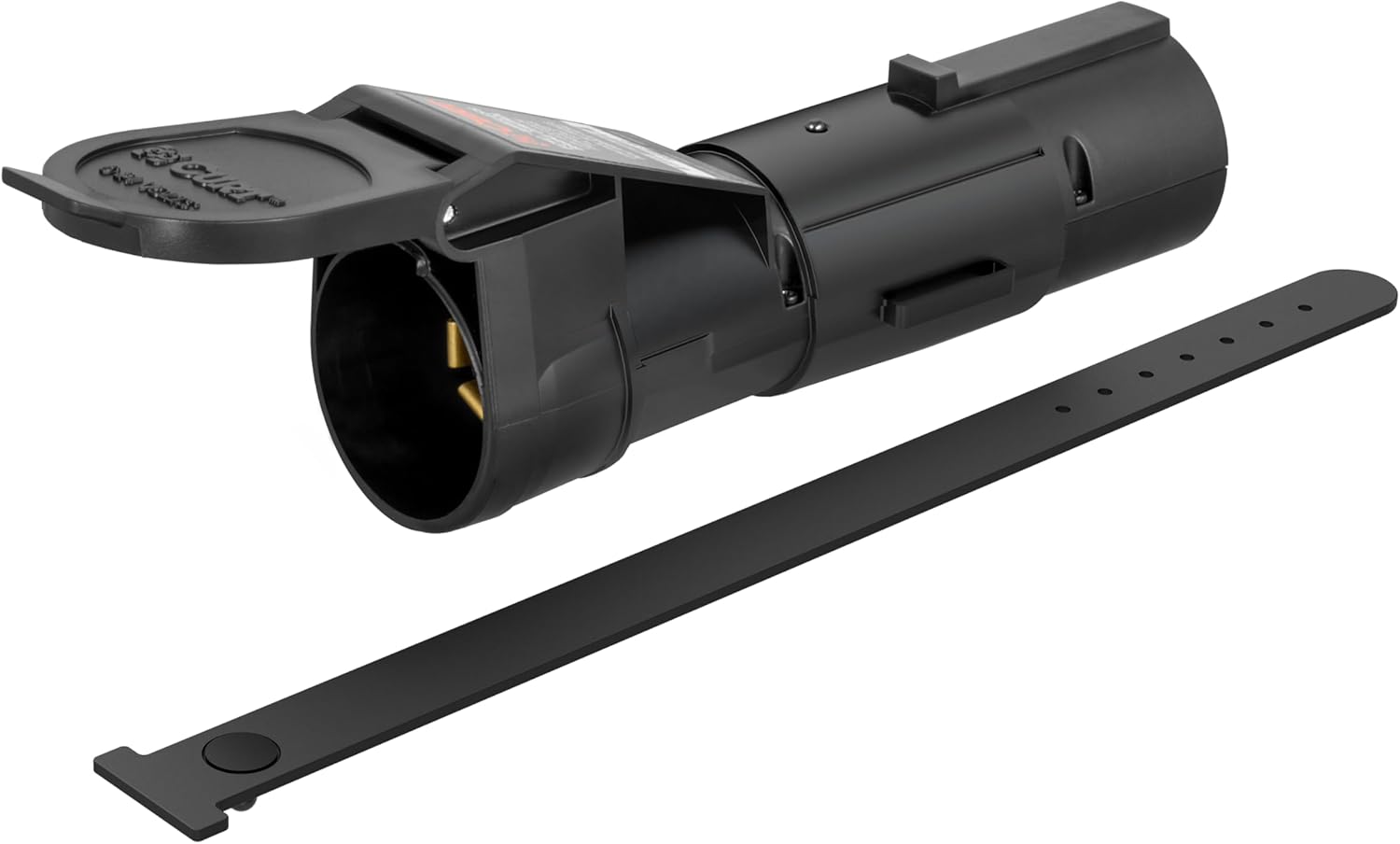
The CURT Echo Mobile is a plug-and-play, portable trailer brake controller that uses Bluetooth and a smartphone app to set up and operate proportional trailer braking. You insert the unit into the vehicle 7-way socket between the vehicle and trailer, pair it with the OneControl Auto app on iOS or Android, and create trailer profiles, adjust maximum output and sensitivity, and trigger manual braking from your phone. Its tri-axis accelerometer provides smooth, hill-aware stops and the sealed, potted housing plus retention strap help keep the connector secure and protected from moisture and vibration. Because it is portable, the Echo is convenient for drivers who tow with more than one vehicle or prefer to stow the controller when not towing. Limitations include reliance on a smartphone and Bluetooth for operation and the need to keep the unit in the 7-way plug rather than an in-cab mounted control, which may be less convenient for drivers who prefer a permanent dash-mounted interface.
Best for: Drivers who want modern app-based setup and the flexibility to move a single controller between multiple vehicles while towing occasional trailers with their Subaru Outback.
Less Ideal for: Drivers who prefer a dedicated in-cab, permanently mounted controller or who need a controller that operates independently of a smartphone.
- True plug-and-play portability for easy transfer between vehicles using the 7-way RV blade
- Bluetooth app control lets you tune profiles, sensitivity, and maximum output without tools
- Tri-axis motion sensor enables proportional braking for smoother stops on grades
- Potted enclosure and retention strap improve durability and connector security
- Compatible with cruise control, ABS, low-voltage systems, PWM and electric-over-hydraulic setups
- Requires a smartphone and Bluetooth connection to access full functionality
Verdict: Choose a Bluetooth/mobile unit for app-based setup, remote tuning, and portable use when you want modern connectivity and flexible mounting options.
6. Tekonsha Primus IQ Proportional Trailer Brake Controller
Best Plug‑and‑Play / Harness‑Ready Controller

| Model | 90160 |
|---|---|
| Voltage | 12 Volts |
| Trailer axles supported | 1-3 axles |
The Tekonsha Primus IQ is a compact proportional brake controller that senses vehicle deceleration and applies trailer brakes in proportion for smoother stops. It is designed to mount under the dash and offers a clear LED display with real-time diagnostics and a manual override. Installation is simplified by a Plug & Play port that accepts vehicle-specific adapters and a snap-in dash clip so the unit can be unplugged and stowed when not in use. Notable features include a three-level boost for extra braking power when hauling heavier loads, self-leveling mounting within a 90-degree vertical range, and a removable electrical connector for cleaner wiring. In practice the Primus IQ gives predictable, proportional braking and is easy to set up for drivers who prefer a tidy, near-factory installation using a harness adapter. Limitations are that advanced smartphone configuration and more sophisticated tuning options found on higher-end models are not available, and the unit is intended for trailers with one to three axles only.
Best for: Buyers who prioritize a clean, near-factory install using a vehicle-specific wiring harness adapter and want reliable, proportional braking without complex setup.
Less Ideal for: Drivers who need smartphone configuration, extensive tuning options, or support for large multi-axle trailers should consider more advanced controllers.
- Proportional braking with internal inertia sensor for smooth, responsive stops
- Plug & Play port and removable connector enable quick, harness-ready installs
- Compact snap-in dash mount keeps the unit out of the way and easy to stow
- Three-level boost control provides extra stopping power when towing heavier loads
- LED display with self-diagnostics helps monitor connection and settings
- Supports trailers up to three axles but lacks the advanced tuning features of higher-end models
Verdict: Pick a harness-ready controller if you want a quick, mostly tool-free install using a vehicle-specific plug‑and‑play wiring adapter for clean, OEM-style hookup.
7. CURT Venturer NEXT Electric Trailer Brake Controller (Low-Profile, Time-Delay)
Best Low‑Profile / Compact Trailer Brake Controller

| Controls brakes | 1-3 axles (up to 6 brakes) |
|---|---|
| Type | Time-delay (fully adjustable) |
| Vehicle system | 12-volt compatible |
| Display | LED ramp indicator, adjustable brightness |
The CURT Venturer NEXT is a low-profile, time-based brake controller that lets you operate up to six trailer brakes (one to three axles) from the cabin without taking up much dash space. It is typically mounted using the included slim bracket and connects to a 12-volt vehicle system; a CURT plug-and-play wiring harness is recommended for faster installation. The unit offers fully adjustable power and ramp time so you can fine-tune braking feel for light loads or heavier trailers, and LED indicators show ramp progress with adjustable brightness for day or night use. Because it has no internal moving parts and can be mounted at any angle, setup is straightforward and reliable. The main limitation is that it is a time-delay controller rather than an inertia-based unit, so braking modulation relies on preset ramp and gain settings instead of real-time deceleration sensing, which may require more dialing-in for precise trailer feel in some towing situations.
Best for: Drivers who prioritize a discreet, space-saving brake controller that installs cleanly in the cabin and can be adjusted to suit a range of trailer loads.
Less Ideal for: Towing situations where the most precise, real-time brake modulation is required or users who prefer inertia-based controllers for automatic proportional braking.
- Low-profile bracket and compact design minimize dash intrusion for a discreet install
- Fully adjustable power and ramp time let you tailor braking to different trailer loads
- LED ramp indicator with brightness control for clear feedback day or night
- Mounts at any angle and has no internal moving parts for simple, reliable setup
- Time-delay operation lacks real-time inertia sensing, so it can require more tuning for precise modulation
Verdict: Choose a low-profile controller when cabin space and a discreet install matter—these units mount compactly and keep controls within reach without bulky hardware.
Choosing the Right 2026 Subaru Outback Trailer Brake Controller: Key Factors to Consider
Compatibility With Outback Electrical System
Ensuring the controller is compatible with the 2026 Subaru Outback and the broader 2020-present Outback family is crucial. The Outback's factory wiring, grounding points, and any available tow package connectors dictate what kind of interface you will need. Some controllers plug into a prewired harness or splice to the vehicle harness; choose a solution that avoids overloading circuits or introducing poor ground connections.
Improper compatibility can lead to intermittent braking performance or conflict with vehicle electronics. Confirming the unit's voltage range, signal type, and whether it uses the vehicle's battery or an auxiliary power source will prevent surprises during installation and operation.
Type of Brake Control: Proportional Vs Time-Delayed
Proportional controllers modulate trailer braking in sync with deceleration, offering smoother, more intuitive control, which is especially beneficial for lightweight tow setups commonly paired with the Outback. Time-delayed controllers apply a preset ramp of braking power after the tow vehicle decelerates, which can work fine for heavier or less frequently used trailers but may feel less refined.
Decide which type fits your towing style. Proportional units typically require a clear inertial sensor installation location and can feel more natural in stop-and-go traffic. Time-delayed units are simpler mechanically and sometimes easier to set up, but they may need more manual tuning to avoid abrupt stops.
Installation Complexity and Wiring Needs
Installation time and skill level vary widely among controllers. Some models offer plug-and-play compatibility with factory tow harnesses or a vehicle-specific adapter, minimizing drilling and splicing. Others require running wires through the firewall, securing a good chassis ground, and routing the controller wiring to the trailer connector.
Consider whether you will perform the installation yourself or use professional help. A more complex wiring job can add significant labor time and cost. Also evaluate if the controller location allows easy in-cab access without impeding vehicle controls or visibility.
Adjustment Controls and In-Cab Ergonomics
How you interact with the controller while driving affects safety and convenience. Look for clear, accessible adjustment controls and displays that can be read at a glance. Some controllers offer one-touch override buttons, incremental gain knobs, or digital readouts for fine-tuning.
Ergonomic mounting options that place the unit within comfortable reach but out of the way of steering and dashboard controls will reduce setup headaches. Consider units with tactile controls you can operate without taking eyes off the road.
Diagnostics, Safety Features, and Reliability
Built-in diagnostics such as short-circuit indicators, open-load warnings, or fault LEDs can help identify wiring problems quickly. Safety features like automatic gain adjustment, trailer detection, or current limiting protect both the vehicle and trailer wiring.
Reliability is critical because inconsistent braking increases risk while towing. Choose controllers with durable housings, sealed connectors where they interface with the trailer circuit, and proven track records for long-term operation under varied weather conditions.
Adjustability for Different Trailer Loads
The Outback may tow small campers, utility trailers, or recreational gear with widely varying weights. A controller with a broad and precise adjustment range helps match braking power to trailer weight and road conditions. Some controllers provide presets for different trailers while others allow continuous gain tuning.
Consider how often you change trailer loads. If you tow multiple trailers, easy switching between settings or memory features can save time and ensure consistent stops without repeated recalibration.
Understanding Towing Limits and Brake System Needs
Before selecting a trailer brake controller, review the towing limits and factory tow configuration for your 2026 Subaru Outback and related 2020-present models. Gross trailer weight and tongue weight influence the amount of braking assistance required, and the controller must be able to deliver appropriate current to the trailer brakes without overstressing the vehicle wiring.
Assess whether your trailer uses electric drum brakes or a different electric braking system, since controller output and connector wiring must match the trailer's design. Matching the controller to the trailer braking type avoids mismatched response and ensures a safer towing experience.
- Confirm Gross Trailer Weight and tongue weight before choosing controller capacity
- Match controller output to trailer brake type and current draw
- Verify whether your Outback has a factory tow harness to simplify installation
Mounting and In-Cab Placement Tips
Good mounting placement improves usability and reduces accidental bumps or obstructed controls. Common mounting points include under-dash locations to the left or right of the steering column, on the center console face, or in a small pocket near the driver. Choose a spot that allows you to reach the controller easily while driving.
Take time to test placement before finalizing mounting hardware. Ensure the controller does not interfere with airbag deployment zones, steering wheel movement, or driver legroom. Cable routing should avoid sharp edges and heat sources and should allow slack for seat movement.
- Test fit placement for reach and visibility before drilling
- Route wiring away from moving parts and heat sources
- Use included mounting templates or brackets when available
Basic Wiring Checklist for the Outback
A reliable wiring job is the backbone of effective trailer braking. Key wiring points include a solid battery or fused ignition power source, trailer brake output to the trailer connector, a robust chassis ground, and, if used, a reverse or turn-signal circuit where applicable. Use heat-shrink connectors or automotive-grade crimp terminals for secure joints.
If your Outback has a factory tow package or prewired harness, start by identifying the brake output conductor and any dedicated ground or power leads. When splicing into the vehicle harness, protect the splice against moisture and mechanical strain. After wiring, test current draw at rest and during a simulated brake to confirm expected operation.
- Identify fused power source and secure proper gauge wiring
- Ensure a good chassis ground near the trailer connector
- Test circuit continuity and current draw before closing dash panels
Tuning Braking Feel for Different Conditions
Fine-tuning gain and response settings helps the trailer braking feel natural and predictable. For light trailers, reduce gain to avoid trailer wheel lockup. For heavier loads or steep descents, higher gains or supplemental braking strategies may be required. If your controller supports manual override, practice using it to manage uphill or downhill slow-speed control.
Adjust settings gradually and test on a low-risk road until you find a balance between immediate trailer response and smooth deceleration. Keep a written note or digital photo of successful settings for each trailer you tow with the Outback to speed future setups.
- Start with conservative gain settings and increase gradually
- Test on quiet roads before towing in traffic
- Record successful settings for each trailer and load
Maintenance and Seasonal Considerations
Regular maintenance ensures consistent performance. Inspect trailer connector pins for corrosion, check wiring insulation for chafing, and verify trailer brake magnets and hardware periodically. Controllers mounted under the dash may still be affected by moisture or dust, so keep vents clear and connectors sealed.
Seasonal temperature changes affect brake magnet resistance and controller current. Revalidate controller tuning after winter or significant temperature shifts, since cold weather can change braking responsiveness. Address any error indicators promptly to avoid degraded braking performance on the road.
- Inspect connector pins and wiring at least annually
- Re-check tuning after seasonal temperature shifts
- Address controller fault indicators immediately
Still looking for the perfect fit?
Select your Subaru Outback configuration to see the most relevant Trailer Brake Controllers recommendations
How We Chose the Best 2026 Subaru Outback Trailer Brake Controller
We focused on criteria that matter specifically for Subaru Outback owners towing with model years 2020 through the current 2026 model. First, compatibility with the Outback electrical system and available tow packages was a primary filter. We prioritized controllers known for stable voltage control and clean signal integration to avoid interference with the vehicle's safety electronics.Next, we evaluated braking performance characteristics including responsiveness, proportionality or time-delayed control modes, and fine adjustment range to suit light to moderate trailer loads typically paired with an Outback. Installation complexity and wiring requirements were weighted heavily because many owners prefer a controller that fits existing harnesses or requires minimal wire routing.We also considered in-cab ergonomics such as mounting options, display clarity, and ease of calibration while driving. Reliability and serviceability were included by assessing build quality and the availability of diagnostics or fault indicators. We excluded controllers that demand extensive vehicle modifications, incompatible higher-voltage systems, or models that lack proven compatibility with Subaru electrical architectures. The resulting list balances practical fitment, predictable braking behavior, and straightforward installation for Outback owners.
Our full evaluation process is outlined in our review methodology.
FAQ
Does the 2026 Subaru Outback require a specific controller for proportional braking?
Not necessarily. The Outback does not mandate a single controller type, but you should choose a unit that is compatible with the vehicle's electrical system and is rated for proportional operation. Confirm mounting location and wiring needs for the proportional sensor before purchase.
Can I install a trailer brake controller myself in the Outback?
Many owners can perform a DIY install if they are comfortable routing wires and making secure electrical connections. However, a professional install is recommended if you lack experience with automotive wiring or if your Outback requires substantial dash removal to reach mounting points.
Will a trailer brake controller affect my Outback's onboard safety systems?
A properly installed controller that uses correct wiring practices and grounding should not interfere with onboard safety systems. Avoid splicing into unrelated vehicle sensor circuits and follow installation guidance to prevent electrical conflicts.
How do I know what gain setting to use for my trailer?
Start with a conservative gain and perform low-speed braking tests. Increase gain in small steps until the trailer follows the vehicle's deceleration smoothly without tugging or locking trailer wheels. Conditions like load, road grade, and trailer condition will influence the final setting.
Is a built-in mounting harness necessary for the Outback?
A built-in harness simplifies installation but is not always necessary. If your Outback lacks a factory harness, choose a controller that matches your wiring confidence level and be prepared to run additional wires or use a vehicle-specific adapter.
How often should I service the trailer brake controller wiring and connector?
Inspect wiring and connectors at least once a year, and more often if you tow regularly or in corrosive environments. Check for loose connections, corrosion on pins, and damaged insulation to maintain reliable braking performance.
Final Verdict
Choose a trailer brake controller that matches the electrical characteristics of your 2026 Subaru Outback and the typical trailers you tow. Prioritize compatibility, ease of installation, and a controllable adjustment range so you can tune braking to each load. Proportional controllers tend to offer a more natural braking feel, while time-delayed units provide simpler setup for occasional towing.Balance ergonomics and wiring complexity against the braking performance you need. With proper wiring, mounting, and tuning, a quality controller will make towing with the Outback safer and more predictable across everyday driving situations.
Explore More:
- Check out all Subaru Outback parts & accessories
- Explore Electronics
- Browse all Accessories
