

Note: This article contains affiliate links. If you click on these links and make a purchase, I may earn a small commission at no extra cost to you. This helps support my research and content. Read my full affiliate disclosure here.
If you tow with a 2026 Nissan Frontier, the trailer brake controller you choose has a big effect on stability, stopping distance, and driver confidence. The right controller delivers consistent modulation between the truck and trailer, reduces rear-end toss during braking, and can make heavy loads feel more manageable during daily driving and emergency stops.This guide covers seven shortlisted trailer brake controllers that suit the 2022-present Nissan Frontier towing envelope. We focused on controllers that provide reliable modulation, straightforward in-cab controls, and wiring options compatible with common Frontier harnesses. Below you will find practical evaluation criteria and what to expect during installation and use.
Looking for other parts? See all Nissan Frontier parts & accessories.
Top Picks at a Glance
| Best Overall Trailer Brake Controller A top pick balancing ease of install, performance, and durability | REDARC Tow-Pro Elite Electric Trailer Brake Controller |  |
| Best Budget Trailer Brake Controller A low-cost, dependable controller for occasional or light towing | Gihdfer Brakeman IV Time-Delayed Electric Trailer Brake Controller |  |
| Best Plug‑and‑Play Kit Trailer Brake Controller Complete vehicle-specific kit that installs without splicing or complicated wiring | REDARC Tow-Pro Trail Electric Trailer Brake Controller Kit |  |
| Best Split‑Design Trailer Brake Controller Remote display and separate control unit for flexible dash placement | Kohree Split Design Trailer Brake Controller Kit with Color LCD | 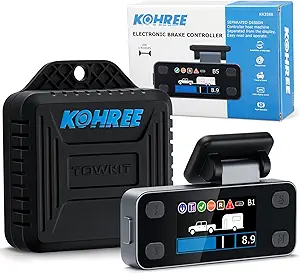 |
| Best Proportional Trailer Brake Controller Automatic, accelerometer-based braking that matches vehicle deceleration smoothly | REDARC Tow‑Pro Liberty Proportional Trailer Brake Controller |  |
| Best Time‑Delay Trailer Brake Controller Digital time‑based controllers with adjustable ramp and manual override | CURT Discovery NEXT Electric Trailer Brake Controller (Time-Delay, Fully Adjustable) |  |
| Best Low‑Profile Trailer Brake Controller Slim, dash‑hugging units that clear tight dash spaces and look discreet | Hopkins 47235 Impulse Plug-In Time-Based Trailer Brake Controller |  |
1. REDARC Tow-Pro Elite Electric Trailer Brake Controller
Best Overall Trailer Brake Controller
| Axle support | 1–3 axles |
|---|---|
| Voltage | 12V/24V compatible |
| Included components | Remote head assembly and main unit with harness |
| Model number | EBRH-ACCV3-NA |
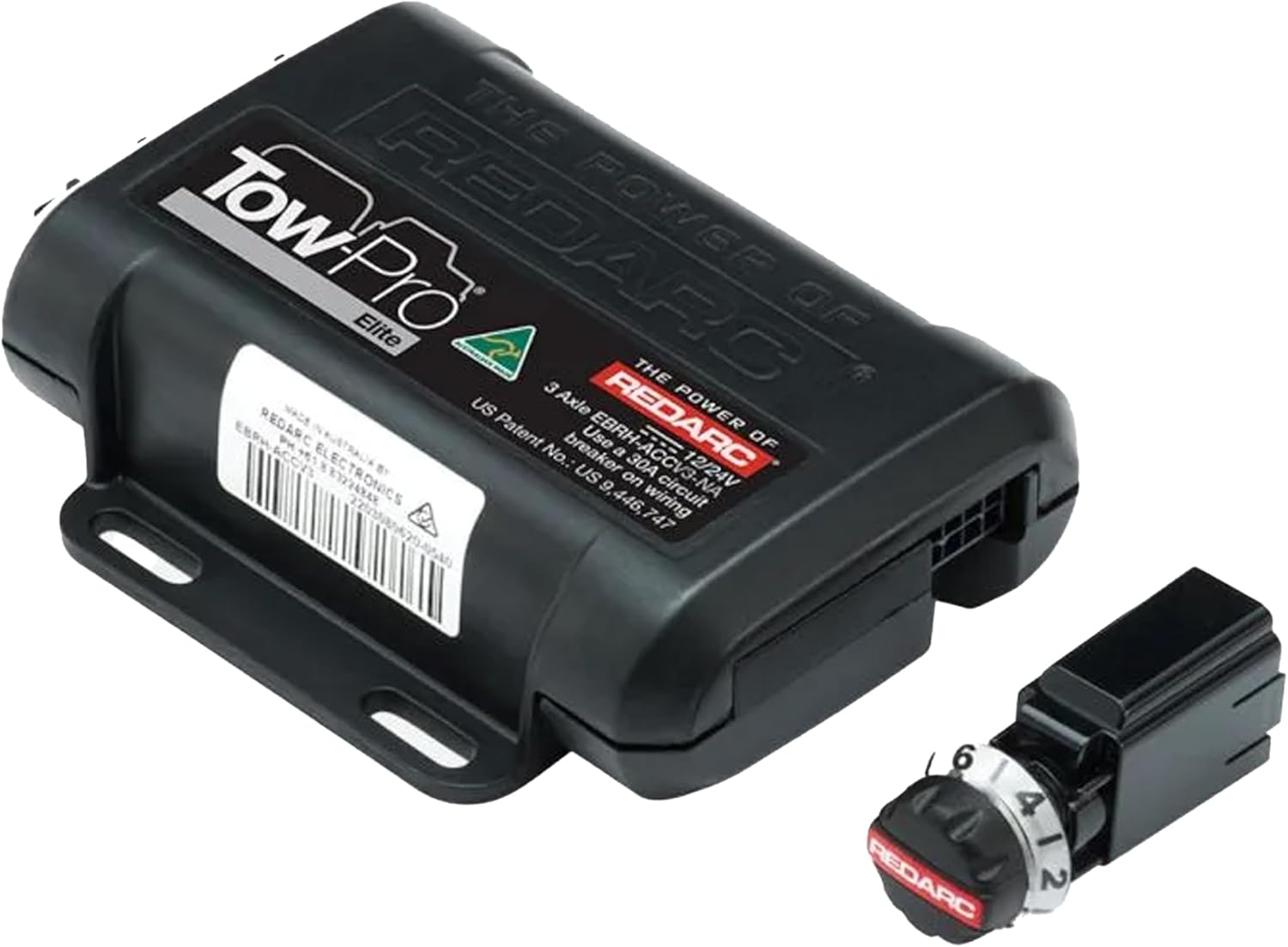
The REDARC Tow-Pro Elite is a compact electric trailer brake controller that gives proportional on-road braking plus a user-controlled mode for off-road precision. It installs with a universal harness and remote head so you can mount the dial on the dash and tuck the main unit under the dash for a near factory-style look. Active calibration and built-in sway control smooth braking whether you are towing light campers or heavier trailers, and the 1–3 axle support covers most common towing setups. Practical benefits include a small dash footprint, a simple dial for instant manual override, and a design tested for rugged conditions. Limitations to note are that full-feature wiring may still require access under the dash and the harness length is modest, which can affect nonstandard mounting locations. The unit is a solid choice for DIYers who want reliable proportional performance with an easy-to-use interface.
Best for: Drivers who want a dependable, easy-to-use controller that delivers proportional braking for everyday towing and the option for manual control when off-roading.
Less Ideal for: Those who need an integrated vehicle-specific plug kit or very long remote wiring runs without modification should consider controllers sold with extended harnesses or vehicle-specific kits.
- Proportional and user-controlled dual braking modes for on-road and off-road control
- Universal plug-and-play harness and remote head for near factory-style installation
- Active calibration and sway control for smoother braking with or without a trailer
- Compact dash dial that provides easy manual override without taking much space
- Harness and cable lengths are relatively short, which may limit mounting flexibility
- May require some under-dash access for full wiring during installation
Verdict: The best overall choice delivers reliable proportional braking, straightforward installation, and durable controls for most DIY towing needs.
2. Gihdfer Brakeman IV Time-Delayed Electric Trailer Brake Controller
Best Budget Trailer Brake Controller

| Fitment | 1 to 4 axles (2-, 4-, 6-, 8-brake systems) |
|---|---|
| Display | LED display |
| Activation | Time-delayed brake activation |
| Package contents | Controller, mounting bracket, 6 screws, instruction |
The Brakeman IV is a straightforward time-delayed electric brake controller designed to provide dependable trailer stopping power without complicated setup. It mounts easily under the dash and connects to a vehicle wiring harness to control 1 to 4 axle trailers, delivering a preset braking pulse after a short delay to smooth out initial trailer braking. The bright LED display reports current braking force and lets you adjust output so you can dial in a comfortable response for light towing tasks. Its small footprint and included mounting hardware make installation quick for occasional users or DIYers who do not want to run proportional wiring. Limitations are its time-delayed control method, which is less responsive than proportional controllers during sudden stops and on steep terrain, and the unit lacks advanced diagnostics or vehicle-integrated features. For infrequent towing and tight budgets it gives clear feedback and simple control, but heavy or technical towing will benefit from a proportional unit instead.
Best for: Buyers who tow only occasionally or are prioritizing low cost and easy DIY installation will appreciate this controller for straightforward, legal trailer braking.
Less Ideal for: Drivers who tow heavy loads frequently, use trailers with sensitive load dynamics, or want automatic proportional braking performance should consider a higher-end proportional controller.
- Compatible with 1 to 4 axle trailers, covering common small to medium trailer setups
- Time-delayed activation smooths initial braking to reduce jerks when towing light loads
- LED display clearly shows braking force for on-the-fly adjustments
- Compact design with included mounting bracket and screws simplifies installation
- Time-delayed operation is not as responsive as proportional controllers in sudden-stop or variable-speed situations
Verdict: If you tow infrequently or on a tight budget, this simple, affordable controller gives safe, legal trailer braking without a big upfront cost.
3. REDARC Tow-Pro Trail Electric Trailer Brake Controller Kit
Best Plug‑and‑Play Kit Trailer Brake Controller

| Manufacturer | REDARC |
|---|---|
| Model | Tow-Pro Trail |
| Item model number | CIKTP-NA-009 |
| Compatibility | Fits many Nissan SUVs and trucks including Frontier |
The REDARC Tow-Pro Trail kit is a factory-style, plug-and-play electric trailer brake controller package built for Nissan SUVs and trucks, including Frontier fitments, that simplifies installation by supplying a vehicle-specific wiring harness, mounting bracket, and switch insert. It gives drivers two modes: a Manual Off-Road Mode for low-speed control on rough terrain and an Everyday Mode tuned for road towing, plus active calibration and sway control to smooth braking whether a trailer is attached or not. The dash-mounted dial is compact and unobtrusive, blending into the cabin while providing straightforward adjustment on the fly. Because the kit is purpose-built for Nissan wiring and includes all integration parts, installation is significantly faster and cleaner than a universal controller, reducing time under the dash and reliance on splicing. The unit is engineered for demanding conditions and carries a limited warranty, but buyers should expect the higher build quality and fitment convenience to come at a premium compared with basic universal controllers.
Best for: Owners who prioritize the easiest, cleanest install and factory-style integration for a Nissan Frontier and want a controller that handles both road towing and off-road situations.
Less Ideal for: Buyers who only tow occasionally with very light trailers and prefer the lowest-cost universal controllers or who need multi-vehicle compatibility.
- Vehicle-specific wiring harness and mounting hardware enable near factory-style, plug-and-play installation
- Dual modes for off-road manual control and everyday automatic braking adapt to varied towing conditions
- Active calibration and sway control provide smooth braking with or without a trailer attached
- Compact dash dial integrates cleanly into the cabin and allows easy on-the-fly adjustment
- Higher cost than basic universal controllers
Verdict: Choose this slot when you want a factory-style, plug-and-play controller kit with harness and mounting hardware for the easiest install.
4. Kohree Split Design Trailer Brake Controller Kit with Color LCD
Best Split‑Design Trailer Brake Controller
| Application | 1-4 axles |
|---|---|
| Boost levels | 9 levels (S1-S9) |
| Display | 1.9" color LCD |
| Braking modes | Proportional and electronic hydraulic |
| Storage | Profiles for up to 8 trailers |
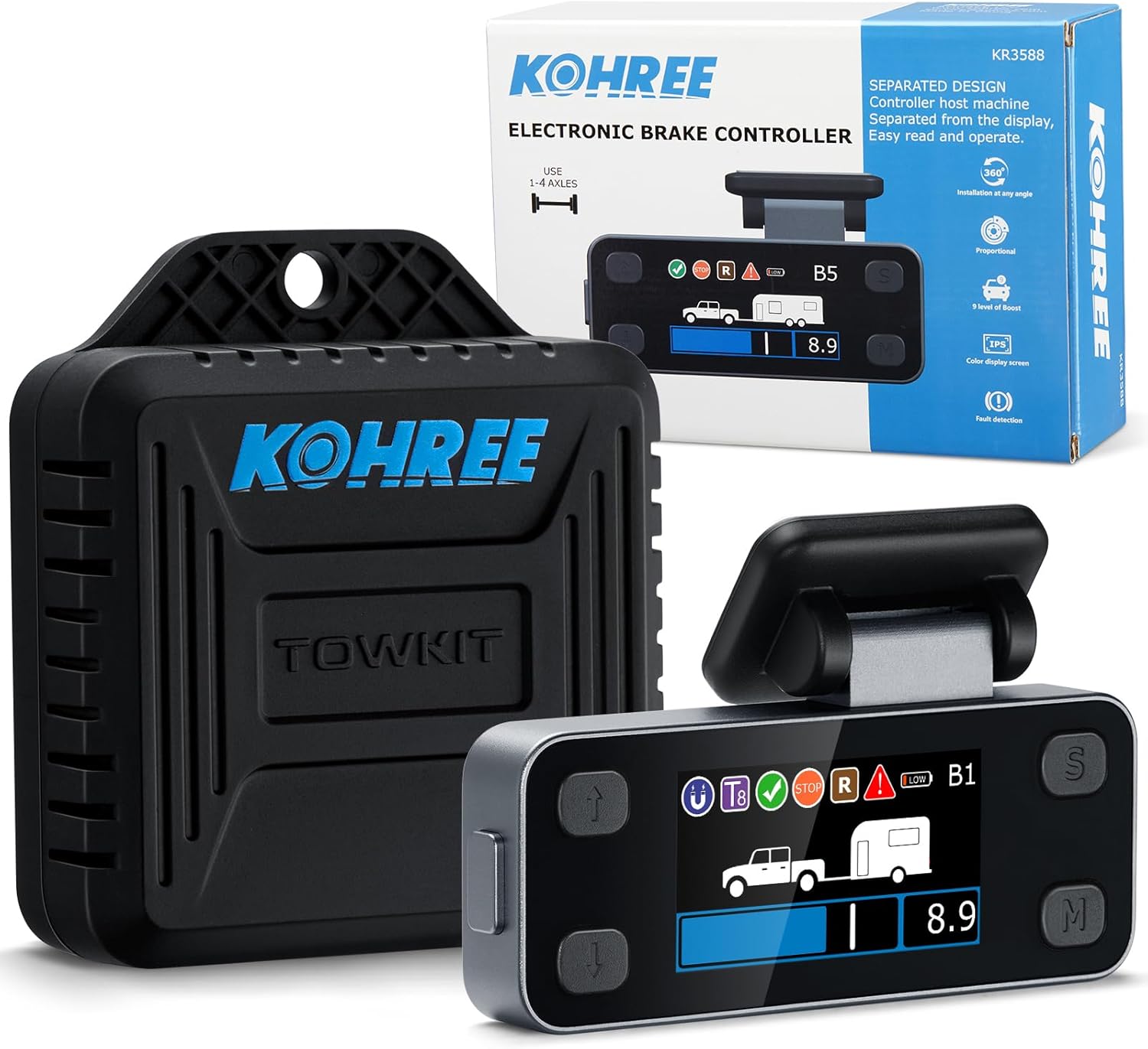
The Kohree split-design trailer brake controller separates the compact control module from a 1.9-inch color LCD display so you can tuck the controller out of sight and keep a clear readout within view. It provides proportional braking driven by built-in sensors and automatic leveling, which simplifies setup and helps deliver smooth, proportional brake force during towing. The unit stores settings for up to eight trailers and offers nine boost levels so you can fine-tune brake sensitivity to different trailer weights and characteristics. Dual 32-bit processors in the display and controller aim to keep signal processing stable for predictable response. Installation is simplified by a plug-in wiring harness and the split layout lets you mount the controller at any angle while positioning the display for visibility. Important limitations are that advanced features depend on proper wiring and calibration for the Nissan Frontier, and a professional installer may be preferable if you are not comfortable with trailer brake wiring and vehicle-specific integration.
Best for: Buyers who want a tidy dashboard and the flexibility to position a clear remote display while keeping the control unit hidden, and who plan to tow varying trailers that need adjustable braking behavior.
Less Ideal for: Drivers who prefer an all-in-one console-mounted controller or who need a controller sold with a vehicle-specific plug-and-play harness for the 2026 Nissan Frontier.
- Split design lets you mount the control module out of sight and place the readable LCD where convenient
- Proportional braking with auto-leveling reduces manual setup and improves brake modulation
- Nine boost settings and storage for multiple trailer profiles let you match response to different trailer weights
- Color IPS LCD is compact and easy to read without occupying much dash space
- Plug-in wiring harness and angle-flexible controller housing simplify installation placement
- Requires correct wiring and vehicle integration to perform as intended, which may need professional installation
- No vehicle-specific harness or fitment guide for the 2026 Nissan Frontier provided in the listing
Verdict: This design separates the display from the controller so you can mount a compact control unit out of the way and keep a readable screen where you need it.
5. REDARC Tow‑Pro Liberty Proportional Trailer Brake Controller
Best Proportional Trailer Brake Controller

| Voltage | 12 Volts |
|---|---|
| Supported axles | 1–2 axles |
| Model number | EBRH-ACCNA |
| Item weight | 8.8 ounces |
The REDARC Tow‑Pro Liberty is a proportional-style electric brake controller that applies trailer brakes in direct response to vehicle deceleration, giving noticeably smoother stops and reduced trailer push or pull. It installs as a remote head with a compact dash dial and connects to a compatible wiring harness for near‑factory integration; the unit supports 1–2 axles and includes a 1 m remote cable and mounting hardware. Notable features include active calibration and built‑in sway control to help stabilize trailers without complex setup, and a compact bezel that blends into the dash for a tidy installation. Because it is proportional, it works best once wired and positioned correctly so the controller senses vehicle deceleration reliably. The Liberty is engineered for heavy use and rated for 12 V systems, but buyers should plan for a vehicle‑specific wiring harness to get factory‑style fit and the full benefits of proportional braking. Overall, it is a practical choice for drivers who tow regularly and want braking that mirrors their truck’s behavior for more controlled towing on highways and back roads.
Best for: Drivers who prioritize smooth, vehicle‑matched trailer braking for highway and everyday towing and who plan to install a dedicated controller with a proper wiring harness.
Less Ideal for: Casual users who tow very infrequently and do not want to run a separate wiring harness or do any installation work.
- True proportional braking that mirrors vehicle deceleration for smoother, more predictable stops
- Active calibration and sway control reduce setup fiddling and help stabilize trailers
- Compact remote head and bezel allow near‑factory dash appearance
- Supports 1–2 axle trailers and includes a 1 m remote head cable and basic mounting hardware
- Designed and tested for heavy use with 12 V compatibility
- Vehicle‑specific wiring harness sold separately for factory‑style integration
Verdict: Pick a proportional controller when you want braking that mirrors your truck’s deceleration for smoother stops and improved trailer control.
6. CURT Discovery NEXT Electric Trailer Brake Controller (Time-Delay, Fully Adjustable)
Best Time‑Delay Trailer Brake Controller

| Display Type | LCD |
|---|---|
| Included Components | Discovery NEXT |
| Item Type Name | Fully Adjustable, Low Profile, 1-3 Axles, Plug-and-Play |
| Material Type | Plastic |
The CURT Discovery NEXT is a compact time-delay brake controller that gives drivers straightforward, user-adjustable control over electric trailer brakes. It installs with a low-profile bracket for improved dash clearance and uses an easy-to-read LCD to show full-text diagnostics and brightness-adjustable feedback. Drivers set gain and ramp time to tune braking feel for predictable stops across different loads, and the unit supports 1–4 axles (2–8 trailer brakes) so it covers common single-trailer towing scenarios. Its compatibility notes include low-volt, PWM, ABS, cruise control, and electric-over-hydraulic systems, which helps avoid integration headaches on modern vehicles. The design has no internal moving parts and does not require leveling, which simplifies installation and long-term reliability. As a time-delay controller it lacks the real-time proportional modulation of more advanced units, so it delivers consistent, configurable braking rather than the adaptive, vehicle-synchronized feel of proportional controllers.
Best for: Drivers who tow a single trailer with predictable loads and want a simple, adjustable controller that gives consistent braking performance and easy diagnostics.
Less Ideal for: Towing setups that require the most natural, proportional brake feel or highly variable, dynamic loads where real-time modulation is preferred.
- Low-profile bracket improves dash clearance and keeps the controller unobtrusive.
- Fully adjustable gain and ramp time let you tune braking for predictable stops across loads.
- LCD with full-text diagnostics and adjustable brightness simplifies setup and troubleshooting.
- Supports 1–4 axles (2–8 brakes) to handle typical single-trailer towing configurations.
- Time-delay operation does not provide proportional, vehicle-synchronized braking feel.
Verdict: A time‑delay controller is appropriate for simple, predictable trailer setups where a user‑adjustable ramp gives consistent braking across loads.
7. Hopkins 47235 Impulse Plug-In Time-Based Trailer Brake Controller
Best Low‑Profile Trailer Brake Controller

| Actuation type | Time-based |
|---|---|
| Adjustable output | 5% to 99% |
| Mounting | Mounts at any angle |
| Trailer brakes controlled | Up to 6 brakes |
The Hopkins 47235 Impulse is a low-profile, time-based trailer brake controller designed for straightforward towing setups. It mounts at any angle and connects via a simple plug-in wiring harness for fast installation in tight dash locations on the 2026 Nissan Frontier. A vertical manual slide gives immediate proportional-style manual braking while the built-in digital display and controls let you set braking power precisely from 5% to 99%. The unit is short-circuit protected and rated to control up to six trailer brakes, so it can handle heavier trailers without extra hardware. Because it uses time-based actuation rather than vehicle-speed proportional sensing, braking feels smooth but may not match the exact feel of more advanced proportional controllers during rapid speed changes. For drivers who want a compact controller that is easy to mount and tune, this delivers solid performance; buyers seeking the most natural, automatically scaled brake feel may prefer a proportional model instead.
Best for: Buyers who need a compact, unobtrusive brake controller that fits cramped dash locations on the 2026 Nissan Frontier and prioritize easy installation and adjustable stopping power.
Less Ideal for: Drivers who want the most natural, automatically scaled brake feel or who prefer proportional controllers that match brake force to vehicle deceleration.
- Low-profile design mounts at any angle for tight dash spaces
- Digital display and adjustable output from 5% to 99% for precise tuning
- Plug-in wiring enables quick, straightforward installation
- Capable of controlling up to six trailer brakes for heavier loads
- Short-circuit protection adds a layer of electrical safety
- Time-based actuation can feel less responsive than vehicle-speed proportional controllers during sudden speed changes
Verdict: Choose a low‑profile controller if you need a compact, unobtrusive unit that mounts neatly in cramped dash areas without sacrificing control.
Choosing the Right 2026 Nissan Frontier Trailer Brake Controller: Key Factors to Consider
Modulation and Braking Smoothness
How a controller modulates braking force directly affects trailer stability and stopping distances. Smooth, predictable modulation helps avoid trailer jackknifing or sudden nose-dive of the tow vehicle by applying the trailer brakes progressively relative to pedal input.
For the 2026 Nissan Frontier, look for controllers with proportional or inertia-based modulation that track vehicle deceleration closely. Adjustable sensitivity and output limits are useful when switching between light loads and heavy trailers so you can avoid overbraking. Poor modulation can increase wear on trailer brakes and make towing feel unstable, so prioritize controllers that allow fine-tuning of braking curves and gain settings.
Installation Complexity
Installation effort influences both upfront cost and how clean the finished setup will be. Some controllers mount neatly under the dash or in a factory-style pocket, while others require drilling or custom brackets. Wiring options vary from simple plug-in adapters that use the vehicle's trailer connector to systems that need direct connection to the tow vehicle's brake light circuit and battery feed.
For Frontier owners, consider whether you prefer a plug-and-play harness or are comfortable routing wires behind the dash. Controllers that require minimal disassembly of interior panels and include clear wiring diagrams will save time and reduce the risk of damaging trim. Also check whether the vehicle needs a brake controller harness or an aftermarket adapter to avoid splicing into factory wiring.
Control Location and Ease of Use
Where the controller places its controls affects safety and convenience while driving. In-cab controllers with ergonomic knobs, clear LED or digital readouts, and reachable mounting positions make it easier to adjust gain or manual apply brakes without taking your eyes off the road for long.
Consider whether you want a dash-mounted unit for quick access or a discreet under-dash install that stays out of the way. Controls that allow one-handed adjustments and give immediate feedback on output level are especially valuable when towing varying loads with the Frontier. Intuitive interfaces reduce driver distraction and help you tune braking on the fly.
Compatibility With Trailer Brake Type
Trailers commonly use electric drum brakes or electric-over-hydraulic systems, and some controllers are optimized for one type over the other. Verify the controller supports the type of trailer brakes you plan to tow and that it can handle the trailer's total brake amperage without overheating or tripping.
If you tow multiple trailers, look for controllers with adjustable output limits or multiple profiles to match different brake configurations. Mismatched controller and brake types can cause sluggish response or insufficient braking force, which increases stopping distances and stress on the tow vehicle's brakes.
Power Handling and Thermal Performance
A controller must safely handle the continuous and peak current demands of the trailer brakes, particularly on long descents or repeated stop-and-go towing. Overheating or thermal limiting can reduce braking effectiveness when you need it most.
Assess the rated current capacity, cooling design, and thermal protection features. Some controllers include built-in heat sinks or design choices that help dissipate heat, while others may throttle output under sustained loads. For the Frontier, where towing may include highway driving and mountain descents, reliable thermal performance preserves consistent brake feel and safety.
Serviceability and Warranty Support
Trailers and controllers see a lot of vibration and environmental exposure, so consider how easy the unit is to service and whether replacement parts or support are available. A controller with modular components or accessible fuses simplifies troubleshooting and repair.
Warranty coverage and manufacturer support are practical considerations. Longer or clearer warranty terms indicate confidence in durability and make it easier to address failures. Also check whether the controller uses standard connectors and fuses so owners can source parts locally if needed.
Proportional Versus Time-Delayed Controllers
Two broad control methods are common: proportional controllers that detect vehicle deceleration and match trailer brake force, and time-delayed units that apply a preset level of braking based on a user-selected gain. Proportional controllers generally offer more natural braking because they scale output with real-time vehicle movement.
For everyday towing with the 2026 Nissan Frontier, proportional units tend to provide smoother stops and less trailer lurching, particularly when towing varying loads. Time-delayed controllers can still be appropriate for lighter trailers or owners who prefer a simple, set-and-forget approach.
- Proportional: better modulation and feel during highway braking
- Time-delayed: simpler setup and predictable initial brake application
- Choose proportional for mixed driving and frequent load changes
Mounting Options and In-Cab Placement
Consider where the controller will be mounted in your Frontier. Common locations include under the dash, on the lower right of the steering column, or in a dedicated pocket in the center console area. The mount affects visibility and how quickly you can reach controls.
If you plan to install the unit yourself, ensure the chosen location gives enough space for the housing and wiring harness without stretching cables or interfering with pedals or steering components.
- Under-dash: clean, out-of-sight installation
- Dash-mounted: easy access and better visibility
- Console-mounting: tidy appearance if space allows
Wiring and Electrical Considerations
Wiring a trailer brake controller involves power, ground, brake switch, and output to the trailer connector. Some controllers plug into factory harnesses designed for brake controllers; others require direct connections to the battery and brake light switch. Proper routing and secure connections prevent electrical issues and reduce noise.
If you are using the Frontier's factory tow package, check whether a dedicated brake controller harness is present. If not, choose a controller with clear wiring instructions and consider adding in-line fuses to protect circuits.
- Use quality connectors and route wiring away from heat and moving parts
- Install in-line fuses on power leads to protect vehicle wiring
- Verify ground connections are on clean metal to avoid intermittent faults
Tuning Settings and Driver Feedback
Good controllers allow you to set gain, sensitivity, and manual override output so you can dial in braking behavior for different trailers. Some offer digital displays and automatic self-calibration routines, while others rely on simple knobs and LEDs to indicate status.
Look for controllers that provide clear, immediate feedback when you adjust settings so you can confidently tune braking while on the road. For drivers who tow infrequently, presets or automatic modes reduce setup time.
- Manual gain knobs let experienced users fine-tune braking
- Digital displays and automatic modes reduce guesswork
- Manual override is essential for correcting trailer sway or stopping quickly
Maintaining Performance Over Time
Routine checks help ensure consistent controller performance. Inspect connections for corrosion, verify mounting hardware is secure, and test output periodically with a multimeter or during a low-speed brake check with a loaded trailer. Environmental contaminants like dust and moisture can degrade connections and sensors.
Replace frayed wiring, clean connector pins, and periodically inspect the controller housing for cracked seals. Proper maintenance preserves modulation quality and avoids unexpected failures on longer trips.
- Inspect wiring and connectors before long trips
- Perform low-speed brake checks after installation
- Clean and secure mounting hardware to reduce vibration damage
Still looking for the perfect fit?
Select your Nissan Frontier configuration to see the most relevant Trailer Brake Controllers recommendations
How We Chose the Best 2026 Nissan Frontier Trailer Brake Controller
We evaluated trailer brake controllers for the 2026 Nissan Frontier by focusing on criteria that matter for real-world towing with this truck. Primary evaluation factors included modulation quality, meaning how smoothly a controller applies trailer brakes relative to truck braking; installation complexity, including whether the unit fits common Nissan Frontier in-cab mounting points and uses standard wiring or requires custom harnessing; user controls and interface clarity for safe adjustments while driving; and compatibility with the Frontier electrical system to avoid overloading circuits.We also considered build quality and environmental resistance because controllers mounted in the cab or under dash should tolerate vibration and temperature swings. Response time and adjustability were reviewed to ensure the controller can be tuned for different trailer weights and brake types. Finally, reliability and serviceability were part of the selection: how easy it is to swap, repair, or replace parts if needed.Excluded from the list were controllers that require extensive vehicle alterations, nonstandard electrical modifications, or those clearly underspecified for the typical towing loads for the Frontier. We prioritized units that balance performance, installation practicality, and durability for owners who tow regularly.
Our full evaluation process is outlined in our review methodology.
FAQ
Do I need a trailer brake controller to tow with my 2026 Nissan Frontier?
It often depends on the trailer's gross vehicle weight and local regulations. Heavier trailers typically require an active brake controller to meet safety and legal requirements, and a controller improves stopping control when towing loads that exceed the vehicle's unbraked towing threshold.
Can I install a controller myself in the Nissan Frontier?
Many owners can install a controller if they are comfortable routing wires and following wiring diagrams. Plug-in harnesses simplify the job, but some setups require panel removal and secure routing of power and ground leads. If you are unsure, a professional installer can ensure clean wiring and correct calibration.
What type of trailer brakes should the controller support?
Controllers should match the trailer brake type you use, typically electric drum brakes or electric-over-hydraulic systems. Verify the controller's output capability and settings are suitable for the trailer's brake configuration to ensure consistent performance.
How do I know if my controller is properly calibrated?
A properly calibrated controller will apply trailer brakes smoothly in proportion to vehicle braking without abrupt jerks. You can test calibration at low speed with a loaded trailer by applying the brakes and observing trailer behavior, then adjusting gain or sensitivity until braking feels balanced.
Will adding a brake controller affect my Frontier's electrical system?
A correctly installed controller should not adversely affect the vehicle's electrical system. Use proper fusing and wiring practices to protect circuits, and ensure the controller's power draw is within its design limits. Poor installation or undersized wiring can cause voltage drops or faults.
Is a proportional controller better for highway towing?
Proportional controllers typically provide smoother, more natural braking during highway driving because they respond to actual vehicle deceleration. This makes them well suited to mixed-speed towing with the Frontier, especially when you frequently change loads or encounter rolling terrain.
Final Verdict
When selecting a trailer brake controller for a 2026 Nissan Frontier, prioritize modulation quality, installation practicality, and electrical compatibility. Proportional controllers often deliver the most natural braking feel, while time-delayed units can work for lighter or simpler towing needs. Focus on a unit that matches your trailer brake type, offers straightforward tuning, and mounts cleanly in the cab.Balance thermal performance and ease of service with the level of control you need. By matching the controller to your typical trailer weights and installation preferences, you can improve towing stability and confidence on the road.
Explore More:
- Check out all Nissan Frontier parts & accessories
- Explore Electronics
- Browse all Accessories
