

Note: This article contains affiliate links. If you click on these links and make a purchase, I may earn a small commission at no extra cost to you. This helps support my research and content. Read my full affiliate disclosure here.
Choosing the right engine oil for a Ford F-250 affects reliability, fuel economy, and service intervals. The wrong viscosity or formulation can increase wear, reduce protection at temperature extremes, or require more frequent oil changes.This guide covers seven shortlisted options suited to the F-250, explaining why each formulation is appropriate and how we evaluated them for common owner priorities like towing, high-mileage use, and cold starts. Read on to match oil type, viscosity, and maintenance practices to how you use your truck.
Looking for other parts? See all Ford F-250 parts & accessories.
Top Picks at a Glance
| Best Overall Engine Oil Top pick balancing protection, compatibility, and DIY-friendly packaging | Motorcraft 5W-30 Engine Oil 5-Quart Jug |  |
| Best Budget Engine Oil Low-cost oil that still meets basic protection and service intervals | Valvoline Daily Protection SAE 5W-30 Synthetic Blend Motor Oil, 5 qt |  |
| Best OEM-spec Engine Oil Meets factory specifications and fit-for-purpose formulations for longevity | Motorcraft SAE 10W-30 Super Duty Diesel Engine Oil, 5-Quart |  |
| Best Diesel Full-Synthetic Oil Full-synthetic formulation sized for diesel truck engines and heavy use | Ford Motorcraft XO 5W-40 Full Synthetic Diesel Motor Oil, 1.25 U.S. Gal |  |
| Best Engine Oil Change Kit Includes oil plus filter(s) or related consumables for one service | Doc's Diesel 6.7L Power Stroke Oil Change Kit with 5W-40 Full Synthetic (4 Gallon) |  |
| Best 5W-20 Engine Oil Light-viscosity 5W-20 oils suited for engines calling for lower cold-viscosity | Motorcraft SAE 5W-20 Synthetic Blend Motor Oil, 5-Quart Jug |  |
1. Motorcraft 5W-30 Engine Oil 5-Quart Jug
Best Overall Engine Oil
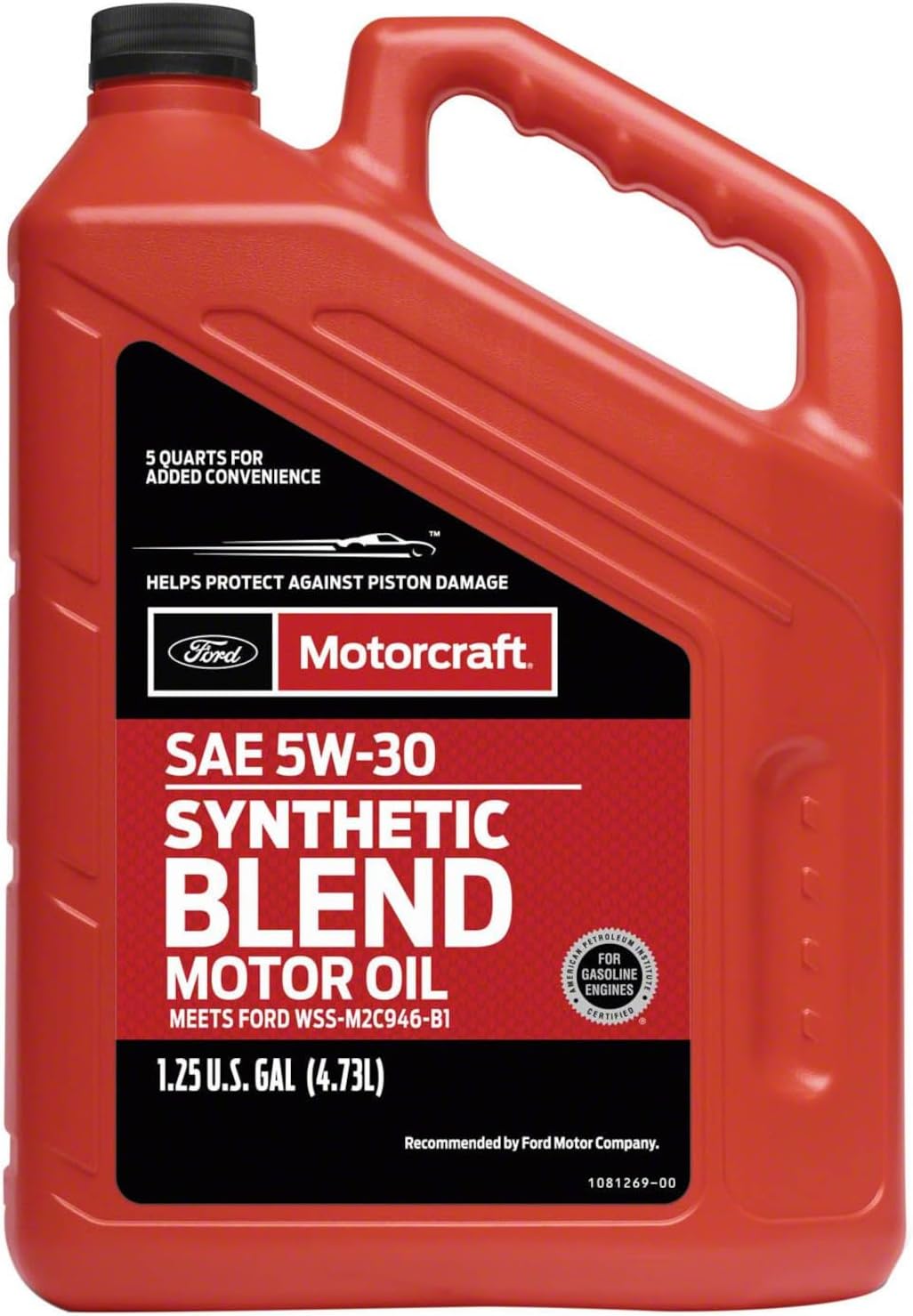
| Viscosity | 5W-30 SAE Grade |
|---|---|
| Size | 5-Quart Jug |
| Vehicle Service Type | Car, SUV, Truck, Van |
| Flash Point | 446 Degrees Fahrenheit |
This Motorcraft 5W-30 jug is designed as a factory-quality engine oil for regular maintenance and DIY oil changes. It provides the common 5W-30 viscosity suitable for many gasoline engines and comes in an easy‑to‑pour 5‑quart container that simplifies filling during routine service. The product notes compatibility with cars, SUVs, trucks, and vans and carries Motorcraft branding which aligns it with Ford and Lincoln recommended parts. Practical benefits include a standard SAE J300 viscosity grade that supports cold starts and normal operating temperatures and a high flash point that indicates thermal stability. The jug size reduces the need to buy multiple bottles for a single service on larger engines. Limitations are that the listing gives general universal fit guidance rather than vehicle-specific approvals and it does not list a detailed specification sheet for extended‑interval or heavy‑duty diesel applications, so users should confirm Ford F-250 engine requirements and oil specification numbers before relying on it for duty cycles beyond normal driving.
Best for: Buyers wanting a dependable, factory-branded 5W-30 for routine oil changes on a Ford F-250 who prioritize easy pouring and compatibility with common gasoline engine requirements.
Less Ideal for: Drivers needing oil specified for heavy towing, extended drain intervals, or diesel engine applications should look for oils with explicit manufacturer specification numbers and heavy‑duty ratings.
- Factory-branded formulation intended for Ford and Lincoln vehicles
- Standard 5W-30 SAE J300 viscosity for reliable cold starts and everyday driving
- 5‑quart jug is convenient for single-service fills on larger engines
- High flash point suggesting good thermal stability during operation
- Product listing shows universal fit and lacks detailed OEM spec numbers for specific Ford engine approvals
Verdict: Choose this slot if you want a reliable, well‑rounded engine oil that balances protection, manufacturer compatibility, and easy pouring for routine DIY oil changes.
2. Valvoline Daily Protection SAE 5W-30 Synthetic Blend Motor Oil, 5 qt
Best Budget Engine Oil

| Viscosity | SAE 5W-30 |
|---|---|
| Container Type | Bottle |
| Compatible with Vehicle Type | Car, Truck |
| Liquid Volume | 5 Quarts |
Valvoline Daily Protection 5W-30 is a synthetic blend motor oil intended for routine oil changes on gasoline engines, including light-duty trucks such as the Ford F-250. It combines refined base stocks with anti-wear additives and detergents to control sludge and varnish while providing high- and low-temperature protection for daily driving and towing light loads. The low-friction formulation helps optimize fuel efficiency and ensures usable flow at cold starts, and the product is labeled for turbocharged engines commonly found in modern trucks. As a synthetic blend it sits between conventional and full synthetic oils, offering better protection than standard oils at a lower cost than full synthetics. The practical trade-off is that it does not provide the extended service interval or maximum thermal stability of full synthetic oils, so it is best used for regular maintenance schedules rather than extended drain intervals or heavy severe-duty use.
Best for: Buyers seeking the most economical oil that still gives reliable day-to-day protection for a Ford F-250 and who plan to follow standard service intervals.
Less Ideal for: Owners who run extended oil-change intervals, perform heavy towing frequently, or want the highest heat and oxidation resistance should opt for a full synthetic oil instead.
- Synthetic blend balances improved protection with lower cost than full synthetics
- Formulated with detergents and anti-wear additives to help resist sludge and engine deposits
- Low-temperature flow and high-temperature protection suitable for typical daily driving and light towing
- Approved for turbocharged gasoline engines, covering many common truck engine configurations
- Not a full synthetic so it offers shorter recommended drain intervals and less extreme-heat resistance compared with full synthetic oils
Verdict: Pick this when you need the cheapest compatible oil that still meets minimum protection and service-interval expectations for regular maintenance.
3. Motorcraft SAE 10W-30 Super Duty Diesel Engine Oil, 5-Quart
Best OEM-spec Engine Oil

| Viscosity | 10W-30 |
|---|---|
| Size | 5 Quart Jug |
| Vehicle Service Type | Car |
| Flash Point | 464 Degrees Fahrenheit |
This Motorcraft 10W-30 Super Duty Diesel Engine Oil is positioned as a factory-quality fluid for vehicles that need a 10W-30 grade. It is supplied in a 5-quart jug and is intended for routine oil changes where maintaining manufacturer-expected lubrication, wear protection, and compatibility with engine seals and additives is important. The product lists a high flash point and is described as a premium aftermarket replacement engineered to provide long-life reliability and performance similar to factory fluids. Practical benefits include straightforward use during standard oil change service and confidence in fitment for Ford and Lincoln applications when a factory-aligned oil is desired. Important limitations are that the label specifies 10W-30 only, so it is not suitable where a different viscosity or modern synthetic low-viscosity oil is recommended, and the formulation details beyond viscosity and flash point are not provided on the listing.
Best for: Buyers who prioritize using oils aligned with factory specifications to preserve engine performance and maintain warranty expectations during scheduled maintenance.
Less Ideal for: Drivers seeking low-viscosity modern synthetics, multi-grade coverage beyond 10W-30, or detailed additive disclosure should consider other formulations.
- Branded by Motorcraft to match factory-quality fit and function for Ford and Lincoln vehicles
- Available in a convenient 5-quart jug suitable for full oil changes
- Formulated to SAE 10W-30 viscosity for engines that specify that grade
- Marketed for long-life reliability and tested to provide consistent performance
- Limited to a single viscosity grade so not appropriate where a different oil spec is required
- Listing does not provide full additive or synthetic/conventional formulation details
Verdict: Select this when you prioritize oils formulated to meet original-equipment specs and preserve factory warranties and engine performance.
4. Ford Motorcraft XO 5W-40 Full Synthetic Diesel Motor Oil, 1.25 U.S. Gal
Best Diesel Full-Synthetic Oil

| SAE Viscosity Grade | 5W-40 |
|---|---|
| API Service Category | CJ-4 |
| Compatible Vehicle Type | Truck |
| Liquid Volume | 160 Fluid Ounces |
This Ford Motorcraft XO 5W-40 is a full synthetic diesel motor oil formulated for heavy-duty use in trucks with Power Stroke and similar diesel engines. It meets API CJ-4 and is intended for engines that require ultralow sulfur diesel fuel and 2007-onward emission controls. In practice it is used for frequent towing, hauling, and sustained high-load operation where thermal stability and deposit control matter. The 5W-40 viscosity covers a wide range of ambient temperatures while providing a thicker film under load than typical 5W-30 diesels. Being a Ford-branded product, it is positioned as a factory-recommended option for Ford diesel applications and should integrate with standard service intervals. Limitations: it is not for use in gasoline engines with catalysts, and buyers should verify their engine specification requirements before switching oils. The product ships in a 1.25 gallon bottle which is convenient for top-offs but may require multiple bottles for full-capacity changes on large diesel crankcases.
Best for: Drivers who tow or haul regularly and need a factory-aligned full‑synthetic diesel oil to protect high-mileage or heavily loaded Ford diesel engines under sustained duty.
Less Ideal for: Drivers who operate gasoline engines with catalytic converters or those who prefer motor oils specified exclusively by other manufacturers should look elsewhere.
- Full synthetic formulation designed for diesel engines and heavy-duty use
- Meets API CJ-4 for 2007-onward emission-compliant diesel engines
- 5W-40 viscosity provides stronger film strength under load and broader temperature coverage
- Ford-branded formulation recommended for Power Stroke-equipped trucks
- Not approved for use in gasoline engines with catalysts
- 1.25 gallon bottle may be small for complete oil changes on large diesel engines
Verdict: Use this slot if you run diesel duty, tow or haul frequently, and need a full‑synthetic oil designed for diesel engine protection under heavy loads.
5. Doc's Diesel 6.7L Power Stroke Oil Change Kit with 5W-40 Full Synthetic (4 Gallon)
Best Engine Oil Change Kit

| Viscosity | 5W-40 |
|---|---|
| Liquid Volume | 4 Gallons |
| Compatible with Vehicle Type | Truck |
| Automotive Fit Type | Vehicle Specific Fit |
This kit supplies everything needed to perform a routine oil change on Ford 6.7L Power Stroke trucks: four gallons of 5W-40 full synthetic engine oil plus the matched filter components listed for this vehicle family. It is designed for owners who do their own maintenance and want a single purchase that removes the hassle of sourcing oil and the correct filter separately. The 5W-40 viscosity suits diesel Power Stroke engines across a wide temperature range, and the brand states the oil and filters are engineered to meet or exceed factory-quality standards. Practical benefits include simplified service prep, consistent fluid compatibility across multiple drain intervals, and reduced risk of buying an incorrect filter. Limitations are that the kit is vehicle-specific so you must confirm fitment for your exact truck and it does not include small consumables like drain pan, gasket, or tools, so a basic toolkit is still required to complete the job.
Best for: Buyers who want one convenient purchase containing the right oil and filter to complete a DIY oil change on a Ford 6.7L Power Stroke without sourcing parts separately.
Less Ideal for: Those who need a complete shop-ready kit with tools and disposal supplies or anyone with a different engine than the specified 6.7L Power Stroke should look elsewhere.
- Single kit includes full synthetic 5W-40 oil tailored for diesel Power Stroke engines
- Packaged with the correct oil filter cross-reference for Ford 6.7L Power Stroke fitment
- Large 4-gallon supply covers a full service and leaves extra oil for topping or future changes
- Simplifies maintenance by consolidating oil and filter into one purchase
- Does not include tools or disposable items such as drain pan or filter wrench
Verdict: Choose this if you want a single purchase that contains oil and required service parts so you can complete an oil change without sourcing extras.
6. Motorcraft SAE 5W-20 Synthetic Blend Motor Oil, 5-Quart Jug
Best 5W-20 Engine Oil

| SAE J300 Viscosity Grade | 5W-20 |
|---|---|
| Liquid Volume | 5 Quarts |
| Compatible with Vehicle Type | Car, SUV, Truck, Van |
| Brand Name | Ford |
| Item Type Name | Premium Synthetic Blend Motor Oil |
This Motorcraft 5W-20 synthetic blend is formulated for Ford vehicles that call for a 5W-20 viscosity and is intended to balance cold-start protection with fuel-efficient lubrication at normal operating temperatures. It is typically used as a routine engine oil fill during maintenance or oil changes for compatible Ford models. The formula combines high-viscosity-index base oils and performance additives to reduce deposits, protect against high-temperature oxidation, resist turbocharger deposits, and limit rust and foaming. Motorcraft highlights friction-reducing technology that can improve fuel economy compared with thicker 5W-30 and 10W-30 oils and notes compatibility with Ford specification WSS-M2C960-A1 and SN PLUS to address low-speed pre-ignition concerns. Packaged in a 5-quart jug, it is convenient for DIY changes and covers most single-oil-change needs for typical passenger trucks and SUVs. Limitations are that it is a synthetic blend rather than a full synthetic and it must only be used where 5W-20 is specified by the vehicle maker.
Best for: Buyers who need a Ford-approved 5W-20 oil for routine maintenance and prioritize factory-spec compatibility and straightforward DIY oil changes.
Less Ideal for: Drivers seeking the highest-end full synthetic protection for heavy towing, extended drain intervals, or extreme operating conditions should consider full synthetic alternatives.
- Formulated to meet Ford WSS-M2C960-A1 and SN PLUS specifications for compatible engines
- Friction-reducing additives that can improve fuel economy versus thicker oils
- Designed to limit deposits, oxidation, turbocharger buildup, rust, and foaming
- Sold in a 5-quart jug convenient for single DIY oil changes
- Synthetic blend rather than full synthetic, so peak high-temperature longevity may be lower than full synthetics
Verdict: Pick this when your engine requires a 5W‑20 viscosity for cold-start performance and fuel-efficient lubrication at normal operating temperatures.
Choosing the Right Ford F-250 Engine Oil: Key Factors to Consider
Viscosity and Cold-Start Performance
Viscosity determines how quickly oil circulates at different temperatures and directly affects engine wear during start-up. For the F-250, select a grade that maintains a protective film at operating temperature while flowing readily on cold mornings. Lower first number grades improve cold-start pumpability but must still provide adequate high-temperature viscosity.
Consider your climate and usage. If you frequently start the truck in low ambient temperatures, prioritize oils with strong low-temperature fluidity. If you tow or haul heavy loads, ensure the oil retains enough viscosity at operating temperature to prevent metal-to-metal contact under sustained high RPMs and loads.
High-Temperature Shear Stability
Shear stability refers to an oil's ability to retain its viscosity after extended high-load operation. Towing, hauling, and extended highway driving raise oil temperature and mechanical stress, which can thin lesser oils and reduce protection.
Choose formulations with proven shear stability so the posted viscosity grade remains effective over service intervals. This reduces bearing wear and keeps valve train clearances stable. Look for oils with additive packages designed to preserve film strength under thermal and mechanical stress.
Detergents, Dispersants, and Deposit Control
Detergent and dispersant additives keep combustion byproducts and contaminants suspended so they can be removed during an oil change. For the F-250, especially when towing or operating under heavy load, controlling sludge and varnish is essential to maintain oil passages and valve train cleanliness.
Oils with strong detergent chemistry reduce the risk of sludge buildup and help maintain oil pump and filter efficiency. This is particularly important if you perform longer drain intervals or operate the truck in dusty or stop-and-go conditions.
Compatibility With Emissions and Seal Materials
Modern engines rely on emissions control devices and a variety of elastomers in seals and gaskets. Some oil chemistries interact poorly with these materials or can interfere with sensors and emissions systems.
Select oils formulated to be compatible with passenger truck emissions hardware and seal materials. This minimizes leaks, prevents premature seal degradation, and helps ensure onboard diagnostics behave as expected. Using oils that meet OEM specifications reduces the risk of negative interactions.
Mileage and Age Considerations
High-mileage engines face issues such as increased blow-by, worn seals, and deposit accumulation. Oils designed for higher mileage vehicles include conditioners that swell seals slightly and address increased oil consumption, while cleaning agents target accumulated deposits.
If your F-250 has high miles, choose an oil formulated for mileage-related concerns. These oils can reduce leaks and improve compression retention, but they may not be necessary or optimal for newer, low-mileage engines where factory tolerances are still tight.
Service Interval and Maintenance Practices
Your intended oil change interval should align with the oil's formulation and the truck's duty cycle. Extended-drain synthetic oils can offer longer intervals, but those benefits depend on driving conditions and load. Severe service, frequent towing, or extensive idling often requires shorter intervals despite premium oil claims.
Consider filter quality, monitoring of oil condition, and manufacturer recommendations when selecting an oil for extended drains. Regular oil analysis or periodic checks can validate longer intervals and protect against unexpected contamination or degradation.
Choosing the Right Viscosity for Your F-250
Selecting the correct viscosity grade balances cold-start flow with high-temperature protection. For many F-250 engines, common grades cover a range of ambient temperatures and duty cycles. Match the viscosity to your climate and typical loads to ensure proper lubrication immediately after start-up and during sustained operation.
If you tow frequently or run heavy loads, prioritize an oil that retains thicker film strength at operating temperature. For predominantly city driving or mild climates, a lower cold-viscosity grade improves circulation on start and can slightly improve fuel economy.
- Cold climates: choose better low-temperature fluidity to reduce start-up wear
- Towing/heavy loads: favor oils with stronger high-temp viscosity retention
- Mixed-use: consider multi-viscosity oils that balance both needs
Synthetic Versus Conventional Options
Synthetic formulations typically offer better thermal stability, lower volatility, and improved cold-flow properties compared with conventional oils. That can translate into more consistent protection during towing and longer usable drain intervals if you follow appropriate maintenance practices.
Conventional oils may still be acceptable for lighter duty cycles or in older engines with specific needs. The main decision point is how you use the truck and whether the benefits of synthetic chemistry justify choosing it for performance and durability under load.
- Synthetic: improved shear stability, better cold starts, typically longer drains
- Conventional: cost-effective for light duty, but may thin faster under stress
Oil for Towing and Heavy-Duty Use
Towing raises oil temperature and mechanical stress, which increases the risk of accelerated wear. For towing, prioritize oils with robust high-temperature protection and detergency to handle combustion contaminants from prolonged high load.
Also consider oil change pacing and filter quality when using the truck for regular towing. Even a premium oil may need shorter intervals under severe duty cycles to maintain peak protection and prevent deposit buildup.
- Look for oils with proven high-temp film strength
- Maintain more frequent oil checks when towing regularly
- Use high-quality filters rated for heavier contamination loads
High-Mileage Considerations for Older F-250s
If your F-250 has high miles, engine wear and increased blow-by can change oil consumption and internal cleanliness demands. High-mileage formulations often include seal conditioners and cleaning agents designed to reduce leaks and manage deposits.
These oils can be a useful stopgap to improve drivability and reduce oil consumption, but they do not reverse mechanical wear. Pairing a high-mileage oil with appropriate maintenance will give the best results for older engines.
- High-mileage oils may reduce leaks and oil consumption
- Expect improved seal performance but not mechanical restoration
- Monitor oil consumption and condition more frequently
Winter Starts and Cold-Weather Strategy
Cold starts are when the most wear occurs because the oil is cold and circulation is limited. For winter operation, choose a formulation with excellent low-temperature pumpability and consider a winter-grade viscosity that still meets engine requirements.
Keep in mind that thicker oils at cold temperatures increase starter load and can affect battery performance, so pairing cold-weather oil choices with proper battery and starter maintenance is important for reliable cold starts.
- Use oils with low pour points and strong cold-flow specs
- Consider a slightly lower cold-numbered viscosity if winters are severe
- Ensure battery and starter health to complement oil selection
Monitoring Oil Condition Between Changes
Regularly check oil level and visual condition. Look for unusual color changes, milky appearance, or metallic particles, which indicate contamination or internal issues. Frequent monitoring is especially important if you tow, operate in dusty environments, or use extended drain intervals.
For owners wanting extra assurance, periodic oil analysis provides data on wear metals, contaminants, and additive depletion. That information helps determine realistic drain intervals and detect problems before they become serious.
- Check level and appearance at each fueling or weekly
- Consider oil analysis for high-mileage or heavy-use trucks
- Change the filter with every oil service to maintain cleanliness
How We Chose the Best Ford F-250 Engine Oil
We focused on engine oils that meet Ford's specifications and address the common operating conditions for the F-250, including towing, highway hauling, and extended idling. Editorial selection prioritized four to six concrete performance dimensions: viscosity range and cold-flow properties, high- and low-temperature protection, deposit control and detergent performance, compatibility with emissions systems and seals, and suitability for high-mileage engines or extended drain intervals.We required that candidates come in common F-250 viscosities and formulations and that technical data support claims about wear reduction and thermal stability. Oils lacking clear performance specifications, appropriate viscosity grades for Ford V8 engines, or compatibility statements were excluded. We also favored formulations with demonstrated detergent and dispersant packages to prevent sludge under heavy loads.Excluded items included single-use or specialty racing oils not formulated for everyday truck service, and products without supporting technical data. The resulting list reflects a balance of durability, cold-start performance, and protection under load, aimed at owners who tow, rack up miles, or need reliable protection through seasonal extremes.
Our full evaluation process is outlined in our review methodology.
FAQ
How often should I change engine oil in my F-250?
It depends on driving conditions. For normal highway use, many owners follow manufacturer intervals, while severe service such as frequent towing or stop-and-go city driving often requires shorter intervals. Monitor oil condition and follow the owner manual for guidance.
Can I switch from conventional to full synthetic in my F-250?
Usually yes. Switching to full synthetic is compatible with most F-250 engines and can improve cold starts and thermal stability. Ensure the chosen oil meets Ford specifications for viscosity and performance before switching.
What viscosity should I use if I tow regularly?
When towing, prioritize an oil that maintains high-temperature viscosity and shear stability. Check your owner's manual for approved grades and pick a formulation within that range that emphasizes high-temp protection.
Are high-mileage oils worth using on older F-250 engines?
High-mileage oils can help reduce leaks and manage deposits in older engines due to seal conditioners and detergents. They do not restore worn components but can improve drivability and reduce oil consumption in many cases.
Will a different oil affect my emissions system?
Some oil chemistries can impact emissions components or sensor function if they do not meet OEM compatibility. Use oils that state compatibility with emissions systems and meet manufacturer specifications to reduce risk.
Can I extend oil change intervals with premium oil?
Premium synthetic oils often offer longer potential intervals, but actual extension depends on load, driving habits, and contamination risk. For frequent towing or severe service, shorter intervals may still be necessary despite a premium oil.
Final Verdict
Prioritize an oil that matches your F-250's duty cycle and climate. For towing and heavy loads, emphasize high-temperature shear stability and deposit control. For cold climates, choose a formulation with strong low-temperature flow.Balance potential extended-drain benefits against real-world service conditions. Monitor oil level and condition, and follow the owner manual for approved viscosities. With that approach you can select an oil that protects the engine and supports the way you use your F-250.
Explore More:
- Check out all Ford F-250 parts & accessories
- Explore Fluids & Chemicals
- Browse all Accessories
