

Note: This article contains affiliate links. If you click on these links and make a purchase, I may earn a small commission at no extra cost to you. This helps support my research and content. Read my full affiliate disclosure here.
Your Ford F-250 Diesel depends on the right coolant to manage heat, resist corrosion, and protect key engine components under heavy towing and long idle times. Using an inappropriate coolant can accelerate corrosion in the radiator, cylinder head, water pump, and cooling passages or reduce freeze and boil-over protection.This guide shortlists seven of the best coolant options for Ford F-250 Diesel applications and evaluates them on the traits that matter most to owners: corrosion inhibitors, extended service intervals, freeze and boilover protection, and compatibility with engine seals and aluminum components. Read on to understand how each property affects durability and maintenance so you can pick the coolant that fits your driving and service habits.
Looking for other parts? See all Ford F-250 parts & accessories.
Top Picks at a Glance
| Best Overall Coolant A well-balanced choice that suits most diesel and gas engines | Ford Gold 50/50 Prediluted Antifreeze/Coolant – 1 Gallon |  |
| Best Budget Coolant A low-cost option that still provides basic engine protection | Zerex Dex-Cool 50/50 Ready-to-Use Antifreeze/Coolant (1 Gallon) |  |
| Best Long-Life Coolant Formulated for extended service intervals and longer corrosion protection | Triax All Fleet ELC Diesel Extreme HD NOAT Concentrate, 1 Gallon |  |
| Best Concentrated Coolant Undiluted concentrate that you mix to the desired freeze/boil protection | Zerex G05 Phosphate-Free Concentrate Antifreeze Coolant 1 Gallon |  |
| Best Pre-Mixed Coolant Ready-to-use coolant that eliminates measuring and mixing at each fill | Valvoline Multi-Vehicle 50/50 Ready-to-Use Antifreeze Coolant, 1 Gallon |  |
| Best Low-Silicate Coolant Low-silicate formula designed to reduce deposit formation in cooling systems | Zerex Original Green Low-Silicate Antifreeze/Coolant 1 Gal |  |
| Best Heavy-Duty Coolant A robust formula built for towing, hauling, and high-heat conditions | Zerex Heavy Duty Nitrite Free Extended Life Concentrate Antifreeze/Coolant (1 gal) |  |
1. Ford Gold 50/50 Prediluted Antifreeze/Coolant – 1 Gallon
Best Overall Coolant

| Formulation | 50/50 prediluted |
|---|---|
| Volume | 1 Gallon |
| Meets specifications | WSS-M97B51-A1, ASTM D3306, ASTM D6210 |
This Ford Gold 50/50 prediluted antifreeze comes ready to pour and is formulated to meet Ford coolant specifications for gasoline and diesel applications in Ford family vehicles. It is typically used as a direct replacement during cooling system service or top-offs when the factory coolant calls for this formulation. Notable features include factory recommendation for Ford, Lincoln, and Mercury, a bittering agent to discourage ingestion, and compliance with multiple industry standards such as WSS-M97B51-A1 and ASTM D 3306. Practical benefits are straightforward: no mixing needed, predictable 50/50 freeze and boil protection, and corrosion inhibitors matched to Ford cooling systems that help preserve aluminum and alloy components. Limitations are that it is a specific Ford-formulated coolant, so using it outside recommended Ford-family applications risks mixing incompatible chemistries, and users who want concentrated coolant for custom mixing will need a different product. For routine maintenance on compatible Ford vehicles this jug simplifies service and maintains factory coolant chemistry.
Best for: Buyers who prioritize a factory-recommended, maintenance-friendly coolant for routine cooling system service on compatible Ford-family trucks and vans and who want a ready-to-use solution that preserves manufacturer-specified chemistry.
Less Ideal for: Drivers working on non-Ford vehicles with different coolant chemistry requirements or technicians who need concentrated coolant for custom mixing should look elsewhere.
- Ready-to-use 50/50 formulation eliminates the need to mix water and simplifies servicing
- Recommended by Ford for use in Ford, Lincoln, and Mercury vehicles which helps maintain factory cooling chemistry
- Meets multiple industry and manufacturer specifications for corrosion and thermal performance
- Includes a bittering agent to reduce accidental ingestion
- Formulated specifically for Ford-family vehicles so it is not a universal coolant for all makes
Verdict: The best all-around coolant that balances corrosion protection, freeze/boil performance, and service life for most routine engine cooling needs.
2. Zerex Dex-Cool 50/50 Ready-to-Use Antifreeze/Coolant (1 Gallon)
Best Budget Coolant

| Formulation | Organic Acid Technology (OAT) |
|---|---|
| Mixture | 50/50 ready-to-use |
| Volume | 1 gallon |
| Compatibility note | Approved for vehicles requiring orange OAT coolant |
This one-gallon Zerex Dex-Cool comes ready to pour and is designed to protect cooling systems using an orange OAT formula. For an F-250 diesel, it provides year-round freeze and boil protection without needing dilution, and its carboxylate chemistry resists corrosion, scale, and deposits on aluminum and other metals. Typical use is topping off the radiator or doing a full coolant flush and refill; the pre-mixed concentrate removes the guesswork for proper mixture. Notable features include manufacturer approval for vehicles that call for Dex-Cool style OAT coolant and a formula free of silicates and phosphates, which helps reduce sludge buildup over time. The main limitation for F-250 diesel owners is that this is a conventional OAT product targeted at standard service life rather than specialty heavy-duty diesel formulas that may carry extended drain intervals or specific heavy-duty anti-foaming additives. If your Ford F-250 diesel manual specifies an OAT orange coolant, Zerex offers a straightforward, low-cost option that focuses on reliable corrosion and freeze protection rather than long-life or fleet-grade extras.
Best for: Ford F-250 diesel owners who want a dependable, no-fuss coolant for routine service and seasonal protection without paying for extended-life or specialty fleet formulas.
Less Ideal for: Drivers who need extended drain intervals, fleet-grade heavy-duty diesel additives, or who are following a service manual that specifies a different proprietary coolant chemistry.
- Ready-to-use 50/50 mix removes need to dilute and simplifies topping off or refilling.
- OAT formula resists corrosion, scale, and deposits on aluminum and other cooling system metals.
- Silicate- and phosphate-free formulation reduces risk of sludge and compatibility issues with other OAT coolants.
- Not formulated as a heavy-duty diesel-specific coolant with extended drain intervals or specialized additives for extreme fleet duty.
Verdict: The best low-cost coolant for buyers who want reliable corrosion and freeze protection without paying for extended-life additives or specialty formulas.
3. Triax All Fleet ELC Diesel Extreme HD NOAT Concentrate, 1 Gallon
Best Long-Life Coolant

| Brand | Triax |
|---|---|
| Model | ELC |
| Formulation | Concentrate |
| Special Features | 1 million mile, 20,000 hours, or 8 years; contains bittering agent; mixes with other antifreeze |
Triax All Fleet ELC is a concentrated NOAT diesel coolant designed for long service intervals in heavy-duty diesel applications. It is intended to be mixed to the correct freeze/boil protection and used in engines where extended-life, SCA-free performance is desired. Notable features include molybdate-based cavitation protection, formulation safe for mixed radiator metals including aluminum, and a concentrated formula that mixes with conventional antifreeze colors. In practice this coolant reduces the frequency of full system drains by offering up to 1 million miles, 20,000 hours, or 8 years of protection when maintained properly, which is useful for DIYers who want fewer coolant changes. Because it is a full concentrate, accurate mixing and following manufacturer service intervals are important. It is aimed at heavy-duty diesel cooling systems and may be overkill for light-duty passenger cars that do not need long-life diesel inhibitors.
Best for: DIY owners seeking to extend coolant change intervals on heavy-duty diesel trucks and equipment who prefer a concentrated, long-life inhibitor they can mix and maintain themselves.
Less Ideal for: People with light-duty gasoline vehicles that follow conventional service intervals or owners who prefer pre-mixed, ready-to-use coolants should consider simpler alternatives.
- Very long service life rated up to 1 million miles, 20,000 hours, or 8 years when used correctly
- Formulated to protect mixed-metal cooling systems including aluminum and cast iron
- Contains molybdate for diesel cylinder liner cavitation protection
- Concentrate allows correct dilution for different climates and service requirements
- Requires accurate mixing and adherence to service procedures since it is a full concentrate
Verdict: The best long-life coolant for DIYers who prefer fewer coolant changes and superior inhibitor longevity between scheduled services.
4. Zerex G05 Phosphate-Free Concentrate Antifreeze Coolant 1 Gallon
Best Concentrated Coolant

| Brand | Valvoline |
|---|---|
| Model | G05 |
| Formula | Hybrid Organic Acid Technology (HOAT) |
| Volume | 1 gallon |
Zerex G05 concentrate is a long-life coolant formulated to be mixed to your required antifreeze ratio for topping off or full system flushes. It uses Hybrid Organic Acid Technology and virgin ethylene glycol to protect aluminum and other cooling-system metals from corrosion, deposits, freezing and boiling, and includes nitrites for diesel cylinder liner cavitation protection. In practice you mix it with water at the ratio that matches your climate and service plan, so it is useful both for precise temperature control and for carrying a single small container to perform multiple top-offs. Notable features include low silicate and phosphate-free chemistry, deposit control additives, and compatibility with gasoline and diesel systems. Limitations are that you must measure and mix correctly for protection and that some fleets may prefer factory-specified premixed formulas to avoid handling errors. For Ford F-250 diesel owners this concentrate gives the flexibility to tailor freeze/boil protection and maintain long-life service intervals when mixed and used per manufacturer guidance.
Best for: Buyers who want a concentrated coolant they can mix to exact ratios for climate-specific protection or to stock a small container for multiple top-offs and maintenance tasks on diesel pickups.
Less Ideal for: Users who prefer ready-to-use, factory-precharged coolant or who want a no-mix product to avoid measuring and handling chemicals on site.
- Concentrated formula lets you mix precise antifreeze-to-water ratios for climate-specific protection
- HOAT chemistry and low silicate, phosphate-free formulation protect aluminum and other metals
- Contains nitrites and deposit control additives for diesel engine protection and reduced scaling
- Suitable for both gasoline and diesel systems and designed for long-life service intervals
- Requires accurate mixing and correct water quality to achieve advertised freeze and boil protection
Verdict: The best concentrated coolant for owners who want to mix to precise antifreeze ratios or stock a smaller package for multiple top-ups.
5. Valvoline Multi-Vehicle 50/50 Ready-to-Use Antifreeze Coolant, 1 Gallon
Best Pre-Mixed Coolant

| Size | 1 Gallon |
|---|---|
| Flash Point | 250 Degrees Fahrenheit |
| Automotive Fit Type | Universal Fit |
| Model | Multi-Vehicle |
This premixed Valvoline Multi-Vehicle coolant is designed to be poured straight into the cooling system without measuring or diluting, which makes topping off or refilling a Ford F-250 diesel straightforward and error-free. It contains the brand's Alugard Plus additive to help prevent corrosion, deposits, and leaks across common cooling system metals including aluminum, and is formulated to meet ASTM D3306 specifications for ethylene glycol engine coolants. The ready-to-use yellow formula provides freeze protection down to -34F and boil-over protection to about 265F in a 50/50 mix with deionized water, so it handles a wide range of climates and heavy-duty operating conditions. Practical benefits include convenience, broad compatibility with other ethylene-glycol coolants, and additives that aim to protect hoses and gaskets. Limitations are that it is a universal premix rather than a vehicle-specific diesel coolant formulation, so for fleets or engines requiring a specific factory coolant chemistry a manufacturer-recommended product should be checked first.
Best for: Buyers who prioritize convenience and consistent protection when topping off or refilling cooling systems on light-duty trucks and diesels and want a ready-to-use coolant with broad compatibility.
Less Ideal for: Service departments, fleets, or owners who must follow a specific factory-specified coolant chemistry for warranty or heavy-duty diesel requirements should choose the manufacturer-recommended product instead.
- Ready-to-use 50/50 premix eliminates dilution mistakes and saves time.
- Alugard Plus additive enhances compatibility with other ethylene-glycol coolants and protects aluminum components.
- Protects against freezing and boiling across a wide temperature range suitable for varied climates.
- Formulated to meet ASTM D3306 for automobiles and light-duty trucks.
- Not a vehicle-specific diesel-only formulation, so it may not match some heavy-duty manufacturer chemistries.
Verdict: The best pre-mixed coolant for consumers who want the convenience of ready-to-use fluid with consistent protection and no dilution errors.
6. Zerex Original Green Low-Silicate Antifreeze/Coolant 1 Gal
Best Low-Silicate Coolant

| Brand | Zerex |
|---|---|
| Model | Original Green |
| Form | Concentrate |
| Manufacturer | Valvoline |
Zerex Original Green is a low-silicate concentrate coolant intended for topping off or refilling cooling systems in diesel trucks like the Ford F-250 when manufacturer specs call for a low-silicate formula. It combines organic acid inhibitors with limited silicate levels to reduce hard silicate deposits while still providing strong corrosion and cavitation protection for mixed-metal systems common in heavy-duty engines. The concentrate format lets you mix to the vehicle maker's recommended ratio for the climate and operating conditions. Practical benefits include long-term corrosion inhibition, freeze protection to typical concentrate levels, and a bittering agent to discourage ingestion. Limitations are that you must dilute it correctly before use and confirm that the F-250's engine specification accepts a low-silicate formula; using the wrong coolant chemistry can reduce protection. For fleet or owner-operators focused on minimizing silicate buildup without sacrificing cavitation resistance, this coolant provides a balanced option.
Best for: Buyers who need a low-silicate coolant that balances reduced silicate deposits with corrosion and cavitation protection for heavy-duty diesel cooling systems and who will follow the vehicle maker's coolant specification.
Less Ideal for: Users who prefer ready-to-use premixed coolant or who cannot verify that their F-250 diesel calls for a low-silicate chemistry should consider different options.
- Low-silicate formulation reduces risk of hard silicate deposits in cooling passages
- Organic acid inhibitor package provides extended corrosion protection for mixed metals
- Concentrate form allows mixing to manufacturer-specified freeze and boil protection
- Contains a bittering agent to discourage accidental ingestion
- Requires correct dilution before use, adding a step compared with pre-mixed coolants
Verdict: The best low-silicate coolant for buyers aiming to minimize silicate deposits while maintaining strong corrosion and cavitation protection for mixed-metal systems.
7. Zerex Heavy Duty Nitrite Free Extended Life Concentrate Antifreeze/Coolant (1 gal)
Best Heavy-Duty Coolant
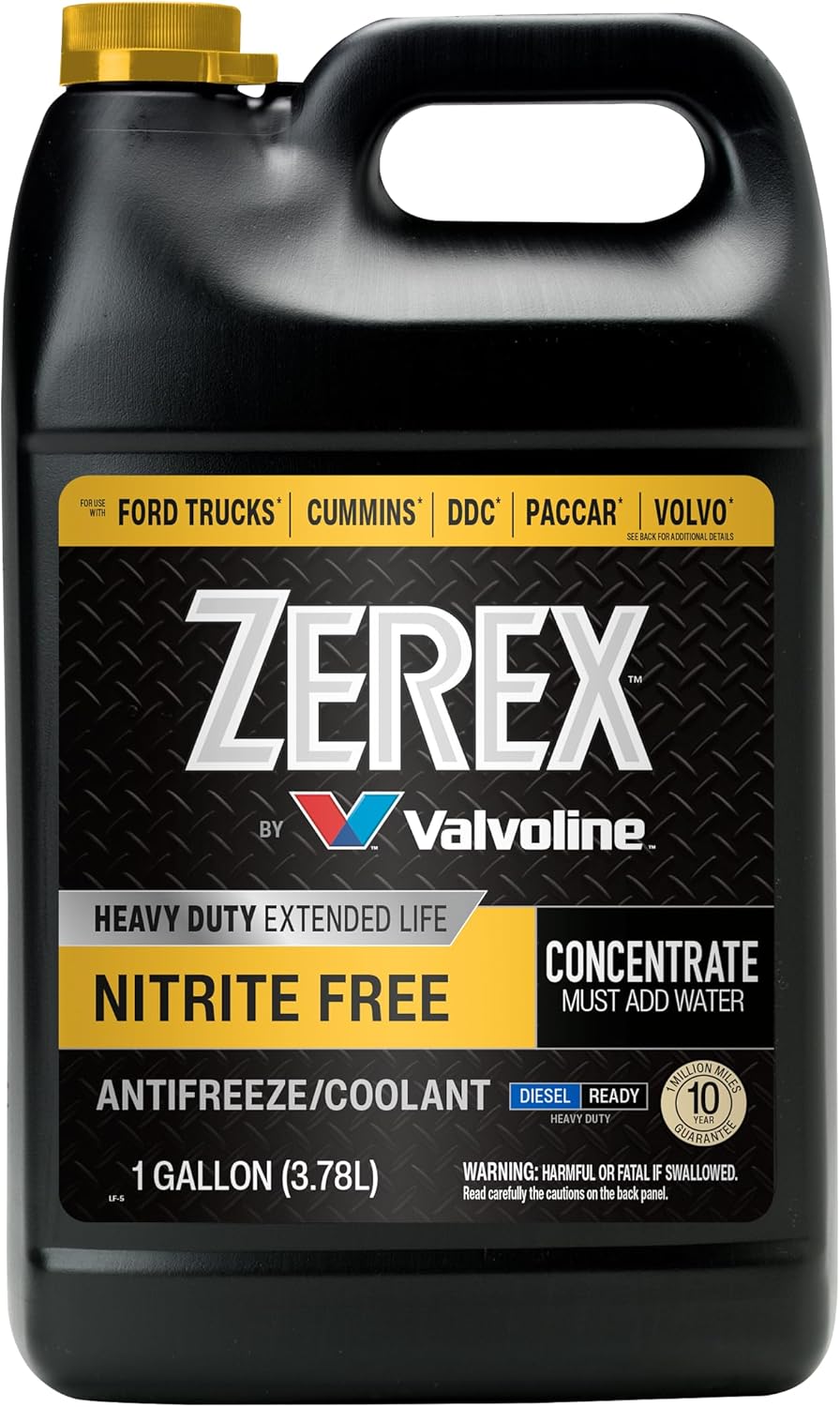
| Type | Concentrate (mix 50/50) |
|---|---|
| Chemistry | Organic Acid Technology (nitrite-free) |
| Special Features | Silicate, amine, and borate-free formula |
| Service Life Claim | Up to 10 years / 1,000,000 miles / 20,000 hours |
Zerex Heavy Duty Nitrite Free Extended Life is a concentrated organic-acid coolant formulated for heavy-duty diesel engines and engineered systems that face sustained high load and thermal stress. It is mixed 50/50 with water and used for system fills or complete flushes to protect against rust, cavitation, hard-water scale and freeze or boil-over conditions. Notable features include a silicate, amine and borate-free chemistry and patented Organic Acid Technology that targets cylinder liner pitting and water pump corrosion. The product is qualified for use in many modern truck engine platforms and carries a long-life performance claim covering up to 10 years, 1,000,000 miles, or 20,000 hours when used per instructions. Practical benefits for fleet or serious owner-operators are extended service intervals, reduced need for supplemental additives, and tuned protection for EGR and ACERT-equipped engines. Limitations: it is a concentrate that requires correct dilution and may not match specific coolant colors or filler requirements for some OEM-filled systems without following manufacturer guidance.
Best for: Buyers who run heavy-duty diesel trucks or fleets and need a coolant that prioritizes long service life and protection against cavitation, corrosion, and hard-water deposits during sustained heavy use.
Less Ideal for: Casual passenger vehicle owners who prefer pre-mixed, color-matched coolants or who need a product explicitly specified by their dealer for warranty compliance.
- Formulated for heavy-duty diesel engines and modern emission-controlled platforms
- Organic Acid Technology protects against cavitation and pitting
- Silicate, amine and borate-free to reduce abrasive wear on water pump seals and liners
- Long-life performance claim up to 10 years or 1,000,000 miles when used as directed
- Sold as a concentrate that must be diluted correctly before use
- Specific fleet or OEM approvals are not listed on the product detail requiring buyers to verify compatibility
Verdict: The best heavy-duty coolant for users who need enhanced thermal stability, extra rust/cavitation protection, and reliable performance under sustained heavy loads.
Choosing the Right Ford F-250 Diesel Coolant: Key Factors to Consider
Coolant Chemistry and Compatibility
Different coolant chemistries use distinct inhibitor packages that control corrosion in aluminum, copper, and iron cooling-system parts. For a Ford F-250 Diesel, compatibility with aluminum cylinder heads, radiators, and mixed-metal systems is critical because incompatible formulations can accelerate pitting or cause protective films to break down.
Always confirm the coolant chemistry matches Ford's recommendations or is explicitly formulated for diesel engines with aluminum components. Pay attention to whether a coolant is OAT, HOAT, or conventional IAT and what that means for mixing with existing coolant. Mixing chemistries can reduce inhibitor effectiveness and shorten service life, so plan for a full system flush if switching types.
Corrosion Inhibitor Package
The type and concentration of corrosion inhibitors determine how long the coolant will protect ferrous and non-ferrous metals under high-temperature, high-load conditions. Diesel engines often see extended idling and heavier thermal cycling, so an inhibitor package that resists depletion and continues to protect water pumps, heaters, and cylinder liners matters.
Look for coolants that specify inhibitor longevity or residual protection and those that include silicate-free or low-silicate formulations if recommended by Ford. Effective inhibitors also reduce the risk of coolant passages becoming blocked by scale or Deposits that can impede heat transfer.
Service Life and Maintenance Intervals
Longer service-life coolants reduce the frequency of full coolant changes, which is valuable for trucks with high mileage or fleet vehicles. However, claimed extended intervals only matter if the product's inhibitor package actually holds up under diesel operating stresses.
Consider your typical duty cycle and whether you tow frequently or operate in extreme temperatures. For heavy use, a coolant with tested long-life credentials and clear guidance on when to perform coolant flushes or condition tests will lower total ownership hassle without sacrificing protection.
Freeze and Boilover Protection
An effective coolant must provide a wide freeze and boilover protection range so the engine remains protected in both cold starts and sustained high-load operation. Diesel engines often run hotter under load, so adequate boilover protection is essential to prevent vapor lock and localized overheating.
Check the documented freeze point and boiling point with the recommended water-to-coolant mix. In colder climates, ensure the mixture still protects against freeze damage; in hot or heavy-tow conditions, adequate boiling-point elevation and antifade performance are crucial.
Seal and Hose Compatibility
Coolants contain additives that can affect rubber hoses, O-rings, and gaskets. Some formulations are formulated to be gentle on common elastomers used in diesel cooling systems, while others can cause accelerated hardening, swelling, or degradation if incompatible.
Before selecting a coolant, verify compatibility with the F-250 Diesel's hoses and seals. If you plan to change coolant types, inspect and, if necessary, replace aging hoses and seals during the flush to avoid leaks caused by a change in chemistry interacting with older components.
Heat Transfer and Deposit Control
Beyond corrosion protection, a coolant must maintain good heat-transfer properties and resist forming scale or Deposits that reduce radiator efficiency. Diesel operation with particulate exposure or older systems susceptible to buildup requires formulations that minimize deposit formation and keep passages clear.
Prioritize coolants that document deposit-control performance or reference testing for thermal conductivity retention over time. Maintaining clean cooling passages will help the engine run at optimal temperature and reduce the risk of hotspots that can lead to component damage.
Preparing the Cooling System for a Fluid Change
A proper coolant change starts with a thorough flush to remove old inhibitors, scale, and buildup. For the Ford F-250 Diesel, draining the system and using a compatible flush agent or plain water rinse removes residual chemistry that could react poorly with the new coolant.
After flushing, inspect the radiator, heater core, hoses, clamps, and water pump for signs of corrosion, leaks, or degraded seals. Replace suspect hoses or clamps to prevent failures once the system is refilled with new coolant. Bleed air pockets according to the factory procedure to avoid hotspots caused by trapped air.
- Drain and flush until runoff is clear
- Inspect hoses, clamps, and water pump
- Replace brittle or swollen hoses
- Refill to the correct mixture and bleed air
Mix Ratios and When to Use Concentrate Vs Pre-Mix
Coolants are offered as concentrate or pre-mixed solutions. Concentrates let you control the water-to-coolant ratio, which matters for reaching a specific freeze or boil point. Pre-mixed coolants are convenient and reduce the chance of incorrect dilution.
For most climates, a 50/50 mix of coolant and distilled water offers balanced freeze and boil protection and maintains inhibitor concentration. If you live in very cold regions, adjust the mix toward a higher antifreeze content; in very hot climates or heavy towing situations, prioritize boilover protection and follow manufacturer guidance.
- 50/50 is a common baseline
- Use distilled or demineralized water to avoid mineral deposition
- Follow label guidance for specialty mixes
Monitoring Coolant Condition Over Time
Regularly check coolant condition with test strips or refractometers that measure freeze point and inhibitor presence. Diesel engines can deplete inhibitors differently depending on duty cycle, so periodic testing helps catch declining protection before corrosion starts.
Also visually inspect the coolant for discoloration, cloudiness, or particulate that indicate contamination or internal corrosion. If the coolant shows significant color changes or test results indicate low inhibitor levels, schedule a flush and refill and investigate for underlying system issues.
- Test freeze point and inhibitor levels periodically
- Look for rust, oil contamination, or cloudiness
- Document service dates and test results for trend tracking
Addressing Overheating and Localized Hotspots
If your F-250 Diesel experiences overheating or localized hotspots, begin by verifying coolant level, thermostat operation, and radiator airflow. Deposits and scale can reduce heat transfer and create hot spots even when coolant chemistry appears nominal.
Corrective steps include performing a cooling-system cleaning, verifying fan operation, and ensuring the correct coolant concentration. Persistent hotspots may indicate head gasket or internal engine issues, so use coolant condition as one diagnostic input rather than the sole cause.
- Check thermostat and fan operation
- Inspect radiator and condenser for obstructions
- Consider professional inspection for persistent overheating
Storing and Handling Coolant Safely
Coolant contains chemicals that require safe storage away from children and pets. Keep containers sealed and store them in a cool, dry place away from direct sunlight to preserve inhibitor effectiveness.
Follow disposal regulations for used coolant because it can be hazardous to the environment. When handling, wear gloves and avoid skin contact; in case of spills, clean promptly and neutralize according to local guidelines.
- Store sealed in original container away from heat
- Dispose of used coolant per local hazardous waste rules
- Avoid mixing unused different-chemistry coolants in storage
Still looking for the perfect fit?
Select your Ford F-250 configuration to see the most relevant Coolants recommendations
How We Chose the Best Ford F-250 Diesel Coolant
We focused on selection criteria that reflect the specific demands of Ford F-250 Diesel engines, prioritizing long-term corrosion resistance and thermal management for heavy-duty use. Evaluation emphasized coolant chemistry compatibility with aluminum cylinder heads and cast-iron blocks, the presence and type of supplemental coolant additives, and manufacturer-recommended corrosion inhibitor technology. We also weighed published service life or change-interval claims alongside common maintenance practices like coolant flush frequency.Practical durability factors were included such as inhibitor depletion rates, scale and deposit control, and suitability for extended drain intervals commonly requested by fleet and towing owners. Heat-transfer characteristics and freeze/boil protection ranges were considered to ensure reliable performance across seasons and load conditions.Excluded from consideration were any fluids intended solely for gasoline passenger cars, temporary stop-leak additives, and products lacking clear technical specification on inhibitor chemistry. The final shortlist reflects compatibility, documented inhibitor technology, service-interval claims, and real-world suitability for diesel cooling-system stresses.
Our full evaluation process is outlined in our review methodology.
FAQ
How often should I change coolant in a Ford F-250 Diesel?
It depends on coolant type and duty cycle. Many long-life formulations claim extended intervals, but for trucks used in towing or heavy duty, check inhibitor levels annually and consider change intervals based on test results rather than fixed mileage.
Can I mix different types of coolant in my F-250 Diesel?
Mixing coolant chemistries is generally discouraged because it can reduce inhibitor effectiveness. If you must change types, perform a full flush to remove the old coolant before refilling with the new formulation.
Will a coolant flush fix overheating issues?
A flush can help if overheating is caused by degraded inhibitors or scale reducing heat transfer. However, overheating may stem from other issues such as thermostat failure, water pump problems, or internal engine faults that a flush will not resolve.
What mix ratio should I use for winter and summer?
A 50/50 mix is a common baseline offering balanced freeze and boil protection. In colder climates increase antifreeze concentration for lower freeze point; in hotter or heavy towing conditions prioritize boiling-point elevation per product guidance.
How do I know if my coolant is corroding components?
Look for rust-colored fluid, particulate in the radiator, or signs of pitting on cooling-system components during inspection. Regular coolant testing for inhibitor levels helps detect declining protection before visible damage occurs.
Is OEM coolant replacement necessary for the F-250 Diesel?
OEM-formulated coolants are designed for compatibility, but equivalent long-life formulations with matching chemistry and specifications can be acceptable. Verify chemistry compatibility and service-life claims before substituting.
Final Verdict
Choose a coolant that matches the chemistry and service-life expectations for the Ford F-250 Diesel. Prioritize formulations that explicitly support mixed-metal systems and provide robust corrosion inhibitor packages, especially if you tow or run the truck under heavy loads.Balance desired maintenance intervals against proven inhibitor longevity and plan for regular testing and periodic flushes when needed. By focusing on compatibility, inhibitor durability, and heat-transfer performance you can select a coolant that protects the engine and reduces the likelihood of cooling-system failures.
Explore More:
- Check out all Ford F-250 parts & accessories
- Explore Fluids & Chemicals
- Browse all Accessories
