

Note: This article contains affiliate links. If you click on these links and make a purchase, I may earn a small commission at no extra cost to you. This helps support my research and content. Read my full affiliate disclosure here.
When you own a 2018-2022 Honda Accord, the transmission fluid you pick affects shift feel, longevity, and long-term repair risk. Using a fluid that matches the factory specifications matters for the Accord's hydraulic controls, clutch packs, and torque converter behavior. This guide looks at seven shortlisted transmission fluids chosen for compatibility with the 2018-2022 Accord range and covers the practical differences you will notice on the road.The shortlisted options focus on qualification to Honda requirements, thermal stability, and service life. Below we explain the evaluation criteria and walk through what matters when you schedule a transmission fluid change or top-up, so you can pick the best option for your driving style and maintenance plan.
Looking for other parts? See all Honda Accord parts & accessories.
Top Picks at a Glance
| Best Overall Transmission Fluid A well-rounded, widely compatible fluid that balances protection and shifting | Honda Genuine ATF DW-1 Automatic Transmission Fluid — 4 Quart Kit with 18mm Drain Plug Washer |  |
| Best Budget Transmission Fluid An inexpensive, OEM‑compatible option for routine fluid changes on a tight budget | AISIN ATF-DW1 Automatic Transmission Fluid (500 ml) |  |
| Best OEM DW-1 Transmission Fluid Factory‑approved DW‑1 formulation that matches Honda's original transmission spec | Honda DW-1 Automatic Transmission Fluid, 1 qt, 4‑Pack |  |
| Best CVT HCF‑2 Fluid CVT‑specific HCF‑2 formula engineered for smooth belt/clutch operation and anti‑shudder | Idemitsu CVTF Type H2 (HCF-2) CVT Transmission Fluid, 5-Quart |  |
| Best ATF‑Type 3.1 Fluid Low‑viscosity ATF‑Type 3.1 fluid designed for improved fuel economy and shifting | Honda Genuine ATF-Type 3.1 Automatic Transmission Fluid, 1 Quart (4-Pack) | 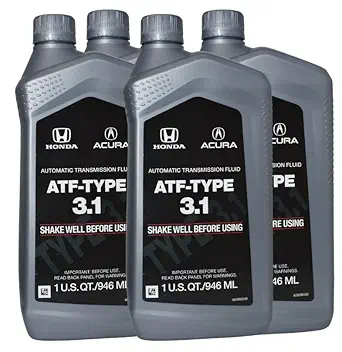 |
| Best Multi‑Quart Service Kit Value kits with multiple quarts and service extras for a full drain-and-fill job | eEuroparts Genuine Honda DW-1 Automatic Transmission Fluid 5 Quart Pack (5 x 1 qt) |  |
| Best Aftermarket Equivalent Fluid High‑quality aftermarket fluids that meet Honda specs without the OEM badge | Idemitsu ATF Type H-Plus Automatic Transmission Fluid, 5 qt |  |
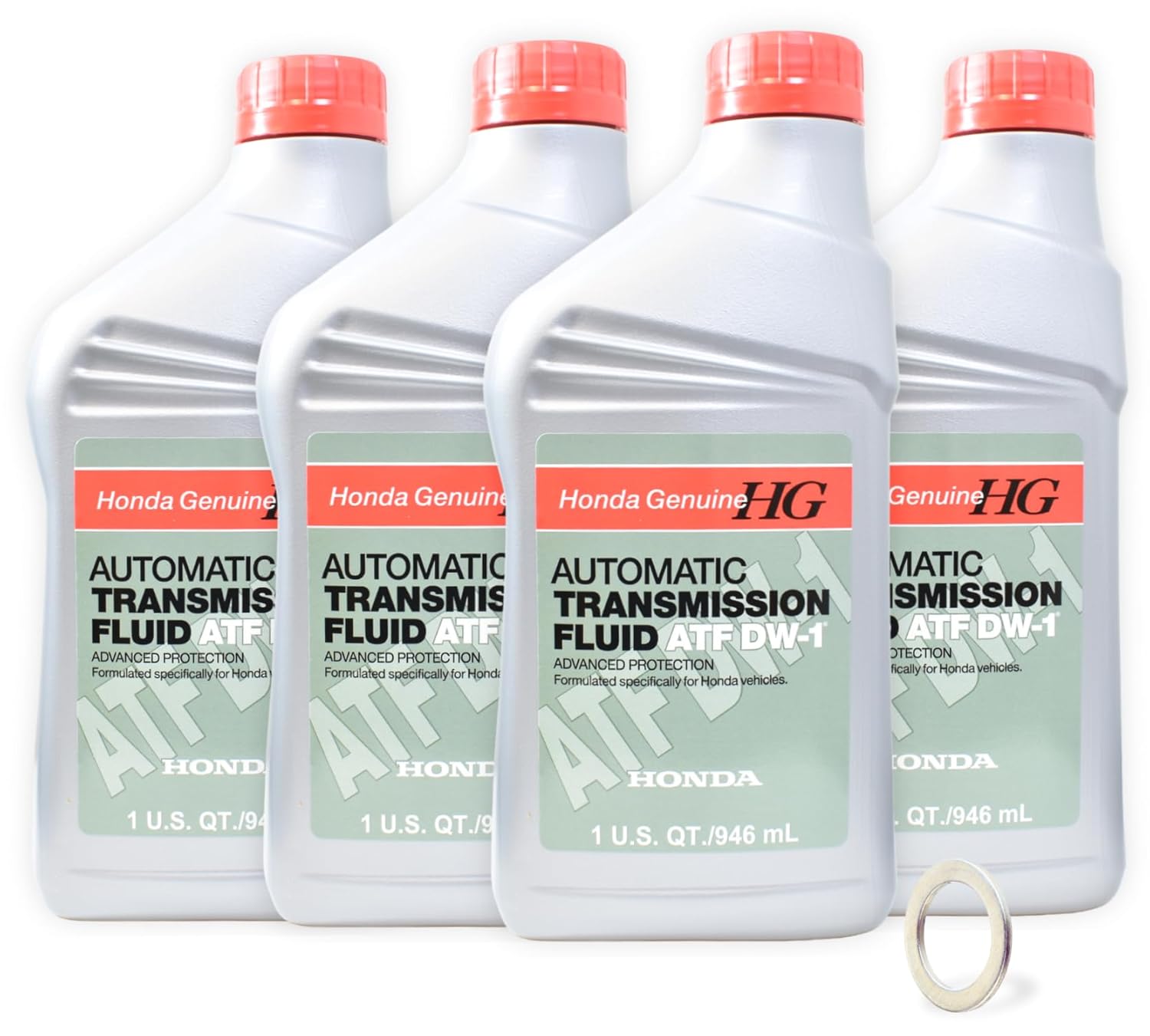
1. Honda Genuine ATF DW-1 Automatic Transmission Fluid — 4 Quart Kit with 18mm Drain Plug Washer
Best Overall Transmission Fluid
| Brand | Honda |
|---|---|
| Liquid Volume | 4 Quarts |
| Unit Count | 128.0 Fluid Ounces |
| SAE J300 Viscosity Grade | 10W-30 |
This kit supplies four 1-quart bottles of Honda Genuine ATF DW-1 and an 18 mm aluminum drain plug washer for a straightforward transmission drain-and-fill service. The fluid is engineered by Honda to meet the friction and thermal characteristics required by Honda automatic transmissions, so it helps restore smooth, quiet shifts and protects internal parts from wear and oxidation. Typical use is periodic maintenance on Hondas that specify DW-1—either a single drain-and-fill or multiple passes to refresh old fluid. Buyers will notice improved shift quality and reduced transmission noise when replacing degraded fluid. Being the factory formulation, it supports factory-compatible performance and helps maintain warranty-aligned service. The kit does not include specialty tools or a full fluid-exchange machine, so technicians performing a complete flush or servicing other makes should plan accordingly. Also verify your Accord model year and fluid spec before use because DW-1 is specific to Honda transmissions that require it.
Best for: DIY owners servicing 2018–2022 Honda Accords who want a single, factory-matched fluid to restore smooth shifting and provide reliable protection during routine drain-and-fill maintenance.
Less Ideal for: Shops or owners seeking a complete transmission flush service or those working on non-Honda transmissions should choose a dedicated flush machine or a fluid specified for their vehicle instead.
- Factory-formulated fluid matched to Honda transmission requirements
- Includes four 1-quart bottles for a full drain-and-fill service
- Comes with an 18 mm drain plug washer for a proper reseal
- Designed to improve shift smoothness and reduce transmission noise
- Formulation resists thermal breakdown and oxidation for long-term protection
- Not a full-machine flush kit so it cannot remove all old fluid in one pass
Verdict: For DIYers who want a single top pick that delivers reliable protection, smooth shifting, and broad compatibility across common transmission types.
2. AISIN ATF-DW1 Automatic Transmission Fluid (500 ml)
Best Budget Transmission Fluid

| Unit Count | 31.98 Fluid Ounces |
|---|---|
| SAE J300 Viscosity Grade | 5W-20 |
| Material | Synthetic |
| Liquid Volume | 500 Milliliters |
This Aisin ATF-DW1 bottle is a synthetic automatic transmission fluid formulated to match Honda DW-1 requirements and designed for everyday transmission service in compatible Honda models. It is typically used for drain-and-fill maintenance or top-ups during routine service to restore shift quality and protect internal seals and O-rings. Notable features from the product listing include a factory-formulated blend, a 500 ml bottle size, and a SAE J300 viscosity reference useful for cold-flow behavior. In practice the fluid promotes smoother shifts across temperature ranges and has low oxidation characteristics that can help maintain fluid life between changes. Because it is produced by a known transmission supplier, it is a practical, budget-friendly alternative when you want a fluid that follows the DW-1 spec without buying branded dealer-only packages. Limitations are the small bottle size, which may require multiple units for a full service, and the product is specific to transmissions requiring DW-1 rather than a universal ATF for other spec systems.
Best for: Buyers who need an affordable, factory-compatible DW-1 fluid for routine maintenance on 2018–2022 Honda Accords and prioritize meeting the correct specification over premium additive packages.
Less Ideal for: Drivers who want a single large-volume container for multiple services or those who need a different ATF specification for non-DW-1 transmissions should look elsewhere.
- Formulated to meet Honda DW-1 specification for compatible transmissions
- Synthetic base with low oxidation for longer fluid life
- Designed to improve shift smoothness across temperature ranges
- Made by a reputable transmission components manufacturer
- Small 500 ml bottle may not cover full transmission service without multiple units
- Not a universal ATF; only appropriate where DW-1 is specified
Verdict: Choose this if you need a low-cost fluid that still meets basic specifications for safe, everyday transmission service without extra additives.
3. Honda DW-1 Automatic Transmission Fluid, 1 qt, 4‑Pack
Best OEM DW-1 Transmission Fluid

| Brand | Honda |
|---|---|
| Liquid Volume | 128 Fluid Ounces |
| SAE J300 Viscosity Grade | 5W-40 |
| Number of Items | 4 |
| Manufacturer Part Number | 08200-9008 |
This is the factory‑specified DW‑1 automatic transmission fluid packaged as four 1‑quart bottles for use in Honda transmissions that call for the DW‑1 formula. It is used for routine drain-and-fill or top‑up service to preserve the transmission's intended shift feel and internal component protection. Notable features include genuine Honda formulation and sealed OEM bottles that are easy to pour with a funnel. In practice the fluid helps maintain smooth, consistent shifts and prevents issues some owners report when substituting aftermarket fluids. The 4‑pack contains about the right volume for many Honda drain-and-fill services so you can complete a service without mixing different fluids. Limitations are that this is a specific Honda formula so it should only be used where the DW‑1 spec is required, and the SAE J300 entry in the listing may not substitute for checking the vehicle's service manual for capacity and procedure. For owners chasing factory compatibility and predictable shifting on 2018–2022 Honda Accord models, this provides direct, like‑for‑like fluid replacement.
Best for: Buyers who prioritize using the factory‑specified DW‑1 fluid to maintain original shift characteristics and stay aligned with Honda service guidance for 2018–2022 Accord models.
Less Ideal for: Drivers who need a universal ATF for multiple makes or who prefer a fluid rated to a different manufacturer specification should consider alternate products.
- Genuine Honda DW‑1 formulation for factory compatibility and shift feel preservation
- Sealed 1‑quart bottles are convenient to store and pour during a drain‑and‑fill service
- Four‑pack provides enough fluid for most Honda transmission service intervals without mixing fluids
- Intended only for vehicles specifying DW‑1 so not a universal replacement for other ATF specs
Verdict: Pick this slot when you want the factory‑specified DW‑1 formula to ensure compatibility and preserve shifting characteristics and warranty alignment.
4. Idemitsu CVTF Type H2 (HCF-2) CVT Transmission Fluid, 5-Quart
Best CVT HCF‑2 Fluid

| Volume | 5 Quart |
|---|---|
| Manufacturer | Idemitsu |
| Recommended application | Honda CVTs requiring HCF-2 |
| Item model number | 30041114-95300C020 |
Idemitsu CVTF Type H2 is formulated specifically for Honda CVTs that call for HCF-2 fluid and is intended for service fills and top-offs. In use it provides anti-shudder additives and friction modifiers designed to preserve clutch friction characteristics so shifts remain smooth and judder is minimized. The formula emphasizes thermal and oxidation resistance to help keep fluid life and component protection strong under highway and daily-driving conditions. Because it is made to the HCF-2 specification, it functions as a direct factory-quality replacement for Honda-branded HCF-2 fluid and is commonly used by shops in bulk. Practical benefits include predictable shift feel after a drain-and-fill and reduced risk of clutch glazing over time. Limitations are straightforward: it is only for CVT applications requiring HCF-2 and should not be used in automatic or dual-clutch transmissions; like any fluid, full benefits depend on correct service intervals and proper fill level during service.
Best for: Drivers maintaining a 2018–2022 Honda Accord CVT who prioritize preserving clutch friction control and preventing judder during normal and highway use.
Less Ideal for: Owners looking for fluid for non-CVT transmissions or for vehicles that require a different Honda transmission specification should choose a different product.
- Meets Honda HCF-2 specification for direct compatibility with Honda CVTs
- Anti-shudder and friction modifiers help maintain clutch feel and prevent judder
- Formulated for oxidation and thermal stability to extend fluid life
- Packaged in a 5-quart container suitable for a full service fill
- Not suitable for torque-converter automatics or dual-clutch transmissions
Verdict: Select this CVT HCF‑2 fluid when replacing or topping off a continuously variable transmission to maintain clutch friction control and prevent judder.
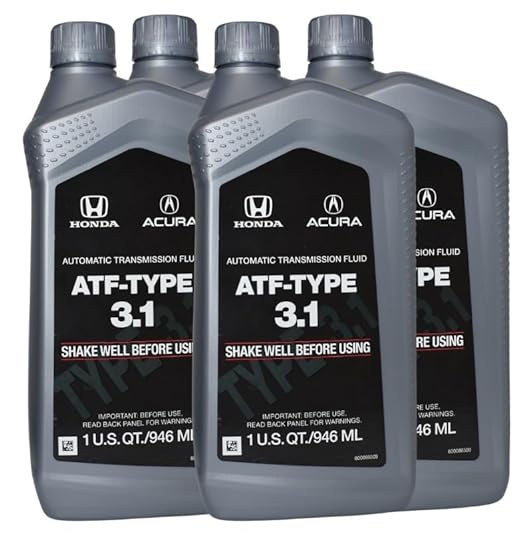
5. Honda Genuine ATF-Type 3.1 Automatic Transmission Fluid, 1 Quart (4-Pack)
Best ATF‑Type 3.1 Fluid
| Material | Synthetic |
|---|---|
| Liquid Volume | 4 Quarts |
| Specific Uses For Product | Honda Vehicles |
| SAE J300 Viscosity Grade | 5W-40 |
This is Honda's factory transmission fluid formulated to meet the ATF-Type 3.1 specification used in many recent Honda ZF-9 and other 3.x transmissions. It is a low-viscosity synthetic blend designed to improve fuel economy and provide crisp, consistent shifts through additives that control friction and shear. Typical use is a direct replacement when the vehicle manual or transmission label calls for ATF 3.x; buyers can use it for drain-and-fill services or topping off during maintenance. The product comes in sealed quarts and is sold as a multi-quart pack that matches the factory fill part number. Practical benefits include confidence in compatibility with Honda systems, predictable shift feel, and avoidance of the compatibility risks tied to generic ATFs. The main limitation is cost compared with aftermarket multi-vehicle fluids and the need to verify your transmission requires ATF-Type 3.1 before purchasing, since it is not a universal ATF replacement.
Best for: Buyers who need the exact ATF-Type 3.1 fluid specified by Honda and prioritize factory-matched performance and shift feel for maintenance or DIY transmission service.
Less Ideal for: Drivers who do not have a Honda transmission that calls for ATF 3.x or who want a lower-cost, multi-vehicle ATF alternative for non-specified applications.
- Engineered to Honda specifications for ATF-Type 3.1 transmissions
- Low-viscosity synthetic formulation that aids fuel economy and smooth shifting
- Sealed quarts suitable for DIY drain-and-fill jobs or precise topping off
- Includes additives tuned for consistent friction characteristics and downshift quality
- Higher purchase cost than generic multi-vehicle ATFs
Verdict: Choose an ATF‑Type 3.1 product if your transmission calls for a low‑viscosity fluid to optimize fuel economy and crisp shift performance.
6. eEuroparts Genuine Honda DW-1 Automatic Transmission Fluid 5 Quart Pack (5 x 1 qt)
Best Multi‑Quart Service Kit

| Unit Count | 160.0 Fluid Ounces |
|---|---|
| Specific Uses For Product | Automatic Transmission (Honda) |
| Viscosity | 5w-30 |
| Item Form | Liquid |
This five-quart pack supplies DW-1 transmission fluid intended for Honda transmissions and is sized to cover a typical drain-and-fill service. The bottles contain factory-spec DW-1 formulation, a calcium-sulfonate-based fluid with a 5W-30 viscosity listed on the label, which helps provide smooth shifts and corrosion protection in transmissions designed for Honda's DW-1 spec. For DIY maintenance the pack removes the need to buy multiple single quarts separately and simplifies topping and refilling during a service. Because it is the correct fluid type for Honda AT systems, it reduces the risk of compatibility problems that can affect shift quality. The product is purely fluid with no additional hardware included, so you will still need basic service tools, a drain pan, and any replacement filter or gasket your vehicle requires. Buyers should confirm the DW-1 recommendation in their 2018–2022 Accord owner's manual or service guide before use.
Best for: DIY Honda owners wanting the correct transmission fluid and enough volume to complete a single drain-and-fill service in one purchase.
Less Ideal for: Shops or technicians who perform full fluid changes with transmission pan servicing and who need replacement filters or hardware included in a kit.
- Pack size covers a standard DIY drain-and-fill without needing extra purchases
- Contains genuine DW-1 formulation specified for many Honda transmissions
- Calcium sulfonate formulation offers corrosion and wear protection
- Sold as individual quart bottles for easy pouring and accurate fill amounts
- No service parts included such as filter, pan gasket, or drain plug washer
Verdict: This label fits multi‑quart bundles and kits that include enough fluid (and sometimes small parts) to complete a DIY drain‑and‑fill service in one purchase.
7. Idemitsu ATF Type H-Plus Automatic Transmission Fluid, 5 qt
Best Aftermarket Equivalent Fluid

| Recommended Uses For Product | Honda and Acura vehicles with ATF Z-1 or DW-1 specifications |
|---|---|
| Unit Count | 159.94 Fluid Ounces |
| Container Type | Bottle |
| Upper Temperature Rating | 258 Degrees Fahrenheit |
| Item Form | Liquid |
Idemitsu ATF Type H-Plus is a factory-quality automatic transmission fluid aimed at Honda and Acura vehicles that call for Z-1 or DW-1. It is used like any OEM fluid during drain-and-fill or multi-stage service and is designed to restore smooth clutch engagement and shift feel while resisting oxidation and thermal breakdown. Notable features include friction-modifying additives for improved clutch performance and anti-wear chemistry to protect gearsets and bearings. For a 2018–2022 Honda Accord this fluid should provide factory-compatible viscosity behavior and shift quality, and many owners report noticeably smoother shifts after a proper fluid service. Practical benefits include longer fluid life compared with lower-grade ATFs and improved fuel economy thanks to optimized viscosity and friction control. Limitations are typical of aftermarket fluids: if a transmission already has severe clutch pack wear or pressure-related faults, fluid replacement alone will not fix mechanical failures, and a three-stage change is recommended to fully refresh the fluid in Hondas that require Z-1/DW-1 replacements.
Best for: Buyers who want an OEM-compatible, well-formulated aftermarket fluid that restores factory shift feel and extends fluid life in late-model Honda Accords without paying for dealer-branded oil.
Less Ideal for: Drivers seeking a fix for transmissions with mechanical damage, electrical pressure control faults, or burnt clutch material should pursue diagnostics and repairs instead of relying on fluid replacement alone.
- Formulated specifically to meet Honda ATF Z-1 and DW-1 specifications for direct compatibility
- Advanced anti-wear additives protect gears and bearings
- Optimized viscosity and friction modifiers help restore smooth clutch engagement and shift quality
- Good resistance to oxidation and thermal breakdown for longer fluid life
- Sold in a single 5-quart bottle which may require multiple bottles or partial disposal during a multi-stage service
Verdict: Pick an aftermarket equivalent when you want a well‑formulated, OEM‑compatible fluid alternative that often offers similar performance at a lower cost.
Choosing the Right 2018-2022 Honda Accord Transmission Fluid: Key Factors to Consider
Manufacturer Specification and Approval
Matching the fluid to the Accord's specified transmission code is the baseline for compatibility. Different years and transmission variants inside the 2018-2022 range may require particular ATF or CVT formulations. Using an approved fluid reduces the risk of incorrect frictional properties that can lead to harsh shifts or premature clutch wear.
Approval also indicates the fluid has been tested against relevant performance benchmarks for the vehicle's hydraulic circuits. If a fluid lacks explicit compatibility, you should avoid it even if general ATF performance looks strong, because micro-friction characteristics and additive balance vary between formulations.
Viscosity and Viscosity Stability
Viscosity affects hydraulic pressure, shift timing, and lubrication at different operating temperatures. A fluid that meets the correct viscosity range at low and high temperatures keeps shifts consistent from cold starts to hot highway runs.
Stability over time matters because viscosity can change with oxidation and contamination. A product that resists thickening or thinning under heat cycles will retain correct hydraulic behavior longer and reduce the need for earlier fluid changes.
Frictional Properties and Shift Feel
Friction modifiers and the additive package determine how smoothly clutches engage and release. The wrong friction profile can cause slipping, shudder, or abrupt shifts on the Accord. For drivers who prioritize smooth daily commuting, seek fluids formulated to preserve linear engagement and minimize stutter during partial throttle transitions.
For sportier driving, balance is important: some formulations add firmer engagement for quicker shifts, but that can increase wear if not matched to the transmission's design. Consider the typical driving style when choosing a fluid based on its described friction characteristics.
Thermal and Oxidation Resistance
Transmissions generate heat, and sustained high temperatures accelerate breakdown of additives and base oils. Fluids with robust thermal and oxidation resistance maintain protective properties longer, lowering the chance of varnish or deposit formation on valves and solenoids.
Better heat resistance also translates to more predictable shift timing under load and reduced risk of overheating-related failures. This matters for Accords used in hot climates, heavy traffic, or occasional towing.
Seal and Component Compatibility
Transmission seals, gaskets, and clutch linings are formulated for specific chemistries. Some fluids contain additives or solvents that can harden, swell, or shrink elastomers over time. Choosing a fluid known to be compatible with the materials used in the 2018-2022 Accord helps avoid leaks and premature seal degradation.
When evaluating options, prefer fluids that explicitly note compatibility with common OEM seal materials or those developed for Honda transmissions to minimize the risk of material incompatibility.
Service Interval and Maintenance Practicality
Different fluids offer different expected service life. Long-life formulations reduce drain frequency but may be more costly per unit. Consider how easy it is to monitor fluid condition, whether the fluid requires filter changes at the same interval, and how straightforward the drain and fill procedure is for the Accord.
Also weigh availability: choosing a fluid you can reliably source simplifies future maintenance and emergency top-ups. A practical service schedule that fits your driving mileage and maintenance habits helps keep the transmission in good condition without unnecessary intervention.
Understanding Transmission Types in the 2018-2022 Accord
The 2018-2022 Honda Accord was offered with transmissions that include conventional automatics, continuously variable transmissions, and manual gearboxes depending on trim and engine option. Each transmission type relies on different fluid chemistries to control friction, hydraulic actuation, and lubrication, so the fluid choice must reflect the Accord's specific transmission configuration.
Identify whether your Accord uses a conventional automatic, CVT, or manual transmission before choosing a fluid. The owner's manual and service stickers provide the exact fluid code and fill capacity, which you should use as the starting point for any selection.
- Conventional automatics need ATFs that balance friction and hydraulic stability.
- CVTs require fluids formulated for belt or chain lubrication and smooth pulley control.
- Manual gearboxes use different gear oils or manual transmission fluids designed for synchronizer performance.
When to Perform a Transmission Fluid Change
Service intervals vary with driving conditions but watch for signs that indicate a fluid change. Dark, burnt-smelling fluid, erratic shift behavior, or clutch chatter are symptoms that warrant inspection and likely fluid service. Routine scheduled changes prevent cumulative degradation that can impair valve body function.
If the Accord is regularly used for heavy commuting, frequent short trips, or towing, shorten the service interval. Conversely, light highway driving may allow longer intervals within the manufacturer's allowed range, provided the fluid condition is checked periodically.
- Check fluid color and odor at recommended intervals.
- Look for milky fluid which could indicate coolant contamination.
- Note any new noises, slipping, or delayed engagement as triggers for earlier service.
How Fluid Choice Affects Shift Quality and Longevity
The right fluid preserves valve body clearances and ensures predictable friction behavior, which directly affects how smoothly the Accord shifts between gears. Over time, degraded fluid can lead to hesitant shifts, increased wear on clutch packs, and potential overheating of internal components.
Selecting a fluid with stable additive packages and proven resistance to foaming and aeration helps maintain consistent hydraulic pressure and responsiveness. This protects mechanical components and keeps the transmission operating close to the original performance envelope.
- Stable friction characteristics reduce clutch wear.
- Anti-foaming additives preserve hydraulic control.
- Detergents and dispersants help prevent deposit buildup on solenoids.
Practical Tips for a Successful Fluid Service
When performing a fluid change, follow the Accord's recommended fill procedure and torque specs for the pan and drain plugs. Some services require the vehicle to be level for accurate fill measurement; others use a fill plug at a specific fluid temperature. Use the correct capacity and check the level after a short test drive.
If replacing fluid after extended service intervals, consider a two-step change where a portion of old fluid is drained and replaced, followed by a short drive and a second draining to more effectively remove degraded fluid. Always inspect the drain plug for metal particles and the pan for debris to gauge internal wear.
- Perform fill-level checks at the specified fluid temperature range.
- Record service dates and mileage for future reference.
- Dispose of used fluid responsibly per local regulations.
Addressing Common Transmission Symptoms
Many common symptoms can be mitigated or diagnosed by checking fluid condition. For example, delayed engagement on startup often points to low fluid or degraded hydraulic performance, while harsh or slipping shifts can indicate incorrect friction characteristics or contamination.
If symptoms persist after a fluid change, further diagnosis of solenoids, valve body wear, or internal clutches may be necessary. Use fluid inspection as the first step in troubleshooting because it is the simplest and most cost-effective diagnostic action.
- Delayed engagement: check fluid level and condition first.
- Harsh shifts: verify fluid specification and look for contamination.
- Shudder or vibration: consider friction compatibility and possible torque converter issues.
Still looking for the perfect fit?
Select your Honda Accord configuration to see the most relevant Transmission Fluids recommendations
How We Chose the Best 2018-2022 Honda Accord Transmission Fluid
We selected products by prioritizing compatibility with the 2018-2022 Honda Accord's transmission types and real-world durability. First, we confirmed each fluid met the vehicle's specified fluid codes or equivalent specifications for the Accord model years covered. Second, we emphasized thermal and oxidative stability to ensure performance under stop-and-go commuting and highway towing or load conditions. Third, we considered friction modifiers and additive packages that influence shift feel, clutch engagement, and torque converter lockup smoothness. Fourth, service life and recommended drain intervals were assessed to favor fluids that maintain properties over extended mileage.We excluded any fluids that did not meet the published manufacturer specification or that relied on ambiguous compatibility claims. We also filtered out products clearly intended for unrelated drivetrains. The final list balances spec compliance, longevity, and expected on-vehicle behavior: fluid chemistry, viscosity stability, additive package, and compatibility with the Accord's valves and seals were the deciding dimensions.
Our full evaluation process is outlined in our review methodology.
FAQ
How often should I change the transmission fluid in a 2018-2022 Honda Accord?
It depends on driving conditions, but many owners follow the manufacturer's interval as a baseline and shorten it for heavy urban commuting or towing. Check fluid condition periodically and change earlier if the fluid is dark, smells burnt, or shift quality declines.
Can I mix different types of transmission fluid during a top-up?
Mixing fluids can alter friction and additive balance, which affects shift behavior and component life. It is best to top up with the same type specified for your Accord's transmission and avoid mixing unless you are using a compatible formulation confirmed by specifications.
What are the signs that my Accord's transmission fluid is failing?
Look for dark discoloration, a burnt odor, foaming, or visible contamination. On-road symptoms include delayed engagement, slipping, harsh shifts, or unusual noises. These signs should prompt an inspection and likely a fluid service.
Is DIY transmission fluid change practical for the 2018-2022 Accord?
A DIY fluid change is possible if you have the correct tools and follow the fill and level procedure precisely. Some procedures require lifting the car and monitoring fluid temperature for accurate filling, so assess your comfort level and the required equipment before attempting it.
Does using a long-life fluid eliminate the need for regular inspections?
Long-life fluids reduce the frequency of changes but do not replace periodic inspections. Even with extended-interval fluids, you should check color and odor during scheduled maintenance to catch contamination or unexpected degradation early.
Final Verdict
Pick a fluid that matches the 2018-2022 Honda Accord's specified formulation and balances viscosity stability with the frictional profile you prefer. Prioritize spec compliance, thermal resistance, and seal compatibility to preserve shift quality and avoid premature wear. For everyday commuting choose fluids that emphasize smooth engagement and long service life; for more demanding use, favor formulations with higher thermal stability. Following the vehicle's service guidance and monitoring fluid condition will help you choose confidently and keep the transmission operating well.
Explore More:
- Check out all Honda Accord parts & accessories
- Explore Fluids & Chemicals
- Browse all Accessories
