

Note: This article contains affiliate links. If you click on these links and make a purchase, I may earn a small commission at no extra cost to you. This helps support my research and content. Read my full affiliate disclosure here.
Picking the right coolant for a 2017-2022 Honda CR-V affects engine longevity, heater performance, and corrosion resistance in the cooling system. Because this generation shares cooling-system design and material compatibility across model years, using a coolant that matches Honda's chemistry and service intervals helps prevent premature thermostat, water pump, and radiator wear. This guide lists the top shortlisted coolants for your CR-V and explains the testing and decision criteria we used. You will see the important tradeoffs—long-life formulations versus universal mixes, corrosion inhibitors versus heat-transfer efficiency—so you can choose the option that fits your driving patterns and maintenance habits.
Looking for other parts? See all Honda CR-V parts & accessories.
Top Picks at a Glance
| Best Overall Coolant A reliable, long‑life coolant that balances protection and compatibility | Zerex Asian Vehicle Blue Prediluted 50/50 Antifreeze/Coolant 1 gal |  |
| Best Budget Coolant An affordable, ready-to-use coolant that covers basic freeze/boil protection | Valvoline Multi-Vehicle 50/50 Ready-to-Use Antifreeze/Coolant, 1 Gallon |  |
| Best OEM Honda Coolant Genuine factory-formula Type‑2 coolant pre-diluted for exact system compatibility | Honda Genuine Type 2 Extended-Life Antifreeze/Coolant 50/50 Pre-Diluted, 1 Gallon |  |
| Best Asian‑Vehicle Formula Coolant A formula tailored for Asian makes with the right inhibitor package | Zerex Asian Vehicle Green 50/50 Ready-to-Use Antifreeze/Coolant — 1 Gallon |  |
| Best Ready‑to‑Use Gallon Coolant Full‑gallon pre-diluted coolant for a full system fill or major top-off | PEAK OET Extended Life 50/50 Prediluted Blue Antifreeze/Coolant (1 Gallon) |  |
| Best Multipack Quarts Coolant Multi‑quart packs for multiple top‑offs or fleet maintenance savings | CYCLEMAX Six-Pack Honda HP 50/50 Coolant Blend with Funnel |  |
1. Zerex Asian Vehicle Blue Prediluted 50/50 Antifreeze/Coolant 1 gal
Best Overall Coolant

| Fluid type | Prediluted 50/50 antifreeze/coolant |
|---|---|
| Chemistry | HOAT (Hybrid Organic Acid Technology) with phosphate additive |
| Silicate/borate | Silicate and borate free |
| Volume | 1 gallon |
| Meets specifications | Hyundai/KIA MS 591‑08, Mitsubishi ES‑64217, JIS K 2234, Ford WSS‑M97B55‑A, ASTM 3306/D4985 |
Zerex Asian Vehicle Blue is a ready‑to‑use 50/50 antifreeze/coolant formulated with Hybrid Organic Acid Technology and a phosphate additive for long‑term protection of cooling system metals. It is intended for Asian makes and is typically used when topping off the reservoir or performing a full system flush; the prediluted gallon removes the need to mix concentrate and is convenient for DIY jobs. Notable features include a silicate‑ and borate‑free formula, OEM‑level specifications listed for several Asian manufacturers, and additives that resist rust, scale and deposits so radiators and water pumps stay cleaner over time. Practical benefits are stable temperature control, reduced risk of corrosion in aluminum and mixed‑metal systems, and compatibility with factory service intervals for vehicles that call for a blue HOAT fluid. Limits: it is a vehicle‑specific formulation so you must confirm the 2017–2022 Honda CR‑V coolant spec before use, and the ready‑to‑use option means you cannot adjust concentration for extreme climates.
Best for: DIYers who want a straightforward, factory‑quality replacement coolant that simplifies routine topping off and full flushes while providing broad corrosion protection for Asian‑spec vehicles like the 2017–2022 Honda CR‑V.
Less Ideal for: Someone who needs a universal coolant for multiple makes with different chemistries or who prefers to mix concentrate to customize freeze protection levels.
- Prediluted 50/50 formula ready to pour without mixing
- HOAT chemistry with phosphate additive for long‑term corrosion and scale control
- Formulated to match Asian vehicle coolant specifications for better fitment
- Silicate‑ and borate‑free to reduce harmful deposits in modern aluminum systems
- Not adjustable concentration since it is premixed, which may be a drawback in extreme cold requiring higher antifreeze ratio
Verdict: The go-to coolant for most DIYers who want broad corrosion protection, proven performance, and minimal fuss when servicing the cooling system.
2. Valvoline Multi-Vehicle 50/50 Ready-to-Use Antifreeze/Coolant, 1 Gallon
Best Budget Coolant

| Size | 1 Gallon |
|---|---|
| Vehicle Service Type | Automobiles and light duty trucks |
| Flash Point | 250 Degrees Fahrenheit |
| Model | Multi-Vehicle |
Valvoline Multi‑Vehicle 50/50 Ready‑to‑Use is a premixed antifreeze/coolant designed to top off or refill the cooling system without dilution. It uses Valvoline’s Alugard Plus chemistry to be compatible with other ethylene glycol coolants and protect aluminum and other metals from corrosion, scaling, freezing and boiling. For a 2017–2022 Honda CR‑V this product removes the need to measure concentrate and distilled water at the driveway, so you can pour and go when topping the radiator or performing a coolant flush. The premix is rated to -34F freeze protection and 265F boil protection in a closed system, and includes additives aimed at reducing leaks and deposits. The main compromise is that premixed coolant costs a little more per gallon-equivalent than concentrate and offers no flexibility for changing concentration. Also it is an ethylene glycol formula, so follow Honda’s coolant specification and service interval recommendations when selecting fluid for a CR‑V.
Best for: Buyers who prioritize convenience and a straightforward, no-mix solution when servicing a 2017–2022 Honda CR‑V and want reliable corrosion protection without specialty chemistry.
Less Ideal for: Drivers who prefer to stock concentrate for long-term cost savings or who need a specific manufacturer-formulated coolant for extended service intervals should consider other options.
- Ready-to-use 50/50 mixture eliminates measuring and mixing for quick top-offs or flushes.
- Alugard Plus additive for cross-compatibility with other ethylene glycol coolants.
- Protects aluminum and common cooling system metals against corrosion and scaling.
- Pre-mixed formula provides winter freeze and summer boil protection without extra steps.
- Less economical per gallon-equivalent than concentrated coolant that you dilute yourself.
Verdict: Choose this pick when you need a low-cost, pre-mixed coolant that restores protection without extra mixing or specialty chemistry.
3. Honda Genuine Type 2 Extended-Life Antifreeze/Coolant 50/50 Pre-Diluted, 1 Gallon
Best OEM Honda Coolant

| Formula | Ethylene glycol 50/50 pre-diluted |
|---|---|
| Service interval | Up to 5 years or 60,000 miles |
| Volume | 1 gallon |
| Manufacturer | American Honda Motor Company |
This genuine Honda Type 2 antifreeze/coolant is a ready-to-use, factory-formulated 50/50 ethylene glycol coolant intended as a direct replacement for Honda cooling systems. It is typically used when refilling or flushing a Honda cooling system to restore corrosion protection, freeze protection, and boil-over resistance without needing dilution. Notable features include the blue long-life formulation matched to Honda specifications, protection for both metal and non-metal components, and an expected service interval of up to 5 years or 60,000 miles. In real-world use it simplifies service by eliminating mixing, reduces risk of incompatible chemistry, and supports long drain intervals for lower maintenance frequency. The product contains a bittering agent for safety and is sold in 1-gallon bottles that will cover most single-system fills. The main trade-offs are cost compared with generic aftermarket coolants and that it uses ethylene glycol rather than propylene glycol, which is standard for many OEM formulas and requires careful handling and disposal.
Best for: Buyers who prioritize using the manufacturer-specified coolant for a like-for-like replacement and low-maintenance service intervals on their Honda CR-V.
Less Ideal for: Drivers who are strictly shopping for the lowest-cost generic coolant or who need a propylene-glycol-based alternative for specific environmental or safety preferences.
- Factory-matched formula for Honda cooling systems to avoid chemistry mismatch
- Pre-mixed 50/50 ready to use with no dilution required
- Long service life rated up to 5 years or 60,000 miles
- Protects both metal and non-metal components against corrosion and rust
- Higher cost than many aftermarket universal coolants
Verdict: This slot is for the manufacturer-formula coolant you pick when you want a direct replacement that matches the factory chemistry and service interval.
4. Zerex Asian Vehicle Green 50/50 Ready-to-Use Antifreeze/Coolant — 1 Gallon
Best Asian‑Vehicle Formula Coolant

| Brand | Zerex |
|---|---|
| Model | Asian Vehicle Green |
| Formulation | 50/50 ready-to-use, HOAT with phosphate additive |
| Free of | Silicates, borates, amines, nitrites |
| Volume | 1 gallon |
Zerex Asian Vehicle Green is a ready-to-use 50/50 antifreeze designed for Asian-brand engines that require a green, silicate- and borate-free formula. It uses Hybrid Organic Acid Technology with a phosphate additive to guard aluminum and other cooling system metals against corrosion, scale and rust while protecting against freezing and boiling in everyday driving and towing conditions. The product arrives pre-mixed so it is convenient for topping off or refilling after a flush; users will appreciate that it is formulated to meet manufacturer specifications for many Acura, Honda and Nissan models. Practical benefits include corrosion protection for radiators and water pumps and reduced risk of additive incompatibility compared with generic coolants. Important limitations are that it is pre-diluted, so achieving an exact coolant concentration after a partial flush can be difficult, and some users may prefer a concentrated formula for custom mixing or long-term service procedures.
Best for: Buyers who prioritize a coolant matched to Asian-engine metallurgy and want a factory-style, ready-to-use coolant for routine top-offs and system refills on compatible vehicles.
Less Ideal for: Those who need a concentrated coolant for custom mixing, commercial fleet service that requires bulk concentrate, or owners who prefer a different coolant chemistry should consider alternatives.
- Formulated for Asian vehicle specifications to minimize compatibility issues with factory materials
- HOAT chemistry with phosphate additives protects aluminum and other metals from corrosion and scale
- Pre-mixed 50/50 is ready to pour for quick top-offs or full refills without mixing
- Free of silicates, borates, amines and nitrites to reduce risk of harmful additive interactions
- Only available as a pre-diluted 50/50 mix in this listing, limiting precise concentration control after partial flushes
Verdict: Select this coolant when you prefer a coolant formulated for Asian-engine metallurgy and additive requirements to reduce compatibility risk.
5. PEAK OET Extended Life 50/50 Prediluted Blue Antifreeze/Coolant (1 Gallon)
Best Ready‑to‑Use Gallon Coolant

| Volume | 1 gallon |
|---|---|
| Dilution | 50/50 prediluted |
| Technology | Phosphate-enhanced Organic Acid Technology (OET) |
This 1-gallon PEAK OET antifreeze arrives prediluted for quick top-offs or a one-gallon refill without mixing. It uses a phosphate-enhanced Organic Acid Technology formulation intended for many Asian vehicles and is designed to prevent rust and corrosion across cooling-system components. The ready-to-use 50/50 mix makes filling the reservoir straightforward and reduces the risk of incorrect dilution, and PEAK advertises extended-life protection when installed as part of a full flush and fill. Practical benefits include easy pouring from the gallon container, compatibility with Asian vehicle coolant specs that call for a blue OET formula, and corrosion protection for long service intervals. Important limitations are that compatibility should be checked against the CR-V service manual since some models and years require specific coolant chemistries, and a single gallon may not be enough for a complete drain-and-fill on every vehicle without assessing system capacity.
Best for: DIYers who want a single ready-to-use gallon to top off a cooling system or keep as a spare and value convenience and extended-life protection.
Less Ideal for: Technicians or owners who need coolant matched to a non-OET specification or who require larger quantities for a full system flush without buying multiple gallons.
- Prediluted 50/50 mix ready to pour, avoids dilution errors
- Formulated to reduce rust and corrosion for extended service life
- Packaged in a convenient 1-gallon bottle suitable for topping off or on-hand spare
- Not guaranteed compatible with every coolant specification so check the vehicle manual
Verdict: This pick suits DIYers who need a one‑gallon, ready-to-use bottle to perform a full refill or to keep a proper spare on hand.
6. CYCLEMAX Six-Pack Honda HP 50/50 Coolant Blend with Funnel
Best Multipack Quarts Coolant
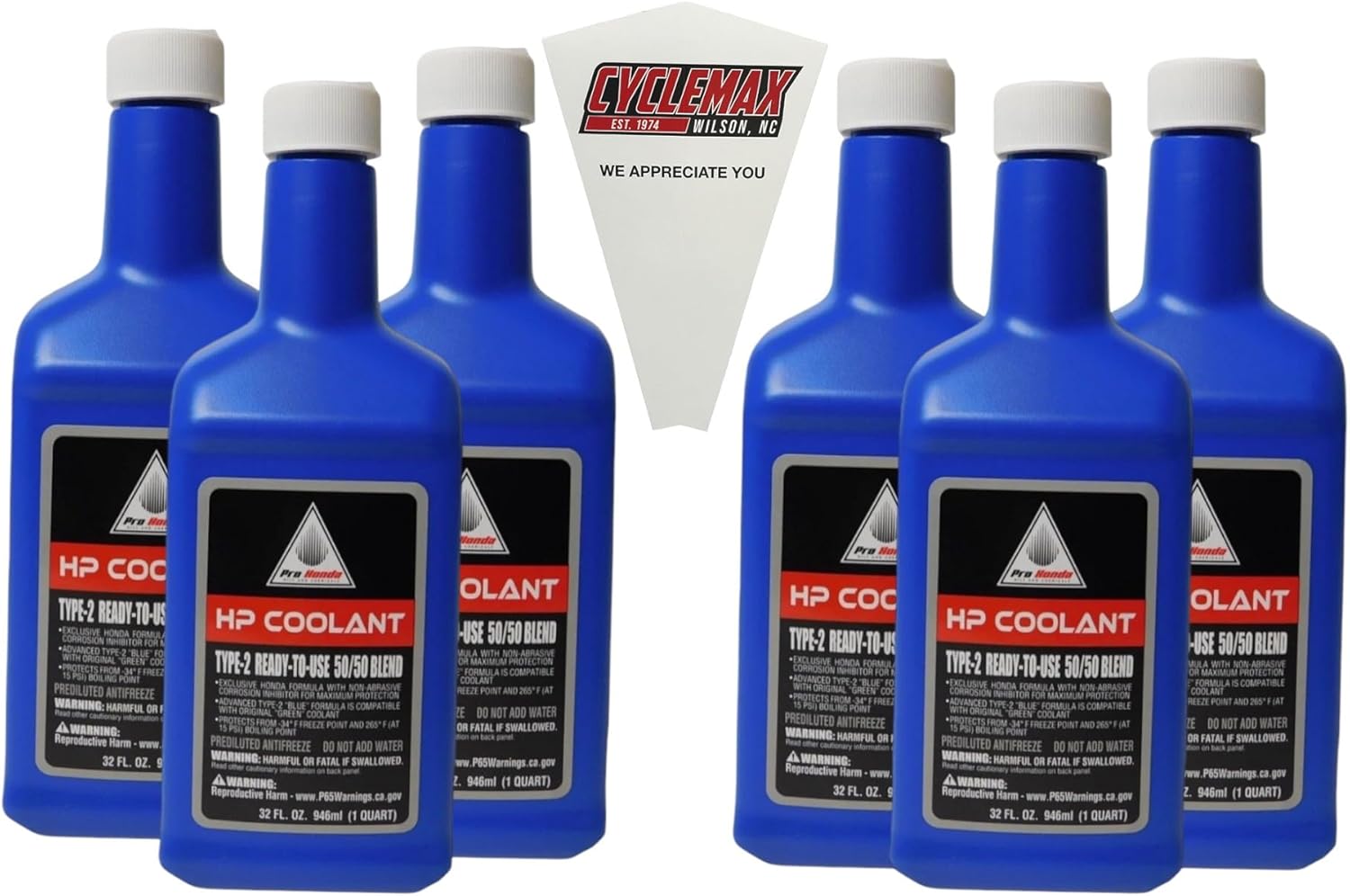
| Brand | CYCLEMAX |
|---|---|
| Mixture | 50/50 premixed |
| Formula Type | Type-2 blue, replaces green coolant |
| Freeze/Boiling Range | Protects to -34°F freeze and 265°F boiling (15 PSI) |
This six-pack supplies ready-to-use 50/50 Honda HP coolant in quart bottles plus a disposable funnel, making routine top-offs and small coolant changes straightforward. The formula is a Type-2 blue coolant that Cyclemax says is compatible with Honda systems and replaces the original green coolant while using organic non-abrasive corrosion inhibitors instead of silicates. For owners doing regular maintenance on compatible Honda vehicles, the premixed quarts are convenient to store and use without measuring, and buying multiple quarts reduces cost per bottle compared with single purchases. The coolant protects to low freeze and high boiling points when used under the stated pressure, and the included funnel helps keep pours tidy. Be aware the product contains ethylene glycol and a bittering agent for safety, and a few buyers reported packaging or quantity errors on delivery; confirm you received six full quarts. This is a practical choice if you want factory-compatible coolant on hand for periodic top-offs and small system fills rather than bulk concentrate or one-time service packs.
Best for: Buy this if you want convenient, ready-to-use quart bottles on hand for regular coolant top-offs and small service jobs on compatible Honda vehicles, prioritizing convenience and per-quart value.
Less Ideal for: Not the best choice if you need bulk concentrate for a full system flush or if you require coolant for non-Honda-specific applications outside the article scope.
- Sold as six premixed quart bottles for easy storage and repeat top-offs
- Formulated for aluminum engines with organic non-abrasive corrosion inhibitors compatible with Honda systems
- Includes a disposable funnel to reduce spills during fills
- Ready-to-use 50/50 blend eliminates mixing and guesswork
- Some customers reported receiving fewer quarts than described or packaging issues during delivery
Verdict: Pick this multipack when you want convenient quart bottles for repeated top‑offs or to save per‑quart on routine maintenance.
Choosing the Right 2017-2022 Honda CR-V Coolant: Key Factors to Consider
Coolant Chemistry and Honda Compatibility
Coolant chemistry—whether it is ethylene glycol-based with organic acid technology or a hybrid inorganic formulation—dictates how it inhibits corrosion on aluminum radiators, cylinder heads, and water pumps. For a 2017-2022 CR-V, using a chemistry compatible with Honda components reduces the risk of galvanic corrosion and minimizes deposit formation. Choosing the right chemistry also affects seal and hose longevity because some inhibitors can attack older rubber compounds.
Check the coolant specification language and technical data to confirm compatibility. A chemistry that matches Honda-recommended inhibitor packages will generally support the expected service interval and maintain consistent heat-transfer characteristics over time.
Corrosion Inhibitor Longevity
Different coolant formulations offer varying inhibitor lifespans. Long-life coolants maintain protective additives for longer intervals and reduce the frequency of full system flushes, which can be attractive if you prefer lower maintenance. However, extended-life inhibitors can require careful initial flushing if converting from a different chemistry to avoid mixing incompatible additive packages.
Consider how long you plan to keep the vehicle and whether you perform regular maintenance. If you keep the CR-V for many years, a long-life coolant that provides multi-year protection can be cost-effective and reduce the chance of corrosion-related failures over time.
Heat-Transfer Performance and Freeze/Boil Protection
A coolant's ability to move heat away from the engine and resist boiling under load is central to preventing overheating in stop-and-go traffic or towing conditions. Freeze protection is also crucial if you operate the CR-V in cold climates. Formulation and correct mix ratio with distilled water determine boiling point elevation and freezing point depression.
Evaluate manufacturer data for properties like specific heat and recommended mix ratios. A properly mixed coolant that achieves the right freeze/boil protection will keep engine temperatures stable across seasonal extremes and driving loads.
Compatibility With Radiator, Hoses, and Seals
Coolants interact with rubber hoses, plastic components, and the radiator core. Some inhibitor packages can be aggressive toward certain elastomers, causing hardening or swelling over time. For the CR-V, which uses modern elastomers and plastic components, picking a coolant with demonstrated compatibility avoids premature failure of hoses, clamps, and seals.
Look for product literature that notes compatibility with typical Asian vehicle materials or includes recommendations for compatibility testing. That reduces the chance of unexpected leaks or part replacements caused by chemical incompatibility.
Maintenance Practices and Flush Intervals
How you plan to maintain the cooling system influences the coolant choice. If you perform routine flushes more frequently, a universal or conventional coolant may suffice. If you prefer longer drain intervals, choose a long-life formulation that retains inhibitor performance and resists breakdown.
Also consider whether you will perform a coolant flush when changing types. Converting between chemistries often requires a thorough flush to avoid mixing incompatible inhibitor packages. Maintenance ease and service interval alignment should guide your coolant selection.
Mixing Ratios and Concentrate Vs Pre-Mixed
Coolants are sold concentrated or pre-mixed. Concentrated products allow you to control freeze and boil protection by mixing with distilled water to the recommended ratio. Pre-mixed solutions are convenient and reduce the risk of improper dilution. For the 2017-2022 CR-V, following the manufacturer-recommended ratio ensures correct protection without stressing the cooling system.
Be aware that mixing tap water can introduce minerals that reduce corrosion protection. Using distilled or deionized water with concentrate maintains inhibitor effectiveness and improves long-term system health.
Why Honda-Compatible Coolant Matters for the CR-V
Honda specifies particular inhibitor chemistries for a reason. The 2017-2022 CR-V cooling system uses aluminum components and modern elastomers that respond differently to silicate, phosphate, or organic acid inhibitor packages. Using a coolant aligned with those expectations helps preserve casting surfaces and maintain gasket and seal pliability.
Beyond chemistry, compatibility reduces the need for unexpected repairs. A coolant that limits electrochemical corrosion and deposit formation keeps water pumps and thermostats functioning reliably, which matters whether you commute daily or take longer trips.
- Reduces galvanic corrosion on aluminum surfaces
- Helps maintain flexible hoses and seals
- Limits scale and deposit buildup in radiator cores
When to Flush the Cooling System on a CR-V
Flush intervals depend on the coolant formulation and driving conditions. Long-life coolants typically call for multi-year intervals, while conventional mixes may need replacement every couple of years. Heavy towing, frequent short trips, or exposure to extreme temperatures may warrant more frequent inspection and earlier flushing.
If you switch inhibitor chemistries, perform a full system flush to remove residual additives. Inspect hoses, clamps, and the radiator for signs of corrosion or leakage while the system is drained.
- Check coolant condition annually or at major service intervals
- Flush when switching inhibitor types to prevent additive clashes
- Inspect hoses and clamps whenever you access the cooling system
Mixing and Dilution Best Practices
Always follow the dilution guidance on the product label and Honda's service recommendations. Use distilled or deionized water when mixing concentrates to avoid mineral contamination that can reduce inhibitor efficacy. Target the specified freeze and boil protection levels for your local climate and driving needs.
Avoid over-dilution, which weakens corrosion protection, and under-dilution, which can affect flow and heat capacity. If using a pre-mixed product, confirm its concentration matches your seasonal requirements before pouring.
- Use distilled water with concentrated coolant
- Aim for manufacturer-recommended freeze/boil protection
- Label reservoir and service records with mix details and date
Signs Your CR-V's Coolant Needs Attention
Monitor coolant color and clarity, heater performance, and engine temperature during normal operation. Rust-colored or muddy fluid, a sweet smell in the cabin, or inconsistent cabin heat are indicators that the coolant's inhibitor package may be depleted or contaminated.
Also watch for external leaks, swelling hoses, or frequent low coolant warnings. Early attention prevents damage to the water pump and head gaskets and avoids unexpected roadside failures.
- Discolored or cloudy coolant
- Reduced heater output or fluctuating cabin temperature
- Visible leaks, swollen hoses, or low coolant alerts
Environmental and Disposal Considerations
Used coolant contains ethylene glycol or propylene glycol and corrosion inhibitors that are harmful to the environment and toxic to animals. Dispose of drained coolant at an approved recycling or hazardous-waste facility rather than pouring it down drains or onto the ground.
Keep replacement and drained coolant in sealed containers and record disposal details in your maintenance log. Proper handling protects the environment and complies with local regulations.
- Collect used coolant in sealed containers
- Recycle or dispose at approved facilities
- Avoid accidental spills and store away from children and pets
Still looking for the perfect fit?
Select your Honda CR-V configuration to see the most relevant Coolants recommendations
How We Chose the Best 2017-2022 Honda CR-V Coolant
We prioritized formulations and attributes that matter specifically for the 2017-2022 Honda CR-V cooling system. Core evaluation criteria included coolant chemistry compatibility with Honda components, corrosion inhibition for aluminum radiators and water pumps, and thermo-physical performance such as boiling and freezing protection and heat-transfer efficiency. Long service life and recommended drain intervals were considered because many CR-V owners prefer extended-interval maintenance, but we also weighed products suited to regular flush schedules. Other criteria included material compatibility with hoses, gaskets, and seals, the presence of silicates or phosphates that can affect older seals, and clarity of manufacturer guidance on mixing ratios. We checked documented manufacturer specifications and technical data to confirm inhibitor package types and service recommendations. Exclusions: formulations that explicitly state incompatibility with Honda or Asian vehicle coolant specs, water-only coolant additives, and products lacking technical data or clear dilution instructions were not considered. The result is a shortlist of coolants that meet Honda-compatible chemistry expectations, provide documented corrosion protection, and offer practical drain intervals suitable for CR-V owners.
Our full evaluation process is outlined in our review methodology.
FAQ
Can I use any long-life coolant in my 2017-2022 CR-V?
It depends. Many long-life formulations work well if their inhibitor chemistry is compatible with Honda specifications. Always check product technical data for compatibility with Asian vehicle requirements and follow Honda's recommended service intervals.
How do I check coolant concentration and freeze protection?
Use a coolant refractometer or hydrometer to measure freeze/boil protection and verify the mix ratio. These tools give a quick read on the ethylene glycol concentration so you can adjust dilution with distilled water if needed.
Is it necessary to flush the system when switching coolant types?
Usually yes. Flushing removes residual inhibitors and prevents incompatible additive packages from reacting. Perform a thorough flush and refill to ensure the new coolant operates as intended.
What are signs of coolant-related corrosion I should watch for?
Look for rusty or brown discoloration, sludge in the radiator or reservoir, and coolant that loses clarity. Also inspect clamps and hose ends for corrosion and watch for coolant loss without visible leaks.
Can I top off the coolant with tap water in an emergency?
Topping off with tap water in an emergency is acceptable short-term, but avoid using it regularly. Tap water contains minerals that reduce corrosion protection. Replace the mixture with proper coolant and distilled water as soon as practical.
How often should I inspect the cooling system on a CR-V?
Inspect the coolant level and look for leaks at least once a month, with a more thorough check of hoses, radiator, and reservoir at every major service interval or annually. Frequency should increase if you notice temperature irregularities or drive in severe conditions.
Final Verdict
Choose a coolant for your 2017-2022 Honda CR-V by prioritizing chemistry compatibility, corrosion inhibition lifespan, and the right mix ratio for your climate. Balance long-life formulations with your willingness to perform thorough flushes when changing types. Regularly inspect the cooling system and follow dilution guidance to protect the radiator, water pump, and seals. Focus on the inhibitor package and documented compatibility with Honda materials when making a final choice. That approach reduces the risk of corrosion-related repairs and helps you maintain reliable cooling performance over the life of your CR-V.
Explore More:
- Check out all Honda CR-V parts & accessories
- Explore Fluids & Chemicals
- Browse all Accessories
