

Note: This article contains affiliate links. If you click on these links and make a purchase, I may earn a small commission at no extra cost to you. This helps support my research and content. Read my full affiliate disclosure here.
Upgrading to a modern 1997-2006 Jeep Wrangler backup camera can make reversing, parking, and hitching a trailer far easier and safer. Whether you use your Wrangler on trails or around town, the right camera reduces blind spots and gives you a clear view behind the vehicle in low light or tight spaces. This guide covers six shortlisted options chosen for fit and function on 1997 through 2006 Wranglers, including typical installation paths and the pros and cons of wired, wireless, and license-plate style systems. We evaluate image clarity, mounting compatibility, and installation complexity so you can pick the best system for your needs. Read on for practical installation tips and what to expect from each style of backup camera.
Looking for other parts? See all Jeep Wrangler parts & accessories.
Top Picks at a Glance
| Best Overall Backup Camera A well-rounded kit that balances image, durability, and fitment | LeeKooLuu LK3 1080p Backup Camera Kit with 4.3" Monitor |  |
| Best Budget Backup Camera Low-cost universal cameras that deliver basic night vision and wide view | eRapta ERT01 HD Wired License Plate Rear Backup Camera |  |
| Best License‑Plate Backup Camera License‑plate frame or flush‑mount cams for low‑profile installs and wide coverage | Salior License Plate Backup Camera with 170° Wide Angle and Night Vision |  |
| Best Backup Camera Kit with Monitor Complete plug‑and‑play kits that include a display and all wiring for fast setup | ZEROXCLUB B7 Wired Backup Camera Kit with 7" Monitor (1080p) |  |
| Best Heavy‑Duty Off‑Road Backup Camera Rugged cameras with metal brackets, higher IP ratings and reinforced mounts | EchoMaster Universal HD Front/Rear Backup Camera with Night Vision |  |
| Best High‑Resolution AHD/1080P Backup Camera Cameras with AHD/1080P sensors or switchable HD modes for sharper imaging | PixelMan PMD2A-S AHD Backup Camera (1080P-capable, 170°) |  |
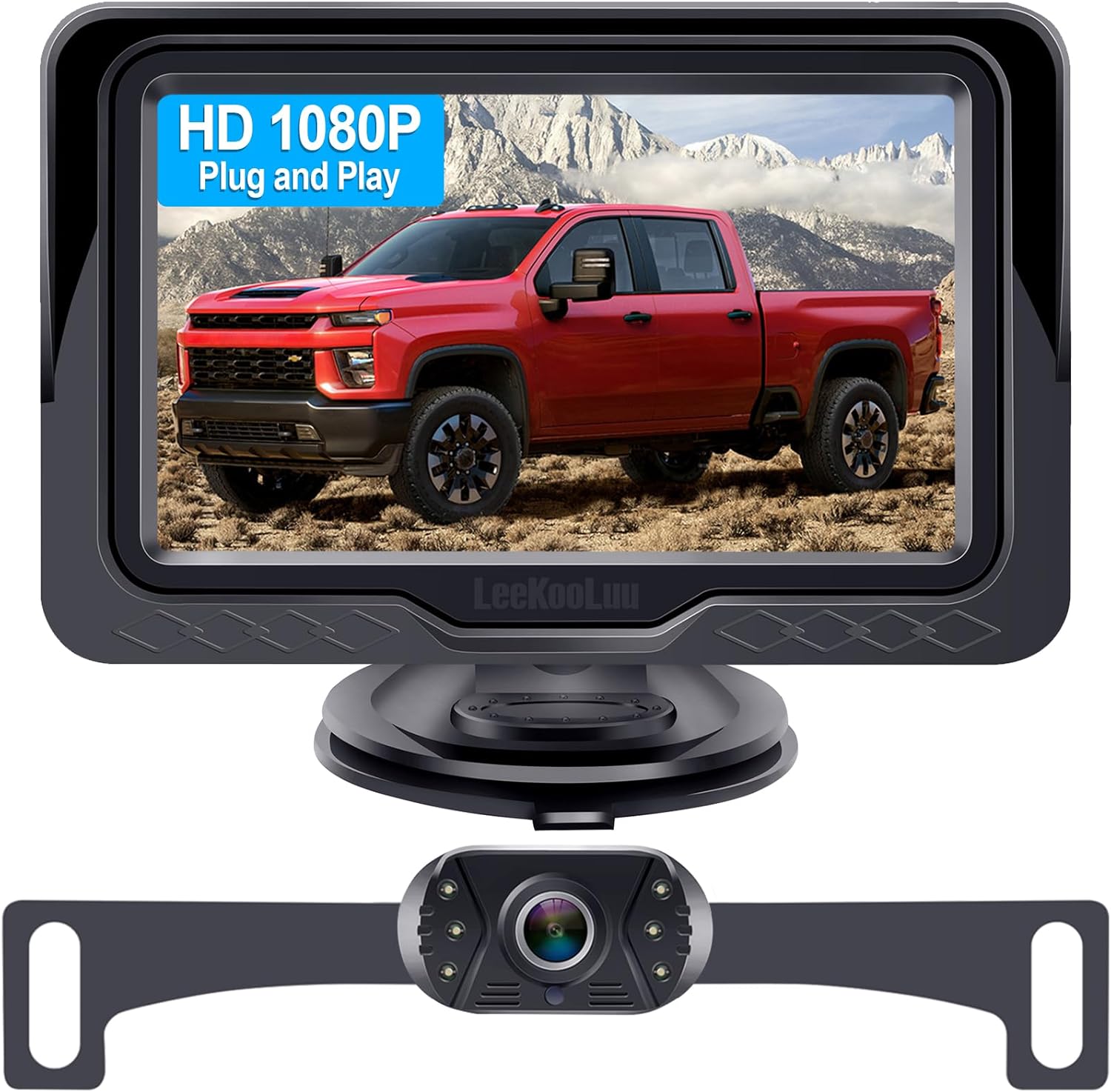
1. LeeKooLuu LK3 1080p Backup Camera Kit with 4.3" Monitor
Best Overall Backup Camera
| Video Capture Resolution | 1080p |
|---|---|
| Field Of View | 149 Degrees |
| Screen Size | 4.3 Inches |
| Connector Type | RCA |
| Voltage | 12 Volts |
The LeeKooLuu LK3 is a straightforward wired backup camera kit built for easy DIY installs and reliable everyday use. It pairs a compact 1080p camera with a 4.3-inch LCD monitor and a long cable so you can mount the camera behind a license plate on a Jeep Wrangler and run the lead to the front-mounted monitor. The system offers adjustable parking grid lines, brightness and contrast controls, and an on/off plug option so you can power it from a cigarette lighter or tie it to the reverse lights for automatic activation. Notable features include IP69-level waterproofing, six white LEDs for low-light help, a 149-degree wide-angle lens, and a 6-glass lens assembly aimed at clearer daytime images and reduced shake. The wired connection delivers stable, low-latency video with minimal interference compared with many wireless kits, but full-frame clarity is limited by the small 4.3-inch display and basic LCD panel. Installation on a Wrangler is practical but will require routing the cable through the tailgate or under the body and securing the monitor bracket so it does not obstruct view. Overall it balances durability, weather resistance, and ease of install for a dependable add-on camera.
Best for: Jeep Wrangler owners who want a practical, weatherproof backup camera they can install themselves to improve reversing visibility and hitching without modifying the vehicle extensively.
Less Ideal for: Drivers seeking the largest, highest-resolution display or advanced night-vision sensors should consider higher-end systems with larger monitors or dedicated low-light imaging instead.
- Wired connection gives stable, near-real-time 1080p video with low lag
- IP69 waterproof rating and temperature tolerance for offroad and exposed Wrangler use
- Adjustable parking guidelines and image settings for tailoring view to bumper height and hitch position
- Long cable and multiple mounting options let you place the camera behind the license plate or on the tailgate
- Includes a compact monitor sized to avoid blocking the windshield while remaining readable
- 4.3-inch LCD is smaller and less sharp than larger premium monitors
- Night image relies on white LEDs and can be less detailed than higher-end low-light cameras
Verdict: Pick this when you want the most practical, reliable backup camera option that balances clarity, weatherproofing, and easy installation for typical DIY installs.
2. eRapta ERT01 HD Wired License Plate Rear Backup Camera
Best Budget Backup Camera

| Field Of View | 148 Degrees |
|---|---|
| Video Capture Resolution | 720p (CVBS output/SD) |
| Connector Type | RCA |
| Power | 12–24V DC |
| Ingress Protection | IP69K |
The eRapta ERT01 is a simple wired backup camera designed to mount at the license plate or trunk and feed any display with an RCA video input. It produces a wide 148 to 149 degree view and uses 10 front LEDs plus an upgraded image chip to give usable low-light performance for reversing at night. Installation is typical for a wired camera: run the 26 ft RCA cable into the cab, tie the power wire to the reverse light circuit, and adjust the bracket for the viewing angle. The camera outputs standard definition CVBS video rather than higher-resolution AHD, so picture detail is limited but clear enough for spotting obstacles and lining up trailers. Build quality is focused on value with a metal housing rated IP69K for moisture resistance and two mounting brackets for license-plate or trunk placement. Buyers should expect straightforward functionality rather than bells and whistles and may need extra time to route cables and tune mirror/guideline wires for their head unit.
Best for: A Jeep owner who wants an inexpensive, functional backup camera to add basic rear visibility and night illumination without upgrading the whole electrical or infotainment system.
Less Ideal for: Drivers who need high-resolution imagery, a wireless or plug-and-play factory-style integration, or a camera designed for continuous front-view monitoring should consider other options.
- Wide 148–149 degree field of view shows blind spots and makes parking easier
- Built-in LEDs and upgraded chip provide usable night visibility
- IP69K-rated metal housing resists water and dust for outdoor mounting
- Includes long 26 ft RCA cable and multiple mounting brackets for flexible placement
- Compatible with any display that accepts CVBS RCA input and 12–24V power
- Outputs standard-definition CVBS video, so image detail is lower than modern HD cameras
- Wired installation requires time to route cable through the vehicle and may need minor drilling or panel removal
- Some users report thin video/power cable and occasional quality-control variation between units
Verdict: Choose this if you need a functional, inexpensive rear camera that gives a wide-angle image and decent night visibility without spending much.
3. Salior License Plate Backup Camera with 170° Wide Angle and Night Vision
Best License‑Plate Backup Camera

| Field Of View | 170 Degrees |
|---|---|
| Video Capture Resolution | 488p |
| Video Format | NTSC |
| Connector Type | RCA |
| Waterproof Rating | IP67 |
This Salior license-plate backup camera is built for discreet plate-area mounting and gives a very wide 170 degree fisheye view that helps eliminate typical rear blind spots. It installs in the license plate frame area and includes a 20 ft RCA video cable and a short power lead designed to tap into the reverse light circuit, so it works with most aftermarket displays that accept an RCA camera input. The unit uses a metal housing and a glue-sealed build rated IP67, so it holds up well in wet conditions, and the 7 infrared LEDs plus one sensor LED deliver usable night visibility when the vehicle has reverse or plate lights. Image resolution is basic (listed around 480p/488p) so detail is adequate for parking and detecting obstacles but not for reading small text at distance. Some users report occasional pixelation or color shift typical of infrared cameras, and mounting hardware uses small screws that may be fiddly during install. Given the Jeep Wrangler scope, the plate-frame mounting keeps the camera tucked and avoids drilling into the body.
Best for: Drivers who want a low-profile, license-plate mounted camera that hides at the rear of the vehicle and emphasizes a very wide field of view for parking and backing up.
Less Ideal for: If you need high-resolution, detailed camera images for trailer hitching or reading small labels at distance, consider a higher-resolution or dedicated hitch‑view camera instead.
- 170° fisheye view minimizes rear blind spots for close-range reversing
- IP67 glue-sealed metal housing resists rain and road spray
- Night-vision LEDs provide usable visibility in low-light reverse situations
- Includes 20 ft RCA video cable and basic power lead for simple wiring to reverse light
- 480p-class resolution can appear pixelated on large or high-resolution displays
- Small mounting screws provided are fiddly and may be difficult to handle during installation
Verdict: Use this when you prefer a discreet license‑plate or flush mount camera that gives a broad field of view and straightforward plate‑area installation.
4. ZEROXCLUB B7 Wired Backup Camera Kit with 7" Monitor (1080p)
Best Backup Camera Kit with Monitor

| Screen Size | 7 Inches |
|---|---|
| Video Capture Resolution | 1080p |
| Connector Type | 4-Pin (mini) and DC |
| Field Of View | 149 Degrees |
| Voltage | 12 Volts |
The ZEROXCLUB B7 kit bundles a 1080p wide-angle license-plate camera and a dedicated 7-inch LCD monitor so you get a complete, self-contained reversing system without searching for a compatible display. Installation is wired and aimed at dash or windshield mounting for the monitor and license-plate mounting for the camera; you can power the monitor from a 12V outlet for continuous use or wire it to the reverse light for automatic activation. Night visibility is boosted by built-in LEDs and the camera is rated IP69K for robust weather resistance. The system uses a mini 4-pin and DC connector pair and only works with the supplied monitor, so there is no RCA or head-unit hookup. Practical benefits include clear image quality, adjustable parking guidelines, and long video cable run for larger vehicles. Expect a modest installation effort routing the cable and finding a secure monitor mount; the LEDs turn on whenever the camera has power and cannot be disabled independently, and the system does not support polarized-sunglass‑friendly viewing on the screen.
Best for: Buyers who want an all-in-one reversing system with an included display and reliable wired signal, prioritizing a ready-made monitor and clear night performance over integrating with factory electronics.
Less Ideal for: Drivers who need a wireless or OEM-integrated solution or who want a display that connects to an existing head unit should consider other options.
- Complete kit with monitor included so no separate display is required
- 1080p camera and wide-angle lens deliver a clear, real-time rear view
- IP69K waterproofing and LED night illumination for reliable all‑weather use
- 33 ft extension cable and 10 ft power lead accommodate larger vehicles and RV setups
- Adjustable parking grid lines and image flip let you tailor the view to installation position
- Wired installation requires routing and sometimes drilling which takes time and basic tools
- Monitor is only compatible with the supplied camera and connectors, so you cannot hook it to a vehicle head unit
Verdict: Pick a kit with a monitor when you want an all‑in‑one, easy to install system—monitor included—so you avoid sourcing a separate display or complex wiring.
5. EchoMaster Universal HD Front/Rear Backup Camera with Night Vision
Best Heavy‑Duty Off‑Road Backup Camera

| Real Angle of View | 170 Degrees |
|---|---|
| Video Capture Resolution | 720p |
| Connector Type | RCA |
| Display Technology | AHD/CVBS |
| Installation Type | Aftermarket |
The EchoMaster HD camera is built for mounting on the front or rear of an off-road vehicle and aims to give a clear, wide view when backing or crawling on trails. It connects over a universal RCA lead and supports AHD or CVBS output so it will plug into most aftermarket head units. The 1/3" CMOS sensor and 720p capture combined with a 170 degree field of view produce a roomy overview that reduces blind spots, while onboard infrared LEDs improve visibility at night. The kit includes both a license plate bracket and a butterfly mount for different installs and the selectable mirror and parking lines let you tailor the image to your setup. The IP67-rated housing and sealed connectors make it suitable for muddy, wet conditions, but some users report the kit may not include every vehicle-specific adapter and wiring can require extra parts or splicing for certain radios. Expect solid image quality and rugged housing for trail use, but plan wiring time and possible adapter purchases during install.
Best for: Built for owners fitting a trail-ready Wrangler who prioritize a rugged, weatherproof camera and wide field of view and are comfortable handling a bit of wiring during installation.
Less Ideal for: Drivers who want a completely plug-and-play, vehicle-specific camera kit with every adapter included or who prefer higher than 720p resolution out of the box should look elsewhere.
- Universal RCA/AHD/CVBS outputs for wide head unit compatibility
- 170 degree ultra wide field of view reduces rear blind spots
- IP67 sealed housing resists water, mud, and dust for off-road use
- Includes multiple mounting brackets to suit license plate or butterfly installations
- Selectable mirror mode and parking lines let you customize the display
- Does not include some vehicle-specific video adapter pigtails so additional wiring or parts may be needed for certain radios
Verdict: Choose this for trail‑ready builds: cameras and brackets engineered for vibration, mud, and water exposure with tougher housings and corrosion‑resistant mounting hardware.
6. PixelMan PMD2A-S AHD Backup Camera (1080P-capable, 170°)
Best High‑Resolution AHD/1080P Backup Camera

| Video Capture Resolution | 1080p (AHD-capable) |
|---|---|
| Field Of View | 170 Degrees |
| Optical Sensor Technology | CMOS |
| Connector Type | RCA |
| Voltage | 12.0 |
The PixelMan PMD2A-S is a small, metal-bodied reversing camera built for clearer rearward visibility on compatible high-resolution displays. It uses a 1/2.7in AHD-capable image sensor and a 170 degree wide-angle glass lens to deliver vivid, bright images and improved low-light performance compared with typical 1/4in backup cams. Installation is straightforward: the kit includes two mounting brackets (license-plate and small surface mount), a 26 ft double-shielded RCA video cable, and a power lead so you can run the feed to a dash monitor or compatible head unit. The camera outputs HD by default and can be switched to AHD for 1080P display when paired with an AHD-capable screen. Practical benefits include durable alloy housing with waterproof sealing rated to resist harsh weather and a stout bracket that holds angle adjustments. Limitations are that the camera requires a monitor with an RCA input and AHD support for full 1080P; on non-AHD displays it will show standard HD, and some users note a fisheye look at the widest angle.
Best for: Drivers fitting a clean, durable aftermarket reverse camera to a compatible high-resolution display who prioritize clearer daytime and low-light image detail for towing or tight reversing tasks on a 1997–2006 Jeep Wrangler.
Less Ideal for: People who need a wireless solution, a plug-and-play camera for a specific factory infotainment connector, or who lack a monitor with RCA/AHD inputs should consider other options.
- AHD-capable sensor and large 1/2.7in chip for improved brightness and color versus smaller sensors
- 170° wide-angle glass lens captures a broad rear field including hitch area
- Sturdy metal alloy housing with nano waterproof sealing for weather resistance
- Includes 26 ft double-shielded RCA cable and two mounting brackets for hidden or surface installs
- Requires an RCA input and an AHD-capable monitor to achieve true 1080P output
Verdict: Select this when image detail matters—AHD/1080P-capable cameras deliver clearer daytime and low‑light pictures and are ideal for hookups to compatible high‑res displays.
Choosing the Right 1997-2006 Jeep Wrangler Backup Camera: Key Factors to Consider
Mounting Style and Fit
Mounting style determines where the camera sits on the vehicle and how much modification is needed. For 1997–2006 Wranglers you will commonly see license-plate mounts, bumper or hitch-mounted units, and tailgate or spare-tire–compatible brackets. Each location affects the field of view and susceptibility to dirt or water spray. Consider whether your Wrangler has an aftermarket bumper or a full-size spare tire carrier, as these change standard mounting geometry. A low-mounted bumper camera typically gives a wider, lower-angle view that is useful for parking, while a spare-tire or tailgate mount sits higher and can be better for aligning a trailer hitch. Choose a mount that balances protection from road debris with the angle you need for hitching or parking.
Image Quality and Low-Light Performance
Image clarity directly affects how easily you can see obstacles and judge distances. Look for cameras with good resolution for close-range details and wide dynamic range to handle bright sunlight and shadowed areas behind the vehicle. Low-light sensitivity matters for night-time reversing or trail use in shaded woods. Infrared LEDs or low-light sensors improve visibility in darkness, but IR can wash out nearby reflective surfaces. A camera with adjustable exposure or a high dynamic range sensor often gives a more usable picture in mixed lighting when backing out of a shaded driveway into bright daylight.
Wired Versus Wireless Connection
Connection type affects installation complexity and signal reliability. Wired systems run video and sometimes power through the vehicle and usually provide a stable, low-latency image. Wired installs can be more time-consuming because cable runs must pass through the cabin or tailgate area and be sealed against water intrusion. Wireless backup camera kits reduce routing effort by sending video to a display over a radio link. They are faster to install but may show interference, delay, or occasional dropouts in areas with heavy radio traffic. Choose wired when you need rock-solid response for towing, and consider wireless when you want minimal cutting or when the monitor location makes wiring difficult.
Durability and Weather Resistance
Wranglers are often exposed to mud, water, and vibration, so camera durability is essential. Look for devices with solid housings, stainless steel or corrosion-resistant fasteners, and an ingress protection rating that indicates water and dust resistance. Shock and vibration resistance matter for off-road use to prevent loosening or image artifacts over time. A camera that can be pressure-washed and resist road salt will last longer on a Jeep that sees heavy use. Pay attention to cable entry points and grommets, especially for tailgate mounts, because those areas are most vulnerable to water getting into the vehicle interior.
Field of View and Mounting Angle
Field of view determines how much of the area behind the vehicle the camera captures. Wider fields of view show more peripheral area but can introduce distance distortion at close range. For parking and hitching on a Wrangler, a camera that balances a wide angle with usable depth perception is best. Some cameras include adjustable vertical angle or shims to set the aim. That adjustability helps when fitting to different bumper heights or tow setups. Check the manufacturer's stated horizontal and vertical field of view and choose a unit that matches your intended use: wider for general parking, narrower and lower-mounted for precise trailer alignment.
Video Output and Monitor Compatibility
Different cameras use composite video, analog signals, or wireless video feeds. Verify compatibility with the display you plan to use, whether that is an aftermarket head unit, a dash monitor, or a mirror screen. Some systems include their own monitor, which simplifies selection but may limit placement. If you intend to integrate with an existing head unit, confirm the camera's video format and connector type. Also consider whether you need guidelines or parking lines and whether the monitor can overlay them. Powering the monitor and handling automatic switching when the Wrangler is shifted into reverse are additional practical considerations.
Why Generation Codes Matter for 1997–2006 Wranglers
The 1997–2006 Wrangler models overlap generations commonly referenced as TJ, LJ, and TJU in owner communities. Knowing the chassis tendencies for those years helps when choosing mounting locations and wiring routes because bumper shapes, spare-tire carriers, and tailgate designs differ.
If your Wrangler has an aftermarket bumper or a full-size spare mounted on a carrier, plan the camera placement accordingly. A TJ, LJ, and TJU era bumper may have different clearance and reinforcement compared with later frames, so confirm bracket geometry before buying mounting hardware.
- Check existing holes and mounting points before selecting a bracket.
- Account for spare tire position and swing-arm clearance when mounting tailgate cameras.
Wiring Paths and Common Installation Challenges
Running a wired reverse camera on a 1997–2006 Wrangler usually means routing cable from the rear of the vehicle through the tailgate or under the carpet into the cab. Tailgate-mounted cameras require a flexible wiring boot to preserve movement and prevent chafing.
Common challenges include sealing pass-through points against water, avoiding sharp edges that can cut wires, and finding an ignition-switched power source if you want the monitor to power only when the vehicle is on. Plan for at least basic hand tools and some sealant for a clean, long-lasting installation.
- Use grommets where wires pass through metal panels.
- Secure wiring with plastic clips or rivets to prevent vibration wear.
Choosing Between License-Plate, Bumper, and Spare-Tire Mounts
License-plate mounts are the least invasive and often the easiest to install, but they sit lower and may pick up road spray. Bumper-mounted cameras can tuck into a recess for protection and offer a stable, low position. Spare-tire or tailgate mounts place the camera higher and can provide a better angle for hitching trailers but can be exposed to the elements and require flexible wiring boots.
Think about how you use your Wrangler most. If you frequently tow, a higher spare-tire mount aimed at the hitch may be preferable. For city parking and reduced exposure to spray, a protected bumper mount may be the better choice.
- License-plate: easiest, lower position, more splash.
- Bumper: protected, stable, may require bracket changes.
- Spare-tire/tailgate: higher view, better for hitching, needs flexible wiring.
Wireless Systems: When to Consider Them
Wireless backup camera systems reduce the need to run long video cables through the vehicle, making them attractive for owners who want a simpler install or who frequently swap tailgates and accessories. They can be quick to set up and useful when integrating with portable monitors.
However, be mindful that wireless signals can be affected by interference or obstructions. If you use your Wrangler in urban areas with many radio devices or if you require a perfectly stable picture for trailer alignment, a wired system is often more reliable.
- Good option for temporary installs and portable displays.
- Less ideal for critical towing situations due to potential signal issues.
Integrating with Aftermarket Head Units and Monitors
Many Wrangler owners replace the factory radio with an aftermarket head unit that accepts a camera input. Confirm that the head unit supports a composite video input and will switch automatically when reverse is engaged if that automatic switching is desired.
If your dash lacks a camera-ready display, consider a standalone monitor that mounts on the dash or rearview mirror. These often include universal inputs and are easier to power during installation.
- Verify video connector types and mounting clearance.
- Consider automatic reverse trigger wiring for convenience.
Still looking for the perfect fit?
Select your Jeep Wrangler configuration to see the most relevant Backup Cameras recommendations
How We Chose the Best 1997-2006 Jeep Wrangler Backup Camera
We focused on practical, Wrangler-specific factors that affect everyday reversing and trail use. Our editorial filters prioritized: installation compatibility with 1997–2006 Jeep Wrangler body and bumper layouts; image performance under low-light and muddy conditions; durability against vibration, water, and off-road debris; mounting options including bumper, license-plate, and tailgate locations; and whether the system offers wired or wireless connectivity suited to common Wrangler head unit and monitor setups. We also considered field-serviceability for owners who use aftermarket bumpers or frequently remove the spare tire. Excluded from consideration were systems designed only for other vehicles or those requiring extensive custom fabrication beyond common Wrangler modifications. We emphasized units with clear wiring diagrams, reasonable ingress protection ratings, and widely supported video outputs. The shortlist reflects systems that balance reliable rearview performance with straightforward installation for typical 1997–2006 Wrangler owners.
Our full evaluation process is outlined in our review methodology.
FAQ
Can I install a backup camera myself on a 1997–2006 Wrangler?
Often yes. Many owners complete a wired or wireless install with basic tools in a weekend. Wired installs require routing cables through the tailgate or under trim panels and sealing pass-throughs. If you are comfortable with basic electrical connections and drilling small holes for mounts, you can do it yourself.
Will a license plate backup camera work well on a Wrangler?
License-plate cameras are a simple, low-impact option and work well for general parking. They sit lower and can be exposed to spray and mud, so consider a protected mounting location if you frequently go off-road. They are usually easier to wire than tailgate-mounted cameras.
Is a wireless backup camera a good choice for towing with a Wrangler?
Wireless systems are convenient but may suffer from signal interference or latency, which can be problematic when precise trailer alignment is needed. For consistent, low-latency performance while towing, a wired connection is generally more reliable.
Do I need to modify the tailgate to route camera wiring?
Not necessarily. Many systems use flexible wiring boots or existing grommets to route cables without permanent modification. Tailgate-mounted cameras require a wiring pass that accommodates movement, and careful sealing is important to prevent water ingress.
What video output should I choose for compatibility with older head units?
Composite analog video (RCA) is the most common and compatible format with many aftermarket head units and monitors. Verify that your display accepts composite input, and if not, consider a monitor that matches the camera output or an adapter compatible with your unit.
How do I keep the camera lens clear when off-roading?
A small overhang or recessed mount helps reduce direct spray and mud buildup. Regular cleaning after muddy runs and choosing a mount shielded by the bumper or spare-tire carrier will keep the lens clearer. Some owners add a hydrophobic coating to the lens for better water beading.
Final Verdict
When choosing a backup camera for your 1997–2006 Jeep Wrangler, prioritize mounting style, connection type, and durability to match how you use the vehicle. If you frequently tow, favor a stable wired camera with an adjustable aim for precise hitch alignment. For owners who want the simplest install and occasional use, a license-plate or wireless option can be a pragmatic choice. Balance image quality and low-light performance against installation complexity and exposure to the elements. With the right tradeoffs you can add a reliable rearview system that improves safety and confidence whenever you back up or park your Wrangler.
Explore More:
- Check out all Jeep Wrangler parts & accessories
- Explore Electronics
- Browse all Accessories
